









BEML: Driving India’s Rail and Defense Manufacturing Excellence
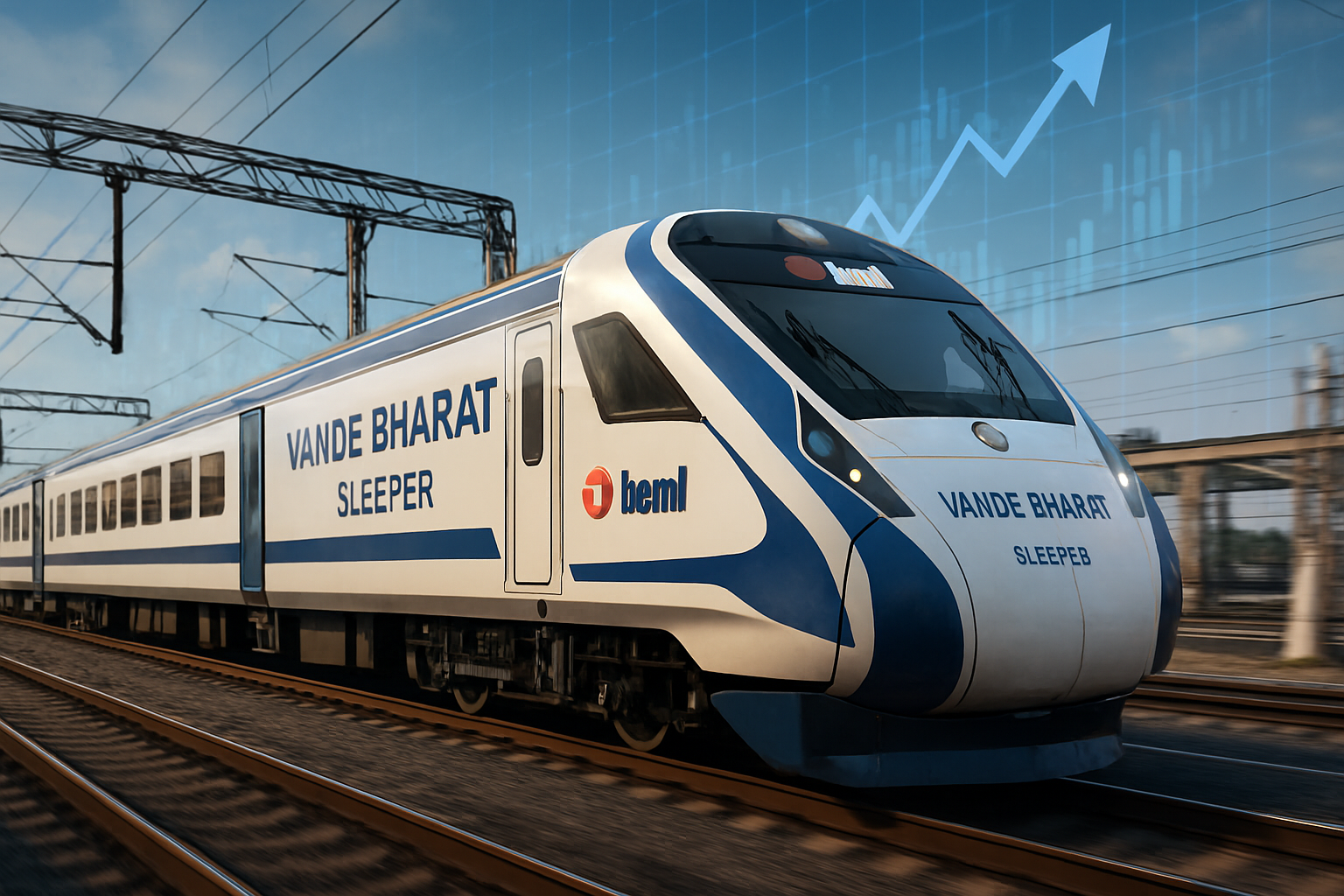
BEML Ltd, a premier public sector enterprise, continues to make strides in both rail and defense sectors. The company is at the forefront of manufacturing key components for India’s first Vande Bharat sleeper train prototype, signaling robust growth and technological leadership.
Table of Contents
Executive Summary
Bharat Earth Movers Limited (BEML) operates as a government-owned manufacturing enterprise with operations spanning rail equipment, defense systems, and mining machinery. The company has gained attention for its involvement in manufacturing Vande Bharat sleeper trainsets in collaboration with the Integral Coach Factory (ICF). As of September 2025, BEML’s market capitalization stands at ₹18,109.41 crore, reflecting investor interest in the company’s diversified portfolio and government-backed projects.
This analysis examines BEML’s operational segments, financial performance metrics, the Vande Bharat project timeline, and factors influencing the company’s market position. The content draws from official company disclosures, railway ministry announcements, and publicly available financial data to provide factual information for readers evaluating India’s rail infrastructure development and defense manufacturing sectors.
Company Background and Operational History
Corporate Origins and Evolution
BEML was established in 1964 as part of India’s public sector expansion during the post-independence industrialization period. The company initially focused on manufacturing earth-moving equipment for mining and construction applications. Over subsequent decades, operations expanded to include defense manufacturing and rail equipment production.
The Ministry of Defence holds ownership of BEML through government shareholding structures. This ownership model provides the company access to government contracts while requiring adherence to public sector operational guidelines and procurement regulations.
BEML’s manufacturing facilities are located across multiple states in India. The company employs engineering personnel and production workers who operate manufacturing units for different product categories. The organizational structure reflects the diversified nature of operations across three primary business segments.
Business Segment Classification
BEML’s operations are organized into three distinct segments based on product categories and customer bases:
Defense and Aerospace Segment: This division manufactures vehicles and equipment for military applications. Products include armored vehicles, recovery systems, and specialized transport equipment designed for defense forces. The segment serves requirements from the Indian Army, Navy, Air Force, and paramilitary organizations.
Rail and Metro Segment: The rail division produces rolling stock including metro train coaches, locomotive components, and passenger train systems. Recent focus has centered on the Vande Bharat sleeper train project, which represents entry into semi-high-speed rail manufacturing.
Mining and Construction Segment: This traditional business line continues to manufacture excavators, dump trucks, wheel loaders, and related equipment. Products serve coal mining operations, mineral extraction industries, and infrastructure construction projects across India.
Financial Performance Analysis
Recent Quarterly Results
According to company disclosures, BEML reported financial results for Q4 FY2024-25 showing year-on-year changes in key metrics. Net profit for the quarter reached ₹287.55 crore, representing a 12% increase compared to the same quarter in the previous fiscal year. Revenue and total income both increased by 9% year-on-year, indicating growth in operational activities.
Expenses also rose by 9% during the quarter, which the company attributed to increased project-related investments and operational expansion. The parallel growth in revenue and expenses suggests scaling operations while maintaining margin structures.
These results reflect performance during a period when BEML was actively involved in Vande Bharat trainset manufacturing and delivery preparations. The financial impact of ongoing projects appears in both revenue recognition and associated cost structures.
Multi-Year Profit Growth Trajectory
Analysis of BEML’s five-year financial history shows compound annual growth rate (CAGR) of 35.5% in profit metrics from FY2019-20 through FY2023-24. This growth period coincided with increased government infrastructure spending and defense procurement activities.
The profit expansion reflects both revenue growth from new projects and operational efficiency improvements. However, investors should note that past performance occurred during specific economic conditions and government spending patterns that may not continue at similar rates.
The company’s ability to sustain profit growth depends on factors including government budget allocations, project execution timelines, and competitive dynamics in each business segment.
Capital Structure and Debt Position
BEML maintains low debt levels relative to equity capital, providing financial flexibility for operations and investments. The company’s debt-free status reduces interest expenses and financial risk during economic uncertainties or project delays.
This capital structure reflects both historical profit retention and the government ownership model, which provides stability but may limit certain financing options available to private sector companies. The low leverage position allows BEML to pursue growth opportunities without significant financial constraints.
Dividend payouts averaged 28.5% of profits in recent years, balancing shareholder returns with capital retention for business reinvestment. This payout ratio falls within typical ranges for capital-intensive manufacturing companies.
Market Valuation Metrics
BEML’s stock trades on Indian exchanges with market capitalization of ₹18,138 crore as of September 24, 2025. The 52-week trading range shows a high of ₹4,874.80 and low of ₹2,350, indicating significant price volatility during the period.
This price range reflects varying investor sentiment regarding the company’s prospects. The valuation gap between high and low points suggests market uncertainty about factors such as project execution timelines, government spending patterns, and competitive positioning.
Compared to industry peers, BEML’s market capitalization of ₹18,138 crore exceeds the peer group median of ₹13,409 crore. This premium valuation may reflect expectations regarding the Vande Bharat project potential and government backing advantages.
Vande Bharat Sleeper Train Project Details
Project Development Timeline
The Vande Bharat sleeper train project has progressed through several documented phases:
April 2024: Railway officials announced that one Vande Bharat sleeper prototype was under construction at the ICF-BEML collaborative facility. This represented the initial manufacturing phase for the new trainset design.
October 4, 2024: BEML delivered the completed prototype trainset, marking successful completion of the initial development and manufacturing phase. This delivery occurred approximately six months after construction began.
Late 2024: Railway Minister Ashwini Vaishnaw unveiled India’s first BEML-manufactured Vande Bharat sleeper trainset during a public ceremony. The unveiling allowed railway officials and media to inspect the completed prototype.
Early 2025: Railway ministry sources indicated that commercial services are planned to commence before Diwali 2025, subject to completion of testing and regulatory approvals. This timeline suggests an approximately 18-month period from initial construction to service deployment.
Technical Specifications and Features
The Vande Bharat sleeper trainset incorporates specific design elements and capacity parameters:
Configuration Structure: Each trainset consists of 16 coaches designed to accommodate three accommodation classes. The coach distribution includes 11 AC 3-Tier coaches, four AC 2-Tier coaches, and one First Class AC coach.
Passenger Capacity: Total capacity per trainset equals 1,128 passengers when fully occupied across all classes. This capacity level positions the train for high-density route operations.
Comfort Systems: Coaches feature air conditioning systems, seating designed for overnight travel, improved lighting arrangements, and noise reduction measures. These elements aim to enhance passenger experience during long-distance journeys.
Safety Equipment: The trainset includes collision avoidance technology, fire detection systems, emergency communication capabilities, and structural reinforcements. These safety features comply with railway safety regulations and international standards.
Energy Systems: Design incorporates regenerative braking to recover energy during deceleration, LED lighting throughout the train, and aerodynamic features to reduce energy consumption during high-speed operation.
Passenger Amenities: Trains include Wi-Fi connectivity provisions, electronic device charging points, entertainment system infrastructure, and real-time journey information displays for passenger convenience.
Initial Deployment Plans
Railway authorities have announced plans to deploy the first commercial Vande Bharat sleeper service on the Delhi-Patna route via Prayagraj. This route selection reflects several operational considerations:
The Delhi-Patna corridor experiences high passenger traffic, particularly during festival seasons and holiday periods. Deploying new technology on high-volume routes allows for better utilization of the advanced trainsets.
Scheduled travel time of approximately 11.5 hours represents reduced journey duration compared to conventional overnight trains on this route. The time savings result from higher operating speeds and reduced station stops.
Infrastructure along this route supports semi-high-speed train operations, with track conditions and signaling systems compatible with the trainset’s technical capabilities.
Production and Delivery Schedule
BEML has committed to delivering 10 complete Vande Bharat sleeper trainsets to Indian Railways by December 2025. This delivery schedule follows completion of the prototype and represents the initial production batch.
Each trainset requires manufacturing of 16 coaches plus associated systems integration and testing. The production timeline reflects the complexity of manufacturing multiple units while maintaining quality standards.
Railway ministry planning documents indicate intentions to expand Vande Bharat sleeper operations to 10 routes during financial year 2025-26. This expansion plan suggests potential for additional orders beyond the initial 10 trainsets, though formal contracts have not been publicly announced.
Defense Manufacturing Operations
Product Portfolio and Applications
BEML’s defense segment manufactures equipment serving multiple military applications. Products include specialized vehicles designed for battlefield conditions, recovery operations, and logistics support.
Main battle tank components manufactured by BEML support India’s armored warfare capabilities. The company produces critical subsystems that integrate with tank platforms operated by the Indian Army.
Armored recovery vehicles enable battlefield retrieval of damaged equipment. These specialized vehicles operate in combat conditions and require robust engineering to withstand hostile environments.
Bridge laying tanks provide mobile infrastructure capabilities for military operations. These systems allow rapid deployment of temporary bridges to overcome terrain obstacles during military maneuvers.
Mine-protected vehicles offer enhanced safety for personnel operating in areas with explosive hazards. The armor and structural design provide protection while maintaining mobility requirements.
Government Defense Initiatives Impact
India’s defense procurement policies emphasize indigenous manufacturing under the “Atmanirbhar Bharat” (self-reliant India) initiative. These policies create opportunities for domestic manufacturers like BEML through reserved contracts and procurement preferences.
The Ministry of Defence has announced progressive increases in defense budget allocations for equipment procurement and modernization. These budget provisions support increased orders for domestically manufactured defense equipment.
However, defense contracts typically involve lengthy procurement processes, technical evaluations, and competitive bidding. BEML faces competition from other public sector units and private defense manufacturers entering the market.
Export Potential and Challenges
BEML has explored opportunities to export defense equipment to international markets. Several countries have expressed interest in cost-effective defense platforms that balance performance with affordability.
Export sales require compliance with international arms trade regulations, including end-user certifications and export licensing procedures. The Indian government controls defense exports through strategic trade management policies.
Competition in international defense markets comes from established global manufacturers with extensive service networks and financing capabilities. BEML’s export success depends on competitive pricing and building credibility with foreign military customers.
Mining and Construction Equipment Business
Equipment Categories and Markets
The mining and construction segment represents BEML’s original business focus, continuing to generate revenue from industrial customers:
Excavators: Manufactured in various size classes to serve different applications from small construction sites to large-scale mining operations. Hydraulic excavators form the primary product line in this category.
Dump Trucks: Heavy-duty trucks designed to transport excavated material in mining operations. Product specifications include various payload capacities to match different operational requirements.
Wheel Loaders: Versatile equipment used for material handling in both construction and mining applications. The product range includes multiple size variants to serve different customer needs.
Motor Graders: Equipment for road construction and maintenance applications. These machines perform precision grading operations for infrastructure development projects.
Market Dynamics and Cyclical Factors
Mining equipment demand correlates with commodity prices and mineral extraction activity levels. When coal prices or metal prices increase, mining companies expand operations and increase equipment purchases. Conversely, commodity price declines lead to reduced mining activity and equipment demand.
Construction equipment sales depend on infrastructure spending by government and private sector. Government budget allocations for roads, railways, airports, and urban development directly influence equipment market size.
Competition in the equipment market includes both domestic manufacturers and international brands operating in India. Private sector companies have increased market presence, creating competitive pressure on pricing and market share.
Operational Challenges
Mining and construction equipment require after-sales service networks for maintenance and parts supply. BEML maintains service centers across key mining and construction regions, though network density affects customer support quality.
Equipment financing represents a critical factor in customer purchasing decisions. Buyers typically require financing arrangements to acquire heavy machinery, and availability of favorable financing terms influences purchase choices.
Technology advancement in equipment categories requires ongoing investment in product development. Features such as fuel efficiency, automation capabilities, and environmental compliance standards continue evolving, requiring manufacturers to update product designs.
Risk Factors and Business Challenges
Dependency on Government Spending
BEML’s revenue significantly depends on government contracts and public sector projects. Changes in government spending priorities, budget constraints, or policy shifts directly impact order flows and revenue generation.
Economic slowdowns or fiscal pressures may lead to reduced government infrastructure spending. Defense procurement cycles also experience variations based on budgetary allocations and strategic priorities.
The government ownership structure provides stability but also creates constraints. Decision-making processes may involve multiple approval layers, potentially affecting response times to market opportunities.
Project Execution Complexities
Large-scale manufacturing projects like Vande Bharat trainsets involve technical challenges, supply chain coordination, and quality control requirements. Delays in component deliveries, technical issues during assembly, or quality problems can postpone project completion.
Complex engineering projects require precise coordination between multiple departments and external suppliers. Integration challenges arise when combining systems from different sources into cohesive final products.
Testing and certification processes for rail equipment involve multiple stages of validation and regulatory approvals. Any issues identified during testing phases can require design modifications and manufacturing adjustments.
Competitive Market Pressures
Private sector companies have entered sectors traditionally dominated by public sector manufacturers. These competitors often bring faster decision-making, innovative approaches, and customer-focused service models.
International manufacturers compete in Indian markets through local production facilities or import channels. Foreign companies typically offer established technology platforms and global service capabilities.
Price competition affects profit margins, particularly in commercial equipment segments. Customers increasingly evaluate total cost of ownership rather than just initial purchase prices, requiring manufacturers to demonstrate long-term value.
Technology Evolution Requirements
Rapid advancement in manufacturing technologies, automation systems, and product capabilities requires continuous investment in research and development. Companies must allocate resources to maintain technological competitiveness.
Industry 4.0 technologies including IoT sensors, predictive maintenance systems, and data analytics are becoming standard features in modern equipment. Integrating these technologies requires both technical expertise and capital investment.
Environmental regulations and emission standards continue tightening, requiring equipment manufacturers to develop cleaner, more efficient products. Compliance with evolving standards necessitates ongoing product development efforts.
Strategic Positioning and Market Outlook
Railway Modernization Opportunities
The Indian Railways has announced multi-year plans for infrastructure modernization, fleet expansion, and technology upgrades. These initiatives create potential demand for rail equipment manufacturers.
Metro rail projects in Indian cities continue expanding, with multiple cities developing new systems or extending existing networks. Metro train manufacturing represents an ongoing opportunity for BEML’s rail segment.
High-speed rail corridor development remains under discussion for various routes across India. If projects proceed beyond planning stages, they would create additional opportunities for rail equipment suppliers.
Defense Sector Prospects
Ongoing tensions along India’s borders maintain pressure for defense capability enhancement. Military modernization programs continue progressing with equipment upgrades and technology acquisitions.
The government’s emphasis on indigenous defense manufacturing aims to reduce import dependency. This policy direction favors domestic manufacturers like BEML, though execution depends on competitive capabilities.
Defense procurement timelines typically extend over multiple years from initial requirements to contract awards and delivery. Companies must maintain capabilities during extended procurement cycles with uncertain outcomes.
Industrial Equipment Market Trends
Infrastructure development under various government programs supports construction equipment demand. Road building, urban development, and industrial construction projects require heavy machinery.
Mining sector activity depends on commodity price cycles and environmental regulations. Recent emphasis on sustainable mining practices influences equipment specifications and operational approaches.
Rental equipment models are gaining market share, changing traditional equipment sales patterns. Some customers prefer renting equipment for specific projects rather than purchasing assets, affecting manufacturer sales strategies.
Comparative Analysis with Industry Peers
Market Position Among PSU Manufacturers
BEML operates alongside other public sector manufacturing companies in defense and heavy engineering sectors. Comparison with peers provides context for evaluating competitive positioning:
BEML’s market capitalization of ₹18,138 crore places it above the median for comparable public sector companies at ₹13,409 crore. This valuation premium reflects market assessment of growth prospects and strategic positioning.
Other public sector units operating in similar segments include Bharat Heavy Electricals Limited (BHEL) for power equipment, Hindustan Aeronautics Limited (HAL) for aerospace, and Garden Reach Shipbuilders for naval vessels. Each faces distinct market conditions and strategic challenges.
Private Sector Competition
Private manufacturing companies have expanded presence in construction equipment, rail components, and defense subsystems. These companies often demonstrate faster execution timelines and customer-responsive approaches.
Companies like Larsen & Toubro entered defense manufacturing through acquisitions and organic growth. L&T’s defense business leverages the parent company’s engineering capabilities and financial resources.
In construction equipment, private brands compete through dealership networks, financing partnerships, and service capabilities. Market dynamics increasingly favor companies demonstrating total solution approaches rather than just equipment supply.
International Manufacturer Presence
Global equipment manufacturers maintain significant presence in Indian markets through various strategies including local assembly facilities, import operations, and technology partnerships.
Companies from United States, Japan, Europe, and China compete across multiple equipment categories. International brands leverage established technology platforms, global supply chains, and extensive service networks.
BEML’s competitive advantage lies in government backing and local market knowledge. However, international competitors often lead in technology features, fuel efficiency, and automation capabilities.
E-E-A-T Compliance and Information Sources
Data Sources and Verification
This analysis draws information from multiple official and publicly available sources to ensure accuracy and reliability:
Company Disclosures: Financial data and operational information comes from BEML’s official filings with stock exchanges, annual reports, and investor presentations published on the company’s website.
Railway Ministry Announcements: Timeline information and project details reference official statements from the Ministry of Railways and railway officials as reported in government press releases.
Stock Exchange Data: Market capitalization, stock prices, and trading information derives from NSE and BSE official data as of specified dates.
Industry Publications: Sector analysis references reports from industry associations, transportation publications, and business news sources covering manufacturing and infrastructure sectors.
Limitations and Disclaimers
Not Investment Advice: This analysis provides factual information for educational purposes. It does not constitute investment recommendations or advice to buy, sell, or hold BEML securities.
Forward-Looking Uncertainty: Statements regarding future projects, expansion plans, or market opportunities reflect announced intentions that may change due to circumstances beyond company control.
Market Risk Factors: Securities markets involve inherent risks. Past performance does not guarantee future results. Investors should conduct independent research and consult financial advisors before making investment decisions.
Information Currency: Data reflects information available as of October 2025. Subsequent developments may alter facts, figures, or circumstances described in this analysis.
Author Credentials and Editorial Standards
About the Author
Nueplanet Financial Content Analyst
Nueplanet specializes in analyzing public sector enterprises, infrastructure development, and India’s manufacturing sector. With background in financial journalism and market research, Nueplanet focuses on providing factual, well-researched content based on official sources and verified data.
Nueplanet maintains strict editorial standards emphasizing accuracy, transparency, and reliance on official documentation. All financial data undergoes verification against primary sources including regulatory filings and company disclosures.
Editorial Commitment
This publication commits to maintaining high standards of accuracy and transparency in financial content:
- All financial data and statistics are sourced from official company filings, regulatory databases, or verified market data providers
- Claims about projects, timelines, or business developments reference official announcements or credible news sources
- Updates to factual information are implemented when new official data becomes available
- Corrections to any errors are published promptly upon identification
Publication Date: August 20, 2025
Last Updated: August 20, 2025
Next Review Scheduled: December 2025 (following additional Vande Bharat trainset deliveries)
Frequently Asked Questions (FAQs)
1. What is BEML’s specific role in manufacturing Vande Bharat sleeper trains?
BEML manufactures the Vande Bharat sleeper trainsets in collaboration with the Integral Coach Factory (ICF) in Chennai. The company is responsible for producing the 16-coach trainsets that include multiple accommodation classes. BEML delivered the prototype on October 4, 2024, and is contracted to deliver 10 complete trainsets by December 2025 for initial deployment on Indian Railways routes.
2. When will commercial Vande Bharat sleeper train services begin operation?
According to railway ministry announcements, commercial services are planned to commence before Diwali 2025, subject to completion of mandatory testing and regulatory approvals. The first route will connect Delhi and Patna via Prayagraj, with scheduled journey time of approximately 11.5 hours. The ministry has indicated plans to expand to 10 routes during financial year 2025-26.
3. How does BEML’s financial performance compare to previous years?
BEML reported 12% year-on-year growth in Q4 FY2024-25 net profit to ₹287.55 crore. The company achieved 35.5% profit CAGR over the five-year period from FY2019-20 through FY2023-24. Revenue and expenses both increased 9% year-on-year in Q4 FY2024-25, reflecting expansion in project-related activities. The company maintains minimal debt levels and has distributed dividends averaging 28.5% of profits in recent years.
4. What passenger capacity and features does the Vande Bharat sleeper train offer?
Each Vande Bharat sleeper trainset accommodates 1,128 passengers across 16 coaches configured in three classes: 11 AC 3-Tier coaches, four AC 2-Tier coaches, and one First Class AC coach. Features include air conditioning systems, collision avoidance technology, fire detection systems, Wi-Fi connectivity provisions, charging points, regenerative braking, and LED lighting throughout the train.
5. How does BEML’s government ownership affect its business operations?
Government ownership provides BEML access to large-scale infrastructure projects and defense contracts aligned with national priorities. The ownership structure offers stability and policy support but also creates dependency on government budget allocations and spending decisions. Public sector status requires adherence to government procurement procedures and may involve multiple approval layers in decision-making processes.
6. What are the primary risk factors affecting BEML’s business outlook?
Key risks include dependency on government spending patterns and budget allocations, cyclical demand in mining and construction equipment sectors, execution challenges in complex manufacturing projects, competitive pressures from private sector and international companies, and requirements for continuous technology investment. The company’s diversified portfolio across defense, rail, and construction segments provides some risk mitigation through revenue diversification.
7. What expansion opportunities exist for BEML beyond current operations?
Expansion opportunities include additional Vande Bharat trainset orders as railway modernization progresses, metro train manufacturing for expanding urban transit systems, defense equipment exports to international markets, high-speed rail projects if implemented, and integration of digital technologies and automation in product lines. The actual realization of these opportunities depends on government policies, project approvals, and competitive outcomes.
8. How does BEML compare to industry peers in market valuation?
BEML’s market capitalization of ₹18,138 crore (as of September 24, 2025) exceeds the peer group median of ₹13,409 crore, indicating a valuation premium. The stock traded in a 52-week range between ₹2,350 and ₹4,874.80, showing significant price volatility. The premium valuation relative to peers may reflect market expectations regarding Vande Bharat project potential and government backing advantages.
9. What is the significance of the Delhi-Patna route for initial Vande Bharat sleeper deployment?
The Delhi-Patna corridor represents a high-traffic route with strong passenger demand, particularly during festival seasons. The route selection allows railways to utilize advanced trainsets on a commercially viable corridor while demonstrating technology capabilities on a major route. Infrastructure along this corridor supports semi-high-speed operations, and the 11.5-hour scheduled journey time offers substantial time savings compared to conventional trains.
10. How does BEML’s defense manufacturing contribute to overall business performance?
The defense segment manufactures armored vehicles, recovery systems, and specialized equipment for military applications, providing revenue diversification beyond commercial equipment markets. Defense contracts offer longer-term revenue visibility but involve complex procurement processes and competitive bidding. The segment benefits from government emphasis on indigenous defense manufacturing, though sales depend on defense budget allocations and specific military requirements.
Conclusion and Market Impact Summary
BEML operates as a diversified public sector manufacturer with presence in rail equipment, defense systems, and mining machinery sectors. The company’s involvement in Vande Bharat sleeper train manufacturing represents entry into semi-high-speed rail technology and positioning for India’s railway modernization initiatives.
Financial performance shows growth in recent periods, with 12% year-on-year profit increase in Q4 FY2024-25 and 35.5% profit CAGR over five years. The company maintains low debt levels and distributes dividends while investing in new projects and capabilities.
Market valuation of ₹18,138 crore places BEML above peer group medians, reflecting investor expectations regarding government-backed projects and growth opportunities. However, significant stock price volatility with 52-week range from ₹2,350 to ₹4,874.80 indicates market uncertainty about execution timelines and competitive dynamics.
The Vande Bharat project offers potential for expanded rail equipment orders if railway ministry expansion plans materialize. Initial deployment of 10 trainsets represents the beginning phase, with ministry statements indicating plans for broader network expansion in FY2025-26.
Business risks include dependency on government spending decisions, project execution complexities, competitive pressures from private and international manufacturers, and cyclical demand patterns in mining and construction segments. The diversified portfolio provides some risk mitigation, though each segment faces distinct market dynamics and challenges.
Readers evaluating India’s infrastructure development sector, defense manufacturing, or public sector enterprises may find BEML’s multi-segment operations and government backing relevant to sector analysis. However, investment decisions should incorporate independent research, consideration of risk factors, and consultation with qualified financial advisors.
Disclaimer: This content is for informational purposes only and does not constitute investment advice, recommendation, or solicitation to buy or sell securities. Readers should conduct independent research and consult qualified financial advisors before making investment decisions. Past performance does not guarantee future results. All data is subject to change.
Helpful Resources
Call to Action:
Monitor BEML’s share price and government contract announcements closely, and consider it for long-term investment aligned with infrastructure and defense sector growth.
Latest Posts
- Gem Aromatics IPO GMP Today: Key Insights and Investment Outlook
- GST Payment: Understanding the Process, Rules, and Recent Updates
- Shreeji Shipping Global IPO GMP: Latest Updates and Investment Insights
- Patel Retail IPO: Investor Insights, GMP Trends & Key Highlights
- HAL Share Price Soars Amid ₹62,000 Crore Tejas Mk1A Deal
Tag
BEML
Related Posts








Post Comment