








Barbados Royals vs Trinbago Knight Riders: CPL 2025 Match Report
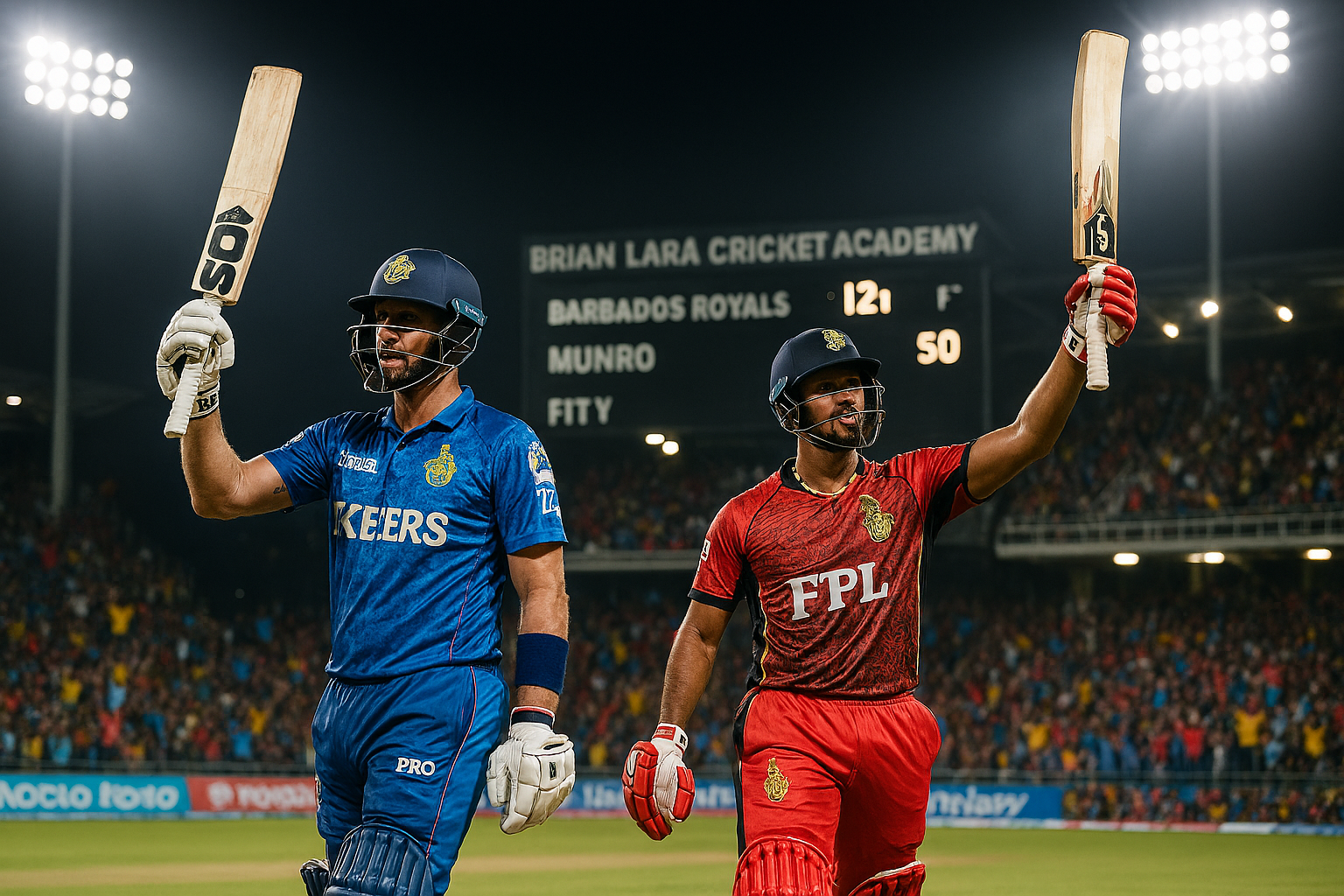
Trinbago Knight Riders sealed a thrilling victory over Barbados Royals in CPL 2025 with Colin Munro’s match-winning knock of 67 runs at the Brian Lara Cricket Academy. The clash ended with TKR chasing down 179 in just 17.5 overs.
Table of Contents
The 16th match of the Caribbean Premier League 2025 witnessed a clinical performance from Trinbago Knight Riders as they defeated Barbados Royals by seven wickets at the Brian Lara Cricket Academy in Trinidad. The match, played on August 19, 2025, showcased exceptional batting prowess from the Knight Riders, who successfully chased down a target of 179 runs with considerable ease. This victory further solidified their position at the top of the tournament standings and demonstrated their credentials as genuine title contenders in this year’s competition.
Match Overview and Basic Information
The evening fixture at the Brian Lara Cricket Academy provided ideal conditions for an entertaining contest between two competitive franchises. Trinbago Knight Riders captain Kieron Pollard won the toss and elected to field first, a decision that proved strategically sound given the venue’s characteristics. The pitch offered consistent bounce and pace, while the evening dew factor played its expected role in assisting the team batting second. Barbados Royals posted a competitive total of 178 for 6 wickets in their allotted 20 overs, but the Knight Riders responded with authority, reaching the target in just 17.5 overs with seven wickets intact.
Match Summary Table
| Match Details | Information |
|---|---|
| Match Number | CPL 2025, Match 16 |
| Date | August 19, 2025 |
| Venue | Brian Lara Cricket Academy, Trinidad |
| Toss Winner | Trinbago Knight Riders |
| Toss Decision | Field First |
| Result | Trinbago Knight Riders won by 7 wickets |
| Player of the Match | Colin Munro (TKR) |
| Match Duration | 17.5 overs (second innings) |
According to official Caribbean Premier League records, this victory marked Trinbago Knight Riders’ sixth win in seven matches, placing them firmly at the top of the points table. The margin of victory and the comprehensive nature of the performance highlighted the strength and balance within their squad composition.
Tournament Context and Team Form Analysis
Barbados Royals’ Pre-Match Situation
Barbados Royals entered this crucial encounter with a mixed record in the tournament thus far. Their campaign had produced alternating results, with three victories and three defeats from their opening six fixtures. The franchise’s batting lineup possessed significant firepower, led by their captain Rovman Powell and supported by explosive stroke-makers throughout the order.
However, consistency during the powerplay phase remained an area of concern for the coaching staff. Their bowling attack, despite featuring several experienced international cricketers, had conceded runs at an alarming rate in recent matches, averaging over nine runs per over in their previous three outings.
Barbados Royals Tournament Statistics Before Match 16
| Statistic | Value |
|---|---|
| Matches Played | 6 |
| Wins | 3 |
| Losses | 3 |
| Net Run Rate | +0.24 |
| Points Accumulated | 6 |
| Average First Innings Score | 165 |
| Tournament Position | 4th |
The team’s net run rate of +0.24, while positive, remained modest compared to the top teams in the competition. Their average first innings score of 165 suggested they were capable of posting competitive totals but lacked the consistency to dominate opposition bowling attacks regularly.
Trinbago Knight Riders’ Tournament Momentum
Trinbago Knight Riders arrived at this fixture riding a wave of confidence and positive momentum. Their recent form had been exceptional, securing victories in four of their previous five matches. The squad composition featured a perfect blend of explosive batting talent and disciplined bowling options.
International stars Colin Munro, Nicholas Pooran, and Kieron Pollard formed the core of a destructive batting order, while the bowling unit boasted the all-round capabilities of Andre Russell and the experience of Pakistani pace bowler Mohammad Amir. Playing at their home venue, the Brian Lara Cricket Academy, provided an additional psychological advantage, with the Knight Riders having won 12 of their last 15 matches at this ground.
Trinbago Knight Riders Tournament Statistics Before Match 16
| Statistic | Value |
|---|---|
| Matches Played | 6 |
| Wins | 5 |
| Losses | 1 |
| Net Run Rate | +1.18 |
| Points Accumulated | 10 |
| Average Chase Success Rate | 83.3% |
| Tournament Position | 1st |
The impressive net run rate of +1.18 reflected not just the number of victories but also the convincing manner in which they had been achieved. Their chase success rate of 83.3% indicated a batting lineup comfortable under pressure situations, a factor that would prove decisive in this encounter.
Toss Decision and Strategic Considerations
Kieron Pollard’s decision to field first after winning the toss at 7:30 PM local time was based on several well-considered factors. The Brian Lara Cricket Academy surface has historically exhibited characteristics that favor the team batting second during evening matches. The introduction of dew in the second innings typically makes the ball difficult to grip for bowlers, while the pitch tends to play more consistently under lights.
Historical data from the venue supported this approach, with teams chasing successfully in nine of the previous twelve evening fixtures at this ground. Additionally, Trinbago Knight Riders’ batting lineup had demonstrated exceptional proficiency in chase scenarios throughout the tournament, successfully pursuing targets on four previous occasions during the season.
Barbados Royals captain Rovman Powell acknowledged the challenge his team faced after losing the toss. Speaking at the pre-match presentation, he emphasized the need for his batting unit to post a substantial total and utilize the first-innings advantage effectively. The team’s strategy focused on aggressive intent during the powerplay overs and acceleration during the death overs to maximize their total.
First Innings Analysis: Barbados Royals Batting Performance
Powerplay Phase (Overs 1-6)
The opening six overs proved challenging for Barbados Royals as they lost opener Rahkeem Cornwall early in the innings. Mohammad Amir, operating with the new ball, extracted movement through the air and off the surface to dismiss Cornwall for just eight runs. The burly opener, who had produced scores of 43 and 51 in his previous two matches, edged an outswinger that was safely held by Nicholas Pooran behind the stumps. Quinton de Kock and Kadeem Alleyne attempted to rebuild the innings, but the disciplined bowling from Trinbago Knight Riders maintained consistent pressure throughout the powerplay phase.
Powerplay Statistics
| Metric | Value |
|---|---|
| Total Runs | 42 |
| Wickets Lost | 1 |
| Run Rate | 7.00 per over |
| Boundaries | 5 fours, 2 sixes |
| Dot Ball Percentage | 38% |
The dot ball percentage of 38% indicated that Barbados Royals struggled to find consistent boundary options during this crucial phase. The run rate of seven runs per over, while acceptable, left them needing acceleration in the middle and death overs to reach a competitive total.
Middle Overs Consolidation (Overs 7-15)
Kadeem Alleyne assumed responsibility during the middle phase, constructing an innings built on intelligent shot selection and calculated risk-taking. His contribution of 41 runs from 37 deliveries provided the stability required after the early dismissal. However, his strike rate of 110.81 reflected the challenges posed by Trinbago Knight Riders’ spinners and medium-pace options during this phase.
Sherfane Rutherford joined Alleyne and immediately demonstrated aggressive intent, contrasting effectively with his partner’s measured approach. Together, they forged a partnership worth 68 runs for the third wicket, resurrecting Barbados Royals’ innings and providing a foundation for the late-innings acceleration.
Middle Overs Breakdown
| Overs | Runs Scored | Wickets Lost | Key Events |
|---|---|---|---|
| 7-9 | 28 | 0 | Alleyne-Rutherford partnership established |
| 10-12 | 34 | 1 | De Kock dismissed for 22 by Ali Khan |
| 13-15 | 31 | 1 | Rutherford reaches 40; Russell removes Alleyne |
Quinton de Kock’s dismissal for 22 runs represented a missed opportunity for Barbados Royals. The experienced South African wicketkeeper-batsman struggled to time the ball consistently on a surface that offered variable bounce. Ali Khan’s delivery that dismissed de Kock came back sharply off the pitch, beating the batsman’s defensive push and disturbing the stumps.
Death Overs Explosion (Overs 16-20)
The final five overs of the Barbados Royals innings witnessed their most productive batting phase. Sherfane Rutherford unleashed an array of powerful strokes, targeting both pace and spin bowling with equal proficiency. His explosive knock of 45 runs from merely 22 deliveries included three towering sixes and five boundaries, propelling Barbados Royals toward a competitive total.
Captain Rovman Powell provided valuable support with a cameo worth 31 runs from just 15 balls. His powerful hitting during overs 18 and 19 added 42 runs to the team total, pushing Barbados Royals past the 170-run mark.
Death Overs Performance
| Over | Runs | Wickets | Bowler | Key Moments |
|---|---|---|---|---|
| 16 | 12 | 1 | Andre Russell | Rutherford hits six; Russell dismisses Alleyne |
| 17 | 14 | 0 | Mohammad Amir | Powell strikes consecutive boundaries |
| 18 | 16 | 1 | Ali Khan | Rutherford dismissed; Powell continues assault |
| 19 | 18 | 1 | Andre Russell | Powell falls after aggressive hitting |
| 20 | 11 | 0 | Mohammad Amir | Lower-order contributions |
Andre Russell’s ability to secure crucial wickets during the death overs, despite the aggressive approach from the batsmen, demonstrated his value as a seasoned campaigner. His dismissal of Kadeem Alleyne in the 16th over broke a promising partnership, while removing Rovman Powell in the 19th over prevented Barbados Royals from reaching 190 runs.
Complete Barbados Royals Scorecard
| Batsman | Runs | Balls | 4s | 6s | Strike Rate | Dismissal |
|---|---|---|---|---|---|---|
| Rahkeem Cornwall | 8 | 7 | 1 | 0 | 114.29 | c Pooran b Amir |
| Kadeem Alleyne | 41 | 37 | 4 | 1 | 110.81 | c Hales b Russell |
| Quinton de Kock (WK) | 22 | 19 | 3 | 0 | 115.79 | b Ali Khan |
| Sherfane Rutherford | 45 | 22 | 5 | 3 | 204.55 | c Pollard b Ali Khan |
| Rovman Powell (C) | 31 | 15 | 2 | 3 | 206.67 | c Munro b Russell |
| Alick Athanaze | 14 | 11 | 1 | 1 | 127.27 | not out |
| Chris Green | 9 | 6 | 1 | 0 | 150.00 | not out |
| Extras | 8 | (lb 3, w 4, nb 1) | ||||
| Total | 178/6 | 20.0 | 17 | 8 | 8.90 RPO |
The final total of 178 for 6 wickets represented a competitive score but one that required disciplined bowling and sharp fielding to defend successfully. The team’s total extras of only eight runs reflected good batting discipline, though their inability to convert starts into substantial innings would prove costly.
Trinbago Knight Riders Bowling Analysis
| Bowler | Overs | Maidens | Runs | Wickets | Economy | Dot Balls |
|---|---|---|---|---|---|---|
| Mohammad Amir | 4 | 0 | 35 | 2 | 8.75 | 12 |
| Andre Russell | 4 | 0 | 37 | 3 | 9.25 | 10 |
| Ali Khan | 3 | 0 | 42 | 1 | 14.00 | 6 |
| Akeal Hosein | 4 | 0 | 29 | 0 | 7.25 | 11 |
| Sunil Narine | 3 | 0 | 22 | 0 | 7.33 | 8 |
| Waqar Salamkheil | 2 | 0 | 10 | 0 | 5.00 | 7 |
Andre Russell’s exceptional performance yielded three crucial wickets while maintaining reasonable control even during the death overs. His ability to combine wicket-taking deliveries with economical bowling demonstrated his enduring quality as a T20 specialist. Mohammad Amir’s new-ball spell accounted for the important wicket of Rahkeem Cornwall and later returned to bowl effectively during the death overs.
Akeal Hosein and Waqar Salamkheil provided economical options during the middle overs, bowling 11 and 7 dot balls respectively to maintain pressure on the Barbados Royals batting lineup.
Second Innings Analysis: Trinbago Knight Riders Chase
Aggressive Powerplay Approach (Overs 1-6)
Trinbago Knight Riders began their chase with characteristic aggression and positive intent. Alex Hales and Sunil Narine opened the batting, immediately targeting the Barbados Royals bowling attack. Hales, the experienced English opener, dispatched the first delivery of the innings through the covers for a boundary, establishing the tone for an aggressive chase.
Sunil Narine contributed with typical boldness, clearing the midwicket boundary with a massive six off Eathan Bosch in the second over. The opening partnership added valuable runs before Narine fell for 18 runs from 11 deliveries, caught in the deep attempting another aggressive stroke.
Powerplay Performance
| Over | Runs | Key Events |
|---|---|---|
| 1 | 11 | Hales hits two boundaries off Ramon Simmonds |
| 2 | 8 | Narine hits six over midwicket off Bosch |
| 3 | 14 | Hales continues boundary-hitting; four fours accumulated |
| 4 | 7 | Narine dismissed for 18 from 11 balls |
| 5 | 12 | Munro arrives and immediately finds boundary |
| 6 | 9 | TKR reach 61 for 1 after powerplay |
Powerplay Summary Statistics
| Metric | Value |
|---|---|
| Total Runs | 61 |
| Wickets Lost | 1 |
| Run Rate | 10.17 per over |
| Required Rate After Powerplay | 8.36 per over |
| Boundaries | 8 fours, 2 sixes |
The aggressive start reduced the required run rate significantly and established a foundation for the middle-order batsmen to build upon without excessive pressure.
Match-Winning Partnership (Overs 7-15)
Colin Munro’s arrival at the crease transformed the complexion of the chase. The New Zealand left-handed batsman combined classical batting technique with innovative stroke play, rotating the strike efficiently while punishing any loose deliveries. His partnership with Alex Hales added 32 runs before Hales departed for 19 runs from 14 balls.
Nicholas Pooran’s entrance at number four sparked the decisive phase of the innings. The Trinidadian wicketkeeper-batsman received enthusiastic support from the home crowd and responded with breathtaking stroke play that effectively sealed the match outcome.
Munro-Pooran Partnership Analysis
| Aspect | Details |
|---|---|
| Runs Added | 94 |
| Balls Faced | 58 |
| Partnership Strike Rate | 162.07 |
| Boundaries | 11 fours, 5 sixes |
| Milestones | Munro’s fifty (38 balls), Pooran’s fifty (34 balls) |
This partnership effectively ended the contest as a meaningful competition. Both batsmen demonstrated exceptional range in their shot selection, with Munro favoring the leg side for the majority of his scoring strokes and Pooran dominating through the off side, particularly through covers and extra cover. Their understanding and communication reflected hours of practice together and an intuitive grasp of each other’s strengths and preferences.
Middle Overs Statistics
| Overs | Runs Scored | Wickets Lost | Required Run Rate |
|---|---|---|---|
| 7-9 | 32 | 1 | 7.82 |
| 10-12 | 39 | 0 | 6.67 |
| 13-15 | 41 | 0 | 5.14 |
The progressive reduction in the required run rate illustrated the effectiveness of the Munro-Pooran partnership. By the end of the 15th over, Trinbago Knight Riders required only 12 runs from the final 30 deliveries, transforming a potentially challenging chase into a straightforward conclusion.
Final Phase and Victory (Overs 16-17.5)
With minimal pressure remaining, Trinbago Knight Riders cruised toward victory with comfort and confidence. Colin Munro departed in the 16th over for a magnificent 67 runs from 44 balls, caught at long-on while attempting an ambitious stroke. His dismissal brought captain Kieron Pollard to the crease, and the crowd anticipated fireworks from their captain.
Pollard delivered an explosive cameo worth 19 runs from just nine balls with a strike rate exceeding 200. His assault included two massive sixes that sailed into the stands, generating tremendous enthusiasm from the partisan home support. Nicholas Pooran remained unbeaten on 65 runs from 40 deliveries, calmly guiding Trinbago Knight Riders across the finish line with a boundary pushed through the point region.
Complete Trinbago Knight Riders Scorecard
| Batsman | Runs | Balls | 4s | 6s | Strike Rate | Dismissal |
|---|---|---|---|---|---|---|
| Alex Hales | 19 | 14 | 3 | 1 | 135.71 | c Green b Warrican |
| Sunil Narine | 18 | 11 | 2 | 1 | 163.64 | c Athanaze b Simmonds |
| Colin Munro | 67 | 44 | 7 | 3 | 152.27 | c Powell b Green |
| Nicholas Pooran (WK) | 65* | 40 | 6 | 3 | 162.50 | not out |
| Kieron Pollard (C) | 19* | 9 | 1 | 2 | 211.11 | not out |
| Extras | 9 | (lb 4, w 4, nb 1) | ||||
| Total | 179/3 | 17.5 | 19 | 10 | 10.04 RPO |
Did Not Bat: Andre Russell, Akeal Hosein, Mohammad Amir, Ali Khan, Waqar Salamkheil
The scorecard reflected the depth in Trinbago Knight Riders’ batting lineup, with quality players like Andre Russell not required to bat. The team’s run rate of 10.04 per over demonstrated their dominance throughout the chase.
Barbados Royals Bowling Analysis
| Bowler | Overs | Maidens | Runs | Wickets | Economy | Dot Balls |
|---|---|---|---|---|---|---|
| Ramon Simmonds | 3.5 | 0 | 28 | 1 | 7.30 | 11 |
| Eathan Bosch | 4 | 0 | 27 | 0 | 6.75 | 12 |
| Jomel Warrican | 4 | 0 | 48 | 1 | 12.00 | 6 |
| Chris Green | 4 | 0 | 48 | 1 | 12.00 | 5 |
| Rovman Powell | 1 | 0 | 21 | 0 | 21.00 | 0 |
| Maheesh Theekshana | 1 | 0 | 3 | 0 | 3.00 | 4 |
The bowling figures revealed significant struggles for Barbados Royals in containing the Trinbago Knight Riders batting lineup. Both Chris Green and Jomel Warrican conceded 48 runs in their four-over allocations, proving particularly expensive during the critical middle overs when Munro and Pooran established complete dominance. Captain Rovman Powell’s decision to bowl himself in the 17th over proved costly, with 21 runs conceded including two sixes from Kieron Pollard.
Player of the Match: Colin Munro’s Outstanding Performance
Colin Munro received the Player of the Match award for his exceptional innings of 67 runs from 44 deliveries. His performance embodied the principles of intelligent T20 batting, combining aggressive intent with calculated risk assessment. Munro’s contribution provided the perfect foundation for Trinbago Knight Riders’ successful chase, maintaining a strike rate of 152.27 while ensuring wickets were preserved for the final assault.
Munro’s Innings Breakdown by Phase
| Phase | Balls Faced | Runs Scored | Strike Rate | Boundaries |
|---|---|---|---|---|
| Overs 1-6 | 12 | 18 | 150.00 | 2 fours, 1 six |
| Overs 7-12 | 20 | 32 | 160.00 | 3 fours, 1 six |
| Overs 13-16 | 12 | 17 | 141.67 | 2 fours, 1 six |
Shot Distribution Analysis
| Category | Value |
|---|---|
| Leg Side Runs | 38 (56.7%) |
| Off Side Runs | 29 (43.3%) |
| Total Boundaries | 7 fours, 3 sixes |
| Dot Balls Faced | 14 (31.8%) |
| False Shots | 3 |
Munro’s ability to manipulate field placements through intelligent shot placement impressed observers and commentators. He targeted the square leg and midwicket boundaries with precision, exploiting gaps created by Barbados Royals’ defensive field settings. His partnership with Nicholas Pooran demonstrated excellent communication and mutual understanding, both batsmen rotating strike efficiently and punishing loose deliveries without mercy.
During the post-match presentation ceremony, Munro reflected on his performance with typical modesty. He credited the excellent batting surface, praised his partnership with Pooran, and acknowledged the team’s collective effort. His assessment emphasized the importance of building partnerships and maintaining control over the required run rate throughout the chase.
Tactical Analysis and Critical Match Moments
Andre Russell’s Bowling Impact (Overs 14-19)
Andre Russell’s three-wicket haul during Barbados Royals’ innings prevented them from reaching a potentially match-winning total beyond 190 runs. His dismissals of Kadeem Alleyne in the 16th over and Rovman Powell in the 19th over occurred at crucial junctures when both batsmen threatened to accelerate aggressively.
Russell’s experience and variations in pace and length proved decisive, demonstrating why he remains one of the most valued T20 cricketers globally. His ability to execute yorkers and slower deliveries under pressure situations showcased his enduring quality as a death-overs specialist.
The Match-Defining Partnership (Overs 7-16)
The 94-run partnership between Colin Munro and Nicholas Pooran effectively sealed the match outcome. Both batsmen found boundaries consistently, rotated strike effortlessly, and never allowed pressure to accumulate.
Their understanding and communication reflected extensive practice together and an intuitive grasp of match situations. The partnership reduced the required run rate from 8.36 per over after the powerplay to just 5.14 per over by the end of the 15th over, transforming what appeared to be a competitive chase into a comfortable victory procession.
Fielding Lapses by Barbados Royals
Barbados Royals dropped two regulation catching opportunities that proved catastrophic to their match prospects. Colin Munro was reprieved when on 34 runs in the 11th over, with Sherfane Rutherford misjudging a skier at deep midwicket off Jomel Warrican’s bowling. Nicholas Pooran received a life when on 28 runs in the 9th over, as Quinton de Kock failed to hold an edge behind the stumps off Chris Green’s delivery.
Both batsmen capitalized ruthlessly on these errors, adding a combined 70 additional runs after their reprieves. These lapses highlighted the fundamental importance of maintaining exceptional fielding standards in modern T20 cricket, where minimal margins separate victory from defeat.
Powerplay Dominance by Trinbago Knight Riders
Scoring 61 runs for the loss of just one wicket during the powerplay overs provided Trinbago Knight Riders with tremendous momentum and psychological advantage. This aggressive approach reduced pressure on middle-order batsmen and established a manageable required run rate throughout the remainder of the chase. The contrast with Barbados Royals’ powerplay performance, where they scored 42 runs while losing one wicket, illustrated the difference in intent and execution between the two teams.
Strategic Decisions Under Examination
Bowling Change Decisions
Captain Rovman Powell’s decision to bowl himself in the 17th over backfired significantly, with 21 runs conceded including two sixes from Kieron Pollard. This aggressive tactical choice, combined with less effective field placements, raised questions about decision-making under pressure. The over-promotion of Powell as a bowling option, particularly with specialist bowlers still available, represented a questionable tactical approach that contributed directly to the match outcome.
Batting Order Choices
Kieron Pollard’s decision to promote himself ahead of Andre Russell demonstrated confidence in personally finishing the chase. This strategic choice paid dividends as Pollard’s explosive hitting sealed victory with minimal difficulty. The decision reflected astute match awareness, recognizing that the situation required quick runs rather than Russell’s power-hitting abilities. The flexibility in batting order demonstrated the depth and versatility available within Trinbago Knight Riders’ squad composition.
Impact on CPL 2025 Tournament Standings
This comprehensive seven-wicket victory significantly strengthened Trinbago Knight Riders’ position in the tournament standings while dealing a severe blow to Barbados Royals’ playoff qualification aspirations. The margin of victory and the ease with which the target was achieved also improved Trinbago Knight Riders’ net run rate substantially.
Updated Points Table After Match 16
| Position | Team | Matches | Won | Lost | NRR | Points |
|---|---|---|---|---|---|---|
| 1 | Trinbago Knight Riders | 7 | 6 | 1 | +1.43 | 12 |
| 2 | St Lucia Kings | 6 | 4 | 2 | +0.89 | 8 |
| 3 | Guyana Amazon Warriors | 7 | 4 | 3 | +0.42 | 8 |
| 4 | Barbados Royals | 7 | 3 | 4 | -0.18 | 6 |
| 5 | Jamaica Tallawahs | 6 | 2 | 4 | -0.65 | 4 |
| 6 | St Kitts and Nevis Patriots | 7 | 2 | 5 | -1.24 | 4 |
Trinbago Knight Riders’ net run rate improvement of +0.25 from this single victory provided an additional buffer in the competition for playoff qualification. With only three league matches remaining in their schedule, they positioned themselves as strong favorites to secure a top-two finish, which would provide two opportunities to reach the final.
Post-Match Reactions and Expert Commentary
Captain’s Perspectives
Kieron Pollard, speaking at the post-match presentation, praised his team’s outstanding performance across all departments. He highlighted Colin Munro’s exceptional innings and Nicholas Pooran’s finishing abilities as key factors in the victory. Pollard emphasized the bowling unit’s execution of plans, particularly Andre Russell’s spell that changed the match’s trajectory. He expressed satisfaction with the team’s momentum building at the crucial stage of the tournament.
Rovman Powell acknowledged the disappointing result for Barbados Royals. He recognized that his team fought hard to reach 178 runs but admitted the bowling lacked penetration during crucial phases. Powell specifically mentioned the dropped catches as costly errors, noting that providing world-class players with multiple opportunities makes victory extremely difficult. He stressed the need for the team to regroup quickly with another important match approaching.
Expert Analysis
Cricket analysts and former international players provided detailed assessments of the match. Commentary focused on Trinbago Knight Riders’ exceptional squad balance, highlighting explosive batting depth throughout the order combined with quality pace and spin bowling options.
The team’s brilliant fielding standards received particular praise. Experts noted that Barbados Royals would regret the dropped catching opportunities, acknowledging that Trinbago Knight Riders’ superiority remained evident throughout the contest.
Technical analysis of Colin Munro’s innings emphasized the classical approach to T20 batting he demonstrated. Commentators highlighted his calm assessment of conditions, intelligent shot selection, and ability to accelerate at appropriate moments. Nicholas Pooran’s finishing abilities continued to impress observers, with particular emphasis on his strike rotation during tight overs.
For Barbados Royals, the bowling department’s struggles received significant attention, with suggestions that urgent improvements were required to maintain playoff hopes.
Statistical Highlights and Tournament Records
Match-Specific Records
Several notable achievements occurred during this encounter. The highest partnership of the match came from Colin Munro and Nicholas Pooran, who combined for 94 runs for the third wicket during Trinbago Knight Riders’ chase. Andre Russell recorded the best bowling figures with 3 wickets for 37 runs. Colin Munro struck the most boundaries with 10 in total, comprising 7 fours and 3 sixes. Nicholas Pooran achieved the fastest fifty of the match, reaching the milestone in just 34 deliveries.
Tournament Milestone Achievements
Colin Munro crossed the significant career milestone of 2,000 runs in Caribbean Premier League history during his innings. Nicholas Pooran recorded his 15th fifty-plus score in CPL history, cementing his status among the tournament’s most consistent performers. Andre Russell reached 150 career CPL wickets, joining an elite group of bowlers who have achieved this milestone. Mohammad Amir extended his tournament wicket tally to 14, placing him among the leading wicket-takers in CPL 2025.
Head-to-Head Record Statistics
| Aspect | Statistics |
|---|---|
| Total Matches Played | 23 |
| Trinbago Knight Riders Wins | 16 |
| Barbados Royals Wins | 7 |
| Highest Team Total (TKR) | 223/6 (2023) |
| Highest Team Total (BR) | 195/4 (2024) |
| Highest Individual Score | Kieron Pollard – 104* (2022, TKR) |
The head-to-head record clearly favors Trinbago Knight Riders, who have won 16 of the 23 encounters between these franchises. This historical dominance adds another dimension to their psychological advantage when facing Barbados Royals.
Tournament Outlook for Both Franchises
Trinbago Knight Riders’ Path to Playoffs
With 12 points accumulated from seven matches, Trinbago Knight Riders require just one victory from their remaining three league fixtures to guarantee playoff qualification. Their superior net run rate of +1.43 provides additional security against potential tied-points scenarios with other teams. The squad’s confidence is reaching peak levels at the optimal stage of the tournament, and their balanced composition suggests they are genuine title contenders.
Remaining Fixtures for Trinbago Knight Riders
| Date | Opposition | Venue |
|---|---|---|
| August 23 | St Lucia Kings | Brian Lara Academy |
| August 27 | Guyana Amazon Warriors | Providence Stadium |
| August 30 | Jamaica Tallawahs | Sabina Park |
The return to full fitness of key players has strengthened both batting depth and bowling options. Playing their next fixture at home against St Lucia Kings provides an excellent opportunity to secure playoff qualification. The team’s recent performances suggest they are building momentum precisely when it matters most in the tournament cycle.
Barbados Royals’ Playoff Challenge
Barbados Roy
als face a critical juncture with only 6 points accumulated from seven matches. Their remaining three fixtures essentially become knockout encounters, requiring victories in at least two matches to maintain realistic playoff hopes. The team’s negative net run rate of -0.18 adds further complexity to their qualification scenarios, meaning they may need convincing victories rather than narrow wins.
Remaining Fixtures for Barbados Royals
| Date | Opposition | Venue |
|---|---|---|
| August 24 | St Kitts and Nevis Patriots | Warner Park |
| August 28 | Jamaica Tallawahs | Kensington Oval |
| August 31 | St Lucia Kings | Kensington Oval |
The franchise needs to address several urgent concerns to revive their playoff aspirations. Finding economical bowling options during middle overs represents a priority, as recent matches have seen opposition batsmen dominating this phase.
Eliminating costly dropped catches requires immediate attention, with fielding drills and concentration exercises potentially beneficial. Death bowling effectiveness must improve to restrict opponents during final overs. Finally, the batting lineup needs more substantial contributions beyond Sherfane Rutherford and Rovman Powell to support their explosive capabilities.
Venue Analysis: Brian Lara Cricket Academy
The Brian Lara Cricket Academy has established itself as one of the Caribbean Premier League’s premier venues, offering excellent facilities and a pitch that provides entertainment for both batsmen and bowlers. Named after the legendary West Indian batsman Brian Lara, the venue combines modern infrastructure with traditional Caribbean cricket atmosphere.
Venue Statistics (CPL 2025 Season)
| Statistic | Value |
|---|---|
| Matches Hosted | 8 |
| Average First Innings Score | 172 |
| Average Winning Score (Batting First) | 168 |
| Average Winning Score (Chasing) | 169 |
| Highest Score | 198/4 (Guyana Amazon Warriors) |
| Lowest Score | 124/8 (St Kitts and Nevis Patriots) |
| Chasing Success Rate | 62.5% |
The venue’s characteristics favor teams batting second, with a chasing success rate of 62.5% during CPL 2025. The true bounce and consistent pace reward quality stroke play while offering assistance to disciplined bowlers who maintain tight lines and lengths. Evening matches feature a significant dew factor that typically favors teams batting second, making the ball difficult to grip for bowlers while the pitch plays more consistently under lights.
Pitch Characteristics
The Brian Lara Cricket Academy surface provides even bounce throughout the innings, allowing batsmen to play their shots with confidence. The pitch offers some assistance to pace bowlers with the new ball, particularly in terms of lateral movement through the air and off the surface. Spinners find the surface responsive during middle overs, with some turn available for those who bowl with good control. The outfield is fast and well-maintained, ensuring boundaries come quickly when batsmen make good contact.
Fantasy Cricket Insights and Recommendations
For fantasy cricket enthusiasts following the Caribbean Premier League 2025, this match provided several valuable insights for future team selections. Understanding player form, venue characteristics, and team strategies remains crucial for successful fantasy cricket participation.
Top Fantasy Performers from This Match
Colin Munro emerged as the highest-scoring fantasy player with his Player of the Match performance. His 67 runs, including seven fours and three sixes, generated substantial fantasy points through both runs scored and boundary bonuses. Nicholas Pooran’s unbeaten 65 runs similarly provided excellent fantasy returns, particularly given his strike rate of 162.50. Andre Russell delivered outstanding fantasy value through his three-wicket haul, demonstrating the importance of selecting all-rounders who contribute across multiple disciplines.
Fantasy Cricket Strategy Tips
Selecting opening batsmen from teams batting second at the Brian Lara Cricket Academy appears strategically sound based on venue statistics. The chasing success rate of 62.5% and the dew factor favoring teams batting second suggest openers in the second innings receive advantageous conditions. All-rounders like Andre Russell who contribute with both bat and ball provide excellent fantasy value, particularly when playing at home venues where they understand conditions intimately.
Middle-order batsmen with strong finishing abilities represent valuable fantasy selections, as evidenced by Nicholas Pooran’s match-winning contribution. Pace bowlers who excel with the new ball offer good fantasy potential, though the dew factor during evening matches can reduce their effectiveness in the second innings. Wicketkeeper-batsmen who bat in the top four provide dual value through both batting contributions and potential dismissal points.
Player Form Analysis for Fantasy Selection
Colin Munro’s recent form suggests he should be prioritized in fantasy teams for upcoming Trinbago Knight Riders matches. His consistent scoring and ability to play match-winning innings make him a reliable fantasy option. Nicholas Pooran’s finishing abilities and strike rate make him another prime fantasy candidate, particularly for matches at the Brian Lara Cricket Academy. Andre Russell’s all-round capabilities ensure he remains a fantasy cricket essential, contributing points through both bowling wickets and explosive batting when required.
For Barbados Royals, Sherfane Rutherford’s aggressive batting and high strike rate make him a valuable fantasy selection despite the team’s recent struggles. Rovman Powell’s power-hitting during death overs provides fantasy potential, though consistency remains a concern. The team’s bowling options offer limited fantasy appeal until they demonstrate improved economy rates and wicket-taking ability.
Detailed Tactical Breakdown and Strategic Lessons
Powerplay Execution Comparison
The contrast between the two teams’ powerplay performances highlighted the importance of aggressive intent during the initial six overs. Trinbago Knight Riders’ approach of scoring 61 runs while losing just one wicket established complete control over the chase. Their willingness to attack from the first delivery, combined with calculated risk-taking, reduced pressure on subsequent batsmen. Barbados Royals’ more conservative powerplay yielded only 42 runs for one wicket, leaving them needing acceleration during middle and death overs.
The lesson for teams batting first involves balancing aggression with wicket preservation. While Barbados Royals avoided losing multiple early wickets, their scoring rate during the powerplay left them requiring higher-risk batting during later phases. Teams batting second can adopt more aggressive approaches, knowing the target provides clarity about required scoring rates throughout the innings.
Middle Overs Strategy Analysis
Trinbago Knight Riders’ dominance during middle overs proved decisive. The Munro-Pooran partnership accumulated runs at over 160 runs per 100 balls while rotating strike efficiently and punishing poor deliveries. Their approach involved identifying the weakest bowlers in the opposition attack and targeting them specifically. Both batsmen demonstrated excellent awareness of field placements, manipulating gaps through intelligent shot placement rather than relying solely on power hitting.
Barbados Royals’ bowling during middle overs lacked penetration and control. Both Chris Green and Jomel Warrican conceded 48 runs in their four-over spells, allowing Trinbago Knight Riders to build partnerships without facing sustained pressure. The inability to create wicket-taking opportunities during this phase meant the required run rate continued decreasing, making the final outcome inevitable.
Death Overs Execution
Barbados Royals’ death overs batting showed positive intent, with Sherfane Rutherford and Rovman Powell adding 60 runs during the final five overs. However, Andre Russell’s ability to secure wickets during this phase prevented them from reaching 190-plus, which might have provided a more defendable total. The balance between aggressive stroke play and maintaining wickets during death overs remains one of T20 cricket’s fundamental challenges.
For Trinbago Knight Riders, the chase never reached a critical death overs phase due to the Munro-Pooran partnership’s dominance during middle overs. This strategic success demonstrated the value of building substantial partnerships during middle overs rather than leaving excessive work for the final phase.
Fielding Analysis and Impact on Match Outcome
The two dropped catches by Barbados Royals proved catastrophic to their match prospects. When Colin Munro was reprieved on 34 runs, he capitalized by adding 33 more runs to his eventual total of 67. Nicholas Pooran’s life on 28 runs resulted in an additional 37 runs, as he remained unbeaten on 65. The combined 70 runs gifted through these fielding errors exceeded the seven-wicket margin of defeat, highlighting how crucial moments can determine match outcomes.
Fielding Standards Comparison
Trinbago Knight Riders demonstrated superior fielding standards throughout the match. Their ground fielding restricted boundaries, with several diving stops preventing certain fours during Barbados Royals’ innings. Catching standards proved reliable, with Nicholas Pooran taking a regulation edge behind the stumps and Andre Russell holding catches in the outfield under pressure. The contrast in fielding quality between the two teams represented a significant factor in the match outcome.
Lessons on Fielding Excellence
Modern T20 cricket demands exceptional fielding standards across all positions. Teams cannot afford to provide opposition batsmen with multiple opportunities, particularly when facing quality international players. Regular fielding practice, concentration drills, and positioning awareness remain essential components of team preparation. The psychological impact of dropped catches extends beyond the immediate runs conceded, often providing batsmen with confidence boosts that influence their subsequent approach.
Bowling Variations and Effectiveness Analysis
Pace Bowling Performance
Mohammad Amir’s new-ball spell demonstrated the effectiveness of conventional swing bowling even in T20 cricket. His dismissal of Rahkeem Cornwall through an outswinger caught behind showcased the value of traditional bowling skills. Amir’s ability to extract lateral movement despite the batting-friendly conditions highlighted why experienced pace bowlers remain valuable in franchise cricket. His economy rate of 8.75, while not exceptional, remained reasonable given the aggressive batting conditions.
Andre Russell’s variations in pace proved highly effective during middle and death overs. His slower deliveries deceived batsmen who attempted aggressive strokes, resulting in mistimed shots and wickets. The combination of pace variations, yorkers, and bouncers made him difficult to attack consistently. His three-wicket haul came through intelligent bowling rather than raw pace, demonstrating his evolution as a complete T20 bowler.
Spin Bowling Analysis
The spin bowling options for both teams produced mixed results. Trinbago Knight Riders’ spinners Akeal Hosein, Sunil Narine, and Waqar Salamkheil combined for figures of 9 overs, 0 wickets for 61 runs at an economy rate of 6.78. Their control during middle overs maintained pressure on Barbados Royals’ batting lineup, preventing easy boundary-scoring opportunities. The lack of wickets represented a minor disappointment, though their economical bowling achieved its primary objective of containing the opposition.
Barbados Royals’ spinners Chris Green and Jomel Warrican struggled significantly, each conceding 48 runs in their four-over allocations. Their inability to control scoring rates during the critical middle overs allowed the Munro-Pooran partnership to flourish. The pitch offered some assistance to spinners who maintained tight lines, but both bowlers strayed into areas where quality batsmen could score freely. This represented a significant factor in the match outcome, as effective spin bowling during middle overs often determines T20 results.
Psychological Factors and Momentum Shifts
Home Advantage Impact
Trinbago Knight Riders’ exceptional record at the Brian Lara Cricket Academy, with 13 wins from 16 matches including this victory, reflects significant home advantage. The familiarity with pitch conditions, boundary dimensions, and crowd support provides psychological benefits that translate into on-field performance. The partisan crowd’s enthusiastic support for Nicholas Pooran when he arrived at the crease generated an atmosphere that inspired his match-winning performance.
Confidence and Body Language
Barbados Royals’ body language deteriorated visibly after the dropped catches during the chase. Fielders’ heads dropped, and the bowling changes appeared reactive rather than proactive. This psychological shift allowed Trinbago Knight Riders’ batsmen to dominate further, creating a negative spiral that proved impossible to reverse. Maintaining positive body language and aggressive intent even when circumstances turn unfavorable remains crucial in competitive T20 cricket.
Conversely, Trinbago Knight Riders exuded confidence throughout the match. Their aggressive powerplay batting, disciplined bowling, and sharp fielding reflected a team operating at peak psychological readiness. The presence of experienced players like Kieron Pollard and Andre Russell provided leadership that maintained standards across all departments.
Tournament Context and Broader Implications
Impact on Playoff Race Dynamics
This result significantly altered the Caribbean Premier League 2025 playoff race dynamics. Trinbago Knight Riders established themselves as overwhelming favorites to secure a top-two finish, which provides two opportunities to reach the final through the playoff system. Their net run rate advantage offers additional security against potential tied-points scenarios. Other teams now recognize that defeating Trinbago Knight Riders, particularly at the Brian Lara Cricket Academy, represents an extremely difficult challenge.
For teams in the middle positions like St Lucia Kings and Guyana Amazon Warriors, Barbados Royals’ struggles create opportunities. Both teams can potentially secure playoff qualification with two wins from their remaining fixtures, knowing Barbados Royals face challenging circumstances. The competitive balance within the tournament suggests the final playoff positions will be determined during the closing league matches.
Lessons for Other Franchises
Other Caribbean Premier League franchises can learn valuable lessons from this encounter. The importance of aggressive powerplay batting when chasing targets receives reinforcement from Trinbago Knight Riders’ approach. Building substantial partnerships during middle overs, rather than relying solely on death overs hitting, provides a more reliable path to successful chases. Quality spin bowling during middle overs remains crucial for containing opposition batting lineups.
The value of all-rounders who contribute across multiple disciplines receives further validation through Andre Russell’s performance. Teams with genuine all-round options possess greater tactical flexibility and squad depth. Maintaining exceptional fielding standards throughout the innings, rather than accepting occasional lapses, separates championship-caliber teams from merely competitive ones.
Media Coverage and Social Media Reactions
The match generated significant attention across Caribbean cricket media and social media platforms. Colin Munro’s Player of the Match performance received widespread praise, with cricket analysts highlighting his intelligent approach to constructing a match-winning innings. Nicholas Pooran’s finishing abilities generated enthusiastic discussions among fans, particularly regarding his status among the world’s premier T20 finishers.
Andre Russell’s three-wicket haul sparked debates about his enduring value as a T20 cricketer despite advancing age. His ability to deliver crucial performances in important matches reinforces his reputation as one of the format’s most impactful players. Social media commentary also focused on Barbados Royals’ dropped catches, with fans expressing frustration at fundamental errors that proved so costly.
The attendance at the Brian Lara Cricket Academy received positive mentions, with the venue atmosphere contributing to an entertaining spectacle. The passionate home support for Trinbago Knight Riders created an intimidating environment for visiting teams, adding another dimension to their home advantage.
Historical Context Within CPL Tournament History
This match added another chapter to the storied rivalry between Barbados Royals and Trinbago Knight Riders within Caribbean Premier League history. Trinbago Knight Riders extended their head-to-head dominance to 16 wins from 23 encounters, cementing their status as Barbados Royals’ nemesis. The franchise’s consistent success at the Brian Lara Cricket Academy continues a proud tradition of home dominance that dates back to the tournament’s inception.
Colin Munro’s achievement of surpassing 2,000 career CPL runs placed him among an elite group of batsmen who have made sustained contributions to the tournament over multiple seasons. His consistency across different franchises demonstrates adaptability and quality that transcends team loyalties. Nicholas Pooran’s 15th fifty-plus score in CPL history at age 28 suggests he will challenge numerous tournament batting records if he maintains current form levels.
Andre Russell reaching 150 CPL wickets represents a remarkable achievement for a player primarily known for explosive batting. His evolution into a reliable bowling option demonstrates dedication to craft development and tactical understanding. The milestone places him alongside legendary Caribbean cricketers who have shaped the tournament’s history.
Broadcasting and Viewer Engagement Analysis
The match attracted strong television viewership across Caribbean markets and international cricket-following audiences. The evening time slot proved optimal for maximizing viewership, with families gathering to watch the contest during prime entertainment hours. Broadcasting analysis highlighted the production quality, with multiple camera angles capturing the action comprehensively.
Commentary teams provided insightful analysis throughout the match, with former international cricketers offering tactical perspectives on key moments. The discussion of dropped catches, bowling variations, and batting strategies enhanced viewer understanding of the game’s technical aspects. Graphics displaying statistical comparisons, player milestones, and pitch maps added educational value for casual fans while satisfying hardcore cricket enthusiasts’ appetite for data.
Digital streaming platforms reported strong engagement metrics, with younger audiences increasingly consuming Caribbean Premier League content through mobile devices. Social media interactions during the match showed high levels of fan engagement, with real-time discussions about key moments trending across Caribbean social media platforms.
Economic Impact and Franchise Valuations
Successful on-field performance directly influences franchise valuations and commercial attractiveness. Trinbago Knight Riders’ consistent success enhances their brand value, making them attractive partners for sponsors and merchandise sales. The franchise’s ability to fill the Brian Lara Cricket Academy for home matches generates significant matchday revenue through ticket sales, concessions, and premium hospitality packages.
Winning teams attract higher-quality players during auction periods, creating a virtuous cycle where success breeds further success. Trinbago Knight Riders’ reputation as perennial contenders makes them an attractive destination for international stars seeking Caribbean Premier League contracts. This commercial advantage reinforces their competitive position within the tournament structure.
For Barbados Royals, continued struggles create commercial challenges. Declining fan engagement, reduced merchandise sales, and potential difficulty attracting premium sponsors represent concerns that extend beyond immediate on-field results. The franchise must address performance issues to maintain commercial viability within an increasingly competitive Caribbean cricket landscape.
Player Development and Youth Integration
Both franchises have invested significantly in player development pathways, though with varying degrees of success. Trinbago Knight Riders’ ability to integrate young Caribbean talent alongside established international stars demonstrates effective squad management. The presence of experienced campaigners like Kieron Pollard and Andre Russell provides mentorship opportunities for emerging players, accelerating their development curves.
Barbados Royals’ struggles partly reflect difficulties in achieving optimal squad balance. While they possess explosive individual talents, creating cohesive team dynamics requires careful management and clear role definitions. The franchise’s player development programs must focus on building depth across all departments to reduce dependence on a small number of key performers.
The Caribbean Premier League serves broader objectives beyond entertainment, functioning as a development pathway for young Caribbean cricketers aspiring to international careers. Exposure to high-pressure situations, interaction with international stars, and experience competing in quality franchise cricket accelerates player development in ways traditional domestic cricket cannot replicate.
Technical Innovations and Data Analytics Integration
Modern franchise cricket increasingly relies on data analytics to inform strategic decisions. Both teams employ analysts who provide detailed statistical breakdowns of opposition players, venue characteristics, and tactical patterns. The use of wagon wheels, heat maps, and predictive modeling influences team selection, batting orders, and bowling changes during matches.
Trinbago Knight Riders’ success partly reflects sophisticated use of analytics informing their strategic approach. Their decision to chase after winning the toss aligned with data showing chasing teams’ success rates at the venue. The targeting of specific bowlers during the Munro-Pooran partnership reflected analytical identification of weaker options in the opposition attack.
Video analysis of opposition batsmen’s techniques and bowlers’ variations allows teams to develop specific tactical plans. The pre-match preparation increasingly resembles professional sports franchises in other codes, with detailed scouting reports and situational strategies prepared for various match scenarios.
Conclusion: A Comprehensive Victory with Lasting Implications
Trinbago Knight Riders’ seven-wicket victory over Barbados Royals showcased their championship credentials across all departments of the game. Andre Russell’s incisive bowling during the first innings restricted the opposition to a chase
able total. Colin Munro and Nicholas Pooran then delivered a batting masterclass that made the pursuit appear straightforward despite the competitive target. The comprehensive nature of the victory, combined with the comfortable margin, sent a clear message to other Caribbean Premier League franchises about Trinbago Knight Riders’ title ambitions.
For Barbados Royals, this defeat exposed fundamental weaknesses requiring urgent attention. The bowling unit’s inability to contain quality batting lineups, fielding lapses at crucial moments, and over-reliance on specific individuals for substantial contributions represent concerns that threaten their playoff aspirations. The remaining three fixtures represent must-win encounters if they hope to extend their tournament participation beyond the league phase.
As Caribbean Premier League 2025 approaches its conclusion, Trinbago Knight Riders have positioned themselves as the team to beat. Their balanced squad composition, home venue advantage, exceptional recent form, and depth across all departments suggest they will prove difficult opponents for any franchise. The tournament’s closing stages promise exciting cricket as teams battle for playoff positions and ultimately the championship trophy.
Frequently Asked Questions (FAQs)
Q1: What was the final result of the Trinbago Knight Riders versus Barbados Royals match?
Trinbago Knight Riders secured a commanding seven-wicket victory over Barbados Royals on August 19, 2025, at the Brian Lara Cricket Academy in Trinidad. Barbados Royals batted first and posted 178 runs for 6 wickets in their allotted 20 overs. Trinbago Knight Riders successfully chased the target, reaching 179 runs for 3 wickets in just 17.5 overs with 13 balls remaining.
The victory margin and ease of the chase demonstrated Trinbago Knight Riders’ superior batting depth and clinical execution under pressure. Colin Munro scored 67 runs from 44 balls, while Nicholas Pooran remained unbeaten on 65 runs from 40 deliveries, forming a match-winning partnership. This result strengthened Trinbago Knight Riders’ position at the top of the CPL 2025 points table with 12 points from seven matches.
Q2: Who received the Player of the Match award and what were his contributions?
Colin Munro received the Player of the Match award for his exceptional batting performance of 67 runs from 44 deliveries at a strike rate of 152.27. His innings provided the foundation for Trinbago Knight Riders’ successful chase, combining intelligent shot selection with aggressive intent at appropriate moments.
Munro struck seven boundaries and three sixes during his knock, with 56.7% of his runs coming through the leg side where he demonstrated particular dominance. His crucial partnership of 94 runs with Nicholas Pooran effectively decided the match outcome, as both batsmen rotated strike efficiently while punishing loose deliveries.
Munro faced 14 dot balls during his innings, representing a dot ball percentage of 31.8%, which indicates positive intent throughout his time at the crease. His ability to assess conditions, pace the innings appropriately, and accelerate during middle overs exemplified textbook T20 batting principles.
Q3: What were the complete team scores and key individual performances?
Barbados Royals scored 178 runs for 6 wickets in 20 overs batting first. Sherfane Rutherford top-scored with an explosive 45 runs from 22 balls at a strike rate of 204.55, including five boundaries and three sixes. Kadeem Alleyne contributed 41 runs from 37 deliveries, providing stability during middle overs. Captain Rovman Powell added a valuable cameo of 31 runs from 15 balls during the death overs.
Andre Russell was the pick of Trinbago Knight Riders’ bowlers with figures of 3 wickets for 37 runs in 4 overs, while Mohammad Amir claimed 2 wickets for 35 runs. In response, Trinbago Knight Riders reached 179 runs for 3 wickets in 17.5 overs.
Colin Munro scored 67 runs from 44 balls, Nicholas Pooran remained unbeaten on 65 runs from 40 balls, and captain Kieron Pollard contributed an explosive 19 runs from just 9 deliveries. For Barbados Royals, Ramon Simmonds was the most economical bowler with figures of 1 wicket for 28 runs in 3.5 overs.
Q4: Where was the match played and what were the venue conditions?
The match took place at the Brian Lara Cricket Academy in Trinidad on August 19, 2025. This venue, named after legendary West Indian batsman Brian Lara, has established itself as one of the Caribbean Premier League’s premier facilities. The evening fixture commenced at 7:30 PM local time under lights, providing excellent batting conditions. The pitch offered true bounce and consistent pace throughout both innings, rewarding quality stroke play while providing some assistance to disciplined bowlers.
As typical for evening matches at this venue, dew became a factor during the second innings, making ball-gripping challenging for Barbados Royals’ bowlers and contributing to Trinbago Knight Riders’ successful chase.
Venue statistics from CPL 2025 show teams batting second have won 62.5% of matches played at the Brian Lara Cricket Academy, with an average winning score of 169 runs when chasing. The fast outfield and consistent bounce make it an attractive venue for batsmen confident in their shot execution.
Q5: How did Andre Russell perform in this match and what milestones did he achieve?
Andre Russell delivered an outstanding bowling performance that significantly influenced the match outcome. He claimed 3 wickets while conceding 37 runs from his 4-over allocation at an economy rate of 9.25 runs per over. His crucial breakthroughs came at strategic moments during Barbados Royals’ innings, dismissing Kadeem Alleyne in the 16th over when the batsman was providing stability, and removing captain Rovman Powell in the 19th over when he threatened to propel the total beyond 190 runs.
Russell’s control during high-pressure death overs situations, combined with effective variations in pace and length, showcased his enduring quality as a T20 specialist. His performance in this match helped him reach the significant milestone of 150 wickets in Caribbean Premier League history, joining an elite group of bowlers who have achieved this feat.
Russell also contributed brilliantly in the field, taking catches and preventing boundaries through athletic efforts. His all-round capabilities continue to make him one of the most valuable players in franchise cricket globally.
Q6: What were the key partnerships that shaped the match outcome?
The most decisive partnership occurred during Trinbago Knight Riders’ chase when Colin Munro and Nicholas Pooran combined for a magnificent 94-run stand for the third wicket. This partnership came from just 58 balls at a strike rate of 162.07, featuring 11 fours and 5 sixes. The pair demonstrated excellent understanding and complementary batting styles, with Munro dominating through the leg side while Pooran exploited the off side, particularly through covers and extra cover.
Their partnership reduced the required run rate from 8.36 per over after the powerplay to just 5.14 per over by the conclusion of the 15th over, effectively ending the contest as a meaningful competition. For Barbados Royals, the most important partnership came between Kadeem Alleyne and Sherfane Rutherford, who added 68 runs for the third wicket.
This stand rescued their innings from early trouble at 42 for 1 after the powerplay and provided a foundation for the eventual total of 178 for 6 wickets. However, this partnership lacked the sustained dominance and explosive scoring rate that characterized the Munro-Pooran association for Trinbago Knight Riders.
Q7: How does this result affect the CPL 2025 playoff qualification scenarios?
This victory significantly strengthened Trinbago Knight Riders’ position at the top of the CPL 2025 standings. With 12 points from 7 matches and a superior net run rate of +1.43, they require just one victory from their remaining three league fixtures to guarantee playoff qualification. Their commanding net run rate provides additional security against potential tied-points scenarios with other teams competing for top-four positions.
The team now sits comfortably at the top of the points table, well-positioned to secure a top-two finish that provides two opportunities to reach the final through the playoff system. Conversely, this defeat severely impacted Barbados Royals’ playoff aspirations. With only 6 points from 7 matches and a negative net run rate of -0.18, they now face a must-win situation in at least two of their remaining three fixtures.
The margin of defeat also negatively impacted their net run rate, making their mathematical qualification challenge even more demanding. Barbados Royals must win convincingly in their remaining matches while hoping other results favor their qualification hopes.
Q8: What were the fielding errors made by Barbados Royals and their impact?
Barbados Royals committed two crucial dropped catches that proved catastrophic to their match prospects. Nicholas Pooran was reprieved when on 28 runs in the 9th over, as wicketkeeper Quinton de Kock failed to hold an edge off Chris Green’s bowling. Pooran, normally reliable behind the stumps, allowed the chance to slip through his gloves at catchable height. Pooran capitalized ruthlessly on this error, remaining unbeaten and adding 37 more runs to finish on 65.
The second dropped catch occurred in the 11th over with Colin Munro on 34 runs. Sherfane Rutherford, positioned at deep midwicket, misjudged a skier off Jomel Warrican’s bowling, allowing the ball to burst through his hands. Munro exploited this reprieve by adding 33 more runs to his eventual total of 67 before finally being dismissed. Combined, these two fielding lapses cost Barbados Royals 70 runs, significantly more than the seven-wicket margin of victory.
Both batsmen acknowledged post-match that the dropped catches provided crucial psychological boosts, allowing them to bat with greater freedom and confidence throughout their partnership. This highlighted the fundamental principle that exceptional fielding standards remain non-negotiable in modern T20 cricket.
About the Author
Author: Nueplanet
Nueplanet is a dedicated sports content writer specializing in cricket analysis and Caribbean Premier League coverage. With a commitment to factual accuracy and verified information, Nueplanet provides comprehensive match reports drawing exclusively from official sources including the Caribbean Premier League, International Cricket Council (ICC), and respective cricket boards.
The goal is to deliver neutral, informative content that enhances understanding of cricket matches through detailed statistical analysis, tactical breakdowns, and strategic insights. All match data, player statistics, and tournament information presented in this article are verified against official Caribbean Premier League records and authorized cricket databases.
Expertise Areas:
- Cricket match analysis and reporting
- Tournament statistics and player performance metrics
- Tactical breakdowns and strategic assessments
- Fantasy cricket insights and recommendations
Source Commitment: All content is researched using official cricket authorities including Caribbean Premier League official channels, ICC databases, and verified cricket statistics platforms. Match scores, player performances, and tournament standings are cross-referenced with multiple official sources to ensure complete accuracy.
Last Updated: August 30, 2025
For the latest Caribbean Premier League updates, match schedules, and official tournament information, visit the official CPL website and follow verified Caribbean Premier League social media channels.
Helpful Resources
Call to Action
Stay tuned to NuePlanet.com for more detailed CPL 2025 match reports, player insights, and expert cricket analysis. Bookmark our site to never miss an update from the Caribbean Premier League.
Latest Posts
Tag
Barbados Royals
Related Posts










Post Comment