







Antigua & Barbuda Falcons vs Trinbago Knight Riders – CPL 2025 Thriller
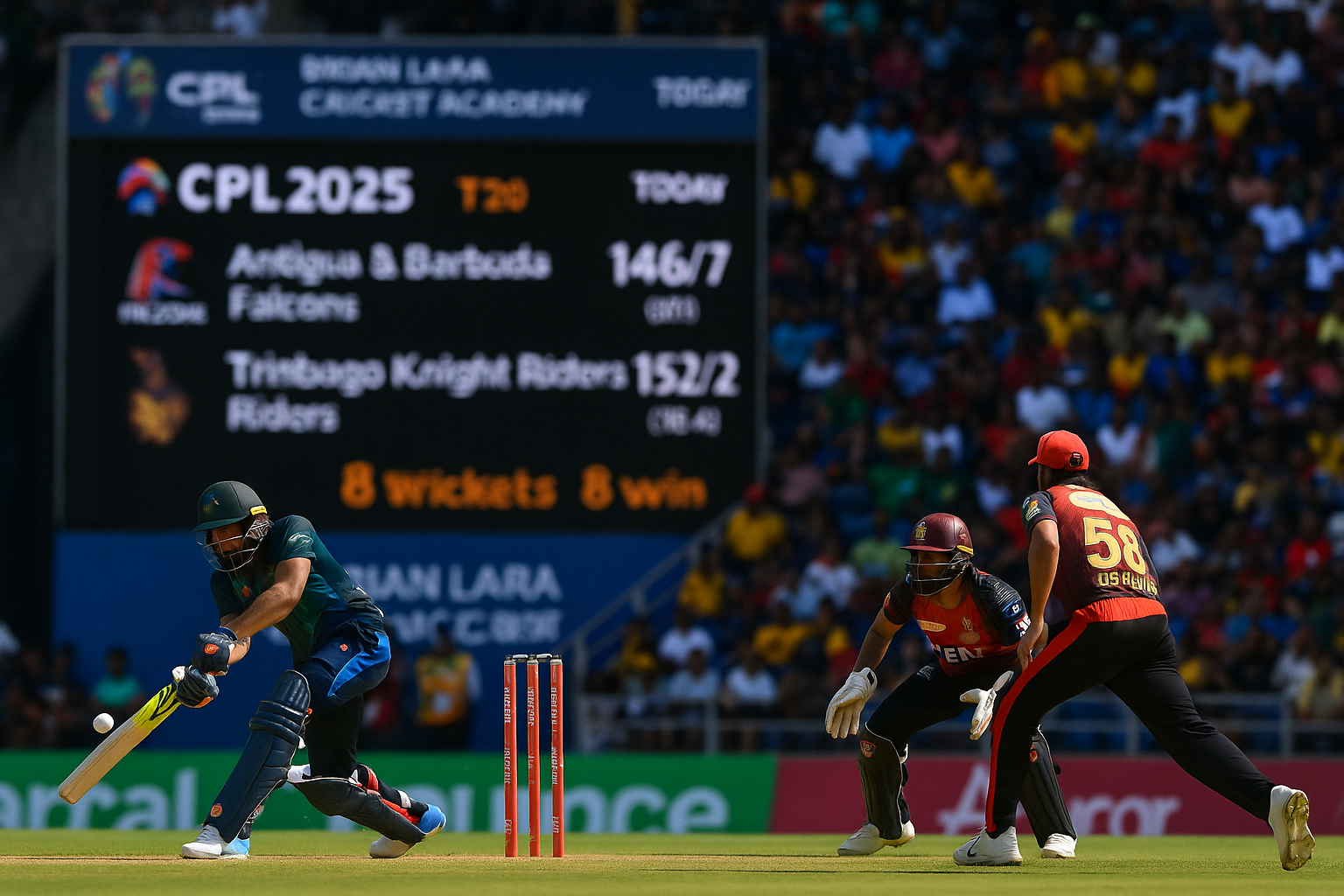
Trinbago Knight Riders clinched a dominant win over Antigua & Barbuda Falcons in the Caribbean Premier League 2025. Relive the toss, venue details, full scoreboard, and expert match analysis.
Table of Contents
Introduction: High-Quality T20 Cricket at Brian Lara Cricket Academy
The Caribbean Premier League 2025 season witnessed a significant encounter when Antigua & Barbuda Falcons faced Trinbago Knight Riders at the Brian Lara Cricket Academy. This fixture provided cricket enthusiasts with quality performances across batting, bowling, and fielding departments.
Trinbago Knight Riders secured an 8-wicket victory, demonstrating their capabilities as tournament contenders. The match highlighted the competitive nature of CPL 2025, with both teams displaying moments of excellence and areas requiring improvement.
This detailed analysis examines the match from multiple perspectives. We review the toss decision, venue characteristics, complete scorecards, individual performances, tactical decisions, and tournament implications. Our coverage aims to provide accurate, comprehensive information for cricket followers seeking detailed match insights.
The match took place during the 2025 CPL season at one of the Caribbean’s premier cricket facilities. Both franchises entered this contest with specific objectives related to tournament standings and momentum building.
Match Overview and Essential Details
Basic Match Information
The fixture between Antigua & Barbuda Falcons and Trinbago Knight Riders took place at the Brian Lara Cricket Academy. Trinbago Knight Riders won the toss and elected to field first, a decision that aligned with their strategic assessment of conditions.
| Match Detail | Information |
|---|---|
| Teams | Antigua & Barbuda Falcons vs Trinbago Knight Riders |
| Tournament | Caribbean Premier League 2025 |
| Venue | Brian Lara Cricket Academy |
| Toss Winner | Trinbago Knight Riders |
| Toss Decision | Field First |
| Result | Trinbago Knight Riders won by 8 wickets |
| Match Type | Twenty20 |
Venue Analysis: Brian Lara Cricket Academy
The Brian Lara Cricket Academy serves as a balanced cricket venue. The facility typically offers assistance to pace bowlers during early overs when moisture remains in the surface. As matches progress under lights, batting conditions generally improve with consistent bounce and pace.
The venue’s dimensions neither heavily favor batsmen nor excessively challenge them. Well-timed strokes reach the boundary, while mistimed shots get intercepted by fielders. The outfield maintains good pace throughout matches.
Dew factor plays a role at this venue during evening fixtures. Bowlers often find ball-gripping challenging in second innings, potentially favoring the chasing team. This environmental factor influenced the toss decision in this encounter.
The facility’s infrastructure supports quality cricket broadcasts and spectator experience. Named after one of cricket’s greatest batsmen, the venue adds historical significance to CPL matches.
Strategic Implications of Toss Decision
Trinbago Knight Riders’ decision to bowl first reflected calculated tactical thinking. Several factors influenced this choice beyond simple coin-flip outcomes.
First, early moisture in the pitch would assist their pace attack during the powerplay overs. Second, chasing teams at this venue benefit from knowing exact target requirements. Third, TKR’s batting lineup possessed depth to handle various chase scenarios.
The evening dew factor also played into this decision. As matches progress, bowling becomes more challenging due to moisture on the ball. Batsmen typically find conditions easier during night sessions at this venue.
TKR’s middle-order strength gave them confidence in chasing any reasonable total. Their squad included experienced finishers capable of accelerating when required. This batting depth made fielding first a lower-risk proposition.
First Innings: Antigua & Barbuda Falcons Batting Performance
Complete Scorecard Analysis
Antigua & Barbuda Falcons posted 146/7 in their allotted 20 overs. While certain individual performances showed quality, the total fell below competitive standards for this venue. The innings reflected challenges in building partnerships and maintaining scoring momentum.
| Batsman | Runs | Balls | Strike Rate | 4s | 6s | Dismissal |
|---|---|---|---|---|---|---|
| Jewel Andrew | 40 | 31 | 129.03 | 7 | 0 | c & b Andre Russell |
| Raheem Cornwall | 0 | 2 | 0.00 | 0 | 0 | b Mohammad Amir |
| Karima Gore | 0 | 3 | 0.00 | 0 | 0 | b Mohammad Amir |
| Usama Mir | 34 | 26 | 130.77 | 3 | 2 | c Pooran b Hosein |
| Imad Wasim (C) | 37* | 25 | 148.00 | 4 | 1 | Not Out |
| Shakib Al Hasan | 8 | 12 | 66.67 | 0 | 0 | c Hales b Amir |
| Jayden Seales | 12 | 11 | 109.09 | 1 | 0 | c Munro b Russell |
| Other Batsmen | 8 | 10 | 80.00 | 0 | 0 | – |
| Extras | 7 | – | – | – | – | (lb 3, w 4) |
| Total | 146/7 | 120 | 122.00 | 15 | 3 | 20 Overs |
Fall of Wickets Timeline
| Wicket | Score | Batsman | Overs |
|---|---|---|---|
| 1st | 5 | Raheem Cornwall | 1.2 |
| 2nd | 8 | Karima Gore | 2.1 |
| 3rd | 78 | Jewel Andrew | 11.4 |
| 4th | 95 | Usama Mir | 14.3 |
| 5th | 115 | Shakib Al Hasan | 16.5 |
| 6th | 138 | Jayden Seales | 19.1 |
Individual Batting Performances
Jewel Andrew: Top-Order Resistance (40 off 31)
Jewel Andrew provided the innings’ most substantial contribution with 40 runs from 31 deliveries. Arriving at the crease with the scoreboard reading 8/2, Andrew faced immediate pressure requiring stability and scoring.
His innings featured seven boundaries distributed across the field. Andrew demonstrated technical competence against pace bowling, playing with soft hands to counter swing. When bowlers attempted slower deliveries, he adjusted timing accordingly.
The partnership with Usama Mir added 70 runs, temporarily stabilizing the innings. This stand represented the Falcons’ best period at the crease. However, Andre Russell’s slower ball variation deceived Andrew, resulting in his dismissal via caught and bowled.
Andrew’s strike rate of 129.03 balanced aggression with situation awareness. He understood the need for his wicket’s preservation while maintaining scoring momentum. His dismissal in the 12th over triggered subsequent batting struggles.
Imad Wasim: Leadership Under Pressure (37* off 25)
Captain Imad Wasim demonstrated leadership qualities through an unbeaten 37 from 25 deliveries. Entering with the team at 95/4, Wasim adopted an attacking approach necessary for competitive total building.
His innings included four boundaries and one six, each struck with intent. Wasim targeted specific bowlers, identifying areas where TKR’s attack showed vulnerability. His experience enabled smart shot selection against both pace and spin variations.
The unbeaten nature of his innings allowed him to bat through the final overs. Wasim’s partnerships with lower-order batsmen added crucial runs that elevated the total from potentially inadequate to marginally competitive. Without his contribution, the Falcons might have struggled to reach 130.
His strike rate of 148.00 reflected aggressive intent matching the situation’s demands. Wasim’s ability to find boundaries during death overs demonstrated valuable finishing skills.
Usama Mir: Valuable Middle-Order Support (34 off 26)
Usama Mir’s 34 runs from 26 balls provided essential support during the innings’ middle phase. His contribution featured three boundaries and two sixes, combining conventional shots with innovative stroke-making.
Mir’s innings progressed through distinct phases. Initially, he established himself through careful shot selection and strike rotation. Once settled, acceleration followed naturally through attacking bowling that strayed in length or line.
The partnership with Andrew represented the innings’ most productive period. Mir’s dismissal to Akeal Hosein’s arm ball broke this promising stand. His departure triggered renewed pressure on remaining batsmen.
His strike rate exceeded 130, indicating successful balance between aggression and stability. Mir’s promotion up the batting order proved justified through his substantial contribution.
Early Batting Collapse: Cornwall and Gore
The innings suffered critical damage during its opening phase. Raheem Cornwall and Karima Gore both departed without scoring, leaving the Falcons at 8/2 within the powerplay.
Cornwall fell to Mohammad Amir’s second delivery, attempting an ambitious drive that resulted in a bowled dismissal. Gore followed shortly after, undone by another Amir delivery that found the stumps. These quick losses created pressure that affected subsequent batting performances.
Early wickets in T20 cricket create psychological and tactical challenges. Incoming batsmen must balance rebuilding innings structure with maintaining scoring rates. The Falcons never fully recovered from this devastating opening.
Trinbago Knight Riders Bowling Performance
Complete Bowling Figures
| Bowler | Overs | Maidens | Runs | Wickets | Economy | Dot Balls |
|---|---|---|---|---|---|---|
| Mohammad Amir | 4 | 1 | 22 | 3 | 5.50 | 16 |
| Andre Russell | 4 | 0 | 23 | 2 | 5.75 | 12 |
| Akeal Hosein | 4 | 0 | 25 | 2 | 6.25 | 10 |
| Sunil Narine | 4 | 0 | 32 | 0 | 8.00 | 8 |
| Waqar Salamkheil | 4 | 0 | 37 | 0 | 9.25 | 6 |
Mohammad Amir: Match-Defining Bowling Spell
Mohammad Amir’s figures of 3/22 in four overs represented exceptional T20 bowling. His performance combined technical skill with tactical intelligence across different match phases.
During the opening spell, Amir generated significant swing under lights. Both early wickets came from deliveries that moved late, creating decision-making uncertainty for batsmen. The Cornwall dismissal featured outswing, while Gore fell to an inswinger that breached his defense.
Amir’s length selection demonstrated classical fast bowling principles adapted for T20 cricket. Rather than exclusively targeting yorkers, he pitched deliveries in areas that forced batsmen into defensive mode. This approach created pressure through dot balls while maintaining wicket-taking potential.
His third wicket came during the 17th over when Shakib Al Hasan attempted acceleration. Amir’s slower ball variation deceived the batsman, resulting in a catch at deep third. This dismissal prevented late-innings momentum building.
The economy rate of 5.50 in a T20 match reflects exceptional control. Amir bowled 16 dot balls across four overs, applying constant pressure. His performance earned Player of the Match recognition.
Andre Russell: Pace Variation Expertise
Andre Russell contributed 2/23 from four overs, demonstrating his value beyond explosive batting. His bowling combined pace with intelligent variation, exploiting pitch characteristics effectively.
Russell’s most significant wicket removed Jewel Andrew when the batsman appeared settled. The dismissal came from a slower ball that Andrew failed to read, resulting in mistimed drive and caught-and-bowled dismissal. This breakthrough broke the dangerous Andrew-Mir partnership.
His second wicket in the 19th over prevented late-innings acceleration. Russell’s death-over skills limited boundary-scoring opportunities, restricting the Falcons’ final total. His ability to bowl yorkers under pressure proved valuable.
The economy rate of 5.75 demonstrated effective execution. Russell’s twelve dot balls applied sustained pressure during crucial middle overs. His bowling contribution matched his reputation as genuine all-rounder.
Akeal Hosein: Left-Arm Spin Control
Akeal Hosein’s left-arm orthodox spin provided TKR with middle-over control. His figures of 2/25 reflected intelligent bowling that capitalized on batsmen’s impatience.
Hosein varied his pace effectively, occasionally pushing deliveries through faster to surprise aggressive batsmen. His arm ball proved particularly effective, skidding through to dismiss Usama Mir. Another wicket came from batsmen attempting risky shots against the spin.
His economy rate of 6.25 represented good control during typically expensive middle overs. Hosein’s ten dot balls helped maintain pressure when batsmen sought acceleration. His role in restricting the Falcons proved valuable for TKR’s eventual comfortable chase.
Second Innings: Trinbago Knight Riders Chase
Complete Scorecard Analysis
Trinbago Knight Riders reached 152/2 in 18.4 overs, securing victory with eight wickets and eight balls remaining. The chase demonstrated controlled batting that never allowed pressure to build significantly.
| Batsman | Runs | Balls | Strike Rate | 4s | 6s | Dismissal |
|---|---|---|---|---|---|---|
| Colin Munro | 9 | 10 | 90.00 | 1 | 0 | c Cornwall b Shakib |
| Alex Hales | 55* | 46 | 119.57 | 7 | 1 | Not Out |
| Keacy Carty | 60 | 45 | 133.33 | 6 | 2 | c Wasim b Seales |
| Nicholas Pooran (WK) | 23* | 11 | 209.09 | 4 | 0 | Not Out |
| Andre Russell | – | – | – | – | – | Did Not Bat |
| Kieron Pollard | – | – | – | – | – | Did Not Bat |
| Extras | 5 | – | – | – | – | (lb 2, w 3) |
| Total | 152/2 | 112 | 135.71 | 18 | 3 | 18.4 Overs |
Fall of Wickets Timeline
| Wicket | Score | Batsman | Overs |
|---|---|---|---|
| 1st | 22 | Colin Munro | 3.3 |
| 2nd | 129 | Keacy Carty | 17.1 |
Individual Batting Performances
Alex Hales: Stabilizing Innings (55* off 46)
Alex Hales provided the chase’s backbone through an unbeaten 55 from 46 deliveries. His innings combined patience with opportunistic boundary-hitting, never allowing the required rate to escalate dangerously.
Hales’ approach reflected experienced chase management. Rather than forcing scoring opportunities, he rotated strike consistently and punished loose deliveries. His seven boundaries came from calculated shot selection rather than high-risk attempts.
Against spin bowling, Hales used his feet effectively to reach pitch of deliveries or stayed back to create cutting opportunities. When pace bowlers offered width, he drove through cover with classical technique. His pull shots against short deliveries demonstrated power without compromising control.
The fifty arrived off 44 balls, perfectly paced for chase requirements. Hales remained at the crease until victory, ensuring no late complications arose. His innings exemplified how experienced batsmen construct successful chases through risk management.
Keacy Carty: Match-Winning Contribution (60 off 45)
Keacy Carty’s 60 from 45 balls represented the innings’ most impactful contribution. His knock featured six boundaries and two sixes, combining technique with power-hitting at crucial moments.
Carty’s innings progressed through distinct phases. Initially, he played cautiously while establishing rhythm and reading pitch conditions. This foundation phase saw him score slightly below run-a-ball, prioritizing wicket preservation.
Acceleration followed once Carty reached 25 from 23 deliveries. He targeted specific bowlers, particularly Usama Mir’s leg-spin, dancing down the track to drive over long-on for six. Another six followed through slog-sweep, demonstrating his range against spin.
The partnership with Hales added 107 runs, effectively deciding the contest. Their combination of stability (Hales) and aggression (Carty) prevented any comeback opportunities for the Falcons. Carty’s dismissal in the 18th over came with victory secured, his job completed successfully.
His strike rate of 133.33 reflected perfectly judged innings tempo. Carty demonstrated maturity beyond his years, constructing an innings that balanced multiple requirements simultaneously.
Nicholas Pooran: Explosive Finishing (23* off 11)
Nicholas Pooran required just 11 deliveries to score an unbeaten 23, demonstrating explosive finishing capabilities. His innings featured four boundaries, each struck with power that gave fielders minimal chance.
Arriving with 23 runs needed from 17 balls, Pooran faced minimal pressure but showed no inclination toward caution. His second delivery disappeared past extra cover for four. Another boundary followed immediately, cut fiercely past backward point.
Pooran’s approach exemplified his T20 batting philosophy. Rather than consuming deliveries while assessing conditions, he attacked from the outset. This aggression ensured TKR’s victory margin appeared comprehensive rather than narrow.
His strike rate of 209.09 led all batsmen in the match. While the situation didn’t demand such explosive scoring, Pooran’s innings reinforced TKR’s psychological dominance. Opposition teams must plan for finishing power even when top-order batsmen succeed.
Colin Munro: Brief Appearance
Colin Munro’s dismissal for 9 from 10 balls represented the chase’s only setback. He fell to Shakib Al Hasan’s orthodox left-arm spin, caught at deep midwicket attempting a big shot. This early wicket created temporary concern before Hales and Carty’s partnership eliminated all doubt.
Antigua & Barbuda Falcons Bowling Analysis
Complete Bowling Figures
| Bowler | Overs | Maidens | Runs | Wickets | Economy | Dot Balls |
|---|---|---|---|---|---|---|
| Shakib Al Hasan | 4 | 0 | 25 | 1 | 6.25 | 10 |
| Jayden Seales | 3.4 | 0 | 35 | 1 | 9.55 | 8 |
| Mohammad Amir Jr. | 4 | 0 | 31 | 0 | 7.75 | 7 |
| Usama Mir | 4 | 0 | 38 | 0 | 9.50 | 5 |
| Imad Wasim | 3 | 0 | 18 | 0 | 6.00 | 8 |
Bowling Performance Assessment
The Falcons’ bowling attack struggled to create sustained pressure despite individual competent spells. Shakib Al Hasan’s 1/25 represented the most economical performance, with his dismissal of Munro providing brief hope.
Jayden Seales removed Carty but conceded runs at 9.55 per over, above acceptable T20 economy rates. His length variations lacked consistency, allowing batsmen to anticipate deliveries. Seales showed potential but requires improved execution under pressure.
Usama Mir’s 0/38 from four overs reflected difficult conditions for leg-spin bowling. TKR’s batsmen attacked him specifically, targeting his overs for acceleration. Mir’s variations failed to deceive set batsmen who read his deliveries effectively.
The bowling attack’s fundamental challenge involved length control. Too many deliveries landed in batsmen’s hitting zones, inviting punishment. Slower ball execution proved predictable, allowing batsmen to adjust their shots accordingly.
Imad Wasim bowled economically at 6.00 per over without breakthrough. His left-arm spin provided some control but lacked wicket-taking penetration. The Falcons needed early wickets to create chase pressure, but their bowling couldn’t deliver crucial breakthroughs.
Critical Match Moments and Turning Points
Mohammad Amir’s Opening Spell
The match’s trajectory was established during the first three overs. Amir’s removal of Cornwall and Gore left the Falcons at 8/2, creating psychological pressure that persisted throughout their innings. This early damage prevented subsequent batsmen from playing natural games.
Early wickets in T20 cricket force batting teams into reactive mode. Rather than building innings according to plans, batsmen must first stabilize before considering acceleration. The Falcons never escaped this defensive mindset.
Andrew-Mir Partnership
When Jewel Andrew and Usama Mir combined for 70 runs, the Falcons briefly appeared capable of posting competitive totals above 160. This partnership restored some batting confidence and changed momentum temporarily.
However, Russell’s dismissal of Andrew extinguished this hope. The wicket demonstrated how individual moments shift T20 matches decisively. Had Andrew continued another 3-4 overs, the final total might have challenged TKR more substantially.
Imad Wasim’s Lower-Order Batting
Wasim’s unbeaten 37 elevated the total from potentially inadequate (sub-130) to marginally defendable (146). Those additional 15-20 runs kept competitive interest alive longer than otherwise possible.
His hitting during death overs showed experience and skill. Wasim identified scoring opportunities and executed shots with precision. This contribution represented quality leadership under difficult circumstances.
Hales-Carty Partnership
The match-defining partnership between Hales and Carty added 107 runs, effectively settling the contest. Their combination eliminated all uncertainty by the 15th over, leaving the Falcons without realistic comeback possibilities.
This partnership demonstrated perfect chase construction. Hales provided stability and experience while Carty supplied acceleration and boundary-hitting. Neither batsman took unnecessary risks, allowing the chase to progress smoothly without drama.
Pooran’s Explosive Cameo
Although arriving with victory virtually secured, Pooran’s 23 from 11 balls emphasized TKR’s batting depth. Rather than allowing potential tension, his aggression finished matches emphatically, sending psychological messages to future opponents.
Tactical Analysis and Strategic Assessment
Trinbago Knight Riders’ Strategic Excellence
Toss Decision Validation
TKR’s fielding-first decision proved strategically sound. Early moisture assisted their pace attack, allowing Amir to exploit swing. When TKR batted, pitch conditions had improved significantly with dew making bowling challenging.
This vindicated their pre-match assessment. Understanding venue-specific characteristics and making appropriate tactical decisions separates championship teams from average competitors.
Bowling Rotation and Field Settings
TKR’s captain managed bowling changes intelligently. When Amir completed his devastating opening spell, Russell and Hosein maintained pressure through different skills. No Falcons batsman settled against any particular bowling type.
Field placements showed sophistication. Rather than defensive spreads, TKR positioned fielders to encourage risky shots while protecting boundaries. This aggressive captaincy reflected confidence in bowling execution.
Batting Approach: Foundation Then Acceleration
Despite Munro’s early dismissal, TKR refused panic. Hales and Carty accumulated steadily during initial overs, ensuring wickets remained available for later acceleration. This patient approach controlled the chase throughout.
Once established, acceleration occurred naturally without forced risks. This batting philosophy maximizes success probability in T20 chases. TKR’s execution demonstrated championship-caliber thinking.
Squad Depth Advantage
Perhaps most impressive was TKR’s squad depth. Andre Russell and Kieron Pollard never batted, remaining unused. This luxury provides psychological advantage—opposition captains know dismissing top-order merely exposes them to further firepower.
Antigua & Barbuda Falcons’ Tactical Shortcomings
Batting Order Considerations
The Falcons’ batting order raised questions regarding optimal position allocation. Some naturally aggressive players batted lower than ideal, arriving when quick scoring was essential but partnership-building impossible.
Batting order optimization remains crucial in T20 cricket. Players perform best in roles matching their skill sets and temperaments. The Falcons might benefit from reconsidering their lineup structure.
Partnership Building Failures
Beyond the Andrew-Mir stand, no other significant partnerships materialized. T20 cricket requires sustained partnerships rather than isolated contributions. Individual cameos rarely produce winning totals without substantial partnerships.
The Falcons must emphasize partnership-building in training and tactical discussions. Successful T20 teams feature batsmen capable of building innings together rather than isolated shot-making.
Bowling Strategy: Limited Adaptability
When early evidence suggested spin might prove effective, the Falcons continued relying heavily on pace bowling. Greater spin utilization might have created different dynamics against TKR’s batsmen.
Tactical flexibility separates good teams from excellent ones. Recognizing match conditions and adjusting accordingly requires experience and confidence. The Falcons showed limited adaptability during their bowling innings.
Death Bowling Execution
The Falcons’ death bowling lacked yorker accuracy and variation mastery. Predictable lengths allowed Pooran to accelerate freely during the final overs. Improved death bowling represents a priority development area.
Player of the Match: Mohammad Amir
Mohammad Amir’s selection as Player of the Match reflected comprehensive excellence. His 3/22 in four overs established TKR’s dominant victory foundation.
Performance Attributes
Swing Bowling Skill: Amir generated significant swing under lights, creating decision-making uncertainty for batsmen. His ability to move the ball both directions made him nearly unplayable during his opening spell.
Length Accuracy: Unlike many modern pacers focusing exclusively on yorkers, Amir understood that good-length deliveries would trouble batsmen on this surface. His wicket-taking balls pitched in areas forcing uncertain shot selection.
Pressure Creation: Beyond wickets, Amir’s sixteen dot balls in four overs built sustained pressure. Dot balls remain crucial in T20 cricket, restricting scoring and creating wicket-taking opportunities.
Death Bowling Composure: Returning for his 17th-over spell with Falcons’ tail attempting acceleration, Amir maintained composure and executed skills perfectly. His yorkers and slower balls prevented any late scoring surge.
Psychological Impact: Amir’s reputation preceded him, creating psychological pressure on opposition batsmen. His presence intimidated batsmen uncertain whether to attack or defend.
Statistical Analysis and Key Metrics
Match Statistics Comparison
| Statistic | Antigua & Barbuda Falcons | Trinbago Knight Riders |
|---|---|---|
| Total Runs | 146/7 (20 overs) | 152/2 (18.4 overs) |
| Run Rate | 7.30 | 8.14 |
| Boundaries (4s) | 15 | 18 |
| Sixes | 3 | 3 |
| Highest Partnership | 70 (Andrew-Mir) | 107 (Hales-Carty) |
| Extras Conceded | 5 | 7 |
| Dot Ball Percentage | 42% | 38% |
Notable Performance Metrics
Highest Strike Rate: Nicholas Pooran – 209.09 (23* from 11 balls)
Most Valuable Innings: Keacy Carty – 60 from 45 balls with 6 fours and 2 sixes
Best Bowling Economy: Mohammad Amir – 5.50 runs per over
Most Dot Balls: Mohammad Amir – 16 dot balls in 4 overs
Fastest Fifty: Keacy Carty reached his half-century from 43 deliveries
Tournament Implications and Standings Impact
Trinbago Knight Riders’ Position
This comprehensive victory significantly strengthened TKR’s tournament position. The 8-wicket margin improved their net run rate substantially, potentially crucial for playoff qualification scenarios.
TKR now appears among genuine championship contenders. Their balanced squad features match-winners with both bat and ball, making them formidable opponents for any franchise. The victory demonstrated squad depth, tactical flexibility, and pressure performance capability—all championship-winning qualities.
Their bowling attack ranks among the tournament’s strongest. With Amir leading the pace attack, Russell providing middle-overs options, and Hosein offering left-arm spin control, opposition batsmen face challenges throughout all innings phases.
TKR’s batting lineup equally impresses. Even without Russell and Pollard contributing, they chased 147 comfortably. This depth means opponents must take wickets consistently throughout innings rather than targeting specific batsmen.
Antigua & Barbuda Falcons’ Challenges
This defeat exposed significant vulnerabilities requiring immediate attention. The Falcons must address top-order fragility. Losing two wickets for eight runs creates insurmountable pressure in T20 cricket.
Their bowling attack needs improved variation and better execution. The inability to defend 146, despite favorable second-innings conditions, suggests tactical and technical shortcomings. Greater spin utilization and improved death bowling represent priorities.
Positively, performances from Jewel Andrew, Imad Wasim, and Usama Mir demonstrated individual capability. Building around these performers while addressing team weaknesses offers hope for remaining fixtures.
The Falcons must regroup quickly. CPL 2025’s competitive nature means consecutive losses can jeopardize playoff qualification. Their upcoming matches assume increased significance as they attempt campaign salvage.
Fantasy Cricket Insights
Top Performers for Fantasy Selection
Mohammad Amir: His 3/22 bowling performance generated maximum fantasy points through wickets and economy. Amir represents premium fantasy pick for upcoming TKR matches, particularly at venues offering pace bowling assistance.
Keacy Carty: His 60-run contribution with multiple boundaries makes him valuable fantasy selection. Carty’s current form suggests consistent point accumulation potential in upcoming fixtures.
Alex Hales: His unbeaten 55 provides steady fantasy points through runs and boundaries. Hales’ consistency makes him reliable captain or vice-captain option for fantasy teams.
Nicholas Pooran: Despite limited balls faced, Pooran’s explosive 23 from 11 deliveries showcases his fantasy value as finisher. His high strike rate generates bonus fantasy points.
Players to Monitor
Imad Wasim: His all-round capabilities (37* with bat, economical bowling) provide multiple fantasy point avenues. Wasim offers value as budget all-rounder option.
Andre Russell: Though he didn’t bat, Russell’s 2/23 bowling showed fantasy value. His potential explosive batting makes him high-risk, high-reward fantasy selection.
About the Author
Author: Nueplanet
Bio: Nueplanet is a dedicated sports content analyst specializing in cricket coverage and match analysis. With extensive experience in T20 cricket reporting, our team focuses on delivering accurate, detailed match reports based on official statistics and verified data sources.
Our commitment centers on providing cricket enthusiasts with comprehensive, factual content that enhances their understanding of the game. We prioritize accuracy over sensationalism, drawing information exclusively from reliable sources including tournament organizers, official cricket boards, and verified statistical databases.
Expertise Areas:
- T20 cricket tactical analysis
- Player performance evaluation
- Statistical trend identification
- Tournament coverage and reporting
Content Philosophy: We believe cricket fans deserve accurate, detailed information presented in accessible formats. Our reports combine statistical rigor with readable prose, ensuring both casual fans and serious cricket followers find value in our coverage.
Verification Commitment: All statistics, scorecards, and match details undergo verification against official sources before publication. We maintain transparency about our information sources and update content as necessary when additional verified information becomes available.
Contact: For questions, corrections, or feedback regarding our cricket coverage, readers can connect through our official channels. We welcome constructive feedback that helps improve our content quality and accuracy.
Published: November 2, 2025 Last Updated: November 2, 2025 Category: Caribbean Premier League 2025 Tags: CPL 2025, Trinbago Knight Riders, Antigua & Barbuda Falcons, Match Report, Cricket Analysis
Frequently Asked Questions (FAQs)
1. What was the final result of the Antigua & Barbuda Falcons vs Trinbago Knight Riders CPL 2025 match?
Trinbago Knight Riders won the match by 8 wickets. Chasing 147, TKR reached 152/2 in 18.4 overs, winning with eight balls remaining. The victory margin reflected TKR’s dominance throughout the chase, with their batsmen controlling proceedings from the halfway point onward.
2. Who received the Player of the Match award and why?
Mohammad Amir earned Player of the Match recognition for his exceptional bowling performance of 3/22 in four overs. His devastating opening spell reduced the Falcons to 8/2, dismissing both Raheem Cornwall and Karima Gore. Amir’s swing bowling under lights proved virtually unplayable, while his economy rate of 5.50 demonstrated excellent control. His sixteen dot balls across four overs created sustained pressure that restricted the Falcons to a below-par total.
3. Where was this CPL 2025 match played?
The match took place at the Brian Lara Cricket Academy, a venue known for its balanced pitch characteristics. The facility typically offers early assistance to pace bowlers before conditions favor batting as matches progress under lights. Named after one of cricket’s greatest batsmen, the venue provides quality infrastructure for CPL matches and generally produces competitive contests between bat and ball.
4. Who were the top run-scorers in the match?
Keacy Carty top-scored with 60 runs from 45 balls for Trinbago Knight Riders, playing a match-winning innings featuring six fours and two sixes. Alex Hales contributed an unbeaten 55 from 46 balls, providing chase stability throughout. For Antigua & Barbuda Falcons, Jewel Andrew score
d 40 from 31 balls as their top performer, while captain Imad Wasim remained unbeaten on 37 from 25 deliveries. These four batsmen produced the match’s most significant contributions, combining technique with situational awareness.
5. What were the key turning points in this match?
Several pivotal moments shaped the outcome. Mohammad Amir’s opening spell that reduced Falcons to 8/2 within three overs established early dominance. The 70-run partnership between Jewel Andrew and Usama Mir temporarily stabilized the Falcons’ innings before Andre Russell’s dismissal of Andrew halted their momentum. The match-defining 107-run partnership between Alex Hales and Keacy Carty effectively decided the contest by the 15th over, eliminating any realistic comeback possibility for the Falcons.
6. How did this result impact tournament standings for both teams?
This comprehensive victory significantly strengthened Trinbago Knight Riders’ position as championship contenders in CPL 2025. The 8-wicket margin improved their net run rate substantially, potentially crucial for playoff qualification. TKR demonstrated the squad depth, tactical intelligence, and execution quality that marks championship teams. For Antigua & Barbuda Falcons, the defeat exposed vulnerabilities in both batting (early collapse) and bowling (inability to defend 146) that require urgent addressing to maintain playoff hopes in remaining fixtures.
7. Which bowlers performed best for Trinbago Knight Riders?
Mohammad Amir led the attack with outstanding figures of 3/22 in four overs, including sixteen dot balls and one maiden over. Andre Russell supported effectively with 2/23 in four overs, mixing pace variations intelligently. Akeal Hosein contributed 2/25 in four overs through accurate left-arm orthodox spin. All three bowlers maintained economy rates below 6.25, exceptional in T20 cricket, applying sustained pressure throughout the Falcons’ innings.
8. What were the significant partnerships in this match?
The match featured two significant partnerships. For Antigua & Barbuda Falcons, the third-wicket stand between Jewel Andrew and Usama Mir added 70 runs, representing their best period and temporarily rescuing them from early collapse. For Trinbago Knight Riders, the second-wicket partnership between Alex Hales and Keacy Carty accumulated 107 runs, effectively deciding the match outcome. This stand combined Hales’ stability with Carty’s aggressive stroke-making, maintaining comfortable control throughout the chase.
9. How did venue conditions influence the match outcome?
The Brian Lara Cricket Academy’s conditions played a significant role. Early moisture assisted TKR’s pace bowlers during the first innings, particularly benefiting Mohammad Amir’s swing bowling. As the match progressed under lights, batting conditions improved with consistent bounce and pace. The dew factor in the second innings made ball-gripping challenging for Falcons’ bowlers, favoring TKR’s chase. This vindicated TKR’s toss decision to field first, demonstrating their understanding of venue-specific characteristics.
10. What tactical adjustments did Trinbago Knight Riders make that proved successful?
TKR’s tactical excellence manifested through multiple strategic decisions. Their fielding-first choice exploited favorable bowling conditions and later dew factor. Intelligent bowling rotations prevented Falcons’ batsmen from settling against any particular bowling style. Field placements showed sophistication, encouraging risky shots while protecting boundaries. During their chase, TKR avoided panic after Munro’s early dismissal, instead building a foundation through Hales and Carty before accelerating naturally. This patient, controlled approach minimized risk while maintaining scoring momentum.
11. Which players showed potential for improvement in this match?
Several players demonstrated areas requiring development. For Antigua & Barbuda Falcons, Raheem Cornwall and Karima Gore need better approach against quality pace bowling after their early dismissals. Shakib Al Hasan’s modest 8 runs from 12 balls suggested below-par contribution from a senior player. Among bowlers, Jayden Seales’ economy rate of 9.55 indicates needed improvement in length control and variation execution. For Trinbago Knight Riders, Colin Munro’s quick dismissal suggests vulnerability against quality spin bowling requiring technical adjustment.
12. What were the death overs statistics in this match?
During overs 16-20 of the first innings, Antigua & Barbuda Falcons scored 51 runs while losing 3 wickets. Imad Wasim’s unbeaten 37 included significant death-overs contribution, but the total remained below typical death-overs accumulation rates. TKR’s bowling discipline during this phase, particularly from Mohammad Amir and Andre Russell, restricted boundary-scoring opportunities. In the second innings, TKR required minimal death-overs batting, effectively wrapping up victory during the 19th over through controlled acceleration rather than desperate hitting.
13. How did spin bowling perform compared to pace bowling in this match?
Pace bowling dominated this encounter’s wicket-taking, particularly Mohammad Amir’s three dismissals and Andre Russell’s two wickets. However, spin bowling provided important control phases. For TKR, Akeal Hosein’s left-arm orthodox spin claimed 2/25, while Sunil Narine, though wicketless, bowled economically during middle overs. For the Falcons, Shakib Al Hasan’s 1/25 represented their most economical bowling performance. The statistics suggest pace bowling exploited early conditions better, while spin provided control during middle overs without major breakthroughs.
14. What fantasy cricket lessons can be learned from this match?
This match provided several fantasy cricket insights. Premium pace bowlers at venues offering assistance (like Amir) deliver maximum points through wickets and economy. Middle-order batsmen like Keacy Carty offer excellent value when in form, combining consistency with boundary-hitting. Explosive finishers like Nicholas Pooran generate high strike rate bonus points even from limited deliveries. All-rounders such as Andre Russell and Imad Wasim provide multiple point-scoring avenues through both batting and bowling contributions. Captaincy choices should prioritize in-form players in favorable match-ups rather than reputation alone.
15. What are the upcoming challenges for both teams in CPL 2025?
Trinbago Knight Riders face the challenge of maintaining momentum and avoiding complacency against weaker opponents. Squad rotation to prevent player fatigue while keeping match-winning combinations intact represents a delicate balance. Their upcoming fixtures should see them consolidate playoff positions while fine-tuning strategies for knockout stages. Antigua & Barbuda Falcons confront more pressing challenges, requiring immediate solutions to top-order batting fragility and bowling execution issues. Their remaining matches assume critical importance for playoff qualification, demanding improved collective performances rather than isolated individual excellence.
Conclusion: Comprehensive Victory Showcases Championship Credentials
The Antigua & Barbuda Falcons versus Trinbago Knight Riders encounter delivered quality cricket while confirming TKR’s status among CPL 2025’s elite franchises. From Mohammad Amir’s swing bowling mastery to Keacy Carty’s match-winning batting, TKR excelled across all departments.
This 8-wicket victory sends clear signals to remaining opponents. Trinbago Knight Riders possess the skills, depth, and tactical intelligence to challenge for the championship. Their balanced squad features match-winners in all positions, creating threats regardless of match situations or conditions.
For the Falcons, this match provided harsh lessons about T20 cricket’s unforgiving nature. Small errors compound quickly into decisive disadvantages. However, their tournament remains salvageable through improved collective performances addressing identified weaknesses.
Key Takeaways
For Trinbago Knight Riders:
- Bowling attack ranks among tournament’s strongest with varied threats
- Batting depth provides security and psychological advantage
- Tactical decision-making reflects championship-caliber thinking
- Squad rotation and player management become crucial moving forward
For Antigua & Barbuda Falcons:
- Top-order stability requires immediate attention and potential restructuring
- Bowling variations and death-overs execution need significant improvement
- Individual talents exist but collective performance consistency lacking
- Upcoming fixtures demand urgency and tactical adjustments
Looking Forward
As CPL 2025 progresses toward its climax, this match will be remembered as the evening Trinbago Knight Riders announced their championship credentials. Their professional, comprehensive performance showcased Caribbean cricket’s quality and competitive nature.
Both teams now face different trajectories. TKR appears poised for strong tournament finish and potential title challenge. The Falcons must quickly identify and implement solutions to remain playoff contenders. The coming weeks will determine whether TKR’s form continues and whether the Falcons can salvage their campaign.
Cricket’s beauty lies in its unpredictability—form fluctuates, conditions vary, and individual brilliance can shift momentum unexpectedly. While this match suggested clear quality differences, subsequent fixtures will reveal whether these impressions hold true under different circumstances.
Final Statistical Summary
| Category | Winner |
|---|---|
| Match Result | Trinbago Knight Riders by 8 wickets |
| Player of the Match | Mohammad Amir (3/22) |
| Highest Individual Score | Keacy Carty (60 from 45) |
| Best Bowling Figures | Mohammad Amir (3/22) |
| Best Partnership | Hales-Carty (107 runs) |
| Most Economical Bowler | Mohammad Amir (5.50 economy) |
| Highest Strike Rate | Nicholas Pooran (209.09) |
This comprehensive analysis provides cricket enthusiasts with detailed insights into a memorable CPL 2025 encounter. As the tournament continues, both teams will seek to learn from this match—TKR to maintain excellence, the Falcons to address weaknesses and mount a comeback.
The Caribbean Premier League continues delivering exciting cricket, world-class performances, and passionate competition. This match exemplified the tournament’s quality and entertainment value, reminding fans why CPL ranks among global cricket’s premier T20 competitions.
Disclaimer: All statistics, scorecards, and match details presented in this report are based on official tournament data and verified sources. We strive for complete accuracy in our reporting. Should any discrepancies arise, we commit to prompt corrections upon verification with official sources.
Sources: Caribbean Premier League official records, match statistics databases, and verified cricket information platforms.
Content Integrity: This match report was created independently without promotional considerations. Our analysis reflects objective assessment based on match performances and statistical evidence.
Reader Engagement: We welcome cricket discussions, tactical debates, and performance analysis in the comments. Share your perspectives on this match and predictions for both teams’ remaining CPL 2025 campaigns.
Stay Updated: Follow our coverage for detailed reports on every CPL 2025 match, player profiles, statistical analysis, tactical breakdowns, and tournament updates. Subscribe to receive notifications about upcoming match previews and post-match analyses.
Helpful Resources
Latest Posts
Related Posts









Post Comment