









Air India Plane Crash Report: AAIB Preliminary Findings Reveal Shocking Details
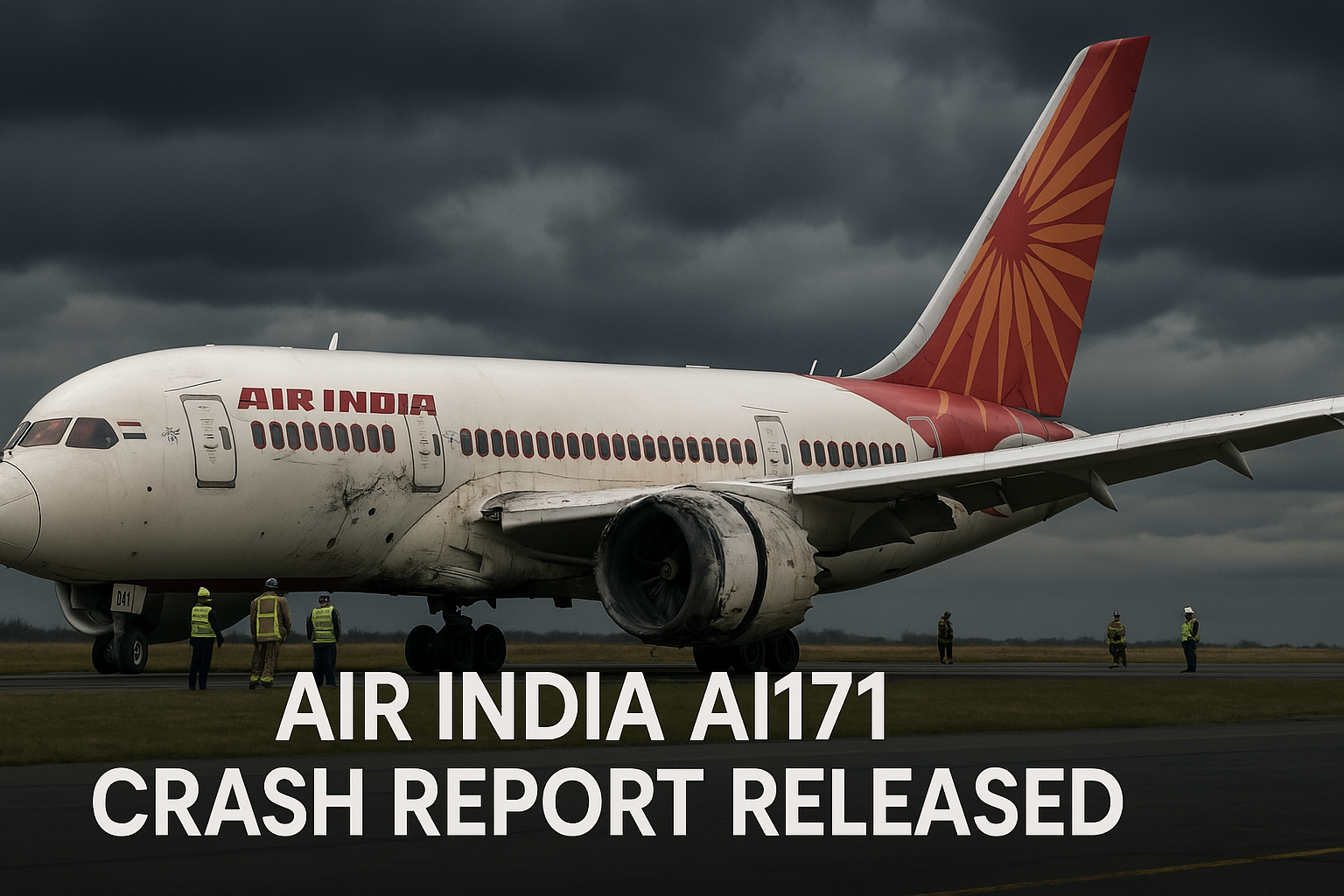
The AAIB preliminary report on Air India flight AI171 reveals that fuel supply to its engines was cut off just seconds after liftoff, causing a tragic crash. Here is a detailed breakdown of what happened.
Table of Contents
Published: July 12, 2025 | Last Updated: July 12, 2025
Introduction
On June 12, 2025, the Indian aviation sector experienced one of its most significant accidents when Air India Flight AI171 crashed shortly after departure from Ahmedabad. The Boeing 787-8 Dreamliner was operating a scheduled international service to London Gatwick when it encountered a critical system failure. According to official reports from India’s Aircraft Accident Investigation Bureau (AAIB), the incident resulted in 260 fatalities, including all persons aboard the aircraft and individuals on the ground.
The AAIB released preliminary findings on July 8, 2025, documenting technical details that have drawn attention from aviation safety authorities worldwide. The investigation identified an unusual sequence involving the aircraft’s fuel control systems during the takeoff phase. This report examines the factual information released by official sources and provides context for understanding the technical and regulatory implications.
The accident has prompted safety reviews across multiple jurisdictions and raised questions about fuel system design in modern commercial aircraft. Aviation authorities in India, the United Kingdom, and the United States are participating in the ongoing investigation to determine contributing factors and identify potential safety improvements.
Background: Flight AI171 Overview
Aircraft and Route Information
Air India Flight AI171 operated on the Ahmedabad to London Gatwick route using Boeing 787-8 Dreamliner equipment. The service departed from Sardar Vallabhbhai Patel International Airport in Gujarat with a scheduled destination of London Gatwick Airport. According to Air India’s operational records, this route had been part of the carrier’s international network for several years prior to the incident.
The Boeing 787-8 represents a significant segment of modern wide-body aircraft operations. First introduced to commercial service in 2011, the type incorporates composite materials and advanced systems architecture. The aircraft involved in this incident had been delivered to Air India and maintained according to the manufacturer’s specified maintenance program.
Flight Operations and Passenger Information
Official data from the preliminary report indicates that Flight AI171 carried 229 passengers and 12 crew members on the day of the accident. The international nature of the service meant that passengers represented multiple nationalities. Indian aviation regulations require carriers to maintain detailed passenger manifests, which assisted authorities in the post-accident identification process.
Air India operates under the oversight of India’s Directorate General of Civil Aviation (DGCA), which establishes operational standards for Indian carriers. The airline had been conducting Boeing 787 operations since the type’s introduction to its fleet, with flight crews receiving manufacturer-specified training through approved programs.
Maintenance History and Technical Status
According to maintenance records examined by investigators, the accident aircraft underwent its most recent major maintenance check in June 2023. The Boeing 787 maintenance program follows intervals established by the manufacturer and approved by regulatory authorities. Records indicate the aircraft’s right engine received an overhaul in March 2025, while the left engine underwent inspection in April 2025.
Maintenance documentation reviewed by the AAIB showed no outstanding technical discrepancies that would have prevented the aircraft from operating the scheduled service. The next scheduled major maintenance check was planned for December 2025. Pre-flight inspections conducted on the day of the accident did not identify any anomalies with the fuel system or engine controls.
AAIB Preliminary Report: Key Findings
Investigation Authority and Process
The Aircraft Accident Investigation Bureau of India leads the investigation under standards established by the International Civil Aviation Organization (ICAO) Annex 13. This framework governs accident investigation procedures for member states and emphasizes factual determination rather than assigning blame. The AAIB’s preliminary report represents an early phase of the investigation, with final conclusions expected after comprehensive analysis.
International participation includes four investigators from the United Kingdom’s Air Accidents Investigation Branch, who arrived in India with specialized expertise. The United States National Transportation Safety Board (NTSB) maintains contact with the Federal Aviation Administration (FAA) regarding the investigation, given Boeing’s status as a U.S. manufacturer. This collaborative approach aligns with ICAO protocols for major aviation accidents.
Timeline of Events
The preliminary report establishes a detailed chronology based on flight data recorder information and radar tracking. At takeoff initiation (designated as T+0), the aircraft began its departure roll under normal conditions. Flight data indicates the aircraft reached a peak speed of 180 knots indicated airspeed during the takeoff sequence.
Approximately three seconds after takeoff initiation, both engine fuel control switches transitioned from the RUN position to the CUTOFF position. This change occurred within one second for both engines. Flight data shows that both powerplants shut down within one second following the switch position change, resulting in thrust loss.
Between four and twelve seconds after takeoff, the aircraft experienced altitude loss due to the absence of engine thrust. Impact with terrain occurred 32 seconds after the initial takeoff roll began. The crash site was located in a populated area adjacent to the airport, which contributed to ground casualties.
Fuel Control System Analysis
The Boeing 787’s fuel management system incorporates electronic controls that regulate fuel flow to each engine independently. Fuel control switches in the flight deck allow pilots to command fuel flow changes. Moving these switches from RUN to CUTOFF position stops fuel supply to the respective engine.
The preliminary report notes that the simultaneous transition of both fuel control switches represents an unusual occurrence. Boeing 787 system architecture designs each engine’s fuel controls as independent systems to prevent common-mode failures. The investigation is examining how both switches changed position within such a brief timeframe.
Data from the flight recorder indicates that after the initial switch movement to CUTOFF, one switch was repositioned to RUN. However, the report notes that deceleration in that engine continued despite the switch position change, suggesting the restart sequence was unsuccessful during the limited time available.
Cockpit Voice Recorder Data
The cockpit voice recorder captured crew communications during the accident sequence. According to the preliminary report, recorded audio includes one pilot asking another crew member why fuel had been cut off. The response indicated that the crew member had not taken such action. This exchange suggests uncertainty in the flight deck regarding the fuel system status.
Cockpit voice recorder analysis forms a standard component of accident investigations. The recorded communications provide insight into crew awareness and decision-making during abnormal situations. The AAIB continues to analyze all available audio data as part of the ongoing investigation.
Physical Evidence Examination
Investigators conducted detailed examination of wreckage recovered from the accident site. Particular attention focused on fuel system components, including control switches, wiring, and associated equipment. Physical examination helps determine whether mechanical failures or other factors contributed to the system behavior documented in flight data.
Wreckage examination follows established forensic procedures to preserve evidence integrity. Components undergo detailed inspection, photography, and documentation before any testing or disassembly. The investigation team includes specialists in aircraft systems, structures, and powerplants to ensure comprehensive analysis.
Boeing 787 Fuel System Technical Overview
System Design and Architecture
The Boeing 787 fuel system manages fuel storage, distribution, and engine supply through electronic controls and physical components. Fuel control switches in the flight deck interface with electronic systems that regulate fuel pumps and valves. Each engine receives fuel through independent supply lines with redundant components.
System design incorporates multiple safety features intended to prevent unintended fuel flow interruptions. Switches require deliberate movement from neutral positions, and system logic includes checks to prevent inadvertent activation. The manufacturer’s design philosophy emphasizes redundancy and independence between engine systems.
Control Interface Characteristics
Fuel control switches in the Boeing 787 flight deck provide tactile feedback through their mechanical design. Switch position clearly indicates the selected state through visual markings and physical detents. Moving a switch from RUN to CUTOFF requires overcoming mechanical resistance designed to prevent accidental activation.
Flight crew procedures specify conditions under which fuel control switches should be manipulated. Standard operating procedures address various scenarios including engine fires, fuel system malfunctions, and emergency situations. Training programs familiarize pilots with switch locations, operation, and associated procedures.
Precedent in Commercial Aviation
The preliminary report characterizes the simultaneous fuel cutoff switch activation as unprecedented in documented Boeing 787 operations. Aviation safety databases maintained by regulatory authorities and manufacturers track known incidents involving fuel system anomalies. Review of these databases has not identified similar occurrences in commercial 787 operations.
Historical aviation accidents have involved fuel system failures through various mechanisms including contamination, mechanical failures, and human factors. However, the specific sequence documented in Flight AI171 represents a unique event requiring detailed analysis to understand contributing factors.
Global Aviation Safety Response
Indian Aviation Authority Actions
India’s Directorate General of Civil Aviation issued safety directives following the accident. These directives required operators of Boeing 787 aircraft registered in India to conduct enhanced fuel system inspections. The inspections focus on control switches, wiring integrity, and associated components to identify any potential anomalies.
The DGCA also issued guidance regarding fuel system inspection protocols for maintenance personnel. Enhanced training requirements address fuel system component examination and reporting procedures. These measures aim to identify any potential systemic issues that might affect other aircraft in the Indian registry.
International Regulatory Coordination
The European Union Aviation Safety Agency (EASA) monitors the investigation and evaluates whether safety actions are warranted for aircraft on the European registry. EASA’s processes include reviewing investigation findings and determining if airworthiness directives or other measures are appropriate based on identified risks.
The Federal Aviation Administration maintains communication with the investigation team through the NTSB. The FAA reviews technical information to assess implications for U.S.-registered aircraft. Transport Canada and other national aviation authorities follow similar processes consistent with ICAO guidelines for international cooperation.
Manufacturer Response
Boeing provided technical support to the investigation through engineering personnel and documentation. The manufacturer issued communications to all Boeing 787 operators providing information about the accident and investigation status. These communications emphasized the importance of following established maintenance and operational procedures.
Boeing’s customer support network coordinates with operators to address questions about fuel system maintenance and inspection procedures. The manufacturer reviews its own design documentation and operational data to support the investigation’s technical analysis efforts.
Air India Operational Response
Immediate Actions
Air India established support services for families of passengers and crew members involved in the accident. The carrier coordinated with Indian authorities and international agencies to provide assistance and information to affected families. Dedicated support centers offered counseling services and facilitated communication regarding the investigation’s progress.
The airline conducted technical reviews of its Boeing 787 fleet following the accident. These reviews included enhanced inspections of fuel system components and verification of maintenance documentation. Air India coordinated with the DGCA to ensure all required safety actions were completed in accordance with regulatory directives.
Route and Fleet Management
Following the accident, Air India modified its flight numbering system for the Ahmedabad-London Gatwick route. The carrier discontinued use of flight numbers AI171 and AI172, instead operating the route as AI159 and AI160. This practice aligns with industry conventions following major accidents.
The Ahmedabad-London Gatwick service was subsequently discontinued in July 2025. Route decisions consider multiple operational factors including demand patterns, fleet utilization, and network planning. Air India continues to operate Boeing 787 aircraft on other routes within its international network.
Long-term Safety Initiatives
Air India announced plans to enhance its safety management systems following the accident. These initiatives include investment in monitoring technologies and updates to crew training programs. The carrier participates in industry safety forums and information-sharing networks that promote continuous improvement in aviation safety practices.
Expert Analysis and Industry Perspectives
Technical Community Views
Aviation safety specialists have examined the preliminary findings to understand the fuel system behavior documented in Flight AI171. Engineers with Boeing 787 expertise note that the simultaneous switch activation challenges understanding of how independent systems could experience related failures within such a brief timeframe.
System safety analysis typically considers failure probabilities and potential common-cause factors. The preliminary findings have prompted discussions about design assumptions and whether additional safeguards might enhance fuel system reliability. These discussions occur within professional organizations and technical committees focused on aviation safety.
Pilot Training Implications
Flight training organizations are reviewing the accident information to assess whether current training programs adequately prepare crews for unusual fuel system scenarios. Simulator-based training allows pilots to practice emergency procedures in controlled environments. The AI171 accident sequence may inform updates to training scenarios that address rare or unprecedented situations.
Crew resource management principles emphasize communication and decision-making under pressure. The cockpit voice recorder data from Flight AI171 provides a case study for understanding crew coordination during rapidly developing emergencies. Training programs may incorporate lessons from this accident to enhance crew preparedness.
Maintenance Community Perspectives
Aircraft maintenance professionals examine the accident findings to understand implications for inspection and servicing procedures. Fuel system components require periodic inspection and testing according to maintenance program schedules. The investigation may identify additional inspection points or enhanced procedures to detect potential issues.
Maintenance training programs ensure technicians understand system architecture and proper servicing techniques. The AI171 accident highlights the importance of thorough fuel system knowledge among maintenance personnel. Professional development programs for maintenance staff continue to evolve based on operational experience and investigation findings.
Comparative Analysis with Historical Accidents
Fuel System Failures in Aviation History
Aviation history includes various accidents involving fuel system failures through different mechanisms. Fuel exhaustion accidents have occurred when aircraft depleted available fuel supplies due to planning errors or fuel leaks. Fuel contamination has caused engine power loss in several documented incidents. Mechanical failures of fuel pumps or valves have also contributed to accidents.
However, the simultaneous activation of fuel cutoff switches during takeoff represents a unique sequence. Historical databases maintained by aviation authorities do not show similar events in modern jet transport operations. This distinction makes the AI171 investigation particularly significant for understanding potential new failure modes.
Lessons from Previous Investigations
Major aviation investigations have historically led to important safety improvements. The 1985 Japan Airlines Flight 123 accident prompted changes to pressure bulkhead inspection procedures. The 1996 TWA Flight 800 investigation resulted in fuel tank safety enhancements. The 2009 Air France Flight 447 accident led to improvements in pilot training and pitot system maintenance.
Each investigation contributes to the cumulative knowledge base that informs aviation safety practices. The AI171 investigation will similarly generate findings and recommendations that may influence future aircraft design, operational procedures, and regulatory requirements.
Investigation Methodology and Timeline
Data Sources and Analysis
The investigation relies on multiple data sources including the flight data recorder, cockpit voice recorder, radar tracking information, and air traffic control communications. Flight data recorders on Boeing 787 aircraft capture hundreds of parameters at high sampling rates, providing detailed information about aircraft systems and flight path.
Analysis of this data requires specialized expertise and software tools. Investigators reconstruct the accident sequence by correlating different data sources and validating their consistency. Physical evidence from wreckage examination provides additional information to support or refine conclusions drawn from recorded data.
Testing and Simulation
The investigation may include testing of fuel system components to understand their operational characteristics. Laboratory testing can reveal whether components functioned normally or exhibited anomalies. Simulator testing allows investigators to recreate flight conditions and evaluate various scenarios that might explain the observed sequence.
Boeing 787 flight simulators provide high-fidelity representation of aircraft systems and flight dynamics. Investigators use simulators to test hypotheses about crew actions, system behavior, and possible failure mechanisms. Simulation results contribute to understanding what occurred and evaluating potential contributing factors.
Expected Timeline for Final Report
ICAO Annex 13 guidelines recommend investigation completion within twelve months when practicable, though complex investigations often require additional time. The AAIB preliminary report notes the investigation remains ongoing with comprehensive analysis continuing. Based on the technical complexity and multiple data sources involved, the final report is anticipated in 2026 or 2027.
Final reports provide detailed analysis of all investigation findings, including probable cause determination and contributing factors. Reports also include safety recommendations directed to manufacturers, operators, or regulatory authorities. Implementation of recommendations typically extends over multiple years as industry stakeholders develop and implement required changes.
Implications for Boeing 787 Fleet Operations
Operational Considerations
Boeing 787 operators worldwide monitor the investigation for information relevant to their operations. Airlines have reviewed their fuel system maintenance procedures and pilot training programs in light of the preliminary findings. Some operators implemented additional monitoring or inspection procedures pending completion of the investigation.
The Boeing 787 fleet includes several variants (787-8, 787-9, and 787-10) operating with carriers globally. As of 2025, hundreds of aircraft are in commercial service. Any safety actions resulting from the investigation could potentially affect this entire fleet, making the findings significant for the broader aviation industry.
Economic and Operational Impact
Major accidents affect airline operations through various mechanisms including fleet modifications, training updates, and regulatory compliance requirements. Airlines must balance safety considerations with operational efficiency and economic constraints. The investigation findings will inform decisions about resource allocation for safety enhancements.
Insurance markets also respond to major accidents through premium adjustments and coverage reviews. Aviation insurance reflects risk assessments based on accident data and safety trends. The AI171 accident contributes to the actuarial data that informs insurance industry risk evaluation.
Regulatory Framework and Safety Standards
ICAO Standards and Recommended Practices
The International Civil Aviation Organization establishes international standards through its annexes and supporting documents. Annex 8 addresses airworthiness of aircraft, while Annex 6 covers aircraft operations. These standards provide the foundation for national regulations implemented by member states.
ICAO’s safety management framework emphasizes proactive identification and mitigation of risks before accidents occur. The organization’s Universal Safety Oversight Audit Programme evaluates whether member states effectively implement ICAO standards. Investigation findings like those from AI171 inform potential updates to international standards.
National Regulatory Approaches
Individual nations implement ICAO standards through their national aviation regulations. India’s civil aviation requirements govern aircraft registration, maintenance, operations, and safety oversight within Indian jurisdiction. The DGCA’s response to the AI171 accident demonstrates how national authorities exercise regulatory oversight.
Different nations may implement varying approaches to specific safety issues while maintaining consistency with international standards. This flexibility allows regulators to address unique circumstances within their jurisdictions while maintaining global safety harmonization.
Technology and Future Safety Enhancements
Advanced Monitoring Systems
Modern aircraft increasingly incorporate health monitoring systems that track component performance and identify potential issues before failures occur. Predictive maintenance technologies analyze operational data to detect anomalies that might indicate developing problems. These systems could potentially identify fuel system issues before they affect flight operations.
Data transmission capabilities allow aircraft to communicate system status to ground-based facilities in real-time. This connectivity enables airlines and manufacturers to monitor fleet health and respond to emerging issues. Enhanced monitoring might provide additional safety layers for critical systems like fuel controls.
Design Philosophy Evolution
Aircraft design continues to evolve as new materials, technologies, and operational experience inform engineering decisions. The AI171 investigation findings may influence future design approaches for fuel system architecture and control interfaces. System designers continually evaluate trade-offs between simplicity, redundancy, and protection against various failure modes.
Certification standards for new aircraft types incorporate lessons from operational experience and accident investigations. Regulatory authorities review proposed designs to verify compliance with established safety standards. The certification process ensures new aircraft meet stringent safety requirements before entering commercial service.
Frequently Asked Questions
What caused the Air India Flight AI171 accident?
The AAIB preliminary report released on July 8, 2025, identified that both engine fuel control switches transitioned from RUN to CUTOFF position within one second of each other shortly after takeoff. This resulted in immediate engine shutdown and loss of thrust. The investigation continues to determine why both switches changed position simultaneously. Cockpit voice recorder data indicates crew uncertainty about the fuel system status, suggesting the pilots did not intentionally activate the switches. Final determination of probable cause awaits completion of the full investigation.
How many people died in the Air India AI171 crash?
According to official data from the AAIB preliminary report, the accident resulted in 260 total fatalities. This included all 241 persons aboard the aircraft (229 passengers and 12 crew members) plus 19 casualties on the ground where the aircraft impacted a populated area near Ahmedabad. The international nature of the flight meant victims represented multiple nationalities.
What is the Boeing 787 Dreamliner’s safety record?
The Boeing 787 entered commercial service in 2011 and has operated millions of flight hours globally. Prior to the AI171 accident, the type had not experienced a fatal crash involving fuel system failure of this nature. The aircraft incorporates advanced materials and systems designed to enhance safety and efficiency. Aviation safety databases track incidents and accidents by aircraft type to monitor safety trends.
What safety actions have aviation authorities taken following this accident?
India’s DGCA issued directives requiring enhanced fuel system inspections for Boeing 787 aircraft on the Indian registry. International aviation authorities including EASA and the FAA monitor the investigation to determine if additional safety actions are warranted for aircraft under their oversight. Boeing issued communications to all 787 operators providing information about the accident and emphasizing adherence to established procedures.
When will the final investigation report be published?
The AAIB preliminary report represents an early phase of the investigation. ICAO guidelines recommend completing investigations within twelve months when practicable, though complex cases often require additional time. Based on the technical complexity of this investigation and the need for comprehensive analysis, the final report is anticipated in 2026 or 2027. The final report will include probable cause determination, contributing factors analysis, and safety recommendations.
What was the maintenance status of the accident aircraft?
Maintenance records reviewed by investigators showed the aircraft underwent its last major maintenance check in June 2023, with the next scheduled for December 2025. The right engine received an overhaul in March 2025, and the left engine was inspected in April 2025. No outstanding technical discrepancies affecting the fuel system were documented prior to the accident flight.
Has Air India continued operating the Ahmedabad-London route?
Following the accident, Air India changed the flight numbers for this route from AI171/AI172 to AI159/AI160. The Ahmedabad-London Gatwick service was subsequently discontinued in July 2025. Route decisions reflect multiple operational considerations including network planning and demand patterns. Air India continues operating Boeing 787 aircraft on other international routes.
What makes the AI171 fuel system failure unprecedented?
The preliminary report characterizes the simultaneous activation of both engine fuel cutoff switches as unprecedented in documented Boeing 787 operations. Boeing 787 fuel systems are designed with independent controls for each engine to prevent common-mode failures. The occurrence of both switches changing position within one second represents a unique sequence not previously documented in commercial operations with this aircraft type.
Conclusion
The Air India Flight AI171 accident of June 12, 2025, represents a significant event in aviation safety history. The AAIB preliminary report released on July 8, 2025, documented an unprecedented sequence involving simultaneous fuel control switch activation during takeoff. This technical finding has prompted safety reviews by aviation authorities worldwide and continues to drive investigation efforts.
The investigation follows established ICAO procedures with international participation from the UK, US, and Boeing technical experts. Multiple data sources including flight recorders, physical evidence, and maintenance records inform the ongoing analysis. The investigation aims to determine not only what happened but why it occurred and what measures might prevent similar events.
Aviation safety advances through systematic investigation of accidents and implementation of resulting recommendations. The AI171 investigation will contribute to this knowledge base regardless of its ultimate findings. Airlines, manufacturers, and regulators continuously evaluate safety practices in light of operational experience and investigation results.
The families affected by this tragedy deserve comprehensive answers about what occurred. The aviation community recognizes the importance of thorough investigation to honor those lost and enhance safety for all who rely on air transportation. As the investigation progresses toward its final report, the findings will inform safety decisions affecting Boeing 787 operations and broader aviation practices.
About the Author
Nueplanet is a dedicated aviation safety analyst and content creator focused on providing accurate, well-researched information about significant aviation events and safety developments. With a commitment to verified sources and factual reporting, Nueplanet draws from official investigation reports, regulatory announcements, and authoritative aviation safety databases to ensure accuracy and transparency.
The goal is to make complex technical information accessible to general audiences while maintaining the precision required for meaningful understanding of aviation safety matters. All content is based on official sources including accident investigation bureaus, regulatory authorities, and recognized aviation safety organizations.
For questions, corrections, or additional information requests, readers are encouraged to verify details through official sources including the Aircraft Accident Investigation Bureau of India, the International Civil Aviation Organization, and other relevant aviation safety authorities.
Disclaimer: This article is based on the preliminary report released by India’s Aircraft Accident Investigation Bureau. Investigation findings may change as analysis continues. Readers should consult official sources for the most current information regarding this accident investigation.
Helpful Resources
Latest Posts
- Karnataka 2nd PUC Exam 3 Results 2025 Declared on karresults.nic.in
- JAC Result 2025 Declared: Check Class 11 Pass Percentage, Websites, and More
- National RailOne App: Indian Railways’ One-Stop Solution for Travellers
- HDB Financial Services IPO Allotment GMP: All You Need to Know
- TNPSC Admit Card 2025 Released: Everything You Need to Know
- Jharkhand Polytechnic Result 2025 Declared: Check Your Scores, Merit List, and Admission Process
Related Posts













Post Comment