









NSDL Share Price: Sensational Gains Post-IPO — What’s Fueling the Rally?
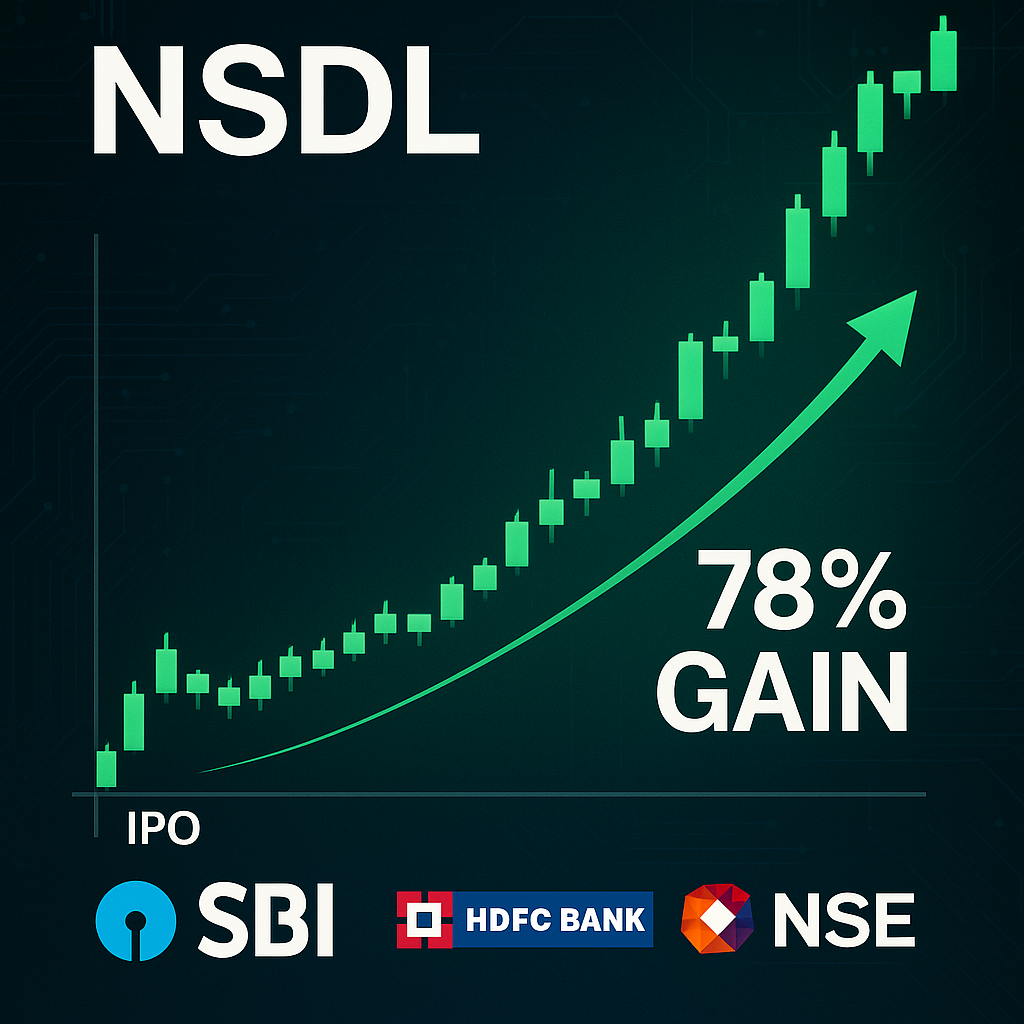
NSDL shares have soared nearly 80% since IPO listing, hitting ₹1,425. Here’s what’s behind the rally, investor gains, and whether it’s time to ride the wave or take profits.
Table of Contents
Overview of NSDL’s Public Market Debut
National Securities Depository Limited (NSDL) completed its initial public offering and commenced trading on the stock exchanges in August. The company, which operates as one of India’s two central securities depositories, priced its IPO at ₹800 per share. The stock opened at ₹880 on its first day of trading, representing a 10% premium to the issue price.
NSDL’s current trading price stands at ₹1,425, reflecting an increase of 78% from the IPO price and 62% from the listing price. The company’s market capitalization has reached approximately ₹26,000 crore. This performance has attracted attention from market participants and analysts studying the depository services sector.
The depository services industry in India operates under the regulatory framework of the Securities and Exchange Board of India (SEBI). NSDL holds approximately 89% market share in the depository segment, according to available market data.
Understanding NSDL’s Business Model and Operations
Core Depository Services
NSDL provides essential infrastructure for India’s securities market by maintaining electronic records of securities. The company’s primary function involves holding securities in dematerialized form and facilitating their transfer through electronic book entries.
The depository services sector operates as a duopoly in India. NSDL and Central Depository Services Limited (CDSL) are the two entities authorized to provide these services. The regulatory framework established by SEBI creates specific entry requirements and operational standards for depositories.
NSDL’s business model generates revenue through multiple channels. Transaction processing fees constitute a significant portion of income. The company also earns from annual maintenance charges levied on demat accounts. Additional revenue streams include value-added services and technology platform licensing.
Market Share and Competitive Position
According to publicly available information, NSDL maintains dominant market share in the depository services segment. The company’s established relationships with banks, brokers, and other financial intermediaries contribute to its market position.
The competitive landscape features two main participants operating under similar regulatory requirements. Both depositories provide comparable core services, though they differ in market penetration and institutional relationships.
Industry analysts note that the depository business benefits from network effects. As more participants join a particular depository’s network, the value proposition for new entrants strengthens. This characteristic influences competitive dynamics within the sector.
Post-IPO Stock Performance Timeline
Listing Day Trading Activity (August 6)
NSDL shares commenced trading at ₹880, representing a 10% premium to the IPO price. The stock maintained positive momentum throughout the session. By the closing bell, shares settled near ₹924, marking a 15.5% gain from the issue price.
Trading volumes on the listing day indicated participation from various investor categories. The volume profile suggested interest from both institutional and retail segments. Market observers noted the absence of significant selling pressure during the initial trading session.
Subsequent Trading Sessions
On the second trading day, NSDL shares experienced a 20% circuit breaker limit, reaching ₹1,123. This represented a 28% cumulative gain from the listing price. The circuit breaker mechanism, implemented by stock exchanges, temporarily halts trading when price movements exceed specified thresholds.
By the third trading day, the stock had extended gains to reflect a 52% increase from the listing price. The sustained upward movement contributed to the company crossing the ₹26,000 crore market capitalization threshold.
On the fourth day of trading, shares reached ₹1,425, marking a 9.6% intraday gain. This price level represented the 78% increase from the IPO price mentioned in market reports.
Trading Volume and Liquidity Analysis
Trading activity during the initial days showed varying volume patterns. The listing day recorded substantial volumes as participants established positions. Subsequent sessions saw continued activity, though volume patterns fluctuated based on circuit breaker constraints and market dynamics.
Liquidity metrics indicated active market participation. The bid-ask spreads and order book depth suggested reasonable liquidity for investors seeking to enter or exit positions. However, circuit breaker hits on certain days temporarily limited trading activity.
Institutional Shareholding Pattern
Major Institutional Investors
State Bank of India (SBI) emerged as a notable investor in NSDL shares. According to available disclosures, SBI’s investment has appreciated substantially from its initial cost. The bank’s stake represents a strategic investment in financial market infrastructure.
HDFC Bank also features among the institutional shareholders. The private sector bank’s participation reflects confidence in the depository services business model. National Stock Exchange (NSE) holds a stake in NSDL, representing vertical integration within the capital markets ecosystem.
Specified Undertaking of the Unit Trust of India (SUUTI), a government investment arm, maintains an investment in NSDL. This shareholding represents part of SUUTI’s portfolio of strategic investments in financial services companies.
Anchor Investor Participation
The IPO process included an anchor investor portion, which attracted participation from domestic and international institutional investors. Anchor investors typically receive allocations before the public offering opens, providing a reference point for pricing and demand assessment.
The quality and composition of anchor investors often influences broader market sentiment toward an IPO. Participation by reputable institutional investors can signal confidence in the company’s prospects and valuation.
Promoter and Management Holdings
The promoter group in NSDL comprises various financial institutions and market infrastructure organizations. This ownership structure reflects the company’s role as a systemically important financial market utility.
Management shareholding patterns and lock-in provisions follow SEBI regulations governing IPOs. These provisions restrict promoter and pre-IPO shareholder selling for specified periods, influencing stock supply dynamics in the secondary market.
Financial Performance Indicators
Revenue Generation and Growth
NSDL’s revenue model depends on transaction volumes in India’s securities markets. The company earns fees for each transaction processed through its depository system. Annual maintenance charges for demat accounts provide recurring revenue.
Revenue growth correlates with several factors. Increasing retail investor participation expands the active account base. Higher trading volumes in equity markets drive transaction fee income. The launch of new financial products requiring depository services creates additional revenue opportunities.
According to company disclosures, NSDL maintains operating margins exceeding 70%. This reflects the relatively low variable costs associated with transaction processing once technology infrastructure is established.
Profitability Metrics
Net profit margins in the depository business typically remain elevated compared to many other financial services segments. NSDL’s business model requires limited physical infrastructure and maintains low debt levels.
Return ratios provide insights into capital efficiency. Return on Equity (ROE) measures how effectively the company generates profits from shareholder capital. Return on Assets (ROA) indicates efficiency in utilizing total assets for profit generation.
The asset-light nature of depository services contributes to strong return metrics. Unlike banks or non-banking financial companies, depositories do not maintain large balance sheets relative to their income generation capacity.
Balance Sheet Strength
NSDL operates with minimal debt, according to available financial information. The debt-free structure eliminates interest expenses and provides financial flexibility for operational and strategic initiatives.
Cash and cash equivalents form a significant portion of assets. This cash position supports dividend payments and potential future investments in technology or business expansion.
Working capital metrics indicate operational efficiency. The nature of depository services results in positive cash conversion cycles, as the company typically receives fees before incurring significant related expenses.
Valuation Analysis and Market Metrics
Price-to-Earnings Ratio Assessment
NSDL’s current Price-to-Earnings (P/E) ratio stands at approximately 76, based on recent financial data and the current share price. This valuation multiple significantly exceeds the broader market average and many financial services sector peers.
For context, the Nifty 50 index trades at a P/E ratio in the mid-20s range. Financial services companies typically trade at P/E multiples ranging from 15 to 35, depending on growth prospects and business characteristics.
The premium P/E multiple reflects market expectations for sustained earnings growth. Investors appear willing to pay higher prices relative to current earnings based on anticipated future performance.
Price-to-Book Value Considerations
The Price-to-Book (P/B) ratio for NSDL currently approximates 13, indicating the stock trades at 13 times its book value per share. This metric compares market valuation to the company’s net asset value.
High P/B ratios typically characterize businesses with strong return profiles and limited tangible asset requirements. Technology companies and asset-light business models often command premium P/B multiples.
Comparing NSDL’s P/B ratio to industry peers provides perspective. CDSL, the other depository in India, trades at its own distinct valuation multiple based on market perceptions of its growth trajectory and competitive position.
Market Capitalization Context
NSDL’s market capitalization of approximately ₹26,000 crore positions it within the mid-cap segment of India’s equity market. This valuation reflects the market’s assessment of the company’s enterprise value.
Market capitalization calculations multiply the current share price by total outstanding shares. Changes in share price directly impact market cap, while corporate actions like bonus issues or splits affect share count.
Within the financial services sector, NSDL’s market cap remains substantially smaller than major banks and insurance companies but significant within the specialized market infrastructure subsector.
Growth Drivers and Market Opportunities
Retail Investor Participation Trends
India’s capital markets have experienced substantial growth in retail investor participation over recent years. Data from stock exchanges indicates millions of new demat accounts opened in recent periods.
Several factors drive this trend. Increased financial literacy and digital connectivity enable broader market access. The proliferation of discount brokers has reduced transaction costs. Government initiatives promoting financial inclusion support market participation.
For NSDL, each new demat account represents a potential long-term revenue source through maintenance charges and transaction fees. The company benefits from the cumulative effect of account additions, even if individual account activity varies.
Digital Financial Services Expansion
India’s financial services sector continues digitalizing across multiple dimensions. Digital payment systems, online banking, and electronic trading platforms reshape how individuals interact with financial services.
NSDL’s digital infrastructure positions it within this transformation. The company’s technology platforms integrate with broker systems, banking channels, and regulatory reporting mechanisms.
Government initiatives like Digital India encourage electronic service delivery. The Jan Dhan-Aadhaar-Mobile (JAM) trinity facilitates financial inclusion through digital means. These policy directions support depository services growth by expanding the financially included population.
Regulatory Environment and Policy Support
SEBI regulations govern depository operations, establishing standards for service delivery, risk management, and investor protection. The regulatory framework has evolved to accommodate market growth while maintaining operational integrity.
Recent regulatory initiatives include streamlined account opening processes, enhanced investor grievance mechanisms, and technology standards for market infrastructure. These measures aim to balance market development with investor protection.
Policy support for capital market development includes measures to encourage long-term investing, expand product offerings, and improve market accessibility. Such policies indirectly benefit depository services by expanding the overall market ecosystem.
Mutual Fund and Insurance Sector Growth
The mutual fund industry in India has grown substantially, with Assets Under Management (AUM) reaching multi-trillion rupee levels. Systematic Investment Plans (SIPs) have gained popularity, creating recurring investment flows.
Insurance penetration remains below developed market levels, suggesting growth potential. Both life and general insurance sectors are expanding product distribution and market reach.
NSDL provides depository services for mutual fund units and insurance-linked securities products. Growth in these sectors translates to expanded transaction volumes and service utilization for the depository.
Risk Factors and Challenges
Valuation-Related Concerns
The current share price incorporates optimistic growth expectations. High valuation multiples leave limited room for disappointment if actual performance falls short of expectations.
Historical market data shows that stocks trading at premium valuations can experience significant corrections during broader market downturns or company-specific challenges. The relationship between valuation and subsequent returns merits consideration.
Investors evaluating entry points at current levels should assess whether the growth outlook justifies the valuation premium. This requires analyzing potential earnings growth rates, margin sustainability, and competitive dynamics.
Regulatory and Policy Risks
As a regulated entity, NSDL faces potential impacts from regulatory changes. Modifications to fee structures, service standards, or operational requirements could affect profitability.
SEBI periodically reviews regulations governing market infrastructure institutions. While regulatory changes typically aim to strengthen market functioning, they may impose additional compliance costs or operational constraints.
Policy decisions affecting capital markets more broadly can impact depository volumes. Tax policy changes, investment regulations, or foreign portfolio investor rules influence market participation levels and transaction activity.
Technology and Competition Dynamics
The financial services technology landscape continues evolving. Blockchain technology, distributed ledger systems, and other innovations could potentially alter traditional depository business models.
While current technology hasn’t disrupted the depository duopoly, long-term technological changes merit monitoring. The company’s ability to adapt and incorporate new technologies influences its competitive sustainability.
Competition from CDSL, though operating within a duopolistic structure, requires ongoing attention. Market share shifts, even within a two-player market, can impact revenue trajectories and competitive positioning.
Market Cyclicality Considerations
Depository transaction volumes correlate with equity market activity. During market downturns or extended periods of low volatility, trading volumes typically decline, impacting transaction fee revenues.
While maintenance charges provide some revenue stability, the overall business remains exposed to capital market cycles. Investors should consider how the company performs across different market conditions.
Historical patterns suggest that market infrastructure businesses demonstrate resilience during downturns compared to more cyclical financial services segments. However, they don’t remain entirely immune to market conditions.
Comparative Analysis: NSDL vs CDSL
Market Share Dynamics
NSDL maintains approximately 89% market share in depository services, according to available data. CDSL holds the remaining market share. These proportions have remained relatively stable, though gradual shifts occur over time.
Market share differences stem from historical factors, institutional relationships, and service delivery approaches. NSDL’s earlier establishment and partnerships with major banks contributed to its larger market presence.
Both depositories provide similar core services under comparable regulatory standards. Product offerings, technology platforms, and customer service approaches represent areas of differentiation.
Financial Performance Comparison
Comparing financial metrics between NSDL and CDSL provides insights into operational efficiency and market positioning. Revenue per account, profit margins, and growth rates offer evaluation benchmarks.
CDSL’s stock market performance and valuation multiples provide reference points for assessing NSDL’s market pricing. Investors often evaluate companies within the same industry segment relative to peers.
Both companies benefit from similar industry tailwinds but face comparable challenges. Comparative analysis helps identify which entity demonstrates stronger execution or positioning advantages.
Competitive Advantages and Distinctions
NSDL’s larger market share provides certain scale advantages. Higher transaction volumes can support technology investments and operational efficiencies. Extensive institutional relationships create network effects.
CDSL’s growth trajectory and strategic initiatives represent competitive responses. The company has pursued technology innovations and service enhancements to strengthen its market position.
The duopolistic market structure provides both companies with regulatory protection from new entrants. This reduces competitive intensity compared to more fragmented industries while still requiring ongoing operational excellence.
Investment Considerations and Strategic Approaches
Long-Term Investment Perspective
Investors considering NSDL with extended time horizons focus on structural growth drivers in India’s financial markets. The country’s demographic profile, economic development trajectory, and increasing financial inclusion support long-term capital market growth.
Depository services occupy a foundational role in market infrastructure. As long as securities trading occurs, depositories provide essential functions. This structural position offers business model durability.
Long-term investors must weigh current valuation against future growth potential. Historical data suggests that companies with sustainable competitive advantages can justify premium valuations if they deliver consistent earnings growth.
Short-Term Trading Considerations
Short-term market participants focus on price momentum, technical indicators, and near-term catalysts. NSDL’s sharp post-IPO rally attracted momentum-oriented traders seeking to capitalize on upward price movement.
Technical analysis tools help traders identify support and resistance levels, trend patterns, and potential reversal signals. Volume analysis provides insights into buying and selling pressure at different price points.
Circuit breakers and volatility should factor into short-term trading strategies. The stock’s rapid appreciation may lead to periods of consolidation or correction as profit-taking occurs.
Entry Point Evaluation for New Investors
Prospective investors face the question of whether current price levels offer attractive entry opportunities. This assessment requires balancing growth prospects against valuation metrics and risk factors.
One approach involves waiting for price corrections to establish positions at lower levels. Historical patterns suggest that even strong-performing stocks experience periodic pullbacks that create entry opportunities.
Alternatively, systematic investment approaches spread purchases across multiple time points, averaging the entry price over time. This method reduces timing risk but requires patience and discipline.
Portfolio Allocation Considerations
NSDL’s sector classification and business characteristics influence its role within diversified portfolios. As a financial services infrastructure company, it offers exposure to capital market growth without direct lending or underwriting risks.
Portfolio allocation decisions depend on individual risk tolerance, investment objectives, and existing holdings. NSDL’s premium valuation and recent price appreciation suggest limiting position size to manage concentration risk.
The stock’s correlation with broader market indices and other financial services companies affects diversification benefits. Investors should evaluate how NSDL fits within their overall asset allocation framework.
Sector Outlook and Industry Trends
Capital Markets Development Trajectory
India’s securities markets have grown substantially over the past decade. Market capitalization as a percentage of GDP has increased, though it remains below developed market levels, suggesting further growth potential.
Several initiatives support capital market deepening. Pension system reforms encourage long-term investing. Corporate governance improvements enhance investor confidence. Market infrastructure upgrades facilitate efficient trading and settlement.
The number of listed companies continues expanding as more businesses access public capital. IPO activity reflects entrepreneurial growth and capital formation needs. These developments support depository transaction volumes.
Financial Inclusion and Democratization
Financial inclusion remains a policy priority in India. Efforts to bring unbanked populations into the formal financial system create potential future capital market participants.
The Pradhan Mantri Jan Dhan Yojana has facilitated hundreds of millions of bank account openings. While these accounts primarily serve savings and payment functions initially, they represent potential pathways to investment products.
Digital connectivity expansion enables market access for individuals in smaller cities and rural areas. As internet penetration increases and digital literacy improves, geographic barriers to market participation diminish.
Asset Management Industry Evolution
India’s asset management industry has experienced robust growth, particularly in mutual funds. Monthly SIP inflows have reached significant levels, creating steady investment demand.
Alternative investment funds, portfolio management services, and other products expand investment options beyond traditional mutual funds and direct equity. This product diversification increases overall market sophistication.
International asset managers have shown interest in India’s market potential. Foreign institutional investor activity influences market liquidity and valuation levels. The interplay between domestic and international flows shapes market dynamics.
Technology Integration and Innovation
Technology continues transforming financial services delivery. Artificial intelligence, machine learning, and data analytics enhance customer service, risk management, and operational efficiency.
Blockchain technology has generated discussion about potential applications in securities settlement and custody. While large-scale implementation faces regulatory and technical hurdles, experimentation continues.
Application Programming Interfaces (APIs) enable integration between different financial services platforms. Open architecture approaches allow customers to access multiple services through unified interfaces. NSDL’s ability to integrate with evolving technology ecosystems influences its relevance.
Governance and Management Quality
Corporate Governance Framework
NSDL operates under governance structures appropriate for a systemically important market infrastructure institution. The board composition includes independent directors who provide oversight and guidance.
SEBI regulations mandate specific governance standards for depositories. These include risk management frameworks, audit requirements, and disclosure obligations. Compliance with these standards indicates governance maturity.
Transparency in operations and communication with stakeholders reflects governance quality. Regular disclosures, responsive investor relations, and clear strategic communication demonstrate management accountability.
Management Track Record
Evaluating management quality involves assessing execution capability, strategic vision, and capital allocation decisions. NSDL’s successful IPO and market positioning reflect management competence in some dimensions.
The management team’s experience in financial services and market infrastructure provides relevant expertise. Industry knowledge and regulatory understanding are crucial in this sector.
Future challenges will test management capabilities. Adapting to technological change, navigating competitive dynamics, and identifying growth opportunities require strong leadership and execution.
Stakeholder Management
NSDL interacts with multiple stakeholder groups: investors, regulators, broker partners, banks, and end-users. Balancing these diverse interests while maintaining operational excellence requires sophisticated stakeholder management.
The company’s relationships with brokers and banks influence its service delivery effectiveness. Strong partnerships facilitate smooth operations and customer satisfaction.
Regulatory relationships require ongoing engagement and responsiveness. Constructive dialogue with SEBI and other regulatory bodies supports favorable operating conditions and industry development.
Market Sentiment and Investor Psychology
IPO Performance and Market Enthusiasm
Strong post-IPO performance often generates positive sentiment and media attention. NSDL’s substantial gains created investor interest in the stock and broader market infrastructure sector.
However, robust IPO returns can also attract speculative interest seeking quick profits. Distinguishing between fundamental value creation and momentum-driven price movements helps assess sustainability.
Market sentiment cycles through optimism and pessimism. Currently positive sentiment toward NSDL may shift if broader market conditions deteriorate or company-specific challenges emerge.
Institutional vs Retail Dynamics
Institutional investors typically conduct detailed fundamental analysis before making investment decisions. Their large stake holdings reflect conviction in long-term prospects based on comprehensive evaluation.
Retail investors may have varying motivations and analytical approaches. Some conduct thorough research, while others respond to recent performance or market buzz. This diversity influences trading patterns and volatility.
Understanding the balance between institutional and retail ownership provides insights into potential price stability. Higher institutional ownership often correlates with lower volatility, though this relationship isn’t absolute.
Media Coverage and Information Flow
Media attention following strong stock performance can influence investor awareness and interest. News articles, analyst reports, and social media discussions shape public perception.
Investors should distinguish between information and noise. Not all market commentary provides actionable insights. Focusing on fundamental data and official company disclosures helps filter relevant information.
The quality and objectivity of information sources matter. Official regulatory filings, company presentations, and established financial media outlets generally provide more reliable information than unverified sources.
Macroeconomic Context and Market Environment
Interest Rate Environment
Interest rates influence equity valuations through multiple channels. Higher rates increase discount rates applied to future cash flows, potentially compressing valuation multiples. Lower rates support higher multiples.
The Reserve Bank of India’s monetary policy stance affects interest rate levels. Policy decisions balance economic growth objectives with inflation control. Current rate levels and future trajectory influence investment decisions.
For NSDL specifically, interest rate impacts operate primarily through valuation effects rather than direct business impacts. The company’s minimal debt exposure reduces interest rate sensitivity of earnings.
Economic Growth and Business Cycle
India’s economic growth rate influences corporate activity, market participation, and investment flows. Stronger economic growth typically supports capital market activity and depository transaction volumes.
GDP growth projections, industrial production trends, and consumer spending patterns provide economic context. While depository services demonstrate relative resilience, they aren’t entirely immune to economic cycles.
Global economic conditions also matter, particularly regarding foreign institutional investor flows. International growth trends, geopolitical developments, and global liquidity conditions influence India’s capital markets.
Inflation and Purchasing Power
Inflation affects real returns on investments. Nominal stock price gains must exceed inflation for investors to experience purchasing power increases.
Moderate inflation often accompanies healthy economic growth. However, excessive inflation can prompt restrictive monetary policy, potentially dampening economic activity and market sentiment.
India’s inflation trajectory, measured by Consumer Price Index (CPI) and Wholesale Price Index (WPI), provides context for real return evaluation. Investors should consider inflation when assessing return adequacy.
Dividend Policy and Shareholder Returns
Dividend Distribution Approach
NSDL’s dividend policy reflects its capital requirements, cash generation capability, and management’s approach to shareholder returns. The company’s cash-rich balance sheet supports potential dividend payments.
Depository businesses typically generate substantial free cash flow after meeting operational and capital expenditure needs. This cash generation capability enables regular dividend distributions without compromising growth investments.
Dividend yield, calculated as annual dividend per share divided by current share price, provides a metric for income-oriented investors. Given the stock’s appreciation, current dividend yield may appear modest relative to the share price.
Capital Allocation Priorities
Management’s capital allocation decisions significantly impact shareholder value creation. Options include dividend payments, share buybacks, growth investments, and strategic acquisitions.
Technology investments represent a key capital allocation area for depositories. Upgrading systems, enhancing security, and developing new capabilities require ongoing expenditure.
Potential business expansion or diversification initiatives would require capital allocation. Management must balance growth opportunities against returns to shareholders through dividends or buybacks.
Total Return Perspective
Total return combines capital appreciation with dividend income. NSDL’s substantial price appreciation has dominated total returns thus far, with dividends representing a smaller component.
Investors focusing solely on capital gains may underweight dividend considerations. However, dividend income contributes to long-term wealth accumulation, particularly when reinvested.
The balance between capital appreciation and dividend yield may shift over time as the company matures and growth rates normalize. Early-stage growth companies often prioritize reinvestment over dividends.
Frequently Asked Questions
What is NSDL’s current market share in India’s depository services sector?
NSDL holds approximately 89% market share in India’s depository services segment, according to publicly available market data. This dominant position reflects the company’s established relationships with financial institutions and its extensive operational infrastructure. The depository services sector in India operates as a duopoly, with NSDL and CDSL being the two authorized entities under SEBI regulations.
Market share distribution has remained relatively stable, though gradual changes occur based on new account additions and service delivery approaches. The company’s large market share provides scale advantages and network effects that contribute to its competitive positioning.
How do depository companies generate revenue?
Depository companies like NSDL generate revenue through multiple channels. Transaction processing fees form a significant component, earned when securities are bought, sold, or transferred between accounts. Annual maintenance charges for demat accounts provide recurring revenue streams. The company also earns from value-added services such as pledge processing, corporate action handling, and various administrative services.
Technology platform licensing and advisory services represent additional revenue sources. The business model benefits from operating leverage, as incremental transactions after infrastructure establishment incur relatively low variable costs. Revenue growth correlates with increasing account numbers, transaction volumes in securities markets, and the introduction of new financial products requiring depository services.
What factors distinguish NSDL from its competitor CDSL?
NSDL and CDSL both provide central depository services under similar regulatory frameworks, but several factors distinguish them. NSDL maintains larger market share with more extensive institutional relationships developed through earlier market entry. The company’s technology infrastructure, operational scale, and brand recognition differ from CDSL.
Both depositories offer comparable core services, but they pursue distinct strategic approaches and service delivery models. CDSL has pursued growth initiatives and technology innovations to enhance its competitive position.
Investors comparing the two companies examine financial metrics including revenue per account, profit margins, growth rates, and valuation multiples. The duopolistic market structure provides both entities with regulatory barriers protecting against new entrants while requiring operational excellence to maintain their respective market positions.
How does NSDL’s business model correlate with equity market conditions?
NSDL’s business demonstrates correlation with equity market activity through transaction-dependent revenue. During periods of high trading volumes, the company processes more transactions and generates increased fee income. Market downturns or extended low-volatility periods typically result in reduced trading activity, impacting transaction revenues.
However, annual maintenance charges for demat accounts provide some revenue stability regardless of trading activity. The company also benefits from the cumulative effect of new account additions, which continue even during market corrections as long-term investors enter markets. Compared to brokers or market-making entities, depositories demonstrate relatively lower sensitivity to market volatility.
The essential infrastructure role of depository services ensures ongoing demand across market cycles, though revenue growth rates may fluctuate with market conditions.
What are the primary risks investors should evaluate when considering NSDL shares?
Investors evaluating NSDL should consider several risk categories. Valuation risk stems from premium multiples that leave limited margin for disappointment if growth expectations aren’t met. Regulatory risk involves potential changes to fee structures, operational requirements, or market regulations that could impact profitability.
Technology disruption risk relates to emerging innovations like blockchain that could potentially alter traditional depository business models. Competition risk exists within the duopolistic structure, where market share shifts could affect revenue trajectories. Market cyclicality poses risks during extended periods of low trading activity.
Macroeconomic factors including interest rate changes, economic slowdowns, or policy shifts affecting capital markets represent additional considerations. Investors should assess these risks against potential returns and their individual risk tolerance levels.
How do depository services support India’s financial market infrastructure?
Depository services form essential infrastructure for India’s securities markets by maintaining electronic records of securities ownership. Before depositories, physical share certificates created inefficiencies, risks of loss or forgery, and settlement delays. Electronic dematerialization through depositories enables faster settlement, reduces operational risks, and facilitates market efficiency.
NSDL’s systems integrate with stock exchanges, clearing corporations, brokers, and banks to enable seamless securities transfer and ownership tracking. The infrastructure supports various market activities including trading, lending, corporate actions, and regulatory reporting. By providing secure, efficient custody and transfer mechanisms, depositories enhance investor confidence and market integrity.
The role becomes increasingly critical as markets grow and transaction volumes expand, making depository infrastructure a foundational element of modern capital markets.
What growth opportunities exist for NSDL beyond its current business model?
NSDL has several potential growth avenues beyond current operations. Geographic expansion within India could target underserved regions as financial inclusion expands. Product diversification might include services for additional asset classes or financial instruments. Technology platform services could be offered to other market participants.
International expansion represents a long-term possibility, though regulatory considerations would influence such initiatives. Data analytics and insights services leveraging the company’s transaction and holding information could create value-added offerings. Integration with emerging technologies including digital payment systems or potential central bank digital currencies might create opportunities.
Partnerships with fintech companies could enable service innovations. The company’s strategic choices regarding which opportunities to pursue will influence its growth trajectory and competitive positioning in evolving financial services landscapes.
How should investors interpret NSDL’s premium valuation multiples?
NSDL’s P/E ratio of approximately 76 and P/B ratio around 13 represent premium valuations compared to broader market averages and many financial services peers. These multiples reflect market expectations for sustained earnings growth driven by increasing market participation, transaction volumes, and India’s capital market development.
Premium valuations characterize companies with strong competitive positions, high return profiles, and favorable growth outlooks. However, they also reduce margin of safety and increase vulnerability to disappointment if growth doesn’t materialize as expected. Investors should evaluate whether anticipated growth rates justify current multiples.
Historical data suggests that premium-valued stocks can deliver strong returns if they meet growth expectations but may experience significant corrections if performance disappoints. Assessment requires analyzing earnings growth potential, competitive sustainability, and comparison with industry peers and historical valuation ranges.
Conclusion: Evaluating NSDL’s Market Position and Investment Merit
National Securities Depository Limited represents a significant participant in India’s financial market infrastructure. The company’s post-IPO performance has attracted substantial attention from investors and market observers. The stock’s movement from ₹800 IPO price to ₹1,425 reflects market confidence in the depository services business model and India’s capital market growth prospects.
Several factors support NSDL’s business outlook. The company’s dominant market share provides competitive advantages and pricing power. India’s expanding retail investor base creates growth opportunities through new account additions and increased transaction volumes. The digital transformation of financial services positions NSDL within broader structural trends. Regulatory frameworks supporting capital market development provide a supportive environment.
However, investors must also consider relevant risk factors and challenges. Premium valuation multiples incorporate optimistic growth expectations, leaving limited room for disappointment. Regulatory changes could impact business operations or profitability. Technology evolution may present both opportunities and disruption risks. Market cyclicality affects transaction volumes and revenue growth.
Investment decisions regarding NSDL should align with individual financial objectives, risk tolerance, and time horizons. Long-term investors might view current levels differently than short-term traders. Thorough analysis of financial metrics, competitive positioning, and growth drivers helps inform investment choices.
The company’s role in India’s financial market infrastructure provides business model durability. As securities markets continue developing, depository services remain essential. Whether current valuation levels offer attractive entry points depends on growth expectations and return requirements.
Prospective investors should conduct comprehensive due diligence, considering financial statements, regulatory disclosures, and industry trends. Consulting with qualified financial advisors can help evaluate NSDL’s fit within broader portfolio strategies. Market conditions evolve continuously, requiring ongoing monitoring and assessment.
Author Information
Financial Markets Research Team of Nueplanet
Our team comprises financial analysts and market researchers committed to providing accurate, fact-based analysis of securities markets and listed companies. We rely exclusively on official sources including regulatory filings, exchange disclosures, company announcements, and verified financial data.
Our Commitment: We prioritize accuracy and transparency in financial reporting. All information presented derives from verifiable sources including SEBI filings, stock exchange notifications, company investor presentations, and official government releases. We avoid speculative commentary and promotional language, focusing instead on factual information and objective analysis.
About This Analysis: This article presents information about NSDL based on publicly available data as of the publication date. The content undergoes regular review to maintain accuracy as new information becomes available.
Disclaimer: This content is for informational purposes only and does not constitute investment advice, recommendation, or solicitation. Readers should conduct independent research and consult qualified financial advisors before making investment decisions. Past performance does not guarantee future results. Securities investments involve risks including potential loss of principal.
Publication Date: August 11, 2025
Last Updated: August 11, 2025
Category: Stock Market Analysis | Financial Services Sector
Helpful Resources
Latest Posts
- 15 August 2025: India’s Independence Day & FASTag Annual Pass Implementation
- ICMAI CMA Results – June 2025 Declared Today: How to Check, Pass Rates & Toppers
- Robert Vadra Allegedly Earned ₹58 Crore in Illegal Land Deals: Chargesheet Details
- All Time Plastics IPO: Subscription Trends, GMP, and Investor Outlook
- Air India Flight AI-2455 Diverted to Chennai: Technical Snag and Turbulence Cause Emergency Diversion
Tag
NSDL Share Price
Related Posts













Post Comment