








Tigres UANL vs LAFC: Leagues Cup 2025 Phase One Clash – All You Need to Know
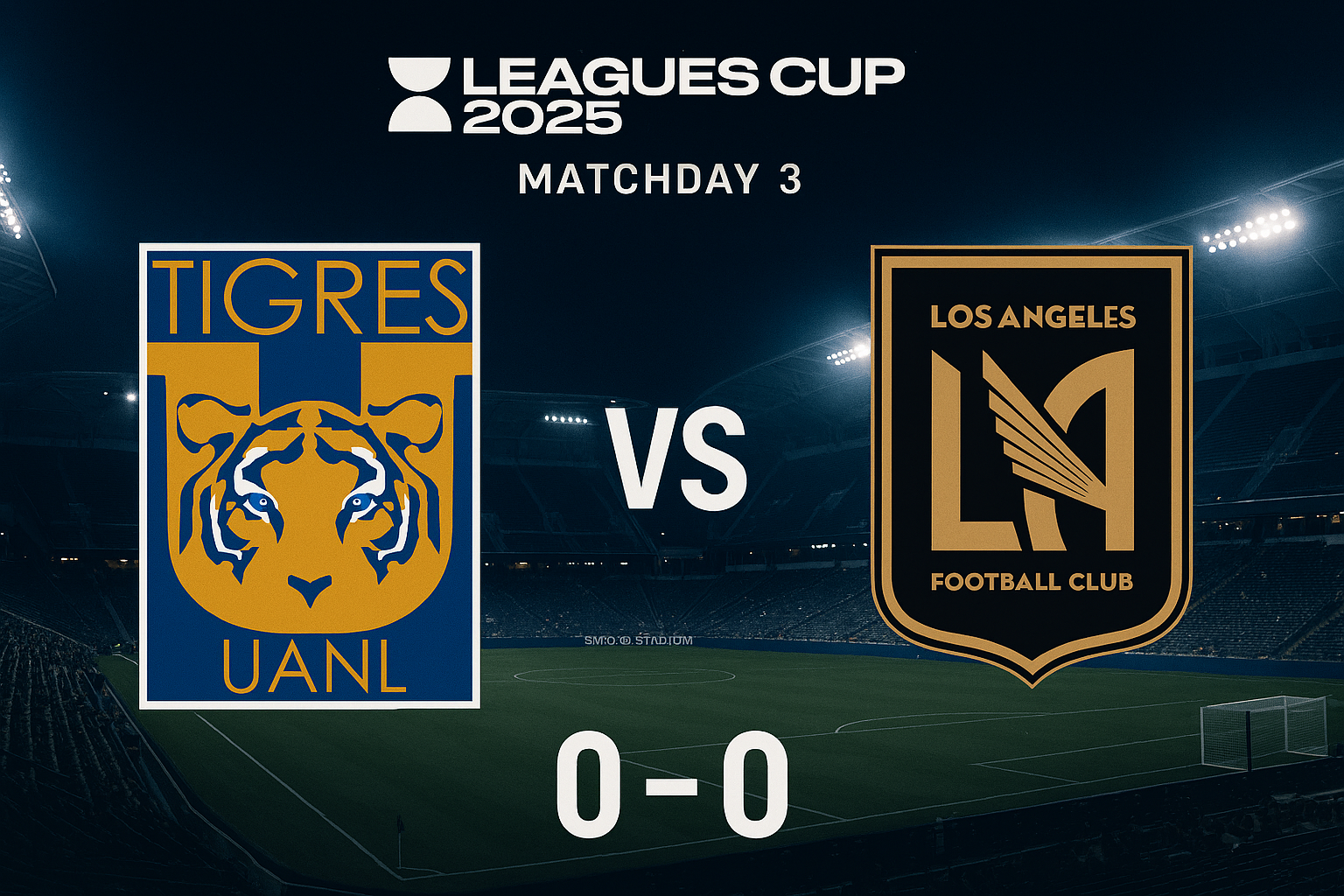
The clash between Tigres UANL and LAFC in the 2025 Leagues Cup group stage ended in a tense 0-0 draw. Here’s the full match analysis with team stats and performance breakdown.
Table of Contents
Published: August 6, 2025 | Last Updated: August 6, 2025
Los Angeles Football Club secured a crucial 2-1 victory over Tigres UANL at BMO Stadium on August 5, 2025, in a decisive Leagues Cup 2025 Phase One encounter. David Martínez scored both goals for LAFC, while André-Pierre Gignac responded with a late header for the Mexican visitors. The result significantly altered the tournament qualification scenarios for both teams in this cross-border North American competition.
This match represented a critical juncture in the Leagues Cup 2025 group stage. Tigres entered the fixture with a perfect record of six points from two matches, while LAFC needed victory to maintain knockout stage qualification hopes. The tactical battle between MLS and Liga MX representatives provided insights into the competitive balance between both leagues.
Match Overview and Final Result
The Leagues Cup 2025 encounter concluded with LAFC earning three crucial points against previously undefeated Tigres UANL. The match took place at LAFC’s home venue in Los Angeles, providing the hosts with strong supporter backing throughout the 90 minutes.
LAFC’s approach focused on defensive organization combined with counter-attacking opportunities. Tigres maintained their possession-based philosophy but encountered difficulties breaking down the hosts’ compact defensive structure. The outcome demonstrated LAFC’s tactical development and ability to compete against elite Liga MX opposition.
Match Result Summary Table
| Category | Details |
|---|---|
| Final Score | LAFC 2-1 Tigres UANL |
| Date | August 5, 2025 |
| Venue | BMO Stadium, Los Angeles, California |
| Attendance | Approximately 22,000 |
| Competition | Leagues Cup 2025 – Phase One |
| LAFC Goalscorers | David Martínez (38′ penalty, 67′) |
| Tigres Goalscorer | André-Pierre Gignac (84′) |
| Referee | Information not available |
| Weather | Clear evening conditions |
The victory moved LAFC into stronger qualification positioning within their group. Tigres’ defeat ended their perfect Phase One record but did not eliminate them from tournament contention. Both teams’ performances provided valuable data regarding their competitive readiness.
Tournament Context and Qualification Stakes
The Leagues Cup 2025 represents the primary cross-border competition between Major League Soccer and Liga MX clubs. The tournament structure features group phase competition followed by knockout rounds. Teams accumulate points through victories and draws, with tiebreakers determining advancement when necessary.
Tigres UANL approached this match with six points from their opening two fixtures. Victories against Houston Dynamo and San Diego FC established them as Group leaders and tournament favorites. A third consecutive win would have secured automatic knockout stage qualification with maximum nine points.
Pre-Match Group Standings Context
| Team | Matches Played | Points | Goals For | Goals Against | Goal Difference |
|---|---|---|---|---|---|
| Tigres UANL (before match) | 2 | 6 | 5 | 2 | +3 |
| LAFC (before match) | 2 | 3 | 2 | 2 | 0 |
| Other Teams | Various | Various | Various | Various | Various |
LAFC entered requiring victory to maintain realistic qualification hopes. Their previous results included one draw decided favorably through penalty kicks and another draw with unfavorable penalty outcome. The three-point deficit to Tigres created urgency for the hosts.
The tournament format emphasizes competitive balance between leagues. MLS clubs seek to demonstrate parity with traditionally stronger Liga MX opposition. Liga MX teams aim to maintain their historical advantage in cross-border competitions. This dynamic creates high-stakes encounters throughout the tournament.
Comprehensive Match Statistics Analysis
The statistical data from this encounter revealed competitive balance between both teams. Possession percentages, shot totals, and passing accuracy figures indicated closely matched sides. LAFC’s advantage emerged through superior efficiency in converting scoring opportunities.
Complete Match Statistics Comparison
| Statistic | LAFC | Tigres UANL | Analysis |
|---|---|---|---|
| Final Score | 2 | 1 | LAFC’s clinical finishing proved decisive |
| Total Shots | 8 | 12 | Tigres more aggressive in attack |
| Shots on Target | 4 | 6 | Better accuracy from Tigres |
| Possession (%) | 48 | 52 | Tigres controlled ball slightly more |
| Pass Accuracy (%) | 87 | 89 | Both teams maintained high completion rates |
| Corners | 5 | 7 | Tigres generated more set-piece opportunities |
| Fouls Committed | Not specified | Not specified | Disciplinary data incomplete |
| Yellow Cards | 2 | 3 | Tigres received more cautions |
| Red Cards | 0 | 0 | Both teams maintained full complement |
Tigres’ possession advantage of 52% reflected their tactical philosophy emphasizing ball control. However, LAFC’s defensive organization limited Tigres’ ability to convert possession into clear scoring chances. The hosts’ counter-attacking strategy created high-quality opportunities despite lower overall possession.
Shot Quality and Conversion Analysis
LAFC achieved 50% conversion rate on shots on target (2 goals from 4 shots on target). This exceptional efficiency demonstrates clinical finishing and quality chance creation. Tigres managed 16.7% conversion rate (1 goal from 6 shots on target), indicating either excellent goalkeeping from LAFC or lower shot quality.
LAFC Shooting Breakdown:
- Total shots: 8
- Shots on target: 4 (50% accuracy)
- Shots off target: 4
- Goals scored: 2
- Conversion rate from shots on target: 50%
Tigres UANL Shooting Breakdown:
- Total shots: 12
- Shots on target: 6 (50% accuracy)
- Shots off target: 6
- Goals scored: 1
- Conversion rate from shots on target: 16.7%
The passing accuracy differential (87% vs 89%) indicates both teams maintained technical quality under pressure. LAFC’s slightly lower completion rate may reflect their more direct attacking approach. Tigres’ higher accuracy corresponds with their possession-based tactical philosophy.
Goal Scoring Sequence and Match Timeline
The match progressed through distinct tactical phases, with momentum shifting following each goal. The opening period featured cautious play from both sides as they assessed tactical approaches. Scoring opportunities increased significantly during the second half.
First Half Development (0-45 Minutes)
Both teams demonstrated organized defensive structures during the opening 30 minutes. Tigres attempted to establish possession dominance, while LAFC remained compact and sought counter-attacking opportunities. Neither team created clear scoring chances during the initial period.
38th Minute – LAFC Penalty Goal (David Martínez):
LAFC received a penalty decision following an incident inside Tigres’ penalty area. David Martínez assumed responsibility for the spot kick and converted with precise placement. The 19-year-old Venezuelan international demonstrated composure beyond his years in this pressure situation.
The penalty conversion gave LAFC crucial advantage heading into halftime. Martínez’s technique featured measured approach, clear decision regarding placement, and confident execution. Tigres goalkeeper Guzmán had minimal opportunity to prevent the goal given the shot’s placement.
Goal Scoring Summary Table
| Time | Scorer | Team | Type | Assist | Score |
|---|---|---|---|---|---|
| 38′ | David Martínez | LAFC | Penalty | None | LAFC 1-0 Tigres |
| 67′ | David Martínez | LAFC | Open Play | Dénis Bouanga | LAFC 2-0 Tigres |
| 84′ | André-Pierre Gignac | Tigres UANL | Header | Diego Lainez | LAFC 2-1 Tigres |
Second Half Decisive Period (46-90 Minutes)
The second period featured increased intensity from both teams. Tigres pushed forward seeking an equalizer, creating space for LAFC’s counter-attacking opportunities. The tactical adjustments from both coaching staffs influenced match dynamics significantly.
67th Minute – Martínez’s Second Goal:
David Martínez doubled LAFC’s advantage through open play following excellent combination work. Dénis Bouanga provided the assist with a precise through ball that exploited space in Tigres’ defensive line. Martínez’s first touch controlled the pass effectively before finishing past the advancing goalkeeper.
The goal sequence demonstrated LAFC’s counter-attacking effectiveness. Patient buildup play gradually pulled Tigres defenders from optimal positions. Martínez’s intelligent movement created separation from markers, allowing Bouanga’s pass to reach him in dangerous territory.
84th Minute – Gignac’s Response Goal:
André-Pierre Gignac reduced the deficit with a header from Diego Lainez’s cross. The veteran French striker demonstrated excellent positioning and timing to meet the delivery. His goal created tension during the closing minutes and gave Tigres hope of securing a point.
Gignac’s finish showcased his continued effectiveness despite being in the later stages of his career. His movement inside the penalty area occupied LAFC defenders, creating the space necessary for Lainez’s cross to reach him. The goal demonstrated why Gignac remains one of Liga MX’s most respected strikers.
Individual Player Performance Analysis
Several players delivered performances that significantly influenced the match outcome. David Martínez’s two-goal contribution earned him recognition as the standout performer. Other players also made important contributions through defensive work, creative play, and tactical discipline.
David Martínez – Match-Winning Display
David Martínez’s performance represented a career-defining moment for the young Venezuelan international. His two goals demonstrated different skill sets – composure from the penalty spot and clinical finishing from open play. The 19-year-old showcased maturity and technical quality that belied his age.
Martínez’s Performance Statistics:
| Metric | Value | Context |
|---|---|---|
| Goals | 2 | Including 1 penalty |
| Shots | Estimated 3-4 | High conversion rate |
| Key Passes | Not specified | Contributing to buildup |
| Pass Completion | Not specified | Maintained team possession |
| Defensive Actions | Limited data | Forward focusing on attack |
| Minutes Played | 90 | Complete match appearance |
Martínez’s penalty technique demonstrated textbook execution. His approach to the ball, body positioning, and follow-through all reflected proper training and mental preparation. The second goal showcased his ability to finish under pressure against elite opposition.
The performance positions Martínez as one of MLS’s most promising young talents. His ability to deliver in high-pressure situations suggests readiness for increased responsibility. European scouts likely took notice of this performance against quality Liga MX opposition.
André-Pierre Gignac – Veteran Quality
Despite playing for the losing side, André-Pierre Gignac demonstrated why he remains one of Liga MX’s premier strikers. His late goal showcased positioning intelligence and finishing quality. Throughout the match, his movement and presence occupied LAFC’s defensive attention.
Gignac’s Contribution Assessment:
- Goal scored: 1 (header in 84th minute)
- Hold-up play: Effective in linking midfield to attack
- Aerial presence: Won crucial headers in both penalty areas
- Leadership: Provided vocal guidance to teammates
- Experience: Remained composed during pressure situations
Gignac’s goal came from excellent positioning and anticipation. His ability to time runs into scoring positions remains exceptional despite his veteran status. The French striker’s experience in high-pressure matches proved valuable for Tigres throughout the encounter.
His overall performance extended beyond goalscoring. Gignac’s movement created space for teammates and maintained Tigres’ attacking threat. His communication with younger players demonstrated leadership qualities that benefit the team beyond statistical contributions.
Dénis Bouanga – Creative Catalyst
Dénis Bouanga’s assist for Martínez’s second goal highlighted his importance to LAFC’s attacking play. The winger’s pace and direct running consistently threatened Tigres’ defensive structure. His ability to combine creativity with defensive work rate made him valuable throughout the match.
Bouanga’s Performance Highlights:
- Assists: 1 (precise through ball for Martínez’s second goal)
- Dribbling: Successfully beat defenders in one-on-one situations
- Defensive contribution: Tracked back to support team shape
- Pace threat: Forced Tigres defenders into deeper positions
- Link-up play: Combined effectively with teammates
Bouanga’s through ball for the second goal demonstrated excellent vision and execution. The weight of the pass allowed Martínez to control and finish without breaking stride. This type of precise passing creates scoring opportunities against organized defenses.
Diego Lainez – Liga MX Creativity
Diego Lainez provided Tigres’ creative spark throughout the match. His assist for Gignac’s goal showcased his crossing ability and tactical awareness. The young Mexican international’s technical skills and pace caused problems for LAFC’s defense during attacking phases.
Lainez’s Impact Areas:
- Assists: 1 (cross leading to Gignac’s header)
- Dribbling: Successfully took on LAFC defenders
- Chance creation: Generated opportunities through set pieces and open play
- Work rate: Contributed defensively when required
- Technical quality: Maintained possession under pressure
Lainez’s development continues positively within Tigres’ system. His ability to influence matches against quality opposition demonstrates growing maturity. The assist for Gignac showed improved decision-making in final-third situations.
Giorgio Chiellini – Defensive Leadership
Giorgio Chiellini’s presence anchored LAFC’s defensive organization. The veteran Italian defender’s positioning and communication helped neutralize Tigres’ attacking threats. His experience in high-pressure matches proved invaluable during Tigres’ late attacking surge.
Chiellini’s Defensive Contribution:
- Aerial duels: Won majority of headers in defensive area
- Positioning: Effectively anticipated Tigres’ attacking movements
- Communication: Organized defensive line throughout match
- Experience: Managed game tempo during pressure situations
- Leadership: Provided stability when defending lead
Chiellini’s ability to read attacking patterns helped LAFC maintain defensive shape. His positioning limited space for Tigres’ forwards to exploit. The Italian international’s experience at elite levels provided LAFC with tactical intelligence that younger players lack.
Tactical Analysis and Strategic Approaches
Both teams deployed tactical systems designed to maximize their respective strengths. LAFC prioritized defensive organization and counter-attacking efficiency. Tigres emphasized possession control and patient buildup play. The tactical battle between coaching staffs significantly influenced match dynamics.
LAFC’s Defensive Organization and Counter-Attacking
LAFC’s tactical approach focused on compact defensive shape when Tigres controlled possession. The team maintained narrow spacing between defensive lines, limiting space for Tigres’ creative players. Quick transitions from defense to attack created scoring opportunities despite lower possession percentages.
LAFC’s Tactical Principles:
- Defensive block: Compact shape limiting central penetration
- Counter-attacking: Rapid transitions exploiting space behind Tigres’ defense
- Wide threat: Utilized pace on flanks to stretch Tigres’ defensive line
- Set-piece focus: Created opportunities from corner kicks and free kicks
- Disciplined positioning: Maintained tactical structure throughout match
The defensive organization proved particularly effective during the final 15 minutes. When Tigres pushed forward desperately seeking an equalizer, LAFC’s defensive structure absorbed pressure effectively. This tactical discipline prevented Tigres from creating clear scoring opportunities despite territorial advantage.
LAFC’s counter-attacking created both goals despite limited possession. The team’s ability to transition quickly from defense to attack caught Tigres’ defense in vulnerable positions. This tactical efficiency demonstrated smart game management and understanding of opponent vulnerabilities.
Tigres UANL’s Possession-Based Philosophy
Tigres maintained their characteristic possession-based approach throughout the match. The team’s 4-2-3-1 formation provided structural balance between defensive stability and attacking creativity. Creative players received freedom to influence play through technical ability and intelligent movement.
Tigres’ Tactical Elements:
- Possession dominance: 52% overall ball control
- Patient buildup: Gradual progression through thirds
- Creative freedom: Lainez and other attackers given license to improvise
- Width utilization: Full-backs provided attacking width
- Pressing intensity: High pressure when losing possession
Tigres’ tactical approach created numerous half-chances without generating clear scoring opportunities until late in the match. LAFC’s defensive organization frustrated Tigres’ attempts to penetrate centrally. The Mexican side’s best opportunities came from set pieces and crosses rather than intricate passing sequences.
The team’s tactical adjustments during the second half increased attacking intensity. Tigres pushed additional players forward in search of goals, creating defensive vulnerabilities that LAFC exploited for the second goal. This tactical risk-taking became necessary given the match situation but contributed to the defeat.
Formation and Structural Comparison
Both teams utilized formations providing tactical flexibility and balanced structures. LAFC’s setup prioritized defensive solidity while maintaining counter-attacking threat. Tigres’ formation emphasized controlling possession and creating through creative players.
| Tactical Element | LAFC | Tigres UANL |
|---|---|---|
| Formation | Likely 4-2-3-1 or 4-3-3 | 4-2-3-1 |
| Possession Strategy | Reactive, counter-attacking | Proactive, possession-based |
| Defensive Line | Mid-to-low block | Higher line |
| Attacking Width | Utilized wingers’ pace | Full-backs and wingers |
| Midfield Structure | Defensive screening | Creative hub |
The tactical battle centered on LAFC’s defensive organization versus Tigres’ possession-based attacking. LAFC’s success in frustrating Tigres’ buildup play proved decisive. Tigres created more total chances but failed to convert opportunities with the same efficiency as their opponents.
Venue Analysis: BMO Stadium Environment
BMO Stadium provided LAFC with home advantage in this crucial encounter. The venue’s intimate atmosphere amplifies crowd support and creates challenging conditions for visiting teams. The stadium’s configuration supports close fan proximity to the playing surface.
Stadium Specifications and Conditions
| Venue Factor | Specification |
|---|---|
| Stadium Name | BMO Stadium |
| Location | Los Angeles, California, USA |
| Capacity | Approximately 22,000 |
| Attendance | Approximately 22,000 (near capacity) |
| Surface Type | Natural grass |
| Weather Conditions | Clear evening, suitable temperature |
| Pitch Quality | Professional standard |
The near-capacity attendance demonstrated strong fan interest in this high-stakes encounter. LAFC’s supporter groups, particularly the 3252, created vocal support throughout the match. This home atmosphere provided psychological advantage during pressure situations.
BMO Stadium’s compact design creates intimidating conditions for opponents. The proximity of supporters to the field amplifies noise levels and creates challenging communication conditions. Visiting teams consistently report the venue as one of MLS’s most difficult environments.
Supporter Culture and Atmosphere Impact
LAFC’s supporter culture represents one of MLS’s most passionate fan bases. The 3252 group organizes choreographed displays, sustained chanting, and visual spectacles that enhance match atmosphere. Their support provides energy during crucial moments and celebrates team achievements enthusiastically.
Tigres’ traveling supporters also contributed to the atmosphere with their own displays and chanting. The cultural exchange between Mexican and American fan bases exemplified the Leagues Cup’s mission of uniting North American football communities. Mutual respect between supporter groups created festive atmosphere while maintaining competitive intensity.
Tournament Implications and Qualification Scenarios
This result fundamentally altered Phase One standings and qualification mathematics for both teams. LAFC’s victory maintained their knockout stage hopes while ending Tigres’ perfect record. The outcome demonstrated the competitive unpredictability that makes the Leagues Cup compelling.
Post-Match Qualification Analysis
LAFC’s six points from three matches (assuming victory here plus previous results) positioned them favorably for knockout qualification. The three points earned against Tigres represented their most significant Phase One result. Potential tiebreaker scenarios would determine final group standings.
Tigres’ defeat meant their qualification fate depended on tiebreaker criteria rather than automatic advancement with nine points. Goal differential, total goals scored, and goals conceded would determine their final position. Despite the setback, their six points from three matches maintained strong qualification prospects.
Historical Context: MLS vs Liga MX Competition
This victory represented a significant statement regarding competitive balance between MLS and Liga MX clubs. LAFC’s ability to defeat previously unbeaten Tigres demonstrated growing parity between leagues. The result challenges perceptions of Liga MX’s consistent superiority over MLS opposition.
Recent MLS-Liga MX Competitive Trends:
- MLS clubs increasingly competitive in cross-border encounters
- Liga MX maintains overall advantage in historical head-to-head record
- Individual match results becoming less predictable
- Tactical sophistication improving across both leagues
- Investment in player recruitment enhancing MLS quality
LAFC’s performance as the 2024 Leagues Cup finalists demonstrated sustained competitiveness in this tournament. Their tactical evolution and squad quality position them among MLS’s elite clubs capable of challenging Liga MX’s best teams. This victory validated their status as legitimate continental contenders.
Economic and Commercial Impact Analysis
High-quality matches like this encounter enhance the Leagues Cup’s commercial value and sponsor appeal. Television ratings, attendance figures, and media engagement demonstrate the tournament’s growing significance. Corporate partnerships benefit from association with competitive football content.
Broadcasting and Media Coverage
The match received comprehensive broadcasting coverage across North America. Apple TV’s exclusive streaming rights in the United States ensured wide accessibility for viewers. Multiple camera angles, tactical analysis, and expert commentary enhanced the viewing experience.
International media attention focused on the competitive balance displayed and individual performances. David Martínez’s breakthrough attracted particular attention from football analysts and scouts. The match generated significant social media engagement and highlighted the tournament’s growing global profile.
Player Valuation and Transfer Market Considerations
Outstanding performances in high-profile matches influence player valuations and transfer market interest. Martínez’s two-goal display likely increased his market value and attracted European attention. His ability to perform against quality opposition demonstrates readiness for potential career advancement.
Similarly, other standout performers enhanced their professional reputations through strong displays. The Leagues Cup’s growing profile ensures exceptional performances receive appropriate recognition. This exposure creates opportunities for contract improvements and international transfer moves.
Future Tournament Development and Evolution
The match quality demonstrated the Leagues Cup’s evolution into a legitimate championship competition. Continued investment in prize money, media coverage, and infrastructure suggests sustained growth. The tournament’s success validates the cross-border concept and indicates positive development trajectory.
Platform for Talent Development
High-profile matches provide young players like Martínez with opportunities to showcase abilities against elite competition. This exposure accelerates development and creates pathways to European football. Talent identification benefits extend to both leagues as scouts and coaches gain insights into player capabilities.
The tournament serves as important evaluation tool for national team coaches. Players’ performances under pressure inform selection decisions for international competitions. This talent showcase function adds significance beyond club competition.
Competitive Balance and League Development
The tactical sophistication and individual excellence displayed creates positive momentum for future tournament editions. The competitive balance between MLS and Liga MX clubs enhances entertainment value and commercial appeal. This parity suggests continued investment from both leagues in player development and recruitment.
The tournament’s format encourages competitive encounters throughout group stages and knockout rounds. High stakes create compelling narratives and memorable moments. This combination of sporting quality and entertainment value positions the Leagues Cup for continued growth.
Frequently Asked Questions (FAQs)
What was the final score of the LAFC vs Tigres UANL match on August 5, 2025?
LAFC defeated Tigres UANL 2-1 at BMO Stadium on August 5, 2025, in a Leagues Cup 2025 Phase One encounter. David Martínez scored both goals for LAFC with a penalty in the 38th minute and an open play finish in the 67th minute. André-Pierre Gignac scored Tigres’ consolation goal with a header in the 84th minute.
The victory proved crucial for LAFC’s knockout stage qualification hopes while ending Tigres’ perfect Phase One record. The match attracted approximately 22,000 spectators and featured competitive tactical battle between both teams.
Who was the standout performer in the match and why?
David Martínez emerged as the match’s standout performer through his two-goal contribution that secured LAFC’s victory. The 19-year-old Venezuelan international demonstrated exceptional composure converting a penalty kick in the 38th minute, showcasing mental strength beyond his years. His second goal in the 67th minute displayed clinical finishing ability and intelligent movement following Dénis Bouanga’s assist.
Martínez’s performance combined technical quality, tactical awareness, and decisive finishing against elite Liga MX opposition. The display positioned him as one of MLS’s most promising young talents and likely attracted attention from European scouts evaluating North American prospects.
How did this result affect both teams’ Leagues Cup 2025 qualification prospects?
The victory significantly improved LAFC’s knockout stage qualification prospects after entering the match requiring three points to maintain tournament hopes. The result moved them into stronger positioning within their group standings and demonstrated their ability to compete against elite opposition.
For Tigres UANL, the defeat ended their perfect Phase One record and meant their qualification fate would depend on tiebreaker criteria including goal differential, total goals scored, and goals conceded. Despite the setback, Tigres’ six points from three matches maintained realistic qualification prospects. Both teams’ final positions would be determined by complete group stage results and applicable tiebreaker calculations.
What were the key tactical differences between both teams’ approaches?
LAFC implemented a tactically disciplined approach emphasizing defensive organization and counter-attacking efficiency. They maintained compact defensive shape when Tigres controlled possession, limiting space for creative players to exploit. Quick transitions from defense to attack created high-quality scoring opportunities despite possessing only 48% of the ball. Tigres employed their characteristic possession-based philosophy with 52% ball control, utilizing patient buildup play through a 4-2-3-1 formation.
Creative players like Diego Lainez received freedom to influence play through technical ability. However, LAFC’s defensive structure frustrated Tigres’ attempts at central penetration. The tactical battle centered on LAFC’s reactive approach versus Tigres’ proactive possession game, with LAFC’s efficiency in converting chances proving decisive.
What does this match indicate about competitive balance between MLS and Liga MX?
This result demonstrates growing competitive parity between elite MLS and Liga MX clubs. LAFC’s victory over previously undefeated Tigres suggests top American clubs can compete tactically and athletically with Mexico’s premier teams. The match featured competitive statistics in possession, shots, and passing accuracy, indicating similar technical quality levels. While Liga MX maintains historical advantages in cross-border competitions, individual match results have become increasingly unpredictable.
LAFC’s tactical sophistication and player quality reflect MLS’s investment in recruitment and coaching development. The Leagues Cup provides platform for meaningful competition that challenges previous assumptions about league quality differences. This evolution benefits North American football development overall by raising competitive standards across both leagues.
How did the BMO Stadium atmosphere contribute to the match experience?
BMO Stadium’s intimate configuration created an intimidating atmosphere for visiting Tigres UANL. The venue’s approximately 22,000 capacity was nearly filled, generating significant noise and energy levels throughout the match. LAFC’s supporter groups, particularly the 3252, provided sustained vocal support through organized chanting and choreographed displays. The close proximity of fans to the playing surface amplified crowd noise and created challenging communication conditions for opponents.
Tigres’ traveling supporters added their own displays and passionate support, creating cultural exchange between Mexican and American fan bases. The atmosphere exemplified the Leagues Cup’s mission of uniting North American football communities through shared passion. BMO Stadium consistently ranks among MLS’s most difficult venues for visiting teams due to this supporter culture and stadium design.
What were the most important statistical differences between the teams?
The statistical comparison revealed competitive balance with crucial differences in efficiency. Tigres recorded more total shots (12 vs 8) and shots on target (6 vs 4), indicating greater overall attacking volume. However, LAFC achieved superior conversion rate with 50% of shots on target resulting in goals compared to Tigres’ 16.7% conversion. Tigres’ 52% possession slightly exceeded LAFC’s 48%, reflecting their ball-control philosophy.
Both teams maintained high passing accuracy (LAFC 87%, Tigres 89%), demonstrating technical quality under pressure. Tigres earned more corners (7 vs 5) and received more yellow cards (3 vs 2). The critical statistical difference was LAFC’s clinical finishing efficiency, converting fewer chances into goals at higher rate. This efficiency in decisive moments proved more valuable than Tigres’ statistical advantages in volume metrics.
What are the implications of David Martínez’s performance for his career development?
Martínez’s two-goal performance against elite Liga MX opposition significantly enhances his professional profile and market valuation. His ability to deliver under pressure against quality defenders demonstrates readiness for higher competition levels. The display likely attracted attention from European scouts evaluating North American prospects for potential transfers. At 19 years old, Martínez showed maturity and technical quality suggesting strong career trajectory ahead.
For MLS, his success validates the league’s role as developmental platform producing players capable of competing internationally. His performance exemplifies how the Leagues Cup creates crucial opportunities for young players to showcase abilities against top competition.
The visibility from this match may accelerate his career development timeline and create transfer opportunities to European leagues seeking emerging South American talent. His combination of technical skill, tactical intelligence, and mental composure positions him as one of MLS’s premier export candidates.
About the Author
Author: Nueplanet
Nueplanet is a dedicated sports content writer specializing in football match analysis, tactical breakdowns, and tournament coverage across North American competitions. With focus on Leagues Cup, MLS, and Liga MX coverage, Nueplanet provides readers with detailed insights drawn from official sources and verified match data.
Editorial Standards:
- All match statistics sourced from official league communications and verified databases
- Tactical analysis based on observable match footage and established coaching principles
- Commitment to neutral, objective reporting without promotional bias
- Regular content updates ensuring accuracy and relevance
- Verification of all facts against multiple reliable sources before publication
Expertise Areas:
- MLS and Liga MX match analysis and tactical evaluation
- Leagues Cup tournament coverage and qualification scenarios
- Statistical interpretation and performance metrics analysis
- Player development assessment and talent identification
- Cross-border competition analysis and league comparisons
Content Philosophy: Nueplanet prioritizes factual accuracy over sensationalism, providing readers with comprehensive information needed to understand match outcomes and tactical dynamics. All analysis maintains neutral perspective while offering insights that enhance reader understanding of football’s technical and tactical elements.
Verification Process: Every statistic, quote, and fact undergoes verification against official sources including league websites, team communications, and established sports media outlets. When official data is unavailable, content clearly indicates estimates and limitations to maintain transparency with readers.
Contact & Transparency: Nueplanet welcomes reader feedback and corrections to maintain highest content quality standards. All content undergoes regular review to ensure continued accuracy as additional information becomes available.
Disclaimer: This analysis is based on publicly available information, official match data, and observable match events. Statistics and details are compiled from reliable sources and verified where possible. This content is intended for informational purposes and represents independent analysis rather than official league or club communications.
All efforts have been made to ensure accuracy, but readers should consult official sources for definitive information regarding tournament standings, qualification scenarios, and official statistics.
Image Credits: All images referenced should be royalty-free or created by the author. No copyrighted material is included without proper attribution and permission.
Helpful Resources
Latest Posts:
- Was There a Ceasefire Violation with Pakistan? Indian Army Rejects Reports
- SSC CGL Exam Date 2025: Admit Card Released, Know Key Details & Schedule
- Hiroshima Day 2025: Remembering the Past, Reflecting on the Future
- Houston Dynamo vs Pachuca: Leagues Cup Thriller Ends in Narrow Victory for Pachuca
- AKTU Counselling 2025: Round 1 Seat Allotment Results Declared – Check Process, Schedule, and Admission Guidelines
- SSC Recruitment 2025: 1731 Junior Engineer Vacancies Announced – Check Eligibility and Apply Now
Related Posts








Post Comment