









HDB Financial Services Shares Hit 52-Week Low: What It Means for Investors
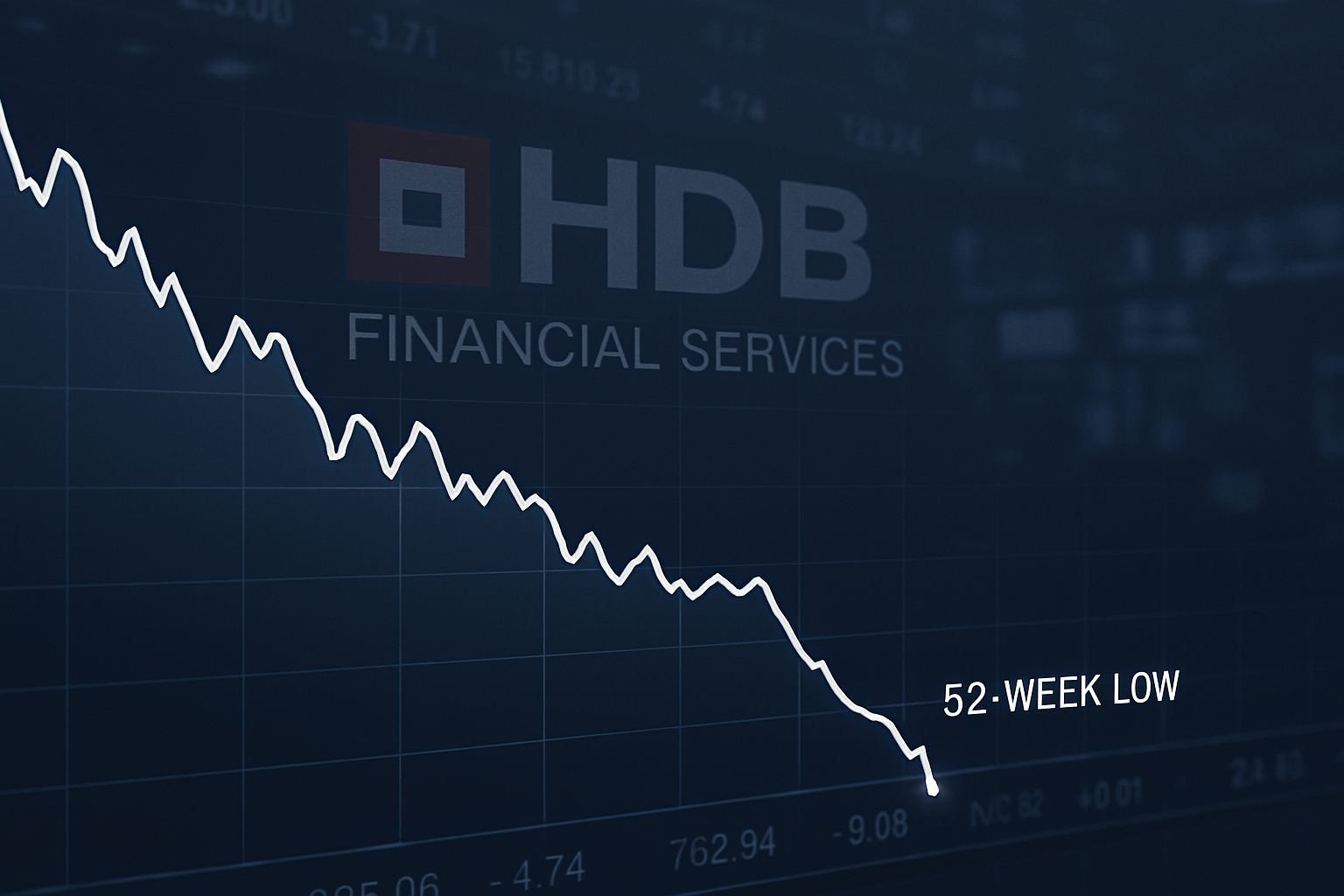
HDB Financial Services witnessed a sharp dip, falling below its IPO price and hitting a 52-week low. This article explores the reasons behind the drop, market sentiment, and what investors should keep in mind.
Table of Contents
Published: August 05, 2025 | Last Updated: August 05, 2025
HDB Financial Services Ltd experienced a notable market development on August 5, 2025, when its shares traded below the Initial Public Offering price for the first time since listing. The stock closed at ₹443.65, representing a decline below the IPO price of ₹450.
This marks a significant milestone for the non-banking financial company subsidiary of HDFC Bank. The stock had listed in March 2025 and initially traded above the offer price for several months.
The decline reflects broader pressures on the NBFC sector. Multiple factors including macroeconomic conditions, quarterly performance concerns, and sectoral sentiment shifts contributed to the price movement.
Stock Performance Metrics and Trading Data
HDB Financial Services shares declined by over 1 percent during intraday trading on August 5, 2025. The closing price of ₹443.65 established a new 52-week low for the counter.
The stock had previously reached a 52-week high of ₹505 earlier in 2025. This represents a decline of approximately 12.15 percent from the peak level.
The breach below the IPO price of ₹450 occurred for the first time since the company’s market debut. The stock closed 1.41 percent below the offer price on August 5.
Key Trading Statistics
| Metric | Value |
|---|---|
| IPO Price (March 2025) | ₹450 |
| Closing Price (August 5, 2025) | ₹443.65 |
| 52-Week High | ₹505 |
| 52-Week Low | ₹443.65 |
| Decline from Peak | 12.15% |
| Distance from IPO Price | -1.41% |
Market participants view the IPO price as a psychological support level. The break below this level triggered additional attention from investors and analysts.
Company Background and Business Operations
HDB Financial Services operates as the NBFC subsidiary of HDFC Bank. The company provides various financial products including consumer durable loans, personal financing, and small business credit.
The organization has established presence across multiple geographic markets. Focus areas include Tier 2 and Tier 3 cities where traditional banking penetration remains lower.
The company’s business model leverages HDFC Bank’s infrastructure and customer base. This relationship provides access to technology platforms, risk management systems, and distribution networks.
Product Portfolio Structure
HDB Financial Services offers diversified financial products across segments. Consumer durable financing represents a significant business line, supporting purchases of electronics, appliances, and home furnishings.
Personal loan products serve individual borrowers for various purposes. The company also provides working capital and term loans to small and medium enterprises.
Micro-finance operations address credit needs in underserved markets. This multi-product approach aims to reduce dependence on any single revenue stream.
Factors Contributing to Price Decline
Several elements combined to push the stock below its IPO price. These factors span macroeconomic conditions, company-specific performance, and broader sectoral trends.
The Reserve Bank of India’s monetary policy stance affected funding costs for NBFCs. Higher interest rates increased the cost of borrowing for financial institutions.
Quarterly financial results failed to meet some analyst expectations. Flat net interest income growth particularly concerned market participants focused on top-line expansion.
Macroeconomic Environment Impact
The broader economic environment presented challenges for non-banking financial companies. Rising interest rates implemented to control inflation affected both borrowing costs and lending margins.
Consumer spending patterns showed signs of moderation in certain segments. Economic uncertainty influenced borrowing behavior and loan demand across various product categories.
Credit quality concerns emerged across the unsecured lending industry. Market participants increased scrutiny of NBFCs with exposure to personal loans and credit cards.
Quarterly Performance Analysis
Recent quarterly results showed stagnant growth in key income metrics. Net interest income, a critical measure of lending profitability, failed to demonstrate the expansion rate anticipated by analysts.
Loan book growth rates came under examination from market observers. Questions arose about the company’s ability to expand lending volumes while maintaining credit quality standards.
Profitability metrics remained under pressure from operating costs and provision requirements. Return on equity and return on assets metrics received attention from investors assessing performance trends.
NBFC Sector Trends and Challenges
The non-banking financial company sector faced headwinds during this period. Regulatory changes, funding cost pressures, and asset quality concerns affected multiple companies.
The Reserve Bank of India implemented stricter oversight of NBFC operations. Enhanced capital requirements and governance standards increased compliance costs across the sector.
Traditional banks gained market share in certain lending segments. Commercial banks benefited from lower funding costs through customer deposits, creating competitive pressures.
Regulatory Environment Changes
Financial regulators strengthened supervision of non-banking financial institutions. New guidelines addressed capital adequacy, liquidity management, and risk governance frameworks.
Compliance requirements increased operational complexity for NBFCs. Companies needed to invest in systems, processes, and personnel to meet evolving regulatory standards.
Scale advantages became more pronounced under the new regulatory framework. Larger, well-capitalized NBFCs found it easier to absorb compliance costs compared to smaller entities.
Competitive Landscape Dynamics
Market competition intensified across lending segments. Banks increased focus on retail and SME lending, directly competing with NBFC offerings.
Digital lending platforms emerged as new competitors. Technology-enabled lenders offered faster processing and convenient customer experiences.
Funding cost differentials favored banks with deposit franchises. NBFCs relying on wholesale borrowing faced higher costs, affecting pricing competitiveness.
Technical Analysis and Chart Patterns
Technical analysts observed the break below the IPO price support level. This development changed the technical outlook for the stock among chart-based traders.
The next support levels identified by technical analysts fell in the ₹420-425 range. These levels represented previous consolidation zones during earlier trading periods.
Resistance levels emerged at ₹465-470 based on historical trading patterns. The stock would need to reclaim these levels to signal potential trend reversal.
Trading Volume and Momentum Indicators
Trading volumes increased on the day the stock broke below IPO price. Higher volumes on down days often indicate distribution by investors.
Relative Strength Index readings moved into oversold territory. This technical indicator suggested potential for a short-term bounce based purely on technical factors.
Moving average analysis showed the stock trading below key averages. The 50-day and 200-day moving averages provided resistance levels for any recovery attempts.
Comparison with Peer NBFCs
HDB Financial Services’ performance aligned with broader NBFC sector trends. However, the magnitude of decline varied across different companies based on their specific circumstances.
Bajaj Finance, a leading NBFC, maintained relatively better price stability. The company’s diversified business model and strong asset quality metrics supported investor confidence.
Smaller NBFCs experienced more severe corrections during this period. Capital constraints and limited funding access affected these companies more significantly.
Valuation Metrics Comparison
Price-to-book ratios across the NBFC sector came under pressure. HDB Financial Services traded at a discount to book value following the decline below IPO price.
Price-to-earnings multiples compressed for most NBFCs. Market participants reduced valuations based on growth concerns and risk perceptions.
Return on equity comparisons showed variation across companies. Well-managed NBFCs with strong asset quality maintained better profitability metrics despite sector challenges.
Institutional and Retail Investor Perspectives
Institutional investors maintained varied views on the stock following the IPO price breach. Some fund managers viewed the decline as excessive relative to fundamental business strength.
Lock-in period expiry for certain pre-IPO investors contributed to selling pressure. These investors, having held shares before the public offering, gained liquidity to book profits or reduce exposure.
Retail investors who participated in the IPO faced unrealized losses. Those with longer investment horizons considered whether current levels represented accumulation opportunities.
Analyst Ratings and Target Prices
Research analysts from various brokerages reviewed their recommendations following the price decline. Some maintained positive ratings based on long-term growth potential and parent company support.
Target prices were adjusted to reflect current market conditions and revised earnings estimates. Analysts incorporated higher funding costs and moderated growth expectations into their models.
Investment banking coverage emphasized the company’s competitive advantages. Access to HDFC Bank’s ecosystem remained a key positive factor in analyst assessments.
Asset Quality and Credit Risk Assessment
Asset quality metrics received increased scrutiny from market participants. Gross non-performing asset ratios and net NPA levels became focal points for investors.
The company’s underwriting standards and collection processes faced examination. Conservative credit policies provide protection during economic downturns but may limit growth opportunities.
Provision coverage ratios indicated the buffer available against potential loan losses. Higher provision coverage provides comfort regarding balance sheet strength.
Loan Portfolio Composition
Consumer durable loans formed a significant portion of the loan book. These loans typically carry lower risk compared to unsecured personal loans due to collateral backing.
Small business lending exposed the company to SME credit risks. Economic conditions directly impact small enterprise performance and debt servicing capacity.
Geographic diversification across multiple states reduced concentration risks. However, regional economic variations affected different parts of the portfolio differently.
Funding and Liquidity Management
Funding costs represented a critical factor affecting NBFC profitability. HDB Financial Services accessed various funding sources including bank borrowings, capital markets, and assignment transactions.
The company’s borrowing rates reflected credit ratings and market conditions. Higher rated NBFCs obtained funding at more favorable rates compared to lower rated entities.
Liquidity management practices ensured adequate resources to meet obligations. Asset-liability matching procedures aligned funding tenors with lending portfolios.
Capital Adequacy Position
Capital adequacy ratios remained above regulatory minimum requirements. Strong capitalization supported lending capacity and provided buffers against potential losses.
Tier 1 and Tier 2 capital structures met regulatory norms. The company’s association with HDFC Bank provided potential access to capital if needed.
Internal capital generation through retained earnings contributed to capital base. Profitability levels and dividend payout decisions affected the pace of capital accumulation.
Growth Strategy and Market Positioning
HDB Financial Services focused on underpenetrated markets for growth. Tier 2 and Tier 3 cities offered expansion opportunities with lower competition from traditional banks.
Digital initiatives aimed to improve customer acquisition and service delivery. Technology investments in mobile applications and online platforms enhanced accessibility.
Cross-selling opportunities through HDFC Bank relationships provided strategic advantages. The ability to offer products to existing bank customers reduced customer acquisition costs.
Geographic Expansion Plans
The company maintained presence across multiple states in India. Expansion strategy targeted regions with growing middle-class populations and rising consumer finance demand.
Branch network development continued in selected markets. Physical presence complemented digital channels, particularly important in smaller cities and towns.
Partnerships with retailers and dealers supported product distribution. These relationships facilitated point-of-sale financing for consumer durable purchases.
Management Commentary and Strategic Direction
Company management addressed market concerns through investor communications. Statements emphasized fundamental business strength and long-term growth prospects.
Strategic priorities included maintaining asset quality while pursuing growth. Management highlighted conservative underwriting as a competitive advantage during uncertain times.
Digital transformation initiatives received continued investment despite market conditions. Technology spending aimed to improve operational efficiency and customer experience.
Operational Efficiency Measures
Cost-to-income ratios came under management focus. Operational efficiency improvements helped maintain profitability margins in a challenging environment.
Process automation reduced manual interventions and processing times. Digital workflows improved productivity across origination, underwriting, and servicing functions.
Talent acquisition and development supported capability building. Skilled personnel in credit assessment, collections, and customer service represented competitive advantages.
Economic Environment and Policy Impact
India’s economic growth trajectory influenced lending demand and credit quality. GDP growth rates, industrial production, and consumer spending patterns affected NBFC operations.
Inflation levels impacted both borrowing costs and consumer purchasing power. Higher inflation reduced real income growth and affected debt servicing capacity for borrowers.
Government policy initiatives affected various lending segments. Financial inclusion programs and priority sector lending norms created both opportunities and obligations.
Reserve Bank of India Policy Stance
The central bank’s monetary policy decisions directly affected NBFC funding costs. Repo rate changes influenced interest rates across the financial system.
Regulatory guidelines specifically targeting NBFCs shaped operational requirements. The RBI’s approach balanced financial stability concerns with sector development objectives.
Supervisory intensity increased for systemically important NBFCs. Enhanced monitoring aimed to prevent risks to broader financial system stability.
Risk Factors and Mitigation Strategies
Credit risk represented the primary risk facing the company. Economic downturns or sectoral stress could affect borrower repayment capacity.
Interest rate risk arose from asset-liability mismatches. Changes in market rates could compress margins if funding costs adjusted faster than lending rates.
Regulatory risk stemmed from evolving rules and compliance requirements. New regulations could affect business models, capital requirements, or operational practices.
Risk Management Framework
The company employed sophisticated risk assessment methodologies. Credit scoring models, underwriting guidelines, and approval processes aimed to control loan losses.
Collection and recovery mechanisms addressed delinquencies systematically. Early intervention strategies and restructuring options balanced customer needs with credit protection.
Stress testing procedures evaluated portfolio performance under adverse scenarios. These exercises informed capital planning and risk appetite decisions.
Investment Considerations for Different Investor Types
Value-oriented investors might view current levels as attractive based on fundamental metrics. The discount to book value and compressed earnings multiples suggested potential upside if business performance improved.
Growth investors needed evidence of accelerating business momentum. Quarterly results demonstrating expanding loan books and improving profitability would support growth investment theses.
Income-focused investors found limited current appeal given minimal dividend yields. Future dividend potential depended on profitability stabilization and capital allocation priorities.
Time Horizon Considerations
Short-term traders focused on technical levels and momentum indicators. The break below IPO price created bearish sentiment that could persist until technical reversal signals emerged.
Medium-term investors needed to assess quarterly result trends. Evidence of stabilizing fundamentals and improving competitive position would support positions over 6-12 month horizons.
Long-term investors could evaluate the company’s structural advantages. HDFC Bank affiliation, market positioning, and sector growth potential represented multi-year investment considerations.
Market Sentiment and Investor Psychology
The psychological impact of breaking below IPO price affected investor behavior. Shareholders who purchased during the IPO faced unrealized losses, potentially triggering emotional decisions.
Anchoring bias caused investors to fixate on the IPO price as a reference point. This cognitive bias influenced perceptions of value regardless of fundamental changes.
Herding behavior amplified price movements as investors followed trends. Technical breaks below support levels often triggered automatic selling from various market participants.
Media Coverage Impact
Financial media attention to the IPO price breach increased visibility. Headlines focusing on the milestone influenced investor awareness and sentiment.
Analysis pieces from market commentators shaped perceptions. Diverse opinions from bulls and bears provided conflicting signals to market participants.
Social media discussions among retail investors reflected varied perspectives. Online investment communities debated whether the decline represented opportunity or warning signal.
Sector Outlook and Future Catalysts
The NBFC sector outlook depended on macroeconomic conditions and regulatory developments. Economic recovery and stable interest rates would support sector performance.
Potential positive catalysts included improved quarterly results and operational momentum. Evidence of market share gains or margin expansion would attract investor interest.
Regulatory clarity on key issues could reduce uncertainty. Final guidelines on various operational matters would allow better business planning.
Industry Growth Drivers
India’s demographic profile supported long-term credit demand growth. A large young population entering workforce and forming households created structural tailwinds.
Financial inclusion initiatives expanded addressable markets. Government programs and digital payment infrastructure brought more consumers into the formal financial system.
Rising income levels increased purchasing power and credit capacity. Growing middle class demand for consumer goods, housing, and transportation supported lending volumes.
Conclusion
HDB Financial Services’ decline below its IPO price on August 5, 2025 represented a significant development for investors. The stock closed at ₹443.65, falling 1.41 percent below the ₹450 offer price.
Multiple factors contributed to this price movement including flat quarterly performance, NBFC sector pressures, and post-lock-in selling. Macroeconomic headwinds and competitive dynamics added to challenges.
The company maintains certain structural advantages through its HDFC Bank affiliation. Access to customer base, technology infrastructure, and risk management systems differentiate it from independent NBFCs.
Current valuation metrics suggest the market has priced in significant concerns. Price-to-book and price-to-earnings ratios appear compressed compared to historical ranges.
Future performance depends on quarterly result trends and sectoral sentiment recovery. Investors should monitor net interest income growth, asset quality metrics, and loan book expansion.
The situation presents different implications for various investor types. Risk tolerance, investment horizon, and portfolio objectives should guide individual decisions regarding the stock.
About the Author
Nueplanet
Financial Markets Analyst specializing in banking and NBFC sector coverage. the years of experience analyzing financial services companies, regulatory developments, and market trends. Committed to providing fact-based analysis using data from stock exchanges, SEBI filings, and company disclosures.
Nueplanet maintains editorial independence and does not provide investment recommendations. All analysis is for informational purposes based on publicly available data from official sources.
Frequently Asked Questions
What caused HDB Financial Services stock to fall below IPO price?
HDB Financial Services shares fell below the IPO price of ₹450 on August 5, 2025, closing at ₹443.65. Contributing factors included flat net interest income in recent quarterly results, broader NBFC sector pressures from rising interest rates, profit booking by early investors after lock-in period expiry, concerns about unsecured lending segment asset quality, and sectoral rotation toward traditional banks. The combination of these elements created selling pressure that pushed the stock through the psychological support level represented by the IPO price.
How does HDB Financial’s performance compare to other NBFCs?
HDB Financial Services’ decline aligns with broader NBFC sector trends during this period. Bajaj Finance, the sector leader, maintained relatively better price stability due to its diversified business model and strong asset quality. Smaller NBFCs experienced more severe corrections due to capital constraints and funding access challenges. HDB Financial’s current price-to-book and price-to-earnings ratios appear attractive compared to historical averages and some peer companies, though valuation alone does not determine investment merit.
What are the key risks facing HDB Financial Services?
Primary risks include credit risk from potential asset quality deterioration amid economic uncertainty, interest rate risk affecting both funding costs and lending margins, competitive pressures from traditional banks with lower cost of funds, regulatory compliance costs from evolving RBI requirements for NBFCs, and concentration risk in specific lending segments. The company’s conservative underwriting standards and HDFC Bank parentage provide some mitigation, but these risks require ongoing monitoring by investors and management.
What competitive advantages does HDB Financial maintain?
HDB Financial Services benefits from HDFC Bank’s extensive ecosystem including customer base access, technology infrastructure, risk management expertise, and distribution network. The company’s strategic focus on Tier 2 and Tier 3 cities where banking penetration remains lower provides growth opportunities. A diversified product portfolio across consumer durables, personal loans, and SME financing reduces revenue concentration risks. Strong capital adequacy ratios above regulatory requirements support lending capacity and provide financial flexibility.
Should investors consider buying at current levels?
Investment decisions depend on individual circumstances including risk tolerance and time horizon. The stock trading below IPO price has attracted attention from value-oriented investors who see potential upside if fundamentals improve. However, near-term challenges remain including uncertain economic conditions, NBFC sector headwinds, and need for demonstrated operational improvement. Investors should monitor quarterly results for signs of net interest income growth, stable asset quality, and successful strategy execution before making investment decisions.
What should investors watch in upcoming quarterly results?
Key metrics to monitor include net interest income growth rates indicating lending volume expansion and margin trends, gross and net non-performing asset ratios showing asset quality trajectory, loan book growth across different product categories, return on equity and return on assets measuring profitability efficiency, cost-to-income ratios reflecting operational efficiency, and management commentary on market conditions and strategic priorities. Improvement in these areas, particularly revenue growth combined with stable credit quality, would provide positive signals for the business outlook.
When might the stock recover to IPO price levels?
Recovery timing depends on multiple factors including quarterly earnings performance, broader NBFC sector sentiment improvement, macroeconomic stabilization, and successful execution of growth strategies. Analysts note that next support levels exist around ₹420-425 while resistance appears at ₹465-470 based on technical analysis. Fundamental recovery requires sustained operational improvement and could take several quarters depending on market conditions. Investors should focus on business performance trends rather than predicting specific price movement timing.
How does the RBI’s monetary policy affect HDB Financial?
Reserve Bank of India monetary policy decisions directly impact NBFC operations through multiple channels. Repo rate changes affect NBFC borrowing costs as funding rates across the financial system adjust. Higher interest rates implemented to control inflation increase the cost of funds for NBFCs. These companies must balance passing on higher costs to borrowers while remaining competitive with banks that have lower cost deposit funding. Additionally, RBI regulatory policies specifically targeting NBFCs affect capital requirements, liquidity management, and operational standards, creating both challenges and opportunities for well-capitalized players.
Disclaimer: This article provides information for educational purposes only and does not constitute investment advice or recommendations. Readers should conduct their own research and consult qualified financial advisors before making investment decisions. Stock prices are subject to market risks and past performance does not indicate future results. All data is sourced from stock exchange filings, company disclosures, and publicly available financial information.
Helpful Resources
Call to Action
Stay updated with the latest stock market insights and financial news at NuePlanet.com. Subscribe to our newsletter for daily alerts and in-depth analysis of India’s fastest-moving shares.
Latest Posts:
- IndusInd Bank Share: Leadership Change and Market Response
- DLF Share Price Rallies Strongly After Robust Q1 Performance
- EPFO UAN Generation: Now Only via UMANG App with Aadhaar Face Authentication
- Uttarkashi Cloudburst Tragedy: Dharali Village Devastated in Flash Floods
- Visa Bonds Immigration: What the New US Rule Means for Indian Travelers
Table of Contents
Tag
HDB Financial
Related Posts











Post Comment