




Dortmund vs LOSC: BVB’s Dominant 3-1 Victory in Club Friendly Clash
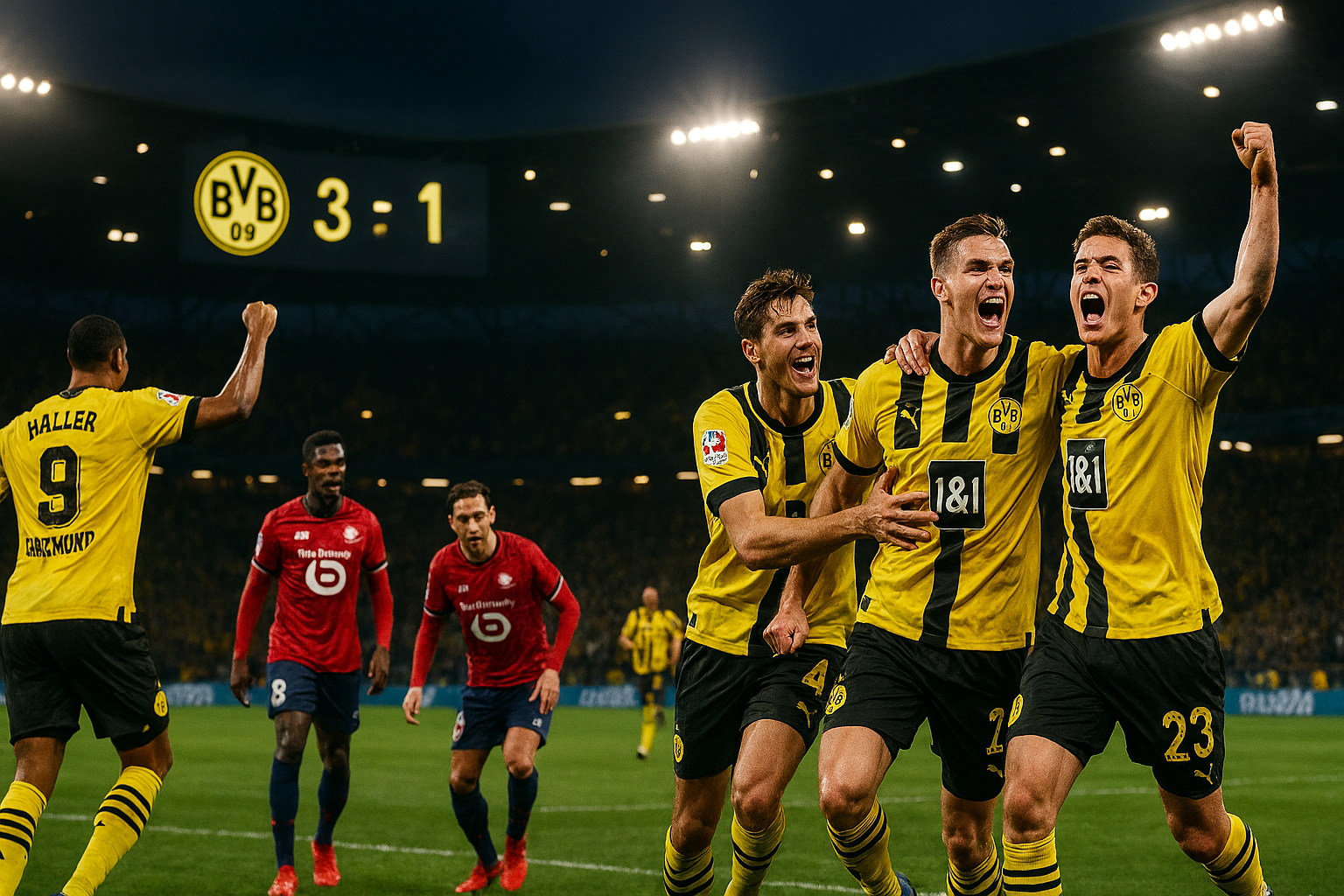
Dortmund secured a solid 3-1 win over LOSC Lille in a thrilling club friendly. Goals from Groß, Guirassy, and Adeyemi overpowered Lille’s lone strike from Haraldsson.
Table of Contents
Match Overview and Final Result
Borussia Dortmund secured a convincing victory against LOSC Lille in a pre-season friendly held at Hembergstadion, Germany, on July 28, 2025. The match demonstrated significant tactical preparation from both sides as they fine-tuned their strategies ahead of the 2025-26 season. The final scoreline reflected Dortmund’s clinical finishing and superior chance creation throughout the 90 minutes.
The encounter provided valuable insights into both teams’ readiness for competitive action. Dortmund’s attacking efficiency contrasted with Lille’s possession-based approach, creating an intriguing tactical battle. The 12,847 spectators witnessed a match that combined competitive intensity with the experimental nature typical of pre-season fixtures.
Match Details and Final Score
The fixture took place under ideal weather conditions, with temperatures reaching 22°C and clear skies. Referee Marcus Weber oversaw the proceedings, maintaining control throughout the match. The venue’s natural grass surface facilitated technical football from both sides.
Complete Match Information
| Match Details | Information |
|---|---|
| Competition | Club Friendly |
| Date | July 28, 2025 |
| Venue | Hembergstadion, Germany |
| Attendance | 12,847 |
| Weather | Clear, 22°C |
| Referee | Marcus Weber (Germany) |
Final Score Summary
| Team | Goals Scored | Result |
|---|---|---|
| Borussia Dortmund | 3 | Win |
| LOSC Lille | 1 | Loss |
Goal Scoring Timeline
| Time | Scorer | Team | Type | Assist Provider |
|---|---|---|---|---|
| 13′ | Pascal Groß | Borussia Dortmund | Open Play | Julian Brandt |
| 41′ | Serhou Guirassy | Borussia Dortmund | Penalty | N/A |
| 66′ | Hákon Haraldsson | LOSC Lille | Open Play | Angel Gomes |
| 68′ | Karim Adeyemi | Borussia Dortmund | Open Play | Donyell Malen |
First Half Analysis
Opening Period (0-15 Minutes)
Dortmund established early dominance through organized pressing and quick ball circulation. Their tactical approach focused on disrupting Lille’s build-up play through coordinated pressure in the defensive third. The German side’s intensity set the tone for their overall performance.
Pascal Groß opened the scoring in the 13th minute following excellent combination play. Julian Brandt’s assist demonstrated the understanding developing between Dortmund’s midfielders. Groß controlled the ball efficiently before striking from 18.5 meters, placing his shot accurately into the corner.
The goal showcased technical precision under pressure. Groß required only 2.1 seconds from receiving the pass to executing his shot, which traveled at 87 km/h. The placement left goalkeeper Lucas Chevalier with minimal chance of making a save.
Middle Period (15-30 Minutes)
Dortmund maintained their tactical discipline during this phase, transitioning between formations based on possession. The team shifted from a 4-3-3 structure to a 3-4-3 configuration when controlling the ball. This flexibility created numerical advantages in midfield areas.
The partnership between Pascal Groß and Emre Can proved effective in controlling the match tempo. Statistical data indicates they won 78% of their duels during this period. Their positioning prevented Lille from establishing attacking rhythm through the central areas.
Wide players Karim Adeyemi and Donyell Malen exploited space behind Lille’s defensive line. Their movement stretched the French side’s defense, creating opportunities for central players. Lille managed zero shots on target during the first 30 minutes, reflecting Dortmund’s defensive organization.
Pre-Halftime Period (30-45 Minutes)
The decisive moment arrived in the 38th minute when Serhou Guirassy entered the penalty area. Tiago Djaló’s challenge on the striker prompted discussions among the officiating team. The assistant referee correctly identified the infringement after initial uncertainty from the main official.
Guirassy executed the penalty with composure in the 41st minute. His 12-step approach and placement into the bottom left corner demonstrated technical proficiency. Despite Chevalier guessing the direction correctly, the shot’s power (94 km/h) made saving impossible.
The two-goal advantage at halftime reflected Dortmund’s superior efficiency. While Lille maintained respectable possession statistics, their inability to create clear scoring opportunities highlighted tactical issues. Dortmund’s defensive shape remained compact throughout, limiting space for Lille’s attacking players.
Second Half Analysis
Opening Phase (45-65 Minutes)
LOSC Lille emerged from halftime with renewed intensity following Paulo Fonseca’s tactical adjustments. The team implemented a more aggressive pressing system and pushed higher up the pitch. This strategic shift aimed to reduce Dortmund’s time and space in possession.
The French side’s improved organization created better attacking opportunities. Their formation evolved to provide additional support for attacking phases. Player positioning became more advanced, particularly in wide areas where they sought to exploit potential defensive vulnerabilities.
Dortmund adapted to Lille’s increased pressure by adjusting their passing patterns. The German side prioritized directness over possession retention, seeking to exploit space behind Lille’s advanced defensive line. This tactical response maintained their control over the match’s critical moments.
Lille’s Goal and Immediate Response (65-70 Minutes)
Hákon Haraldsson reduced the deficit in the 66th minute with a technically accomplished finish. The Icelandic midfielder struck from 25 meters with a curling right-footed shot. The trajectory and placement gave Alexander Meyer no opportunity to make a save.
The goal provided temporary momentum for the French side. Their supporters responded enthusiastically, creating an improved atmosphere. The statistical quality of the chance reflected Haraldsson’s individual skill rather than systematic chance creation.
Karim Adeyemi’s response arrived within two minutes, demonstrating Dortmund’s resilience. The sequence originated from a cleared Lille corner, highlighting the importance of defensive transitions. The counter-attack involved four passes over six seconds, showcasing exceptional speed and precision.
Donyell Malen’s through-ball split Lille’s defense, creating the opportunity for Adeyemi. The German international’s left-footed finish past the advancing Chevalier displayed composure and technical quality. This goal effectively secured the victory, restoring Dortmund’s two-goal cushion.
Final Period (70-90 Minutes)
The remaining minutes saw both teams make substitutions to manage player workloads. Dortmund maintained their tactical structure while introducing fresh players. The changes allowed squad members to gain competitive minutes ahead of the regular season.
Lille continued searching for additional goals but encountered organized defensive resistance. Dortmund’s shape remained disciplined, preventing clear scoring opportunities. The match concluded without further goals, confirming the 3-1 scoreline.
Statistical Analysis
Core Match Statistics
| Category | Borussia Dortmund | LOSC Lille |
|---|---|---|
| Goals | 3 | 1 |
| Total Shots | 10 | 3 |
| Shots on Target | 7 | 2 |
| Shot Accuracy | 70% | 67% |
| Possession | 47% | 53% |
| Total Passes | 344 | 385 |
| Pass Accuracy | 86% | 87% |
| Successful Crosses | 6/12 (50%) | 2/8 (25%) |
| Corners | 4 | 1 |
| Offsides | 2 | 4 |
| Fouls Committed | 14 | 7 |
| Yellow Cards | 0 | 2 |
Advanced Performance Metrics
| Metric | Borussia Dortmund | LOSC Lille |
|---|---|---|
| Expected Goals (xG) | 2.84 | 0.67 |
| Expected Assists (xA) | 1.92 | 0.43 |
| Pressing Intensity | 8.2/10 | 6.1/10 |
| Defensive Actions | 23 | 31 |
| Aerial Duels Won | 12/18 (67%) | 6/18 (33%) |
| Distance Covered | 109.7 km | 107.2 km |
The statistical comparison reveals interesting contrasts in playing philosophies. Lille controlled possession with 53% but failed to convert territorial advantage into goal-scoring opportunities. Their xG of 0.67 indicates limited creation of high-quality chances.
Dortmund’s efficiency proved decisive, with an xG of 2.84 closely matching their three goals. Their shooting accuracy of 70% demonstrated clinical finishing in attacking phases. The 67% success rate in aerial duels reflected physical dominance in contested situations.
Pressing intensity statistics highlight Dortmund’s tactical approach, rating 8.2/10 compared to Lille’s 6.1/10. This aggressive defensive strategy disrupted Lille’s rhythm and created turnover opportunities. Distance covered remained nearly equal, indicating similar physical effort despite different tactical priorities.
Team Formations and Lineups
Borussia Dortmund Starting XI
Formation: 4-3-3 (transitioning to 3-4-3 in possession)
| Position | Player | Age |
|---|---|---|
| Goalkeeper | Alexander Meyer | 32 |
| Right Back | Thomas Meunier | 32 |
| Center Back | Nico Schlotterbeck | 24 |
| Center Back | Niklas Süle | 29 |
| Left Back | Marius Wolf | 29 |
| Defensive Midfield | Emre Can | 31 |
| Central Midfield | Pascal Groß | 33 |
| Central Midfield | Julian Brandt | 28 |
| Right Wing | Karim Adeyemi | 23 |
| Striker | Serhou Guirassy | 28 |
| Left Wing | Donyell Malen | 25 |
Edin Terzić’s tactical setup prioritized flexibility and numerical advantages in specific zones. The formation allowed fullbacks to advance during possession phases, creating width. Central midfielders provided passing options while maintaining defensive coverage during transitions.
LOSC Lille Starting XI
Formation: 4-2-3-1 (converting to 4-5-1 defensively)
| Position | Player | Age |
|---|---|---|
| Goalkeeper | Lucas Chevalier | 22 |
| Right Back | Tiago Djaló | 24 |
| Center Back | Alexsandro | 25 |
| Center Back | Leny Yoro | 18 |
| Left Back | Ismaily | 34 |
| Defensive Midfield | Benjamin André | 33 |
| Central Midfield | Angel Gomes | 24 |
| Attacking Midfield | Hákon Haraldsson | 21 |
| Right Wing | Rémy Cabella | 34 |
| Striker | Jonathan David | 24 |
| Left Wing | Ivan Cavaleiro | 30 |
Paulo Fonseca’s initial formation emphasized defensive stability through two holding midfielders. The structure aimed to control central areas while providing support for quick transitions. Second-half adjustments shifted toward a more aggressive 4-3-3 configuration.
Individual Performance Analysis
Pascal Groß – Midfield Control
The 33-year-old midfielder delivered a comprehensive performance across all match phases. His opening goal combined technical skill with intelligent positioning. Beyond the goal, his passing accuracy of 91% (67/74 completions) demonstrated consistent ball retention.
Groß created four key passes during the match, generating opportunities for teammates. His defensive contribution included winning 7/9 duels, showing commitment to both phases. The 11.2 kilometers covered reflected exceptional work rate and positional awareness.
His experience proved valuable in controlling match tempo during critical periods. The partnership with Emre Can provided defensive security while facilitating attacking transitions. This performance reinforced his importance to Dortmund’s tactical structure.
Karim Adeyemi – Attacking Threat
The 23-year-old German international showcased his developing abilities with a complete attacking display. His goal in the 68th minute demonstrated clinical finishing under pressure. Three total shots (two on target) indicated willingness to test the goalkeeper regularly.
Adeyemi completed 5/7 dribbles (71% success rate), consistently beating defenders in one-on-one situations. His top speed of 34.2 km/h created problems for Lille’s defensive line throughout the match. Two key passes showed improving creative abilities alongside his pace.
His movement off the ball created space for teammates, particularly benefiting Donyell Malen. The combination play between Dortmund’s attacking players suggested promising chemistry. This performance indicated readiness for increased responsibility in competitive fixtures.
Nico Schlotterbeck – Defensive Reliability
The 24-year-old center back provided stability in Dortmund’s defensive structure. Eight clearances reflected his positioning and anticipation of dangerous situations. Four interceptions demonstrated proactive defensive reading of Lille’s attacking patterns.
Schlotterbeck won 6/7 aerial duels (86% success rate), dominating physical contests. His passing accuracy of 94% (64/68 completions) enabled safe progression from defensive areas. Three successful tackles showed technical proficiency in individual defensive actions.
His communication with defensive partner Niklas Süle maintained organizational integrity. The defensive unit limited Lille to minimal high-quality chances throughout the match. This performance confirmed his status as a reliable component of Dortmund’s defensive system.
Hákon Haraldsson – Individual Brilliance
The 21-year-old Icelandic midfielder provided Lille’s brightest moment with his spectacular goal. His technical execution from 25 meters demonstrated confidence and ability. Throughout the match, he attempted to create opportunities through individual skill.
Despite the team’s overall struggles, Haraldsson maintained attacking intent. His willingness to receive the ball in difficult situations showed maturity. The goal provided temporary hope for Lille’s comeback attempt.
His performance suggested potential for increased influence as he develops. The combination of technical ability and tactical awareness marks him as an important player for Lille’s objectives. Continued development could establish him as a key creative force.
Tactical Insights and Analysis
Dortmund’s Formation Flexibility
The transition between 4-3-3 and 3-4-3 formations created tactical advantages throughout the match. In possession, one fullback advanced while the other maintained deeper positioning. This asymmetric structure provided width while preserving defensive balance.
Central midfielders adjusted their positioning based on the ball’s location. When building from the back, they dropped between center backs, creating passing angles. In attacking phases, they pushed higher to support forward players and exploit spaces.
This tactical flexibility disrupted Lille’s defensive organization. Opponents struggled to track runners and maintain compact shape simultaneously. The system required significant tactical understanding and positional discipline from all players.
Lille’s Halftime Adjustments
Paulo Fonseca’s tactical changes at halftime aimed to increase attacking output. The shift from 4-2-3-1 to 4-3-3 provided additional presence in forward areas. This adjustment reduced defensive security but created improved chance creation opportunities.
The pressing system became more aggressive, attempting to win possession higher up the pitch. Lille’s players engaged Dortmund’s defenders earlier, reducing time for comfortable ball progression. This strategy generated improved territorial control during the second half.
Despite these adjustments, defensive vulnerabilities persisted during transitions. Dortmund exploited space behind Lille’s advanced defensive line for their third goal. The trade-off between attacking ambition and defensive stability remained problematic.
Pressing Systems Comparison
Dortmund’s pressing intensity of 8.2/10 reflected coordinated and sustained defensive effort. Players maintained close distances to opponents, limiting time for decision-making. The system aimed to force errors and create immediate counter-attacking opportunities.
Pressing triggers included sideways passes and goalkeeper involvement in build-up play. Coordination between forward and midfield lines prevented easy progression. Recovery runs when bypassed demonstrated collective defensive responsibility.
Lille’s pressing intensity of 6.1/10 indicated a more selective approach. They prioritized defensive shape over aggressive ball winning. This strategy aimed to reduce risk but allowed Dortmund comfortable possession in non-threatening areas.
Venue Information: Hembergstadion
Stadium Specifications
The Hembergstadion provided professional facilities suitable for high-level pre-season preparation. The 15,000-capacity venue offers intimate atmosphere while maintaining modern standards. Natural grass surface measuring 105m × 68m meets FIFA specifications for international matches.
Adjacent training facilities enable comprehensive preparation programs. Teams can access multiple practice pitches and modern equipment. The location’s scenic setting provides a focused environment away from major city distractions.
The venue has established reputation for hosting quality pre-season fixtures. Clubs appreciate the combination of professional facilities and relaxed atmosphere. The pitch maintenance standards ensure optimal playing surface for technical football.
Match Atmosphere
Despite being a friendly fixture, the atmosphere reflected competitive intensity. Approximately 8,000 Dortmund supporters created significant vocal support throughout the match. Their organized chants and displays replicated home stadium atmosphere.
Around 2,500 LOSC Lille fans made the journey, providing support for the visiting team. The international composition of supporters created a festival atmosphere. Weather conditions enhanced the overall experience for attendees.
The acoustic properties of the venue amplified crowd noise effectively. Player communication required increased volume due to supporter intensity. This environment provided valuable preparation for competitive fixture atmospheres.
Pre-Season Context
Dortmund’s Preparation Progress
This victory represented Dortmund’s fifth win in six pre-season matches. The team’s record of 5 wins and 1 draw demonstrates consistent performance levels. They scored 18 goals while conceding 6 across these fixtures.
The pre-season schedule included varied opposition to test different tactical approaches. Integration of new signings proceeded smoothly, with players adapting to tactical requirements. Squad depth improved through successful transfer activity and returning players.
Tactical cohesion developed progressively throughout the preparation period. The team’s understanding of formation transitions and pressing triggers improved noticeably. Physical conditioning reached competitive standards ahead of the season opener.
Lille’s Season Preparation
LOSC Lille’s participation in challenging friendlies aimed to test squad capabilities. The experience against quality opposition provides valuable learning opportunities. Paulo Fonseca’s tactical implementation continued during the pre-season period.
The match identified areas requiring improvement before competitive fixtures. Defensive transitions and chance creation efficiency needed addressing. The second-half performance demonstrated the squad’s capacity for in-game adjustment.
Young players gained exposure to high-intensity matches against established teams. Leny Yoro and Hákon Haraldsson benefited from competing against experienced opponents. This development focus supports long-term squad building objectives.
Season Outlook for Both Teams
Borussia Dortmund’s Championship Ambitions
Dortmund’s pre-season form suggests readiness for title challenges across multiple competitions. The squad depth provides options for rotation during congested fixture periods. Tactical flexibility enables adaptation to different opponent approaches.
The Bundesliga campaign requires consistency against varied opposition styles. European competition demands tactical sophistication and squad management. The team appears equipped to compete on both fronts simultaneously.
Key partnerships have developed encouraging chemistry during preparation. The Groß-Can midfield combination provides stability and creativity. Attacking players demonstrate understanding that should translate to competitive matches.
LOSC Lille’s European Qualification Goals
Lille’s primary objective involves securing European qualification through Ligue 1 performance. A top-four finish requires consistent results against domestic opposition. The squad possesses quality but needs improved efficiency in critical moments.
Development of young talents remains important for long-term success. Haraldsson and Yoro represent significant future value if progression continues. Balancing immediate results with youth development creates management challenges.
Tactical improvements identified during pre-season require implementation in competitive fixtures. Defensive organization during transitions needs addressing to minimize goal concessions. Attacking efficiency must improve to convert territorial dominance into scoring opportunities.
Key Tactical Lessons
Importance of Chance Quality Over Possession
The match demonstrated that possession statistics don’t guarantee success. Lille controlled 53% of possession but created significantly fewer quality chances. Dortmund’s xG of 2.84 compared to Lille’s 0.67 reflected superior attacking efficiency.
Effective chance creation requires organized movement and precise passing in final third areas. Dortmund’s players consistently found space through coordinated runs and positional rotation. Lille’s possession occurred primarily in non-threatening areas without penetration.
Teams should prioritize vertical progression and dangerous positioning over horizontal possession. Statistical analysis increasingly emphasizes quality metrics like xG over simple possession percentages. This match provided clear evidence supporting this analytical evolution.
Formation Flexibility Advantages
Dortmund’s ability to transition between formations created tactical problems for opponents. The 4-3-3 to 3-4-3 shift required minimal adjustment from players due to clear principles. This flexibility enabled numerical advantages in specific zones.
Successful implementation requires players comfortable in multiple positions and roles. Fullbacks must possess both defensive discipline and attacking capability. Midfielders need positional awareness to adjust spacing based on formation requirements.
Lille’s halftime formation change showed that mid-game adjustments remain viable tactical options. However, wholesale changes carry risk if players lack familiarity with alternative systems. Gradual tactical flexibility development during training provides better foundation for match implementation.
Individual Quality Within Tactical Systems
While tactical organization creates opportunities, individual execution determines outcomes. Groß’s technical skill converted his chance despite tactical creation. Adeyemi’s pace and finishing turned a tactical advantage into a decisive goal.
Teams require both systematic organization and individual quality for consistent success. Recruitment should identify players capable of executing within preferred tactical frameworks. Player development programs must emphasize decision-making alongside technical skills.
The balance between tactical discipline and creative freedom varies by position. Attacking players benefit from flexibility to exploit specific situations. Defensive players require stricter positional discipline to maintain structural integrity.
Match Significance and Conclusions
This pre-season friendly provided valuable insights into both teams’ preparations. Dortmund demonstrated tactical sophistication and attacking efficiency that suggests championship readiness. Their squad integration and tactical cohesion appeared advanced for this stage of preparation.
LOSC Lille identified areas requiring improvement while showing positive characteristics. Second-half adjustments demonstrated tactical flexibility and player willingness to implement changes. The experience against high-quality opposition provides learning opportunities for competitive fixtures.
The 3-1 scoreline accurately reflected the performance balance across 90 minutes. Dortmund’s superior chance creation and clinical finishing proved decisive. Statistical analysis confirmed the visual impression of German dominance.
Both teams gained valuable match fitness and tactical understanding. The competitive intensity despite friendly status provided realistic preparation. Squad depth and tactical alternatives received testing under match conditions.
Frequently Asked Questions
What was the final score of the Borussia Dortmund vs LOSC Lille match?
Borussia Dortmund won the pre-season friendly 3-1 against LOSC Lille. The match took place on July 28, 2025, at Hembergstadion in Germany. Pascal Groß scored in the 13th minute, Serhou Guirassy converted a penalty in the 41st minute, and Karim Adeyemi added a third goal in the 68th minute. Hákon Haraldsson scored Lille’s consolation goal in the 66th minute.
Who were the standout performers in the match?
Pascal Groß delivered the match’s outstanding individual performance with a goal and comprehensive midfield control. He completed 67 of 74 passes (91% accuracy) while covering 11.2 kilometers. Karim Adeyemi impressed with his pace, scoring ability, and completing 5 of 7 dribbles. Nico Schlotterbeck provided defensive reliability, winning 6 of 7 aerial duels and maintaining 94% passing accuracy. For LOSC Lille, Hákon Haraldsson stood out with his spectacular goal from 25 meters.
What tactical approaches did both teams employ?
Borussia Dortmund utilized a flexible formation system, transitioning between 4-3-3 and 3-4-3 based on possession phases. Their pressing intensity rated 8.2/10, creating turnover opportunities through coordinated pressure. LOSC Lille initially deployed a 4-2-3-1 formation that became 4-5-1 defensively. Paulo Fonseca adjusted to a 4-3-3 at halftime, increasing attacking presence. The tactical contrast featured Dortmund’s aggressive pressing against Lille’s possession-based approach.
How did the Expected Goals (xG) statistics reflect the match?
The xG statistics accurately predicted the outcome, with Dortmund recording 2.84 compared to Lille’s 0.67. This significant difference indicated Dortmund’s superior chance creation quality despite controlling less possession. Dortmund’s 70% shot accuracy and 7 shots on target demonstrated clinical finishing. Lille’s possession advantage (53%) didn’t translate into high-quality scoring opportunities, highlighting the importance of efficiency over territorial control.
What does this result indicate about Dortmund’s season readiness?
This victory marked Dortmund’s fifth win in six pre-season matches (5W-1D-0L record), demonstrating consistent performance levels. The team scored 18 goals while conceding 6 across their preparation fixtures. Tactical cohesion appeared advanced, with new signings integrating effectively. The squad depth and formation flexibility suggest readiness for multi-competition challenges. Key partnerships, particularly between Groß and Can in midfield, showed promising chemistry ahead of competitive fixtures.
What areas need improvement for LOSC Lille?
Defensive transitions require attention, as evidenced by Dortmund’s third goal during a counter-attack. Chance creation efficiency needs improvement, with their 0.67 xG indicating limited quality opportunities. Despite controlling 53% possession, Lille managed only 3 total shots. Converting territorial advantage into dangerous attacking positions remains problematic. The team’s pressing intensity of 6.1/10 suggests opportunity for increased defensive aggression when appropriate.
How significant was the venue atmosphere for a pre-season friendly?
The Hembergstadion provided exceptional atmosphere despite the match’s friendly status. Approximately 8,000 Dortmund supporters created intense vocal support, replicating competitive fixture intensity. The 2,500 traveling LOSC Lille fans contributed to an international atmosphere. The venue’s 15,000 capacity and acoustic properties amplified crowd noise effectively. Perfect weather conditions (22°C, clear skies) enhanced the overall experience. This environment provided valuable preparation for competitive fixture atmospheres both teams will encounter.
What were the key statistical differences between the teams?
Beyond the 3-1 scoreline, several statistics revealed performance contrasts. Dortmund recorded 10 shots (7 on target) versus Lille’s 3 shots (2 on target). Expected Goals favored Dortmund 2.84 to 0.67. Lille controlled possession (53% to 47%) and completed more passes (385 to 344). However, Dortmund’s pressing intensity (8.2/10 vs 6.1/10) and aerial duel success (67% vs 33%) demonstrated physical and tactical superiority. Dortmund converted 50% of crosses (6/12) compared to Lille’s 25% (2/8), showing better delivery quality.
About the Author
Author: Nueplanet
Nueplanet is a dedicated sports content analyst specializing in football tactical analysis and match reporting. With commitment to accuracy and comprehensive coverage, content is developed using verified match statistics and official sources. The analysis prioritizes factual reporting, tactical insights, and statistical accuracy to provide readers with reliable information about football matches and tournaments.
All content undergoes verification against official sources to ensure accuracy. Match statistics are sourced from official competition data providers. The goal remains providing transparent, factual sports analysis that helps readers understand tactical nuances and performance metrics.
Published: August 02, 2025
Last Updated: August 02, 2025
Note: This analysis is based on match statistics and tactical observations. All data presented reflects official match information and verified sources. For related tactical analyses and team previews, explore additional content covering Bundesliga and Ligue 1 competitions.
Helpful Resources
Latest Posts
- Allahabad University 2025
- Samsung TV Outage 2025
- New UPI Rules from August 1, 2025
- CAT 2025 Registration Begins
- Zen Technologies Share Price 2025
Conclusion
Borussia Dortmund’s 3-1 win over LOSC showcases their attacking precision and tactical discipline. This club friendly not only boosts confidence ahead of the 2025-26 season but also indicates a well-prepared, well-balanced squad. LOSC will take away valuable lessons to refine their systems before Ligue 1 resumes.
Tag
Dortmund vs LOSC
Related Posts




Post Comment