









CAT 2025 Registration Begins: Dates, Eligibility, Pattern & Complete Guide
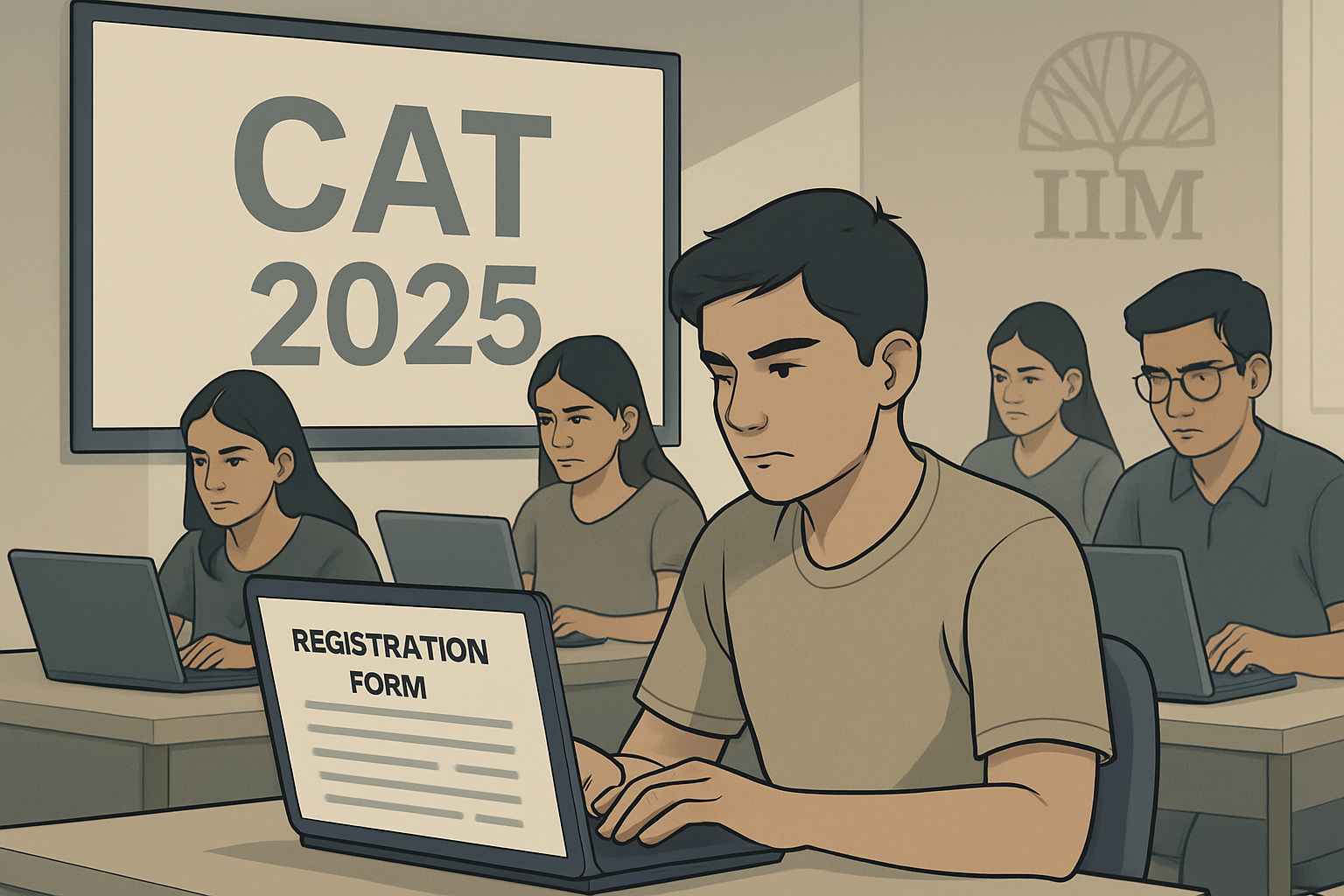
CAT 2025 registration kicks off on August 1 with IIM Kozhikode conducting this year’s exam on November 30. From fees to eligibility, exam pattern to seat allotment, here’s everything aspirants need to know.
Table of Contents
The Indian Institutes of Management have announced the registration schedule for the Common Admission Test (CAT) 2025. IIM Kozhikode will conduct the examination this year, with registration opening on August 1, 2025, at 10:00 AM. The examination is scheduled for November 30, 2025, across multiple cities in India.
This article provides comprehensive information about CAT 2025, including registration procedures, eligibility requirements, examination structure, and preparation guidelines. All information presented is based on official notifications from IIM Kozhikode and follows the standard CAT examination framework.
Understanding CAT: Purpose and Significance
The Common Admission Test functions as the primary entrance examination for admission to postgraduate management programs at Indian Institutes of Management and numerous other business schools across India. The examination serves as a standardized assessment tool evaluating candidates’ aptitude for management education.
CAT provides admission pathways to approximately 21 IIMs and over 1,000 other management institutions throughout India. These institutions use CAT scores as part of their selection criteria, combining examination performance with academic records, work experience, and interview assessments. The examination maintains consistent standards across all participating institutions.
IIM Kozhikode assumes responsibility for conducting CAT 2025, including registration management, examination administration, and result declaration. Each year, one IIM rotates this administrative responsibility, ensuring systematic oversight and continuous improvement in examination processes.
Important Dates for CAT 2025
Understanding the complete timeline helps candidates plan their preparation and complete registration procedures without missing critical deadlines. The following dates are confirmed through official notifications.
Complete Timeline
| Event | Date and Time | Significance |
|---|---|---|
| Official Notification Release | July 27, 2025 | Complete guidelines publication |
| Registration Opens | August 1, 2025, 10:00 AM | Application window begins |
| Registration Closes | September 13, 2025, 5:00 PM IST | Final submission deadline |
| Correction Window | September 22-25, 2025 (Tentative) | Application modification period |
| Admit Card Availability | November 5-30, 2025 | Download period for hall tickets |
| Examination Date | November 30, 2025 | Computer-based test administration |
| Result Declaration | January 2026 (First Week) | Score and percentile announcement |
The registration period extends from August 1 to September 13, 2025, providing approximately six weeks for application completion. Candidates should complete registration well before the deadline to avoid technical difficulties or last-minute complications.
The correction window, tentatively scheduled for September 22-25, 2025, allows modifications to specific application details. However, fundamental information such as candidate name, date of birth, and category typically cannot be changed during this period.
Admit cards become available for download from November 5, 2025, through the official CAT website. Candidates must download and print these documents, as they serve as mandatory entry passes for examination centers.
Eligibility Criteria
Candidates must meet specific educational qualifications to register for CAT 2025. Understanding these requirements ensures appropriate application submission.
Educational Qualifications
Minimum Degree Requirement:
Candidates must possess a bachelor’s degree from a recognized university or educational institution. The degree should be granted by an institution recognized by the University Grants Commission or equivalent regulatory authority. All academic disciplines qualify for CAT registration.
Minimum Marks Requirement:
| Category | Minimum Percentage |
|---|---|
| General Category | 50% aggregate marks |
| Economically Weaker Section (EWS) | 50% aggregate marks |
| Non-Creamy Layer Other Backward Classes | 50% aggregate marks |
| Scheduled Caste | 45% aggregate marks |
| Scheduled Tribe | 45% aggregate marks |
| Persons with Disability | 45% aggregate marks |
The percentage calculation follows the method used by the candidate’s university. For universities using CGPA or grade systems, candidates should convert their scores to percentages using their institution’s standard conversion formula.
Final Year Students:
Students currently in their final year of bachelor’s degree programs may register for CAT 2025 provisionally. These candidates must complete their degree requirements and submit final results by June 30, 2026. Admission to management programs remains conditional upon degree completion within this timeframe.
Professional Qualifications
Professional degrees equivalent to bachelor’s degrees are acceptable for CAT registration. Chartered Accountants, Company Secretaries, and Cost and Works Accountants who have completed their professional qualifications qualify for registration. These qualifications must be recognized as equivalent to graduation by relevant government authorities.
Distance Learning and Correspondence Programs
Degrees obtained through distance learning or correspondence programs are valid for CAT registration if the offering institution holds recognition from the University Grants Commission, All India Council for Technical Education, or Association of Indian Universities. Candidates should verify their institution’s recognition status before applying.
International Degrees
Candidates holding degrees from foreign universities must ensure their qualifications are equivalent to Indian bachelor’s degrees. The Association of Indian Universities provides equivalence certifications for foreign degrees. Candidates may need to submit equivalence certificates during admission processes at participating institutions.
Age Limitations
CAT 2025 does not specify any upper age limit for candidates. Individuals of any age meeting the educational qualifications may register for the examination. This policy recognizes that candidates may pursue management education at different career stages.
Application Fee Structure
The registration fee varies based on candidate category. Payment must be completed during the registration process, as incomplete applications without fee payment are not processed.
Fee Details
Standard Fee Categories:
- General Category candidates: ₹2,600
- Economically Weaker Section candidates: ₹2,600
- Non-Creamy Layer Other Backward Classes: ₹2,600
- Scheduled Caste candidates: ₹1,300
- Scheduled Tribe candidates: ₹1,300
- Persons with Disability: ₹1,300
The fee is non-refundable under all circumstances, including application withdrawal, examination cancellation by candidates, or disqualification due to eligibility issues. Candidates should verify all information before completing payment.
Payment Methods
Multiple payment options facilitate fee submission:
Online Payment Channels:
- Credit cards (Visa, MasterCard, American Express, Diners Club)
- Debit cards from nationalized and private banks
- Net banking through participating banks
- Unified Payments Interface (UPI) applications
Payment gateways use secure transaction protocols to protect financial information. Candidates receive transaction confirmation via email and SMS upon successful payment. Save payment confirmation receipts for future reference.
Payment Security
All financial transactions occur through encrypted channels meeting international security standards. The payment gateway employs multiple authentication layers to verify transactions and prevent unauthorized access. Candidates should complete payments only through the official CAT website to ensure security.
Step-by-Step Registration Process
The registration process occurs entirely online through the official CAT website. Following systematic steps ensures accurate application submission without errors.
Step 1: Accessing the Portal
Navigate to the official CAT website at iimcat.ac.in using a computer or mobile device with stable internet connectivity. Locate the registration link prominently displayed on the homepage. Click “New Registration” to begin the application process.
The website functions optimally on updated web browsers including Google Chrome, Mozilla Firefox, Microsoft Edge, and Safari. Ensure browser settings allow cookies and JavaScript for proper portal functionality.
Step 2: Initial Registration
Creating Login Credentials:
Provide a valid email address that will serve as the primary communication channel throughout the examination process. Enter an active mobile number for receiving one-time passwords and important notifications. Create a strong password containing uppercase letters, lowercase letters, numbers, and special characters.
The system generates a registration number upon successful initial registration. This number, combined with your password, provides access to the application portal for completing remaining sections. Store these credentials securely for future logins.
Step 3: Personal Information
Required Personal Details:
Enter your full name exactly as shown on Class 10 or Class 12 certificates. This name will appear on admit cards and score cards. Any mismatch between application name and identification documents may cause issues during examination or admission processes.
Provide your date of birth, gender, category (General/EWS/OBC-NCL/SC/ST), and subcategory if applicable. Select Persons with Disability status if claiming accommodations under this category. Specify your nationality and state of eligibility for state quota considerations at certain institutions.
Step 4: Communication Details
Address Information:
Provide your current correspondence address where physical communications can reach you if necessary. Include complete details: house number, street name, locality, city, state, and postal code. This address appears on admit cards and official communications.
Enter your permanent address following the same format. If correspondence and permanent addresses are identical, select the option to copy details rather than entering information twice.
Step 5: Academic Information
Educational Background Entry:
Class 10 Details:
- Board name (CBSE, ICSE, State Boards, or others)
- Year of passing
- Roll number or registration number
- Percentage of marks obtained
Class 12 Details:
- Board name
- Year of passing
- Roll number or registration number
- Percentage of marks obtained
- Stream (Science, Commerce, Arts, or others)
Bachelor’s Degree Details:
- University or institution name
- Degree type (B.A., B.Sc., B.Com., B.Tech., or others)
- Specialization or major subject
- Year of passing (or expected year for final year students)
- Percentage or CGPA obtained
- Aggregate percentage calculation method
For final year students, select the “Appearing” option and provide expected completion date. Enter marks obtained in completed semesters or years as applicable.
Step 6: Work Experience Details
Professional Background Information:
Candidates with work experience should provide employment details including organization name, designation, industry sector, employment duration, and nature of work. This information helps participating institutions assess professional experience during admission processes.
Work experience entry is optional for candidates without professional background. Freshers may skip this section without affecting their application validity. However, accurate work experience reporting benefits candidates during admission selections at institutions valuing professional experience.
Step 7: Document Upload
Required Document Specifications:
All documents must be scanned or photographed clearly, saved in specified formats, and uploaded within size limitations.
Photograph Requirements:
- Recent passport-sized photograph
- Colored image against light background
- Clear facial features without accessories covering face
- File format: JPG or JPEG
- File size: Between 10 KB and 200 KB
- Dimensions: Minimum 200 pixels width, 230 pixels height
Signature Requirements:
- Signature on white paper using black or blue ink
- Clear, unhurried signature
- File format: JPG or JPEG
- File size: Between 5 KB and 100 KB
- Dimensions: Minimum 140 pixels width, 60 pixels height
Certificate Documents:
- Class 10 certificate or mark sheet
- Class 12 certificate or mark sheet
- Bachelor’s degree certificate (or provisional certificate for recent graduates)
- Category certificate (SC/ST/OBC-NCL/EWS) issued by competent authority
- Persons with Disability certificate from authorized medical board
- Work experience certificates (if claiming professional experience)
- File format: PDF
- File size: Maximum 1 MB per document
Documents not meeting specifications may result in application rejection. Verify all uploads display clearly and contain accurate information before proceeding.
Step 8: Test City Selection
Examination Center Preferences:
CAT 2025 will be conducted in over 150 cities across India. Candidates may select up to five preferred cities in order of preference. The examination conducting body assigns test centers based on availability and candidate preferences.
Popular metropolitan cities typically reach capacity quickly. Consider selecting smaller cities or multiple options to increase probability of receiving preferred center allocations. The assigned test center will be specified on admit cards downloaded before the examination.
Test city preferences can be modified during the correction window. However, center assignments depend on availability at the time of allotment, regardless of preference order.
Step 9: Application Review
Before proceeding to payment, review all entered information thoroughly. Check for accuracy in:
- Personal details matching identification documents
- Academic information reflecting certificates
- Contact details for receiving communications
- Uploaded documents meeting specifications
- Test city preferences in desired order
The application preview displays all entered information in a single view. Print or save this preview for future reference.
Step 10: Fee Payment
Select your preferred payment method from available options. The system redirects to the payment gateway for transaction completion. Follow prompts to enter payment details and authenticate the transaction.
Upon successful payment, the system generates a payment confirmation page showing transaction details, receipt number, and payment date. Download and save this confirmation. The confirmation also arrives via email and SMS to registered contact details.
Step 11: Application Submission
After payment confirmation, the application submission process completes automatically. The system generates a unique application number and displays a confirmation message. Download the completed application form showing all details and payment confirmation.
This application form serves as proof of registration. Store it securely along with payment receipts for future reference during admit card download, examination day, and admission processes.
Examination Pattern and Structure
CAT 2025 follows a computer-based testing format with specific structure, timing, and scoring mechanisms. Understanding these elements helps candidates prepare effectively.
Overall Examination Framework
Test Format:
The examination occurs entirely on computers at designated test centers. Questions appear on screen, and candidates respond using mouse and keyboard. The computer-based format allows precise time tracking, automatic answer saving, and systematic question navigation.
Total Duration:
The examination continues for 120 minutes (2 hours) total. This time divides into three sections with fixed sectional timing. Candidates cannot exceed allocated time for any section, and remaining time in one section cannot transfer to another.
Question Distribution:
CAT 2025 contains 66 to 68 questions across three sections. The exact number may vary slightly from the previous year’s pattern. Questions are distributed approximately equally across sections, though specific distributions may vary.
Section-Wise Breakdown
Section 1: Verbal Ability and Reading Comprehension (VARC)
This section assesses language comprehension, reading speed, vocabulary knowledge, and grammar understanding.
Time Allocation: 40 minutes Number of Questions: Approximately 24 questions
Question Types:
- Reading Comprehension passages from various topics
- Para jumbles requiring sentence arrangement
- Paragraph summary questions
- Sentence completion or odd sentence identification
- Vocabulary-based questions
Reading Comprehension typically constitutes the majority of questions in this section. Passages cover diverse subjects including business, economics, social sciences, literature, science, and technology. Questions test literal comprehension, inferential understanding, critical analysis, and vocabulary in context.
Section 2: Data Interpretation and Logical Reasoning (DILR)
This section evaluates analytical thinking, logical deduction, and data interpretation capabilities.
Time Allocation: 40 minutes Number of Questions: Approximately 20 questions arranged in sets
Question Types:
- Data Interpretation from charts, tables, graphs, and case studies
- Logical Reasoning puzzles involving arrangements and selections
- Games and tournaments reasoning
- Network and path-based problems
- Set theory and Venn diagram applications
Questions appear in sets of 4-5 questions based on common data or logical scenario. Candidates must analyze the given information to answer all questions within each set. Some sets prove more challenging than others, requiring strategic set selection.
Section 3: Quantitative Ability (QA)
This section tests mathematical aptitude, calculation speed, and problem-solving skills across various mathematical topics.
Time Allocation: 40 minutes Number of Questions: Approximately 22 questions
Question Types:
- Arithmetic (percentage, profit and loss, ratio and proportion, time and work, time-speed-distance, simple and compound interest, averages, mixtures and alligations)
- Algebra (equations, inequalities, functions, logarithms, progressions)
- Geometry (triangles, circles, quadrilaterals, coordinate geometry, mensuration)
- Number Systems (divisibility, remainders, factors, prime numbers, LCM and HCF)
- Modern Mathematics (probability, permutations and combinations, set theory)
Questions test conceptual understanding and application rather than direct formula substitution. Problems often require multiple steps and integrated concept application.
Question Types
Multiple Choice Questions (MCQs):
These questions present four answer options, from which candidates must select the single correct answer. MCQ questions constitute approximately 70-75% of total questions across all sections.
Type In The Answer (TITA) Questions:
These questions require candidates to calculate answers and enter them directly using the keyboard. No options are provided. TITA questions appear in all three sections, comprising approximately 25-30% of total questions.
Scoring System
Positive Marking:
Each correctly answered question earns 3 marks, regardless of whether it is MCQ or TITA type. This uniform positive marking applies across all sections and question types.
Negative Marking:
Incorrect MCQ responses result in a deduction of 1 mark from the candidate’s score. This penalty applies only to MCQ questions where candidates select wrong options.
TITA questions carry no negative marking. Incorrect answers to TITA questions result in zero marks but do not reduce the overall score.
Unattempted Questions:
Questions left unattempted receive zero marks without any penalty. Candidates may strategically choose to leave questions unanswered if uncertain about correctness, particularly for MCQ questions subject to negative marking.
Raw Score and Scaled Score
The initial score calculation uses the marking scheme to determine raw scores for each section and overall. These raw scores then undergo scaling to account for variations in difficulty across different test forms if multiple forms are used.
Scaled scores normalize performance across different test versions, ensuring fairness when comparing candidates who attempted different question sets. The scaling process maintains score equivalence regardless of the specific questions attempted.
Percentile Calculation
CAT results present scores as percentiles rather than raw marks. Percentile indicates the percentage of candidates scoring equal to or below a particular score. For example, a 90 percentile means 90% of candidates scored equal to or less than that score.
Sectional Percentiles:
Each section generates a separate percentile based on that section’s scaled score. Sectional percentiles matter because many participating institutions specify minimum sectional percentile requirements for admission consideration.
Overall Percentile:
The overall percentile calculates from the total scaled score across all three sections. This overall percentile serves as the primary metric for initial screening by most participating institutions.
Percentiles calculate independently for different categories in some cases. Some institutions consider category-wise percentiles for admission purposes, while others use common percentiles across all categories.
Detailed Syllabus
Understanding specific topics within each section guides focused preparation. While CAT does not publish an official syllabus document, the examination consistently tests certain areas within each section.
Verbal Ability and Reading Comprehension Syllabus
Reading Comprehension Topics:
Passages appear from diverse domains:
- Business and economics
- Social sciences and philosophy
- Literature and arts
- Science and technology
- Current affairs and contemporary issues
Questions test:
- Central theme identification
- Specific detail location
- Inference and implication understanding
- Author’s tone and purpose recognition
- Vocabulary in context
- Critical reasoning and argument analysis
Verbal Ability Topics:
- Para jumbles: Arranging sentences in logical order
- Para summary: Selecting best summary for given paragraphs
- Sentence completion: Filling blanks with appropriate words or phrases
- Odd sentence out: Identifying sentences not fitting paragraph themes
- Grammar and usage: Error identification and sentence correction
- Vocabulary: Synonyms, antonyms, and word usage
Data Interpretation and Logical Reasoning Syllabus
Data Interpretation Topics:
- Tables: Data organized in rows and columns
- Bar charts: Single, multiple, and stacked variations
- Line graphs: Single and multiple line comparisons
- Pie charts: Percentage and proportional representations
- Combination charts: Multiple chart types presenting related data
- Caselets: Paragraph-based data presentations
- Venn diagrams: Set theory representations
Logical Reasoning Topics:
- Seating arrangements: Linear, circular, rectangular configurations
- Scheduling and sequencing: Tournament formats, time-based arrangements
- Selection and distribution: Team formation, resource allocation
- Network and routes: Path problems, connectivity questions
- Family relationships: Genealogical reasoning
- Blood relations: Extended family structure problems
- Games and tournaments: Sports scheduling, knockout formats
- Propositions and assumptions: Logical deductions
Quantitative Ability Syllabus
Arithmetic Topics:
- Percentage calculations and applications
- Profit, loss, and discount problems
- Simple interest and compound interest
- Ratio, proportion, and variation
- Averages and weighted averages
- Mixtures and alligations
- Time and work problems
- Time, speed, and distance
- Boats and streams
- Trains and relative motion
Algebra Topics:
- Linear equations and systems
- Quadratic equations and roots
- Inequalities and graphical solutions
- Functions and graphs
- Logarithms and exponents
- Arithmetic and geometric progressions
- Polynomial expressions
Geometry Topics:
- Properties of triangles
- Circles and their properties
- Quadrilaterals and polygons
- Coordinate geometry
- Mensuration: Areas and volumes
- Height and distance problems
Number Systems:
- Properties of numbers
- Divisibility rules
- Factors and multiples
- LCM and HCF
- Prime numbers
- Remainder theorem
- Number bases and conversions
Modern Mathematics:
- Permutations and combinations
- Probability basics
- Set theory and Venn diagrams
Preparation Strategy
Effective preparation requires systematic planning, consistent execution, and strategic resource utilization. The following framework provides structured guidance for CAT preparation.
Preparation Timeline
For 6-Month Preparation:
Months 1-2: Foundation Building
Focus on understanding fundamental concepts across all three sections. Study basic principles, learn standard formulas, and practice elementary problems. Avoid rushing through topics; prioritize conceptual clarity.
VARC: Read newspapers daily, build vocabulary systematically, review basic grammar rules, practice simple comprehension passages.
DILR: Learn basic logical frameworks, practice simple puzzles, understand data interpretation from basic charts.
QA: Master arithmetic fundamentals, review algebra and geometry basics, memorize essential formulas.
Months 3-4: Skill Development
Advance to moderate difficulty problems, develop speed alongside accuracy, practice diverse problem types, and identify personal strengths and weaknesses.
VARC: Read complex passages from varied sources, practice advanced vocabulary, attempt para jumbles and summaries.
DILR: Solve moderate complexity puzzle sets, practice interpreting multiple chart types, work on time optimization.
QA: Solve application-based problems, practice shortcut techniques, attempt previous year questions.
Months 5-6: Examination Readiness
Take regular full-length mock tests, analyze performance systematically, refine time management strategies, and focus on weak areas through targeted practice.
All Sections: Attempt 2-3 mock tests weekly, maintain error logs, revise important concepts regularly, practice sectional tests for specific skills.
Section-Specific Strategies
VARC Preparation Approach:
Reading Practice: Develop daily reading habits using quality newspapers, magazines, and online articles. Focus on editorial sections, opinion pieces, and analytical articles. Gradually increase reading speed while maintaining comprehension.
Vocabulary Building: Learn new words systematically rather than random memorization. Study words in context, create word groups by theme or root, and review regularly using spaced repetition techniques.
RC Strategy Development: Practice active reading by noting main ideas, supporting details, and author perspectives while reading. Learn to skim passages initially, then read carefully when answering questions.
DILR Preparation Approach:
Puzzle-Solving Practice: Start with simpler puzzles to build logical thinking frameworks. Progress to complex arrangements involving multiple variables and conditions. Develop systematic approaches for different puzzle types.
Set Selection Strategy: During practice and examinations, evaluate set difficulty quickly. Attempt easier sets first to secure marks before investing time in difficult sets. Develop judgment through extensive practice.
Accuracy Focus: DILR rewards accuracy over attempts. Solve fewer sets completely rather than partially attempting many sets. Complete sets fully to maximize scoring potential.
QA Preparation Approach:
Concept Mastery: Understand principles before memorizing formulas. Learn formula derivations to remember them better and apply them in varied contexts. Focus on fundamental concepts that frequently appear.
Calculation Speed: Practice mental mathematics daily for common operations. Learn calculation shortcuts for squares, cubes, percentages, and fractions. Use approximate calculations when exact values aren’t necessary.
Question Selection: During examinations, attempt questions matching your strengths first. Mark difficult questions for later review. Balance time between moderate and difficult questions strategically.
Mock Test Strategy
Mock tests serve as the single most important preparation tool for CAT. They simulate actual examination conditions, identify weak areas, improve time management, and build mental stamina for the two-hour test.
Mock Test Schedule:
Begin mock testing after completing initial concept learning (typically 2-3 months into preparation). Start with one mock test every two weeks initially. Increase frequency to one mock test every 4-5 days during the final two months.
Mock Test Analysis:
Spend at least two hours analyzing each mock test. Review all questions attempted, understand mistakes in solved questions, analyze unattempted questions to identify knowledge gaps, and track performance trends across multiple mocks.
Create detailed error logs categorizing mistakes into:
- Conceptual errors (fundamental understanding gaps)
- Calculation errors (arithmetic mistakes)
- Time pressure errors (rushing through solvable questions)
- Question interpretation errors (misunderstanding requirements)
Performance Tracking:
Maintain spreadsheets or notebooks tracking:
- Section-wise scores across mocks
- Attempt rates and accuracy percentages
- Time spent per question on average
- Strong and weak topic areas
- Score progression over time
Use these insights to modify preparation strategies, focusing additional effort on consistently weak areas while maintaining strengths.
Resource Utilization
Study Materials:
Use established books covering CAT syllabus comprehensively. Focus on completing selected books thoroughly rather than collecting many resources. Practice previous year CAT papers to understand question styles and difficulty levels.
Online Resources:
Educational platforms offer video explanations, practice questions, and doubt resolution forums. Use these resources to supplement self-study, particularly for topics requiring visual explanations or interactive practice.
Coaching Classes:
Coaching institutes provide structured curricula, regular testing, peer learning environments, and expert guidance. Decide based on personal learning preferences, self-discipline levels, and resource availability. Many candidates succeed through self-study with quality materials and consistent effort.
Admit Card and Examination Day
Downloading Admit Cards
Admit cards become available for download approximately four weeks before the examination date. Access the admit card download section on the official CAT website using registration credentials (registration number and password).
The admit card contains:
- Candidate name and photograph
- Registration and roll numbers
- Examination date and reporting time
- Test center name and address
- Important examination instructions
Print multiple copies of the admit card on white paper. Ensure photographs and text appear clearly. Carry admit cards to the examination center along with valid identification documents.
Identification Requirements
Carry one valid photo identification document from the following list:
- PAN Card
- Passport
- Voter ID Card
- Driving License
- Aadhaar Card (physical or e-Aadhaar with photograph)
- College ID (with photograph)
- Employee ID from recognized organizations
- Bank Passbook with photograph
The identification document must contain a clear photograph matching the admit card photograph. Names on admit cards and identification documents should match substantially.
Examination Day Guidelines
Reporting Time:
Arrive at the test center at least 60 minutes before the scheduled examination time. Entry gates typically close 30 minutes before test start time. Late arrivals may not gain entry regardless of circumstances.
Permitted Items:
Carry only essential items:
- Admit card (printed copy)
- Valid photo identification
- Personal mask (if required)
Prohibited Items:
The following items are strictly prohibited:
- Mobile phones and electronic devices
- Watches of any kind
- Study materials, books, notes
- Calculators and other calculation devices
- Bags, pouches, or carrying cases
- Food items and water bottles
- Jewelry and accessories
Test centers provide secure storage for prohibited items, but the examination conducting body assumes no responsibility for lost belongings. Avoid bringing unnecessary items.
Center Protocols:
Follow all instructions from test center staff. Complete biometric verification (photograph and fingerprint capture). Proceed to assigned computer systems. Verify personal information displayed on screen. Report any technical issues immediately.
During the Examination
Computer Interface:
Familiarize yourself with the examination interface through mock tests. The interface includes question palette showing all questions, navigation buttons for moving between questions, section timer displaying remaining time, and options to mark questions for review.
Time Management:
Each section provides exactly 40 minutes without flexibility. The system automatically moves to the next section when time expires. Manage time within each section carefully, allocating appropriate duration per question based on difficulty.
Question Approach:
Attempt easier questions first to secure marks quickly. Skip difficult questions initially, marking them for review. Return to marked questions if time permits after completing easier ones. Remember that unattempted questions carry no penalty.
Technical Issues:
Report any computer problems, interface malfunctions, or other technical difficulties immediately to test center supervisors. They will address issues promptly or provide alternative systems if necessary.
Result Declaration and Scorecard
Result Timeline
CAT 2025 results are expected during the first week of January 2026. The exact date will be announced through the official website approximately two weeks before result declaration. Results become available online only; no physical scorecards are mailed.
Accessing Results
Log into the CAT website using registration credentials. Download your scorecard PDF containing:
- Scaled scores for each section
- Sectional percentiles
- Overall scaled score
- Overall percentile
- Category-wise percentile (if applicable)
The scorecard remains available for download for several months after declaration. Save digital copies and print physical copies for admission applications.
Understanding Your Scorecard
Scaled Scores:
These represent your performance after normalization across different test forms. Scaled scores are not equivalent to raw marks calculated from correct and incorrect answers.
Percentiles:
Sectional and overall percentiles indicate your relative performance compared to all test-takers. Higher percentiles demonstrate better performance relative to peers.
Percentiles are calculated to two decimal places, allowing fine distinctions between candidates even at high performance levels.
Using CAT Scores
Participating institutions announce their selection processes after result declaration. These processes typically include:
Shortlisting Criteria:
Institutions specify minimum percentile requirements (overall and sectional). Candidates meeting these criteria receive calls for subsequent selection stages. Cut-off percentiles vary by institution, program, and candidate category.
Written Ability Tests:
Some institutions conduct additional written tests assessing essay writing and analytical abilities. These tests supplement CAT scores in the selection process.
Personal Interviews:
Shortlisted candidates appear for personal interviews evaluating communication skills, subject knowledge, career clarity, and overall suitability for management programs. Interview performance significantly influences final selection.
Final Selection:
Final merit lists combine CAT scores, academic records, work experience, written test performance, and interview scores using institution-specific weightages. The relative importance of each component varies by institution.
Frequently Asked Questions
1. When does CAT 2025 registration begin and what is the application deadline?
CAT 2025 registration opens on August 1, 2025, at 10:00 AM Indian Standard Time. The registration window closes on September 13, 2025, at 5:00 PM IST. Candidates have approximately six weeks to complete the registration process. It is advisable to register early rather than waiting until the final days, as this avoids potential technical issues, payment gateway problems, or last-minute complications. Late registrations are not accepted under any circumstances after the deadline, regardless of the reason.
2. What are the educational eligibility requirements and can final year students apply?
Candidates must hold a bachelor’s degree from a recognized university with minimum aggregate marks of 50% for General, EWS, and NC-OBC categories, and 45% for SC, ST, and PwD categories. The degree can be in any academic discipline. Students currently in their final year may register provisionally but must complete their degrees and submit final results by June 30, 2026. Professional qualifications such as Chartered Accountancy, Company Secretaryship, and Cost Accountancy are acceptable if equivalent to graduation. Distance learning degrees are valid if from UGC, AICTE, or AIU recognized institutions.
3. What is the complete examination pattern and how much time is allocated for each section?
CAT 2025 consists of 66-68 questions across three sections with a total duration of 120 minutes. Section 1 (Verbal Ability and Reading Comprehension) contains approximately 24 questions with 40 minutes. Section 2 (Data Interpretation and Logical Reasoning) contains approximately 20 questions with 40 minutes. Section 3 (Quantitative Ability) contains approximately 22 questions with 40 minutes. Each section has a fixed 40-minute time limit with no flexibility to transfer time between sections. The examination uses computer-based testing with both Multiple Choice Questions and Type In The Answer questions across all sections.
4. What is the scoring system and how does negative marking work?
Each correct answer earns 3 marks regardless of question type. Incorrect answers to Multiple Choice Questions (MCQs) result in a deduction of 1 mark. Type In The Answer (TITA) questions have no negative marking for wrong answers. Unattempted questions receive zero marks without penalty. After calculating raw scores using this marking scheme, the system generates scaled scores to normalize performance across different test forms. Results are presented as percentiles indicating relative performance rather than absolute marks. Both sectional percentiles and overall percentiles are calculated, and many institutions specify minimum percentile requirements for both.
5. What documents are required during registration and what are the technical specifications?
Registration requires uploading several scanned documents: a recent passport-sized photograph (JPG format, 10-200 KB, minimum 200×230 pixels) against a light background; signature on white paper (JPG format, 5-100 KB, minimum 140×60 pixels); Class 10 and 12 certificates; bachelor’s degree certificate or provisional certificate; category certificate from competent authority if claiming SC/ST/OBC/EWS status; Persons with Disability certificate if applicable; and work experience certificates if relevant. All certificate documents should be in PDF format not exceeding 1 MB per file. Documents must be clear, legible, and meet specified technical requirements as applications with improper uploads may face rejection.
6. What is the application fee and what payment methods are accepted?
The registration fee is ₹2,600 for General, EWS, and NC-OBC category candidates, and ₹1,300 for SC, ST, and PwD category candidates. The fee is non-refundable under all circumstances including application withdrawal or candidate disqualification. Payment can be completed through credit cards (Visa, MasterCar
d, American Express, Diners Club), debit cards from various banks, net banking from participating financial institutions, or Unified Payments Interface (UPI) applications. All transactions occur through secure encrypted payment gateways with multiple authentication layers. Candidates receive payment confirmation via email and SMS, which should be saved for future reference throughout the examination process.
7. Can I modify my application after submission and what changes are allowed?
A correction window typically opens after the registration deadline closes, tentatively scheduled for September 22-25, 2025. During this period, candidates can modify specific details including test city preferences, uploaded photograph, and uploaded signature. However, fundamental information such as candidate name, date of birth, gender, category, and parent names cannot be changed during the correction window. These critical details must be entered accurately during initial registration. Any errors in unchangeable fields may require contacting the examination conducting authority directly with supporting documentation, though changes are not guaranteed.
8. How are test centers assigned and can I choose my examination city?
During registration, candidates select up to five preferred cities in order of preference from over 150 cities where CAT 2025 will be conducted. Test center assignment occurs based on availability and stated preferences, but assignment to a preferred city is not guaranteed. Popular metropolitan cities typically reach capacity quickly. The specific test center location within the assigned city will be mentioned on the admit card, which becomes available for download from November 5, 2025. Candidates cannot change their assigned test center after allotment, emphasizing the importance of selecting realistic and accessible city preferences during registration.
9. What identification documents are required on examination day?
Candidates must carry their printed admit card and one valid original photo identification document to the examination center. Acceptable identification documents include PAN Card, Passport, Voter ID Card, Driving License, Aadhaar Card (physical or e-Aadhaar with photograph), College ID with photograph, Employee ID from recognized organizations, or Bank Passbook with photograph. The identification document must contain a clear photograph and the name should match substantially with the admit card. Candidates without proper identification will not be permitted to take the examination regardless of other circumstances. Multiple copies of the admit card should be printed for safety.
10. When will results be declared and how can I access my scorecard?
CAT 2025 results are expected to be declared during the first week of January 2026. The exact date will be announced on the official CAT website approximately two weeks before result publication. Results will be available online only through the official website at iimcat.ac.in. Candidates must log in using their registration credentials to download their scorecards. The scorecard contains scaled scores for each section, sectional percentiles, overall scaled score, overall percentile, and category-wise percentile where applicable. Physical scorecards are not mailed; candidates must download and save digital copies. Scorecards remain available for download for several months after declaration for use in admission applications to various management institutions.
11. What is the difference between scaled scores and percentiles on the scorecard?
Scaled scores represent your performance after statistical normalization across different test forms. If multiple test versions are administered, scaling ensures fairness by accounting for difficulty variations between forms. Scaled scores are not the same as raw marks calculated directly from correct and incorrect answers. Percentiles indicate your relative performance compared to all CAT test-takers. A percentile of 95 means you scored equal to or better than 95% of all candidates. Both sectional percentiles (for each of the three sections) and overall percentile (based on total performance) are calculated. Participating institutions use these percentiles to establish eligibility criteria for their admission processes, often specifying minimum requirements for both sectional and overall percentiles.
12. How many times can I attempt CAT and is there any age limit?
There is no restriction on the number of times a candidate can attempt CAT. Individuals meeting the educational eligibility criteria may register for CAT as many times as they wish across different years. Additionally, CAT 2025 does not specify any upper age limit for candidates. People of any age who possess the required educational qualifications may register and appear for the examination. This policy recognizes that candidates pursue management education at various career stages. However, individual management institutions may have their own age-related admission criteria separate from CAT eligibility, which candidates should verify with specific institutions during the admission process.
13. Which management institutions accept CAT scores and how do I apply to them?
CAT scores are accepted by all 21 Indian Institutes of Management across India, including IIM Ahmedabad, Bangalore, Calcutta, Lucknow, Kozhikode, Indore, and others. Additionally, over 1,000 other management institutions accept CAT scores including Faculty of Management Studies (FMS) Delhi, SP Jain Institute of Management and Research (SPJIMR) Mumbai, Management Development Institute (MDI) Gurgaon, and many others. Each institution conducts its own admission process separate from CAT registration. After CAT results are declared, participating institutions announce their selection processes, shortlisting criteria, and application procedures. Candidates must apply separately to institutions where they seek admission, following each institution’s specific timeline and requirements. Different institutions have different cut-off percentiles, selection components, and weightage systems.
14. What preparation resources are recommended for CAT 2025?
Preparation resources should cover all three sections comprehensively. Standard reference books for quantitative ability, logical reasoning, and verbal ability provide structured topic coverage. Previous year CAT question papers help understand question patterns and difficulty levels. Mock test series from reputable sources simulate actual examination conditions and provide performance analytics. Quality newspapers help develop reading comprehension and general awareness. Educational websites and platforms offer video explanations, practice questions, and doubt resolution forums. Some candidates benefit from coaching institutes that provide structured curricula, regular testing, and expert guidance, while many others succeed through disciplined self-study. The key is consistent practice, regular mock testing, detailed error analysis, and focused work on weak areas rather than simply accumulating multiple resources.
15. What accommodations are available for Persons with Disability (PwD) candidates?
Candidates with benchmark disabilities receive several accommodations during CAT 2025. The registration fee for PwD candidates is ₹1,300, representing a 50% reduction from the standard fee. The minimum educational qualification requirement is 45% aggregate marks instead of 50% for general category candidates. During the examination, PwD candidates may receive additional time based on the nature of their disability as per official guidelines. Accessible test centers with necessary facilities are provided where possible. Candidates must upload valid PwD certificates from authorized medical boards during registration to avail these provisions. The specific accommodations depend on disability type and supporting medical documentation. Candidates with questions about accommodations should contact the examination conducting authority directly for detailed guidance.
Preparation Tips for Different Career Stages
For Fresh Graduates
Fresh graduates typically have time flexibility and strong recent academic foundations. Leverage these advantages by dedicating substantial daily hours to preparation, utilizing fresh mathematical and analytical skills, engaging with peer study groups, and maintaining consistent long-term preparation schedules.
Focus on building conceptual foundations thoroughly rather than rushing through topics. Develop strong fundamentals that will serve throughout business education and professional careers. Use academic resources available through college libraries and faculty guidance where possible.
For Working Professionals
Working professionals balance CAT preparation with employment responsibilities. Time management becomes critical for this group. Utilize commute times for reading newspapers or listening to educational content. Schedule dedicated morning or evening study hours before or after work. Maximize weekend preparation with longer focused sessions.
Leverage professional experience during admission processes, as many institutions value work experience positively. Use analytical skills developed professionally to approach DILR and QA sections strategically.
For Repeat Candidates
Candidates attempting CAT multiple times should analyze previous attempts objectively. Identify specific weak areas from past performances. Modify preparation strategies addressing previous shortcomings. Avoid repeating the same preparation methods expecting different results.
Consider different resource materials or coaching approaches if previous methods proved ineffective. Focus intensively on sections where previous percentiles were lowest. Maintain confidence despite previous setbacks, as many successful candidates required multiple attempts before achieving target scores.
Understanding Percentile Requirements
Institution-wise Cut-offs
Different management institutions specify different minimum percentile requirements. Older IIMs like Ahmedabad, Bangalore, and Calcutta typically require very high overall percentiles (typically 99+ percentile) along with strong sectional percentiles. Newer IIMs and other top institutions have comparatively lower but still competitive requirements.
Cut-off percentiles vary based on candidate category, with relaxations provided for SC, ST, NC-OBC, EWS, and PwD categories. Past year cut-offs provide approximate guidelines, though actual requirements fluctuate annually based on candidate performance and institutional considerations.
Beyond Cut-offs
Meeting minimum percentile requirements qualifies candidates for subsequent selection stages but does not guarantee admission. Final selection considers multiple factors including academic records throughout education, work experience quality and duration, performance in written ability tests, personal interview scores, and diversity factors.
Strong CAT percentiles improve chances significantly but represent only one component of comprehensive admission processes. Candidates should prepare for all selection stages rather than focusing exclusively on CAT scores.
Post-CAT Admission Process
Application to Institutions
After result declaration, candidates must separately apply to institutions where they seek admission. Each institution publishes its application process, deadlines, and required documentation. Some institutions charge application fees while others offer free applications.
Application processes typically require:
- CAT registration and roll numbers
- CAT scorecard details
- Academic transcripts from all educational levels
- Work experience certificates
- Statement of Purpose or Essays
- Letters of Recommendation
- Diversity statements where applicable
Complete applications accurately and thoroughly, as incomplete submissions may lead to disqualification regardless of CAT scores.
Written Ability Tests
Many institutions conduct Written Ability Tests (WAT) as part of their selection process. These tests assess writing skills, analytical thinking, and ability to articulate thoughts coherently within time constraints.
WAT topics typically relate to current affairs, business issues, social topics, or abstract concepts. Candidates receive 15-30 minutes to write essays of 200-300 words. Preparation should include practicing timed writing, developing opinions on diverse topics, and structuring arguments logically.
Personal Interviews
Personal interviews evaluate communication skills, subject knowledge, career clarity, personality traits, and overall fit for management programs. Interview panels typically include faculty members and industry professionals.
Prepare by reviewing your academic background thoroughly, understanding current business and economic affairs, clarifying career goals and post-MBA plans, and practicing common interview questions. Authenticity and honest self-assessment resonate better than rehearsed responses.
Final Selection
Institutions calculate final merit scores using institution-specific formulas combining:
- CAT scores (typically 25-40% weightage)
- Academic performance (typically 15-30% weightage)
- Work experience (typically 10-20% weightage where considered)
- WAT scores (typically 5-10% weightage)
- Personal interview scores (typically 20-35% weightage)
Different institutions use different weightage systems reflecting their institutional priorities and program philosophies.
Official Information Sources
Primary Source
The official CAT website at iimcat.ac.in serves as the sole authoritative source for all CAT-related information. Check this website regularly for:
- Official notifications and announcements
- Registration and examination updates
- Admit card downloads
- Result declarations
- Frequently asked questions
- Contact information for queries
Do not rely on unofficial sources, coaching institute websites, or social media posts for critical information. Always verify any information against official announcements.
IIM Kozhikode
As the conducting authority for CAT 2025, IIM Kozhikode’s website may publish additional information or clarifications. Monitor both the general CAT website and IIM Kozhikode’s official communications.
Email and SMS Communications
Ensure your registered email address and mobile number remain active throughout the CAT cycle. Important communications including admit card availability, result declarations, and other critical updates arrive through these channels.
Check registered email regularly, including spam folders, to avoid missing important communications. Update contact details immediately if they change after registration.
Conclusion
CAT 2025 represents an important opportunity for candidates seeking admission to management programs at India’s premier institutions. The examination assesses verbal, analytical, and quantitative abilities through a standardized computer-based test format. Understanding the complete process from registration through result declaration helps candidates navigate the examination systematically.
Successful performance requires thorough preparation across all three sections, regular mock testing, strategic time management, and consistent effort over several months. Begin preparation early, utilize quality resources, practice extensively, and analyze performance regularly to identify and address weak areas.
Complete registration between August 1 and September 13, 2025, ensuring all information is accurate and all documents meet technical specifications. Prepare systematically using the guidelines provided in this article, adapting strategies to your personal strengths, weaknesses, and circumstances.
Remember that CAT scores represent one component of comprehensive admission processes at management institutions. Prepare for subsequent selection stages including written ability tests and personal interviews alongside CAT preparation. Strong performance across all selection components maximizes admission probability at preferred institutions.
Monitor the official CAT website regularly for updates, announcements, and communications throughout the examination cycle. Verify all critical information against official sources rather than relying on unofficial channels.
Your management education journey begins with systematic preparation for CAT 2025. Approach the process strategically, maintain consistent effort, and stay focused on your educational goals.
About the Author
Nueplanet
Nueplanet is an educational content specialist focusing on competitive examinations and higher education admission processes in India. With the years of experience analyzing entrance examination patterns and admission procedures, Nueplanet provides accurate, verified information to help students make informed educational decisions.
This platform is committed to delivering factual, transparent information sourced exclusively from official notifications, government publications, and authorized institutional communications. All content undergoes verification against primary sources before publication to ensure accuracy and reliability for readers.
Nueplanet maintains regular analysis of examination trends, admission processes, and educational policies. The goal is to help candidates access reliable information for their educational planning without exaggeration or promotional content.
Commitment to Accuracy: Every article published is researched using official notifications from conducting authorities including IIMs, NTA, and other authorized bodies. Information is updated promptly when official announcements modify previous notifications. Readers are encouraged to verify critical information with official sources before making decisions.
Last Updated: August 01 , 2025
Published: August 01, 2025
Verification Status: All information in this article has been verified against the official CAT 2025 notification published by IIM Kozhikode on July 27, 2025. Readers should check the official website at iimcat.ac.in for any updates or modifications announced after this publication date.
Disclaimer: This article provides informational guidance based on official CAT 2025 notifications and standard examination procedures. The author and platform assume no responsibility for changes, modifications, or updates made by examination authorities after publication. Candidates must verify all information with official CAT communications before taking action. This content is educational and does not constitute professional admission counseling.
Latest Posts
Here are relevant posts by NuePlanet.com that may interest you:
- MHT CET CAP Round 1 Seat Allotment 2025
- HTET Answer Key 2025 Released
- IBPS Clerk Notification 2025
- SSC Protest 2025
- Adani Power Share Price & Stock Split Update – Q1 FY26 Result Analysis
- Zen Technologies Share Price 2025
Helpful Resources
Times of India – CAT 2025 Registrations Begin at iimcat.ac.in (Test Funda, The Economic Times)
Economic Times – CAT 2025 Notification, Dates & Fee Details (The Economic Times)
IndiaToday/BestColleges – How to Apply CAT 2025, Step-by-Step Guide (Best Colleges India Today)
Wikipedia – CAT Overview: Eligibility & Exam Pattern (en.wikipedia.org)
Tag
CAT 2025













Post Comment