








MHT CET CAP Round 1 Seat Allotment 2025: Results, Acceptance & Round II Schedule
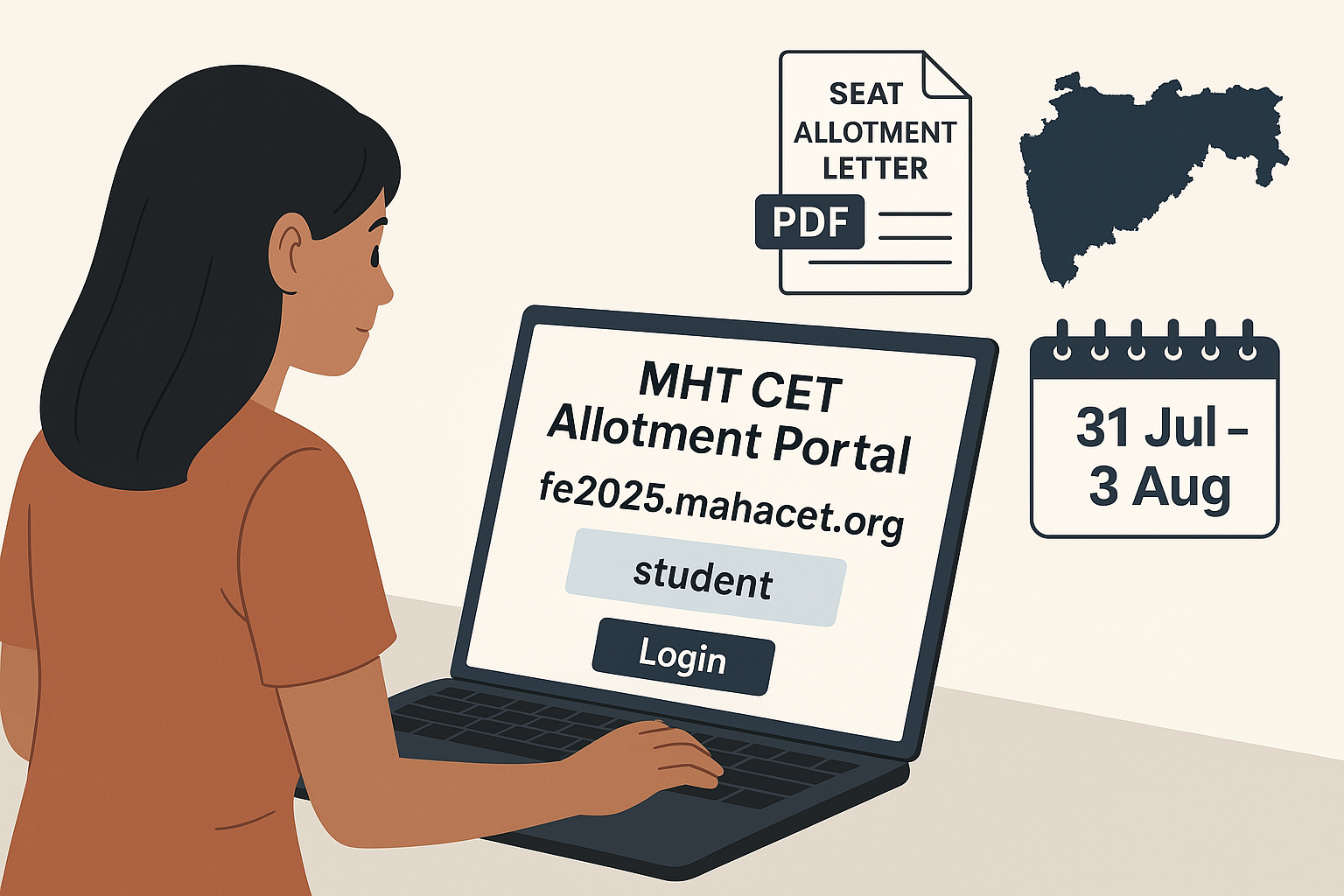
The Maharashtra CET Cell has released the CAP Round 1 seat allotment results for MHT CET 2025 this evening. Candidates can now log in at fe2025.mahacet.org, accept their seat, and prepare for the upcoming Round II counselling process.
Table of Contents
The Maharashtra State Common Entrance Test Cell has announced the CAP Round 1 seat allotment results for MHT CET 2025 on July 31, 2025. This marks an important milestone in the admission process for engineering, pharmacy, and other professional courses across Maharashtra. This comprehensive guide provides verified information about the seat allotment process, acceptance procedures, document requirements, and strategic guidance for candidates navigating the admission system.
Understanding MHT CET and Its Role in Maharashtra Admissions
The Maharashtra Common Entrance Test (MHT CET) serves as the primary entrance examination for admission to undergraduate professional courses in Maharashtra. The examination is conducted by the State Common Entrance Test Cell, operating under the Directorate of Technical Education, Maharashtra State. MHT CET evaluates candidates seeking admission to engineering, pharmacy, and agriculture programs across government and private institutions.
The examination assesses candidates in Physics, Chemistry, and Mathematics for engineering aspirants, or Physics, Chemistry, and Biology for pharmacy and agriculture candidates. The test employs a computer-based format with multiple-choice questions designed to evaluate subject knowledge and problem-solving abilities. Performance in MHT CET determines eligibility for the Centralized Admission Process (CAP) through which seats are allocated across participating institutions.
Maharashtra maintains one of India’s largest networks of technical education institutions, making MHT CET a critical pathway for thousands of students annually. The examination and subsequent admission process follow standardized procedures ensuring merit-based selection and transparent allocation across various quota categories including government-funded seats, institutional quotas, and reserved category provisions.
MHT CET 2025 Examination Timeline and Key Dates
Examination Schedule
The MHT CET 2025 examinations were conducted from May 2 to May 20, 2025, across multiple sessions to accommodate the large candidate pool. The examination utilized computer-based testing infrastructure at designated centers throughout Maharashtra. Candidates were assigned specific dates and time slots based on their registration details and selected examination groups.
The PCM (Physics, Chemistry, Mathematics) group examinations were conducted for engineering aspirants, while PCB (Physics, Chemistry, Biology) group tests were administered for pharmacy and agriculture candidates. Multiple sessions per day were organized during morning and afternoon time slots to manage the examination logistics effectively across the state.
Each examination session lasted for a specified duration with strict protocols for candidate verification, entry procedures, and examination conduct. The computer-based format ensured standardized testing conditions and automated scoring mechanisms for efficient result processing.
Result Declaration and CAP Timeline
The MHT CET 2025 results were declared on June 15, 2025, providing candidates with their scores and percentiles across tested subjects. The merit list was subsequently published on June 20, 2025, ranking candidates based on their performance and establishing their position for the admission process.
The Centralized Admission Process registration opened on July 1, 2025, allowing candidates to register for counseling and begin the admission journey. The option form filling period extended from July 5 to July 15, 2025, during which candidates submitted their college and course preferences. Document verification was conducted between July 16 and July 25, 2025, at designated centers across the state.
The Round 1 seat allotment results were announced on July 31, 2025, as scheduled by the Maharashtra CET Cell. The acceptance period for Round 1 allocations extends from August 1 to August 3, 2025, requiring candidates to confirm their acceptance and complete initial reporting procedures within this timeframe.
CAP Round 1 Seat Allotment Results: What You Need to Know
Accessing Your Allotment Results
The Round 1 seat allotment results are accessible through the official Maharashtra CET Cell admission portal at fe2025.mahacet.org. Candidates can also access results through the alternative portal at cetcell.mahacet.org, which serves as a backup during periods of high website traffic. Both portals provide identical information and maintain secure access protocols.
To check allotment results, candidates must log in using their application number or registration number assigned during the CAP registration process. Authentication requires either the candidate’s password created during registration or date of birth in the specified format. The portal includes security verification measures to protect candidate information and ensure authorized access.
The allotment result displays comprehensive information including the allocated institution name, specific course or branch assigned, category under which allocation occurred, and the cutoff rank for that particular seat. Candidates can download their provisional allotment letter in PDF format, which serves as an official document for subsequent admission procedures.
Understanding Your Allotment Information
The allotment letter contains several critical pieces of information that candidates must review carefully. The institution details include the complete name, location, and official contact information for the allocated college or university. Course specifications mention the program name, branch or specialization, duration, and any specific conditions applicable to that seat.
The allotment rank indicates the candidate’s merit position at which the particular seat was allocated, providing context about competitiveness and cutoff trends. Category information specifies whether allocation occurred under General, OBC, SC, ST, EWS, or other applicable quota provisions. This classification determines fee structures and documentation requirements during final admission.
Candidates should verify all information on the allotment letter for accuracy, including spelling of names, date of birth, category claims, and contact details. Any discrepancies should be reported immediately to the CET Cell helpdesk for rectification before proceeding with acceptance procedures.
The Seat Allotment Process: How CAP Determines Allocations
Merit-Based Allocation System
The MHT CET CAP seat allotment operates on an algorithm that processes candidate preferences against available seats based on merit rankings. The system begins with the highest-ranked candidate and processes their submitted preferences in the order specified during option form filling. If a seat matching the first preference is available in the candidate’s category, allocation occurs immediately.
If the first preference seat is unavailable due to prior allocation to higher-ranked candidates, the system evaluates the second preference, continuing sequentially through all submitted options. This process continues for each candidate in descending order of merit rank until all seats are allocated or all preferences are exhausted.
The algorithm ensures that no candidate receives a seat lower than what they would have obtained if manually processed, maintaining fairness and transparency throughout the allocation process. Real-time seat availability tracking prevents double allocation and ensures each seat is assigned to only one candidate.
Quota Category Implementation
The allocation system implements various quota provisions mandated by government regulations and institutional policies. The General or Open category seats are filled purely on merit without any relaxation provisions. Reserved category seats under SC, ST, OBC, and EWS quotas follow prescribed percentage allocations as per state government norms.
Maharashtra domicile candidates receive priority for certain seat categories, particularly in government and government-aided institutions where specific percentages are reserved for state residents. All India quotas in centrally funded institutions follow different allocation procedures managed through separate counseling processes.
Minority institution quotas, management quotas, and NRI quotas operate under specific guidelines with varying selection criteria and fee structures. The CAP process primarily handles government quota seats and institutional quota seats participating in the centralized process, while management quota admissions may follow institutional-specific procedures.
Tie-Breaking Mechanisms
When multiple candidates have identical MHT CET ranks, the system employs predetermined tie-breaking rules to determine precedence. The first tie-breaker considers individual subject scores, typically giving priority to Mathematics scores for engineering courses or Biology scores for pharmacy programs.
If the tie persists after subject score comparison, the candidate’s date of birth becomes the next criterion, with older candidates receiving preference. In rare cases where ties continue beyond these parameters, additional criteria including marks in qualifying examinations or alphabetical order of names may be applied as specified in the official CAP guidelines.
These tie-breaking mechanisms ensure objective and transparent resolution of ranking conflicts without requiring subjective evaluation or manual intervention in the allocation process.
Seat Acceptance Options: Freeze, Float, and Slide Explained
The Freeze Option
The Freeze option represents a final acceptance of the allocated seat with no participation in subsequent CAP rounds. Candidates choosing Freeze confirm their satisfaction with the current allocation and withdraw from further seat allotment processes. This option guarantees admission security as the seat remains confirmed regardless of subsequent round outcomes.
Choosing Freeze is appropriate for candidates who have received their preferred college and course combination or those prioritizing admission certainty over potential upgrades. Once a candidate selects Freeze and completes the acceptance process, they cannot re-enter the CAP process for alternative allocations in the same admission cycle.
The Freeze option provides complete closure to the admission process, allowing candidates to focus entirely on preparation for their academic program without monitoring subsequent counseling rounds. It eliminates uncertainty and enables early engagement with the allocated institution for orientation and preparation activities.
The Float Option
The Float option allows candidates to accept their current allocation while remaining in the pool for potential upgrades in subsequent rounds. Candidates selecting Float secure their currently allocated seat as a backup while the system continues evaluating their remaining higher preferences in Round 2 and beyond.
If a seat matching a higher preference becomes available in a subsequent round, the system automatically upgrades the candidate to the better option, and the previous seat is released back into the available seat pool. If no upgrade occurs, the candidate retains their original allocation from Round 1.
Float is the strategic choice for candidates who received acceptable but not ideal allocations and wish to pursue better opportunities without risking complete loss of admission. This option balances security with opportunity, providing a safety net while keeping upgrade possibilities open through the counseling process.
The Slide Option
The Slide option is specifically designed for candidates satisfied with their allocated institution but seeking a different branch or specialization within the same college. Choosing Slide freezes the institution allocation while keeping branch upgrade possibilities open within that specific institution only.
Unlike Float, which allows upgrades to different institutions and branches, Slide restricts upgrade opportunities to alternative branches at the same allocated college. This conservative approach suits candidates who prioritize institutional choice over specific branch preferences or those confident about the institution’s overall quality across programs.
Slide provides security regarding institution allocation while maintaining flexibility for branch optimization. If a preferred branch becomes available at the same institution in subsequent rounds, the upgrade occurs automatically. If not, the original branch allocation remains confirmed at the conclusion of the CAP process.
Seat Acceptance Process: Step-by-Step Procedure
Online Acceptance Timeline
The online seat acceptance period for CAP Round 1 extends from August 1 to August 3, 2025, with a strict deadline of 3:00 PM IST on the final day. Candidates must complete their acceptance decision and fee payment within this window to confirm their allocated seats. The online portal remains accessible 24×7 during this period to accommodate candidate convenience.
Late acceptance submissions beyond the deadline result in automatic forfeiture of allocated seats, which are then released into the vacant seat pool for subsequent rounds. The system does not provide extensions or grace periods, making timely action essential for securing admissions.
Completing Online Acceptance
To complete online acceptance, candidates log into the CAP portal using their credentials and navigate to the seat acceptance section. The system displays the allocated seat details and presents the three acceptance options: Freeze, Float, and Slide. Candidates must carefully review their allocation and select the appropriate option based on their preferences and strategies.
After selecting an option, candidates proceed to fee payment through the integrated payment gateway. The portal accepts multiple payment methods including net banking, debit cards, credit cards, and UPI-based transactions. Payment confirmation generates a receipt that must be saved for future reference and reporting purposes.
Upon successful fee payment, the system generates a provisional admission letter or seat acceptance confirmation document. Candidates should download this document immediately and maintain both digital and printed copies. This confirmation serves as proof of acceptance during physical reporting at the allocated institution.
Fee Structure for Acceptance
The acceptance fee structure varies based on candidate category. General and OBC category candidates pay an acceptance fee of ₹1,000, while SC and ST category candidates pay a reduced fee of ₹500. These fees are adjusted against the total admission fee during final admission at the institution.
The acceptance fee is non-refundable if a candidate later withdraws from the admission process or fails to complete physical reporting. However, for candidates proceeding with admission, the fee amount is credited toward the institution’s fee structure, effectively serving as an advance payment rather than an additional charge.
Payment receipts must be retained carefully as they may be required during document verification and final admission procedures at the allocated institution. The receipt serves as proof of acceptance and timeline compliance during the reporting process.
Physical Reporting and Document Verification
Required Documents Checklist
Candidates must report to their allocated institutions with original documents for verification and admission completion. The essential document list includes 10th standard mark sheet and passing certificate, 12th standard mark sheet and passing certificate, MHT CET 2025 admit card and scorecard, and the seat allotment letter downloaded from the CAP portal.
Category certificate is required for candidates claiming reservation benefits under SC, ST, OBC, or EWS quotas. The certificate must be issued by competent authority and follow the prescribed format specified by the Maharashtra government. Domicile certificate or Maharashtra residence proof is necessary for claiming domicile benefits where applicable.
Income certificate may be required for fee concession claims or scholarship eligibility verification. Transfer certificate from the previously attended institution and migration certificate for candidates who completed qualifying examinations under boards other than Maharashtra State Board are essential administrative documents for admission processing.
Additional requirements include recent passport-size photographs, Aadhaar card or other government-issued identity proof, and medical fitness certificate from a registered medical practitioner. Some institutions may have specific additional requirements, which are typically communicated through the allotment letter or institutional websites.
Reporting Timeline and Procedures
Physical reporting at allocated institutions must typically occur within the specified timeframe indicated in the allotment letter or official CAP notifications. Candidates should contact their allocated institutions immediately after acceptance to confirm reporting schedules and any institution-specific requirements.
The reporting process involves document verification where institution authorities examine original certificates against the information provided during CAP registration. Any discrepancies discovered during verification may lead to admission cancellation, making accuracy in registration details critically important.
After successful document verification, candidates complete admission formalities including fee payment for the academic session, form submission for institutional records, and receipt of admission confirmation documents. Some institutions may conduct orientation programs or provide information about academic calendars, hostel facilities, and commencement of classes during the reporting process.
CAP Round 2: Timeline and Preparation Strategy
Round 2 Schedule
The CAP Round 2 process begins with publication of vacant seats on August 4, 2025. This list includes seats that remained unfilled after Round 1 allocations, seats released by candidates who selected Float or Slide options and received upgrades, and seats vacated by candidates who failed to accept or complete reporting procedures.
The option entry window for Round 2 operates from August 5 to August 7, 2025, providing candidates a three-day period to submit fresh preferences or modify existing choices based on available vacant seats. Candidates can strategically adjust their preferences considering Round 1 cutoff trends and their position relative to available opportunities.
Round 2 seat allotment results are scheduled for announcement on August 11, 2025, following the same allocation algorithm used in Round 1 but processing only candidates participating in Round 2. The acceptance and reporting period for Round 2 allocations extends from August 12 to August 14, 2025, with similar Freeze, Float, and Slide options available.
Who Can Participate in Round 2
Round 2 participation is open to several candidate categories. Candidates who did not receive any seat allocation in Round 1 due to their preferences not matching available seats at their rank automatically remain in the pool for Round 2 consideration. These candidates can modify their option forms to include more institutions or branches with realistic cutoff expectations.
Candidates who selected Float option in Round 1 participate automatically in Round 2, with the system evaluating their higher preferences against newly available seats. If an upgrade occurs, their Round 1 seat is released; if not, they retain their original allocation with continued Float status for subsequent rounds if available.
Candidates who selected Slide option continue in Round 2 with evaluation limited to better branches at their allocated institution. New candidates who registered late or completed verification procedures after Round 1 may also participate if they meet eligibility criteria and timeline requirements.
Strategic Approach for Round 2
Candidates should analyze Round 1 cutoff trends and seat matrix changes before submitting Round 2 preferences. Understanding which seats filled at what ranks helps calibrate expectations and make realistic preference selections. Expanding preference lists to include more options increases allocation probability, particularly for candidates in competitive rank ranges.
Research vacant seat distributions by institution type, location, and branch to identify opportunities aligned with individual priorities. Some institutions or branches may have higher vacancy rates due to specific factors, presenting opportunities for candidates with appropriate rank ranges and preferences.
Maintain documentation readiness for immediate reporting if allocation occurs, as Round 2 acceptance windows remain time-constrained. Having documents organized, fees prepared, and backup plans established enables quick response to allocation outcomes without delays.
Recent CAP Reforms and System Changes
Four-Round Structure Implementation
Maharashtra has introduced a four-round CAP structure for the 2025 admission cycle, expanding from the previous three-round system. This modification aims to improve seat utilization, reduce vacancy rates, and provide additional opportunities for candidates to secure admissions in their preferred institutions and courses.
The expanded round structure distributes the admission process across more stages, potentially reducing pressure on individual rounds and allowing more gradual seat filling. Each round follows similar procedures of seat allocation, acceptance, and reporting, maintaining consistency in process mechanics while extending opportunity windows.
The additional round particularly benefits candidates in mid-range merit positions who may require multiple opportunities to secure optimal placements. It also assists institutions in achieving better enrollment rates by providing more chances to fill vacant seats through the centralized process.
Mandatory Freeze Requirements
New regulations introduce progressive mandatory freeze requirements across CAP rounds to reduce seat blocking by high-ranking candidates. Candidates receiving their first preference in Round 1 must select Freeze, eliminating their ability to hold premium seats while exploring other options in subsequent rounds.
In Round 2, candidates receiving allocations among their top three preferences face mandatory Freeze requirements. This escalates to top six preferences in Round 3, further restricting the ability of well-ranked candidates to hold multiple desirable options across rounds. The policy aims to release premium seats earlier in the process for candidates with lower ranks.
These reforms address the historical issue of seat blocking where high-ranking candidates would secure good seats but continue participating in subsequent rounds seeking marginal upgrades, preventing lower-ranked candidates from accessing those seats until very late in the admission cycle.
Institutional Seat Pooling
Round 4 introduces institutional-level seat pooling mechanisms that integrate certain management quota seats into the centralized allocation process. This reform increases seat availability through the transparent CAP system while reducing opacity in management quota admissions.
Participating institutions contribute specified numbers of seats to the common pool, which are allocated based on merit through the CAP algorithm. This ensures more seats are distributed through transparent, merit-based processes rather than institutional discretion, promoting fairness and accessibility.
The pooling mechanism follows the Karnataka CET model, which has demonstrated success in reducing admission irregularities and improving seat utilization rates. Maharashtra’s adoption of similar practices reflects progressive reform aimed at enhancing admission process integrity.
Understanding Cutoff Trends and Predictions
Government Engineering College Cutoffs
Government engineering colleges in Maharashtra represent the most competitive admission category due to their established reputation, lower fee structures, and perceived quality advantages. Premier institutions like College of Engineering Pune (COEP), VJTI Mumbai, and Government College of Engineering Aurangabad consistently demonstrate very high cutoff ranks.
Top branches like Computer Science and Engineering at premier government institutions typically require ranks within the top 1,000 candidates. Electronics and Telecommunication Engineering, Information Technology, and allied technology branches generally require ranks between 500 and 2,500 depending on the specific institution and competition levels.
Traditional core engineering branches including Mechanical, Civil, and Electrical Engineering at government colleges require ranks ranging from 1,000 to 8,000 depending on institutional tier and specific branch popularity. These cutoffs vary annually based on factors including examination difficulty, candidate performance distribution, and seat availability.
Private Institution Landscape
Private engineering colleges in Maharashtra offer diverse options across fee structures, infrastructure quality, and academic reputations. Deemed universities and autonomous institutions with established track records typically require ranks between 1,000 and 10,000 for popular branches, while regional private colleges may admit candidates with ranks extending to 25,000 or higher.
Branch-wise competition exists in private institutions similar to government colleges, with Computer Science and allied technology branches requiring substantially higher ranks than traditional core engineering disciplines. However, the rank differences between branches are typically smaller in private institutions compared to government colleges.
Fee structures significantly influence private institution cutoffs, with higher-fee institutions often requiring lower ranks due to affordability constraints limiting applicant pools. Candidates should evaluate total program costs including tuition, hostel, and other expenses when assessing private institution options against rank-based allocation probabilities.
Pharmacy Program Cutoffs
Pharmacy programs including B.Pharm and Pharm.D courses maintain distinct cutoff patterns compared to engineering courses. Government pharmacy colleges typically require ranks between 500 and 5,000 depending on location and institutional reputation. These colleges attract candidates due to lower fees and government institution status.
Private pharmacy colleges demonstrate wider rank ranges, generally admitting candidates with ranks between 2,000 and 15,000 depending on specific institutions and market positioning. Pharm.D programs, which lead to Doctor of Pharmacy degrees with clinical emphasis, often maintain slightly higher cutoffs than traditional B.Pharm courses due to enhanced career prospects.
Pharmacy cutoff trends have shown gradual increases in recent years due to growing awareness about pharmaceutical career opportunities, expanding healthcare sectors, and improved pharmacy education standards. Candidates with interest in pharmaceutical sciences should research career pathways and institutional capabilities when evaluating pharmacy options.
Strategic Decision-Making Framework
Evaluating College Options
Candidates should evaluate allocated or potential institutions across multiple dimensions beyond simple ranking or reputation considerations. Academic quality indicators include faculty qualifications, student-to-teacher ratios, curriculum relevance, research output, and accreditation status from bodies like NBA or NAAC.
Infrastructure assessment covers laboratory facilities, library resources, computational infrastructure, internet connectivity, and availability of modern educational technology. These factors directly impact learning experiences and practical skill development essential for professional success.
Placement records provide insights into institutional effectiveness in preparing students for employment. Examine placement percentages, companies visiting campus, salary ranges, and sector diversity of placed students. However, recognize that placement outcomes also depend significantly on individual effort, not solely institutional support.
Location considerations include proximity to home, industrial areas providing internship opportunities, cost of living, campus safety, and transportation connectivity. These factors affect both educational experience and financial burden during the academic program.
Financial Planning Considerations
Engineering and pharmacy education involves significant financial investment requiring careful planning. Tuition fees vary dramatically between government and private institutions, with government colleges charging substantially lower fees. Calculate total program costs including tuition, examination fees, and other institutional charges across the program duration.
Living expenses including accommodation, food, transportation, and personal needs add substantially to educational costs. Hostels typically cost less than private accommodation but may have limited availability. Day scholar options reduce expenses but may limit campus engagement opportunities.
Scholarship opportunities exist through government schemes, institutional programs, and private foundations. Merit-based scholarships reward academic performance, while need-based assistance supports economically disadvantaged students. Research available scholarship programs and eligibility criteria early in the admission process.
Education loans from banks and financial institutions provide funding options for students unable to pay fees upfront. Understand interest rates, repayment terms, moratorium periods, and collateral requirements when evaluating loan options. Many institutions have tie-ups with specific banks offering preferential terms to admitted students.
Career Alignment Assessment
Candidates should evaluate how potential allocations align with long-term career objectives and interests. Engineering branches vary significantly in career pathways, industry demand, and role types. Computer Science and IT branches lead predominantly to software development and technology sector careers, while core engineering branches offer opportunities in manufacturing, infrastructure, and traditional industries.
Emerging fields like Artificial Intelligence, Data Science, Robotics, and Sustainable Energy represent growing career areas with increasing demand but may not yet have established independent branches in many institutions. Consider how traditional branches can be adapted toward these emerging areas through elective selections and specialized certifications.
Pharmacy careers span pharmaceutical manufacturing, hospital pharmacy, retail pharmacy, drug regulatory affairs, and pharmaceutical research. Pharm.D programs particularly prepare for clinical pharmacy roles requiring patient interaction and healthcare team collaboration. Assess personal interest in these varied career paths when evaluating pharmacy admissions.
Research career trends in various engineering and pharmacy sectors to make informed decisions aligned with future employment landscapes. Industries undergo continuous transformation due to technological advancement, making adaptability and continuous learning essential regardless of specific branch choices.
Maximizing Admission Success: Practical Tips
Timeline Management
Successful navigation of the CAP process requires disciplined timeline management. Check allotment results immediately upon declaration rather than delaying, as this maximizes time available for decision-making and documentation preparation. Procrastination increases stress and may lead to rushed decisions or missed deadlines.
Complete seat acceptance and fee payment early in the acceptance window rather than approaching the deadline. Early action provides buffer against technical issues, payment gateway problems, or unexpected circumstances that might interfere with last-minute submissions.
Prepare document sets in advance with multiple photocopies of all certificates, properly attested where required. Having documents ready eliminates scrambling during reporting periods and ensures smooth admission completion. Verify that all original documents are accessible and not engaged in other processes during reporting timelines.
Information Verification
Always verify critical information through official sources rather than relying on secondary channels or unverified social media posts. The official Maharashtra CET Cell website and authorized admission portal contain accurate, current information about dates, procedures, and requirements.
Cross-reference important information across multiple official sources when possible. Press releases, official notifications, and help desk communications should align consistently. Discrepancies warrant direct clarification with authorities rather than assumptions.
Be cautious about information from coaching centers, informal student groups, or commercial education portals that may contain outdated, inaccurate, or misleading content. While these sources may provide useful perspectives, critical decisions should rest on officially verified information.
Communication Strategy
Maintain open communication with family members or guardians throughout the decision-making process. Important choices about institution selection, financial commitments, and career directions benefit from collaborative discussion rather than isolated decision-making.
Contact allocated institutions directly to clarify reporting procedures, fee structures, hostel availability, and other specific concerns. Institutional offices can provide authoritative answers to queries not addressed in general CAP documentation.
Keep contact information current in your CAP profile to ensure receipt of official communications via SMS and email. Regularly check registered email accounts and mobile messages during the admission period for important updates or changes in schedules.
Backup Planning
Despite thorough preparation, not all candidates receive desired allocations in initial rounds. Maintain realistic expectations aligned with your rank and competition levels. Having backup options identified in advance reduces disappointment and enables quick pivoting toward alternative opportunities.
Research backup institutions and courses before allotment results to facilitate rapid decision-making if primary preferences are unavailable. Understanding the full range of acceptable options enables better preference form preparation and reduces post-allotment uncertainty.
Consider alternative examinations or admission pathways if CAP outcomes are unsatisfactory. Other state CETs, national-level examinations, and direct institutional admissions provide multiple routes to engineering and pharmacy education. Keeping alternative pathways open provides insurance against unfavorable CAP outcomes.
Key Takeaways for MHT CET Candidates
The CAP Round 1 seat allotment marks a significant milestone in the Maharashtra engineering and pharmacy admission process. Candidates who received allocations must act decisively within the acceptance timeline of August 1-3, 2025, selecting appropriate options aligned with their preferences and strategic objectives.
Understanding the differences between Freeze, Float, and Slide options enables optimal decision-making balancing admission security against upgrade opportunities. Candidates satisfied with their allocations should Freeze for certainty, while those seeking potential improvements should Float to maintain upgrade possibilities in subsequent rounds.
Comprehensive document preparation and timely physical reporting at allocated institutions ensures smooth admission completion. Missing reporting deadlines or having incomplete documentation can jeopardize admissions despite successful seat allocation, making preparation and punctuality critical.
Round 2 provides additional opportunities for unallotted candidates and those seeking upgrades. Strategic preference revision based on Round 1 trends and vacant seat analysis increases success probability in subsequent rounds for candidates continuing in the CAP process.
The reformed four-round system with progressive freeze requirements aims to improve overall fairness and seat utilization. Understanding these reforms helps candidates navigate the evolving process effectively and maximize their admission outcomes.
Maharashtra’s extensive technical education infrastructure offers diverse quality options across government and private institutions. Thoughtful evaluation of institutional characteristics, financial implications, and career alignment ensures selections supporting long-term educational and professional success beyond simple ranking considerations.
Frequently Asked Questions (FAQs)
When and where were the MHT CET CAP Round 1 seat allotment results declared?
The Maharashtra State CET Cell declared the CAP Round 1 seat allotment results on July 31, 2025, as per the published schedule. Results are accessible through the official admission portal at fe2025.mahacet.org and the alternative portal at cetcell.mahacet.org. Candidates can log in using their application number and password or date of birth to view their allocation details. The results include allocated institution name, course details, category, and cutoff information. Both portals remain accessible 24×7 with mobile-responsive interfaces for convenient access.
What is the deadline for accepting allocated seats in CAP Round 1?
Candidates allocated seats in CAP Round 1 must complete their acceptance and fee payment between August 1 and August 3, 2025, with a strict deadline of 3:00 PM IST on August 3. The acceptance process requires logging into the CAP portal, selecting an appropriate option (Freeze, Float, or Slide), and completing online fee payment. General and OBC category candidates pay ₹1,000 while SC and ST candidates pay ₹500 as acceptance fees. Failure to complete acceptance within this timeline results in automatic forfeiture of the allocated seat.
What are Freeze, Float, and Slide options and which should I choose?
Freeze means accepting your current seat and exiting all future rounds, suitable for candidates satisfied with their allocation who prioritize admission certainty. Float accepts the current seat while maintaining eligibility for upgrades to better colleges or branches in subsequent rounds, ideal for candidates with acceptable but not optimal allocations. Slide accepts the college but allows branch changes only within the same institution, appropriate for candidates happy with their college but seeking different specializations. Choose based on your satisfaction level with the current allocation and willingness to pursue potential upgrades versus securing immediate admission.
What documents are required for physical reporting at allocated institutions?
Required documents include original 10th and 12th standard mark sheets and passing certificates, MHT CET 2025 scorecard and admit card, provisional allotment letter from the CAP portal, caste certificate for reserved category candidates, domicile certificate for Maharashtra residence claims, income certificate for fee concessions, transfer certificate from previous institution, migration certificate for students from other educational boards, recent passport-size photographs, Aadhaar card or government identity proof, and medical fitness certificate. Candidates should verify institution-specific requirements through allotment letters or institutional communications as some colleges may have additional documentation needs.
What is the complete schedule for CAP Round 2 and who can participate?
CAP Round 2 follows this timeline: vacant seat list publication on August 4, 2025, option entry window from August 5-7, Round 2 allotment results on August 11, and acceptance plus reporting from August 12-14, 2025. Eligible participants include candidates who did not receive any allocation in Round 1, candidates who selected Float option in Round 1 seeking upgrades, candidates who chose Slide option for branch changes at their allocated institution, and new candidates completing late registrations or verifications. All participating candidates can modify preferences based on available vacant seats and Round 1 cutoff trends.
How is the seat allotment process conducted in MHT CET CAP?
The seat allotment algorithm processes candidates in descending order of merit rank, evaluating submitted preferences sequentially against available seats. For each candidate, the system checks if their first preference is available in their category quota. If available, allocation occurs immediately; if not, the system proceeds to evaluate subsequent preferences in order. This continues until a match is found or all preferences are exhausted. The algorithm ensures no candidate receives a lower preference than they would have obtained through any other processing method. Quota provisions for SC, ST, OBC, EWS, and domicile categories are implemented according to government regulations throughout the allocation process.
What are the key reforms introduced in Maharashtra CAP system for 2025?
Maharashtra has implemented several significant reforms for the 2025 admission cycle. The CAP structure has expanded from three rounds to four rounds, providing additional opportunities for seat allocation and upgrades. Progressive mandatory freeze requirements now apply: candidates receiving first preference in Round 1 must Freeze, top three preferences in Round 2 require Freeze, and top six in Round 3 mandate Freeze. These requirements aim to reduce seat blocking by high-ranking candidates. Round 4 introduces institutional seat pooling where management quota seats are integrated into the centralized process. These reforms, inspired by the Karnataka CET model, promote fairer seat distribution and improved utilization rates.
How should I prepare strategically if I selected Float or Slide option?
Candidates who selected Float or Slide should actively prepare for Round 2 participation by analyzing Round 1 cutoff trends across institutions and branches to understand competitive landscapes. Review the vacant seat list published on August 4 thoroughly to identify new opportunities matching your preferences and rank. Consider expanding your preference list to include additional realistic options based on Round 1 allocation patterns. Maintain all documents in ready state for immediate reporting if an upgrade occurs in Round 2. Research newly available institutions or branches that might offer better opportunities than initially considered. Stay informed about Round 2 timelines and ensure availability during the option entry window of August 5-7 and potential reporting period of August 12-14, 2025.
About the Author
Nueplanet is an educational content specialist with comprehensive expertise in engineering entrance examinations and admission processes across India. With detailed knowledge of state-level CET systems and centralized admission procedures, Nueplanet provides accurate, verified guidance helping students navigate complex admission landscapes. All content is thoroughly researched using official state CET Cell notifications, government regulations, and verified institutional information to ensure complete accuracy and reliability for student readers.
Commitment to Accuracy: This article is based exclusively on official Maharashtra State CET Cell communications, published CAP schedules, and verified admission procedures. Information is regularly updated to reflect the latest official announcements and procedural changes.
Last updated: August 01, 2025|| Published : August 01, 2025
Disclaimer: This article provides informational guidance based on official sources and published admission procedures. Candidates must verify all critical information including specific dates, document requirements, and procedural details through official Maharashtra CET Cell channels at cetcell.mahacet.org and fe2025.mahacet.org for the most current and authoritative information.
Stay informed about important admission updates, examination notifications, and educational opportunities. Monitor official sources regularly for verified, timely information supporting your academic and career objectives.
Helpful Resources
Economic Times – MHT CET CAP Round 1 Allotment Results Out at fe2025.mahacet.org (The Economic Times)
BestColleges IndiaToday – How to Check Allotment Steps (Best Colleges)
Times of India – Reforms & Additional CAP Rounds Details (The Times of India)
Times of India – Karnataka Admission Best Practices Visited by Maharashtra Team (The Times of India)
Latest Posts
- Aditya Infotech IPO: ₹1,300 Crore Issue Set to Launch July 29, GMP Near 30%
- Kotak Bank Share Price 2025 Review: Why Shares Sank in Q1 & What Lies Ahead
- Laurus Labs Share Price: Q1 Surge, Land Allotment & Market Outlook
- Adani Green Share Price: Q1 Jump, Valuation & Outlook for 2025
- Operation Mahadev: Kashmir Encounter & Pahalgam Attack Mastermind Neutralized
- International Tiger Day 2025: India Roars as Global Leader in Tiger Conservation












Post Comment