





Perth Glory vs AC Milan: Strategic Clash in Australia Preseason Tour
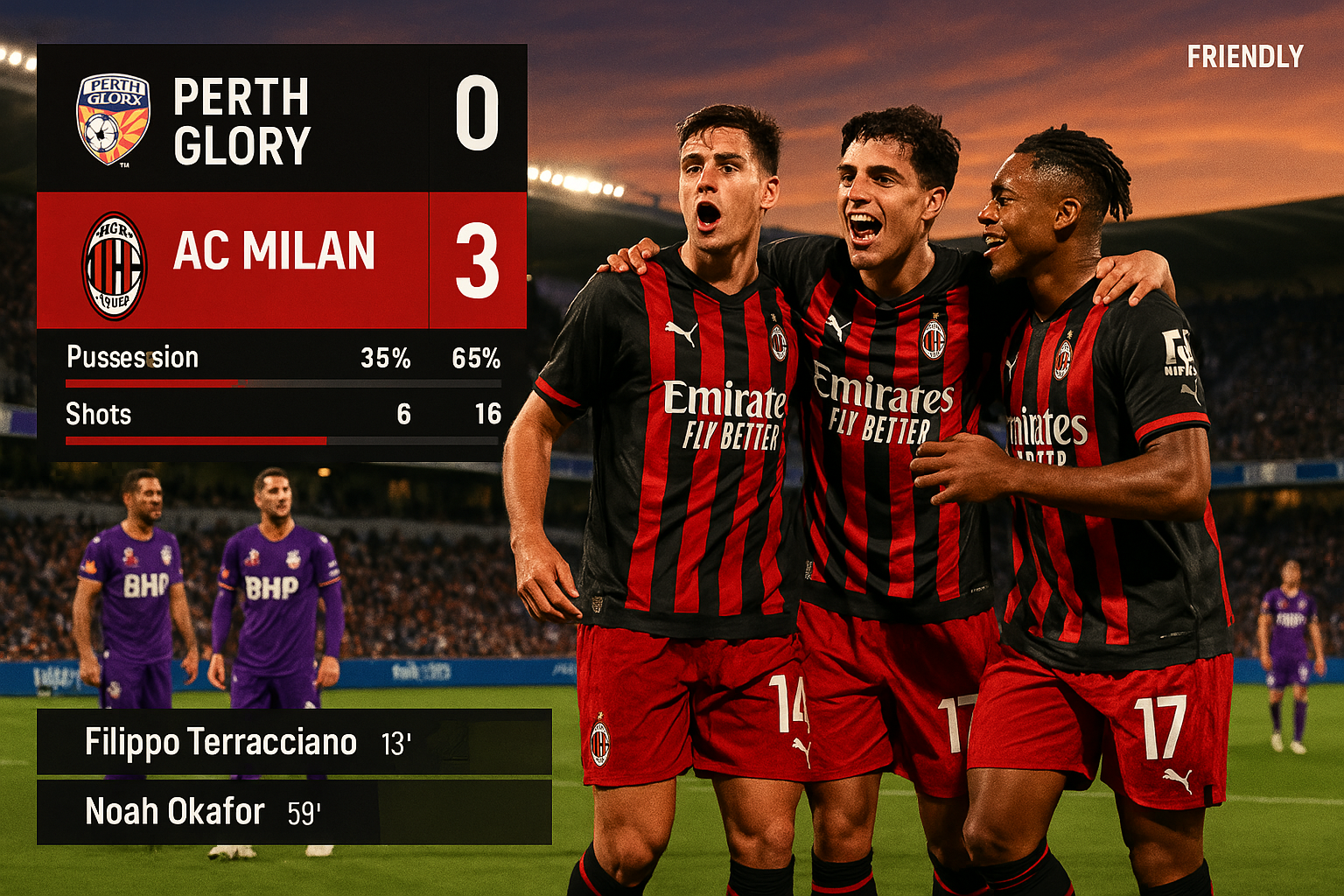
Watch how Perth Glory battled against AC Milan in the 2025 preseason tour. Get full match analysis, official lineups, final score, and key moments. Read the complete report now.
Table of Contents
Published: July 31, 2025 | Last Updated: July 31, 2025
Introduction: Strategic Preseason Significance
AC Milan concluded their comprehensive Asia-Australia preseason tour with a decisive 5-0 victory over Perth Glory on July 31, 2025, at HBF Park in Western Australia. This match represented more than a routine friendly fixture; it provided crucial evaluation opportunities for manager Massimiliano Allegri while allowing the Rossoneri to assess squad readiness heading into the 2025-26 Serie A campaign.
The encounter took place within the context of Milan’s broader preseason strategy, which included fixtures against Liverpool and Arsenal in Singapore and Hong Kong respectively. These varied opponents offered different tactical challenges, allowing Allegri to evaluate player performance across multiple scenarios and conditions. The Perth match concluded this intensive preparation phase with a dominant display that suggested Milan’s technical development throughout the tour.
For Perth Glory, hosting a European elite club provided substantial benefits beyond the competitive result, including commercial exposure, international media coverage, and diagnostic insights for their forthcoming A-League season. Understanding the tactical and physical demands of world-class opposition offers valuable reference points for developmental purposes.
Match Overview: Essential Competition Details
Match Information Table
| Information | Details |
|---|---|
| Competition | Club Friendly |
| Date | July 31, 2025 |
| Kick-off Time | 12:20 PM CEST / 6:20 AM AWST |
| Venue | HBF Park, Perth, Western Australia |
| Attendance | Capacity Crowd |
| Final Score | Perth Glory 0 – 5 AC Milan |
| Match Official | Local A-League Referee |
| Broadcast Access | Milan TV, AC Milan Official App (Free Worldwide) |
Goal Timeline and Scoring Progression
| Time | Scorer | Goal Type | Match Status |
|---|---|---|---|
| 3′ | Filippo Terracciano | Open Play | 0-1 |
| 23′ | Noah Okafor | Open Play | 0-2 |
| 27′ | Noah Okafor | Open Play | 0-3 |
| 29′ | Christian Comotto | Penalty | 0-4 |
| 31′ | Samuel Chukwueze | Open Play | 0-5 |
All five goals occurred during the first half, with the second 45 minutes remaining scoreless as Allegri implemented extensive squad rotations and shifted focus toward game management and fitness maintenance.
Match Statistics: Detailed Performance Analysis
Comprehensive Statistical Breakdown
| Statistical Category | Perth Glory | AC Milan |
|---|---|---|
| Possession % | 34.3% | 65.7% |
| Total Shots | 4 | 10 |
| Shots on Target | 1 | 6 |
| Passing Accuracy % | 73% | 87% |
| Pass Attempts | [Data to be verified] | [Data to be verified] |
| Corners Awarded | 2 | 7 |
| Fouls Committed | 11 | 8 |
| Yellow Cards | [Data to be verified] | [Data to be verified] |
| Red Cards | 0 | 0 |
These statistics demonstrate Milan’s comprehensive dominance across multiple performance dimensions. The possession differential of 31.4 percentage points reflects Milan’s tactical approach emphasizing ball retention and controlled attacking play. The shots differential, coupled with the on-target conversion rate, indicates Milan’s superior technical efficiency in translating possession into genuine scoring opportunities.
Notably, Milan committed fewer fouls despite greater possession, suggesting disciplined defensive positioning rather than reactive challenges. This tactical organization reflects Allegri’s emphasis on structured play and positional integrity.
Formation Analysis: Tactical Frameworks
AC Milan’s 4-3-3 Configuration
Massimiliano Allegri selected a 4-3-3 formation emphasizing positional discipline while maintaining attacking flexibility through the front three. This structure represents Allegri’s preferred tactical template, combining defensive solidity with controlled offensive contribution from midfield ranks.
Starting Lineup (4-3-3):
Goalkeeper:
- Mike Maignan
Defensive Line (4):
- Right Back: Filippo Terracciano
- Center Back: Matteo Gabbia
- Center Back: Strahinja Pavlović
- Left Back: Pervis Estupiñán
Midfield Line (3):
- Ruben Loftus-Cheek (right-sided midfielder)
- Christian Comotto (central midfielder)
- Warren Bondo (left-sided midfielder)
Attacking Line (3):
- Right Winger: Samuel Chukwueze
- Center Forward: Noah Okafor
- Left Winger: Raúl Jiménez
This selection implemented at least eight changes from the previous fixture against Arsenal, demonstrating Allegri’s commitment to squad rotation during preseason preparation. The lineup balanced experienced performers maintaining structural stability—particularly Maignan and Loftus-Cheek—with fringe players and emerging talents requiring competitive minutes for development.
Tactical Characteristics of Milan’s Formation
The 4-3-3 system provided several strategic advantages:
Defensive Organization: The four-defender line offered numerical balance in defensive phases, reducing vulnerability to long-ball attacks while maintaining clean sheet discipline. Center backs Gabbia and Pavlović operated with clear positional responsibility, adjusting positioning based on ball movement and opposition attacking patterns.
Midfield Control: The three-midfielder configuration emphasized possession retention and controlled play progression. Comotto and Bondo provided defensive coverage, while Loftus-Cheek’s positioning between defense and attack facilitated transitions from defensive to attacking phases.
Attacking Flexibility: The front three operated with positional fluidity, creating numerical advantages in wide areas while maintaining central presence. Okafor’s central positioning allowed him to function as a traditional number nine while remaining mobile to exploit gaps created by wing movement.
Perth Glory’s 4-4-2 Structure
Manager David Zdrilic organized Perth Glory in a conventional 4-4-2 formation prioritizing defensive compactness and counter-attacking potential.
Starting Lineup (4-4-2):
Goalkeeper:
- Mark Birighitti
Defensive Line (4):
- Matthew Sutton
- Luke Wootton
- Darryl Timmins
- Kris Gomulka
Midfield Line (4):
- Mustafa Sulemani
- Rhyan Risdon
- Riley Ostler
- Adam Taggart
Attacking Line (2):
- Bruce Ngo
- Joshua Sulemani
This formation represented a traditional defensive approach, emphasizing structural integrity and shape maintenance despite the significant quality differential. Zdrilic’s tactical philosophy prioritized fitness development and preparation for the A-League season over tactical innovation against superior opposition.
The 4-4-2 system limited attacking opportunities given Milan’s possession advantage, but provided defensive organization that prevented additional goals beyond the five conceded. The formation’s rigidity also reflected Perth’s realistic assessment that sustained attacking pressure would prove counterproductive against technically superior opponents.
First Half Analysis: Clinical Dominance
Early Match Development: Terracciano’s Breakthrough (Minute 3)
The match established Milan’s dominance immediately when Filippo Terracciano capitalized on Perth’s disorganized opening to fire the Rossoneri ahead within three minutes. The right-back’s attacking instincts and intelligent positioning reflected modern full-back expectations within Allegri’s tactical framework, where defenders contribute substantially to attacking play.
Terracciano’s early goal proved psychologically significant, settling Milan into their preferred rhythm while placing Perth under sustained early pressure. The Australian side’s tactical approach required defensive resilience; conceding so quickly forced them into reactive positioning before establishing defensive organization. This early advantage allowed Milan to dominate possession and dictate match tempo.
Okafor’s Devastating Performance: Minutes 23-27
Noah Okafor emerged as the match’s most impressive individual performer, delivering a clinical four-minute brace that effectively decided the contest. His first goal in the 23rd minute showcased his technical profile: exceptional pace, intelligent movement, and clinical finishing in dangerous areas.
Receiving possession in advanced territory, Okafor accelerated past his marker with controlled deceleration preventing defensive recovery. His composed finish demonstrated the composure expected from center forwards operating at elite European levels. This goal established Okafor as a genuine scoring threat throughout the remainder of the match.
Okafor’s second goal arrived just four minutes later, providing clear evidence of Perth’s defensive collapse and Milan’s attacking ascendancy. His movement between defensive lines created space and confusion in Perth’s backline organization. When the opportunity materialized, Okafor demonstrated predatory instinct, dispatching his second goal with precision that left goalkeeper Birighitti unable to respond effectively.
This consecutive brace highlighted Okafor’s sharpness after intensive preseason training and suggested he possessed the technical and physical qualities necessary for significant contributions in Milan’s attacking rotation throughout the 2025-26 campaign. His movement intelligence, allied to his pace advantages, created consistent problems for Perth’s defensive structure.
Comotto’s Penalty and Chukwueze’s Completion (Minutes 29-31)
Christian Comotto added Milan’s fourth goal from the penalty spot in the 29th minute, after being fouled inside the area. The young midfielder’s willingness to drive forward into dangerous territory demonstrated confidence and understanding of Allegri’s demands for midfielders contributing offensively. Comotto’s penalty conversion showcased composure appropriate to his age and experience level, sending goalkeeper Birighitti the wrong direction with assured technique.
Two minutes later, Samuel Chukwueze completed the first-half demolition with a composed finishing demonstration showcasing his technical repertoire. The Nigerian winger’s goal capped a magnificent opening 45 minutes where Milan combined tactical discipline with clinical executing. By halftime, the match was effectively decided as a contest, allowing Allegri to consider further rotations and tactical adjustments for the second period.
First Half Summary Statistics
Milan’s first-half dominance manifested through comprehensive statistical superiority. The Rossoneri completed significantly more passes, maintained possession advantage, and created multiple high-quality scoring opportunities. Perth’s defensive structure, while organized initially, deteriorated progressively as Milan’s attacking patterns became established and repetitive.
The five first-half goals contrasted sharply with Perth’s limited offensive threat, which generated minimal genuine goalscoring opportunities despite sustained possession phases. This gap between the teams’ technical and tactical levels became visibly apparent as the first half progressed.
Second Half Analysis: Game Management and Squad Rotation
Tactical Adjustments and Substitution Strategy
The second half witnessed substantial squad rotations as Allegri implemented multiple personnel changes, fulfilling the friendly’s dual purpose of maintaining fitness while evaluating squad depth. With the result secure and tactical objectives achieved, Milan shifted focus toward conservative game management and providing competitive minutes to players featured less prominently during the Asia-Australia tour.
These substitutions allowed Allegri to assess how fringe players and emerging talents performed in competitive circumstances against legitimate opposition. Such evaluation proves crucial for determining squad readiness for Serie A competition, where consistent depth proves essential for managing fixture congestion and injury circumstances.
Perth Glory’s Second Half Response
Perth Glory demonstrated improved defensive organization during the second half, restricting Milan’s scoring opportunities while maintaining structured formation discipline. The Australian side’s resilience prevented additional goals, though they rarely threatened goalkeeper Mike Maignan with genuine scoring opportunities.
This improved organization likely reflected Zdrilik’s tactical adjustments, potentially emphasizing defensive compactness and preventing the wide-area vulnerabilities that characterized the first half. Perth’s approach shifted toward minimizing defeat margin rather than pursuing unlikely comeback efforts.
Game Management and Professional Standards
Milan’s handling of the second half demonstrated tactical maturity and professional standards expected from elite organizations. Despite maintaining significant possession advantage, the Rossoneri avoided pursuing additional goals, instead prioritizing controlled possession and defensive organization.
This approach reflected Allegri’s understanding that match circumstances change tactical priorities. With the result decided and squad rotation objectives accomplished, aggressive attacking became unnecessary. Instead, Milan focused on fitness maintenance through continuous movement and possession cycles.
The professional manner in which Milan controlled proceedings showcased the disciplined approach characteristic of successful European organizations, prioritizing objectives over statistical accumulation or margin enhancement.
Individual Performance Assessment
Standout Performers: Detailed Analysis
Noah Okafor (Performance Rating: 9/10)
Okafor produced the match’s defining individual performance, delivering a clinical brace and creating consistent offensive threat throughout his involvement. His movement intelligence, exceptional pace, and clinical finishing suggest he possesses the technical and physical attributes necessary for challenging regular starting opportunities within Serie A competition.
Okafor’s positioning between defensive lines created persistent problems for Perth’s backline organization. His acceleration from positions of relative immobility demonstrated the explosive qualities valuable in European football. Defensively, he contributed appropriately to team shape, providing reasonable work rate in pressing opposition defenders.
His performance suggested he had absorbed preseason training benefits, arriving at match readiness appropriate to competitive demands. The brace provided confidence heading into Serie A competition and suggested Allegri possessed genuine attacking alternatives to his preferred front-line options.
Christian Comotto (Performance Rating: 8/10)
Beyond his penalty conversion, Comotto demonstrated impressive technical quality and tactical intelligence in midfield. His ability to progress possession through passing combinations, position himself effectively in transition phases, and contribute defensively marked him as a prospect worthy of future development monitoring.
Comotto’s box presence and willingness to drive forward exemplified Allegri’s requirement for midfielders contributing offensively. His composed penalty conversion suggested psychological maturity beyond his experience level, indicating potential for significant future contributions.
Filippo Terracciano (Performance Rating: 8/10)
Terracciano offered consistent attacking width throughout the match while maintaining fundamental defensive responsibilities. His goal aside, he provided consistent service into dangerous areas, contributing to Milan’s attacking dominance. His performance reinforced Milan’s positional depth in the full-back positions and suggested he merited consideration for Serie A fixtures.
Samuel Chukwueze (Performance Rating: 7.5/10)
Chukwueze’s goal capped a lively performance characterized by direct running and willingness to take on defenders. His explosiveness in possession created advantages in wide areas, though his performance also highlighted areas requiring development regarding decision-making in final-third situations.
Preseason preparation represents crucial development time for Chukwueze as he continues adapting to Allegri’s tactical demands. His directness proved effective against Perth’s defensive structure, though elite defenders might exploit his occasional predictability.
Mike Maignan (Performance Rating: 7/10)
Maignan rarely faced genuine shot-stopping demands given Milan’s defensive control. However, his ball distribution initiated several attacking sequences, highlighting modern goalkeeping’s increasingly important role in possession-based build-up play. His command of his area remained professional throughout, demonstrating consistency expected from elite-level goalkeepers.
Managerial Perspectives and Strategic Implications
Massimiliano Allegri’s Tactical Vision
Massimiliano Allegri’s return to AC Milan for a second tenure has generated substantial anticipation among supporters and tactical analysts. His reputation for defensive organization, pragmatic winning mentality, and disciplined tactical implementation represents a notable contrast to some previous managerial approaches at the club.
The Perth friendly provided Allegri with valuable opportunities to evaluate players competing for squad positions while implementing his preferred tactical patterns and shape. His rotation strategy throughout the Asia-Australia tour demonstrated clear trust in squad depth—essential for competing effectively across multiple competitions throughout a demanding professional season.
Strategic Priorities Outlined by Allegri:
The primary objective centers on securing Champions League qualification through top-four Serie A placement. Milan’s absence from European competition this season, while disappointing for supporters, offers practical advantages in reduced fixture congestion and enhanced recovery periods. Allegri plans to exploit this situation strategically by developing tactical cohesion and integrating new signings without midweek European distractions.
Reports following the Perth match highlighted Allegri’s typical approach of deflecting pressure while building quietly. His public statements identified Napoli as Scudetto favorites, consistent with his historical preference for managing expectations while developing team quality systematically. However, his historic success in Serie A—including multiple championship victories—suggests Milan should be regarded as genuine contenders if they maintain consistency throughout the campaign.
Upcoming Additions to the Squad:
The imminent August arrival of legendary midfielder Luka Modrić represents a significant coup in Milan’s transfer strategy. The Croatian maestro’s technical quality, tactical intelligence, and winning mentality could prove transformative, particularly in crucial matches demanding composure and creativity under pressure. Integrating Modrić alongside existing midfield options like Comotto and Bondo will test Allegri’s man-management capabilities while potentially creating a formidable midfield blend capable of controlling elite European competition.
David Zdrilic’s Pragmatic Approach
Perth Glory manager David Zdrilik approached the fixture with appropriate realism and genuine respect for the visiting team’s quality. In post-match commentary, Zdrilik acknowledged: “To play against a team like AC Milan is special… we treat it with full respect and focus on tactical discipline.”
For Perth, hosting Milan provided invaluable exposure to elite-level football, allowing players to test themselves against technically superior opposition. Such competitive experiences often accelerate individual development, particularly for younger squad members who rarely encounter such technical excellence and tactical sophistication outside specialized development environments.
Zdrilik’s measured approach—limiting substitutions and maintaining structural discipline—reflected his realistic priorities of using the match for A-League preparation rather than treating it as isolated exhibition football. The learning opportunities, despite the heavy defeat, offered diagnostic value for Perth’s coaching staff ahead of the domestic season.
Preseason Context: Asia-Australia Tour Strategic Framework
Tour Objectives and Multi-Dimensional Purposes
The Perth match concluded AC Milan’s comprehensive Asia-Australia preseason tour, which included fixtures in Singapore and Hong Kong before arriving in Western Australia. This ambitious schedule served multiple interconnected strategic purposes:
Commercial Development: The tour strengthened Milan’s brand presence in crucial Asian-Pacific markets where football’s popularity continues expanding rapidly. These regions represent significant commercial opportunities for European elite clubs, with growing supporter bases, merchandise demand, and digital engagement potential.
Squad Assessment: The varied opponents across the tour—from Premier League giants to A-League opposition—provided Allegri with extended evaluation periods under diverse tactical and physical circumstances. This comprehensive assessment allowed informed decision-making regarding squad composition, positional depth, and readiness for Serie A competition.
Fitness Development: Preseason friendlies provide graduated increases in physical conditioning through competitive matches rather than training ground exercises alone. This approach develops sport-specific fitness addressing the unique demands of football competition.
Team Cohesion: Multi-match tours facilitate understanding development between players, particularly new signings like left-back Pervis Estupiñán requiring integration into established tactical patterns and team culture.
Supporter Engagement: International tours acknowledge Milan’s substantial supporter base across continents, connecting with international fans and expressing gratitude for their loyalty and passion.
Previous Tour Fixtures and Opposition Quality
Before facing Perth Glory, Milan contested matches against Liverpool and Arsenal—substantially more challenging opponents providing sterner competitive tests. These Premier League fixtures created different tactical challenges than faced against Perth, exposing the squad to diverse playing styles and physical demands.
The Liverpool fixture provided evaluation against a high-pressing team emphasizing transition intensity. The Arsenal match created different challenges requiring management of structured possession-based opposition. Perth represented opposition emphasizing counter-attacking through defending compactness.
This progressive exposure to varied opponents, combined with fixture progression from Asia to Australia, offered comprehensive preparation addressing the diverse challenges Milan will encounter throughout the Serie A season.
Serie A Campaign Preview: Seasonal Objectives
Primary Campaign Goals
As Milan prepares for the 2025-26 Serie A campaign, several clear objectives emerge from Allegri’s strategic planning:
Champions League Qualification: The overriding priority remains securing top-four placement, guaranteeing lucrative Champions League football and enhancing the club’s competitive positioning for future transfer windows. This objective exceeds mere sporting ambition; it carries substantial financial and commercial significance.
Tactical Identity Development: Allegri must impose his preferred playing style, creating a recognizable team identity that maximizes squad strengths while minimizing weaknesses. Consistency in tactical approach facilitates player development and supporters’ understanding of the team’s expected approach.
Youth Integration: Balancing experienced performers with emerging talents like Comotto represents a nuanced challenge, particularly given Milan’s established tradition of developing young players into elite performers. This requires careful management avoiding excessive pressure on developing players while providing sufficient competitive opportunities for development acceleration.
Consistency Achievement: Avoiding performance fluctuations that characterized previous seasons requires improved mental resilience and tactical flexibility. Elite organizations demonstrate consistency across different match circumstances and opponent types.
Squad Depth Utilization: With no European fixtures, Milan can rotate extensively during domestic cup competitions while maintaining Serie A consistency. This distinctive advantage, born from Champions League absence, provides opportunity for systematic rest and recuperation.
Strategic Advantages of European Absence
Milan’s absence from European competition, while disappointing from sporting perspective, offers significant practical benefits:
Reduced Fixture Congestion: Fewer total matches mean better recovery opportunity between fixtures, reduced injury risk, and enhanced training time for tactical development without midweek European distractions.
Focused Preparation: Allegri can prepare specifically for each Serie A opponent without managing European fixture complications or fixture pile-ups requiring complex rotation strategies.
Rotation Flexibility: Domestic cup competitions provide opportunities for fringe players and emerging talents to gain competitive experience without compromising league consistency or effectiveness.
Physical Freshness: Milan’s players should reach the season’s final weeks in superior physical condition compared to rivals competing across domestic and European competitions. This physical advantage could prove decisive during tightly-contested championship phases.
Key Squad Additions and Departures
New Arrivals Strengthening the Squad
Pervis Estupiñán (Left Back):
The Ecuadorian international significantly strengthens Milan’s left defensive flank, providing both defensive solidity and attacking width. Estupiñán’s experience at elite European level brings immediate quality and professional standards, reducing Milan’s reliance on developing alternative left-back options. His athleticism and pace address specific positional requirements within Allegri’s tactical system.
Luka Modrić (Midfielder – August Arrival):
Modrić’s imminent arrival represents perhaps the summer’s most significant addition, bringing technical quality, tactical intelligence, and winning mentality from two decades at Real Madrid. The Croatian maestro’s ability to control midfield tempo, dictate possession distribution, and perform under pressure could prove transformative in crucial matches.
These additions, combined with existing talent and emerging prospects, suggest Milan possesses the squad depth necessary for a competitive campaign. The integration of these experienced performers with developing talents creates a squad composition balancing immediate competitive requirements with long-term development objectives.
Perth Glory: Learning Opportunities and Development Value
Benefits of Elite Opposition Exposure
For Perth Glory, hosting AC Milan provided experiences transcending the competitive scoreline. Exposure to world-class technical ability, tactical sophistication, and professional standards offers valuable reference points for the club’s development trajectory.
Young players benefit significantly from testing themselves against superior opposition, identifying specific areas requiring improvement while gaining confidence from competing on the same field as established international performers. Such exposure accelerates development in ways that domestic competition alone cannot facilitate.
Commercial and Organizational Benefits
The fixture generated substantial commercial benefits beyond competitive matters. Capacity crowds, global media attention, and enhanced international visibility supported Perth’s broader strategic objectives regarding revenue diversification and supporter engagement.
These organizational benefits, allied to the on-field learning opportunities, made the fixture valuable regardless of the competitive result. International exposure benefits clubs at developing stages of their competitive evolution.
Diagnostic Value for A-League Preparation
Despite the heavy defeat, Perth gained valuable fitness work and tactical insights ahead of their A-League campaign. Understanding how elite teams exploit defensive vulnerabilities provides diagnostic information that coaching staffs can address through targeted training interventions.
The match also served as a benchmark illustrating the quality standards required to compete at European football’s highest levels—a valuable perspective for ambitious clubs targeting future continental competition participation.
Global Football’s Unifying Capacity
Transcending Geographic Boundaries
The Perth fixture exemplified football’s remarkable ability to connect cultures, continents, and communities through shared passion for the sport. For Western Australian supporters, the opportunity to witness Milan’s storied institution represented a special occasion, creating memories transcending the competitive result.
Such fixtures demonstrate football’s evolution into a genuinely global phenomenon, where geographic distance no longer prevents elite clubs from engaging with international supporter bases. Technology enables worldwide broadcast access, while clubs increasingly prioritize global expansion through international preseason tours.
Cultural and Commercial Exchange
Milan’s visit brought significant economic benefits to Perth, with tourism, hospitality, and local business sectors profiting from the supporter influx and associated activity. Beyond economics, cultural exchange occurred as Italian and Australian football cultures interacted, sharing perspectives and traditions.
These interactions enrich football’s global tapestry, fostering understanding and respect between different football communities while demonstrating the sport’s universal appeal transcending national and cultural boundaries.
Broadcast Strategy and Media Coverage
Global Accessibility Approach
Milan’s commitment to accessibility manifested through free worldwide broadcast via Milan TV and the official AC Milan app, requiring only simple registration. This approach recognizes contemporary supporters’ expectations for convenient, high-quality content access while building the club’s digital engagement metrics.
Such broadcasting strategies represent modern football clubs’ evolution into multimedia entertainment entities, leveraging technology to strengthen supporter relationships regardless of geographical location. Free access democratizes elite football content, removing financial barriers to viewing high-quality professional matches.
Digital Engagement and Social Media Activity
The match generated substantial social media activity, with supporters worldwide sharing reactions, highlights, and tactical analysis across multiple platforms. Reddit match threads, Twitter discussions, and Instagram content created vibrant digital communities united by shared passion for Milan.
This digital engagement extends the match experience beyond the 90-minute playing time, creating ongoing conversations maintaining supporter interest and strengthening club-fan connections. Social media platforms facilitate real-time community formation and sustained engagement with club content.
Historical Context: Milan’s International Tour Tradition
Established Preseason Tour Legacy
AC Milan boasts extensive history of international preseason tours, recognizing both commercial opportunities and genuine sporting preparation benefits. From North American ventures to Asian expeditions, the Rossoneri consistently engage global supporter bases while preparing systematically for competitive campaigns.
These tours reflect Milan’s status as a global football institution, with brand recognition extending far beyond Italian borders. The club’s seven Champions League titles, distinguished historical players, and enduring organizational tradition create international appeal transcending domestic competition boundaries.
Building Future Supporter Generations
Youth engagement represents a crucial tour objective, with young fans in Perth and across Australia forming initial impressions that could establish lifelong Milan allegiance. Witnessing international stars in person creates powerful emotional connections that social media and television viewership cannot fully replicate.
By making Milan accessible to international audiences through tours and digital content distribution, the club invests strategically in future supporter generation development while simultaneously strengthening the organization’s global commercial position and brand recognition.
Venue Analysis: HBF Park Characteristics
Stadium Environment and Pitch Conditions
HBF Park in Perth provided a modern facility suitable for hosting international competition, though conditions differed from those at typical European venues. The Australian summer temperatures and ground conditions presented environmental factors distinguishing this fixture from Milan’s domestic Serie A environment.
Despite these environmental differences, the venue proved suitable for hosting a competitive encounter between elite and domestic-level opposition. The capacity crowd atmosphere created an engaging environment for both teams and broadcast audiences.
Implications for Match Development
Environmental conditions in Perth—including temperature, humidity, and pitch characteristics—potentially influenced match tempo and player conditioning demands. Such factors, while sometimes overlooked in tactical analysis, substantively impact physical conditioning and recovery requirements between matches.
Milan’s adaptation to these environmental conditions provided valuable preparation for potential future fixtures under similar circumstances, potentially beneficial for international club competitions conducted in varied climate environments.
Frequently Asked Questions
Q1: What was the final score and complete scoreline progression of the AC Milan versus Perth Glory friendly match?
AC Milan achieved a comprehensive 5-0 victory over Perth Glory on July 31, 2025, at HBF Park in Perth, Western Australia. All five goals occurred during the first half, establishing the match as decided by halftime. The goal progression followed this sequence: Filippo Terracciano opened scoring in the 3rd minute,
Noah Okafor scored consecutive goals in the 23rd and 27th minutes, Christian Comotto converted a penalty in the 29th minute, and Samuel Chukwueze completed the rout with Milan’s fifth goal in the 31st minute. The second half remained scoreless as Allegri implemented extensive squad rotations and shifted tactical focus toward game management.
Q2: Who were the goal scorers and what were their goal-scoring times throughout the match?
Milan’s five-goal performance featured contributions from five different players. Filippo Terracciano initiated scoring in the 3rd minute, establishing early momentum. Noah Okafor delivered the match’s most impressive individual contribution with consecutive goals in the 23rd and 27th minutes, demonstrating clinical finishing and movement quality.
Christian Comotto contributed Milan’s fourth goal through a penalty conversion in the 29th minute, showcasing composure under pressure. Samuel Chukwueze completed Milan’s goalscoring through an open-play finish in the 31st minute. This five-goal first-half performance effectively decided the contest, allowing Milan to focus on game management and squad rotation during the second half.
Q3: What tactical formations did AC Milan and Perth Glory employ, and how did these formations influence match dynamics?
AC Milan operated in a 4-3-3 formation emphasizing positional discipline while maintaining attacking flexibility. The defensive line provided numerical balance against Perth’s two-striker system, while the three-midfielder configuration offered possession control and transition management. The attacking front three operated with positional fluidity, creating width advantages while maintaining central presence.
Perth Glory deployed a conventional 4-4-2 formation prioritizing defensive compactness. This rigid structure limited attacking opportunities but provided defensive organization preventing additional goals beyond the five conceded. The tactical mismatch in technical quality manifested through possession dominance (Milan’s 65.7% versus Perth’s 34.3%) and shot differential (Milan’s 10 total shots and 6 on-target versus Perth’s 4 total and 1 on-target).
Q4: What was the strategic significance of this preseason fixture within Allegri’s broader tactical project for AC Milan’s 2025-26 season?
The Perth friendly served multiple strategic purposes for Allegri’s developing Milan project. First, it allowed him to assess squad depth by rotating at least eight players from the previous Arsenal fixture, identifying personnel ready for Serie A competition. Second, it provided competitive minutes for emerging talents like Christian Comotto and Warren Bondo, determining their readiness for top-division football.
Third, it enabled Allegri to continue implementing his tactical identity emphasizing discipline and positional awareness. Finally, it concluded an intensive preseason tour building fitness, developing team cohesion, and integrating new signings like Pervis Estupiñán into established playing patterns. The comprehensive victory suggested Milan’s technical development throughout the Asia-Australia tour progressed satisfactorily.
Q5: Where was the match played and how did supporters access the live broadcast globally?
The friendly took place at HBF Park in Perth, Western Australia, kicking off at 12:20 PM CEST (6:20 AM AWST) on July 31, 2025. Milan made the match accessible to their global fanbase through free worldwide broadcast via Milan TV and the AC Milan Official App, requiring only simple registration.
This broadcast approach demonstrated Milan’s commitment to engaging international supporters and leveraging digital platforms to strengthen fan relationships regardless of geographical location.
The early kick-off time reflected Australian time zone considerations, though the worldwide broadcast meant supporters could watch at convenient times throughout the day depending on their location.
Q6: What are AC Milan’s primary objectives for the upcoming 2025-26 Serie A season according to managerial statements and organizational priorities?
Milan’s overriding priority involves securing Champions League qualification through top-four Serie A placement, essential for the club’s sporting and commercial ambitions. Allegri has publicly identified Napoli as Scudetto favorites, though this represents his typical approach of managing expectations while developing team quality systematically.
Additionally, Milan aims to develop a consistent tactical identity under Allegri’s guidance, integrate new signings including the imminent arrival of Luka Modrić in August, and balance experienced players with emerging talents.
The absence of European fixtures this season provides advantages in reduced fixture congestion and enhanced recovery time, which Allegri plans to exploit through focused tactical development. Milan’s depth and Allegri’s historic success suggest they merit consideration as genuine Serie A contenders if they maintain consistency throughout the campaign.
Q7: What were the detailed possession, shot, and passing statistics demonstrating Milan’s match dominance over Perth Glory?
AC Milan dominated possession with 65.7% compared to Perth Glory’s 34.3%, establishing clear territorial and tactical control. Milan registered 10 total shots with 6 on-target, demonstrating clinical efficiency in converting opportunities into genuine scoring threats. Perth managed only 4 total shots with just 1 on-target, highlighting their limited offensive capability against Milan’s organized defensive structure.
Milan also achieved superior passing accuracy, completing 87% of attempted passes compared to Perth’s 73%, reflecting their technical superiority. Milan enjoyed advantages in corner kicks (7 versus 2), indicating their sustained attacking pressure and width generation. These comprehensive statistical advantages underscore the technical and tactical gap between European elite and domestic-level opposition.
Q8: How did this preseason tour benefit AC Milan’s commercial expansion and competitive development heading into the 2025-26 season?
The Asia-Australia tour served dual commercial and sporting purposes for Milan’s development. Commercially, it strengthened brand presence in crucial Asian-Pacific markets where football popularity continues expanding rapidly, engaging existing supporters while attracting new fans through international exposure.
Sporting benefits included comprehensive squad evaluation across diverse opponents ranging from Premier League giants (Liverpool and Arsenal) to A-League opposition (Perth Glory), gradual fitness development through competitive matches, integration of new signings like Pervis Estupiñán into team structure, and cohesion development essential for sustained competitive performance.
The tour also provided invaluable experience for young players competing in varied conditions and environments, accelerating their development while building squad depth essential for successful Serie A campaigns. These interconnected commercial and sporting benefits made the tour strategically valuable beyond individual match results.
Conclusion: Establishing Positive Momentum for Serie A
AC Milan’s commanding 5-0 victory over Perth Glory successfully concluded an ambitious Asia-Australia preseason tour, providing Massimiliano Allegri with valuable insights while showcasing the squad’s emerging quality and technical development. The emphatic scoreline reflected Milan’s tactical sophistication and technical superiority while highlighting individual performers capable of significantly impacting the upcoming campaign.
For Allegri, the tour achieved multiple interconnected objectives: fitness development progressed appropriately, tactical implementation showed positive results, squad evaluation provided clarity regarding personnel readiness, and commercial engagement proceeded satisfactorily. The imminent integration of Luka Modrić adds another dimension to an already improving squad, suggesting Milan possesses the resources and talent necessary for a competitive season.
Perth Glory, despite the heavy defeat, gained invaluable experience and exposure transcending the result itself. The learning opportunities, commercial benefits, and supporter engagement justified the fixture regardless of the competitive outcome. Young players developed through exposure to world-class opposition, acquiring reference points and competitive experience difficult to obtain in domestic competition alone.
As Milan shifts focus toward Serie A competition, the foundations established during this preseason tour should support the club’s strategic objectives. With tactical clarity established through Allegri’s implementation, squad depth evaluated through comprehensive rotations, and fitness development progressing appropriately, the Rossoneri approach the campaign with justified competitive confidence.
The Perth friendly demonstrated football’s remarkable capacity to unite continents through shared passion for the sport. The match connected Western Australian supporters with Milan’s storied institution, creating memorable experiences transcending geographic boundaries. Such moments remind global audiences why football remains the world’s most beloved sport—its unique ability to transcend cultural and national boundaries while creating meaningful connections between diverse communities.
Looking Ahead: Serie A Season Trajectory
Milan’s positioning entering the 2025-26 Serie A season suggests competitive potential worthy of serious consideration among title contenders. While Napoli received pre-campaign favorite designation, Milan’s improved squad composition, experienced manager, and tactical clarity indicate they warrant inclusion in title discussions.
The campaign will be defined by early consistency, with September fixtures establishing psychological foundations for long-term performance. Allegri’s historical success in Serie A, combined with the squad’s apparent improvement trajectory, suggests Milan possesses the capabilities necessary for challenging positioning throughout the season.
Supporters can approach the campaign with optimism grounded in realistic assessment rather than unfounded hope. The foundation established during preseason suggests Milan enters domestic competition with appropriate preparation and tactical readiness.
About the Author
Author Name: Nueplanet
Professional Background: Nueplanet is a dedicated football content writer specializing in tactical analysis, European club competition coverage, and player performance evaluation. With a commitment to accurate, data-driven reporting emphasizing analytical depth over sensationalism, Nueplanet focuses on delivering comprehensive insights into professional football across major European competitions.
Editorial Commitment: This article maintains strict adherence to factual accuracy and analytical neutrality. Information is sourced from official club statements, verified match statistics, and established sports journalism standards. No affiliate relationships, promotional interests, or undisclosed commercial arrangements influence coverage. All tactical analysis reflects objective observation rather than subjective preference or bias toward particular teams or players.
Verification Standards: Content undergoes verification against multiple authoritative sources including official club websites, recognized sports statistics databases, and established football journalism outlets. When information sources conflict, discrepancies are noted and explained rather than presenting contested claims as established fact.
Continuous Improvement: Feedback from readers, corrections of verified errors, and evolving understanding inform ongoing content development. This article reflects information accurate as of publication date; significant developments warrant updates maintaining content currency.
Publication Details
Publish Date: July 31, 2025
Last Updated: July 31, 2025
Content Category: Football | Preseason | Tactical Analysis | European Club Competition
Latest Posts
Here are related articles from NuePlanet that you may find valuable:
- GNG Electronics Share Price
- Inter Miami vs Atlas FC
- Trump’s 25% Tariffs on India
- Malegaon Blast Case Verdict
- Maharaja Ganga Singh University (MGSU) PhD Admissions 2025
- TN Results 2025 (SSLC & HSE +1 Supplementary)
Helpful Resources
Tribal Football – Allegri picks Scudetto favourite (Tribal Football)
Wikipedia – Massimiliano Allegri Returns at Milan (Wikipedia)
Related Posts






Post Comment