








Malegaon Blast Case Verdict: Sadhvi Pragya & Others Acquitted After 17 Years
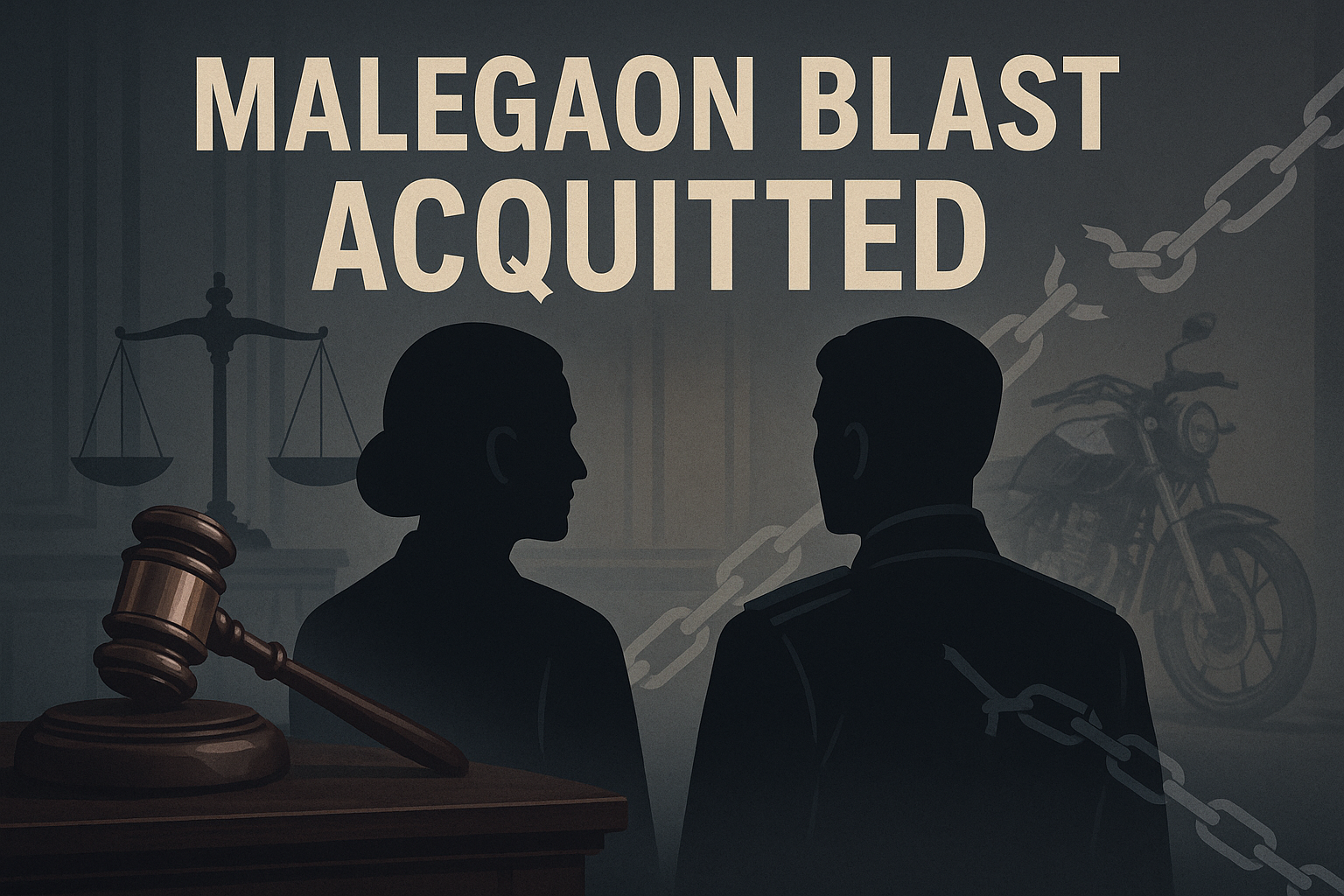
A special NIA court in Mumbai acquitted all seven accused, including Sadhvi Pragya Singh Thakur and Lt Col Prasad Purohit, in the 2008 Malegaon bomb blast case—citing lack of reliable evidence, judicial scrutiny on ATS/NIA procedures, and procedural lapses.
Table of Contents
Published: July 31, 2025
Last Updated: July 31, 2025
Reading Time: 20 minutes
Overview: Historic Acquittal After 17-Year Legal Battle
On July 31, 2025, a Special Court under the National Investigation Agency in Mumbai issued a significant verdict in one of India’s most scrutinized terrorism cases. All seven individuals accused in the 2008 Malegaon bomb blast incident received acquittal after nearly 17 years of legal proceedings. The acquitted individuals include former Bharatiya Janata Party Member of Parliament Sadhvi Pragya Singh Thakur and retired military intelligence officer Lieutenant Colonel Prasad Purohit.
Special Judge A.K. Lahoti delivered the comprehensive judgment citing insufficient evidence, procedural irregularities, and investigative shortcomings as primary grounds for acquittal. The verdict represents a landmark development in India’s counterterrorism jurisprudence. It raises important questions about investigative standards, evidentiary requirements in terrorism cases, and the consequences of prolonged trials on all parties involved.
This detailed analysis examines the complete timeline of the Malegaon blast case. The examination covers the original incident from September 2008, the subsequent investigation conducted by multiple agencies, the extensive trial proceedings, and the final verdict with its broader implications for Indian legal and political systems.
The 2008 Malegaon Blast: Incident Details
Timeline of Events on September 29, 2008
The town of Malegaon in Maharashtra’s Nashik district experienced a devastating explosion during the Islamic holy month of Ramadan. At approximately 7:35 PM local time, an explosive device detonated near the intersection of Bhikku Chowk and Anjuman Chowk. This timing coincided with evening prayers when thousands of residents gathered in the area, and markets operated at peak capacity ahead of Iftaar, the evening meal during Ramadan.
The explosion resulted in six civilian fatalities and approximately 95 injuries with varying severity levels. The blast occurred shortly before the Hindu festival of Navratri, immediately raising concerns about potential communal motivations. Malegaon, a town with historical sensitivity to religious tensions, faced renewed anxiety following this violent incident.
Emergency response teams arrived at the scene amid chaotic conditions. Narrow streets filled with smoke and debris complicated rescue efforts as medical personnel worked to transport casualties to local hospitals. Healthcare facilities experienced overwhelming patient influx as injured individuals arrived throughout the evening.
Immediate Aftermath and Initial Response
The explosion generated significant concern beyond Malegaon’s local boundaries. Maharashtra state leadership condemned the attack and committed to swift investigation and justice delivery. The Maharashtra Anti-Terrorism Squad assumed primary investigative responsibility, initiating what would become one of India’s most controversial and extensively examined terrorism investigations.
National media coverage began immediately following the incident. Television news channels broadcast footage from the blast site and conducted interviews with survivors and witnesses. The 2008 blast occurred just two years after a 2006 Malegaon explosion that killed 37 people, intensifying public concern about recurring violence in the area.
Community leaders representing both Hindu and Muslim populations appealed for calm to prevent retaliatory violence. The town maintained uneasy peace as investigators began collecting evidence from the crime scene. Initial investigative work would later face severe judicial criticism nearly two decades after the incident.
Investigation Timeline: Multiple Agencies Involved
Maharashtra Anti-Terrorism Squad Investigation Phase
The Maharashtra Anti-Terrorism Squad, under the leadership of late Chief Hemant Karkare, conducted the initial investigation. Their probe took a direction that differed from conventional terrorism investigation patterns by examining alleged Hindu extremist networks rather than typical suspects in such cases.
The ATS investigation claimed evidence pointing toward a motorcycle-borne improvised explosive device. According to their findings, the vehicle belonged to Sadhvi Pragya Singh Thakur, a former member of the Akhil Bharatiya Vidyarthi Parishad. This revelation generated significant political attention as it challenged prevailing narratives about terrorism sources in India.
Further ATS investigation led to the arrest of Lieutenant Colonel Prasad Shrikant Purohit, a serving military intelligence officer. The ATS alleged that Purohit procured RDX explosives from Kashmir and facilitated the conspiracy. These allegations linking serving military personnel and religious figures to terrorism created substantial media attention and public debate.
Arrest Details and Charges Filed
Between October and November 2008, the Maharashtra ATS arrested seven individuals in connection with the blast:
- Sadhvi Pragya Singh Thakur: Religious figure with ABVP affiliation
- Lieutenant Colonel Prasad Shrikant Purohit: Military intelligence officer on active duty
- Major Ramesh Upadhyay (Retired): Former military officer
- Ajay Rahirkar: Alleged conspiracy participant
- Sameer Kulkarni: Accused facilitator
- Sudhakar Chaturvedi: Alleged conspirator
- Sudhakar Dhar Dwivedi: Accused participant
The charges filed against these individuals carried severe legal consequences. Under the Unlawful Activities Prevention Act, India’s stringent anti-terrorism legislation, the accused faced allegations including criminal conspiracy, murder, attempted murder, and promoting enmity between religious groups. Additional charges under various Indian Penal Code sections compounded their legal jeopardy.
National Investigation Agency Takes Control
The investigation’s direction changed significantly when the National Investigation Agency assumed control. Created in 2009 specifically for handling terrorism investigations, the NIA brought different perspectives and resources to the case. However, their findings began diverging from the ATS conclusions in important ways.
NIA forensic experts questioned the original evidence collection methodology. Their ballistics analysis raised questions about the motorcycle’s role in the explosion. Witness testimonies forming the prosecution’s foundation faced renewed scrutiny, with allegations emerging about coercion and inconsistencies in statements.
This transition between investigative agencies created confusion and controversy. Critics accused the NIA of weakening the case under political pressure, while supporters argued they simply followed evidence more rigorously. The divergence between ATS and NIA findings eventually proved crucial to the court’s final verdict.
Trial Proceedings: Nearly Two Decades of Legal Process
Procedural Framework and Complexity
The Malegaon blast trial became an extended legal process spanning nearly 17 years. Operating under special court procedures designed for terrorism cases, the proceedings involved examining hundreds of witnesses, reviewing thousands of documentary evidence pages, and addressing numerous procedural motions from both defense and prosecution legal teams.
The trial experienced multiple delays stemming from various factors. Witness unavailability, defense requests for additional evidence review, prosecution amendments to charge sheets, and the substantial volume of material requiring judicial consideration all contributed to extended timelines. Each delay prolonged the ordeal for accused individuals, several of whom spent years in judicial custody before receiving bail.
Legal teams representing both sides comprised experienced criminal lawyers. Defense attorneys systematically challenged every aspect of the prosecution’s case, from evidence collection procedures to witness credibility. Prosecution lawyers worked to maintain their case despite mounting challenges to its foundations.
Critical Evidentiary Issues in Trial
Several evidentiary matters dominated the trial proceedings:
Motorcycle Ownership Dispute: The prosecution’s claim that Pragya Thakur owned the motorcycle allegedly used in the blast became a central legal battleground. Defense lawyers presented evidence showing the vehicle’s chassis and engine numbers had been erased or tampered with, making definitive ownership identification impossible.
RDX Procurement Claims: Allegations that Lieutenant Colonel Purohit obtained military-grade explosives from Kashmir faced intensive scrutiny. The prosecution struggled to produce concrete evidence of procurement, transportation, or storage of RDX by any accused individual.
Witness Testimony Credibility: Multiple witnesses recanted earlier statements, claiming coercion during initial interrogations. The Supreme Court and Bombay High Court had previously flagged concerns about witness testimony credibility in related cases, creating precedents that defense attorneys utilized effectively.
Crime Scene Management: Evidence emerged that the blast site had not been properly secured or barricaded immediately after the explosion. This potential contamination compromised forensic evidence, providing defense teams with arguments about evidence reliability.
Impact on Accused Individuals During Trial
The 17-year legal battle imposed enormous personal costs on all accused individuals. Sadhvi Pragya Singh Thakur spent nine years in custody before receiving bail in 2017, during which period she reportedly developed serious health conditions. Lieutenant Colonel Purohit’s military career effectively ended, his professional reputation affected by the allegations regardless of their ultimate validity.
The other accused individuals similarly faced social ostracism, financial difficulties, and psychological trauma. Their families endured years of uncertainty, unable to plan futures while legal proceedings continued. The human dimension of prolonged trials became starkly evident in this case.
July 31, 2025 Verdict: Complete Analysis
Judge A.K. Lahoti’s Comprehensive Judgment
Special Judge A.K. Lahoti delivered a verdict spanning hundreds of pages, methodically examining every aspect of the prosecution’s case. His judgment represented a comprehensive analysis of the charges that had defined these individuals’ lives for 17 years.
The court’s judgment emphasized a fundamental principle: “Terrorism has no religion, and conviction cannot be based on moral or public perception but must rest on legally admissible, reliable evidence proving guilt beyond reasonable doubt.” This statement set the framework for the detailed analysis that followed.
Primary Grounds for Acquittal
1. Defective UAPA Sanction Orders
The court identified fundamental procedural flaws in the Unlawful Activities Prevention Act sanction orders that authorized prosecution under anti-terrorism law. These technical defects related to proper authorization procedures required under UAPA’s stringent provisions. The invalid UAPA sanctions eliminated the terror-related charges entirely, causing the prosecution’s terrorist conspiracy claims to collapse.
2. Unproven Motorcycle Ownership
Judge Lahoti’s judgment definitively rejected claims that Sadhvi Pragya owned the motorcycle allegedly used in the blast. The court noted several critical issues:
- Chassis and engine numbers had been erased or tampered with, rendering identification unreliable
- No documentary evidence conclusively established ownership
- Witness testimony regarding ownership was contradictory and inconclusive
- Pragya had reportedly renounced material possessions two years before the blast, making motorcycle ownership inconsistent with her stated lifestyle
3. Unsupported RDX Allegations
The prosecution’s claims about RDX procurement and storage by Lieutenant Colonel Purohit faced devastating judicial scrutiny. The court found:
- No forensic evidence proving RDX storage or transportation by any accused individual
- Witness testimonies about explosive procurement were unreliable and contradictory
- Chain of custody for alleged explosive materials was never properly established
- Expert testimony failed to definitively link any accused person to explosive acquisition
4. Crime Scene Contamination Issues
The judgment highlighted serious lapses in crime scene management. Poor barricading and inadequate protection of the blast site immediately after the explosion allowed contamination that potentially compromised forensic evidence. This failure undermined the prosecution’s ability to establish definitive connections between accused individuals and physical evidence from the scene.
5. Victim Count Discrepancies
The court meticulously verified the actual number of blast victims, finding 95 injured persons rather than the 101 claimed by the prosecution. While this discrepancy might seem minor, it exemplified broader problems with investigative thoroughness and accuracy that pervaded the case.
6. Witness Credibility Concerns
Multiple prosecution witnesses faced significant credibility challenges. Some recanted previous statements, claiming coercion during ATS interrogations. Others provided contradictory testimony across different proceedings. The court found insufficient reliable witness testimony to establish guilt beyond reasonable doubt.
Legal Standard Applied: Beyond Reasonable Doubt
Judge Lahoti’s verdict emphasized the constitutional principle that criminal conviction requires proof beyond reasonable doubt. Suspicion, regardless of strength, cannot substitute for evidence. Moral judgments or public perception, regardless of passion, cannot override established legal standards.
The court acknowledged that the blast was a genuine tragedy requiring accountability. However, legal accountability must follow established procedures and evidentiary standards. Conviction of innocent individuals to satisfy public demand for justice would represent a greater injustice than acquitting potentially guilty persons when evidence is insufficient.
Compensation Directed for Victims
Recognizing the genuine suffering of blast victims and acknowledging investigative and prosecutorial failures, the court directed government compensation:
- ₹2 lakh (approximately $2,400) to families of each deceased victim
- ₹50,000 (approximately $600) to each injured survivor
This compensation order, while modest in monetary terms, represented judicial acknowledgment that investigative failures denied victims proper closure and potentially allowed actual perpetrators to escape justice.
Profiles of Acquitted Individuals
Sadhvi Pragya Singh Thakur
Born into a Rajput family, Pragya Singh Thakur became associated with Hindu nationalist organizations during her youth. Her involvement with the Akhil Bharatiya Vidyarthi Parishad, the student wing of the Rashtriya Swayamsevak Sangh, marked her early political engagement.
Her arrest in 2008 transformed her from a relatively obscure religious figure into a national controversy. The nine years spent in custody reportedly affected her health significantly, with claims of mistreatment during interrogation. After receiving bail in 2017, she transitioned into active politics, winning the Bhopal Lok Sabha seat in 2019 as a BJP candidate.
Throughout the trial, Pragya maintained absolute innocence, characterizing herself as a victim of political persecution designed to malign Hindu organizations. Her acquittal vindicated these claims in her view, though legal experts note that acquittal based on insufficient evidence differs from positive proof of innocence.
Lieutenant Colonel Prasad Shrikant Purohit
A career military intelligence officer, Purohit’s arrest shocked India’s defense establishment. The allegations suggested that serving military personnel had facilitated domestic terrorism, a scenario with profound implications for national security institutions.
Purohit consistently denied all charges, arguing that his intelligence work had been misrepresented and that he was targeted for political reasons. The military suspended him from service pending trial resolution, effectively ending his career. His acquittal came too late to restore what was lost professionally, though it cleared his name legally.
Other Acquitted Individuals
Major Ramesh Upadhyay (Retired): A retired military officer whose alleged involvement was never substantiated with credible evidence. His acquittal restored dignity after years of social stigma.
Ajay Rahirkar, Sameer Kulkarni, Sudhakar Chaturvedi, and Sudhakar Dhar Dwivedi: These individuals faced similar evidentiary deficiencies in the prosecution’s case. Each spent years under the shadow of serious terrorism charges, their lives disrupted and reputations damaged, before ultimate acquittal.
Legal and Investigative Implications
Critique of Investigation Standards
The Malegaon verdict represents a significant criticism of investigative practices in this case. The court’s findings suggest multiple levels of failure:
Evidence Collection: Basic protocols for crime scene preservation and evidence chain-of-custody were violated or inadequately implemented, compromising forensic reliability.
Witness Handling: Allegations of coerced testimony and inconsistent witness statements suggest interrogation methods that prioritized securing statements supporting predetermined theories over objective truth-seeking.
Interagency Coordination: The divergence between ATS and NIA findings reveals coordination failures that undermined prosecution effectiveness.
Political Considerations: While not explicitly stated in the judgment, many observers believe investigative decisions were influenced by political considerations rather than purely evidentiary factors.
UAPA and Terror Prosecution Challenges
The case highlights ongoing controversies surrounding the Unlawful Activities Prevention Act. Critics argue that UAPA’s stringent provisions, including extended detention periods and reversed bail presumptions, are frequently misused for political purposes.
The procedural defects that invalidated UAPA charges in this case demonstrate the importance of scrupulous adherence to statutory requirements. When investigators and prosecutors fail to follow proper procedures, they undermine cases that might otherwise succeed on merits.
Judicial Oversight and Accountability
The Supreme Court and various High Courts had previously flagged concerns about investigations in related cases. These judicial warnings went unheeded, contributing to the eventual prosecution collapse. The verdict emphasizes the critical role of judicial oversight in preventing investigative excesses.
Questions remain about accountability for investigative failures. Should officials who conducted flawed investigations face consequences? How can systemic improvements prevent similar failures in future terrorism cases? These questions remain subjects of ongoing debate.
Political and Social Reactions
Sadhvi Pragya’s Response
Following the verdict, Sadhvi Pragya Singh Thakur characterized the acquittal as a triumph for Hindu nationalism. In statements to media, she declared that the case had destroyed her life, health, and reputation through politically motivated persecution.
Her supporters celebrated the verdict as vindication of their beliefs about her innocence and proof of what they characterized as conspiracy to defame Hindu organizations. The BJP, while officially welcoming the judgment as validation of judicial independence, maintained relative public restraint given the case’s sensitivity.
Opposition Political Response
Political opposition figures expressed disappointment with the verdict. Asaduddin Owaisi, leader of the All India Majlis-e-Ittehadul Muslimeen, termed the verdict “deeply disappointing” and accused investigating agencies of communal bias favoring Hindu accused while treating Muslim suspects more harshly.
Civil rights organizations raised concerns about what the acquittal means for terrorism victims seeking justice. They argued that investigative failures denied closure to families who lost loved ones in the blast, potentially allowing actual perpetrators to escape accountability.
Victim Families’ Perspective
Representatives of blast victims expressed anguish at the verdict. Many indicated intentions to challenge the acquittal in higher courts, arguing that the Special Court applied evidentiary standards too strictly. Their frustration reflected genuine trauma—losing loved ones to violence and then watching accused individuals acquitted after 17 years.
Some victims’ advocates argued that focus should shift toward identifying and prosecuting actual perpetrators rather than dwelling on this acquittal. Others maintained belief in the acquitted individuals’ guilt despite the verdict, illustrating the disconnect between legal outcomes and public perception.
Media Analysis
Indian media coverage reflected the nation’s polarized discourse. Right-leaning outlets emphasized investigative failures and characterized the prosecution as politically motivated. Left-leaning publications raised concerns about differential treatment of Hindu and Muslim terrorism suspects.
International media noted the verdict’s significance for India’s secularism debates and rule of law questions. Western outlets highlighted the case as exemplifying tensions between security imperatives and civil liberties protections in democratic systems.
Broader Context: Hindu Nationalism and Terror Investigations
The “Hindu Terror” Debate
The Malegaon case emerged during a period when Indian security agencies began investigating alleged Hindu extremist networks. This investigative focus proved intensely controversial, challenging assumptions that terrorism in India stemmed exclusively from Islamist or separatist sources.
Cases like Malegaon, the 2007 Samjhauta Express bombing, and the 2007 Mecca Masjid blast in Hyderabad involved accusations against individuals affiliated with Hindu nationalist organizations. These investigations occurred during the Congress-led United Progressive Alliance government, leading to accusations of political motivation from BJP and Hindu nationalist circles.
The term “Hindu terror” or “saffron terror” became politically charged. Hindu organizations argued that it unfairly stigmatized their community while the Congress and secular parties maintained that extremism must be investigated regardless of perpetrators’ religious affiliations.
Pattern of Acquittals in Similar Cases
The Malegaon acquittal follows a pattern in similar cases. Several other investigations involving allegations of Hindu extremist involvement have resulted in acquittals due to insufficient evidence:
- The 2007 Mecca Masjid blast case resulted in acquittals of all accused
- The 2007 Ajmer Sharif Dargah blast produced similar outcomes
- The 2006 Malegaon blast case also resulted in acquittals
This pattern raises critical questions: Were investigations genuinely flawed, or does systemic bias favor Hindu accused? Are prosecutors inadequately prepared for complex terrorism cases? Did political interference undermine legitimate investigations?
Different stakeholders draw opposing conclusions from these acquittals, reflecting broader societal divisions about secularism, nationalism, and justice.
Human Cost of Prolonged Trials
Physical and Psychological Impact on Accused
Beyond legal technicalities and political debates lies profound human suffering. The accused individuals spent years—in some cases over a decade—fighting charges that could have resulted in life imprisonment or death sentences. The psychological trauma of facing such severe allegations while maintaining innocence is difficult to quantify.
Medical reports regarding Sadhvi Pragya’s deteriorating health during custody raised concerns about treatment of undertrials. Lieutenant Colonel Purohit’s professional destruction, regardless of ultimate acquittal, exemplifies how accusations alone can devastate lives even when later proven unfounded.
Impact on Families of Accused
The families of accused individuals endured parallel ordeals. Children grew up with imprisoned or legally embattled parents. Spouses struggled financially and emotionally. Extended families faced social ostracism in communities where accusations often equated to guilt in public perception.
These collateral consequences of prolonged trials affect innocent individuals who committed no crimes but suffered nonetheless due to association with accused persons. The judicial system’s pace—necessary for thorough consideration but painfully slow for those awaiting resolution—compounds this suffering.
Victims’ Ongoing Trauma
Equally important is the continuing trauma of blast victims and their families. Seventeen years after losing loved ones or suffering life-altering injuries, they watched accused individuals acquitted without achieving closure or justice. Their wounds—physical, emotional, and psychological—remain unhealed.
The compensation ordered by the court, while symbolically important, cannot restore lost lives or undo permanent disabilities. For these families, the acquittal represents a second victimization—first by the blast itself, then by a justice system that failed to deliver accountability.
Lessons for India’s Criminal Justice System
Need for Investigation Reforms
The Malegaon verdict underscores urgent need for comprehensive investigation reforms:
Enhanced Training: Investigators require better training in evidence collection, crime scene management, and witness handling techniques that withstand judicial scrutiny.
Forensic Capabilities: Investment in modern forensic technology and expertise would strengthen evidence quality and reduce reliance on potentially problematic witness testimony.
Procedural Compliance: Strict adherence to legal procedures—particularly in UAPA and terrorism cases—must become non-negotiable. Shortcuts undermine prosecutions and deny justice to victims.
Political Insulation: Investigating agencies require greater independence from political interference, allowing evidence-based conclusions rather than politically convenient outcomes.
Balancing Security and Rights
The case illustrates eternal tension between national security imperatives and individual rights protections. Democratic societies must combat terrorism effectively while respecting constitutional guarantees and rule of law principles.
Laws like UAPA serve legitimate security purposes but carry potential for abuse. Strong judicial oversight, robust defense rights, and accountability mechanisms for investigating agencies provide essential checks against excess.
Expediting Justice Delivery
Seventeen years from incident to verdict is unacceptably long for any criminal case. Both accused individuals awaiting exoneration and victims seeking accountability deserve faster resolution. Systemic reforms to expedite terrorism trials—without compromising thoroughness—must become priority.
This requires adequate judicial resources, specialized courts with appropriate expertise, and procedural reforms eliminating unnecessary delays while preserving defendants’ rights to fair trial.
Future Legal Proceedings
Appeal Possibilities
The verdict can be appealed to higher courts. Victim families and prosecution authorities have indicated intentions to challenge the acquittal in the Bombay High Court and potentially the Supreme Court. However, appeals in acquittal cases face high procedural bars.
Appellate courts typically defer to trial courts’ factual findings unless clear legal errors occurred. The prosecution would need to demonstrate that Judge Lahoti misapplied legal standards or overlooked critical evidence. Given the judgment’s comprehensive nature and detailed reasoning, successful appeals face significant challenges.
Timeline for Appeals Process
The appeals process could extend for several more years. Appellate court schedules, the complexity of the case record, and procedural requirements all contribute to extended timelines. Legal experts suggest that final resolution through the complete appellate process could take three to five additional years.
Implications for Counterterrorism Policy
Impact on Future Investigations
The Malegaon acquittal will influence how investigating agencies approach future terrorism cases. The detailed judicial criticism of investigative procedures will likely prompt more cautious evidence collection and documentation practices.
However, concerns exist that excessive caution might hamper effective terrorism investigation. Finding appropriate balance between thorough, legally compliant investigation and timely action to prevent terrorist attacks remains an ongoing challenge for security agencies.
Legislative Considerations
The case may prompt legislative review of counterterrorism laws including UAPA. Debates about whether current legal frameworks provide appropriate balance between security needs and individual rights protections will likely intensify.
Some legal experts advocate for reforms providing stronger procedural safeguards while maintaining investigative tools necessary for effective counterterrorism work. Others argue that existing laws are adequate if properly implemented, making enforcement reform more important than legislative changes.
Comparative Analysis: International Perspectives
Terrorism Prosecution Standards Globally
Democratic nations worldwide grapple with similar challenges balancing security imperatives against civil liberties protections. The United States, United Kingdom, and European nations have all faced criticism regarding terrorism prosecution standards and detention practices.
International human rights organizations monitor terrorism cases globally, advocating for standards that effectively combat terrorism while respecting fundamental rights. The Malegaon case fits within this broader international debate about appropriate legal frameworks for addressing terrorism threats.
Lessons from Other Jurisdictions
Other democracies have implemented various approaches to terrorism prosecution. Some countries utilize specialized terrorism courts with judges trained in security matters and evidentiary standards. Others maintain standard criminal courts with enhanced procedural protections for terrorism cases.
India’s experience with the Malegaon case and similar prosecutions can inform international discussions about best practices for terrorism investigation and prosecution in democratic societies.
Statistical Context
Terrorism Case Conviction Rates in India
According to data from the National Crime Records Bureau, conviction rates in terrorism cases under UAPA and similar laws remain relatively low compared to other criminal offenses. Between 2015 and 2023, conviction rates in UAPA cases averaged approximately 29%, significantly below the overall conviction rate of around 50% for all crimes.
These statistics suggest systemic challenges in terrorism prosecution, including evidentiary difficulties, witness protection issues, and the high burden of proof required for conviction under anti-terrorism laws.
Duration of Terror Trials
The 17-year duration of the Malegaon trial significantly exceeds average trial lengths even for complex criminal cases. National Judicial Data Grid statistics indicate that terrorism cases take an average of 7-8 years from charge sheet filing to final verdict, though high-profile cases often take considerably longer.
This extended duration affects all stakeholders—accused individuals awaiting trial resolution, victims seeking justice, and the judicial system’s overall efficiency and credibility.
Key Takeaways from the Malegaon Verdict
The July 31, 2025 verdict represents a watershed moment in Indian counterterrorism jurisprudence. All seven accused individuals received acquittal based on insufficient evidence, procedural irregularities, and investigative failures. The judgment emphasizes that conviction requires proof beyond reasonable doubt, not merely suspicion or public perception.
The verdict highlights systemic issues requiring attention. Investigation quality, procedural compliance, witness testimony reliability, and crime scene management all need improvement to ensure effective terrorism prosecution while protecting individual rights.
For the acquitted individuals, the verdict brings legal vindication but cannot restore lost years or repair damaged reputations. For victims and their families, the acquittal delivers disappointment rather than justice, raising questions about who actually perpetrated the blast and whether they will ever face accountability.
The case’s political dimensions remain contentious, with different stakeholders drawing opposing conclusions about its meaning for Indian secularism, nationalism, and justice. These debates will likely continue influencing Indian political discourse for years.
Frequently Asked Questions
Q1: What were the main reasons for acquittal in the Malegaon blast case?
The Special NIA Court acquitted all seven accused on July 31, 2025, based on multiple critical failures in the prosecution’s case. Judge A.K. Lahoti identified defective UAPA sanction orders that invalidated terrorism-related charges, insufficient evidence proving motorcycle ownership by Sadhvi Pragya, lack of forensic proof connecting Lieutenant Colonel Purohit to RDX procurement, crime scene contamination due to poor barricading, discrepancies in victim counts, and unreliable witness testimony with allegations of coercion. The court emphasized that conviction requires proof beyond reasonable doubt, which the prosecution failed to establish despite 17 years of legal proceedings.
Q2: What is the difference between acquittal and proven innocence?
This distinction is crucial in understanding the verdict. Acquittal means the prosecution failed to prove guilt beyond reasonable doubt—not that the accused were positively proven innocent. The court did not make findings of factual innocence but rather determined that available evidence was insufficient, unreliable, or procedurally defective. In criminal law, the burden rests entirely on the prosecution to prove guilt; defendants need not prove innocence. The acquitted individuals are legally presumed innocent under law, though this differs from a definitive judicial finding that they did not commit the alleged acts.
Q3: Can the Malegaon blast acquittal verdict be appealed?
Yes, the verdict can be appealed to higher courts. Victim families and prosecution authorities have indicated intentions to challenge the acquittal in the Bombay High Court and potentially the Supreme Court. However, appeals in acquittal cases face high procedural standards. Appellate courts typically defer to trial courts’ factual findings unless clear legal errors occurred. The prosecution would need to demonstrate that Judge Lahoti misapplied legal standards or overlooked critical evidence. Given the judgment’s comprehensive nature spanning hundreds of pages with detailed reasoning, successful appeals face significant challenges. The appeals process could extend for several additional years.
Q4: Why did the UAPA charges fail in this case?
The court found that UAPA sanction orders—formal authorizations required before prosecuting under the anti-terrorism law—contained procedural defects making them legally invalid. UAPA’s stringent provisions demand scrupulous compliance with statutory requirements; shortcuts or technical errors can invalidate entire prosecutions. This highlights tensions around UAPA’s application: while the law serves legitimate security purposes, its severe provisions require equally rigorous procedural safeguards. The verdict doesn’t invalidate UAPA itself but emphasizes that investigators and prosecutors must follow all procedural requirements meticulously, or risk case collapse regardless of underlying evidence quality.
Q5: What compensation will Malegaon blast victims receive?
Judge Lahoti directed the government to provide ₹2 lakh (approximately $2,400) to families of each deceased victim and ₹50,000 (approximately $600) to each injured person. This compensation acknowledges investigative failures that denied victims proper justice. However, many consider these amounts inadequate given the magnitude of loss and suffering. The compensation represents symbolic acknowledgment more than substantive redress. Victim advocates argue that the government should provide more comprehensive support including ongoing medical care for injured survivors, educational assistance for victims’ children, and counseling services for traumatized families.
Q6: How does this case compare to other terror investigations involving Hindu accused?
The Malegaon acquittal follows a pattern of similar outcomes in cases involving allegations against Hindu nationalist-affiliated individuals. The 2007 Mecca Masjid blast, 2007 Ajmer Sharif Dargah blast, and 2006 Malegaon blast cases all resulted in acquittals due to insufficient evidence. This pattern raises important questions about whether investigations in these cases were genuinely flawed or whether systemic bias exists favoring Hindu accused compared to Muslim suspects in terrorism cases. Different observers draw opposing conclusions. Some argue that the original investigations were politically motivated lacking evidentiary foundation. Others contend that investigative agencies fail to pursue cases involving Hindu extremist allegations with the same rigor applied to Islamist suspects.
Q7: What was the human cost of the 17-year trial?
The prolonged trial imposed enormous costs on all parties. The accused individuals spent years—in some cases over a decade—fighting charges that could have resulted in life imprisonment or death sentences. Sadhvi Pragya spent nine years in custody and reportedly developed serious health conditions. Lieutenant Colonel Purohit’s military career effectively ended. Families of the accused endured financial hardship, social ostracism, and psychological trauma. Equally important, blast victims and their families waited 17 years for justice, only to see all accused acquitted without achieving closure. Their physical wounds, emotional trauma, and psychological suffering remain unaddressed. The modest compensation ordered cannot restore lost lives or undo permanent disabilities.
Q8: What reforms should India implement to prevent similar investigative failures?
Experts recommend several critical reforms. First, enhanced training for investigators in evidence collection, crime scene management, and proper interrogation techniques that don’t rely on coercion. Second, investment in modern forensic capabilities and scientific evidence gathering providing more reliable proof than witness testimony alone. Third, stricter procedural compliance mechanisms ensuring investigators follow all legal requirements, particularly in sensitive cases under laws like UAPA. Fourth, greater institutional independence for investigating agencies from political interference, allowing evidence-based conclusions regardless of political convenience. Fifth, faster case resolution through specialized terrorism courts with adequate resources and streamlined procedures protecting defendants’ rights while avoiding endless delays. Finally, robust accountability mechanisms holding investigators and prosecutors responsible for serious procedural failures that deny justice to victims.
About the Author
Nueplanet is a legal affairs analyst specializing in criminal justice, counterterrorism law, and constitutional matters in India. With comprehensive experience examining complex legal cases and their broader societal implications, Nueplanet provides fact-based analysis drawing from official court documents, government sources, and verified institutional data.
This analysis reflects commitment to accuracy, neutrality, and thorough examination of multifaceted legal developments. All information presented derives from publicly available court judgments, official government statements, verified media reports from authoritative sources, and established legal databases.
Editorial Standards: Content undergoes verification against multiple authoritative sources including court judgments, government press releases, National Crime Records Bureau data, and reports from established legal institutions. Publish and update dates are clearly indicated to ensure readers access current information. Analysis maintains political neutrality, presenting multiple perspectives on contentious issues without advocating specific positions.
Disclaimer: This content provides informational analysis of legal developments and should not be construed as legal advice, opinions about guilt or innocence of individuals, or endorsements of specific legal positions. Readers should consult qualified legal professionals for advice on specific legal matters.
Sources:
- Special NIA Court Mumbai judgment dated July 31, 2025
- National Investigation Agency official statements
- Maharashtra Anti-Terrorism Squad records
- Supreme Court and Bombay High Court precedents cited in judgment
- National Crime Records Bureau statistics
- Ministry of Home Affairs press releases
Helpful Resources
Malegaon blast case: Court acquits all seven accused including ex-BJP MP, Purohit – Economic Times
All seven accused acquitted in 2008 Malegaon blast case – LiveLaw
Latest Posts
Here are five relevant prior posts on NuePlanet.com for deeper context:
Related Posts












Post Comment