









Asian Paints Share Price: Q1 FY26 Results & Future Outlook
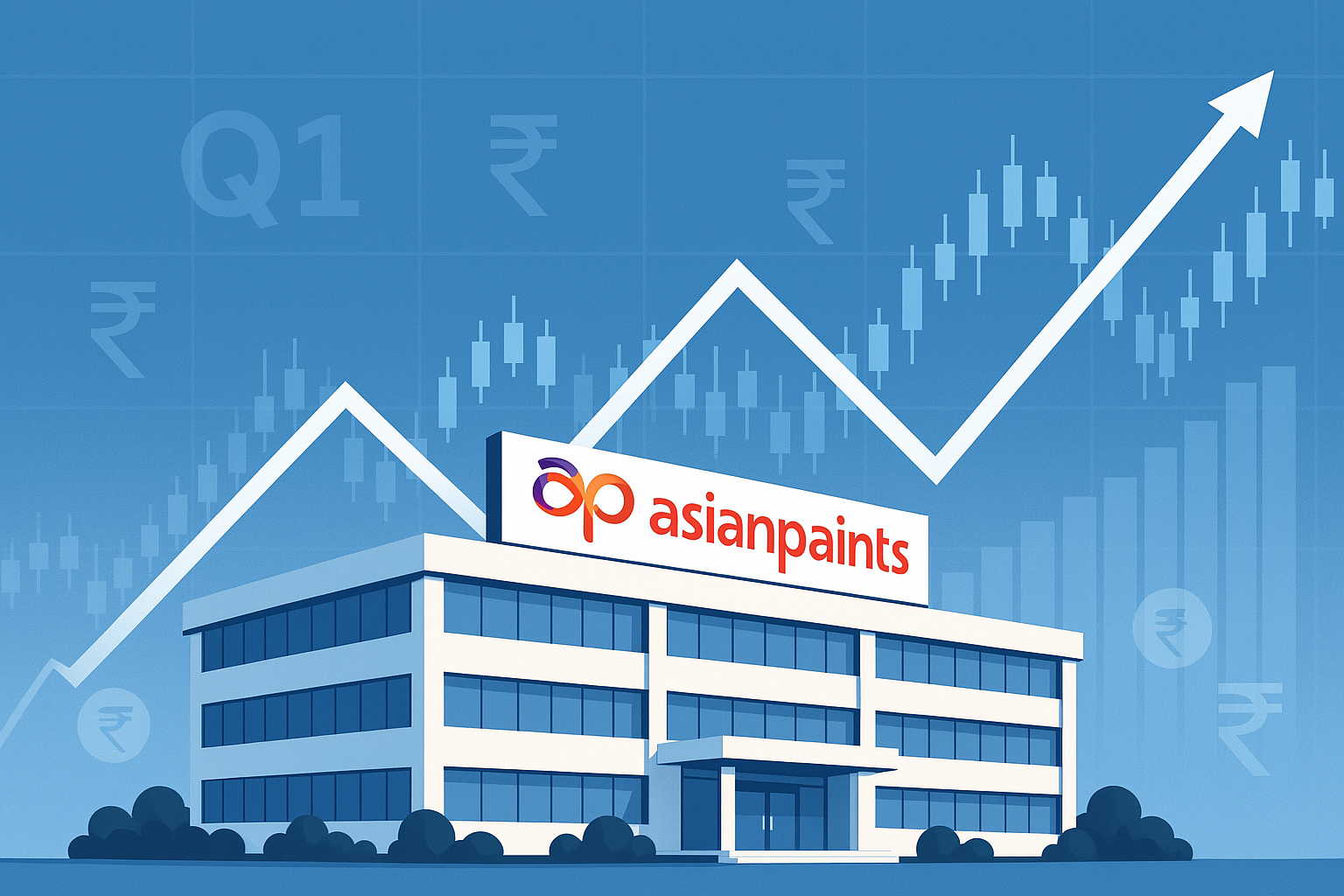
Asian Paints reported a 6% YoY drop in consolidated PAT for Q1 FY26, testing investor confidence amid rising competition and margin pressures. This article breaks down the results, share price movements, and what lies ahead for India’s paint market leader.
Table of Contents
Executive Summary
Asian Paints Limited, India’s largest decorative paints manufacturer, released its first quarter results for fiscal year 2026 on July 25, 2025. The company reported consolidated net profit of ₹1,100 crore, marking a 6% year-over-year decline from ₹1,170 crore in the corresponding quarter of the previous fiscal year. Total revenue stood at ₹8,970 crore, reflecting marginal contraction amid challenging market conditions.
The earnings report revealed multiple operational pressures affecting India’s paint industry leader. Volume growth in the decorative segment remained subdued at 2-3%, while operating margins contracted by 50-70 basis points. Despite these headwinds, Asian Paints maintained robust cash generation and a debt-free balance sheet with net cash reserves exceeding ₹4,200 crore.
The company’s stock closed at ₹2,358.95 on July 28, 2025, approximately 30% below its 52-week high of ₹3,394 reached in September 2024. This comprehensive analysis examines the financial performance, competitive landscape, valuation metrics, and strategic outlook for investors evaluating Asian Paints during this transitional period.
Last Updated: October 30, 2025
Q1 FY26 Financial Performance Overview
Revenue Performance and Segment Analysis
Asian Paints generated total consolidated revenue of ₹8,970 crore during the April-June 2025 quarter. This represented a marginal year-over-year decline that aligned with analyst expectations given prevailing demand conditions in India’s paint sector.
The decorative paints division, contributing approximately 80% of total revenues, experienced volume growth of just 2-3% year-over-year. This weak expansion reflected multiple concurrent challenges including monsoon-related construction disruptions, consumer preference shifts toward economy product segments, and intensifying price competition from newer market participants.
The industrial coatings segment, accounting for roughly 15% of revenues, demonstrated relatively better resilience. Ongoing automotive original equipment manufacturer contracts and infrastructure project commitments provided stability. However, recent automotive sector softness has begun affecting paint demand patterns in this division as well.
International operations continued expanding at mid-single-digit rates. Asian Paints maintains presence across Bangladesh, Sri Lanka, Nepal, and several Middle Eastern markets. This geographic diversification provides revenue stability, though currency fluctuations in these regions introduce margin volatility.
Profitability Metrics and Margin Analysis
Consolidated net profit for Q1 FY26 totaled ₹1,100 crore, declining 6% from ₹1,170 crore reported in Q1 FY25. The profit contraction exceeded the modest revenue decline, indicating margin compression across operations.
Operating profit reached ₹1,466 crore, remaining virtually unchanged on a quarter-over-quarter basis. The EBITDA margin contracted by approximately 50-70 basis points compared to the same quarter last year. This compression stemmed from competitive pricing pressures, elevated distribution costs, and less favorable product mix as consumers shifted toward value-oriented offerings.
Operating expenses increased approximately 3.3% year-over-year. The company maintained aggressive promotional spending to defend market share amid heightened competition from new entrants. Depreciation and administrative costs surged nearly 10%, driven primarily by capacity expansion investments from previous quarters now reflecting in profit and loss statements. Technology infrastructure upgrades aimed at supply chain efficiency improvements also contributed to cost increases.
Interest expenses remained minimal given Asian Paints’ strong balance sheet position and negligible debt burden. However, other income declined as treasury yields softened and opportunities for surplus cash deployment narrowed during the quarter.
Impact of Exceptional Items from Previous Quarter
Understanding Q4 FY25 performance provides important context for evaluating Q1 FY26 results. During the January-March 2025 quarter, Asian Paints recorded significant impairment charges related to goodwill on two acquisitions: White Teak, a luxury wood coatings brand, and Causeway, an international venture.
These non-cash charges, combined with foreign exchange losses on overseas operations, substantially depressed overall profitability in Q4 FY25. The company also absorbed one-time restructuring costs associated with distribution network optimization initiatives during that period.
Management maintains these expenses position the company for improved operational efficiency in subsequent quarters. When adjusting for exceptional items to assess underlying operational performance, the year-over-year profit decline approximates 4-5% rather than the reported 6%.
Cash Flow Generation and Balance Sheet Strength
Despite profitability pressures, Asian Paints continues demonstrating robust operating cash flow generation. Q1 FY26 operating cash flow reached approximately ₹1,350 crore, representing cash conversion of roughly 95% of operating profit.
This consistent cash generation reflects disciplined working capital management practices. Inventory turnover rates remain healthy across finished goods and raw materials. Receivables collection periods remain well-controlled, minimizing working capital intensity.
Capital expenditure during the quarter totaled approximately ₹320 crore. These investments directed primarily toward capacity expansion at existing manufacturing facilities in Mysore, Rohtak, and Visakhapatnam. Distribution infrastructure enhancements also received capital allocation to improve logistics efficiency.
The company maintains expansion plans targeting 15-20% capacity growth over the next 24 months. This positions Asian Paints for demand recovery while maintaining competitive cost structures through economies of scale.
The balance sheet remains exceptionally strong with net cash of approximately ₹4,200 crore. The debt-to-equity ratio stands near zero. This financial flexibility provides management with multiple strategic options including potential acquisitions, aggressive promotional spending to defend market position, or enhanced capital returns to shareholders through dividends or buybacks.
Stock Price Performance Analysis
Recent Trading Activity and Market Reaction
On July 28, 2025, Asian Paints shares closed at ₹2,358.95 on the National Stock Exchange, posting a modest 1% gain despite broader market weakness. This resilience surprised some market observers who anticipated negative reaction following the Q1 results announcement.
The stock’s outperformance relative to smaller competitors proved notable. Smallcap paint manufacturers Jenson & Nicholson and Shalimar Paints declined sharply during the same period. This divergence suggested investors distinguished between Asian Paints’ temporary operational headwinds and more structural challenges facing smaller competitors with limited financial resources.
Trading activity in days immediately preceding the earnings release showed heightened volatility. On July 24-25, 2025, the stock declined approximately 0.9% to ₹2,352 as market participants positioned defensively ahead of the results announcement. Options market activity indicated expectations for modest disappointment, though implied volatility remained below levels observed during previous earnings cycles.
Longer-Term Price Context and Historical Performance
Examining broader timeframes reveals the magnitude of Asian Paints’ valuation reset over recent months. The stock currently trades approximately 30-31% below its 52-week high of ₹3,394, reached in September 2024.
That peak valuation occurred amid optimism about post-pandemic construction recovery and before competitive threats from new market entrants fully materialized. Market sentiment reflected expectations for sustained high-single-digit volume growth and margin expansion as raw material costs normalized.
One-year performance shows Asian Paints shares down approximately 17.4%. This significantly underperforms both the broader Nifty 50 index and the BSE Consumer Durables index during the same period. The underperformance reflects sector-specific headwinds rather than broad market weakness, as investors reassessed sustainability of premium valuations amid growth deceleration.
However, five-year perspective provides more encouraging context. Despite recent declines, Asian Paints shares remain up approximately 43% over five years. This equates to an annualized return of roughly 7.4%. While modest by equity standards, this return encompasses periods of pandemic disruptions, raw material cost spikes, and now intensifying competition.
Trading Volume and Liquidity Indicators
Daily trading volumes have remained healthy throughout the recent price decline. Typical volumes range between 8-12 lakh shares changing hands daily. This liquidity ensures institutional investors can adjust positions without significant market impact, though it also means downward price pressure can accelerate during negative news flow.
Delivery percentages have increased to the 55-60% range, up from typical levels of 45-50%. Delivery percentage measures the proportion of trades resulting in actual ownership transfer rather than intraday speculation. Rising delivery percentages often signal accumulation by long-term investors who view current prices as attractive entry points. This pattern provides some technical support to the stock price.
Valuation Metrics and Investment Analysis
Price-to-Earnings Ratio Assessment
At the current price of approximately ₹2,359, Asian Paints trades at a trailing twelve-month price-to-earnings ratio of approximately 62x. This premium substantially exceeds the broader paint industry average of 53x and the Nifty 50 index multiple of roughly 23x.
Several factors support arguments for this valuation premium. Asian Paints commands dominant market share of 45-48% in decorative paints with unmatched brand recognition across urban and rural markets. The company has consistently demonstrated superior return on equity compared to competitors. Its distribution network reaching over 150,000 retail touchpoints represents a nearly impossible-to-replicate competitive advantage.
However, critics argue that earnings growth deceleration no longer justifies such stretched multiples. If volume growth remains constrained at low single digits and margin expansion proves elusive, the stock’s PEG ratio (price-to-earnings ratio divided by earnings growth rate) climbs to uncomfortable levels above 3-4x.
Forward price-to-earnings calculations using FY26 consensus estimates of approximately ₹39-40 earnings per share yield a multiple of roughly 59x. This represents modest compression from trailing figures but still demands premium pricing of growth recovery that remains uncertain given current operating environment.
Price-to-Book and Return Metrics
Asian Paints currently trades at approximately 11.6x price-to-book value. This exceeds historical averages of 8-10x observed over the past decade. The elevated multiple reflects market recognition that the company’s true value lies substantially in intangible assets—brand equity, distribution relationships, technical know-how, and customer loyalty—that don’t appear fully on balance sheets prepared under accounting standards.
Comparing this metric to global paint industry leaders provides useful context. Sherwin-Williams trades at roughly 4-5x book value, while PPG Industries commands approximately 3x. However, these Western companies operate in mature, low-growth markets. Indian paint demand is expected to compound at 8-10% annually over the next decade, justifying some premium to developed market comparables.
Return on equity has compressed to the low-to-mid teens percentage range from historical levels of 18-22%. If ROE continues declining due to intensifying competition and margin pressures, the price-to-book multiple must eventually contract to maintain rational valuation equilibrium.
Enterprise Value and Cash Flow Considerations
Enterprise value-to-EBITDA calculations yield approximately 42-45x based on trailing twelve-month figures. This represents a substantial premium to industry peers. However, Asian Paints’ net cash position means enterprise value sits modestly below market capitalization, providing some valuation cushion.
Free cash flow yields of roughly 2.5% compare unfavorably to 10-year government bond yields near 7%. This suggests the stock offers minimal yield compensation for equity risk at current levels. Growth-oriented investors dismiss this concern, noting free cash flow should accelerate as revenue growth reaccelerates and capital intensity moderates following the current expansion cycle.
Competitive Landscape and Market Share Dynamics
Emergence of Well-Capitalized New Entrants
The Indian paint industry’s competitive dynamics have shifted dramatically over the past 18-24 months, fundamentally altering the strategic environment Asian Paints must navigate. Well-capitalized new entrants backed by large industrial conglomerates have disrupted previously stable market share positions.
Birla Opus, the paint venture backed by the Aditya Birla Group, has emerged as the most formidable new challenger. Launched with significant financial backing and aggressive go-to-market strategy, Birla Opus specifically targets the premium decorative segment where Asian Paints generates its highest profit margins.
Birla’s approach emphasizes digital-first customer engagement. Marketing campaigns target millennial and Gen-Z homeowners through social media platforms and influencer partnerships. The brand has undercut Asian Paints’ pricing by 10-15% in several product categories while maintaining comparable quality claims. This forces difficult strategic choices about whether to match price cuts and sacrifice margins or maintain pricing and risk volume loss.
JSW Paints, backed by the diversified JSW Group, has pursued a different competitive strategy focused on distribution density and dealer incentive programs. The company has rapidly expanded its retail footprint, particularly in tier-2 and tier-3 cities where Asian Paints’ presence, while dominant, faces less entrenched customer loyalty.
JSW’s dealer margin structure reportedly offers 2-3 percentage points more than Asian Paints provides to retailers. This creates economic incentives for dealers to actively push JSW products to customers. The strategy has proven effective in markets where price-sensitive consumers lack strong brand preferences.
Traditional Competitors Intensify Efforts
Berger Paints and Kansai Nerolac, the established number-two and number-three players in India’s paint market, have responded to new entrants by becoming more aggressive themselves. Both companies have increased advertising spending substantially to defend existing market positions.
These established players have launched premium product lines targeting the same customer segments as new entrants. They have also selectively matched competitive pricing in key markets where share defense requires price response. This multi-directional competitive pressure leaves Asian Paints defending market share against attacks from multiple competitors simultaneously.
Market Share Trends and Geographic Patterns
Asian Paints’ decorative segment market share has declined by approximately 150-200 basis points over the past 18 months. The company’s share has slipped from roughly 48-49% to the current 46-47% range. While this remains dominant by substantial margin, the trajectory concerns investors who previously viewed Asian Paints’ market position as essentially impregnable.
Volume growth analysis reveals that virtually all market share loss has occurred in urban metropolitan areas, particularly among younger consumers undertaking first-time home painting projects. These customers demonstrate greater digital savviness and price sensitivity. They show increased willingness to experiment with newer brands offering aggressive promotional pricing and contemporary aesthetic positioning.
In contrast, Asian Paints maintains stronger positioning in semi-urban and rural markets. In these geographies, brand trust and painter relationships matter more than digital engagement or marginal price differences. The company’s extensive distribution network and decades-long relationships with local dealers provide durable advantages that new entrants struggle to replicate quickly.
Regulatory Scrutiny Developments
Adding complexity to the competitive landscape, Asian Paints faces increasing regulatory attention from competition authorities. Complaints filed with the Competition Commission of India allege anti-competitive practices including exclusive dealer arrangements and predatory pricing designed to squeeze smaller competitors.
Asian Paints has vigorously challenged these allegations through legal responses. The company argues its market position results from superior products, efficient operations, and earned customer loyalty rather than anti-competitive conduct. Asian Paints has filed responses in Delhi High Court contesting the CCI’s jurisdiction and procedural handling of complaints.
While regulatory investigations often require years to resolve conclusively, the mere existence of such scrutiny creates reputational risks. It also constrains strategic flexibility as Asian Paints must ensure its competitive responses to new entrants don’t expose the company to additional regulatory liability. This potentially limits ability to match aggressive competitor tactics that might otherwise prove effective.
Demand Environment and Growth Outlook
Near-Term Demand Headwinds
The June-August 2025 period corresponding to Q1 FY26 typically represents seasonally weak demand for paints due to monsoon weather patterns. Heavy rainfall delays construction projects, prevents outdoor painting activities, and generally dampens consumer home improvement spending.
This year’s monsoon arrived on schedule and has been slightly above normal intensity in several regions including Maharashtra and Karnataka. This weather pattern explains a significant portion of the volume weakness observed during the quarter.
Consumer sentiment in urban India has softened amid persistent inflation concerns and job market uncertainty. This particularly affects discretionary spending categories like home renovation and redecoration. Real estate transaction volumes in major metropolitan areas have moderated from 2024’s elevated levels, reducing new home painting demand that typically accompanies property purchases.
Raw material costs, while moderating from 2024 peaks, remain elevated on a historical basis. Crude oil derivatives that form key paint inputs have stabilized but haven’t declined sharply enough to enable significant price reductions that might stimulate volume recovery. This cost structure limits companies’ ability to deploy aggressive pricing as a demand stimulus lever.
Structural Growth Drivers for Indian Paint Industry
Stepping back from quarterly fluctuations, several structural factors support Indian paint industry growth over the medium term. India’s housing stock continues expanding as urbanization progresses and household formation increases among young populations entering peak earning years.
The paint consumption-to-GDP ratio remains well below developed market levels. This suggests substantial headroom for per-capita consumption growth as household incomes rise and consumer preferences evolve toward more frequent home refreshes.
Government infrastructure investment under various central and state schemes should support industrial coatings demand. Road construction programs, railway modernization projects, and urban transit expansions all require protective and decorative coatings. These provide growth avenues beyond consumer decorative segments.
The home improvement and renovation cycle in India is accelerating compared to previous generations. Whereas earlier generations might repaint homes every 8-10 years, urban consumers increasingly refresh interiors every 5-7 years. This shift is driven by aesthetic preferences influenced by social media exposure to global design trends. This frequency increase expands addressable market demand even with static housing stock.
Premium product segment growth is outpacing value segments as consumers trade up to offerings with enhanced features. Low-VOC formulations, anti-bacterial properties, specialty textures, and designer finishes are gaining traction. Asian Paints’ strength in innovation and R&D positions the company to capture disproportionate share of this premiumization trend, potentially offsetting volume pressure in economy segments.
Analyst Perspectives and Rating Actions
Jefferies Upgrade and Bullish Thesis
Jefferies initiated coverage of Asian Paints with a ‘Buy’ rating and ₹2,830 price target on August 2, 2025. This implies approximately 13% upside potential from current levels around ₹2,359. The firm’s investment thesis rests on several key pillars.
First, input cost relief is expected to materialize as crude oil and derivative chemical prices have stabilized following 2024’s volatility. Jefferies projects potential for margin expansion in coming quarters as pricing adjusts with typical lag effects. The firm models 100-150 basis points of EBITDA margin expansion over the next 18 months as cost benefits flow through income statements.
Second, competition stabilization appears likely as the most disruptive phase of new entrant aggression passes. Birla Opus and JSW Paints have achieved initial market penetration but now face their own profitability pressures. Jefferies expects competitive pricing intensity to moderate as these players shift focus from pure share gain to sustainable unit economics.
Third, volume recovery is anticipated post-monsoon season. Seasonality typically brings demand improvement in the October-December quarter. Combined with pent-up construction activity and potential government stimulus ahead of state elections, Jefferies forecasts volume growth reaccelerating to 6-8% range in H2 FY26.
Finally, valuation reset creates opportunity according to the firm. The 30% price decline from peaks has brought valuations closer to fair value territory. While not cheap on absolute price-to-earnings basis, risk-reward has improved substantially. Jefferies notes that during past periods of temporary margin pressure, particularly 2018-19, patient investors earned strong returns as the company navigated challenges successfully.
Neutral Stance from Motilal Oswal
Motilal Oswal maintains a ‘Neutral’ rating with ₹2,400 price target, essentially at current market prices. The firm acknowledges Asian Paints’ quality franchise and market leadership but questions near-term catalysts for multiple expansion or positive earnings surprises.
Key concerns include expectations that volume growth likely remains subdued at 3-5% through FY26 given weak demand environment and ongoing market share pressure. Margin expansion potential appears limited as competitive dynamics constrain pricing power across most product categories.
Current valuation at 59x forward earnings leaves little room for disappointment according to Motilal. Any earnings miss or further competitive deterioration could trigger valuation de-rating. The firm believes better risk-reward opportunities exist in other consumer discretionary segments where growth visibility is stronger and valuations are more reasonable.
Cautious View from Kotak Institutional Equities
Kotak Institutional Equities published a more bearish ‘Reduce’ rating with ₹2,200 price target, implying approximately 7% downside from current levels. Kotak’s analysis emphasizes structural concerns rather than cyclical factors.
The firm argues that well-capitalized new entrants represent permanent competitive intensity increase rather than temporary disruption. Asian Paints’ premium valuation was predicated on sustained volume compound annual growth rate of 8-10%, which now appears unachievable for the next 2-3 years given market dynamics.
Return ratios will likely compress toward mid-teens levels from historical 20%+ returns on equity. This fundamental deterioration in profitability metrics warrants valuation de-rating according to Kotak’s framework. The firm also notes that management’s response to competition has been measured but perhaps slower than circumstances warrant, suggesting potential strategic challenges in adapting to the new competitive environment.
Management Commentary and Strategic Direction
Earnings Call Highlights and Guidance
Asian Paints’ management team struck a measured tone during the Q1 FY26 earnings conference call held on July 25, 2025. Managing Director and CEO Amit Syngle acknowledged the challenging operating environment while expressing confidence in medium-term prospects and strategic positioning.
Regarding demand outlook, management stated expectations for sequential improvement through the fiscal year as monsoon recedes and festival season approaches. Real estate activity indicators suggest pent-up painting requirements that should materialize in the second half of the fiscal year according to management assessment.
On competition response, leadership emphasized welcoming competitive intensity as it expands category awareness and ultimately grows the overall market size. Management highlighted Asian Paints’ brand strength, product innovation capabilities, and distribution depth as sustainable competitive advantages. The company is selectively responding to competitive pricing where strategically appropriate rather than engaging in across-the-board price wars that would destroy margins unnecessarily.
Regarding margin trajectory, executives noted that raw material costs have stabilized and the company expects gradual sequential improvement in profitability margins. Management emphasized the company is not chasing unprofitable volume and will maintain price discipline in product categories where superior quality justifies premium positioning.
Strategic Priorities for FY26 and Beyond
Management outlined three primary focus areas for navigating current challenges and positioning for sustained growth. First, accelerating premium product launches to defend high-margin segments against competitive incursion. Asian Paints plans to introduce differentiated offerings that justify price premiums through enhanced features and performance benefits.
Second, expanding distribution presence in underpenetrated tier-3 and tier-4 towns where brand trust remains paramount and new entrants struggle to establish cost-effective presence. The company will accelerate dealer recruitment and painter engagement programs in these markets.
Third, enhancing digital customer engagement capabilities to compete effectively with digitally native challengers like Birla Opus. This includes building out direct-to-consumer sales platforms, improving online customer service, and developing digital tools that help consumers visualize color choices and make informed purchase decisions.
The executive team declined to provide specific numerical guidance for FY26, citing demand uncertainty and competitive dynamics. However, management reiterated confidence in achieving “industry-leading” growth rates over a 3-5 year strategic horizon as temporary headwinds moderate and strategic initiatives deliver results.
Shareholding Pattern and Institutional Activity
Promoter Holdings and Insider Activity
The founding Vakil and Choksey families maintain approximately 52% ownership stake in Asian Paints. This substantial promoter holding provides management continuity and strong alignment with long-term value creation rather than short-term results.
Promoter stake has remained stable with no significant selling activity even during recent price weakness. This provides a positive signal suggesting insiders retain conviction in the business trajectory and long-term value proposition. Indian regulations prevent promoters from increasing stakes beyond certain thresholds without triggering mandatory open offer requirements, effectively capping holdings near current levels.
Foreign and Domestic Institutional Investors
Foreign Institutional Investors and Domestic Institutional Investors collectively own approximately 40-45% of outstanding shares. Representation is relatively balanced between foreign and domestic institutional capital sources.
Notable FII shareholders include several marquee global investment funds. Capital Group, Government Pension Investment Fund of Japan, and various emerging market-focused vehicles maintain positions. Recent quarters have seen modest net FII selling pressure, with foreign investors reducing exposure by 1-2% of equity. This selling appears driven more by broader portfolio rebalancing and emerging market capital outflows rather than Asian Paints-specific concerns.
Domestic institutional ownership has remained relatively stable during the price decline. Major domestic mutual fund houses including HDFC Mutual Fund, SBI Mutual Fund, and ICICI Prudential rank among significant holders. Several domestic funds have actually increased positions during recent quarters, viewing the price decline as accumulation opportunity for quality franchise at reasonable valuations.
Retail and Public Holdings
Retail and other public shareholders account for approximately 5-8% of shares outstanding. This relatively small retail float for a widely recognized consumer brand partly reflects the concentrated promoter holding structure. It also indicates individual investors haven’t found valuations compelling enough for significant accumulation despite the 30% price decline from peaks.
Dividend Policy and Capital Allocation Strategy
Historical Dividend Track Record
Asian Paints has historically maintained shareholder-friendly capital allocation policies balancing growth investment requirements with cash returns to shareholders. The company typically declares dividends 2-3 times annually. A final dividend is announced alongside full-year results, with interim dividends potentially declared after strong quarterly performance.
Over the past five years, dividend payout ratios have ranged between 30-40% of consolidated net profit. This provides shareholders steady income stream while retaining adequate capital for growth investments including capacity expansion, technology upgrades, and potential acquisitions.
The most recent annual dividend for FY25 totaled ₹31.50 per share, representing approximately 34% payout ratio. At current share prices around ₹2,359, this translates to dividend yield of approximately 1.3%. While modest compared to fixed income alternatives, this yield aligns with the company’s growth-oriented capital allocation philosophy.
FY26 Dividend Outlook and Buyback Potential
Management has not signaled any changes to dividend policy despite Q1 profit weakness. The strong balance sheet with net cash position exceeding ₹4,200 crore provides ample financial flexibility to maintain or potentially increase dividends even if near-term earnings remain under pressure.
Some market observers speculate that Asian Paints might consider enhanced capital returns through share buyback programs if valuation remains depressed. The company has occasionally utilized buybacks when management perceived shares as undervalued relative to intrinsic value. The most recent buyback occurred in 2020 during pandemic-induced market dislocation.
Current cash reserves provide substantial capacity for buyback programs if management deems this the most appropriate capital allocation given circumstances. A buyback would signal management confidence in long-term value proposition while providing support to the share price.
Capital Expenditure Plans Despite Near-Term Headwinds
Despite near-term profitability challenges, Asian Paints continues investing in capacity expansion and infrastructure improvements. The company has outlined plans for approximately ₹1,500-1,800 crore in capital expenditure during FY26.
Key investment areas include manufacturing capacity additions at existing plants in Mysore, Rohtak, and Visakhapatnam. These expansions position the company for anticipated demand recovery while improving economies of scale. Distribution center expansions will improve logistics efficiency and reduce delivery times to dealers and customers.
Technology investments in supply chain optimization, dealer management systems, and direct-to-consumer platforms represent another priority area. Research and development facility enhancements will accelerate new product development cycles, supporting the strategy of defending margins through innovation and differentiation.
This sustained investment program signals management confidence in medium-term demand recovery and competitive positioning. The capital allocation suggests leadership views current operational headwinds as cyclical rather than structural, justifying continued growth-oriented investment despite temporary profitability pressure.
Investment Considerations and Risk Factors
Bullish Investment Case Summary
Several factors support a constructive long-term view on Asian Paints despite near-term challenges. The company retains India’s strongest paint brand with unmatched customer awareness and loyalty. Distribution network reaching over 150,000 retail touchpoints represents competitive moat that new entrants cannot replicate quickly regardless of financial resources.
The 30% valuation decline from September 2024 peaks has brought the stock closer to reasonable valuation territory. While not cheap on absolute metrics, relative to quality and market leadership position, risk-reward has improved substantially from prior levels.
Current weakness appears heavily influenced by transitory factors including monsoon disruptions, temporary consumer sentiment softness, and one-time competitive intensity as new entrants establish initial market presence. These headwinds should moderate through 2026 as seasonal patterns normalize and competitive dynamics stabilize.
Input cost stabilization provides path to meaningful margin expansion over the next 12-18 months. Even modest volume recovery combined with margin improvement could drive earnings compound annual growth rate of 12-15%, justifying current valuation multiples and supporting share price appreciation.
India’s structural paint demand drivers remain favorable with low per-capita consumption relative to developed markets, ongoing urbanization trends, and premiumization supporting mid-to-high single digit volume growth over the coming decade.
Bearish Investment Case Summary
Counter-arguments emphasize that well-capitalized new entrants represent lasting competitive intensity increase rather than temporary disruption. Market share losses may continue and profitability ratios may not recover to historical levels given permanently altered competitive landscape.
At 59x forward price-to-earnings ratio, Asian Paints continues pricing in optimistic recovery scenarios. Any earnings disappointment or further growth deceleration could trigger additional multiple compression. Limited downside protection exists at current valuation levels given premium pricing.
If volume growth remains constrained in the 2-4% range rather than recovering to 6-8% as bulls anticipate, the company cannot achieve earnings growth necessary to justify premium valuation multiples. Sustained low single-digit volume growth would necessitate valuation de-rating toward 40-45x forward earnings.
Management’s response to competitive threats has been measured and perhaps insufficiently aggressive. More dramatic strategic pivots may prove necessary, introducing execution risks and potential for strategic missteps that could further damage competitive positioning and financial performance.
Balanced Perspective for Different Investor Types
Asian Paints represents a high-quality business facing moderate-to-significant challenges depending on perspective. Investment decision appropriateness depends heavily on individual investor time horizons and risk tolerance profiles.
Long-term investors with 5+ year investment horizons may find current levels attractive for initiating or adding to positions. Viewing temporary headwinds as opportunity to accumulate quality franchise at reasonable valuation aligns with value investing principles. Historical periods of margin pressure have typically resolved favorably for patient shareholders willing to look through cyclical volatility.
Medium-term investors with 2-3 year horizons should consider waiting for clearer evidence of volume recovery and margin stabilization before committing significant capital. Current risk-reward appears balanced rather than compelling. Better entry points may emerge if competitive pressures intensify or demand environment deteriorates further.
Short-term traders face heightened volatility and fundamental uncertainty. Stock likely remains range-bound between ₹2,200-2,500 until demand trends clarify and competitive dynamics stabilize sufficiently for market participants to gain confidence in forward earnings trajectory.
Key Developments to Monitor Going Forward
Several critical indicators will signal whether Asian Paints successfully navigates current challenges or faces more prolonged difficulties. Investors should closely monitor these developments when evaluating ongoing investment thesis.
Volume Growth Trends in Upcoming Quarters
Quarterly volume growth figures in Q2 and Q3 FY26 will reveal if post-monsoon demand recovers to the 6-8% range necessary to support earnings growth targets. Sustained volume growth below 5% would suggest more structural demand challenges requiring reassessment of growth assumptions.
Sequential Margin Improvement Trajectory
Demonstrating ability to translate input cost stabilization into profitability expansion is essential. Sequential EBITDA margin improvement of 30-50 basis points per quarter would indicate successful execution of efficiency initiatives and pricing discipline maintenance.
Market Share Stabilization or Continued Erosion
Quarterly market share trends in decorative paints segment will show whether competitive share losses are stabilizing around current 46-47% levels or continuing to deteriorate. Further share loss below 45% would represent concerning competitive dynamic requiring strategic response.
Regulatory Investigation Outcomes
Developments from Competition Commission of India investigations into alleged anti-competitive practices could create either continued overhang or relief. Favorable rulings would remove uncertainty, while adverse findings could constrain competitive flexibility and damage reputation.
Competitor Commentary on Pricing Discipline
Quarterly earnings commentary from major competitors including Berger Paints, Kansai Nerolac, Birla Opus, and JSW Paints regarding pricing discipline versus volume pursuit will indicate whether competitive intensity is peaking or escalating further.
New Product Launch Success and Premium Segment Defense
Success of new premium product launches in defending high-margin segments against competitive incursion will significantly impact profitability trajectory. Strong reception and volume growth in premium categories would support margin recovery thesis.
Frequently Asked Questions (FAQs)
What caused Asian Paints’ net profit to decline 6% in Q1 FY26?
Asian Paints reported net profit of ₹1,100 crore in Q1 FY26, down 6% year-over-year from ₹1,170 crore. The decline resulted from multiple concurrent factors affecting operations and profitability.
Volume growth in the decorative paints segment remained weak at just 2-3% year-over-year. This anemic expansion reflected monsoon-related construction disruptions, consumer preference shifts toward economy product segments, and intensifying price competition from new market entrants including Birla Opus and JSW Paints.
Operating expenses increased approximately 3.3% as the company maintained aggressive promotional spending to defend market share. Depreciation and administrative costs surged nearly 10%, driven by capacity expansion investments from previous quarters now flowing through profit and loss statements. Technology infrastructure upgrades also contributed to cost increases.
EBITDA margin contracted by 50-70 basis points compared to Q1 FY25. This compression stemmed from competitive pricing pressures limiting ability to pass through costs and less favorable product mix as consumers shifted toward value offerings. Previous quarter exceptional items including goodwill impairment charges on White Teak and Causeway acquisitions also created difficult comparison bases.
Is Asian Paints a good investment at current share price of ₹2,359?
Investment appeal depends heavily on individual time horizons and risk tolerance. At ₹2,359, Asian Paints trades approximately 30% below its September 2024 peak of ₹3,394, representing significant valuation reset.
The stock trades at approximately 62x trailing price-to-earnings ratio and 59x forward P/E based on FY26 consensus estimates. This represents substantial premium to industry averages of 53x and broader Nifty 50 index multiple of 23x. The premium reflects market recognition of Asian Paints’ dominant 46-47% market share, strong brand equity, and extensive distribution network reaching 150,000+ retail touchpoints.
Jefferies initiated coverage with ‘Buy’ rating and
₹2,830 price target in early August 2025, implying approximately 13% upside potential. The firm’s bullish thesis rests on expectations for input cost relief, competition stabilization, and volume recovery to 6-8% range in H2 FY26.
Conversely, Motilal Oswal maintains ‘Neutral’ rating at ₹2,400 target, citing limited near-term catalysts and subdued volume growth outlook of 3-5% through FY26. Kotak Institutional Equities holds ‘Reduce’ rating with ₹2,200 target, emphasizing structural concerns about permanently elevated competitive intensity and return ratio compression.
Long-term investors with 5+ year horizons may view current levels as reasonable entry point for quality franchise facing temporary headwinds. Medium-term investors should wait for clearer evidence of volume recovery and margin stabilization. Current valuation offers limited margin of safety despite the 30% decline from peaks.
Which competitors pose the biggest threats to Asian Paints’ market leadership?
Birla Opus, backed by the Aditya Birla Group’s substantial financial resources, represents the most formidable new challenger to Asian Paints’ dominance. Launched with aggressive go-to-market strategy, Birla Opus specifically targets premium decorative segments where Asian Paints generates highest profit margins.
The brand employs digital-first marketing approach targeting millennial and Gen-Z homeowners through social media and influencer partnerships. Birla Opus has undercut Asian Paints’ pricing by 10-15% in several product categories while maintaining comparable quality claims. This forces difficult strategic choices about matching price cuts versus defending margins.
JSW Paints, backed by the diversified JSW Group, pursues different strategy focused on distribution density and dealer incentives. The company has rapidly expanded retail footprint in tier-2 and tier-3 cities. JSW’s dealer margin structure reportedly offers 2-3 percentage points more than Asian Paints, creating economic incentives for retailers to push JSW products.
Established competitors Berger Paints and Kansai Nerolac have also intensified efforts, increasing advertising spending and selectively matching competitive pricing. This multi-directional competitive pressure has driven Asian Paints’ decorative market share down approximately 150-200 basis points to current 46-47% range from previous 48-49% levels. Virtually all share loss has occurred in urban metros among younger, more price-sensitive consumers.
Will Q1 FY26 profit decline impact Asian Paints’ dividend payments?
Dividend impact appears unlikely in the medium term based on the company’s strong financial position and historical capital allocation practices. Asian Paints maintains fortress-strong balance sheet with net cash exceeding ₹4,200 crore and debt-to-equity ratio near zero. This provides substantial financial flexibility for maintaining dividend payments despite temporary earnings pressure.
The company historically targets dividend payout ratios of 30-40% of consolidated net profit, maintaining this policy through previous periods of earnings volatility. The most recent annual dividend for FY25 totaled ₹31.50 per share, representing approximately 34% payout ratio and yielding 1.3% at current share prices.
Management has signaled no changes to capital allocation philosophy following Q1 results. Operating cash flow generation remains robust at approximately ₹1,350 crore in Q1 FY26, representing 95% cash conversion of operating profit. This consistent cash generation supports dividend sustainability even if near-term profitability remains under pressure.
Some market observers speculate Asian Paints might consider enhanced capital returns through share buyback programs if valuation remains depressed. Current cash reserves provide substantial capacity for buybacks if management perceives shares as significantly undervalued. The company has previously utilized buybacks during market dislocations, most recently in 2020 during pandemic-induced volatility.
How does Asian Paints’ valuation compare to global paint industry peers?
Asian Paints trades at significant premium to global paint industry leaders on most valuation metrics. At approximately 62x trailing price-to-earnings ratio and 11.6x price-to-book value, Asian Paints commands multiples substantially above international competitors.
Sherwin-Williams, the largest paint manufacturer in North America, trades at roughly 25x trailing P/E and 4-5x book value. PPG Industries, another major global player, commands approximately 20x earnings and 3x book value. AkzoNobel, the European paint leader, trades at similar valuation levels to other developed market peers.
However, these developed market companies operate in mature, low-growth environments with limited organic expansion opportunities. North American and European paint markets grow at 2-3% annually compared to Indian market expectations of 8-10% compound annual growth over the next decade.
Asian Paints’ premium valuation reflects several factors beyond growth differential. The company maintains dominant 46-47% market share in India’s decorative segment compared to more fragmented competitive landscapes in Western markets. Return on equity, while compressing from historical levels, remains in low-to-mid teens compared to high single digits for many global peers.
The valuation premium also reflects India’s structural growth drivers including low per-capita paint consumption relative to developed markets, ongoing urbanization, rising household incomes, and premiumization trends. These factors justify some multiple premium to mature market competitors, though the magnitude of premium reflects optimistic growth assumptions that may face challenges given current competitive dynamics.
What are the main risks facing Asian Paints investors currently?
Several significant risks warrant consideration for investors evaluating Asian Paints at current levels. Competitive intensity from well-capitalized new entrants including Birla Opus and JSW Paints may prove more structural than cyclical. If these competitors establish sustainable market positions, Asian Paints’ market share and profitability margins may not recover to historical levels.
Volume growth remaining constrained at 2-4% range rather than recovering to 6-8% would prevent achievement of earnings growth necessary to justify current valuation multiples. Sustained weak volume growth would likely trigger further valuation de-rating toward 40-45x forward earnings from current 59x.
Regulatory scrutiny from Competition Commission of India investigations into alleged anti-competitive practices creates uncertainty and reputational risk. Adverse findings could constrain competitive response flexibility and potentially result in penalties. The investigations may take years to resolve, creating prolonged overhang.
Raw material cost volatility remains ongoing risk. While crude oil derivatives have stabilized recently, any renewed spike in input costs would pressure margins if competitive dynamics prevent full pass-through to customers. The company’s ability to maintain pricing discipline faces ongoing testing.
Execution risks exist as management navigates strategic responses to altered competitive landscape. If premium product launches fail to gain traction, distribution expansion in smaller towns doesn’t offset urban share losses, or digital engagement capabilities lag competitors, the company’s competitive position could deteriorate further.
Macroeconomic headwinds including consumer sentiment weakness, real estate market softness, and potential economic slowdown in India could suppress paint demand below even conservative expectations. As discretionary home improvement spending category, paints face particular sensitivity to broader economic conditions and consumer confidence levels.
How significant is the regulatory investigation by Competition Commission of India?
The Competition Commission of India investigation creates meaningful uncertainty though outcomes remain highly uncertain. Complaints allege anti-competitive practices including exclusive dealer arrangements and predatory pricing designed to squeeze smaller competitors from the market.
Asian Paints has vigorously contested these allegations through legal responses. The company argues its market leadership results from superior products, operational efficiency, earned customer loyalty, and legitimate competitive advantages rather than anti-competitive conduct. Legal challenges have been filed in Delhi High Court contesting CCI’s jurisdiction and procedural handling.
Regulatory investigations in India often require several years to reach final conclusions. During this period, the mere existence of investigation creates several challenges for Asian Paints. Reputational risks exist even absent adverse findings as allegations receive media attention and public scrutiny.
Strategic flexibility becomes constrained as the company must ensure competitive responses to new entrants don’t expose it to additional regulatory liability. Aggressive tactics that might otherwise prove effective in defending market share could be viewed as evidence of anti-competitive intent, limiting response options.
If investigations ultimately result in adverse findings, potential consequences could include monetary penalties, restrictions on dealer arrangements, requirements to modify distribution practices, or other remedies designed to promote competition. Such outcomes would materially impact competitive positioning and potentially require significant strategic adjustments.
However, precedent suggests Indian competition authorities face high evidentiary burdens in establishing anti-competitive conduct by dominant firms. Many investigations conclude without significant adverse findings. The ultimate impact remains highly uncertain pending investigation progress and legal proceedings over coming years.
What is Asian Paints’ strategy for competing against digital-first challengers like Birla Opus?
Asian Paints has outlined multi-pronged strategy for addressing competitive threats from digitally native challengers. Management recognizes that younger consumers increasingly research and purchase paint products through digital channels, requiring enhanced online capabilities beyond traditional distribution strengths.
Direct-to-consumer platform expansion represents key priority. While current D2C penetration remains below 5% of revenues, the company is building out online sales capabilities and direct delivery options for urban consumers preferring digital purchasing. Enhanced website functionality, mobile app improvements, and partnerships with e-commerce marketplaces form part of this initiative.
Digital visualization tools help consumers make informed color and product choices online. Asian Paints is developing augmented reality features allowing customers to virtually visualize different paint colors in their actual rooms using smartphone cameras. These tools address traditional advantage of physical retail where customers can see color samples.
Social media engagement and influencer partnerships are being strengthened to reach millennial and Gen-Z demographics more effectively. The company is increasing digital marketing budgets and developing content strategies that resonate with younger consumers who discover brands through social platforms rather than traditional advertising.
However, Asian Paints emphasizes defending core competitive advantages rather than purely matching digital competitors on their terms. The extensive physical distribution network reaching 150,000+ retail touchpoints provides customer access that purely digital players cannot replicate. Relationships with painters and contractors who influence significant purchase decisions represent another durable advantage.
Premium product innovation targeting quality-conscious consumers who value performance over pure price represents defensive strategy in segments less susceptible to digital disruption. Launches like Royale Glitz premium metallic finishes and enhanced durability formulations with extended warranties aim to justify price premiums through tangible differentiation.
When might Asian Paints’ volume growth and margins recover to historical levels?
Recovery timeline remains uncertain and depends heavily on several variables including competitive dynamics evolution, macroeconomic conditions, and execution of strategic initiatives. Management has declined providing specific guidance but expressed confidence in sequential improvement through FY26.
Most optimistic scenarios envision volume growth recovering to 6-8% range by H2 FY26 as post-monsoon seasonality brings demand improvement. This assumes pent-up construction activity materializes, consumer sentiment stabilizes, and competitive pricing intensity moderates as new entrants shift focus toward profitability. Under this scenario, EBITDA margins could expand 100-150 basis points over 18 months through combination of operating leverage and input cost benefits.
More conservative projections suggest volume growth remains in 3-5% range through FY26 and potentially into FY27 as competitive pressures persist and market share stabilization takes longer than hoped. Under this scenario, margin recovery proves more gradual with 50-75 basis points of annual improvement as efficiency initiatives offset ongoing pricing pressures.
Bearish case suggests volume growth remains structurally constrained at 2-4% for extended period as new entrants permanently alter competitive dynamics. Market share could decline further toward 44-45% range before stabilizing. Margins might not recover meaningfully from current compressed levels as competitive pricing prevents expansion despite input cost relief.
Historical precedent from 2018-19 period when Asian Paints faced temporary margin pressure provides some encouragement. The company successfully navigated those challenges with profitability recovering over 18-24 month period. However, current situation differs in featuring well-capitalized new entrants with sustained commitment rather than purely cyclical headwinds.
Investors should monitor quarterly volume trends, sequential margin movements, and management commentary for evolving assessment of recovery probability and timeline. Clear evidence of sustained volume acceleration above 5% and margin expansion would significantly improve outlook confidence.
Conclusion and Market Outlook
Asian Paints Limited faces a complex operating environment as India’s paint industry undergoes structural transformation with arrival of well-capitalized new competitors. The company’s Q1 FY26 results reflected these challenges with 6% net profit decline, weak 2-3% volume growth, and margin compression.
Despite near-term headwinds, Asian Paints retains several competitive strengths including dominant market share, strong brand equity, extensive distribution network, and robust balance sheet with over ₹4,200 crore net cash. The 30% stock price decline from September 2024 peaks has reset valuation to more reasonable levels, though premium multiples of 59x forward P/E remain demanding.
Investment appeal depends heavily on individual time horizons and conviction regarding recovery trajectory. Long-term investors may view current levels as opportunity to accumulate quality franchise facing temporary challenges. Medium-term investors should await clearer evidence of volume recovery and margin stabilization before committing significant capital.
Key developments to monitor include quarterly volume trends, sequential margin improvement, market share stabilization, competitive commentary on pricing discipline, and regulatory investigation outcomes. These indicators will determine whether current headwinds prove transitory or signal more lasting competitive and profitability challenges.
The Indian paint industry’s long-term structural growth drivers remain favorable with low per-capita consumption, ongoing urbanization, and premiumization trends. Asian Paints’ ability to navigate current challenges while positioning for sustained growth in this attractive market will determine investment returns over coming years.
About the Author
Financial Analysis Team of NUeplanet
Our financial content team comprises experienced market analysts and researchers specializing in Indian equity markets, corporate earnings analysis, and sector research. We are committed to providing accurate, balanced, and thoroughly researched financial content based exclusively on verified information from official sources.
Our Commitment to Accuracy:
- All financial data sourced from official company filings, stock exchange announcements, and regulatory disclosures
- Market data verified through NSE, BSE, and authorized financial data providers
- Analysis based on publicly available information without speculation or unverified claims
- Regular content updates to reflect latest developments and official announcements
Transparency Note: This analysis is provided for informational purposes only and does not constitute investment advice. Investors should conduct their own research and consult with qualified financial advisors before making investment decisions. The author(s) may or may not hold positions in securities mentioned in this article.
Published: July 29, 2025 ||Last Updated: July 29, 2025
Disclaimer: This article is for informational and educational purposes only. It does not constitute financial, investment, or trading advice. Investors should conduct independent research and consult with licensed financial advisors before making investment decisions. Stock market investments carry inherent risks including potential loss of capital. Past performance does not guarantee future results. All data and information provided is believed to be accurate based on official sources available at time of publication, but no warranty is made regarding accuracy or completeness.
Latest Posts
Explore related articles on NuePlanet.com:
Helpful Resources
Live Mint – Asian Paints Q1 FY26 PAT falls 6% YoY (The Economic Times, Upstox – Online Stock and Share Trading, mint, The Economic Times, The Economic Times, mint)
Economic Times – PAT falls 6% YoY to ₹1,100 cr (The Economic Times)
Reuters – Asian Paints meets profit view, shares rise (Reuters)
Economic Times – Jefferies upgrades to Buy with ₹2,830 target (The Economic Times)
Live Mint – Q1 Preview: demand slow & margin under pressure (mint)
Related Posts











Post Comment