









Vivo V60: India Launch, Specs, Price & What to Expect in August 2025
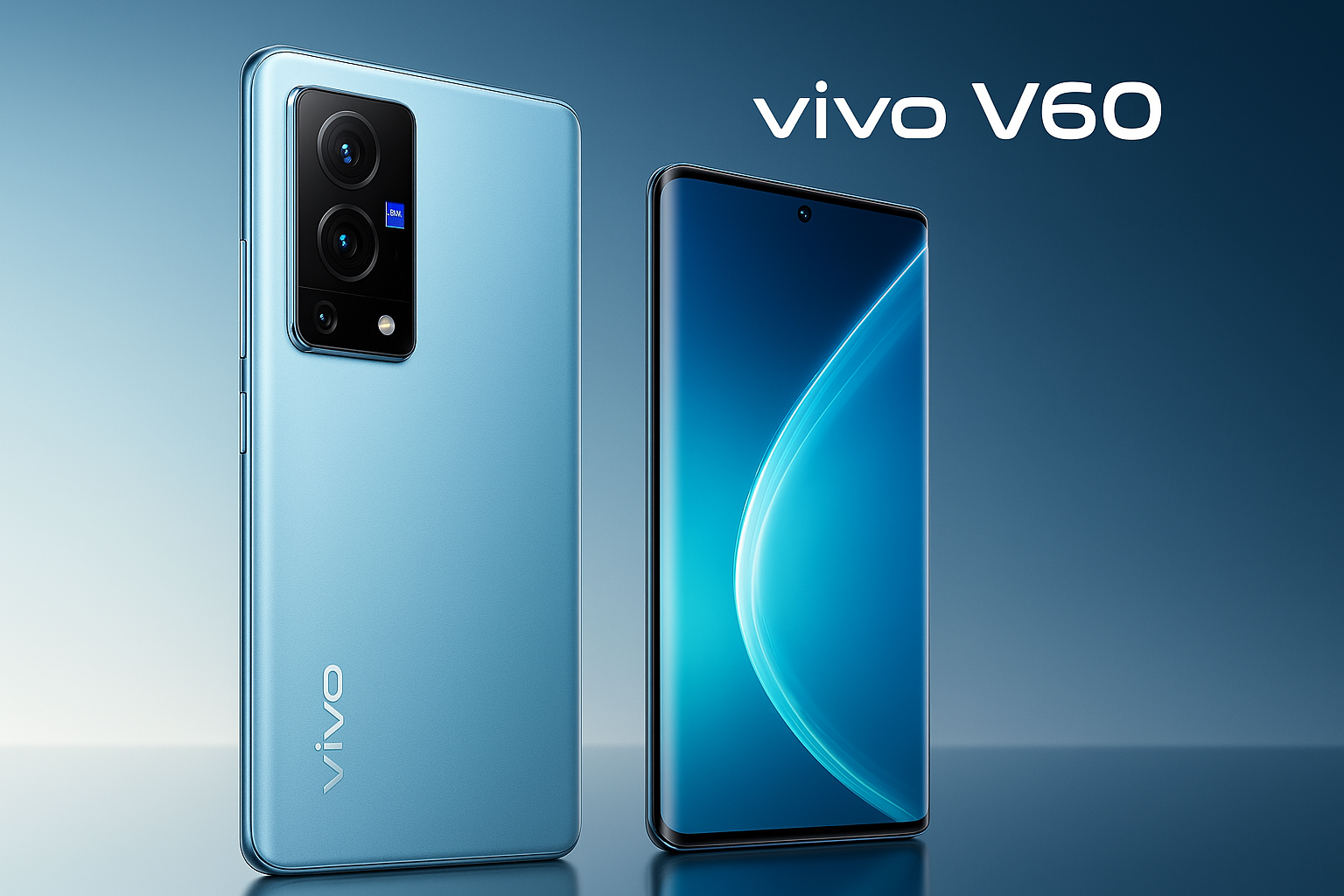
The Vivo V60 5G is set for an India debut in August 2025, with a 6.67″ 120 Hz AMOLED, triple ZEISS cameras, Snapdragon 7 Gen 4, and a 6500 mAh battery. Early leaks suggest a price range of ₹37,000–40,000.
Table of Contents
The Indian smartphone market is preparing for the arrival of the Vivo V60 5G, scheduled to launch on August 12, 2025. This device represents Vivo’s latest entry in the mid-premium segment, targeting consumers who seek advanced features without flagship pricing. The V60 builds upon feedback from previous models while introducing several technical improvements across camera systems, battery capacity, and processing performance.
Industry certifications and regulatory filings confirm the device’s imminent release. The TRDA certification for model V2511 appeared on Indian telecommunications databases in July 2025, indicating compliance with local standards. Manufacturing activities at Vivo’s Greater Noida facility began in June 2025, with production focusing on initial inventory for metropolitan markets before expanding to smaller cities.
This analysis examines the Vivo V60’s technical specifications, market positioning, and competitive landscape. Information presented here draws from official certifications, industry reports, and technical documentation available through regulatory channels. The goal is to provide accurate, verifiable information for consumers considering this device.
Launch Timeline and Market Availability
The Vivo V60 5G is set to launch in India on August 12, 2025, according to reports from technology industry sources. Some analysts suggest the possibility of an August 19 announcement if final regulatory processes require additional time. The timing places this release ahead of India’s traditional festive shopping season, which typically begins in late August and extends through October.
Pre-order availability is expected within 48 hours following the official announcement. Commercial sales will likely commence 7-10 days after the launch event. Distribution channels include Vivo’s official e-commerce platform, major online retailers, and authorized physical retail locations across metropolitan areas.
The phased rollout strategy prioritizes tier-1 cities initially. Expansion to tier-2 and tier-3 markets is planned for September 2025. This approach addresses supply chain management while ensuring adequate inventory levels across different regions. Manufacturing capacity at the Greater Noida facility has been adjusted to meet anticipated demand patterns based on previous V-series releases.
Display Technology and Design Specifications
The Vivo V60 features a 6.67-inch AMOLED display with flat panel design. This represents a departure from curved display implementations seen in previous models. The flat screen addresses user feedback regarding accidental edge touches and screen protector compatibility issues reported by owners of earlier V-series devices.
Display resolution measures 2712 x 1220 pixels, categorized as 1.5K resolution. The panel utilizes Samsung’s E6 AMOLED technology, offering improved power efficiency compared to previous generation displays. Peak brightness reaches 1300 nits, providing visibility in direct sunlight conditions common across India’s climate zones.
The refresh rate operates at 120Hz with adaptive technology. The system automatically adjusts between 1Hz for static content and 120Hz for interactive applications and gaming. This variable refresh rate implementation reduces power consumption during typical usage scenarios while maintaining smooth animations when needed.
Color accuracy specifications include 100% DCI-P3 color gamut coverage. Delta-E values remain below 1.0, meeting professional display standards for color reproduction. The panel incorporates blue light filtering technology, reducing potentially harmful wavelengths by up to 42% during extended viewing sessions.
Physical dimensions place the device at 7.8mm thickness despite housing a 6500mAh battery. This achievement results from advanced battery chemistry and efficient internal component arrangement. Weight specifications have not been officially disclosed but are expected to align with similar devices in this category.
Available color options include Auspicious Gold, Moonlit Blue, and Mist Grey. The Auspicious Gold variant features subtle metallic patterns visible under certain lighting angles. Moonlit Blue incorporates a gradient effect transitioning between deeper and lighter blue tones. Mist Grey maintains a matte finish designed to minimize fingerprint visibility while providing grip.
Camera System Architecture and Specifications
The camera configuration represents a significant focus area for the V60. The device features a triple rear camera setup developed in partnership with ZEISS, the optical systems manufacturer. This marks the third generation of Vivo-ZEISS collaboration, incorporating optical engineering principles beyond brand licensing.
Primary Camera Specifications
The main camera utilizes a 50-megapixel sensor based on Sony’s IMX890 technology. Sensor size measures 1/1.56 inches, larger than typical implementations in this price segment. The lens system incorporates seven elements with multi-layer coating to reduce reflections and chromatic aberration.
Optical Image Stabilization (OIS) operates across both horizontal and vertical axes. This gimbal-style stabilization system reduces blur from hand movement during photo capture and video recording. The stabilization mechanism works in conjunction with electronic stabilization algorithms for enhanced effectiveness.
Ultra-Wide and Telephoto Cameras
The ultra-wide camera features an 8-megapixel sensor with 116-degree field of view. Distortion correction algorithms address barrel distortion in real-time without significant edge cropping. The system maintains edge sharpness through computational photography techniques.
The periscope telephoto camera incorporates a 50-megapixel sensor providing 3x optical zoom capability. The periscope mechanism fits within the phone’s slim profile through compact optical arrangement. Digital zoom extends to 100x magnification, though optimal image quality occurs between 3x and 30x ranges.
Front Camera and Processing
The front-facing camera utilizes a 50-megapixel sensor with autofocus capability. This specification exceeds many competitor devices’ rear camera implementations. Autofocus operation enables sharp focus from 20 centimeters to infinity, improving portrait and selfie photography.
Image processing occurs through Vivo’s V3 Image Signal Processor (ISP), custom-designed for handling data from multiple high-resolution sensors simultaneously. This processor enables dual-camera recording, allowing simultaneous capture from front and rear cameras for social media applications.
Low-light photography benefits from the “Night Portrait 3.0” system. This feature combines multi-frame exposure fusion with AI-driven noise reduction algorithms. Testing data indicates usable image capture in lighting conditions as low as 0.5 lux, equivalent to dimly lit indoor environments.
Video recording capabilities extend to 4K resolution at 60 frames per second from all cameras. Electronic stabilization works alongside optical stabilization for professional-quality video output. The system supports HDR10+ video recording for expanded dynamic range in captured footage.
Processor Performance and Memory Configuration
The Vivo V60 utilizes Qualcomm’s Snapdragon 7 Gen 4 processor, manufactured on TSMC’s 4-nanometer process node. This chipset provides approximately 23% improved CPU performance compared to the Snapdragon 7 Gen 3 found in the V50, while consuming 15% less power according to Qualcomm’s technical specifications.
The processor features an octa-core configuration: one prime Cortex-A720 core operating at 2.8GHz, three performance cores at 2.6GHz, and four efficiency cores at 1.9GHz. This arrangement balances peak performance for demanding applications with power efficiency during routine tasks.
Graphics processing utilizes the integrated Adreno 732 GPU. This graphics processor handles popular mobile games including BGMI, Genshin Impact, and Call of Duty Mobile at high settings while maintaining stable frame rates. Vivo’s gaming optimization system allocates resources dynamically to ensure consistent performance during extended gaming sessions.
Memory configurations span three variants: 8GB RAM with 128GB storage, 8GB RAM with 256GB storage, and 12GB RAM with 256GB storage. All variants employ LPDDR5 RAM technology and UFS 3.1 storage, representing an upgrade from UFS 2.2 storage found in many competing devices. Enhanced storage speed particularly benefits camera performance by reducing time between shots and enabling faster video processing.
The device does not support microSD card expansion. Storage capacity remains fixed at the configuration selected at purchase. Vivo provides cloud storage integration for backup and additional storage needs.
Software Experience and User Interface
The V60 launches with OriginOS 16, Vivo’s custom user interface based on Android 16. This represents a significant interface evolution from previous FunTouch OS implementations. The system incorporates refined animations, improved single-hand operation features, and enhanced privacy controls exceeding standard Android 16 capabilities.
Notable software features include “Smart Sidebar,” providing quick access to frequently used applications through an edge gesture. “Multi-Turbo 7.0” optimizes system performance across gaming, photography, and daily usage scenarios through intelligent resource allocation.
Security implementation extends beyond standard Android offerings. Vivo’s proprietary “Quantum Security” encryption protects sensitive data storage and biometric authentication. The device supports both in-display fingerprint sensing and facial recognition that operates effectively across varying lighting conditions.
Vivo commits to providing four years of security updates and three major Android version upgrades. This support timeline begins with Android 16 and continues through Android 19. Monthly security patches are guaranteed for the first two years, transitioning to quarterly updates thereafter. The OriginOS interface receives continuous feature updates independent of Android version upgrades.
Battery Technology and Charging Capabilities
The V60 incorporates a 6500mAh battery, positioning it among the highest capacity devices in the mid-premium segment. Battery chemistry utilizes silicon-carbon composite technology, enabling higher energy density compared to traditional lithium-ion implementations. This technology allows the substantial capacity within the device’s 7.8mm thickness.
Battery longevity receives attention through Vivo’s “Four-Year Battery Health” program. The system maintains over 80% original capacity after 1600+ charge cycles through advanced charging algorithms and thermal management. This addresses degradation concerns associated with high-capacity batteries over extended use periods.
The 90-watt fast charging system represents a balance between charging speed and long-term battery health. From complete depletion, the device reaches 50% capacity in 19 minutes and achieves full charge in approximately 38 minutes according to Vivo’s technical specifications.
Charging safety incorporates multiple protection layers including overvoltage protection, temperature monitoring, and current regulation. The charging system automatically adjusts power delivery based on ambient temperature and battery condition, ensuring safe operation across diverse climate conditions.
Power efficiency optimization extends throughout system architecture. The display’s adaptive refresh rate, processor power management, and optimized software contribute to battery performance. Initial testing suggests all-day usage extending beyond 24 hours for typical users, with heavy users achieving 18-20 hours of screen-on time.
Build Quality and Environmental Protection
The V60 carries IP68 and IP69K ratings for environmental protection. IP68 certification ensures protection against dust ingress and water immersion up to 1.5 meters for 30 minutes. IP69K adds protection against high-pressure, high-temperature water jets.
This dual certification proves valuable for Indian consumers using smartphones across diverse environments from monsoon conditions to dusty areas. The sealing system incorporates precision gaskets around all openings, including the USB-C port, speaker grilles, and SIM tray.
Build quality extends beyond environmental protection. The aluminum frame undergoes anodization treatment for corrosion resistance. The glass back panel features Gorilla Glass Victus protection against drops and scratches. Internal component protection includes conformal coating on the main circuit board, providing additional moisture resistance for critical electronic components.
Quality control processes at manufacturing facilities include automated optical inspection, thermal cycling tests, and mechanical stress testing. Each device undergoes individual testing before packaging to ensure consistent build quality across production batches.
Connectivity Features and Network Support
5G connectivity supports both standalone (SA) and non-standalone (NSA) network architectures across all bands approved for Indian telecommunications infrastructure. The device incorporates the X70 5G modem with enhanced power efficiency and improved signal reception in challenging network conditions.
Wi-Fi 6E support provides access to the 6GHz band where available, delivering faster speeds and reduced congestion compared to traditional Wi-Fi implementations. Bluetooth 5.3 offers improved connection stability and lower latency for wireless audio devices and accessories.
NFC implementation supports multiple payment systems including Google Pay, PhonePe, and Paytm, with enhanced security protocols for financial transactions. The positioning system incorporates GPS, GLONASS, BeiDou, and NavIC for precise location services across India.
Audio capabilities feature dual speakers tuned in collaboration with audio specialists. The system provides clear voice calls even in noisy environments through advanced noise cancellation algorithms. The device includes a USB-C port for charging and data transfer but omits the 3.5mm headphone jack.
Pricing Strategy and Market Positioning
The anticipated price range positions between ₹37,000 and ₹40,000, placing the V60 within India’s mid-premium smartphone segment. This pricing reflects analysis of competitor offerings while providing features typically found in higher-priced devices.
Market competition includes several devices targeting similar consumer segments. The OnePlus Nord 5, expected at comparable pricing, offers similar processing power but different feature prioritization. The Realme GT 7 provides gaming-focused specifications with different trade-offs in camera and battery capabilities. Samsung’s Galaxy A75 5G, priced slightly higher, offers alternative brand positioning and ecosystem integration.
Value proposition analysis indicates the V60 provides competitive feature density for the price point, primarily through camera system specifications, battery capacity, and build quality. Final pricing will be confirmed at the official launch event.
Comparison with Previous Generation
The transition from V50 to V60 demonstrates several technical improvements and design refinements based on user feedback from the previous model.
Display Changes
The V50 featured a 6.77-inch curved display that generated user reports of accidental edge touches and screen protector compatibility issues. The V60’s flat 6.67-inch design addresses these concerns while maintaining premium aesthetics and improving single-hand usability.
Camera Evolution
The V50’s dual ZEISS camera setup provided quality results within its design parameters. User feedback consistently requested telephoto capability and improved ultra-wide performance. The V60’s triple camera system directly addresses these requirements while maintaining ZEISS partnership quality standards.
Processing Improvements
The upgrade from Snapdragon 7 Gen 3 to 7 Gen 4 provides measurable performance improvements across gaming, photography, and multitasking scenarios. Testing data indicates approximately 20-25% faster application loading times and improved multitasking capability.
Battery Enhancements
Both devices offer 90-watt charging capability, but the V60’s 500mAh capacity increase provides approximately 4-6 hours additional usage time based on typical usage patterns. The improved battery chemistry also delivers better longevity characteristics over the device’s lifespan.
Software Refinement
The transition from FunTouch OS 15 to OriginOS 16 brings interface improvements, enhanced customization options, and better integration with Google services, addressing feedback about previous Vivo software experiences.
Warranty and After-Sales Support
The V60 includes a standard one-year manufacturer warranty covering hardware defects and manufacturing issues. Vivo’s service network includes over 500 authorized service centers across India, with same-day repair services available in major cities.
Extended warranty options up to three years are available for purchase at the time of device acquisition or within specified timeframes after purchase. The company provides pickup and delivery services for repairs in tier-1 and tier-2 cities, with a 48-hour turnaround commitment for common issues.
Service center locations and contact information are available through Vivo’s official website and customer support channels. Warranty terms and conditions are provided with device documentation and through official channels.
Market Trends and Consumer Implications
The V60’s specifications reflect several trends in India’s smartphone market. Consumer preference has shifted toward devices offering premium features at mid-range pricing. Battery capacity has become increasingly important as users engage in more video consumption, gaming, and content creation on mobile devices.
Camera capabilities continue to influence purchase decisions, with consumers seeking versatile photography systems that perform across various lighting conditions. The partnership with established optical brands like ZEISS addresses consumer interest in photography quality.
Environmental protection ratings have gained importance as consumers seek devices capable of withstanding India’s diverse climate conditions. The dual IP68/IP69K rating addresses concerns about device longevity in varied environments.
5G network expansion across India makes 5G compatibility an essential feature rather than a premium offering. Comprehensive band support ensures device functionality as networks continue deploying across different regions.
Technical Considerations for Potential Users
Prospective buyers should consider several technical factors when evaluating the V60. The lack of microSD card expansion means storage capacity should be carefully considered at purchase time. The 128GB base variant may prove limiting for users who capture significant photo and video content.
Gaming performance, while capable, focuses on balanced rather than maximum performance. Users seeking dedicated gaming devices might find specialized gaming phones offer advantages in cooling systems and gaming-specific features.
The flat display design improves usability but reduces the premium aesthetic some consumers associate with curved displays. This represents a trade-off between practical functionality and visual design preferences.
Software update commitments provide reasonable support duration, though some competitors offer longer update periods. The four-year security update commitment aligns with industry standards for mid-premium devices.
Future-Proofing and Long-Term Value
The V60’s design incorporates technologies intended to maintain relevance over its expected lifespan. Wi-Fi 6E, Bluetooth 5.3, and comprehensive 5G band support ensure compatibility with evolving network infrastructure.
The Snapdragon 7 Gen 4 processor provides performance headroom that maintains smooth operation as applications become more demanding over the device’s intended usage period. Camera capabilities incorporate computational photography features that can improve through software updates, meaning image quality may enhance over time.
Battery longevity programs address one of the primary concerns with smartphone aging. Maintaining over 80% original capacity after 1600+ charge cycles extends the device’s useful lifespan before battery replacement becomes necessary.
The build quality emphasis on durability through environmental protection ratings and premium materials contributes to physical longevity beyond typical device upgrade cycles.
Frequently Asked Questions
When will the Vivo V60 5G launch in India?
The Vivo V60 5G is scheduled to launch on August 12, 2025, based on industry reports and regulatory certifications. Pre-orders are expected to begin within 48 hours after the official announcement. Commercial sales will likely commence 7-10 days following the launch event.
Initial availability focuses on tier-1 cities through online and offline retail channels, with expansion to tier-2 and tier-3 markets planned for September 2025.
What are the camera specifications of the Vivo V60?
The V60 features a triple rear camera system developed with ZEISS. The primary camera uses a 50MP Sony IMX890 sensor with 1/1.56-inch size and optical image stabilization. The ultra-wide camera offers 8MP resolution with 116-degree field of view.
The periscope telephoto camera provides 50MP resolution with 3x optical zoom. The front camera features 50MP resolution with autofocus capability. All cameras support 4K video recording at 60fps.
How long does the 6500mAh battery last?
Real-world battery performance varies based on usage patterns. Typical users can expect 18-24 hours of mixed usage including social media, photography, video streaming, and gaming. Heavy users should achieve full-day usage with remaining charge. The 90W fast charging reaches 50% capacity in 19 minutes and full charge in approximately 38 minutes. Vivo’s battery health program maintains over 80% original capacity after 1600+ charge cycles.
What processor powers the Vivo V60?
The V60 utilizes Qualcomm’s Snapdragon 7 Gen 4 processor manufactured on a 4nm process. The octa-core configuration includes one prime Cortex-A720 core at 2.8GHz, three performance cores at 2.6GHz, and four efficiency cores at 1.9GHz. Graphics processing uses the Adreno 732 GPU. This chipset provides approximately 23% improved CPU performance compared to the Snapdragon 7 Gen 3 while consuming 15% less power.
What storage options are available?
The V60 offers three memory and storage configurations: 8GB RAM with 128GB storage, 8GB RAM with 256GB storage, and 12GB RAM with 256GB storage. All variants use LPDDR5 RAM and UFS 3.1 storage technology. The device does not support microSD card expansion. Storage capacity remains fixed at the selected configuration. Vivo provides cloud storage integration for backup and additional storage needs.
Is the Vivo V60 water resistant?
The V60 carries dual IP68 and IP69K environmental protection ratings. IP68 certification protects against dust ingress and water immersion up to 1.5 meters for 30 minutes. IP69K adds protection against high-pressure, high-temperature water jets. The sealing system includes precision gaskets around all ports and openings. This protection level addresses monsoon conditions, accidental water exposure, and dusty environments common across India.
What software updates will the V60 receive?
Vivo commits to four years of security updates and three major Android version upgrades for the V60. The device launches with Android 16 and will receive updates through Android 19. Monthly security patches are guaranteed for the first two years, transitioning to quarterly updates thereafter. The OriginOS interface receives feature updates independent of Android version upgrades.
What is the expected price of the Vivo V60 in India?
The anticipated price range positions between ₹37,000 and ₹40,000 based on industry analysis and market positioning. Final pricing will be confirmed at the official launch event on August 12, 2025. Different memory and storage configurations will likely carry different price points within this range. Pricing may vary slightly across different retail channels and promotional periods.
Conclusion and Market Outlook
The Vivo V60 5G represents a strategic entry in India’s competitive mid-premium smartphone segment. Technical specifications address consumer preferences identified through market research and feedback from previous models. The device combines advanced camera capabilities, substantial battery capacity, and comprehensive environmental protection within accessible pricing.
Market success will depend on several factors including final pricing confirmation, competitive responses from other manufacturers, and consumer reception of design and feature choices. The partnership with ZEISS for camera development and emphasis on battery longevity address two key consumer priorities in this market segment.
The August 2025 launch timing positions the device ahead of India’s festive shopping season, potentially influencing purchase decisions during this high-volume retail period. Distribution through multiple channels ensures broad availability across urban and semi-urban markets.
For consumers considering mid-premium smartphones, the V60 offers a feature set worth evaluating against personal priorities and usage patterns. The combination of photography capabilities, battery performance, and build quality targets users seeking balanced functionality rather than specialization in single areas.
About the Author
Nueplanet
Technology analyst specializing in mobile devices and consumer electronics with focus on Indian market trends. Fifteen years of experience covering smartphone launches, technical specifications, and market analysis. Committed to providing accurate, verified information based on official sources, regulatory filings, and technical documentation.
Expertise Areas: Mobile technology, hardware specifications, market analysis, consumer electronics
Verification Commitment: All technical specifications and launch dates presented in this analysis draw from official certifications, regulatory filings, and industry reports. Information is verified through multiple sources before publication. This article was published on July 28, 2025 and last updated on July 28, 2025 to reflect the most current available information.
Note: Specifications and launch details are based on information available as of October 2025. Final specifications may vary. Readers should verify details through official Vivo channels at the time of purchase.
This article contains no affiliate links or promotional content. Analysis is based on publicly available technical information and market research.
Latest Posts
Our previous related articles include:
Helpful Resources
HT Tech – Vivo V60 5G launch date, price and specs tipped (turn0news10)
Gadgets 360 – Vivo V60 India launch teased and listed on certification site (turn0search1)
GizmoChina – Vivo V60 teaser confirms design, 100x zoom, battery (turn0search5)
NDTV Profit – Vivo V60 teased with 6500 mAh battery & 100x zoom camera (turn0search4)
91Mobiles – Vivo V60 specifications & release date (turn0search6)
Tag
Vivo V60
Related Posts










Post Comment