









CAT 2025: Notification Released, Registration Opens August 1 – Everything You Must Know
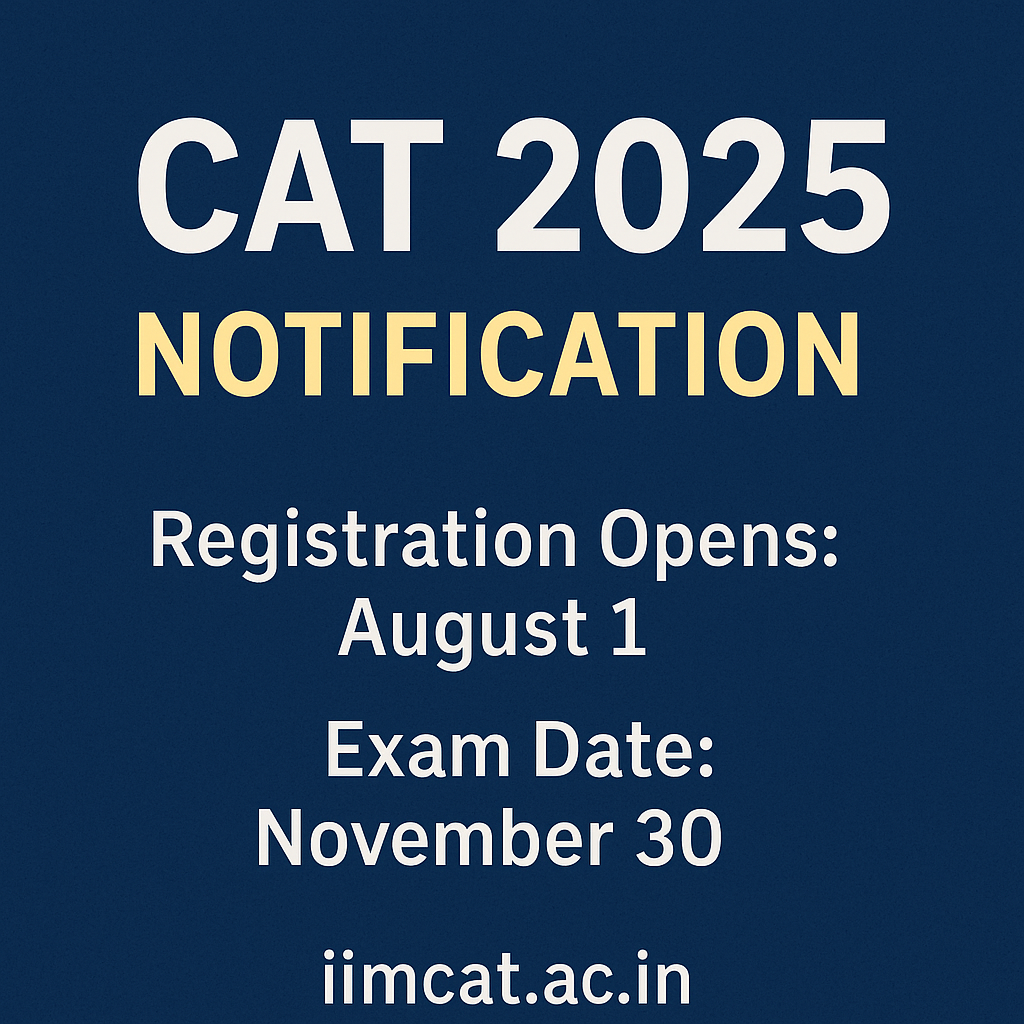
The official CAT 2025 notification is now live at iimcat.ac.in. Registration begins on August 1, 2025, and the exam is scheduled for November 30, 2025. Read on for dates, fees, eligibility, syllabus, and more.
Table of Contents
Introduction to CAT 2025
IIM Kozhikode has officially released the notification for the Common Admission Test (CAT) 2025 on July 27, 2025. This announcement initiates the application process for one of India’s most significant management entrance examinations. CAT serves as the primary gateway for admission to Indian Institutes of Management and numerous other business schools across the country.
The examination is scheduled for November 30, 2025, providing candidates with adequate preparation time. IIM Kozhikode, as the conducting authority for this year, will oversee all aspects of examination administration including registration, test conduct, and result processing. The notification includes detailed information about eligibility criteria, application procedures, and examination structure.
This comprehensive guide provides verified information based on the official CAT 2025 notification. All details presented are sourced from IIM Kozhikode announcements and official documentation available at iimcat.ac.in.
Understanding CAT: Purpose and Significance
What is CAT?
The Common Admission Test (CAT) is a national-level management entrance examination conducted annually by one of the Indian Institutes of Management on a rotational basis. The test evaluates candidates’ aptitude in quantitative ability, verbal ability, reading comprehension, data interpretation, and logical reasoning. These skills are considered essential for success in management education programs.
CAT scores are accepted by all 21 IIMs for their postgraduate management programs. Additionally, over 1,200 business schools across India use CAT scores as part of their admission criteria. This widespread acceptance makes CAT one of the most valuable entrance examinations for management education aspirants.
The examination follows a computer-based format conducted across multiple cities throughout India. Standardized evaluation procedures ensure fair assessment regardless of test location or session timing.
Importance of CAT for Management Aspirants
CAT represents the primary entry route to premier management institutions in India. IIMs consistently rank among the top business schools globally, making CAT performance crucial for candidates seeking quality management education. The examination’s comprehensive assessment methodology evaluates multiple competencies required for management studies.
Beyond IIMs, numerous prestigious institutions including Faculty of Management Studies (FMS) Delhi, SP Jain Institute of Management and Research (SPJIMR), and Management Development Institute (MDI) Gurgaon accept CAT scores. This creates diverse opportunities for candidates based on their scores and preferences.
The merit-based selection process ensures that academic capability and preparation determine success rather than background factors. This accessibility has made CAT a preferred choice for management education aspirants from varied educational and professional backgrounds.
CAT 2025 Important Dates Timeline
Complete Schedule Overview
Notification Release Date: The official notification was published on July 27, 2025, through the CAT website and IIM Kozhikode’s official portal. This announcement provides complete details about examination procedures, eligibility requirements, and application guidelines.
Registration Period:
- Opening Date: August 1, 2025, at 10:00 AM IST
- Closing Date: September 13, 2025, at 5:00 PM IST
- Duration: Approximately 6 weeks
The registration window provides sufficient time for candidates to gather required documents and complete the application process. Early registration is advisable to avoid technical issues that may occur during the final days due to increased server traffic.
Admit Card Availability:
- Release Date: November 5, 2025
- Validity: Through November 30, 2025
- Download Mode: Official website only
Admit cards contain essential information including examination center details, session timing, and candidate instructions. Candidates must download and verify all information immediately upon release.
Examination Date:
- Test Date: November 30, 2025 (Sunday)
- Sessions: Three different time slots
- Format: Computer-based test
The Sunday schedule accommodates working professionals and students without conflicting with regular weekday commitments.
Post-Examination Timeline:
- Answer Key Publication: Early December 2025 (tentative)
- Results Declaration: First week of January 2026 (tentative)
- Score Cards: Available through candidate login
These dates are tentative and subject to confirmation through official announcements. Candidates should monitor the official website for exact timings.
Eligibility Criteria for CAT 2025
Educational Qualifications
Minimum Degree Requirements: Candidates must possess a bachelor’s degree from a recognized university or institution. The degree should be awarded by an institution recognized by the University Grants Commission (UGC) or equivalent regulatory body. Three-year bachelor’s degrees following 10+2 education qualify for CAT application.
Percentage Requirements:
- General and NC-OBC candidates: Minimum 50% aggregate marks or equivalent CGPA
- SC, ST, and PwD candidates: Minimum 45% aggregate marks or equivalent CGPA
These percentage requirements apply to the entire bachelor’s degree program. Calculation methods may vary based on university grading systems, and candidates should verify conversion procedures if applicable.
Professional Qualifications: Professional degrees are accepted as equivalent to bachelor’s degrees for CAT eligibility. Chartered Accountancy (CA), Company Secretary (CS), and Cost and Works Accountancy (ICWA) qualifications meet the educational requirements. Candidates must have completed all examination requirements and practical training for these professional courses.
International Degrees: Degrees obtained from foreign universities require equivalence certification from the Association of Indian Universities (AIU). Candidates must obtain this certification before the admission process begins, though it is not mandatory at the application stage.
Final Year Students Eligibility
Students currently pursuing their final year of bachelor’s degree programs can apply for CAT 2025. These candidates must select “Appearing” status during registration and provide their expected graduation date. However, they must complete all degree requirements before joining any MBA program.
Final year applicants should ensure their final results will be available before MBA program commencement dates. Most institutions require degree completion certificates during document verification processes. Failure to complete degree requirements by specified deadlines may result in admission cancellation.
Age and Attempt Restrictions
Age Limit: CAT 2025 does not impose any age restrictions for candidates. This policy recognizes that individuals may pursue management education at various career stages. Both fresh graduates and experienced professionals can appear for the examination.
Number of Attempts: There is no limitation on the number of times a candidate can appear for CAT. Candidates can attempt the examination in consecutive years or after gaps based on their preparation and circumstances. Each attempt is evaluated independently without reference to previous performances.
This unrestricted attempt policy allows candidates to improve their scores and apply to institutions based on their best performance.
CAT 2025 Registration Process
Accessing the Official Portal
Visit the official CAT website at iimcat.ac.in using any standard web browser. The portal functions optimally on updated versions of Chrome, Firefox, Safari, and Edge browsers. Mobile device access is possible, though desktop or laptop computers provide better user experience for form completion.
Ensure stable internet connectivity throughout the registration process. Save the application periodically if the system provides this option. Maintain a record of your registration credentials for future reference.
Step-by-Step Application Procedure
Step 1: New User Registration Click on “New Candidate Registration” or similar link on the homepage. Enter a valid email address that you access regularly, as all official communications will be sent here. Provide an active mobile number for OTP verification and updates.
The system sends verification codes to both email and mobile number. Enter these codes within the specified time limit to authenticate your account. Create a secure password following the system’s specified requirements including minimum length and character types.
Step 2: Personal Information Entry Fill in your complete name exactly as it appears on your graduation certificate or mark sheets. Any discrepancy between application details and supporting documents may cause complications during admission processes. Enter date of birth, gender, and category information accurately.
Select your category from available options: General, Economically Weaker Section (EWS), Non-Creamy Layer Other Backward Classes (NC-OBC), Scheduled Caste (SC), Scheduled Tribe (ST), or Persons with Disability (PwD). Category selection determines application fee amount and reservation benefits during admission.
Step 3: Educational Details Submission Provide complete information about your bachelor’s degree including university name, degree type, specialization, and year of graduation. Enter your aggregate percentage or CGPA accurately. Final year students should select “Appearing” status and specify expected graduation date.
For professional qualifications like CA, CS, or ICWA, provide registration numbers and completion status. International degree holders should indicate their qualification and be prepared to submit equivalence certificates during admission processes.
Step 4: Contact and Communication Details Enter your current correspondence address where postal communications can reach you. Provide permanent address details as well. These addresses appear on admit cards and score cards, so accuracy is essential.
Reconfirm email address and mobile number as these serve as primary communication channels. Enable email notifications from the CAT domain to ensure important updates don’t land in spam folders.
Step 5: Document Upload Upload a recent color photograph meeting specified dimensions and file size requirements (10KB to 200KB). The photo should be a clear frontal view with neutral background taken within the last three months. Avoid photos with shadows, filters, or accessories covering facial features.
Upload your signature scan (4KB to 30KB) that clearly shows your usual signature style. The signature should be created on white paper using black or blue ink. This signature will be used for verification during examination and admission processes.
Reserved category candidates must upload relevant certificates issued by competent authorities. PwD candidates should upload disability certificates from authorized medical boards.
Step 6: Test City Selection Select up to six test cities in order of preference. The system attempts to assign test centers based on stated preferences, though allocation depends on center availability and demand. Choose cities considering travel convenience, accommodation availability, and familiarity with locations.
Metropolitan cities typically have more test centers but also experience higher demand. Tier-2 cities may offer easier logistics and less crowded examination environments. Consider these factors when prioritizing city preferences.
Step 7: Fee Payment Review all entered information thoroughly before proceeding to payment. Corrections after payment may be limited or impossible for certain fields. Once confirmed, proceed to the secure payment gateway.
Payment options include net banking, credit cards, debit cards, and UPI. The system generates a unique application number upon successful payment completion. Download the payment confirmation receipt immediately and save it securely.
Step 8: Final Submission and Confirmation After successful payment, download the complete application form PDF. Verify all details in this document as it represents your official application. Keep multiple digital and physical copies for future reference.
Note your application number prominently as it serves as your primary identifier for all future correspondence. You will need this number for admit card download, result checking, and admission processes.
Application Form Correction Window
IIM Kozhikode typically provides a correction window after the registration deadline closes. This facility allows candidates to modify certain details if errors were made during initial submission. However, critical fields like name, date of birth, and category generally cannot be changed.
Specific dates for the correction window are announced separately on the official website. Candidates should monitor announcements carefully and utilize this facility if needed. Some corrections may require supporting document uploads for verification.
CAT 2025 Fee Structure
Category-Wise Application Fees
For General, EWS, and NC-OBC Candidates: Application fee: ₹2,600
This amount covers examination administration costs including test center arrangements, question paper development, evaluation processes, and result declaration.
For SC, ST, and PwD Candidates: Application fee: ₹1,300
The reduced fee for reserved category candidates ensures accessibility across economic backgrounds. This 50% fee reduction acknowledges the need for inclusive access to educational opportunities.
Payment Methods
The online payment system accepts multiple payment modes for convenience. Net banking through major banks provides direct debit from savings or current accounts. Credit and debit cards from Visa, Mastercard, RuPay, and other networks are accepted. United Payments Interface (UPI) enables payment through mobile applications.
Payment transactions are processed through secure encryption ensuring financial information safety. The system generates immediate payment confirmation upon successful transaction completion. Failed transactions are automatically reversed within 5-7 working days as per banking protocols.
Fee Refund Policy
Application fees are generally non-refundable except in specific circumstances outlined in the official notification. Examination cancellation by the conducting authority may result in full or partial fee refunds. Technical issues causing multiple payment deductions are resolved through the grievance redressal mechanism.
Candidates should carefully review all eligibility criteria before payment to avoid unnecessary financial losses. Fee payment completion constitutes confirmation of application submission and agreement to examination terms and conditions.
CAT 2025 Examination Pattern
Test Format and Duration
CAT 2025 follows a computer-based test format conducted in controlled examination centers. The total test duration spans 120 minutes (2 hours) divided equally among three sections. Each section receives a fixed time allocation of 40 minutes with no cross-section movement permitted.
This sectional time constraint requires candidates to manage time effectively within each segment. Unattempted questions in one section cannot be compensated by extra time in others. Strategic time allocation becomes crucial for optimal performance.
Session Timings
The examination is conducted in three different sessions on the same day to accommodate all registered candidates:
Morning Session: 9:00 AM to 12:00 PM Afternoon Session: 2:30 PM to 5:30 PM Evening Session: 7:00 PM to 10:00 PM
Session allocation is done by the conducting authority based on various factors including test center capacity and candidate distribution. Candidates cannot choose their preferred session but receive session information on their admit cards.
All sessions contain equivalent difficulty levels ensured through normalization procedures. The multi-session approach reduces crowding and provides logistical flexibility for examination administration.
Section-Wise Structure
Section 1: Verbal Ability and Reading Comprehension (VARC)
- Number of Questions: 24
- Time Allotted: 40 minutes
- Question Types: Multiple choice and Type In The Answer
This section evaluates language proficiency, comprehension skills, and critical thinking abilities. Reading comprehension passages cover diverse topics from various domains. Grammar, vocabulary, and sentence structure questions assess fundamental language skills.
Section 2: Data Interpretation and Logical Reasoning (DILR)
- Number of Questions: 22
- Time Allotted: 40 minutes
- Question Types: Multiple choice and Type In The Answer
DILR tests analytical thinking and problem-solving capabilities through data sets and logical puzzles. Questions present information in various formats including charts, tables, graphs, and textual data. Logical reasoning problems involve pattern recognition, sequencing, and deductive thinking.
Section 3: Quantitative Ability (QA)
- Number of Questions: 22
- Time Allotted: 40 minutes
- Question Types: Multiple choice and Type In The Answer
Quantitative Ability assesses mathematical proficiency and numerical problem-solving skills. Topics span arithmetic, algebra, geometry, trigonometry, and modern mathematics. Questions range from straightforward calculations to complex multi-step problems.
Marking Scheme
Multiple Choice Questions (MCQs):
- Correct Answer: +3 marks
- Incorrect Answer: -1 mark
- Unattempted: 0 marks
The negative marking for MCQs requires strategic attempt selection. Candidates should answer questions they are confident about while avoiding wild guesses on uncertain questions.
Type In The Answer (TITA) Questions:
- Correct Answer: +3 marks
- Incorrect Answer: 0 marks
- Unattempted: 0 marks
TITA questions carry no negative marking, making them relatively safer to attempt. These questions require candidates to type numerical answers or short text responses rather than selecting from given options.
The absence of negative marking for TITA questions allows candidates to attempt these based on reasonable estimates without severe penalty risks.
CAT 2025 Syllabus Coverage
Verbal Ability and Reading Comprehension
Reading Comprehension: Passages are drawn from diverse subjects including business, economics, science, technology, social sciences, and humanities. Passages typically range from 300 to 800 words requiring rapid comprehension and analysis. Questions test understanding, inference, tone identification, and critical reasoning based on passage content.
Vocabulary: Questions assess contextual vocabulary usage, word meanings, synonyms, and antonyms. Emphasis is placed on understanding words within context rather than isolated definitions.
Grammar and Sentence Correction: Assessment of grammatical accuracy, sentence structure, and language usage follows standard English conventions. Questions may involve error identification, sentence improvement, or para jumbles requiring logical sentence sequencing.
Critical Reasoning: These questions evaluate ability to analyze arguments, identify assumptions, strengthen or weaken arguments, and draw logical conclusions from given information.
Data Interpretation and Logical Reasoning
Data Interpretation: Questions present data through tables, charts (bar, pie, line), graphs, and caselets. Candidates must extract relevant information, perform calculations, and draw conclusions. Data sets may involve single or multiple related data representations requiring integrated analysis.
Logical Reasoning: Puzzles include seating arrangements, scheduling problems, team formations, and constraint-based scenarios. Blood relation problems, directions, and logical sequences test deductive reasoning. Syllogisms assess logical deduction from given premises.
Analytical Reasoning: Questions involve analyzing relationships, patterns, and logical connections between given elements. These may include arrangement problems, distribution scenarios, or selection-based puzzles.
Quantitative Ability
Arithmetic: Number systems, percentages, profit and loss, simple and compound interest, time and work, time and distance, averages, ratios and proportions, mixtures and allegations.
Algebra: Linear and quadratic equations, inequalities, functions, progressions (arithmetic and geometric), logarithms, and basic algebraic identities.
Geometry: Lines, angles, triangles, quadrilaterals, circles, polygons, coordinate geometry, and mensuration covering areas and volumes of various shapes.
Modern Mathematics: Permutations and combinations, probability, and basic set theory applications.
Trigonometry: Trigonometric ratios, identities, equations, and applications in height and distance problems.
The syllabus does not require advanced calculus or statistics beyond basic concepts. Focus remains on fundamental mathematical principles and their practical applications.
Preparation Strategy for CAT 2025
Foundation Phase (August – September)
Conceptual Understanding: Begin with thorough syllabus coverage focusing on fundamental concept clarity. Study each topic systematically using standard reference materials and online resources. Avoid rushing through topics without proper understanding as this creates knowledge gaps affecting advanced problem-solving.
Reading Development: Develop consistent reading habits through newspapers, business magazines, and diverse online publications. This practice enhances both reading speed and comprehension skills essential for VARC section success. Aim for at least 30-45 minutes of focused reading daily.
Basic Problem Solving: Practice fundamental problems for each quantitative and logical reasoning topic. Build confidence through regular problem-solving before advancing to complex questions. Maintain error logs identifying recurring mistakes and conceptual weaknesses.
Intensive Practice Phase (October – November)
Mock Test Practice: Increase mock test frequency to 3-4 full-length tests weekly. Simulate actual examination conditions including time constraints and sectional restrictions. Analyze performance comprehensively identifying strong and weak areas.
Sectional Time Management: Practice completing each section within the 40-minute allocation. Develop strategies for question selection, skip patterns, and review procedures. Time management often determines score differences between candidates with similar preparation levels.
TITA Question Focus: Given the absence of negative marking for TITA questions, develop confidence in attempting these questions even with reasonable estimates. Practice calculation accuracy as these questions require precise numerical answers.
Weak Area Strengthening: Allocate additional study time to consistently weak topics or question types. Use targeted practice sets focusing specifically on problem areas. Monitor improvement through periodic reassessment.
Final Preparation Phase (Late November)
Revision and Consolidation: Review key formulas, important concepts, and common problem-solving approaches. Avoid introducing completely new topics during this phase. Focus on strengthening existing knowledge rather than expanding coverage.
Stress Management: Maintain regular sleep patterns, exercise routines, and healthy eating habits. Physical wellness directly impacts mental performance and test-day execution. Practice relaxation techniques for managing examination anxiety.
Logistics Planning: Finalize test center familiarity, travel arrangements, and accommodation if required. Prepare required documents well in advance. Eliminate all non-academic concerns before examination day.
Test Center and Admit Card Information
Test Center Allocation
CAT 2025 will be conducted across more than 170 cities throughout India. Test center allocation considers candidate’s stated city preferences while balancing center capacity and candidate distribution. Metropolitan cities typically have multiple test centers, while smaller cities may have one or two centers.
The final test center address appears on the admit card approximately three weeks before the examination. Candidates cannot change allocated centers after admit card release except under extraordinary circumstances with proper justification.
Admit Card Download Process
Admit cards become available from November 5, 2025, through the official CAT website. Candidates must log in using their application credentials to download admit cards. The document contains photograph, signature, examination center address, session timing, and important instructions.
Download multiple copies of the admit card in PDF format. Print at least 2-3 copies on good quality paper. Verify all printed information for accuracy immediately after download. Any discrepancies should be reported to the helpdesk immediately.
Required Documents for Examination Day
Candidates must carry the following to the examination center:
Mandatory Documents:
- Printed admit card with clear photograph
- Valid original photo identification proof (Aadhaar card, PAN card, Passport, Driving License, or Voter ID)
- Additional copy of the same ID proof
ID proof name must match the name on the admit card exactly. Any mismatch may lead to examination entry denial. Carry multiple ID proofs if possible to avoid issues from any single document problem.
Prohibited Items: Electronic devices including mobile phones, smartwatches, calculators, and cameras are strictly prohibited. Personal items like bags, wallets, and study materials cannot be carried inside the examination hall. Test centers provide minimal storage facilities, and candidates are responsible for their belongings.
Score Calculation and Percentile System
Raw Score Calculation
Raw scores are calculated based on the marking scheme for correct and incorrect answers. Each section generates a separate raw score based on attempted questions. The total raw score represents the sum of individual section scores.
TITA questions contribute positively to scores without penalty risk, making them strategically important for score maximization. The balanced attempt strategy considers both accuracy and the number of attempts.
Normalization Process
CAT uses normalization procedures to account for difficulty variations across different sessions. This ensures fair comparison of scores regardless of the session candidates appear in. Normalized scores rather than raw scores determine final percentiles.
The normalization formula considers section-wise difficulty levels and candidate performance distributions. This process maintains equity ensuring no candidate gains advantage or disadvantage from their session allocation.
Percentile Interpretation
CAT results report sectional and overall percentiles rather than absolute scores. Percentile indicates the percentage of candidates scoring lower than a particular candidate. For example, 99 percentile means the candidate scored higher than 99% of all test-takers.
IIMs and other institutions use percentile scores for shortlisting candidates for further selection processes. Sectional percentile requirements ensure balanced performance across all areas. Overall percentile determines general eligibility while sectional cutoffs filter for specific competencies.
Institutions Accepting CAT Scores
Indian Institutes of Management
All 21 IIMs accept CAT scores for their flagship two-year MBA programs. These include IIM Ahmedabad, Bangalore, Calcutta, Lucknow, Kozhikode, Indore, Shillong, Rohtak, Ranchi, Raipur, Trichy, Udaipur, Kashipur, Nagpur, Visakhapatnam, Amritsar, Bodh Gaya, Sambalpur, Sirmaur, Jammu, and Mumbai.
Each IIM has its own admission process following CAT scores. This typically includes Written Ability Tests (WAT), Group Discussions (GD), and Personal Interviews (PI). Academic records, work experience, and diversity factors also influence final selection.
Other Premier B-Schools
Faculty of Management Studies (FMS), Delhi: FMS Delhi consistently ranks among India’s top business schools with strong industry connections and placement records.
SP Jain Institute of Management and Research (SPJIMR), Mumbai: Known for its innovative curriculum and strong corporate relationships, SPJIMR offers specialized management programs.
Management Development Institute (MDI), Gurgaon: MDI provides comprehensive management education with emphasis on leadership development and ethical practices.
Indian Institute of Foreign Trade (IIFT): While IIFT conducts its own entrance examination, it also considers CAT scores for certain programs.
CAT-Accepting Business Schools
Over 1,200 business schools across India accept CAT scores for admission to their MBA and PGDM programs. This extensive acceptance network provides diverse options based on specialization preferences, geographical choices, and score ranges.
State-level institutions, private universities, and autonomous business schools participate in CAT-based admissions. Candidates can apply to multiple institutions simultaneously, selecting based on their scores and preferences.
Frequently Asked Questions (FAQs)
Q1: When does CAT 2025 registration begin and what are the exact timings?
Registration for CAT 2025 opens on August 1, 2025, at 10:00 AM IST and continues until September 13, 2025, at 5:00 PM IST. The registration portal at iimcat.ac.in remains accessible throughout this six-week period. Candidates should complete registration early to avoid technical difficulties that may occur during the final days due to increased website traffic. The extended registration window provides adequate time for document preparation and application form completion.
Q2: Which IIM is conducting CAT 2025 and what are its responsibilities?
IIM Kozhikode serves as the designated conducting authority for CAT 2025. As the conducting IIM, Kozhikode is responsible for all examination-related activities including notification release, application processing, test administration, answer key publication, result declaration, and score card distribution. The conducting IIM rotates annually among different IIMs, ensuring fresh perspectives while maintaining consistent quality standards. IIM Kozhikode’s educational administration expertise guarantees reliable examination conduct.
Q3: What is the complete fee structure for different categories in CAT 2025?
The application fee is ₹2,600 for General category, Economically Weaker Section (EWS), and Non-Creamy Layer Other Backward Classes (NC-OBC) candidates. Scheduled Caste (SC), Scheduled Tribe (ST), and Persons with Disability (PwD) candidates pay a reduced fee of ₹1,300. This 50% fee reduction for reserved categories ensures accessibility across economic backgrounds while covering examination administration costs including test center arrangements, evaluation processes, and result processing.
Q4: Can final-year graduation students apply for CAT 2025?
Yes, students currently in their final year of bachelor’s degree programs are eligible to apply for CAT 2025. These candidates should select “Appearing” status during registration and provide their expected graduation date. However, they must complete all degree requirements and obtain the minimum required percentage before joining any MBA program. Final year applicants should ensure their results will be available before MBA program commencement dates as degree completion certificates are required during admission processes.
Q5: What happens if errors are made in the CAT 2025 application form?
The registration system typically provides a correction window after the main registration deadline closes. This facility allows candidates to modify certain application details if errors were made during initial submission. However, critical fields such as name, date of birth, and category generally cannot be changed after final submission. Specific dates for the correction window are announced separately on the official website. Candidates should verify all information thoroughly before final submission to minimize the need for corrections.
Q6: How many cities will host CAT 2025 examination centers?
CAT 2025 will be conducted across more than 170 cities throughout India, ensuring geographical accessibility for candidates from diverse locations. The extensive network includes metropolitan cities, state capitals, and smaller urban centers. Candidates can select up to six test cities in order of preference during registration. Final test center allocation depends on stated preferences, center capacity, and candidate distribution. Metropolitan cities typically have multiple centers while smaller cities may have one or two testing locations.
Q7: What is the complete examination pattern and marking scheme for CAT 2025?
CAT 2025 comprises three sections with 40 minutes allocated to each section: Verbal Ability and Reading Comprehension (24 questions), Data Interpretation and Logical Reasoning (22 questions), and Quantitative Ability (22 questions). The marking scheme awards +3 marks for correct answers across all question types. Multiple Choice Questions (MCQs) carry -1 mark for incorrect responses, while Type In The Answer (TITA) questions have no negative marking. The total test duration is 120 minutes with sectional time restrictions preventing cross-section movement.
Q8: What is the validity period of CAT 2025 scores and which institutions accept them?
CAT 2025 scores remain valid for one year and are accepted by all 21 Indian Institutes of Management for their MBA programs. Additionally, numerous premier institutions including FMS Delhi, SPJIMR Mumbai, MDI Gurgaon, and over 1,200 business schools across India accept CAT scores. Score validity applies to the specific admission cycle immediately following the examination. Candidates cannot use these scores for subsequent year admissions and must reattempt CAT for future application cycles.
Conclusion and Next Steps
The release of CAT 2025 notification by IIM Kozhikode on July 27, 2025, marks the beginning of the application and preparation phase for management education aspirants. With registration opening on August 1, 2025, candidates have a clear timeline for completing applications and preparing for the November 30, 2025 examination.
Successful CAT performance requires strategic preparation encompassing conceptual understanding, consistent practice, and effective time management. The comprehensive syllabus across verbal, logical, and quantitative areas demands balanced preparation focus. Candidates should utilize the available preparation time effectively through structured study plans and regular mock test practice.
Understanding eligibility requirements, application procedures, and examination patterns forms the foundation for successful CAT journey. The detailed information provided in this guide assists candidates in making informed decisions and avoiding common application pitfalls. Regular monitoring of the official website ensures candidates remain updated about any procedural changes or important announcements.
Key Takeaways
Verify eligibility criteria carefully before beginning the application process. Ensure educational qualifications meet the specified percentage requirements for your category. Gather required documents including photographs, signatures, and category certificates before registration opens.
Complete application registration early within the August 1 to September 13, 2025 window. Early submission avoids technical issues and provides peace of mind for focusing on preparation. Verify all entered information thoroughly before final submission to prevent complications during later stages.
Develop a comprehensive preparation strategy covering all three sections systematically. Allocate time for concept building, practice, and mock tests. Monitor progress through regular self-assessment and adjust strategies based on performance analysis.
Immediate Action Items
For Prospective Applicants:
- Mark August 1, 2025, in your calendar for registration opening
- Collect required documents including recent photograph and signature scans
- Verify educational qualification documents and calculate aggregate percentages
- Prepare list of preferred test cities considering logistics and convenience
- Arrange fee payment methods ensuring adequate funds are available
For Preparation:
- Obtain reliable study materials and reference resources
- Create detailed study schedule through November 2025
- Identify coaching or self-study approach based on personal learning style
- Join online forums or study groups for peer learning and motivation
- Begin building reading habits and solving basic quantitative problems
The CAT 2025 opportunity is now available through official notification. Systematic preparation combined with proper application procedures positions candidates optimally for success. Whether targeting IIMs or other premier business schools, CAT performance significantly influences management education prospects and future career trajectories.
About the Author
Nueplanet
Management Entrance Examination Analyst specializing in CAT, GMAT, and MBA admission processes.
Nueplanet specialize in providing accurate, verified information about management entrance examinations and admission procedures. All content is sourced from official conducting authority notifications, IIM announcements, and verified educational resources. My goal is helping MBA aspirants access reliable information for application and preparation planning. Content is regularly updated to reflect latest official developments and examination patterns.
Content Verification Commitment:
All information presented is sourced from official IIM Kozhikode notifications and the CAT 2025 official website. Content accuracy is verified against official announcements and updated regularly to maintain current relevance.
Published Date: July 27, 2025
Last Updated: July 27, 2025
Next Review: August 15, 2025
Disclaimer: This article provides information based on official CAT 2025 notifications available as of July 27, 2025. Candidates should verify all details from the official website (iimcat.ac.in) before taking action. The author is not affiliated with IIM Kozhikode or CAT conducting authorities and provides content for informational purposes only.
Helpful Resources
Latest Posts
Tag
CAT 2025













Post Comment