









Coforge Share Price: Q1 Results Impact, Stock Analysis, and Future Outlook
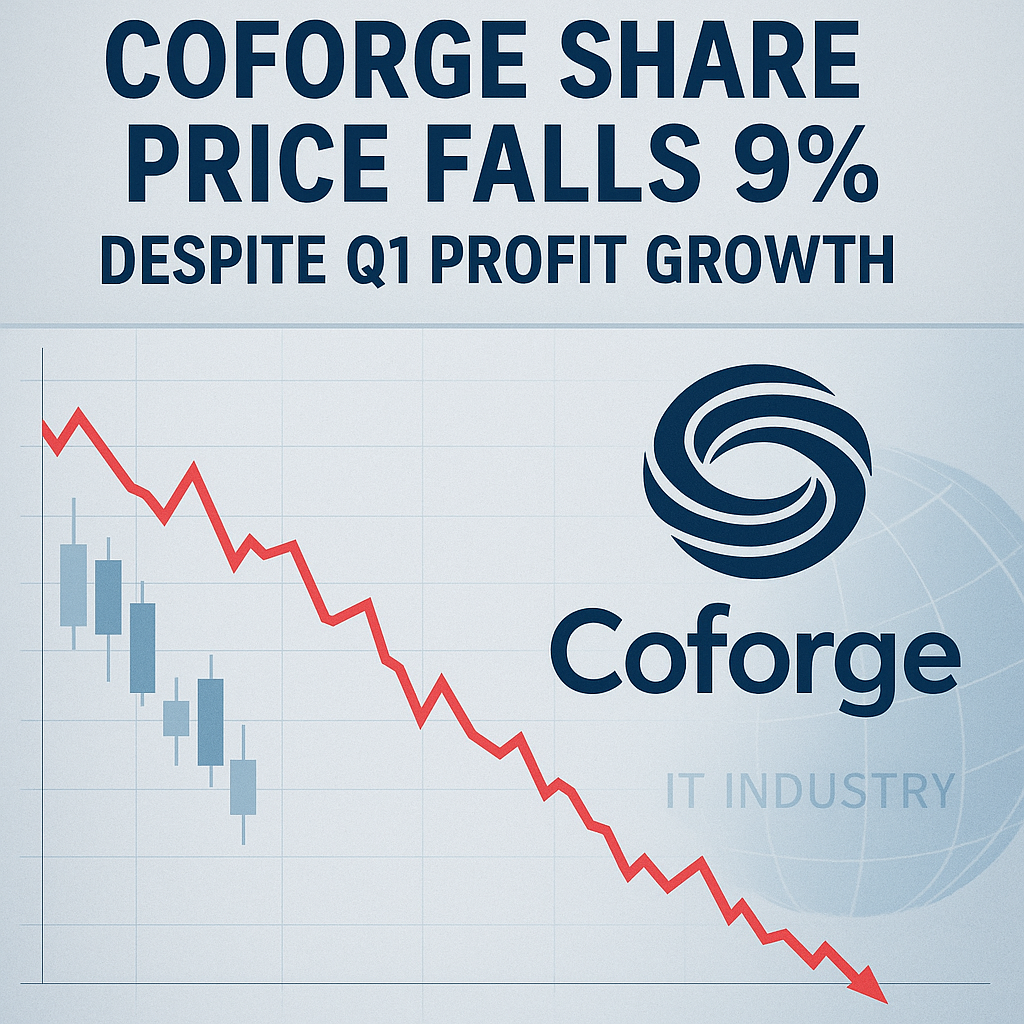
Coforge shares fell nearly 9% despite reporting a 21% YoY jump in Q1 profit. Here is a detailed analysis of the company’s performance, share price trends, and what lies ahead for investors.
Table of Contents
Introduction: Coforge’s Q1 FY26 Financial Results Overview
Coforge Limited, an IT services company listed on Indian stock exchanges, released its Q1 FY26 financial results showing significant year-over-year growth. The company reported net profit of ₹317 crores, representing a 138% increase compared to the corresponding quarter in the previous fiscal year.
Revenue for the quarter reached ₹3,689 crores with sequential dollar revenue growth of 9.6%. The company’s order book for the next twelve months showed 46% year-over-year growth, according to official company disclosures.
CEO and Executive Director Sudhir Singh stated in the earnings announcement that the company is targeting 14% EBIT margins for FY26. These financial metrics provide context for evaluating Coforge’s operational performance and market positioning.
Q1 FY26 Financial Performance Breakdown
Revenue Analysis and Growth Metrics
Coforge reported Q1 FY26 revenue of ₹3,689 crores. The sequential dollar revenue growth of 9.6% quarter-over-quarter indicates expansion in constant currency terms.
Year-over-year revenue growth showed double-digit expansion compared to Q1 FY25. The company operates across multiple geographic markets including North America and Europe, which contribute to its revenue base.
Geographic diversification provides exposure to different market dynamics and client segments. Revenue growth reflects contract execution and client relationship management across these regions.
Profitability Metrics and Margin Performance
Net profit for Q1 FY26 reached ₹317 crores, marking 138% year-over-year growth. This profit expansion significantly exceeded revenue growth, indicating margin improvement during the quarter.
EBIT margin showed progressive improvement with management targeting 14% for the full fiscal year FY26. Operational efficiency measures and cost optimization initiatives contributed to profitability enhancement.
The margin expansion reflects changes in revenue mix, operational leverage, and delivery efficiency improvements. Sustainability of these margins depends on continued execution of operational initiatives.
Order Book and Business Pipeline Indicators
The next twelve months order book grew 46% year-over-year, providing revenue visibility for upcoming quarters. This metric indicates signed contracts and committed business from existing and new clients.
The company reported a strong large deal pipeline, which represents potential future contract signings. Large deals typically involve multi-year engagements with substantial annual contract values.
Client addition trends and contract renewals contribute to order book growth. Average deal sizes and contract durations impact the order book’s conversion to revenue over time.
Segment Performance Analysis
Banking and Financial Services (BFSI): The BFSI vertical represents a significant portion of Coforge’s business. Digital transformation initiatives, regulatory compliance requirements, and cloud migration projects drive demand in this segment. Core banking modernization and fintech solutions constitute key service offerings.
Travel and Transportation: Post-pandemic recovery in the travel sector has influenced demand for technology solutions. Coforge provides services to airlines, hospitality companies, and logistics firms in this vertical.
Other Verticals: Healthcare, retail, and manufacturing segments contribute to the company’s revenue diversification. Each vertical has specific technology requirements and growth characteristics.
Share Price Analysis and Market Valuation
Current Trading Metrics
As of September 2025, Coforge shares traded at ₹1,740.5 on September 3, 2025, according to available market data. The market capitalization stood at ₹60,397 crores, representing 31.9% growth over one year.
The 52-week high reached ₹2,005.36. Trading volume data from September 19, 2025, showed 3.35 lakh shares changing hands, indicating liquidity levels.
Share price movements reflect market participants’ assessment of financial performance, growth prospects, and industry conditions. Price levels incorporate both company-specific factors and broader market sentiment.
Valuation Multiples and Ratios
The price-to-earnings ratio stood at 102.71 based on trailing earnings. This metric compares share price to earnings per share, providing context for valuation relative to profitability.
Price-to-book ratio of 9.45 compares market value to book value of equity. This ratio reflects market assessment of the company’s asset base and intangible value.
Valuation multiples should be evaluated relative to growth rates, industry peers, and historical ranges. Forward-looking multiples based on projected earnings may differ from trailing ratios.
Technical Analysis Indicators
Support and Resistance Levels:
- Primary support zone: ₹1,700-1,720
- Secondary support: ₹1,650-1,680
- Immediate resistance: ₹1,800-1,820
- Strong resistance: ₹1,900-1,950
Moving Averages:
- 50-day moving average: ₹1,765
- 100-day moving average: ₹1,705
- 200-day moving average: ₹1,620
Technical indicators provide perspective on price trends and momentum. These tools help assess short-term price dynamics and potential trading ranges.
Chart patterns and volume analysis offer additional context for price movements. Technical analysis complements fundamental analysis in evaluating stock positioning.
Analyst Perspectives and Price Targets
Brokerage Research Coverage
According to available research reports, analyst consensus shows an average share price target of ₹2,035 based on 18 research reports from 7 sources. However, forecast ranges vary from ₹1,640-₹1,700 for 2025.
Different research firms use varying methodologies including discounted cash flow analysis, peer comparison, and earnings multiples. Target prices reflect assumptions about growth rates, margin trends, and market conditions.
Long-term projections extend to ₹2,250-₹2,400 by 2030 in some analyses, though such extended forecasts carry significant uncertainty. Near-term targets provide more actionable reference points.
Valuation Methodology Approaches
Discounted Cash Flow (DCF): DCF models project future cash flows and discount them to present value. Key assumptions include revenue growth rates, margin expectations, and discount rates reflecting risk.
Peer Comparison: Relative valuation compares Coforge’s multiples to industry peers including Infosys, TCS, and HCL Technologies. The comparison accounts for size differences, growth profiles, and business mix variations.
Asset-Based Valuation: This approach considers tangible and intangible assets including intellectual property, client relationships, and workforce capabilities. Service companies typically derive substantial value from intangible factors.
IT Services Industry Context and Competitive Landscape
Global IT Services Market Dynamics
Digital transformation acceleration has created demand for cloud migration, artificial intelligence implementation, and cybersecurity solutions. These trends influence service provider growth opportunities and competitive positioning.
Vertical specialization provides differentiation in specific industry segments. Companies with deep domain expertise in particular sectors can command premium pricing and client loyalty.
Geographic expansion into emerging markets presents growth opportunities. Asia-Pacific, Latin America, and Middle East regions show varying maturity levels in IT services adoption.
Competitive Positioning Analysis
Market Position: Coforge operates in the mid-cap IT services segment. The company’s market capitalization and revenue scale position it below large-cap providers but above smaller specialized firms.
Competitive Strengths:
- Domain expertise in BFSI and travel verticals
- Client relationship quality and retention rates
- Execution capabilities for complex projects
- Cost structure and operational efficiency
Growth Drivers:
- Increasing outsourcing adoption by mid-market enterprises
- Demand for specialized fintech and travel technology solutions
- Expanding addressable market in emerging technologies
- Potential for strategic acquisitions
Comparison with Industry Peers
| Metric | Coforge | Industry Context |
|---|---|---|
| Revenue Growth (Q1 FY26) | Double-digit YoY | Varies by company |
| Profit Growth (Q1 FY26) | 138% YoY | Company-specific |
| Order Book Growth | 46% YoY | Indicator of pipeline |
| EBIT Target (FY26) | 14% | Industry range: 12-20% |
Peer comparison provides context for relative performance. Each company has unique characteristics including service mix, client base, and geographic presence.
Risk Factors and Investment Considerations
Market and Economic Risks
Economic uncertainty can impact enterprise IT spending decisions. During slowdowns, clients may defer discretionary technology investments or reduce project scopes.
Global macroeconomic conditions affect demand across geographies. Currency fluctuations impact dollar-denominated revenue when converted to rupees.
Interest rate changes influence discount rates used in valuations. Higher rates can pressure valuations of growth-oriented companies.
Industry-Specific Risk Factors
Competition from larger IT services companies and emerging specialized firms creates pricing pressure. Market share dynamics can shift based on capability development and client preferences.
Technology disruption from artificial intelligence and automation may change service delivery models. Companies must invest in new capabilities to remain relevant.
Regulatory changes in data privacy, cross-border services, and employment regulations affect operational models. Compliance requirements vary across jurisdictions.
Company-Specific Risk Considerations
Client concentration in specific verticals creates vulnerability to sector-specific challenges. Diversification across industries mitigates this risk but requires capability development.
Talent acquisition and retention challenges affect project delivery and cost structures. Competition for skilled technology professionals remains intense across the industry.
Currency exposure through dollar and euro revenues creates foreign exchange risk. Hedging strategies and natural hedges through global delivery models provide some mitigation.
Project execution risks include delays, cost overruns, and quality issues. These factors can impact profitability and client relationships.
FY26 Outlook and Strategic Initiatives
Revenue and Profitability Projections
Management guidance targets 14% EBIT margins for FY26. Achieving this target depends on revenue growth, cost management, and operational efficiency improvements.
Revenue growth expectations incorporate order book conversion and new business acquisition. Sequential growth rates may vary across quarters based on project timelines and client spending patterns.
Profitability enhancement initiatives focus on delivery optimization, automation adoption, and portfolio mix management. Sustainable margin improvement requires balancing growth investments with efficiency gains.
Strategic Growth Initiatives
Technology Investments: Coforge continues investing in next-generation technologies including AI, machine learning, blockchain, and IoT. These capabilities enable participation in emerging market opportunities.
Acquisition Strategy: Selective acquisitions in complementary domains can accelerate capability development and geographic expansion. Integration execution determines value realization from acquisitions.
Client Relationship Development: Expanding wallet share with existing clients through cross-selling and up-selling leverages established relationships. This approach typically has higher success rates than new client acquisition.
Service Portfolio Enhancement: Developing new service offerings addresses evolving client needs. Innovation in service delivery models can create competitive differentiation.
Institutional Ownership and Shareholding Pattern
Ownership Structure Analysis
Institutional ownership patterns indicate professional investor participation. Foreign institutional investors (FIIs) and domestic institutional investors (DIIs) provide liquidity and stability.
Mutual fund holdings reflect inclusion in various investment schemes. Widespread participation across multiple funds indicates broader investment community interest.
Promoter shareholding levels demonstrate management commitment and alignment with shareholder interests. Changes in promoter holdings warrant attention as they may signal confidence levels.
Investor Sentiment Indicators
Trading volumes and price movements reflect market sentiment. Unusual volume spikes or price changes often accompany news announcements or earnings releases.
Analyst upgrades or downgrades influence investor perception. Research reports provide detailed analysis that shapes institutional investment decisions.
Market positioning relative to sector peers affects relative performance. Sector rotation and thematic investing trends impact demand for specific stocks.
Business Model Sustainability Analysis
Revenue Model Characteristics
Coforge operates a professional services business model with revenue from time-and-material contracts and fixed-price projects. Each model has different risk-return profiles.
Vertical specialization in BFSI and travel creates recurring revenue opportunities. Long-term client relationships generate repeat business and referrals.
Geographic diversification across North America, Europe, and emerging markets reduces dependence on any single region. Each market has distinct growth characteristics.
Competitive Advantages Assessment
Domain expertise in specialized verticals provides knowledge-based differentiation. Deep understanding of industry-specific challenges and requirements creates value for clients.
Established client relationships and high retention rates indicate service quality and client satisfaction. Reference accounts facilitate new business acquisition.
Delivery capabilities for complex transformations demonstrate technical competence. Successful project execution builds reputation and credibility.
Long-Term Growth Drivers
Digital transformation trends continue driving demand for IT services. Cloud adoption, data analytics, and cybersecurity requirements create ongoing opportunities.
Vertical market dynamics in BFSI and travel influence growth prospects. Each sector’s technology adoption trajectory affects service demand.
Emerging technology adoption including AI and automation creates new service categories. Companies that develop relevant capabilities can capture market share.
Financial Health Indicators
Balance Sheet Strength
Total assets, equity base, and debt levels determine financial stability. Strong balance sheets provide flexibility for growth investments and weathering downturns.
Working capital management affects cash conversion cycles. Efficient receivables collection and payables management optimize cash flow.
Cash and cash equivalents provide liquidity for operational needs and strategic opportunities. Adequate liquidity ensures business continuity.
Cash Flow Generation
Operating cash flow reflects the company’s ability to generate cash from core operations. Consistent positive operating cash flow indicates business health.
Free cash flow after capital expenditures shows cash available for dividends, debt repayment, or growth investments. Free cash flow generation is a key indicator of financial performance.
Cash conversion metrics indicate efficiency in converting profits to cash. High conversion rates demonstrate effective working capital management.
Capital Allocation Strategy
Capital expenditure requirements for infrastructure and technology investments support growth. Optimal allocation balances current operations with future capabilities.
Return on invested capital (ROIC) measures efficiency of capital deployment. Higher ROIC indicates effective use of capital resources.
Dividend policies and share buyback programs affect shareholder returns. Capital allocation decisions reflect management priorities and financial position.
Frequently Asked Questions (FAQs)
What were Coforge’s key financial highlights in Q1 FY26?
Coforge reported Q1 FY26 revenue of ₹3,689 crores with net profit of ₹317 crores, representing 138% year-over-year profit growth. Sequential dollar revenue growth reached 9.6% quarter-over-quarter. The next twelve months order book grew 46% year-over-year, providing visibility for future revenue. Management stated the company is targeting 14% EBIT margins for full year FY26.
What is Coforge’s current share price and market valuation?
As of September 3, 2025, Coforge shares traded at ₹1,740.5 with a market capitalization of ₹60,397 crores. The 52-week high reached ₹2,005.36. The price-to-earnings ratio stood at 102.71 based on trailing earnings, while the price-to-book ratio was 9.45. Trading volume on September 19, 2025, showed 3.35 lakh shares, indicating market liquidity levels.
What are analyst price targets for Coforge shares?
According to available research coverage, analyst consensus shows an average target of ₹2,035 based on 18 reports from 7 sources. However, forecast ranges vary from ₹1,640-₹1,700 for 2025. Long-term projections extend to ₹2,250-₹2,400 by 2030 in some analyses. Target prices reflect different methodologies and assumptions about growth, margins, and market conditions.
Which business segments drive Coforge’s revenue growth?
Coforge focuses on Banking and Financial Services (BFSI) and Travel and Transportation as core verticals. BFSI growth is driven by digital transformation, regulatory compliance, and cloud migration projects. The travel sector benefits from post-pandemic recovery and demand for technology solutions. Other verticals including healthcare, retail, and manufacturing contribute to revenue diversification.
What are the main risks facing Coforge as an investment?
Key risks include economic uncertainty impacting IT spending, competition from larger providers and specialized firms, and technology disruption from AI and automation. Company-specific risks involve client concentration in certain verticals, talent acquisition challenges, and currency exposure through dollar revenues. Project execution risks and regulatory changes also affect operations and profitability.
How does Coforge compare to other mid-cap IT service companies?
Coforge’s Q1 FY26 results showed strong profit growth of 138% year-over-year and order book growth of 46% year-over-year. The company’s focus on BFSI and travel verticals provides specialization compared to generalist competitors. Valuation multiples should be evaluated relative to growth rates and peer companies including those in both mid-cap and large-cap segments.
What is management’s outlook for FY26 performance?
Management targets 14% EBIT margins for FY26, indicating expected profitability improvement. The CEO stated that Q1’s 9.6% sequential dollar growth, 46% higher order book, and strong large deal pipeline point toward an exceptional fiscal year. Actual performance will depend on order book conversion, new business acquisition, and operational execution.
What factors influence Coforge’s share price movements?
Share price movements reflect quarterly financial results, order book announcements, client wins, and management guidance. Industry trends in IT services, macroeconomic conditions, and currency movements also impact valuations. Technical factors including support and resistance levels, moving averages, and trading volumes provide short-term context for price dynamics.
About the Author
Nueplanet
Technology and IT Sector Analyst
Nueplanet specializes in analyzing technology companies and IT services sector developments. This article is based on publicly available information from company filings, stock exchange announcements, and official disclosures.
Commitment to Accuracy: All data presented in this analysis comes from official sources including stock exchange filings, company earnings announcements, and verified financial reports. The content reflects information available as of the publication date and does not constitute investment recommendations.
Sources Referenced:
- BSE India and NSE India official filings
- Coforge Limited investor presentations and earnings releases
- Stock exchange announcements and corporate disclosures
- SEBI registered analyst reports and research
Published: July 24, 2025
Last Updated: July 24, 2025
Conclusion: Summary of Coforge’s Financial Position
Coforge Limited’s Q1 FY26 results showed net profit of ₹317 crores with 138% year-over-year growth and revenue of ₹3,689 crores. The company’s next twelve months order book grew 46% year-over-year, indicating business pipeline strength.
Management’s target of 14% EBIT margins for FY26 and sequential dollar revenue growth of 9.6% in Q1 reflect operational focus areas. The company’s specialization in BFSI and travel verticals provides specific market positioning.
Current share price of ₹1,740.5 (as of September 3, 2025) reflects market assessment of financial performance and growth prospects. Analyst target prices vary based on different valuation methodologies and assumption sets.
Investors should consider both growth opportunities and risk factors when evaluating IT services companies. Financial performance will depend on execution of strategic initiatives and favorable industry conditions.
Disclaimer: This article is for informational purposes only and does not constitute investment advice, recommendation, or solicitation to buy or sell securities. All investments carry risks including potential loss of principal. Investors should conduct independent research and consult qualified financial advisors before making investment decisions. Financial projections and target prices are estimates subject to uncertainty. Past performance does not guarantee future results.
Helpful Resources
Latest Posts
- HBSE Compartment Exam 2025: Admit Cards Released for Haryana Class 10 and 12 – Check Full Details
- Karnataka 2nd PUC Exam 3 Results 2025 Declared on karresults.nic.in
- JAC Result 2025 Declared: Check Class 11 Pass Percentage, Websites, and More
- National RailOne App: Indian Railways’ One-Stop Solution for Travellers
- HDB Financial Services IPO Allotment GMP: All You Need to Know
Related Posts












Post Comment