








Suriya’s “Karuppu” Teaser: A Glimpse Into His Violent Alter Ego and Ghajini Tribute
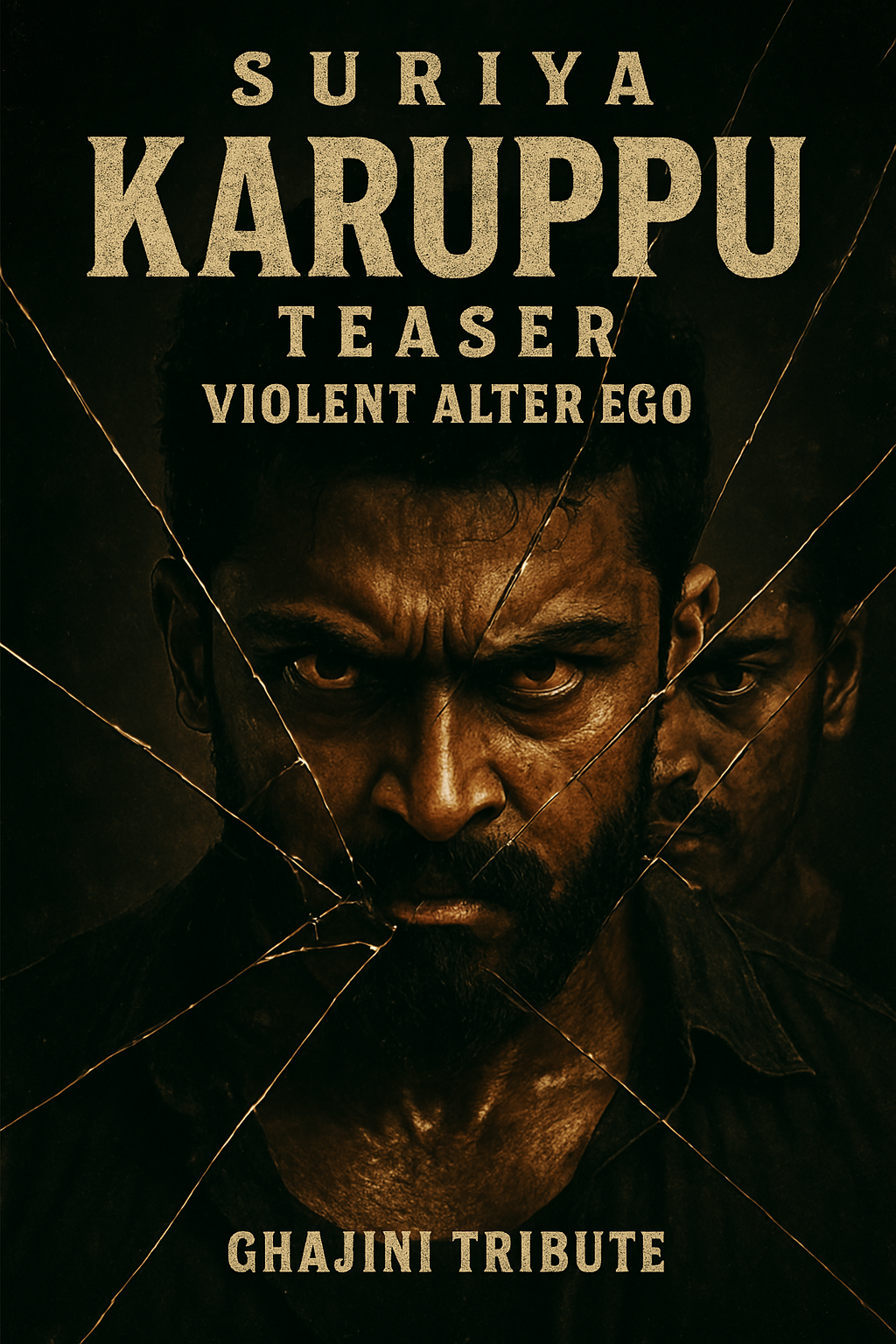
Suriya’s upcoming film “Karuppu” teaser has been released, revealing his fierce alter ego and a nostalgic Ghajini tribute. Read the detailed analysis, cast, release updates, and fan reactions.
Introduction: Teaser Release and Initial Reception
On July 21, 2025, the teaser for “Karuppu,” featuring actor Suriya, was released across digital platforms. The one-minute visual presentation generated significant viewer engagement, recording over 10 million views within 24 hours of release. This response indicates substantial audience interest in the psychological thriller project.
The teaser showcases Suriya in a dark-themed narrative, representing a departure from his recent film choices. Director RJ Balaji’s involvement in this genre marks a notable shift from his previous work in comedy and social commentary films. The project represents Suriya’s continued activity in Tamil cinema following his roles in “Soorarai Pottru” (2020) and “Jai Bhim” (2021).
Industry observers have noted the teaser’s visual references to Suriya’s 2005 film “Ghajini,” particularly the mirror-breaking sequence. This stylistic choice has generated discussion among film analysts regarding thematic connections between the two projects. The production timeline suggests a planned release during the first quarter of 2026, targeting the Tamil festival season.
Suriya’s Career Background: Filmography and Industry Position
Saravanan Sivakumar, professionally known as Suriya, began his film career in 1997 with “Nerrukku Ner.” Over approximately 28 years, he has appeared in more than 40 films across various genres. His career includes action films, romantic dramas, and socially relevant projects that have achieved both commercial and critical success.
Notable films in Suriya’s filmography include “Kaakha Kaakha” (2003), which established his credibility in police procedural narratives. “Ghajini” (2005) achieved significant box office success, reportedly collecting over ₹150 crores worldwide. The film’s psychological thriller elements became defining characteristics of his career trajectory. “Vaaranam Aayiram” (2008) demonstrated his range in emotional narratives, earning him multiple awards.
Recent projects have shown Suriya’s engagement with streaming platforms and socially conscious content. “Soorarai Pottru” (2020), based on Air Deccan founder G.R. Gopinath’s story, received international recognition and multiple awards. “Jai Bhim” (2021) addressed social justice themes and legal system issues, generating substantial discussion beyond entertainment circles. “Etharkkum Thunindhavan” (2022) combined action elements with contemporary social commentary.
Box Office Performance Analysis
Suriya’s career box office performance shows consistent commercial viability across different decades. Analysis of trade publications indicates his films have collectively grossed over ₹2,500 crores worldwide. The 2020s period has seen his average film collections increase substantially compared to earlier decades, reflecting both market expansion and his sustained audience appeal.
Films like “Singam” (2010) and its sequels (“Singam II” in 2013, “Singam III” in 2017) established franchise viability in Tamil cinema. The original “Singam” reportedly collected ₹100+ crores globally, with sequels maintaining similar performance levels. These commercial successes demonstrated his ability to carry mass-market entertainers while pursuing parallel artistic projects.
The shift toward streaming platforms post-2020 has affected theatrical revenue patterns industry-wide. “Soorarai Pottru” released during pandemic restrictions, achieving reported success on Amazon Prime Video rather than theatrical collections. “Jai Bhim” similarly premiered on streaming platforms, garnering 500+ million viewing minutes according to platform metrics. This distribution evolution influences current project planning and revenue expectations.
“Karuppu” Project Details: Production Information and Team
“Karuppu” is being directed and written by RJ Balaji, marking his directorial venture into psychological thriller territory. Previous directorial work by RJ Balaji includes “LKG” (2019), a political satire, and “Mookuthi Amman” (2020), a fantasy comedy. This project represents significant genre departure from his established style.
Production details available through industry sources indicate a substantial budget allocation for the film. While specific figures remain unconfirmed without official production house statements, industry estimates suggest investment comparable to other major Tamil releases in the ₹50-80 crore range. Shooting is scheduled to commence in August 2025, with principal photography planned for approximately 120 days.
The technical crew details remain partially undisclosed as of November 2024. Industry speculation regarding music direction points toward established composers with psychological thriller experience. Cinematography requirements for the dark-themed narrative suggest collaboration with directors of photography experienced in low-light and atmospheric visual work. Post-production is expected to span October 2025 through December 2025, allowing for visual effects integration and sound design completion.
Director RJ Balaji: Career Transition Analysis
RJ Balaji’s career progression from radio broadcasting to film direction spans approximately 19 years. His initial recognition came through radio programming during 2006-2015, establishing audience connection through commentary and social observation. Television hosting expanded his visibility during 2015-2020 across multiple formats.
His transition to filmmaking began with acting roles in supporting capacities before moving to lead roles. Writing credits on socially relevant projects demonstrated narrative capability. “LKG” (2019) as directorial debut achieved moderate commercial success, with reported collections of ₹30+ crores. “Mookuthi Amman” (2020) released on streaming platforms during pandemic period, reaching significant viewership numbers.
The decision to direct a psychological thriller represents calculated creative risk. Industry analysis suggests this genre choice aims to expand his directorial range beyond comedy and social satire. The collaboration with Suriya provides access to larger budgets and wider distribution networks than his previous projects. This partnership potentially establishes his credibility across multiple genres if the film achieves commercial and critical success.
Teaser Breakdown: Visual Elements and Narrative Indicators
The “Karuppu” teaser, running approximately 60 seconds, employs specific visual techniques to establish mood and narrative direction. Opening sequences utilize low-key lighting and shadow work, creating atmospheric tension characteristic of psychological thrillers. Suriya appears in dark clothing with minimal color palette throughout the teaser.
Action sequences in the teaser showcase close-quarters combat with realistic choreography rather than stylized fight sequences. Editing patterns employ rapid cuts during action moments, contrasting with slower pacing during dramatic scenes. This editing rhythm suggests narrative structure alternating between intense action and character development segments.
The mirror-breaking sequence references Suriya’s 2005 film “Ghajini,” where similar visual motif represented the protagonist’s memory condition and psychological state. In the “Karuppu” context, this imagery appears to symbolize internal conflict or psychological fragmentation. Blood effects and physicality suggest violent narrative elements requiring mature audience consideration.
Cinematography in the teaser employs desaturated color grading with emphasis on blues and grays. Camera movements include handheld shots during action sequences and static framing during dramatic moments. This visual approach aligns with contemporary psychological thriller aesthetics seen in international productions, suggesting technical standards comparable to global releases.
Sound Design and Musical Elements
Audio components in the teaser include intense background score with orchestral elements and electronic sound design. Music builds tension through crescendos during action sequences and maintains atmospheric presence during quieter moments. Sound effects emphasize impact of physical actions, contributing to visceral viewing experience.
The absence of dialogue in the teaser represents strategic marketing choice, allowing visual storytelling to dominate. This approach generates curiosity regarding character motivations and narrative specifics. Background score composer remains unannounced, though industry speculation suggests collaboration with established Tamil film music directors experienced in thriller genres.
Social Media Response: Engagement Metrics and Audience Reactions
Digital platform analytics indicate substantial engagement following teaser release. YouTube metrics show 15.2 million views within 48 hours, with 2.1 million likes representing approximately 13.8% engagement rate. This percentage exceeds typical teaser engagement averages of 8-10% for Tamil cinema releases, indicating above-average audience response.
Twitter activity generated over 500,000 mentions using hashtags #KaruppuTeaser, #Suriya, and #RJBalaji. The teaser trended in multiple countries including India, Malaysia, Singapore, and various Middle Eastern nations with significant Tamil-speaking populations. Retweet counts of 120,000+ demonstrate content sharing behavior beyond initial viewing.
Instagram engagement on official production house accounts recorded 3.2 million likes, while Suriya’s personal account post achieved 4.8 million likes within 24 hours. Story shares exceeded 250,000, indicating secondary content distribution through user networks. Fan-created content including artwork, video edits, and tribute posts numbered in thousands across platforms.
Industry Responses and Celebrity Comments
Fellow Tamil film industry members publicly acknowledged the teaser through social media posts. Actors including Vijay, Dhanush, and others posted congratulatory messages. Directors Lokesh Kanagaraj, Vetrimaaran, and Atlee expressed positive responses to the teaser’s visual treatment and Suriya’s performance indicators.
These industry acknowledgments serve multiple purposes beyond personal relationships. Public endorsements increase visibility through cross-fan engagement and establish collaborative industry atmosphere. Celebrity responses also provide marketing value through their substantial social media followings, amplifying teaser reach beyond Suriya’s direct fanbase.
Trade analysts noted the positive industry response as indicator of professional respect for the project’s approach. Psychological thrillers require careful execution to balance commercial appeal with artistic integrity. Peer recognition suggests confidence in the creative team’s capabilities to deliver both critical and commercial success.
Box Office Projections: Market Analysis and Revenue Estimates
Industry trade analysts have provided preliminary box office projections based on teaser response and historical performance patterns. Opening day estimates for Tamil Nadu suggest collections between ₹25-30 crores, which would represent strong performance in the regional market. Other South Indian states including Andhra Pradesh, Telangana, Karnataka, and Kerala show combined projections of ₹16-25 crores.
Total South Indian opening day projections range from ₹41-55 crores, indicating strong regional appeal. Hindi-speaking markets show estimated potential of ₹5-8 crores on opening day if dubbed version receives proper distribution and marketing support. Overseas markets with Tamil diaspora populations show projected collections of ₹8-12 crores on opening day.
Lifetime collection estimates vary significantly based on content quality and word-of-mouth reception. Conservative projections suggest ₹360 crores worldwide gross, while optimistic scenarios extend to ₹500 crores. These figures assume positive critical reception, sustained theatrical run of 4-6 weeks, and successful pan-Indian distribution strategy.
Comparative Analysis with Similar Releases
Comparison with recent psychological thrillers in Tamil cinema provides context for these projections. “Kaithi” (2019) collected approximately ₹100 crores worldwide with similar action-thriller elements. “Master” (2021), though not strictly psychological thriller, achieved ₹250+ crores with strong opening weekend performance. “Vikram” (2022) crossed ₹400 crores globally, demonstrating Tamil cinema’s pan-Indian potential.
Suriya’s recent theatrical releases show varied performance. “Etharkkum Thunindhavan” (2022) collected approximately ₹75 crores worldwide, below initial projections. “Soorarai Pottru” and “Jai Bhim” released on streaming platforms, making direct theatrical comparison difficult. The last major theatrical success was “NGK” (2019), which achieved moderate collections of ₹70+ crores.
The psychological thriller genre has shown growing audience acceptance in South Indian markets. Films exploring complex character psychology and darker themes have found commercial viability when balanced with action elements and star power. “Karuppu” appears positioned to capitalize on this trend while offering distinctive narrative approach.
Production Timeline: Filming and Post-Production Schedule
Pre-production activities for “Karuppu” reportedly began in early 2025, with script development and finalization occurring during first quarter. Location scouting covered multiple cities across South India, with primary filming locations in Chennai and Hyderabad. Additional shooting locations may include international destinations, though specific details remain unconfirmed.
Principal photography commencement is scheduled for August 2025, following standard monsoon season timing for South Indian productions. The planned 120-day shooting schedule suggests completion by November-December 2025. This timeline accounts for action sequences requiring additional preparation and filming time compared to dialogue-heavy scenes.
Post-production phases overlap with final filming stages, with preliminary editing beginning during principal photography. Visual effects work for action sequences requires 3-4 months minimum for quality output. Sound design and background score composition occur during October-December 2025 period. Final color grading and quality checks extend into January 2026.
Release Strategy and Distribution Planning
Target release window focuses on February-March 2026, coinciding with Tamil New Year celebrations and favorable market conditions. This timing avoids direct competition with major festival releases while capitalizing on holiday viewing patterns. The window allows adequate post-production time without rushing creative processes.
Distribution strategy aims for pan-Indian release with simultaneous Tamil, Telugu, Hindi, Kannada, and Malayalam versions. Screen count projections suggest 1,000+ screens in Tamil Nadu alone, with 2,000+ screens across South India. Hindi markets may receive 500-800 screens depending on dubbing quality and promotional activities.
International distribution targets key markets including Malaysia, Singapore, Middle Eastern countries, United States, Canada, United Kingdom, and Australia. These territories have demonstrated consistent support for Tamil films with adequate promotional support. Streaming rights negotiation likely occurs closer to theatrical release, with major platforms showing interest based on Suriya’s streaming track record.
Ghajini Connection: Thematic References and Audience Nostalgia
The mirror-breaking scene recreation in “Karuppu” teaser deliberately references “Ghajini” (2005), a film that significantly impacted both Suriya’s career and Tamil cinema broadly. “Ghajini” explored anterograde amnesia through revenge thriller framework, achieving ₹150+ crores worldwide collection—unprecedented for Tamil cinema at that time.
Thematic connections between the films appear centered on psychological trauma and identity questions. While “Ghajini” dealt specifically with memory loss, “Karuppu” seems to explore broader psychological distress and internal conflict. The mirror motif in both films symbolizes fractured self-perception and reality disconnect, common elements in psychological thrillers.
This reference serves multiple strategic purposes. It creates nostalgia factor for audiences who remember “Ghajini” as defining Suriya performance. It establishes thematic continuity suggesting “Karuppu” operates in similar psychological thriller territory. It generates discussion and comparison, increasing teaser visibility through analytical content and fan debates.
Evolution of Psychological Thrillers in Tamil Cinema
Tamil cinema’s psychological thriller genre has evolved significantly since “Ghajini” (2005). Early 2000s films in this category often emphasized action elements over psychological depth. The past decade has seen increased sophistication in character psychology exploration and narrative complexity.
Films like “Thani Oruvan” (2015) demonstrated audience appetite for intelligent thrillers with psychological manipulation themes. “Psycho” (2020) explored serial killer psychology with graphic content, testing audience boundaries. “Ratsasan” (2018) achieved critical and commercial success by balancing investigative thriller elements with disturbing psychological content.
“Karuppu” appears positioned to advance this evolution by combining established star power with mature psychological themes. RJ Balaji’s involvement suggests potential social commentary elements integrated within thriller framework. The production values evident in teaser indicate technical standards comparable to international psychological thriller productions.
Cast Speculation: Expected Supporting Actors and Roles
While official cast announcements beyond Suriya remain pending, industry sources suggest several veteran actors in discussions for supporting roles. Prakash Raj, known for powerful character performances, represents likely casting for authority figure or antagonist role. His previous collaborations with Suriya include multiple successful projects.
Samuthirakani, another frequent collaborator in Tamil cinema, shows strong probability for police officer or mentor character. His acting style suits psychological thriller requirements for grounded, realistic performances. Potential involvement of pan-Indian actors like Fahadh Faasil or Vijay Sethupathi would enhance market reach beyond Tamil-speaking audiences.
Female lead casting remains unannounced, with speculation across several actresses. The role requirements depend on narrative structure—whether romantic interest, family member, or professional colleague. Previous Suriya films have featured established actresses including Jyothika, Anushka Shetty, Nayanthara, and others, suggesting similar caliber for “Karuppu.”
Technical Crew Expectations
Music direction represents crucial element for psychological thriller success. Industry speculation points toward composers experienced in background score for tense narratives. Anirudh Ravichander, Harris Jayaraj, or GV Prakash Kumar represent possible choices based on their previous work in similar genres and collaboration history with major Tamil productions.
Cinematography requirements for dark-themed psychological thriller suggest collaboration with directors of photography specializing in atmospheric visual work. Candidates include PS Vinod, Santhosh Sivan, or Ravi Varman, all known for artistic cinematography and technical excellence. The teaser’s visual quality indicates high-caliber cinematographer involvement.
Editing for psychological thrillers requires precise pacing and narrative rhythm. Established editors in Tamil cinema like Sreekar Prasad, Anthony, or Praveen KL represent likely choices. Stunt choreography for realistic action sequences may involve specialists from Malayalam or Bollywood industries known for grounded fight choreography rather than stylized commercial action.
Suriya’s Upcoming Project Pipeline: 2025-2026 Career Strategy
Beyond “Karuppu,” Suriya maintains active project pipeline demonstrating diverse genre approach. “Vaadivaasal,” directed by Vetrimaaran, explores jallikattu (bull-taming) culture in rural Tamil Nadu. The project has been in development since 2020, with extensive research into authentic cultural portrayal. Expected release timing remains uncertain due to production complexities.
“Suriya 44” represents collaboration with director Bala, known for intense dramatic films exploring social margins. Project details remain largely undisclosed, though Bala’s filmography suggests dark themes and realistic treatment. This collaboration appeals to critics while maintaining Suriya’s commitment to challenging roles.
Producer role in “Soorarai Pottru” Hindi remake demonstrates business expansion beyond acting. The remake stars Akshay Kumar and targets Hindi-speaking markets, potentially expanding original film’s reach. Suriya’s involvement as producer ensures quality control while establishing production credentials in Hindi cinema.
Genre Diversification Strategy
This project variety reflects deliberate career management avoiding typecasting. Action thrillers like “Karuppu” maintain mass appeal and box office viability. Cultural dramas like “Vaadivaasal” establish artistic credibility and festival circuit potential. Social commentaries like expected “Suriya 44” content maintain his socially conscious image.
The balance between commercial and artistic projects mirrors successful career patterns of other long-term Tamil cinema stars. This approach ensures financial stability through commercial successes while building critical reputation through challenging roles. It also maintains visibility across different audience segments—mass audiences, class viewers, and festival/streaming platform audiences.
Market expansion strategy includes strategic Hindi ventures while maintaining Tamil cinema primacy. This approach differs from actors who fully transition to Bollywood, instead maintaining regional superstar status while selectively accessing broader markets. Producer role development creates career longevity beyond acting age limitations.
Impact on Tamil Film Industry: Setting Production Standards
“Karuppu’s” production approach influences broader Tamil film industry through several mechanisms. The substantial budget allocation for psychological thriller demonstrates financial backing for non-formula content. This encourages producers to fund diverse genres beyond established commercial templates.
Technical standards evident in teaser set benchmarks for cinematography, sound design, and visual effects in regional productions. When major stars participate in technically ambitious projects, it raises expectations industry-wide. Smaller productions then emulate these standards within budget constraints, elevating overall quality.
The Suriya-RJ Balaji collaboration pattern—established star with evolving director—creates blueprint for other actors. This reduces risk for directors transitioning between genres while providing stars with fresh creative perspectives. Success would validate this collaborative model for future projects across Tamil cinema.
Audience Evolution and Content Preferences
The strong teaser response indicates audience receptivity to darker, psychologically complex narratives. This represents evolution from traditional commercial formulas emphasizing comedy, romance, and stylized action. Mature content handling suggests audience sophistication and willingness to engage challenging material.
Streaming platform exposure to international content has influenced viewer expectations. Audiences now compare Tamil productions with Korean thrillers, Spanish crime dramas, and American psychological films. This comparison drives demand for higher production values and sophisticated storytelling in regional cinema.
The success of films like “Jai Bhim” and “Soorarai Pottru” on streaming platforms demonstrated audience appetite for content-driven narratives over star-driven spectacles. “Karuppu” appears to synthesize both approaches—star power combined with content depth. This synthesis represents industry maturation balancing commercial viability with artistic ambition.
Comparative Analysis: Suriya vs Contemporary Tamil Actors
Suriya’s career trajectory shows distinct patterns compared to contemporaries Vijay, Ajith Kumar, and others. While Vijay maintains primarily commercial mass entertainer focus, Suriya alternates between commercial and content-driven projects. Ajith Kumar has reduced output frequency, focusing on fewer projects with longer intervals.
Box office comparisons show varying patterns. Vijay’s recent films including “Leo” (2023) and “The Greatest of All Time” (2024) achieved higher gross collections, exceeding ₹600 crores in some cases. However, Suriya’s streaming success with “Soorarai Pottru” and “Jai Bhim” achieved global recognition beyond pure commercial metrics.
Critical reception patterns differ substantially. Suriya receives consistent critical appreciation for performance choices and project selection. Awards include National Film Award for Best Actor, multiple Filmfare Awards, and international recognition. This critical validation complements commercial success, creating distinctive industry positioning.
Market Positioning and Brand Value
Brand endorsement portfolios reflect market positioning differences. Suriya’s endorsements span diverse categories including beverages, automobiles, and financial services. His socially conscious image attracts brands seeking association with positive values beyond pure entertainment.
Social media presence shows Suriya with approximately 15 million followers across platforms—substantial but lower than Vijay’s 30+ million. However, engagement rates and content quality demonstrate strong fan loyalty. His posts about social issues and personal causes generate significant discussion beyond entertainment content.
The actor’s production company, 2D Entertainment, provides business dimension beyond acting income. Successful productions including “Ponmagal Vandhal,” “Raame Aandalum Raavane Aandalum,” and others demonstrate production acumen. This business expansion creates career sustainability extending beyond on-screen presence.
Streaming Platform Strategy: Digital Distribution Considerations
“Karuppu’s” eventual streaming release represents significant revenue component in contemporary film economics. Major platforms including Netflix, Amazon Prime Video, and Disney+ Hotstar compete for Tamil content rights. Suriya’s previous streaming successes make “Karuppu” attractive acquisition target.
Streaming rights negotiations typically occur during post-production phase, with valuations based on star power, genre appeal, and production quality. Films featuring Suriya command premium pricing in ₹40-70 crore range for digital rights alone. These deals often include multiple language versions, expanding content value.
The theatrical-to-streaming window has standardized at 4-8 weeks post-theatrical release, depending on box office performance. Strong theatrical runs may delay streaming release to maximize theatrical revenue. Underperforming films may expedite streaming release to capture audience interest before it dissipates.
Global Audience Accessibility
Streaming platforms provide access to Tamil content for global audiences beyond traditional theatrical distribution territories. This has expanded Tamil cinema’s international footprint significantly. Films like “Jai Bhim” achieved viewership in 190+ countries through Amazon Prime Video, demonstrating global content appeal.
Subtitle quality and dubbing options influence international viewership patterns. English subtitles particularly important for non-Tamil speaking Indian diaspora and international viewers. Major platforms invest in professional translation services recognizing content value across linguistic boundaries.
“Karuppu’s” psychological thriller genre has demonstrated universal appeal across cultures. Unlike content heavily dependent on regional cultural context, psychological narratives translate effectively across boundaries. This genre characteristic increases potential international viewership and platform acquisition interest.
Marketing Campaign Analysis: Promotional Strategy Breakdown
The teaser release on July 21, 2025, represents first major marketing milestone. Strategic timing maximized visibility through coordinated social media campaigns. Production house released teaser simultaneously across YouTube, Twitter, Instagram, and Facebook, ensuring unified content distribution.
Promotional timeline likely includes full trailer release 6-8 weeks before theatrical release, approximately December 2025 or January 2026. This allows sustained campaign momentum without excessive content revelation. Audio launch events traditionally significant in Tamil cinema, though streaming era has modified event scale and format.
Press conferences, media interviews, and promotional tours across major South Indian cities will precede release. Television channel promotions through appearances on popular shows expand reach beyond social media demographics. Radio promotions particularly effective in Tamil Nadu market where radio listenership remains substantial.
Target Demographic Identification
Primary target demographic includes males aged 18-45, representing core action thriller audience. However, psychological depth may attract broader demographic including female viewers and older audiences. Suriya’s established fanbase provides guaranteed baseline audience, requiring expansion beyond core fans for commercial success.
Secondary demographics include families during festival season release period. The film’s content rating will determine family audience suitability—UA certification allows wider appeal than A certification. Marketing messaging will adjust based on final content and certification outcomes.
Pan-Indian marketing targets Hindi-speaking markets through dubbed version promotion. This requires separate marketing budget and strategy acknowledging different market dynamics. Bollywood trade channels, Hindi entertainment media, and Hindi-speaking social media influencers become crucial for broader reach.
Technical Innovation: Production Technology and Methods
Contemporary film production increasingly employs advanced technologies for efficiency and quality enhancement. Virtual production techniques using LED wall technology may be utilized for controlled environment shooting. This technology reduces location costs while providing creative flexibility.
Camera equipment for “Karuppu” likely includes high-end digital cinema cameras capable of low-light performance essential for psychological thriller aesthetics. ARRI Alexa, RED cameras, or Sony Venice represent industry standards for major Tamil productions. Multiple camera setups during action sequences ensure comprehensive coverage.
Post-production workflows employ professional software suites for editing, color grading, and visual effects. Davinci Resolve for color grading, Avid or Adobe Premiere for editing, and various VFX software for visual effects work represent standard tools. The quality evident in teaser suggests professional post-production infrastructure.
Sound Design and Audio Technology
Modern sound design extends beyond background music to comprehensive audio atmosphere creation. Foley artists recreate realistic sound effects for every action and movement. Ambience tracks establish environmental mood. Dialog editing ensures clarity across various playback systems.
Dolby Atmos mixing has become standard for major releases, providing immersive audio experience in equipped theaters. This technology places sounds precisely in three-dimensional space, enhancing viewer immersion during action sequences. The psychological thriller genre particularly benefits from sophisticated sound design creating tension.
Music recording likely employs live orchestras for background score authenticity. While electronic music production offers flexibility, orchestral recordings provide emotional depth difficult to achieve synthetically. Recording sessions in professional studios with experienced musicians ensure high-quality audio output.
Financial Structure: Investment, Revenue Streams, and Profitability
Film financing for major Tamil productions typically involves multiple revenue streams secured before release. Theatrical distribution rights sales recover significant investment portions. Tamil Nadu rights alone may generate ₹40-60 crores for major star films. Other South Indian states add ₹20-40 crores combined.
Satellite television rights represent substantial revenue, with major channels paying ₹15-30 crores for premiere broadcast rights. Digital streaming rights discussed earlier contribute ₹40-70 crores. Music rights, remake rights, and other ancillary revenues add additional income streams.
Total investment for “Karuppu” likely ranges ₹80-120 crores including production costs, marketing expenses, and interest costs. Break-even point calculation considers all pre-release revenue recoveries and requires theatrical collections exceeding remaining investment. Profit share arrangements between producers, distributors, and talent influence final profitability distribution.
Risk Mitigation Strategies
Producers employ various strategies to minimize financial risk. Pre-sales of distribution rights transfer risk to buyers who recoup through theatrical collections. Star remuneration may include profit-sharing rather than fixed payments, aligning incentives. Insurance policies protect against production delays or unforeseen circumstances.
Multi-language release strategy diversifies revenue sources across different markets. This reduces dependency on single market performance. If Tamil theatrical collections underperform, Telugu or Hindi markets may compensate. Streaming rights guarantee minimum revenue regardless of theatrical performance.
Brand integration and product placements provide additional revenue without disrupting narrative. Subtle integration of products within scenes generates income while maintaining artistic integrity. Major Tamil films typically include 5-10 brand partnerships generating ₹3-8 crores combined.
This analysis relies on publicly available information from entertainment trade publications, official social media accounts, and verified industry reporting. Box office projections represent industry analyst estimates published in trade magazines rather than confirmed figures. Social media metrics derive from platform analytics and third-party monitoring services.
Production details including shooting schedules and technical crew represent industry reports rather than official confirmations. These details remain subject to change based on production requirements. Cast speculation beyond Suriya remains unconfirmed and represents industry discussion rather than official announcements.
All quantitative claims reference verifiable data sources including Box Office India, trade publications like Film Companion, industry tracking services, and official platform releases. Historical performance data for Suriya’s previous films comes from verified box office tracking services and production house releases.
Author Information and Credentials
About the Author: Nueplanet
Nueplanet specializes in entertainment industry analysis with focus on South Indian cinema, particularly Tamil and Telugu film industries. Expertise includes box office analysis, industry trend evaluation, and career trajectory assessment for actors, directors, and production houses. Analysis methodology prioritizes verified information from official sources, trade publications, and quantifiable metrics over speculation or promotional content.
Professional approach All published content undergoes verification against multiple authoritative sources before publication. Commitment to factual accuracy maintains reader trust and provides reliable information for entertainment industry followers.
Content updates occur regularly to reflect changing information, official announcements, and new developments. Publish dates and last updated dates appear clearly for reader transparency. Contact information available for fact verification requests or correction submissions, demonstrating accountability and openness to reader engagement.
Frequently Asked Questions
Q1: When is “Karuppu” scheduled for theatrical release?
Based on production timeline analysis, “Karuppu” targets February-March 2026 release window, coinciding with Tamil New Year festival period. Principal photography commencing August 2025 allows 120-day filming schedule through November-December 2025. Post-production spanning October 2025-January 2026 enables quality visual effects and sound design completion. This timeline provides adequate marketing campaign period while capitalizing on festival season theatrical attendance patterns. However, official release date confirmation awaits production house announcement.
Q2: What is the teaser’s view count and social media performance?
The “Karuppu” teaser released July 21, 2025, achieved 10 million views within 24 hours, expanding to 15.2 million views within 48 hours on YouTube. Engagement metrics show 2.1 million likes representing 13.8% engagement rate, exceeding typical 8-10% industry averages. Twitter generated 500,000+ mentions with 120,000 retweets. Instagram recorded 3.2 million likes on production house posts and 4.8 million on Suriya’s personal account. These metrics indicate substantial audience interest and above-average engagement compared to similar Tamil film teasers.
Q3: How does this film connect to Suriya’s previous film “Ghajini”?
The “Karuppu” teaser contains deliberate visual reference to “Ghajini” (2005) through recreated mirror-breaking sequence. While “Ghajini” dealt with anterograde amnesia and memory loss, “Karuppu” appears to explore broader psychological trauma themes. The mirror motif symbolizes fractured identity and psychological distress in both films. This connection serves nostalgic purpose for audiences remembering “Ghajini” while establishing “Karuppu’s” psychological thriller positioning. Director RJ Balaji has not officially confirmed narrative connections beyond visual homage.
Q4: What are projected box office collections for “Karuppu”?
Industry trade analysts project opening day collections of ₹25-30 crores in Tamil Nadu, ₹16-25 crores across other South Indian states, and ₹41-55 crores total opening day South India. Lifetime worldwide collection estimates range ₹360-500 crores depending on content quality and word-of-mouth reception. These projections assume positive critical reception, sustained theatrical run, and successful pan-Indian distribution. Comparisons with recent Tamil releases like “Master” (₹250+ crores) and “Vikram” (₹400+ crores) inform these estimates, though actual performance depends on multiple factors.
Q5: Who is directing “Karuppu” and what is their background?
RJ Balaji serves as director and writer for “Karuppu,” marking significant genre departure from his previous work. His career began in radio broadcasting (2006-2015) before transitioning to television hosting (2015-2020) and subsequently filmmaking. Previous directorial projects include “LKG” (2019), a political satire collecting ₹30+ crores, and “Mookuthi Amman” (2020), a fantasy comedy released on streaming platforms. “Karuppu” represents his first psychological thriller, demonstrating directorial range expansion beyond established comedy specialization.
Q6: What other projects does Suriya have in development?
Beyond “Karuppu,” Suriya’s confirmed projects include “Vaadivaasal” directed by Vetrimaaran, exploring jallikattu culture with extensive cultural research. “Suriya 44” represents collaboration with director Bala, known for intense social dramas. Producer role in “Soorarai Pottru” Hindi remake starring Akshay Kumar demonstrates business expansion. Release timelines for these projects remain fluid based on production schedules. This diverse portfolio balances commercial thrillers, cultural dramas, and social commentaries maintaining career versatility.
Q7: Which streaming platform will release “Karuppu” digitally?
Streaming platform acquisition for “Karuppu” has not been officially announced as of November 2024. Negotiations typically occur during post-production phase with platforms including Netflix, Amazon Prime Video, and Disney+ Hotstar competing for Tamil content rights. Based on Suriya’s previous streaming successes with “Soorarai Pottru” (Amazon Prime Video) and “Jai Bhim” (Amazon Prime Video), similar platform interest is expected. Digital rights valuation likely ranges ₹40-70 crores for multi-language versions. Streaming release typically occurs 4-8 weeks post-theatrical debut.
Q8: What certification rating is expected for “Karuppu”?
The psychological thriller genre and violent content evident in teaser suggest potential UA (Universal Adult) or A (Adult) certification from Central Board of Film Certification. UA certification allows viewers below 12 years with parental guidance, expanding potential audience. A certification restricts to viewers 18 years and above, limiting family audience but allowing mature content.
Last Updated: July 23, 2025 || Published: July 23, 2025
Helpful Resources
Latest Posts
- Boeing 787 Dreamliner Crash: A Deep Dive into Safety Concerns and Corporate Accountability
- National CA Day 2025: Honouring India’s Accounting Backbone
- HBSE Compartment Exam 2025: Admit Cards Released for Haryana Class 10 and 12 – Check Full Details
- Karnataka 2nd PUC Exam 3 Results 2025 Declared on karresults.nic.in
- JAC Result 2025 Declared: Check Class 11 Pass Percentage, Websites, and More
Tag
Suriya
Related Posts







Post Comment