








MCC Counselling 2025: Registration, Schedule, and Key Updates for NEET UG Aspirants
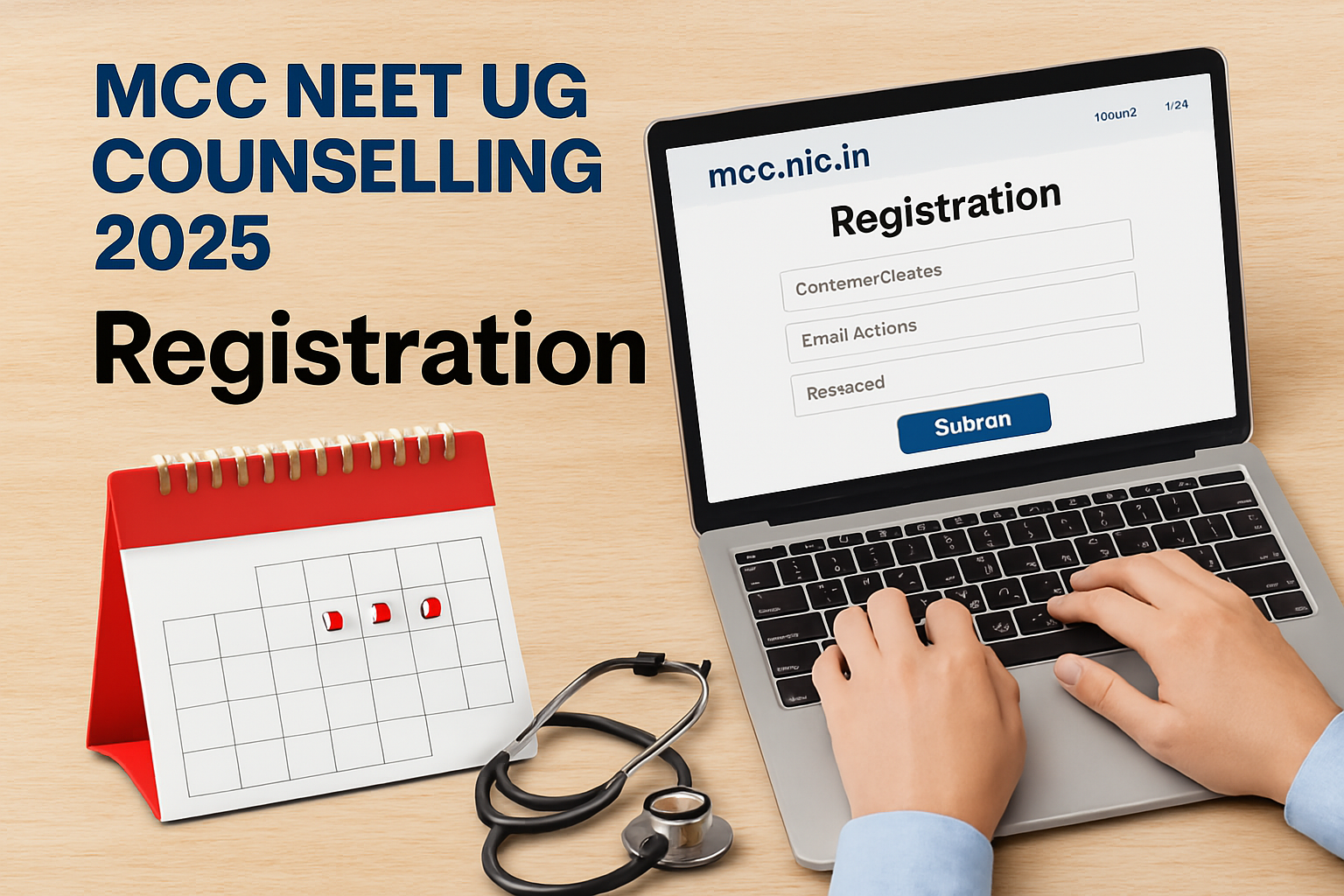
MCC NEET UG counselling 2025 has officially begun. Here is the complete registration process, schedule, eligibility, and seat allotment details every aspirant must know today.
Table of Contents
The Medical Counselling Committee has initiated the registration process for NEET UG Counselling 2025 Round 1 on July 20, 2025. Over 20 lakh qualified NEET UG candidates can now register through the official portal at mcc.nic.in for undergraduate medical admissions across India.
This centralized counselling system manages seat allocation for MBBS, BDS, and B.Sc Nursing programs through All India Quota, deemed universities, central universities, ESIC institutions, and AFMC. The registration deadline is set for July 25, 2025, at 12:00 noon.
Understanding MCC NEET UG Counselling: Overview and Purpose
The Medical Counselling Committee operates as the central authority conducting admission processes for undergraduate medical courses in India. This system ensures merit-based seat distribution while maintaining transparency and fairness across participating institutions nationwide.
MCC counselling serves multiple educational pathways including government medical colleges, private institutions under AIQ, deemed universities, and central universities. The process accommodates various reservation categories ensuring equitable access to medical education for candidates from diverse backgrounds.
Scope of MCC Counselling 2025
The counselling mechanism covers several program categories:
- MBBS Programs: Bachelor of Medicine and Bachelor of Surgery seats in government colleges, AIQ private institutions, deemed universities, and central universities
- BDS Programs: Bachelor of Dental Surgery admissions in government and private dental colleges
- B.Sc Nursing: Nursing programs offered by participating institutions
- Specialized Quotas: Reserved seats for SC, ST, OBC, EWS, and PwD categories
The All India Quota constitutes 15% of total undergraduate medical seats. State quotas manage the remaining 85% through separate state counselling processes conducted by respective state authorities.
Key Updates and Changes in 2025 Counselling
The 2025 counselling cycle incorporates several modifications aimed at improving process efficiency and preventing malpractices. These changes reflect recommendations from the National Medical Commission and stakeholder feedback.
Enhanced Security Protocols
Biometric verification has become mandatory during college reporting to prevent proxy admissions and seat blocking. Institutions will conduct fingerprint scanning, photograph verification, and digital signature validation for all admitted candidates.
This authentication system creates permanent records linking students to their admissions. The measure aims to eliminate fraudulent practices that previously undermined the integrity of medical admissions.
Infrastructure and Portal Improvements
The MCC portal underwent significant technical upgrades to manage high traffic volumes during peak periods. Enhanced server capacity and cloud-based architecture ensure stable performance during registration and result declaration phases.
Improved database management systems process applications more efficiently. The user interface has been redesigned for easier navigation across different devices including smartphones and tablets.
Revised Fee Structure
Security deposit requirements for deemed university seats have been adjusted for 2025. This modification reflects current educational costs and ensures genuine commitment from candidates accepting allotments.
The fee structure includes category-based variations with provisions for partial refunds under specific circumstances. Reserved category candidates continue receiving appropriate fee concessions as per government norms.
MCC NEET UG Counselling 2025 Round 1: Complete Schedule
Understanding the counselling timeline helps candidates plan their activities and meet critical deadlines. The schedule is designed to allow adequate time for each phase while ensuring timely commencement of the academic session.
Round 1 Important Dates
| Activity | Date and Time | Details |
|---|---|---|
| Registration Opens | July 20, 2025 (2:00 PM) | Portal access begins for new registrations |
| Registration Closes | July 25, 2025 (12:00 Noon) | Final deadline for Round 1 registration |
| Choice Filling Period | July 21-26, 2025 | Candidates select and arrange college preferences |
| Processing Phase | July 27-28, 2025 | MCC processes applications and runs allotment algorithm |
| Result Declaration | July 29, 2025 | Seat allotment results published on portal |
| Reporting to Colleges | July 30 – August 5, 2025 | Physical reporting at allotted institutions |
The registration window remains open for five days providing candidates adequate time to complete formalities. Technical support is available throughout the registration period for resolving queries.
Subsequent Counselling Rounds
After Round 1 completion, additional rounds address remaining vacant seats:
- Round 2: Scheduled after Round 1 reporting concludes
- Mop-Up Round: Focuses on deemed and central university vacancies
- Stray Vacancy Round: Final allocation opportunity for registered candidates
Each round follows a similar pattern with registration, choice filling, processing, and reporting phases. Fresh registration is typically permitted in Round 2 and Mop-Up rounds but not in the Stray Vacancy round.
Step-by-Step Registration Process
The registration procedure requires careful attention to ensure error-free submission. Candidates should gather necessary documents and information before starting the online process.
Accessing the MCC Portal
Visit the official website at mcc.nic.in and locate the UG Medical Counselling 2025 section. Use updated browser versions like Chrome, Firefox, Safari, or Edge for optimal compatibility.
Desktop or laptop computers are recommended for completing the registration process. While mobile devices are supported, larger screens facilitate easier document uploads and form filling.
Account Creation and Login
Registration requires the NEET UG 2025 roll number and password used during the examination. These credentials ensure seamless integration between exam results and counselling participation.
Two-factor authentication through registered mobile numbers adds security to the login process. SMS verification codes confirm identity before allowing access to registration functions.
Fee Payment Methods
The payment system accepts multiple transaction modes:
- Net banking from major Indian banks
- Debit and credit cards (Visa, Mastercard, RuPay)
- Digital wallets and UPI payments
- Payment gateways with encrypted security
Payment confirmation generates an automatic receipt that should be saved for future reference. Transaction failures allow multiple payment attempts without affecting the registration process.
Document Upload Requirements
Candidates must upload scanned copies of required documents in specified formats:
- File format: PDF files only
- Maximum file size: Typically 100KB to 2MB per document
- Image quality: Clear, legible scans with good contrast
- Resolution: Minimum 200 DPI for text clarity
Poor quality uploads may lead to verification delays or rejection. Keep multiple copies in different formats as backup options.
Choice Filling Strategy and Selection Process
The choice filling phase determines seat allotment outcomes based on candidate preferences and available seats. Strategic selection maximizes chances of securing desired institutions.
Understanding the Choice System
Candidates can select up to 500 preferences including different colleges, courses, and seat types. Choices should be arranged in genuine order of preference as the allotment algorithm favors higher-ranked selections.
The system considers candidate rank, category, chosen preferences, and seat availability. Once a seat is allotted based on the highest available preference, lower preferences become irrelevant for that round.
Research and Planning
Effective choice filling requires comprehensive research:
- Previous year cutoff ranks for different institutions
- College infrastructure and clinical facilities
- Faculty qualifications and student-teacher ratios
- Hospital affiliations for clinical training
- Geographic location and accessibility
- Fee structure and total educational costs
The MCC portal provides institutional information including course details, seat matrix, and previous year statistics. State counselling websites offer additional data about specific colleges.
Choice Arrangement Strategy
Structure your 500 choices strategically:
- Aspirational choices (20-30%): Top preference institutions slightly above predicted cutoff
- Realistic choices (40-50%): Institutions matching expected rank range
- Safety choices (20-30%): Lower cutoff options ensuring some allotment
Include geographic diversity to expand opportunities. Consider both MBBS and BDS options if flexible about course selection.
Locking and Finalization
After arranging all preferences, candidates must lock their choices. No modifications are permitted after locking within the same counselling round.
Review all selections carefully before final submission. The locking mechanism ensures candidates consciously confirm their preferences before the allotment algorithm runs.
Eligibility Criteria for MCC NEET UG Counselling 2025
Eligibility requirements ensure only qualified candidates participate in the counselling process. These criteria balance academic standards with inclusive access policies.
NEET UG Qualification Requirements
Candidates must have qualified NEET UG 2025 with scores meeting minimum cutoff percentiles:
- General category: 50th percentile
- OBC/SC/ST categories: 40th percentile
- PwD candidates: 45th percentile (General), 40th percentile (Reserved)
The qualifying examination must be the valid NEET UG 2025 conducted by the National Testing Agency. Results from previous years are not acceptable for 2025 counselling.
Age Limit Specifications
Age criteria follow National Medical Commission guidelines:
- Minimum age: 17 years as of December 31, 2025
- Maximum age: No upper limit for unreserved category
- Reserved categories: Specific relaxations as per government norms
Candidates must provide valid date of birth proof through Class 10 certificates or birth certificates issued by competent authorities.
Academic Qualifications
Candidates must have passed Class 12 or equivalent examination with:
- Physics, Chemistry, and Biology as mandatory subjects
- English as a compulsory language
- Minimum 50% aggregate marks in PCB (40% for reserved categories)
Qualifying examinations must be from recognized boards or universities approved by regulatory authorities. Foreign qualification holders require equivalence certificates from the Association of Indian Universities.
Category-Based Reservations
The All India Quota follows central government reservation policies:
- Scheduled Castes (SC): 15% of total seats
- Scheduled Tribes (ST): 7.5% of total seats
- Other Backward Classes (OBC): 27% of total seats
- Economically Weaker Sections (EWS): 10% of total seats
- Persons with Disabilities (PwD): 5% horizontal reservation
Valid certificates from competent authorities are mandatory for claiming reservation benefits. Category certificates must meet specified validity and format requirements.
Essential Documents Required for Counselling
Document preparation prevents delays during verification and reporting phases. Candidates should organize both original documents and photocopies as specified.
Primary Academic Documents
NEET UG 2025 Documentation:
- NEET UG admit card (original)
- NEET UG scorecard with rank
- NEET UG result confirmation page
Educational Certificates:
- Class 10 certificate for date of birth verification
- Class 12 mark sheet showing subject-wise scores
- School leaving certificate or transfer certificate
- Migration certificate (if applicable for different boards)
Identity Verification Documents
Proof of Identity:
- Aadhar card (preferred document)
- Passport (alternative option)
- Voter ID card (for eligible voters)
- Driving license (government-issued)
Proof of Citizenship:
- Indian passport for citizens
- Birth certificate issued by municipal authorities
- Domicile certificate from competent authority
Category-Specific Certificates
Reservation Category Documents:
Candidates claiming reserved category benefits must submit:
- Caste certificate for SC/ST/OBC candidates issued by competent authority
- EWS certificate with current financial year validity
- Income certificate not older than one year from issuance date
- Non-creamy layer certificate for OBC candidates (valid for current year)
Persons with Disabilities:
- PwD certificate from medical board with disability percentage
- Disability identification card from authorized body
- Medical fitness certificate mentioning specific accommodations needed
Additional Documents
For Specific Categories:
NRI candidates require:
- Passport copies showing foreign residence
- Income proof from foreign sources
- Embassy attestation for relevant documents
Gap year students need:
- Gap certificates or affidavits explaining educational breaks
- Work experience certificates if employed during gap period
Understanding the Seat Allotment Algorithm
The computerized allotment system ensures transparent and fair seat distribution. Understanding this mechanism helps candidates appreciate how preferences translate to actual allotments.
Algorithm Functioning
The seat allotment algorithm operates on multiple parameters simultaneously:
- Candidate’s NEET UG rank and percentile
- Category classification and reservation applicability
- Filled choice preferences in order of priority
- Institutional seat availability and category-wise distribution
- Special quotas and horizontal reservations
Processing occurs in rank order starting from the highest rank. For each candidate, the system attempts to allocate the highest available preference satisfying all criteria.
Allotment Priorities
When multiple preferences are potentially available, the algorithm selects based on:
- Highest preference number in candidate’s choice list
- Category-wise seat availability in selected institution
- Compatibility between candidate category and seat type
- Reservation rules including horizontal quotas
The system ensures no candidate receives a lower preference when a higher preference was available and allocable based on rank and category.
Multiple Round System
The multi-round structure serves specific purposes:
Round 1 and Round 2: Accommodate majority of candidates with fresh registrations permitted. Candidates can modify preferences between rounds based on updated information.
Mop-Up Round: Focuses on deemed and central university vacancies. Provides targeted opportunities for candidates seeking these specific institution types.
Stray Vacancy Round: Addresses final vacant seats without fresh registrations. Only previously registered candidates can participate using existing credentials.
College Reporting Process After Allotment
Successful allotment requires physical reporting to complete admission formalities. Understanding reporting requirements ensures smooth admission confirmation.
Reporting Timeline
Candidates must report between July 30 and August 5, 2025, during institutional working hours. Most colleges operate from 9:00 AM to 5:00 PM on weekdays.
Weekend reporting availability varies by institution. Contact allotted colleges directly to confirm specific reporting schedules and requirements.
Documents Required During Reporting
Carry original documents along with photocopies:
- Seat allotment letter downloaded from MCC portal
- All documents uploaded during registration (originals and copies)
- Additional photographs as specified by institution
- Medical fitness certificate from registered practitioner
- Character certificate from previous institution
Institutions verify original documents against uploaded copies. Discrepancies may lead to admission rejection despite valid allotment.
Admission Completion Formalities
At the college, candidates complete:
- Document verification against original certificates
- Biometric registration including fingerprints and photographs
- Fee payment through institutional designated modes
- Medical examination by college authorities
- Collection of admission confirmation documents
Provisional admission is granted subject to final document verification by the institution. Academic sessions typically begin shortly after reporting period concludes.
Consequences of Non-Reporting
Failure to report within the stipulated timeframe results in:
- Automatic cancellation of seat allotment
- Forfeiture of security deposits without refund
- Ineligibility to claim the same seat in future
- Seat becomes available for subsequent counselling rounds
Medical emergencies may be considered with supporting documentation from recognized medical boards. Such cases require prior communication with both MCC and the allotted institution.
Fee Structure and Financial Planning
Understanding financial requirements helps candidates prepare adequately for counselling and educational expenses. Costs vary significantly across institution types.
Counselling Registration Fees
Registration fees differ by candidate category:
- General and OBC candidates: Higher fee bracket
- SC/ST candidates: Reduced fees as per government norms
- PwD candidates: Concessional rates applicable
Fees cover administrative costs, portal maintenance, and processing expenses. These amounts are non-refundable regardless of allotment outcome.
Security Deposits for Different Institutions
Government Medical Colleges:
- Typically no or minimal security deposit
- Deposits if charged are refundable after course completion
- Amounts adjusted against final year fees
Deemed Universities:
- Substantial security deposits required
- Amounts increased in 2025 compared to previous years
- Partial refunds available under specific withdrawal conditions
Central Universities:
- Moderate security deposits
- Refund policies vary by institution
- Check individual university guidelines for exact amounts
Annual Tuition and Other Charges
Government Colleges:
- Annual tuition: ₹10,000 to ₹50,000
- Development fees: Minimal or waived
- Total first-year cost: ₹25,000 to ₹1,00,000
Private Colleges (AIQ):
- Annual tuition: ₹5,00,000 to ₹15,00,000
- Development and infrastructure charges applicable
- Total first-year cost: ₹8,00,000 to ₹20,00,000
Deemed Universities:
- Annual tuition: ₹10,00,000 to ₹25,00,000
- Additional charges for hostel, mess, and facilities
- Total first-year cost: ₹15,00,000 to ₹30,00,000
Scholarship and Financial Aid
Government Scholarship Schemes:
Various scholarships reduce financial burden:
- National Scholarship Portal programs
- State government medical student scholarships
- Merit-based awards from different departments
- Category-specific financial assistance
Educational Loans:
Nationalized banks offer education loans with favorable terms:
- Loan amounts covering full tuition and living expenses
- Moratorium period until course completion
- Competitive interest rates with government subsidies
- Collateral requirements vary by loan amount
Technical Support and Assistance
Candidates may encounter technical difficulties during various counselling phases. Multiple support channels address different types of queries.
Helpline Services
MCC Official Helpline:
- Operational during registration and critical phases
- Email support for detailed queries
- Response time typically within 24-48 hours
Technical Support:
- Portal-related technical issues
- Login and password problems
- Document upload difficulties
- Payment gateway failures
Self-Help Resources
The MCC portal provides comprehensive resources:
- Video tutorials demonstrating registration process
- PDF guides for step-by-step procedures
- FAQ sections addressing common questions
- Previous year cutoff data and statistics
Download user manuals before starting registration. Familiarize yourself with portal navigation during non-critical periods to avoid confusion during actual registration.
State-Level Assistance
State counselling authorities offer supplementary support:
- Information about state quota seats
- Combined counselling procedures where applicable
- Regional helpline numbers for local queries
- Help desk facilities at verification centers
Common Challenges and Solutions
Understanding typical problems helps candidates prepare contingency plans. Many issues can be resolved through proactive measures.
Server Overload During Peak Times
High traffic during registration opening and result declaration causes temporary accessibility issues. The MCC has improved infrastructure, but congestion may still occur.
Solutions:
- Access portal during early morning (6:00-8:00 AM) or late evening (10:00 PM-12:00 AM)
- Clear browser cache and cookies before starting
- Use stable internet connections with backup options
- Complete registration well before deadline to avoid last-minute rush
Document Upload Failures
File size limitations and format specifications cause upload rejections. Proper document preparation prevents such problems.
Solutions:
- Scan documents at recommended resolution (200-300 DPI)
- Convert all documents to PDF format using reliable software
- Compress files if they exceed size limits without losing clarity
- Maintain multiple versions of each document for backup
Payment Processing Issues
Transaction failures during fee payment cause anxiety and potential registration delays. Banking systems occasionally face technical glitches.
Solutions:
- Use reliable payment modes like net banking from major banks
- Keep complete banking details ready before starting payment
- Allow 2-3 hours for payment confirmation before retrying
- Save transaction reference numbers for failed attempts
- Contact MCC helpline if amount debited but registration not confirmed
Choice Filling Confusion
The 500-choice system overwhelms some candidates leading to suboptimal selections. Strategic planning prevents poor decisions.
Solutions:
- Research colleges thoroughly using official data sources
- Create Excel spreadsheets organizing preferences before portal entry
- Use previous year cutoffs as reference but not absolute predictors
- Consult with seniors or counselors about realistic expectations
- Review all choices multiple times before final locking
Frequently Asked Questions (FAQs)
1. What is the exact registration deadline for MCC NEET UG Counselling 2025 Round 1?
Registration for Round 1 closes on July 25, 2025, at 12:00 noon sharp. The Medical Counselling Committee strictly adheres to published deadlines without granting extensions. Candidates should complete registration at least 24 hours before the deadline to accommodate any technical difficulties. Late submissions are not accepted under any circumstances, making timely completion essential for counselling participation.
2. Can candidates modify their choice preferences after locking them in the portal?
No modifications are permitted after choices are locked within the same counselling round. The locking mechanism ensures candidates consciously confirm their final preferences before the allotment algorithm executes. However, candidates can register for subsequent rounds (Round 2 or Mop-Up) with entirely new preferences. This system encourages thorough research and careful consideration during initial choice filling while providing multiple opportunities through different rounds.
3. What documents are mandatory for college reporting after seat allotment?
Candidates must carry original documents including NEET UG admit card and scorecard, Class 10 and 12 certificates, transfer certificate, migration certificate if applicable, category certificates for reserved candidates, income certificates, Aadhar card, medical fitness certificate, and character certificate. Photocopies of all documents should accompany originals. The allotment letter downloaded from the MCC portal is essential along with additional passport photographs as specified by institutions.
4. How does the biometric verification process work during college reporting?
Biometric verification includes fingerprint scanning, photograph verification, and digital signature validation conducted at the allotted institution during physical reporting. This process creates permanent records linking candidates to their authentic identity and prevents proxy admissions. Candidates must personally present themselves at colleges between July 30 and August 5, 2025. The verification data is stored in centralized databases accessible to regulatory authorities for future reference.
5. What happens if a candidate fails to report within the specified timeframe?
Failure to report during the July 30 – August 5, 2025 window results in automatic seat cancellation. Security deposits are forfeited without refund, and the candidate loses their allotment for that round. The vacated seat becomes available for subsequent counselling rounds. Reporting extensions are rarely granted except in exceptional circumstances like medical emergencies, which require supporting documentation from recognized medical boards and prior communication with authorities.
6. Are AIIMS and JIPMER institutions included in MCC NEET UG counselling?
Yes, AIIMS and JIPMER institutions are fully integrated into MCC NEET UG counselling following policy changes eliminating separate entrance examinations. Candidates can access these prestigious institutions through the centralized counselling system using NEET UG scores. The same registration, choice filling, and reporting procedures apply to AIIMS and JIPMER seats as other participating institutions under All India Quota.
7. What is the fee structure difference between government colleges and deemed universities?
Government medical colleges charge ₹10,000 to ₹50,000 annual tuition with minimal additional fees, totaling ₹25,000 to ₹1,00,000 for the first year. Deemed universities charge ₹10,00,000 to ₹25,00,000 annual tuition with substantial development fees, totaling ₹15,00,000 to ₹30,00,000 for the first year. Security deposits for deemed universities have increased in 2025 and are significantly higher than government institutions. Fee reimbursement schemes and scholarships are available for eligible candidates.
8. How many counselling rounds are conducted, and can candidates participate in all rounds?
MCC conducts four rounds: Round 1, Round 2, Mop-Up Round, and Stray Vacancy Round. Fresh registration is permitted in Round 1, Round 2, and Mop-Up Round, allowing candidates to participate with new preferences. The Stray Vacancy Round does not allow fresh registrations—only previously registered candidates can participate. Each round addresses vacant seats remaining from previous rounds, with the Stray Vacancy Round being the final opportunity for seat allocation.
9. What strategy should borderline candidates adopt for choice filling?
Borderline candidates should diversify their 500 choices across three categories: 20-30% aspirational choices for dream institutions slightly above predicted cutoffs, 40-50% realistic choices matching expected rank range based on previous year data, and 20-30% safety choices with lower cutoff requirements ensuring some allotment possibility. Geographic flexibility significantly improves prospects. Consider both MBBS and BDS options if flexible about course selection, as BDS typically has lower cutoffs.
10. Where can candidates find official information and technical support during counselling?
The official MCC portal at mcc.nic.in provides all authentic information regarding schedules, procedures, and updates. Technical support is available through the MCC helpline operating during registration and critical phases. Email support addresses detailed queries with typical response times of 24-48 hours. The National Medical Commission website and state counselling authority portals offer supplementary information about policies and regulations. Avoid relying on unofficial sources or social media groups for critical counselling information.
About the Author
Nueplanet
Nueplanet specializes in medical education admissions and counselling processes with extensive experience covering NEET UG and postgraduate medical entrance procedures across India. With a background in educational consulting, nueplanet provides accurate, verified information sourced directly from official notifications issued by the Medical Counselling Committee, National Testing Agency, and National Medical Commission.
Expertise and Commitment: This article draws exclusively from official sources including the MCC portal (mcc.nic.in), NMC guidelines, and government policy documents. All dates, procedures, and requirements are verified against official notifications to ensure accuracy. The content is regularly updated to reflect the latest changes in counselling procedures and regulatory requirements.
Professional Approach: Nueplanet maintains transparency by clearly citing official sources and avoiding speculative information. The goal is to help medical aspirants navigate complex admission processes with confidence by providing factual, comprehensive guidance based on authentic government communications.
Article Published: July 21, 2025
Last Updated: July 21, 2025
Sources: Medical Counselling Committee official portal, National Medical Commission guidelines, Government of India policy notifications
Disclaimer: This article is intended for informational purposes only. Candidates must verify all details on the official MCC portal at mcc.nic.in and refer to official notifications for the most current and accurate information. The author and website assume no responsibility for decisions made based on this content. Always cross-reference information with official sources before taking any action related to counselling or admission procedures.









Post Comment