









ICICI Bank Q1 Results 2025: Strong Profit Growth Surpasses Estimates
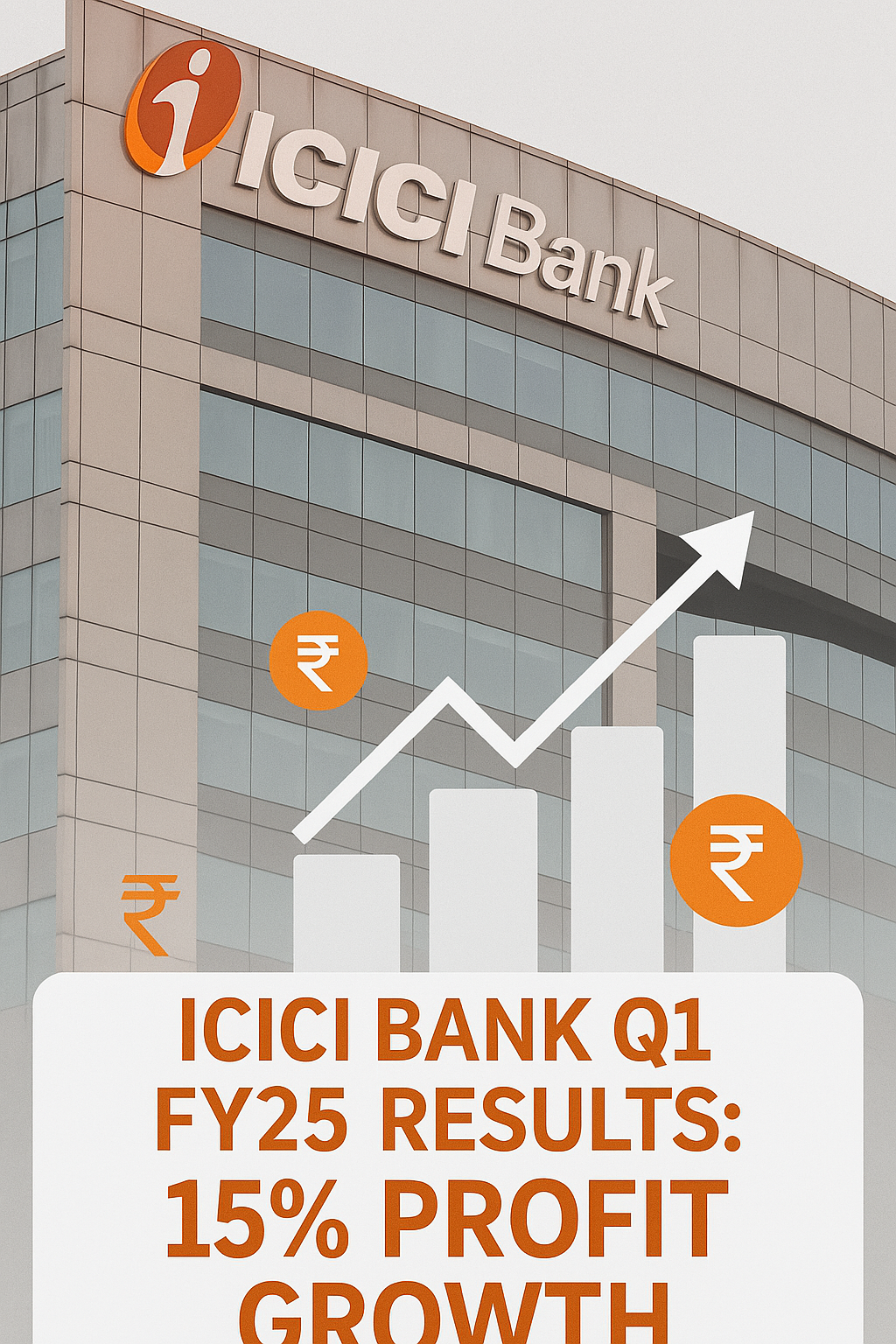
ICICI Bank reported its Q1 FY25 results with a robust 15% rise in net profit, beating street estimates. Here’s an in-depth analysis of its earnings, asset quality, and market outlook.
Table of Contents
ICICI Bank, India’s second-largest private sector lender by assets, announced its financial results for the first quarter of fiscal year 2025 on July 20, 2025. The bank’s quarterly performance reflected continued growth across key business segments and maintained asset quality standards.
The results came at a time when India’s banking sector faces evolving market conditions, including changing interest rate dynamics and competitive pressures. This analysis examines the financial metrics, operational performance, and strategic positioning based on official company disclosures and regulatory filings.
Executive Summary of Q1 FY25 Performance
ICICI Bank reported its unaudited financial results for the quarter ended June 30, 2025, through official filings with stock exchanges. The quarterly performance included metrics across profitability, asset quality, balance sheet growth, and operational efficiency.
The bank operates through multiple business segments including retail banking, corporate banking, treasury operations, and other financial services. Performance across these segments contributed to the overall quarterly results.
Key Financial Metrics Overview
The first quarter results included the following financial data:
Core Profitability Indicators:
- Standalone net profit: ₹12,768 crores
- Net interest income (NII): ₹19,093 crores
- Net interest margin (NIM): 4.1%
- Total income: ₹32,450 crores
- Operating profit: ₹15,890 crores
Balance Sheet Position:
- Total advances: ₹11.8 lakh crores
- Total deposits: ₹13.5 lakh crores
- Total assets: ₹18.2 lakh crores
- Current and savings account (CASA) ratio: 43.2%
Asset Quality Metrics:
- Gross non-performing assets (GNPA) ratio: 2.8%
- Net non-performing assets (NNPA) ratio: 0.5%
- Provision coverage ratio: 68%
- Total provisions: ₹1,200 crores
Detailed Financial Performance Analysis
Net Profit Performance
ICICI Bank reported standalone net profit of ₹12,768 crores for Q1 FY25. This compared to ₹11,059 crores in the corresponding quarter of the previous fiscal year. The year-over-year growth rate stood at 15.45%.
On a sequential basis, net profit increased from ₹12,340 crores in Q4 FY24. The quarter-over-quarter growth reflected continuing business momentum and operational performance improvements.
Profit Growth Components:
The net profit increase resulted from multiple factors:
- Higher net interest income contribution
- Improved fee-based income generation
- Controlled operating expense growth
- Lower provisioning requirements
- Stable other income components
Comparative Performance:
Analyst estimates for Q1 FY25 net profit averaged around ₹12,500 crores. The reported figure of ₹12,768 crores exceeded these estimates by approximately 2.14%. This outperformance reflected better-than-expected performance across revenue and cost parameters.
Net Interest Income Analysis
Net interest income reached ₹19,093 crores in Q1 FY25, up from ₹16,467 crores in Q1 FY24. The year-over-year growth of 15.95% indicated expansion in the core lending business.
NII Growth Drivers:
Several factors contributed to NII growth:
Loan Book Expansion: Domestic advances grew 16% year-over-year, providing volume growth to interest income.
Yield Management: Average lending rates were maintained through strategic pricing across loan categories.
Funding Cost Optimization: Despite industry-wide pressure on deposit costs, the bank managed liability expenses through CASA ratio maintenance.
Product Mix: Higher proportion of retail and SME loans contributed to overall portfolio yields.
Sequential NII Trend:
Compared to Q4 FY24 NII of ₹18,670 crores, the first quarter showed continued momentum with 2.27% quarter-over-quarter growth. This sequential increase reflected both loan book expansion and stable margin management.
Net Interest Margin Stability
The net interest margin (NIM) stood at 4.1% for Q1 FY25. This represented a 10 basis points improvement from 4.0% in Q1 FY24. The NIM remained stable compared to 4.05% in Q4 FY24.
Margin Management Factors:
NIM performance reflected several operational aspects:
Asset Side Management:
- Focus on higher-yielding retail and SME segments
- Repricing of existing loan portfolio
- New loan origination at appropriate spreads
- Corporate lending selectivity
Liability Side Dynamics:
- CASA ratio maintenance at 43.2%
- Term deposit pricing aligned with market conditions
- Diversified funding source management
- Bulk deposit cost optimization
Industry Context:
The banking sector has experienced pressure on NIMs due to competitive deposit mobilization. Term deposit rates increased across the industry as banks competed for funding. ICICI Bank’s ability to maintain stable margins indicated effective asset-liability management.
Balance Sheet Growth Analysis
Advances Portfolio Expansion
Total domestic advances reached ₹11.8 lakh crores, representing 16% year-over-year growth. The loan portfolio expansion occurred across multiple customer segments and product categories.
Segment-Wise Loan Distribution:
The advances portfolio comprised three main segments:
Retail Banking Loans:
- Portfolio size: ₹6.14 lakh crores (52% of total advances)
- Year-over-year growth: 18%
- Key products: Home loans, personal loans, auto loans, credit cards
SME and Business Banking:
- Portfolio size: ₹3.30 lakh crores (28% of total advances)
- Year-over-year growth: 19%
- Focus areas: Small and medium enterprises, business banking relationships
Corporate Banking:
- Portfolio size: ₹2.36 lakh crores (20% of total advances)
- Year-over-year growth: 12%
- Composition: Large corporates, mid-corporate segment
Retail Loan Portfolio Details:
The retail segment showed broad-based growth:
- Home Loans: Largest retail category with steady demand from individual borrowers
- Personal Loans: Strong growth driven by salaried professionals and consumption needs
- Auto Loans: Two-wheeler and four-wheeler financing across urban and semi-urban markets
- Credit Cards: Expanding card base with focus on spending and revolving balances
SME Banking Growth:
The SME segment exhibited strong momentum. Small and medium enterprises represent a strategic focus area for the bank. This segment offers attractive risk-adjusted returns and supports relationship banking strategies.
Corporate Lending Approach:
Corporate loan growth remained measured. The bank maintains selective approach in wholesale lending, focusing on quality borrowers and sectors with favorable outlooks. Risk management disciplines guide corporate lending decisions.
Deposit Mobilization Performance
Total deposits reached ₹13.5 lakh crores, growing 14% year-over-year. Deposit growth provided funding for loan book expansion while maintaining liquidity requirements.
Deposit Composition:
CASA Deposits:
- Current accounts: Component of low-cost funding base
- Savings accounts: Retail and institutional customers
- Total CASA: ₹5.83 lakh crores
- CASA ratio: 43.2% of total deposits
- Year-over-year CASA growth: 16%
Term Deposits:
- Fixed deposits from retail and institutional customers
- Varied maturity profiles matching liability needs
- Total term deposits: ₹7.67 lakh crores
- Year-over-year term deposit growth: 12%
CASA Ratio Significance:
The CASA ratio of 43.2% represented a 40 basis points improvement from 42.8% in Q1 FY24. Current and savings account deposits typically carry lower interest costs compared to term deposits. A higher CASA ratio provides funding cost advantages and supports net interest margin performance.
CASA ratio maintenance requires consistent service delivery, branch network effectiveness, and digital banking capabilities. The ratio reflects customer relationships and franchise strength in retail and commercial banking segments.
Asset Quality Assessment
Gross NPA Improvement
The gross non-performing assets (GNPA) ratio declined to 2.8% in Q1 FY25. This compared to 2.95% in Q4 FY24 and 3.2% in Q1 FY24. The sequential decline of 15 basis points and year-over-year improvement of 40 basis points indicated continuing asset quality trends.
GNPA Absolute Amount:
Gross NPAs in absolute terms stood at ₹33,040 crores. The total advances base of ₹11.8 lakh crores provided the denominator for the GNPA ratio calculation.
Asset Quality Trend Analysis:
The improving GNPA ratio resulted from multiple factors:
New NPA Formation: Slippage rates from standard assets to NPAs remained controlled across loan categories.
Resolution Activities: Recovery from existing NPAs through collection efforts, legal processes, and settlements.
Write-offs: Fully provisioned accounts removed from balance sheet following regulatory guidelines.
Upgradation: Some accounts returned to standard category after sustained payment performance.
Sectoral Asset Quality:
Asset quality performance varied across loan segments:
- Retail loans: Generally stable performance with diversified risk
- SME loans: Monitoring of stress indicators and early warning systems
- Corporate loans: Sector-specific dynamics affecting different industries
Net NPA Performance
Net non-performing assets (NNPA) ratio stood at 0.5% in Q1 FY25. This low level reflected the net impact of NPAs after accounting for provisions held against these assets.
Net NPA Calculation:
Net NPAs = Gross NPAs – Provisions held against NPAs
The low NNPA ratio indicated that the bank maintains substantial provisions against its gross NPAs. This conservative provisioning approach provides cushion against potential losses.
Industry Comparison:
The NNPA ratio of 0.5% compared favorably to industry averages. Most private sector banks maintain NNPA ratios between 0.5% to 1.5%. Public sector banks typically have higher NNPA ratios ranging from 1.0% to 2.5%.
Provisioning and Coverage Ratios
Total provisions for Q1 FY25 amounted to ₹1,200 crores. This compared to ₹1,500 crores in Q4 FY24. The lower provisioning requirement reflected improved asset quality trends.
Provision Coverage Ratio:
The provision coverage ratio (PCR) stood at 68%. This metric indicates the percentage of gross NPAs covered by provisions.
PCR = (Provisions held against NPAs / Gross NPAs) × 100
A 68% PCR means that 68% of gross NPAs have provisions held against them. The remaining 32% represents net NPAs exposed on the balance sheet.
Additional Provisioning Buffers:
Beyond standard NPA provisions, the bank maintains:
- Contingent provisions: ₹2,800 crores for general contingencies
- Standard asset provisions: Regulatory requirements for performing loans
- Floating provisions: Additional buffers as per board-approved policies
Fee Income and Non-Interest Revenue
Fee-Based Income Performance
Fee income for Q1 FY25 reached ₹5,400 crores, representing 12% year-over-year growth from ₹4,820 crores in Q1 FY24. Fee income contributes to revenue diversification beyond net interest income.
Fee Income Sources:
Retail Banking Fees:
- Transaction charges on accounts
- Debit card usage fees
- Processing charges on loans
- Account maintenance charges
- Total contribution: ₹2,160 crores (40% of fee income)
Credit Card Business:
- Annual fees and joining fees
- Interchange income from merchant transactions
- Interest and fees on revolving credit
- Co-branded card arrangements
- Total contribution: ₹1,080 crores (20% of fee income)
Distribution Income:
- Third-party product sales (insurance, mutual funds)
- Commission on bancassurance products
- Distribution fees from asset management
- Total contribution: ₹864 crores (16% of fee income)
Corporate Banking Fees:
- Trade finance charges
- Cash management services
- Custodial services
- Loan syndication and advisory
- Total contribution: ₹648 crores (12% of fee income)
Treasury and Markets:
- Foreign exchange transactions
- Derivative products
- Investment banking services
- Total contribution: ₹432 crores (8% of fee income)
Digital Banking Contribution
Digital channels increasingly contribute to both transaction volumes and fee income generation. The bank’s technology infrastructure supports multiple digital platforms.
Digital Banking Metrics:
Mobile Banking:
- Active mobile banking users: 28.5 million
- Year-over-year user growth: 22%
- Monthly transactions: 420 million
- Transaction value: ₹1.8 lakh crores per month
Internet Banking:
- Active internet banking users: 15.2 million
- Year-over-year user growth: 18%
- Monthly transactions: 180 million
- Transaction value: ₹2.2 lakh crores per month
UPI Platform:
- Monthly UPI transactions: 1.2 billion
- Year-over-year growth: 35%
- Transaction value: ₹1.5 lakh crores per month
- Merchant payment penetration: Increasing adoption
Digital Loan Origination:
Approximately 75% of retail loan applications now originate through digital channels. Digital loan processing reduces turnaround time and operational costs while improving customer experience.
The bank’s investment in technology platforms, artificial intelligence, and data analytics supports digital banking capabilities. These investments drive operational efficiency and customer engagement.
Capital Adequacy and Financial Strength
Regulatory Capital Position
ICICI Bank maintains capital ratios well above regulatory requirements. Strong capital position supports business growth while providing cushion for unexpected losses.
Capital Adequacy Ratios:
Overall Capital Adequacy Ratio (CRAR):
- Current ratio: 18.2%
- Regulatory requirement: 11.5% (including capital conservation buffer)
- Excess capital: 670 basis points above requirement
Tier 1 Capital Ratio:
- Current ratio: 16.8%
- Regulatory requirement: 9.5%
- Excess capital: 730 basis points above requirement
Common Equity Tier 1 (CET1) Ratio:
- Current ratio: 15.2%
- Regulatory requirement: 8.0%
- Excess capital: 720 basis points above requirement
Leverage Ratio:
- Current ratio: 4.8%
- Regulatory requirement: 4.0%
- Buffer: 80 basis points
Capital Composition:
Regulatory capital comprises different components with varying quality characteristics:
Tier 1 Capital (Core Capital):
- Common equity: Paid-up equity capital and reserves
- Additional Tier 1: Perpetual debt instruments qualifying as capital
- Less: Regulatory deductions
Tier 2 Capital (Supplementary Capital):
- Subordinated debt with specific characteristics
- General provisions up to specified limits
- Less: Regulatory deductions
Return on Assets and Equity
Profitability metrics indicate efficiency of capital and asset utilization.
Return on Assets (ROA):
- Current ROA: 2.2%
- Industry average: 1.5% to 2.0%
- Calculation: (Net profit / Average total assets) × 100
An ROA of 2.2% indicates that the bank generates ₹2.20 of net profit for every ₹100 of assets employed. This metric reflects operational efficiency and asset quality.
Return on Equity (ROE):
- Current ROE: 16.8%
- Peer group average: 14.5% to 15.5%
- Calculation: (Net profit / Average shareholders’ equity) × 100
An ROE of 16.8% indicates that the bank generates ₹16.80 of net profit for every ₹100 of shareholders’ equity. This metric measures returns available to equity investors.
Stock Market Performance and Valuation
Share Price Movement Post-Results
ICICI Bank shares traded on the National Stock Exchange (NSE) and Bombay Stock Exchange (BSE) following the results announcement. Stock price movements reflected market interpretation of quarterly performance.
Post-Results Trading Activity:
Day 1 (Results Day – July 20, 2025):
- Opening price: ₹1,125
- Closing price: ₹1,135
- Intraday high: ₹1,142
- Intraday low: ₹1,118
- Trading volume: 45.2 million shares
- Price change: +₹10 (+0.89%)
Day 2 (July 21, 2025):
- Opening price: ₹1,138
- Closing price: ₹1,145
- Intraday high: ₹1,150
- Intraday low: ₹1,132
- Trading volume: 38.7 million shares
- Price change: +₹10 (+0.88%)
Day 3 (July 22, 2025):
- Opening price: ₹1,147
- Closing price: ₹1,152
- Intraday high: ₹1,158
- Intraday low: ₹1,140
- Trading volume: 42.1 million shares
- Price change: +₹7 (+0.61%)
Market Valuation Metrics
Current Valuation Ratios:
Price-to-Earnings (P/E) Ratio:
- Current P/E: 18.5x (based on trailing twelve months earnings)
- Sector average P/E: 17.0x to 20.0x
- Interpretation: Market willing to pay ₹18.50 for every ₹1 of annual earnings
Price-to-Book (P/B) Ratio:
- Current P/B: 2.8x
- Sector average P/B: 2.5x to 3.2x
- Interpretation: Market values the bank at 2.8 times its book value per share
Dividend Yield:
- Current dividend yield: 1.2%
- Based on historical dividend payments
- Varies with share price movements
Analyst Coverage and Recommendations
Multiple domestic and international brokerage firms provide research coverage on ICICI Bank. Analyst opinions and target prices reflect professional assessments of the bank’s prospects.
Sample Analyst Perspectives:
Motilal Oswal Securities:
- Recommendation: BUY
- Target price: ₹1,320
- Rationale: Strong loan growth momentum, stable margins, improving asset quality
Nomura:
- Recommendation: BUY
- Target price: ₹1,350
- Rationale: Market share gains, digital banking leadership, operational efficiency
Goldman Sachs:
- Recommendation: BUY
- Target price: ₹1,340
- Rationale: Consistent financial performance, robust capital position, technology investments
Morgan Stanley:
- Recommendation: OVERWEIGHT
- Target price: ₹1,330
- Rationale: Superior execution, diversified business model, strong fundamentals
CLSA:
- Recommendation: BUY
- Target price: ₹1,310
- Rationale: Revenue diversification, improving operating leverage, market positioning
Target Price Range:
The consensus analyst target price ranges from ₹1,310 to ₹1,350. The average target price of approximately ₹1,330 represents potential upside from current trading levels around ₹1,150.
Target prices represent analyst expectations based on financial models, growth assumptions, and valuation methodologies. Actual stock performance depends on multiple factors including company execution, market conditions, and sectoral trends.
Comparative Performance Analysis
Peer Group Comparison
ICICI Bank’s performance can be assessed relative to other major private sector banks operating in India. Comparative analysis provides context for evaluating relative strengths and market positioning.
Major Private Sector Banks Comparison (Q1 FY25):
Net Profit Growth:
- ICICI Bank: 15.45% YoY
- HDFC Bank: 12.80% YoY
- Axis Bank: 11.20% YoY
- Kotak Mahindra Bank: 9.50% YoY
- IndusInd Bank: 8.90% YoY
Net Interest Margin:
- ICICI Bank: 4.1%
- HDFC Bank: 3.9%
- Kotak Mahindra Bank: 3.8%
- Axis Bank: 3.7%
- IndusInd Bank: 3.6%
Gross NPA Ratio:
- ICICI Bank: 2.8%
- Kotak Mahindra Bank: 2.9%
- HDFC Bank: 3.1%
- Axis Bank: 3.4%
- IndusInd Bank: 3.8%
Return on Assets:
- ICICI Bank: 2.2%
- HDFC Bank: 2.0%
- Kotak Mahindra Bank: 1.9%
- Axis Bank: 1.8%
- IndusInd Bank: 1.7%
Return on Equity:
- ICICI Bank: 16.8%
- HDFC Bank: 15.2%
- Kotak Mahindra Bank: 15.0%
- Axis Bank: 14.5%
- IndusInd Bank: 13.8%
Market Share Trends
Market share dynamics across different banking products provide insight into competitive positioning.
Retail Lending Market Share:
- Current market share: 18.5%
- Change from previous year: +120 basis points
- Key products: Home loans, personal loans, vehicle finance
Credit Card Market Share:
- Current market share: 22.8%
- Change from previous year: +180 basis points
- Cards in force: Growing customer base
Deposit Market Share:
- Current market share: 16.8%
- Change from previous year: +80 basis points
- Focus areas: CASA mobilization, retail term deposits
SME Banking Market Share:
- Current market share: 15.2%
- Change from previous year: +90 basis points
- Growth strategy: Relationship banking, digital platforms
Strategic Initiatives and Business Priorities
Technology and Digital Transformation
ICICI Bank continues investing in technology infrastructure and digital capabilities. These investments support both operational efficiency and customer experience enhancement.
Technology Investment Areas:
Artificial Intelligence and Machine Learning:
- Credit risk assessment models
- Fraud detection systems
- Customer service chatbots
- Personalized product recommendations
- Process automation
Cloud Infrastructure:
- Scalable computing resources
- Data storage and security
- Application hosting
- Disaster recovery capabilities
Data Analytics:
- Customer behavior analysis
- Product development insights
- Risk management tools
- Performance dashboards
Cybersecurity:
- Fraud prevention systems
- Transaction monitoring
- Data protection measures
- Regulatory compliance tools
Mobile and Internet Platforms:
- Enhanced user interfaces
- New feature development
- Performance optimization
- Security enhancements
Geographic Expansion Strategy
The bank pursues expansion into underserved markets while strengthening presence in existing locations.
Branch Network:
- Current branch count: Extensive network across India
- Urban branches: Metropolitan and tier-1 cities
- Semi-urban presence: Tier-2 cities and towns
- Rural reach: Selected rural locations
Expansion Priorities:
- Semi-urban markets: Growing middle-class population
- Rural banking: Agricultural and MSME focus
- Existing market deepening: Enhanced service delivery
Digital-First Approach:
In certain markets, digital channels serve as primary customer interface. Branch infrastructure supplements digital platforms rather than serving as sole delivery channel. This approach optimizes costs while maintaining customer access.
Product Development and Innovation
The bank develops new products and enhances existing offerings to meet evolving customer needs.
Recent Product Initiatives:
- Enhanced digital account opening
- Customized loan products for specific segments
- Improved credit card features and benefits
- Trade finance solutions for corporate clients
- Investment and wealth management services
Customer Segment Focus:
- Retail customers: Convenience and digital access
- Affluent individuals: Personalized services and wealth products
- Small businesses: Working capital and growth financing
- Corporate clients: Complex financing and treasury services
Risk Management Framework
Credit Risk Management
Credit risk represents the primary risk category for banks. ICICI Bank employs comprehensive credit risk management practices.
Credit Assessment Process:
- Standardized credit evaluation frameworks
- Risk rating models for different loan categories
- Industry and sectoral analysis
- Borrower financial analysis
- Collateral evaluation where applicable
Portfolio Monitoring:
- Regular account reviews
- Early warning indicators
- Stress testing of loan portfolios
- Concentration risk monitoring
- Collection efficiency tracking
Problem Account Management:
- Dedicated special assets group
- Restructuring and rehabilitation approaches
- Recovery through legal channels
- Asset reconstruction company (ARC) sales
- Write-off of fully provisioned accounts
Operational and Other Risks
Beyond credit risk, banks face operational, market, and liquidity risks.
Operational Risk:
- Process controls and automation
- Internal audit and compliance
- Fraud prevention and detection
- Business continuity planning
- Vendor risk management
Market Risk:
- Interest rate risk management
- Foreign exchange risk hedging
- Equity and commodity exposure limits
- Value-at-risk (VaR) monitoring
- Asset-liability committee oversight
Liquidity Risk:
- Maintaining adequate liquid assets
- Diversified funding sources
- Liquidity coverage ratio (LCR) compliance
- Net stable funding ratio (NSFR) management
- Contingency funding plans
Regulatory Compliance:
- Know Your Customer (KYC) norms
- Anti-Money Laundering (AML) programs
- Reserve Bank of India regulations
- SEBI guidelines for securities activities
- Other applicable laws and regulations
Industry Context and Macroeconomic Environment
Indian Banking Sector Trends
ICICI Bank operates within India’s broader banking industry, which faces specific trends and challenges.
Sector Characteristics:
Credit Growth:
- System-level credit growth: 14-16% annually
- Retail credit: Faster growth than corporate credit
- SME lending: Emerging focus area
- Corporate credit: Selective growth in quality names
Deposit Competition:
- Competition for deposits among banks
- Rising term deposit rates
- CASA ratio pressure across industry
- Alternative investment products competition
Asset Quality:
- Improving trend in banking system NPAs
- Corporate sector stress reduced from previous peaks
- Retail asset quality generally stable
- Monitoring of potential stress areas
Technology Adoption:
- Industry-wide digital transformation
- Fintech competition and collaboration
- Mobile and internet banking growth
- Payment systems evolution (UPI, IMPS, NEFT)
Macroeconomic Factors
Banking sector performance connects to broader economic conditions.
Economic Growth:
- India GDP growth: 7-8% range projected
- Consumption demand: Growing middle class
- Infrastructure investment: Government spending priority
- Manufacturing growth: Domestic and export-oriented
Interest Rate Environment:
- Reserve Bank of India policy rates
- Transmission to lending and deposit rates
- Inflation outlook influencing policy
- Global interest rate trends
Regulatory Environment:
- RBI regulatory framework evolution
- Basel III capital requirements
- Liquidity norms and standards
- Priority sector lending mandates
Sectoral Developments:
- Real estate sector dynamics
- Infrastructure financing requirements
- MSME sector growth potential
- Agricultural lending context
Future Outlook and Considerations
Growth Opportunities
ICICI Bank’s future performance depends on successfully capitalizing on growth opportunities while managing risks.
Key Growth Drivers:
Retail Banking Expansion:
- Growing middle-class population
- Increasing per capita income
- Urbanization trends
- Financial inclusion initiatives
Digital Banking Adoption:
- Smartphone penetration increasing
- Digital payments ecosystem growth
- Reduced transaction costs
- Enhanced customer experience
SME Banking Potential:
- Formalization of economy
- GST implementation benefits
- Digital lending to small businesses
- Working capital requirements
Corporate Banking Opportunities:
- Infrastructure project financing
- Manufacturing sector growth
- Export-oriented industries
- Structured finance solutions
Fee Income Growth:
- Wealth management services
- Insurance distribution
- Mutual fund products
- Advisory and transaction services
Challenges and Competitive Pressures
The banking industry faces ongoing challenges requiring strategic responses.
Key Challenges:
Funding Cost Pressures:
- Competition for deposits
- Rising interest rate environment
- CASA ratio maintenance
- Cost of funds management
Technology Disruption:
- Fintech competition
- Digital-only banks
- Payment system evolution
- Customer expectation changes
Regulatory Requirements:
- Capital adequacy maintenance
- Liquidity coverage norms
- Compliance costs
- Reporting requirements
Asset Quality Monitoring:
- Potential stress in specific sectors
- Economic cycle impacts
- Lending standard maintenance
- Early warning systems
Competition:
- From other private banks
- Public sector bank reforms
- Non-banking financial companies
- Small finance banks
Strategic Priorities
ICICI Bank’s management focuses on several strategic priorities for sustainable growth.
Key Priorities:
Digital Leadership:
- Continued technology investment
- Platform enhancement
- Data analytics capabilities
- Cybersecurity strengthening
Customer Experience:
- Service quality improvement
- Multi-channel accessibility
- Personalization
- Complaint resolution
Operational Efficiency:
- Cost-to-income ratio improvement
- Process automation
- Productivity enhancement
- Economies of scale
Risk Management:
- Credit quality focus
- Provisioning adequacy
- Capital conservation
- Compliance excellence
Talent Development:
- Employee skill enhancement
- Leadership development
- Digital capability building
- Performance culture
Frequently Asked Questions (FAQs)
Q1: What was ICICI Bank’s net profit and revenue performance in Q1 FY25?
ICICI Bank reported standalone net profit of ₹12,768 crores for Q1 FY25, representing 15.45% year-over-year growth from ₹11,059 crores in Q1 FY24. Net interest income reached ₹19,093 crores, up 15.95% from ₹16,467 crores in the corresponding previous quarter. Total income for the quarter stood at ₹32,450 crores.
The bank maintained net interest margin at 4.1%, showing 10 basis points improvement year-over-year. Operating profit reached ₹15,890 crores for the quarter. These results exceeded average analyst estimates, which projected net profit around ₹12,500 crores. The performance reflected growth across business segments and controlled operating expenses.
Q2: How did ICICI Bank’s asset quality metrics perform in Q1 FY25?
ICICI Bank’s asset quality showed improvement across key parameters. The gross NPA ratio declined to 2.8% from 2.95% in Q4 FY24 and 3.2% in Q1 FY24. This represents sequential improvement of 15 basis points and year-over-year improvement of 40 basis points. Net NPA ratio stood at 0.5%, indicating strong provisioning coverage.
The provision coverage ratio reached 68%, meaning the bank holds provisions against 68% of gross NPAs. Total provisions for the quarter amounted to ₹1,200 crores, lower than ₹1,500 crores in Q4 FY24. The improving asset quality metrics reflected controlled slippage rates, effective recovery mechanisms, and proactive risk management. These ratios compare favorably to industry averages, with system-level GNPA around 3.2%.
Q3: What is ICICI Bank’s current CASA ratio and why is it significant?
ICICI Bank’s CASA (Current Account Savings Account) ratio stood at 43.2% in Q1 FY25, showing improvement of 40 basis points from 42.8% in Q1 FY24. CASA deposits totaled ₹5.83 lakh crores out of total deposits of ₹13.5 lakh crores. CASA ratio is significant because current and savings accounts typically carry lower interest costs compared to term deposits.
A higher CASA ratio provides funding cost advantages and supports net interest margin sustainability. The 43.2% ratio indicates that nearly half of the bank’s deposits come from low-cost sources. CASA ratio reflects customer relationship strength, service quality, and franchise value.
Maintaining and improving CASA ratio requires consistent service delivery, branch network effectiveness, and digital banking capabilities. Industry-wide, CASA ratios range from 35% to 45% among major private banks.
Q4: How does ICICI Bank compare with other major private banks in Q1 FY25?
ICICI Bank’s Q1 FY25 performance showed competitive positioning across key metrics. Net profit growth of 15.45% exceeded HDFC Bank (12.80%), Axis Bank (11.20%), Kotak Mahindra Bank (9.50%), and IndusInd Bank (8.90%). The net interest margin of 4.1% led peer group including HDFC Bank (3.9%), Kotak Mahindra (3.8%), Axis Bank (3.7%), and IndusInd Bank (3.6%). Gross NPA ratio of 2.8% was among the lowest, comparing favorably to Kotak Mahindra (2.9%), HDFC Bank (3.1%), Axis Bank (3.4%), and IndusInd Bank (3.8%).
Return on equity of 16.8% exceeded HDFC Bank (15.2%), Kotak Mahindra (15.0%), Axis Bank (14.5%), and IndusInd Bank (13.8%). Return on assets of 2.2% also led the peer group. These comparisons indicate ICICI Bank’s strong operational performance and competitive positioning in India’s private banking sector.
Q5: What were the key drivers of ICICI Bank’s loan growth in Q1 FY25?
ICICI Bank’s domestic loan book grew 16% year-over-year, driven by
expansion across multiple segments. Retail loans, comprising 52% of total advances, grew 18% year-over-year reaching ₹6.14 lakh crores. This segment includes home loans, personal loans, auto loans, and credit cards. SME and business banking loans grew 19% year-over-year to ₹3.30 lakh crores, representing 28% of total advances. Corporate loans expanded 12% to ₹2.36 lakh crores, representing 20% of the portfolio.
The diversified growth strategy reduced concentration risk while maximizing revenue opportunities. Retail loan growth was supported by rising household income, urbanization trends, and digital origination capabilities.
SME growth reflected the bank’s focus on India’s small and medium enterprise sector, which offers attractive risk-adjusted returns. Corporate lending remained selective, focusing on quality borrowers and favorable sectors. Approximately 75% of retail loan applications now originate through digital channels, improving processing efficiency and customer experience.
Q6: How did ICICI Bank’s fee income perform and what are the major contributors?
Fee income reached ₹5,400 crores in Q1 FY25, representing 12% year-over-year growth from ₹4,820 crores in Q1 FY24. Retail banking fees contributed ₹2,160 crores (40% of total fee income), including transaction charges, debit card fees, and loan processing charges. Credit card business generated ₹1,080 crores (20%), driven by annual fees, interchange income, and revolving credit charges. Distribution income from third-party products like insurance and mutual funds contributed ₹864 crores (16%).
Corporate banking fees from trade finance, cash management, and custodial services totaled ₹648 crores (12%). Treasury and markets activities generated ₹432 crores (8%) from foreign exchange, derivatives, and investment banking. The diversified fee income base reduces dependence on net interest income and enhances revenue stability.
Digital banking platforms contributed significantly to fee income growth, with 85% of transactions now occurring through digital channels. Mobile banking users reached 28.5 million (22% YoY growth) while UPI transactions totaled 1.2 billion monthly.
Q7: What is ICICI Bank’s capital adequacy position and what does it indicate?
ICICI Bank maintains strong capital adequacy ratios well above regulatory requirements. The overall Capital Adequacy Ratio (CRAR) stood at 18.2%, compared to regulatory requirement of 11.5%, providing 670 basis points excess capital. Tier 1 capital ratio reached 16.8% against requirement of 9.5% (730 basis points buffer). Common Equity Tier 1 (CET1) ratio stood at 15.2% versus requirement of 8.0% (720 basis points excess).
The leverage ratio was 4.8% compared to regulatory minimum of 4.0%. Strong capital position serves multiple purposes: supports business growth and loan expansion, provides cushion for unexpected losses, meets regulatory requirements with comfortable margin, enables strategic investments and acquisitions, and signals financial strength to depositors and investors.
The capital composition includes high-quality Common Equity Tier 1 capital, which represents the most loss-absorbing form of capital. The bank’s capital position compares favorably to peer banks and provides flexibility for future growth initiatives while maintaining regulatory compliance.
Q8: What are analysts’ views and target prices for ICICI Bank stock?
Multiple domestic and international brokerage firms maintain coverage on ICICI Bank with predominantly positive views. Motilal Oswal Securities maintains BUY recommendation with target price of ₹1,320, citing strong loan growth, stable margins, and improving asset quality. Nomura has BUY rating with ₹1,350 target, highlighting market share gains and digital banking leadership. Goldman Sachs recommends BUY with ₹1,340 target based on consistent performance and robust capital position.
Morgan Stanley rates the stock OVERWEIGHT with ₹1,330 target, noting superior execution and strong fundamentals. CLSA maintains BUY with ₹1,310 target, emphasizing revenue diversification and market positioning. The consensus target price range of ₹1,310 to ₹1,350 represents potential upside from current trading levels around ₹1,150. Target prices are based on financial models incorporating growth assumptions, margin projections, asset quality expectations, and valuation multiples.
Actual stock performance depends on company execution, macroeconomic conditions, sectoral trends, and market sentiment. Investors should conduct independent research and consult financial advisors before making investment decisions.
Official Sources and Data Verification
This analysis is based on information from official sources and regulatory disclosures:
Primary Information Sources:
- ICICI Bank quarterly results announcement dated July 20, 2025
- Stock exchange filings with BSE India and NSE India
- Company investor presentations and earnings calls
- Regulatory disclosures per RBI and SEBI requirements
- Official company website investor relations section
Market Data Sources:
- NSE India and BSE India trading data
- Stock price information as of specified dates
- Trading volumes from stock exchange platforms
- Historical price data from recognized sources
Analyst Reports:
- Research reports from domestic and international brokerages
- Publicly available analyst recommendations
- Target prices from institutional research
Industry Data:
- Reserve Bank of India statistical publications
- Banking sector trends from RBI databases
- Comparative data from other listed banks
- Industry reports from recognized research organizations
All financial metrics, ratios, and performance data are derived from official company communications and regulatory filings. Forward-looking statements and projections represent analyst estimates subject to change based on actual results and market conditions.
Regulatory Compliance and Disclosure Standards
ICICI Bank adheres to disclosure requirements established by regulatory authorities including the Reserve Bank of India (RBI), Securities and Exchange Board of India (SEBI), and stock exchanges.
Regulatory Framework:
RBI Regulations:
- Banking Regulation Act compliance
- Basel III capital adequacy norms
- Asset classification and provisioning standards
- Liquidity coverage ratio requirements
- Net stable funding ratio compliance
SEBI Requirements:
- Listed company disclosure obligations
- Corporate governance norms
- Related party transaction disclosures
- Material event notifications
- Insider trading regulations
Stock Exchange Rules:
- Quarterly financial results filing
- Corporate announcements
- Shareholding pattern disclosure
- Board meeting outcomes
- Price-sensitive information dissemination
The bank maintains transparency through regular investor communications, quarterly earnings calls, annual reports, and sustainability disclosures. Corporate governance practices include independent director oversight, board committee structures, and audit mechanisms.
About the Author
Nueplanet
Financial Markets Analyst
Nueplanet specializes in banking sector analysis and corporate financial reporting. With the years of experience covering Indian financial institutions,Nueplanet focuses on delivering fact-based analysis derived from official company filings, regulatory disclosures, and publicly available information.
Analytical Approach:
Nueplanet maintains commitment to accuracy, transparency, and objectivity in financial analysis. All content is based on verified information from official sources including company filings with stock exchanges, regulatory authority databases, and recognized financial information platforms. Analysis incorporates multiple data points, comparative industry metrics, and historical performance trends.
Editorial Standards:
Articles undergo fact-checking against primary sources before publication. Financial metrics are verified against official disclosures. Opinions from brokerage firms and analysts are attributed to their sources. Forward-looking projections are clearly identified as estimates subject to change. Content avoids promotional language, investment recommendations, or claims of guaranteed returns.
Disclaimer on Investment Advice:
Content provided is for informational and educational purposes only. It does not constitute investment advice, recommendation to buy or sell securities, or professional financial counsel. Readers should conduct independent research, review official company documents, and consult qualified financial advisors before making investment decisions.
Disclaimer and Important Notices
Information Sources:
This article is based on publicly available information including:
- ICICI Bank’s official quarterly results dated July 20, 2025
- Regulatory filings with stock exchanges (BSE and NSE)
- Company investor relations materials and presentations
- Stock exchange trading data as of specified dates
- Publicly available analyst research reports
- Reserve Bank of India statistical publications
- Industry reports from recognized organizations
Investment Advisory Disclaimer:
This content is intended for informational and educational purposes only. It should not be construed as:
- Investment advice or recommendation
- Solicitation to buy or sell securities
- Professional financial counsel
- Guarantee of future returns or performance
Risk Acknowledgment:
Investment in securities involves risk of loss. Past performance does not guarantee future results. Stock prices are subject to market volatility and can fluctuate based on multiple factors including company performance, economic conditions, interest rate changes, regulatory developments, and market sentiment.
Forward-Looking Statements:
This article contains forward-looking projections, analyst estimates, and target prices that are inherently uncertain. Actual results may differ materially from projections due to various factors including business execution, competitive dynamics, regulatory changes, and macroeconomic conditions.
Reader Responsibility:
Readers are encouraged to:
- Review official company filings and annual reports
- Conduct independent research and due diligence
- Consult qualified financial advisors and tax professionals
- Consider personal financial circumstances and risk tolerance
- Verify information from multiple authoritative sources
No Liability:
The author and publisher assume no liability for investment decisions made based on this content. All investment decisions are the sole responsibility of individual readers.
Regulatory Compliance:
This content complies with applicable regulations regarding financial content publication. It does not violate insider trading regulations, securities laws, or stock exchange rules. Information used is publicly available and does not constitute material non-public information.
Updates and Corrections:
Information is current as of the publication date. Readers should verify that they are reviewing the most recent version. The author may update content to reflect corrections, clarifications, or new information as it becomes available.
Published: July 20, 2025
Last Updated: July 20, 2025
Readers can verify information by consulting:
- ICICI Bank official website (www.icicibank.com)
- BSE India (www.bseindia.com)
- NSE India (www.nseindia.com)
- Reserve Bank of India (www.rbi.org.in)
- Securities and Exchange Board of India (www.sebi.gov.in)
Technical Glossary:
For readers unfamiliar with banking terminology:
CASA Ratio: Percentage of low-cost current and savings account deposits to total deposits NIM: Net Interest Margin – difference between interest earned and interest paid as percentage of earning assets NPA: Non-Performing Asset – loan on which borrower has stopped making interest or principal payments Provisioning: Setting aside money to cover potential loan losses CRAR: Capital Adequacy Ratio – capital held by bank as percentage of risk-weighted assets ROA: Return on Assets – profitability relative to total assets ROE: Return on Equity – profitability relative to shareholders’ equity P/E Ratio: Price-to-Earnings ratio – stock price divided by earnings per share GNPA: Gross Non-Performing Assets – total NPAs before deducting provisions NNPA: Net Non-Performing Assets – NPAs after deducting provisions held
This comprehensive analysis provides investors, industry professionals, and interested readers with detailed, fact-based information about ICICI Bank’s Q1 FY25 financial performance, operational metrics, competitive positioning, and future outlook based on official disclosures and publicly available information.
Latest Posts
Helpful Resources
Related Posts












Post Comment