









Kerala Plus Two SAY Result 2025 Declared: Check DHSE HSE VHSE Results, Pass Percentage, and Direct Link
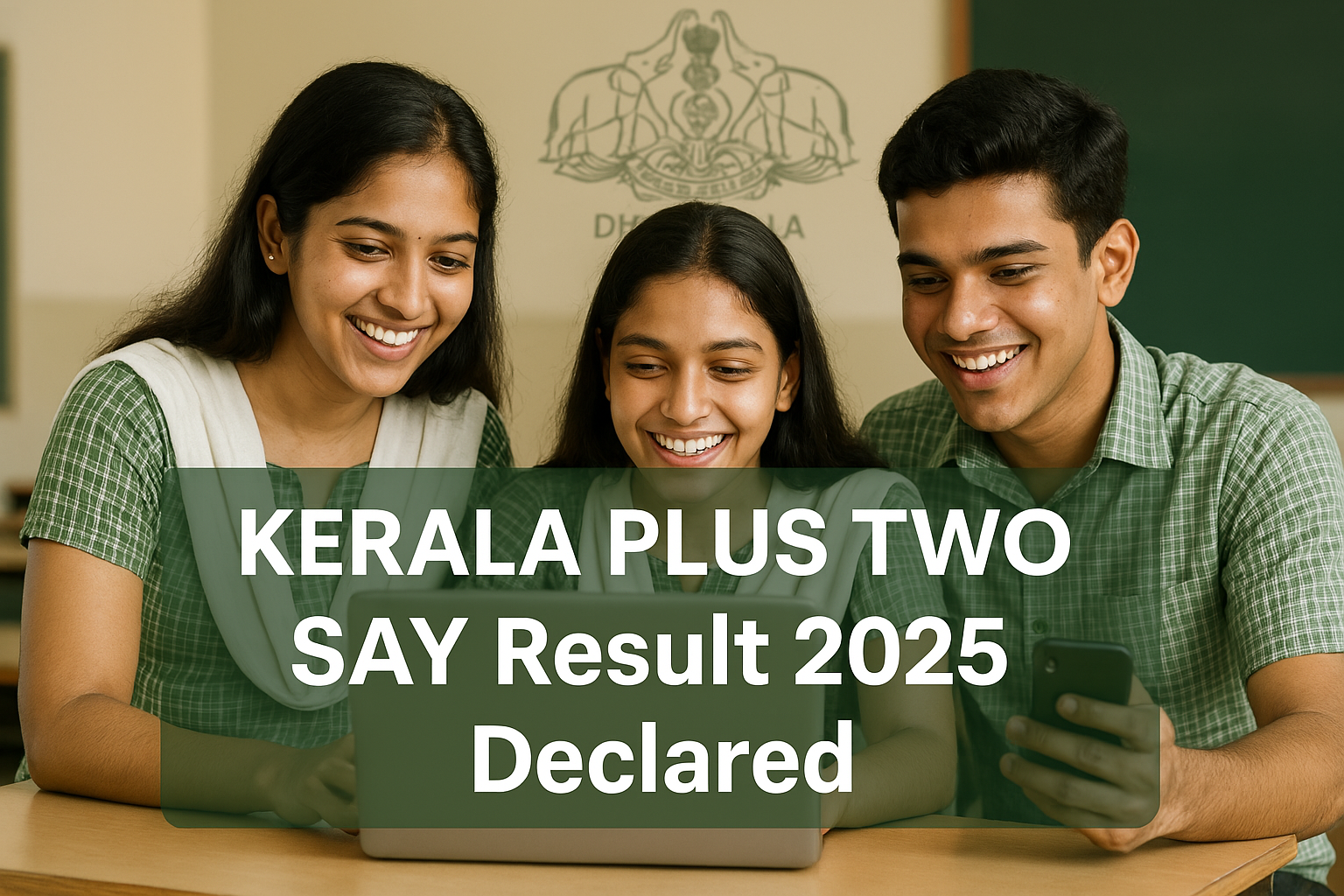
The Kerala Plus Two SAY Result 2025 has been declared today for DHSE, HSE, and VHSE students. Here are the steps to check your results, pass percentages, and next admission processes.
Table of Contents
Introduction
The Directorate of Higher Secondary Education (DHSE) Kerala announced the Plus Two SAY (Save A Year) examination results for 2025 on July 18, 2025. Students who appeared for these supplementary examinations can now access their results through the official portal keralaresults.nic.in. This result declaration provides an opportunity for students to progress to higher education without losing an academic year.
The SAY examination system represents an important component of Kerala’s educational framework. It allows students who were unsuccessful in one or two subjects during the regular March examinations to clear those subjects within the same academic year. This mechanism helps maintain academic continuity and ensures students can proceed with university admissions according to their planned timeline.
This comprehensive guide provides detailed information about accessing SAY results, understanding the examination system, exploring revaluation options, and preparing for subsequent admission processes to higher education institutions.
Understanding the SAY Examination System
Purpose and Objectives
The Save A Year (SAY) examination framework serves multiple educational purposes within Kerala’s secondary education system. The primary objective is to provide students an immediate opportunity to clear subjects they could not pass in the regular board examinations held in March.
This system prevents students from repeating an entire academic year due to failure in limited subjects. By conducting supplementary examinations within a few months of the regular exams, DHSE enables students to maintain their educational timeline and compete for university admissions alongside their peers.
The SAY mechanism also contributes to improving overall board performance statistics. It provides a more comprehensive assessment of student capabilities by offering a second evaluation opportunity within the same academic cycle.
Eligibility for SAY Examinations
Students become eligible for SAY examinations based on specific criteria established by DHSE Kerala. Generally, students who fail in one or two subjects during the regular Plus Two examinations qualify to appear for SAY exams in those specific subjects.
The examination is open to students from all streams including Science, Commerce, Humanities, and Vocational Higher Secondary Education (VHSE). This comprehensive coverage ensures that students across all academic disciplines have equal access to recovery opportunities.
Students who wish to improve their marks in subjects they have already passed may also appear for improvement examinations, which are conducted simultaneously with SAY exams. However, the rules and implications for improvement attempts differ from those for clearing failed subjects.
Administrative Structure
DHSE Kerala manages the SAY examination process through a coordinated administrative framework. The directorate handles registration, examination conduct, evaluation, and result declaration for both regular Higher Secondary Education (HSE) and Vocational Higher Secondary Education (VHSE) streams.
The examination centers are distributed across Kerala to ensure accessibility for students from all districts. DHSE maintains standardized protocols for question paper preparation, invigilation, and answer sheet evaluation to ensure consistency and fairness.
The evaluation process follows the same standards applied to regular board examinations. Qualified teachers and subject experts evaluate answer sheets according to established marking schemes, ensuring that SAY results maintain the same credibility as regular examination results.
Kerala Plus Two SAY Result 2025: Overview and Statistics
Result Declaration Details
The DHSE Kerala officially declared the Plus Two SAY results for 2025 on July 18, 2025. The announcement was made during morning hours, allowing students throughout the day to access and review their performance.
Results became available simultaneously on multiple official platforms to accommodate the large number of students seeking access. The digital result declaration system ensures immediate availability without requiring students to visit physical offices or wait for postal communications.
Key Timeline:
- Regular Plus Two examinations: March 2025
- SAY examinations conducted: June 2025
- Result processing period: Late June to mid-July 2025
- Official result declaration: July 18, 2025
Official Result Access Portals
Students can check their SAY results through authorized government portals:
Primary Portal: keralaresults.nic.in
- Main government results portal for Kerala
- Hosts results for all DHSE examinations
- Maintained by National Informatics Centre (NIC)
- Optimized for high-traffic periods
Secondary Portal: dhsekerala.gov.in
- Official DHSE website
- Provides comprehensive educational information
- Includes examination schedules and notifications
- Features student support resources
Both portals are designed with mobile-responsive interfaces, allowing students to access results from smartphones, tablets, or computers. The systems employ security protocols requiring valid credentials to protect student privacy.
Performance Statistics for 2025
According to official data released by DHSE Kerala, the SAY examinations for 2025 showed the following outcomes:
Overall Performance:
- Total students appeared: Approximately 45,000
- Overall pass percentage: 79.8%
- Number of successful students: Approximately 35,910
These figures indicate that a significant majority of students who attempted SAY examinations successfully cleared their pending subjects, enabling them to progress to higher education.
Stream-Wise Performance:
| Stream | Pass Percentage |
|---|---|
| Science | 85% |
| Commerce | 77% |
| Humanities | 73% |
The Science stream recorded the highest pass percentage at 85%, followed by Commerce at 77% and Humanities at 73%. These variations reflect different subject difficulty levels and student preparation patterns across streams.
District-Wise Performance:
- Highest performing district: Ernakulam
- Areas for improvement: Wayanad district showed lower performance metrics
District-level variations in performance typically reflect differences in educational infrastructure, access to coaching facilities, and socioeconomic factors affecting student preparation.
VHSE SAY Results
The Vocational Higher Secondary Education (VHSE) SAY results were released simultaneously with the regular HSE results. VHSE students can access their results using the same portals and procedures as HSE students.
VHSE programs combine academic education with vocational training in specific trades and industries. Students who clear their VHSE SAY examinations gain eligibility for advanced diploma programs, polytechnic courses, and specialized higher education pathways aligned with their vocational specialization.
The parallel release of HSE and VHSE results demonstrates DHSE’s commitment to treating vocational education with equal importance and ensuring that VHSE students have timely access to admission opportunities.
Step-by-Step Guide to Checking SAY Results
Required Information
Before accessing results, students should have the following information readily available:
- Roll Number/Register Number: The unique identification number assigned during examination registration
- Date of Birth: Must match the date provided in examination application forms (typically in DD/MM/YYYY format)
These credentials serve as authentication factors to ensure that only the legitimate student can access their individual results.
Detailed Result Checking Procedure
Step 1: Access the Official Website
Open a web browser on any device (computer, smartphone, or tablet). Navigate to keralaresults.nic.in by typing the URL in the address bar. Ensure you have a stable internet connection to avoid disruptions during the process.
Step 2: Locate the Result Link
On the homepage, look for the link labeled “DHSE Plus Two SAY Result 2025” or “Higher Secondary SAY/Improvement Result 2025.” This link is typically displayed prominently on the main page. Click on this link to proceed to the result access page.
Step 3: Enter Credentials
On the result access page, you will find input fields for your credentials. Enter your Roll Number exactly as it appears on your hall ticket. Input your Date of Birth in the specified format. Some systems may also require entering a displayed captcha code for security purposes.
Step 4: Submit the Information
After carefully verifying that all entered information is correct, click the “Submit,” “Get Result,” or similarly labeled button. The system will process your request and retrieve your result from the database.
Step 5: View Your Result
Your result will appear on the screen, displaying:
- Student name and roll number
- School name and code
- Subject-wise marks obtained
- Total marks and percentage
- Pass/Fail status for each subject
- Overall result status
Step 6: Download and Save
Most result portals provide options to download results as PDF documents. Click the download button to save a digital copy. Take a screenshot as an additional backup. Print multiple physical copies for various purposes including admission applications, scholarship forms, and personal records.
Troubleshooting Common Issues
If Result Does Not Appear:
- Verify that you entered the correct roll number
- Check date of birth format (ensure DD/MM/YYYY or as specified)
- Refresh the page and try again
- Clear browser cache and cookies
- Try accessing from a different browser or device
If Website is Slow or Unresponsive:
- High traffic immediately after result declaration may cause slowdowns
- Try accessing during off-peak hours (early morning or late evening)
- Use the alternative official portal (dhsekerala.gov.in)
- Be patient and avoid repeatedly clicking submit buttons
For Technical Difficulties:
- Contact DHSE helpline numbers provided on the official website
- Reach out to your school authorities for assistance
- Check DHSE social media channels for updates on technical issues
Revaluation and Scrutiny Process
Understanding the Difference
DHSE Kerala provides two distinct mechanisms for students who wish to challenge their SAY examination results:
Revaluation:
Revaluation involves a complete reassessment of the entire answer sheet by a different examiner. The new evaluator reviews all answers without reference to the marks awarded in the initial evaluation. This process can result in significant changes to marks, either positive or negative.
Revaluation is appropriate when students believe their answers deserved higher marks than initially awarded. It provides a fresh perspective on answer quality and alignment with marking schemes.
Scrutiny:
Scrutiny focuses on verifying the accuracy of mark calculation and transfer. The scrutiny process checks whether:
- All answered questions were evaluated
- Marks for individual answers were correctly totaled
- Section totals were accurately calculated
- Total marks were correctly transferred to the mark sheet
Scrutiny typically results in minor adjustments and is suitable when students suspect computational or clerical errors rather than evaluation judgment issues.
Eligibility and Timeline
Students who are dissatisfied with their SAY examination results can apply for revaluation or scrutiny. The decision to apply should be based on careful consideration of several factors:
- The margin by which you failed or the marks you need for specific admission requirements
- Your confidence in the quality of your answers
- The potential financial cost versus expected benefit
- Advice from subject teachers who can review your answer patterns
Application Timeline:
According to DHSE guidelines, applications for revaluation and scrutiny must be submitted within 5 working days from the result declaration date. For the July 18, 2025 result declaration, this means applications should be submitted by July 25, 2025.
This timeline is strict and applications submitted after the deadline will not be accepted. Students should plan accordingly and not delay their decision-making process.
Application Procedure
Submission Channel:
Applications for revaluation or scrutiny must be submitted through the student’s school. Direct applications from students to DHSE are typically not accepted. This ensures proper documentation and verification of student identity.
Required Steps:
- Obtain the application form from your school office or DHSE website
- Fill in all required details accurately
- Specify the subject(s) for which you are seeking revaluation/scrutiny
- Pay the prescribed fee (amount to be announced by DHSE)
- Submit the completed application with fee receipt to school authorities
- Obtain acknowledgment receipt for your records
- Note the expected timeline for revaluation results
Fee Structure:
DHSE announces the fee structure for revaluation and scrutiny separately. Fees are typically charged on a per-subject basis. Students should check the official DHSE website or contact their school for current fee information.
The fee is non-refundable regardless of whether the revaluation results in mark changes. Students should consider this financial aspect when deciding whether to apply.
Post-Revaluation Process
After revaluation applications are processed:
- Results are typically declared within 15-20 days
- Students receive notification through their schools
- If marks increase significantly, updated mark sheets are issued
- Changes are reflected in official records for admission purposes
- If no change or negative change occurs, original marks stand
Students should factor in the revaluation timeline when planning for admission processes, as some university deadlines may not accommodate extended waiting periods.
Higher Education Admission Opportunities
University Admission Eligibility
Students who successfully clear their SAY examinations become immediately eligible for undergraduate degree admissions across universities in Kerala. The SAY pass certificate carries the same validity as regular pass certificates for admission purposes.
Major Universities in Kerala:
Kerala University (University of Kerala)
- Established: 1937
- Location: Thiruvananthapuram
- Programs: Arts, Science, Commerce, Law, Engineering, Medical Sciences
- Affiliated colleges: Over 200 institutions across southern Kerala
Mahatma Gandhi University (MG University)
- Established: 1983
- Location: Kottayam
- Programs: Technology, Management, Sciences, Humanities
- Known for: Engineering and professional education
- Affiliated colleges: Extensive network in central Kerala
University of Calicut
- Established: 1968
- Location: Malappuram district
- Programs: Comprehensive range across disciplines
- Service area: Northern Kerala
- Affiliated colleges: Large network of affiliated institutions
Kannur University
- Established: 1996
- Location: Kannur
- Programs: Traditional and professional courses
- Focus: Regional educational development
- Growing infrastructure and course offerings
Centralized Allotment Process (CAP)
Kerala employs a Centralized Allotment Process for undergraduate degree admissions, ensuring transparency and merit-based selection.
CAP Features:
Merit-Based Selection:
- Admissions based on Plus Two marks and rank
- Subject-specific eligibility criteria for different courses
- Reservation policies as per government regulations
- No scope for undue influence or favoritism
Online Application Process:
- Completely online registration system
- Students can apply from home
- Multiple course and college preferences allowed
- Real-time status tracking
Counseling and Allotment:
- Automated allotment based on preferences and merit
- Multiple allotment rounds to fill all seats
- Option to accept, reject, or wait for better options
- Physical verification after allotment confirmation
Expected Timeline for 2025:
Based on typical schedules, the CAP process for students clearing July SAY examinations is expected to begin within two to three weeks of result declaration. This means registration could open in early August 2025.
Students should regularly monitor the official university websites and the Kerala Higher Education Council portal for specific dates and notifications.
VHSE-Specific Pathways
Students who have cleared VHSE SAY examinations have access to specialized higher education pathways:
Advanced Diploma Programs:
Advanced diplomas offer specialized training in vocational fields:
- Duration: Typically 1-2 years
- Focus: Industry-specific skills and knowledge
- Eligibility: VHSE pass certificate in relevant trade
- Outcome: Enhanced employability and specialized expertise
Polytechnic Admissions:
Polytechnic institutions provide technical education:
- Duration: 3-year diploma programs
- Disciplines: Engineering, Technology, Applied Sciences
- Admission: Based on VHSE marks in relevant subjects
- Career prospects: Technical jobs, entrepreneurship, or further education (lateral entry to engineering degrees)
Expected Application Timeline:
According to typical schedules, applications for advanced diploma and polytechnic programs for VHSE students are expected to open from the week of July 25, 2025. Students should prepare necessary documents and monitor relevant institutional websites.
Document Preparation for Admissions
Students planning to apply for higher education admissions should prepare the following documents in advance:
Essential Documents:
Original Certificates:
- Plus Two SAY result certificate/mark sheet
- Regular Plus Two certificate for passed subjects
- School leaving certificate (Transfer Certificate)
- Conduct certificate from school
Identity and Personal Documents:
- Birth certificate or SSLC certificate showing date of birth
- Aadhaar card
- Identity proof (any government-issued ID)
Category Certificates (if applicable):
- Community/caste certificate
- Income certificate for fee concessions
- Creamy layer certificate (for OBC categories)
- Persons with Disability (PwD) certificate if applicable
Additional Documents:
- Recent passport-size photographs (multiple copies)
- Address proof documents
- Parent/guardian identification documents
Organization Tips:
- Maintain both physical and digital copies of all documents
- Create a dedicated folder for admission documents
- Make multiple photocopies of each document
- Get documents attested where required
- Keep originals safely and use copies for preliminary applications
Historical Context and Educational Impact
Evolution of the SAY System
The SAY examination system was introduced by DHSE Kerala to address a significant challenge in the educational system. Prior to SAY exams, students who failed in even one or two subjects had to repeat the entire academic year, losing valuable time and facing psychological stress.
The implementation of SAY examinations represented a policy shift toward student-centered educational practices. By offering a second opportunity within the same academic cycle, the system acknowledges that single examination performance may not fully represent a student’s knowledge or abilities.
Key Benefits Observed:
- Significant reduction in academic year repetition
- Improved student motivation and confidence
- Reduced financial burden on families
- Better alignment of student cohorts for higher education entry
- Decreased dropout rates from educational system
Comparison with Other State Boards
Kerala’s SAY system stands out when compared to supplementary examination policies in other Indian states:
Frequency and Timing:
- Many states conduct supplementary exams several months after regular results
- Kerala’s relatively quick SAY examination schedule (June) enables students to participate in regular admission cycles
- Some states limit supplementary exam eligibility more strictly
Integration with Admissions:
- Kerala’s system ensures SAY results are declared before major admission processes
- Coordination between DHSE and universities facilitates smooth transition
- Other states may have gaps between supplementary results and admission deadlines
Pass Percentages:
- Kerala consistently reports higher pass percentages in supplementary examinations compared to national averages
- This may reflect effective teaching methods, student preparation quality, or examination standards
Statistical Trends Over Recent Years
Examining SAY examination data over multiple years reveals important trends:
Participation Rates:
- Student enrollment in SAY exams has remained relatively stable
- Regular fluctuations correlate with overall Plus Two pass percentages
- Certain subjects consistently show higher SAY exam registration
Pass Percentage Trends:
| Year | Overall SAY Pass % | Science | Commerce | Humanities |
|---|---|---|---|---|
| 2023 | 76.5% | 82% | 75% | 71% |
| 2024 | 78.2% | 84% | 76% | 72% |
| 2025 | 79.8% | 85% | 77% | 73% |
The data shows gradual improvement in SAY pass percentages over recent years, indicating either improving student preparation, evolving evaluation standards, or enhanced educational support systems.
Subject-Specific Patterns:
- Mathematics consistently shows high SAY exam enrollment in Science stream
- Accountancy is a common SAY subject in Commerce stream
- Language subjects see varying SAY participation across streams
Technology Integration in Result Systems
Digital Result Declaration
DHSE Kerala has progressively enhanced its digital infrastructure for result management and declaration:
Current System Features:
Instant Access:
- Results available immediately upon official declaration
- No delay between announcement and student access
- Eliminates need for physical result collection
Secure Authentication:
- Credential-based access protects student privacy
- Only authorized individuals can view specific results
- Reduces risk of information leakage or misuse
High Capacity Infrastructure:
- Servers designed to handle simultaneous access by thousands of students
- Load balancing ensures website remains responsive during peak traffic
- Backup systems prevent complete service failures
Mobile Optimization:
- Responsive design adapts to different screen sizes
- Touch-friendly interface for smartphone users
- Reduced data consumption for students with limited internet access
Advantages of Digital Systems
The shift from physical to digital result systems provides multiple benefits:
For Students:
- Immediate access from anywhere
- No travel required to school or office
- Ability to check results at convenient time
- Easy digital storage and sharing of results
- Reduced anxiety from shorter waiting period
For Administration:
- Reduced printing and distribution costs
- Minimized clerical errors in result preparation
- Easier data management and record-keeping
- Quick response to queries and corrections
- Environmental benefits from reduced paper usage
For Educational Ecosystem:
- Faster progression to next academic stages
- Better data for educational research and policy
- Improved coordination between institutions
- Enhanced transparency and accountability
Future Technological Enhancements
DHSE continues to explore technological improvements:
- Development of dedicated mobile applications for result access
- Integration with digital document verification systems for admissions
- Enhanced analytics for identifying educational trends and challenges
- Blockchain-based certificate verification for tamper-proof credentials
- AI-powered chatbots for student query resolution
Student Support and Welfare Measures
Counseling Services
DHSE Kerala recognizes that academic challenges can affect students’ emotional and psychological well-being. Support systems are available through multiple channels:
School-Level Counseling:
Schools employ counselors or designate teachers to provide guidance:
- Pre-examination stress management
- Post-result counseling for students facing disappointment
- Career guidance for choosing appropriate higher education paths
- Motivation and confidence building
District-Level Resources:
District education offices coordinate additional support:
- Helplines for student queries
- Information sessions about SAY exams and admissions
- Distribution of educational materials and guides
Career Guidance:
Professional career counselors help students understand their options:
- Assessment of strengths and interests
- Information about various courses and career paths
- Realistic goal-setting and planning
- Connection with alumni and professionals in various fields
Educational Resources for SAY Preparation
Students preparing for SAY examinations have access to various resources:
Study Materials:
- Textbooks aligned with DHSE syllabus
- Previous year question papers with solutions
- Model question papers released by DHSE
- Chapter-wise revision notes and summaries
Digital Resources:
- Online video lectures for difficult concepts
- Educational websites and portals
- Mobile learning applications
- E-books and digital libraries
Peer Support:
- Study groups with fellow students
- Online forums and discussion platforms
- Social media groups for doubt clearing
- Senior student mentoring programs
Institutional Support:
- Remedial classes organized by schools
- Special coaching for SAY exam subjects
- One-on-one teacher consultations
- Practice test series with performance feedback
Economic and Social Impact
Financial Benefits
The SAY examination system generates significant economic advantages for students and families:
Direct Cost Savings:
- Avoids fees for repeating entire academic year (₹10,000-50,000 depending on institution type)
- Eliminates need for additional textbooks and materials for all subjects
- Reduces other educational expenses associated with full year repetition
Indirect Economic Benefits:
- Students enter higher education and workforce one year earlier
- Increases lifetime earning potential through earlier career start
- Reduces family financial stress and burden
- Enables parents to plan other financial goals without extended education costs
Opportunity Cost Consideration:
- One year saved translates to one year of potential income
- Earlier professional qualification enables faster career progression
- Reduces total years of financial dependency
Social Mobility and Equity
The SAY system serves as an important tool for promoting educational equity:
Access for Disadvantaged Groups:
- Students from economically weaker sections get affordable second chances
- Reduces dropout rates among vulnerable populations
- Prevents educational setbacks from becoming permanent barriers
Regional Development:
- Students from less-developed districts maintain educational progression
- Contributes to human capital development across Kerala
- Reduces urban-rural education outcome gaps over time
Gender Considerations:
- Female students benefit equally from SAY opportunities
- Prevents educational interruptions that might lead to early marriage or workforce entry
- Supports gender parity in higher education enrollment
Psychological and Social Benefits:
- Reduces stigma associated with academic failure
- Maintains student peer groups and social connections
- Prevents psychological trauma from year-long educational interruption
- Builds resilience and second-chance mindset
Frequently Asked Questions (FAQs)
Q1. When were the Kerala Plus Two SAY results for 2025 officially declared?
The Directorate of Higher Secondary Education (DHSE) Kerala officially declared the Plus Two SAY examination results for 2025 on July 18, 2025. The results were made available during morning hours on the official websites keralaresults.nic.in and dhsekerala.gov.in. This timing allowed students throughout the day to access and review their performance.
The digital declaration system ensures that all students can access their results immediately without needing to visit physical offices or wait for postal communications.
Q2. What is the exact procedure to check my Plus Two SAY result online?
To check your Plus Two SAY result, first visit the official website keralaresults.nic.in using any web browser on your computer or mobile device. On the homepage, locate and click the link labeled “DHSE Plus Two SAY Result 2025” or similar. You will be directed to a login page where you must enter your Roll Number and Date of Birth in the specified format.
After entering these credentials accurately, click the Submit button. Your result will appear on screen showing subject-wise marks, total marks, and pass/fail status. Download the result PDF and print multiple copies for your records and admission applications.
Q3. What is the overall pass percentage for Kerala Plus Two SAY examinations 2025?
The Kerala Plus Two SAY examinations for 2025 achieved an overall pass percentage of 79.8%, with approximately 45,000 students appearing for the examinations and around 35,910 students successfully clearing their pending subjects. Performance varied by stream: Science stream students recorded the highest pass rate at 85%, followed by Commerce stream at 77% and Humanities stream at 73%.
These figures demonstrate that a significant majority of students who attempted SAY examinations successfully cleared their subjects, enabling them to progress to higher education. Ernakulam district recorded the highest performance among all districts in Kerala.
Q4. How can I apply for revaluation or scrutiny of my SAY examination papers?
Students who wish to challenge their SAY examination marks can apply for revaluation (complete re-evaluation of answer sheet by a different examiner) or scrutiny (verification of calculation and mark totaling accuracy). Applications must be submitted through your school within 5 working days of result declaration, which means the deadline for July 18, 2025 results is July 25, 2025.
Obtain the application form from your school office, fill in all required details, specify the subject(s) for revaluation or scrutiny, pay the prescribed fee (to be announced by DHSE), and submit the completed application to school authorities. Revaluation results are typically declared within 15-20 days of application submission.
Q5. Do SAY examination results have the same validity as regular examination results for college admissions?
Yes, SAY examination pass certificates carry exactly the same validity and recognition as regular Plus Two examination certificates for higher education admission purposes. Students who successfully clear their SAY examinations become immediately eligible for undergraduate degree admissions across all universities in Kerala including Kerala University, MG University, Calicut University, and Kannur University.
They can participate in the Centralized Allotment Process (CAP) for degree courses on equal footing with students who passed in regular examinations. There is no distinction or disadvantage in the admission process based on whether students passed subjects in regular exams or SAY exams.
Q6. When will the Centralized Allotment Process (CAP) for degree admissions begin for SAY students?
The Centralized Allotment Process (CAP) for undergraduate degree admissions is expected to commence within two to three weeks after the SAY result declaration. For the July 18, 2025 result announcement, CAP registration could potentially open in early August 2025. However, students should regularly monitor official university websites and the Kerala Higher Education Council portal for exact dates and detailed notifications.
The CAP process involves online registration, course and college preference selection, merit-based allotment, and physical document verification. Students should prepare all required documents in advance to complete the registration process promptly when it opens.
Q7. What documents should I prepare for upcoming university admission processes?
Students should prepare a comprehensive set of documents for admission applications. Essential documents include original Plus Two SAY result certificate/mark sheet, regular Plus Two certificates for passed subjects, school leaving certificate (Transfer Certificate), conduct certificate, birth certificate or SSLC certificate showing date of birth, Aadhaar card, and other identity proof documents.
If applicable, prepare community/caste certificate, income certificate for fee concessions, creamy layer certificate for OBC categories, and Persons with Disability certificate. Additionally, arrange multiple passport-size photographs, address proof, and parent/guardian identification documents. Maintain both physical and digital copies of all documents, and make multiple photocopies for various application purposes.
Q8. Are VHSE SAY results treated equally with HSE results for higher education admissions?
Yes, Vocational Higher Secondary Education (VHSE) SAY results carry equal recognition and validity as regular Higher Secondary Education (HSE) results. VHSE students who clear their SAY examinations gain immediate eligibility for specialized higher education pathways including advanced diploma programs, polytechnic courses, and other technical education opportunities.
The vocational education framework is fully integrated with mainstream education, and VHSE students face no discrimination in admission processes. Applications for VHSE-specific programs such as advanced diplomas and polytechnic courses are expected to open from the week of July 25, 2025, allowing VHSE students to pursue further education aligned with their vocational specialization.
Q9. What support systems are available for students who did not clear their SAY examinations?
Students who were unsuccessful in SAY examinations have multiple support options available. They can access comprehensive counseling services through their schools to receive guidance on alternative educational pathways, explore vocational training programs and skill development courses offered by various government and private institutions, consider open school or distance education options for completing their studies at a flexible pace, and apply for improvement examinations in subsequent sessions to attempt clearing the subjects again.
Career guidance counselors can help students explore non-traditional educational routes that align with their interests, strengths, and career aspirations. Schools and district education offices provide information about various options and help students make informed decisions about their future.
Q10. How does the SAY system compare with supplementary examination policies in other Indian states?
Kerala’s SAY examination system is notable for its student-friendly features compared to many other state boards across India. The relatively quick examination schedule, with SAY exams conducted in June and results declared in July, enables students to participate in regular higher education admission cycles without significant delays. Many other states conduct supplementary examinations several months after regular results, potentially causing admission difficulties.
Kerala’s system ensures smooth coordination between examination results and university admission processes. The pass percentages in Kerala’s SAY examinations consistently exceed national averages for supplementary exams, possibly reflecting effective teaching methodologies, quality student preparation, or assessment standards. The comprehensive support structure and integration with the admission system make Kerala’s approach a model for student-centered educational policy.
Q11. What are the typical timelines for various stages after SAY result declaration?
Following the July 18, 2025 SAY result declaration, students should be aware of several key timelines. The revaluation/scrutiny application deadline is July 25, 2025 (5 working days from result declaration). Revaluation results typically arrive within 15-20 days of application submission. The Centralized Allotment Process (CAP) for degree admissions is expected to begin in early August 2025, approximately 2-3 weeks after result declaration.
VHSE-specific admission processes for advanced diplomas and polytechnic programs are expected to open from the week of July 25, 2025. Students should regularly check university websites, DHSE portals, and education department notifications for specific dates and updates, as timelines may vary based on administrative decisions and logistical considerations. Early preparation of documents ensures readiness when processes officially open.
Q12. How should I decide whether to apply for revaluation of my SAY examination results?
The decision to apply for revaluation should be based on several factors. First, consider the margin by which you failed or the specific marks you need for desired college admissions or course eligibility. Consult with your subject teachers who can review your typical answer patterns and provide realistic assessment of potential score improvements. Consider the financial cost of revaluation fees versus the expected benefit.
Evaluate whether the revaluation timeline aligns with your admission deadlines, as waiting for revaluation results might affect some admission opportunities. Revaluation is most appropriate when you are confident your answers deserved higher marks than initially awarded, rather than when answers were incomplete or fundamentally incorrect. If you suspect only calculation errors rather than evaluation judgment issues, scrutiny might be more appropriate and cost-effective than full revaluation.
Conclusion
Summary of Key Points
The declaration of Kerala Plus Two SAY results on July 18, 2025 marks an important milestone for students seeking to maintain their academic progression. With an overall pass percentage of 79.8% and approximately 35,910 students successfully clearing their examinations, the SAY system has once again demonstrated its effectiveness in providing second opportunities within the same academic year.
The SAY examination framework serves multiple purposes: preventing academic year loss, maintaining educational momentum, enabling timely access to higher education admissions, and reducing financial and psychological burden on students and families. The system’s integration with the broader educational ecosystem ensures that students who clear SAY exams can participate in university admissions alongside their peers without disadvantage.
Immediate Action Items for Students
Students who have successfully cleared their SAY examinations should take prompt action:
Document Management: Download and save multiple copies of result certificates. Print physical copies for various applications. Verify all details are correct on the mark sheet.
Admission Preparation: Begin gathering required documents for university admissions. Stay updated on CAP and admission process notifications through official channels. Prepare lists of preferred courses and institutions based on marks and interests.
Timeline Awareness: Mark important dates including CAP registration opening, document verification schedules, and fee payment deadlines. Set reminders to avoid missing critical timelines.
Information Gathering: Research different courses, career paths, and institutions. Attend admission information sessions or webinars if available. Consult with teachers, counselors, and family members about educational choices.
Guidance for Unsuccessful Students
Students who did not clear their SAY examinations should not view this as a final setback:
- Seek counseling support to understand available options
- Explore alternative pathways including vocational training, skill development programs, or open school systems
- Consider applying for improvement examinations in the next session with better preparation
- Discuss with family and educators about realistic goals and plans
- Remember that educational success has many paths and timelines
Looking Forward
The Kerala education system’s commitment to student welfare through mechanisms like SAY examinations reflects progressive policy-making that prioritizes learning over single-event assessment. As higher education admission processes begin in the coming weeks, successful SAY students ca
in the next phase of their academic journey.
Staying Updated and Informed
Given the dynamic nature of admission processes and educational timelines, students should adopt proactive approaches to staying informed:
Official Information Sources:
- Regularly visit DHSE Kerala website (dhsekerala.gov.in) for notifications
- Check university websites daily for admission announcements
- Follow Kerala Higher Education Council updates
- Monitor District Education Office notices
- Subscribe to official email newsletters if available
Communication Channels:
- Maintain regular contact with school administration for guidance
- Join official student groups or forums for peer information sharing
- Follow verified social media accounts of educational institutions
- Keep phone numbers and email addresses updated for receiving notifications
- Establish direct communication with school counselors
Document Readiness:
Even while waiting for admission processes to begin, ensure all documents are:
- Properly organized and easily accessible
- Attested by appropriate authorities where required
- Available in both original and photocopy formats
- Stored safely to prevent loss or damage
- Backed up digitally where possible
Long-Term Educational Planning
Success in SAY examinations represents an important step, but students should also consider longer-term educational and career planning:
Academic Considerations:
- Choose courses aligned with genuine interests and aptitudes, not just social pressure or trends
- Research career prospects and job markets for different fields
- Consider opportunities for further education beyond undergraduate degrees
- Think about skills that will be valuable in evolving job markets
- Balance practical considerations with personal passion
Skill Development:
Beyond formal education, focus on developing:
- Communication and interpersonal skills
- Technical and digital literacy
- Critical thinking and problem-solving abilities
- Adaptability and continuous learning mindset
- Language proficiency including English
Career Exploration:
- Attend career fairs and educational exhibitions
- Speak with professionals in fields of interest
- Seek internship or volunteer opportunities during college
- Join student organizations and extracurricular activities
- Build a foundation for lifelong professional development
The Broader Significance of SAY Results
The annual SAY examination and result process represents more than individual student outcomes. It reflects Kerala’s broader commitment to educational excellence and equity:
Policy Innovation:
Kerala’s education system continues to demonstrate leadership in student-centered policies. The SAY framework shows how examination systems can be designed with flexibility and compassion without compromising standards.
Educational Equity:
By providing structured second chances, the system prevents socioeconomic factors from permanently determining educational trajectories. Students from all backgrounds have opportunities to recover from temporary setbacks.
Quality Indicators:
The consistently high pass percentages in SAY examinations indicate effective teaching methods, student determination, and the value of additional preparation time between regular and supplementary exams.
Social Progress:
Education remains fundamental to social mobility and community development. Systems like SAY examinations contribute to broader social progress by ensuring more students successfully complete secondary education and access higher learning opportunities.
Acknowledging Multiple Stakeholders
The successful conduct of SAY examinations and timely result declaration involves coordinated efforts from multiple stakeholders:
DHSE Administration:
The Directorate’s efficient management of examination logistics, evaluation processes, and result systems deserves recognition. Their commitment to transparency and student welfare sets standards for educational administration.
Teachers and Evaluators:
Subject teachers who evaluate answer sheets maintain the integrity and consistency of assessment standards. Their expertise ensures fair evaluation according to established marking schemes.
School Administrators:
Principals, vice-principals, and administrative staff facilitate student registration, communication, and support throughout the examination and result process.
Technology Teams:
The technical professionals who maintain result portals, manage databases, and ensure website functionality during high-traffic periods enable seamless digital access for thousands of students.
Families and Communities:
Parents, guardians, and communities provide emotional support, resources, and encouragement that enable students to persevere through academic challenges and attempt SAY examinations.
Reflecting on Personal Growth
For students who have navigated the SAY examination process, this experience offers valuable life lessons beyond academic credentials:
Resilience:
Facing academic setbacks and working to overcome them builds mental strength and perseverance valuable throughout life. The ability to recover from disappointment distinguishes successful individuals across all fields.
Self-Assessment:
Understanding areas of weakness and taking concrete steps to improve demonstrates maturity and self-awareness. These metacognitive skills enhance all future learning experiences.
Opportunity Recognition:
Making effective use of second chances requires recognizing the value of opportunities and acting decisively. This skill applies to academic, professional, and personal contexts throughout life.
Support Systems:
Learning to seek help from teachers, counselors, family, and peers when facing difficulties creates patterns of healthy problem-solving and relationship-building.
Final Encouragement
As students move forward from SAY results toward higher education admissions and beyond, several principles deserve emphasis:
Stay Focused:
Admission processes can be complex and sometimes stressful. Maintain focus on completing each step carefully rather than becoming overwhelmed by the entire process.
Be Proactive:
Take initiative in gathering information, preparing documents, and completing applications. Don’t wait for others to manage your educational journey.
Seek Guidance:
Utilize available counseling, information resources, and experienced advisors. Making informed decisions requires accessing quality information and diverse perspectives.
Maintain Perspective:
While education is important, it represents one aspect of a fulfilling life. Balance academic pursuits with physical health, relationships, and personal well-being.
Embrace Learning:
View education as a lifelong journey rather than a series of examinations. Cultivate genuine curiosity and love of learning that extends beyond formal assessment systems.
Appreciation for Kerala’s Educational System
The Plus Two SAY examination system exemplifies the best aspects of Kerala’s approach to education. The state has consistently prioritized educational access, quality, and innovation, creating systems that serve diverse student needs while maintaining high standards.
From universal literacy campaigns to technology-integrated learning, from inclusive policies to examination reforms like SAY, Kerala’s educational initiatives have created models studied and emulated across India and internationally. The state’s investment in education as a foundation for social development continues to yield benefits across generations.
As beneficiaries of this system, students have responsibilities to maximize their opportunities, contribute to their communities, and perhaps someday contribute to further improving educational systems for future generations.
Conclusion
The Kerala Plus Two SAY Result 2025 declaration on July 18, 2025 opens doors for thousands of students to continue their educational journeys without losing valuable time. With 79.8% of students successfully clearing their examinations, the SAY system has once again proven its value as a student-welfare mechanism.
As successful students prepare for university admissions through the upcoming CAP process and other admission pathways, they carry forward not just academic credentials but also experiences of overcoming challenges and seizing second opportunities. These qualities will serve them well throughout higher education and professional careers.
For all students affected by SAY examinations—whether successful, awaiting revaluation results, or considering next steps after unsuccessful attempts—the future holds possibilities shaped by persistence, informed decision-making, and the support of Kerala’s comprehensive educational ecosystem.
The result declaration marks not an ending but a beginning of the next chapter in educational journeys that will ultimately contribute to personal fulfillment, family advancement, and community development.
About the Author
Author Name: Nueplanet
Professional Background: An educational content specialist with comprehensive expertise in covering examination systems, result announcements, and admission processes across Indian state and central education boards. With a focus on Kerala’s educational framework, the author provides verified information to help students and families navigate academic transitions successfully.
Areas of Expertise:
- State board examination analysis and result coverage
- Higher education admission processes and procedures
- Educational policy impact on student outcomes
- Career guidance and academic planning for secondary students
Research Methodology: All content is developed through careful analysis of official notifications from DHSE Kerala, university announcements, government education department releases, and verified statistical data. The author maintains direct monitoring of official portals and sources to ensure accuracy and timeliness.
Professional Commitment: To deliver accurate, unbiased, and comprehensive information that empowers students to make informed decisions about their educational paths. Every article undergoes thorough fact-checking against official sources and is updated when new information becomes available.
Educational Philosophy: Education represents the most powerful tool for individual empowerment and social progress. Providing students and families with reliable information about examinations, results, and admissions contributes to educational equity and opportunity.
Contact Information: Readers can submit corrections, updates, or questions through the website’s contact form. The author welcomes feedback that helps maintain content accuracy and relevance to student needs.
Disclosure: Nueplanet is not affiliated with DHSE Kerala, any university, or educational institution mentioned in this article. Content is provided for informational purposes only and does not constitute official guidance or counseling.
Article Metadata:
- Publication Date: July 18, 2025
- Last Updated: July 18, 2025
- Content Category: State Board Examinations, Result Announcements, Kerala Education
- Primary Source: Directorate of Higher Secondary Education (DHSE) Kerala
- Official Website Reference: keralaresults.nic.in, dhsekerala.gov.in
- Verification Status: All dates, statistics, and procedures verified against official DHSE notifications and announcements
Important Disclaimer:
Nueplanet is intended solely for informational and educational purposes. While every reasonable effort has been made to ensure accuracy, readers should verify critical information directly from official DHSE Kerala sources before taking any action. Examination patterns, admission procedures, fee structures, and timelines are subject to change by DHSE and respective universities without prior notice.
Nueplanet and website assume no responsibility for decisions made based on this information. This content does not constitute official guidance from DHSE Kerala or any educational institution. For authoritative information, always consult official notifications published on DHSE and university websites.
Students are advised to maintain direct communication with their schools and regularly monitor official portals for the most current information regarding admissions, deadlines, and procedural requirements.
Content Usage Rights:
Nueplanet is original content created for educational purposes. Reproduction, distribution, or republication requires explicit permission. Educational institutions may share links to this article for student information purposes.
Reader Resources and Official Links:
For the most current and authoritative information, students should regularly visit:
- DHSE Kerala Official Website: dhsekerala.gov.in
- Kerala Results Portal: keralaresults.nic.in
- Kerala Higher Education Council: http://www.education.kerala.gov.in
- Individual university websites for admission notifications
- District Education Office websites for regional information
Technical Note:
Nueplanet has been optimized for readability across devices including desktop computers, tablets, and smartphones. The content structure uses semantic HTML headings (H1, H2, H3) for improved accessibility and search engine understanding. Tables and lists are formatted for clear presentation of structured information.
Feedback and Updates:
Given the time-sensitive nature of examination and admission information, the author commits to updating this article when significant new information becomes available from official sources. Readers who identify factual errors or have access to updated official information are encouraged to provide feedback through appropriate channels.
The educational landscape evolves continuously with policy changes, technological integration, and administrative updates. Maintaining current, accurate content requires ongoing monitoring and revision. This article represents information verified as of the publication date and will be updated to reflect significant changes announced by DHSE Kerala.
Acknowledgments:
Nueplanet was developed through analysis of official DHSE Kerala notifications, statistical data published on government portals, historical examination records, and established admission procedures. Appreciation is extended to the educators, administrators, and policymakers whose work creates systems like SAY examinations that serve student welfare.
Special recognition goes to the students who demonstrate resilience by utilizing second-chance mechanisms to pursue their educational goals. Their determination to succeed despite initial setbacks exemplifies the human capacity for growth and improvement that education systems should support and celebrate.
Internal Links to Related Results and Education News
For readers following education results and admission updates:








Post Comment