









GSEB 2025 Results: Gujarat Board SSC Class 10 Supplementary Result Declared at www.gseb.org
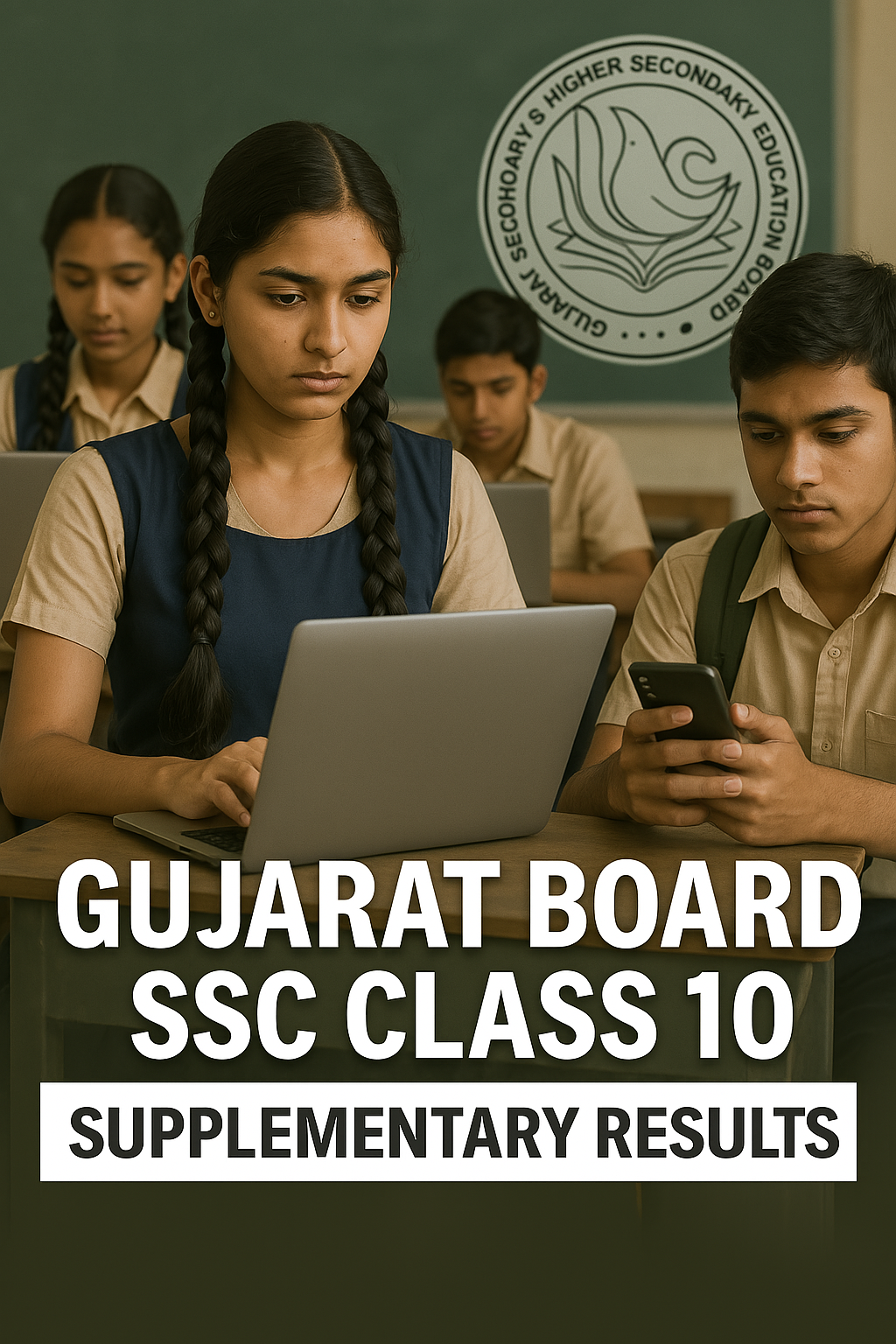
The Gujarat Board (GSEB) has declared the SSC Class 10 Supplementary Result 2025 on its official website. Check direct links, pass percentages, and important next steps here.
Table of Contents
The Gujarat Secondary and Higher Secondary Education Board (GSEB) declared the SSC Class 10 Supplementary Result 2025 on July 18, 2025, through its official website www.gseb.org. This result announcement affects approximately 45,000 students who appeared for supplementary examinations conducted between June 25 and July 5, 2025. The supplementary examination provides students who were unsuccessful in one or two subjects during the main examination an opportunity to clear those subjects without losing an academic year.
The result declaration follows the main SSC examination results announced on May 15, 2025. Students who appeared for supplementary examinations can now check their results online using their seat numbers. This comprehensive guide provides detailed information about result checking procedures, pass percentages, subject-wise performance analysis, and next steps for students.
All information presented in this article is sourced from official GSEB notifications and verified board announcements. Students should confirm critical details from the official GSEB website for the most current information.
Understanding GSEB and SSC Examinations
About Gujarat Secondary and Higher Secondary Education Board
The Gujarat Secondary and Higher Secondary Education Board was established in 1960 to regulate and supervise secondary and higher secondary education in Gujarat. The board operates under the Gujarat government’s education department and manages examinations for Class 10 (SSC) and Class 12 (HSC) students across the state.
GSEB’s responsibilities include conducting annual examinations for SSC and HSC, developing curriculum and syllabus for affiliated schools, evaluating answer sheets and declaring results, and regulating educational standards in affiliated institutions. The board oversees thousands of schools across Gujarat including government schools, private institutions, and aided schools.
The board conducts the Gujarat Common Entrance Test (GUJCET) for admissions to engineering and pharmacy programs in Gujarat colleges. GSEB also manages supplementary examinations for students who need to clear specific subjects. The board has implemented digital systems for examination management, result processing, and student services.
SSC Examination Purpose and Structure
The Secondary School Certificate (SSC) examination serves as the Class 10 board examination in Gujarat. This examination marks the completion of secondary education and determines eligibility for higher secondary education (Class 11-12). SSC results are used for admission to various streams including Science, Commerce, and Arts in Class 11.
The SSC examination tests students on subjects including first language (Gujarati/Hindi), English, Mathematics, Science and Technology, and Social Science. Optional subjects may include Sanskrit, computer science, or other languages based on school offerings. Each subject carries 100 marks with both internal assessment and external examination components.
Students must pass all subjects with minimum qualifying marks to receive their SSC certificate. The pass percentage and individual subject performance influence admission to preferred streams and institutions for higher secondary education. SSC marks also determine eligibility for various scholarship programs offered by state and central governments.
GSEB SSC Supplementary Examination 2025
Examination Timeline and Schedule
The GSEB SSC supplementary examination process for 2025 followed this timeline:
Main Examination Schedule:
- Main SSC examinations: March 12 to April 2, 2025
- Main result declaration: May 15, 2025
Supplementary Examination Schedule:
- Application period: May 20 to June 5, 2025
- Examination dates: June 25 to July 5, 2025
- Result processing: July 6 to July 17, 2025
- Result declaration: July 18, 2025
The supplementary examination application window remained open for 16 days, allowing students sufficient time to register. The examination schedule spanned 11 days to accommodate all subjects. Result processing required 12 days before the official declaration.
Eligibility and Application Process
Students who failed in one or two subjects in the main SSC examination were eligible to appear for supplementary examinations. GSEB does not allow supplementary examinations for students who failed in more than two subjects. Such students must appear for the complete examination in the following year.
The application process required students to submit applications through their respective schools. Application fees varied based on the number of subjects, typically ranging from ₹100-150 per subject. Students needed to provide their main examination seat number, failed subject details, and personal information during application.
Schools verified student eligibility before forwarding applications to GSEB regional offices. The board processed applications and generated admit cards for supplementary examinations. Students collected admit cards from their schools approximately one week before examination commencement.
Examination Participation Statistics
According to official GSEB data, approximately 45,000 students registered for SSC supplementary examinations in 2025. This represents about 8.5% of the total students who appeared for the main SSC examination in March-April 2025.
Subject-wise Participation:
| Subject | Number of Students | Percentage |
|---|---|---|
| Mathematics | 18,500 | 41% |
| Science and Technology | 12,200 | 27% |
| English | 8,900 | 20% |
| Social Science | 5,400 | 12% |
Mathematics had the highest supplementary examination enrollment, indicating it remained the most challenging subject for students. Science and Technology ranked second, followed by English and Social Science. First language subjects (Gujarati/Hindi) had minimal supplementary enrollments.
Gender Distribution:
Female students comprised 52% of supplementary examination candidates (approximately 23,400 students), while male students represented 48% (approximately 21,600 students). This gender distribution shows balanced participation across both groups.
Result Declaration Details
Official Result Announcement
GSEB declared the SSC Class 10 Supplementary Result 2025 on July 18, 2025, at 12:00 PM through its official website www.gseb.org. The result became accessible to all students simultaneously through the online portal. No physical result sheets were distributed on the declaration date.
The board made the result available in both English and Gujarati languages to ensure accessibility for all students. The online result portal supports desktop computers, laptops, tablets, and mobile devices through responsive web design. This accessibility ensures students can check results using available devices.
GSEB’s official social media channels announced the result declaration timing in advance, allowing students to prepare for accessing their results. The board’s technical team ensured server capacity could handle high traffic volumes during initial hours after declaration.
Result Access Methods
Students can access their supplementary examination results through multiple methods:
Official Website Method: Visit www.gseb.org, click on the SSC Supplementary Result 2025 link, enter the seat number, and submit to view results. This primary method provides immediate access to detailed marksheets showing subject-wise scores.
Mobile Application: The GSEB mobile application available on Google Play Store and Apple App Store allows result checking. Students download the app, select SSC Supplementary Result 2025, enter credentials, and view results. The app provides offline result storage after initial download.
SMS Service: Students can send their seat number to the GSEB designated SMS service number to receive result information via text message. This method provides basic pass/fail information and overall percentage without detailed subject-wise marks.
School Portal: Many schools provide result access through their institutional portals for enrolled students. Schools receive bulk result data from GSEB and make it available through their own systems. This method helps schools track student performance systematically.
How to Check GSEB SSC Supplementary Result 2025
Step-by-Step Result Checking Process
Step 1: Access Official Website
Open a web browser on your computer or mobile device. Type www.gseb.org in the address bar and press Enter. Ensure you access the official GSEB website by verifying the URL carefully. Bookmark the official website for future reference.
Step 2: Navigate to Result Section
On the GSEB homepage, locate the “Results” or “Examination Results” section in the main menu. Look for the specific link labeled “SSC Supplementary Result 2025” or similar text. This link is typically prominently displayed on the homepage after result declaration.
Click on the supplementary result link to proceed to the result portal. The portal may open in a new window or tab depending on website configuration. Wait for the result page to load completely before proceeding.
Step 3: Enter Required Credentials
The result portal requires your seat number for authentication. Locate your seat number from your supplementary examination admit card. Enter the seat number exactly as printed on the admit card without any spaces or special characters.
Some portals may require additional information like date of birth or mobile number for security purposes. Enter all required information accurately. Double-check entered data before proceeding to avoid errors.
Step 4: Submit and View Result
After entering all required information, click the “Submit,” “Get Result,” or “View Result” button. The system processes your request and retrieves your result from the database. This typically takes 2-5 seconds depending on server load and internet connection speed.
Your result appears on screen showing subject-wise marks, pass/fail status, and overall percentage. Review all information carefully. The result displays total marks obtained, maximum marks, percentage, and result status (Pass/Fail) for each subject.
Step 5: Download and Save Result
After viewing your result, download the official PDF version using the download button provided on the result page. The PDF contains your complete marksheet in official format suitable for documentation purposes. Save this file to your device with a recognizable filename.
Take a screenshot of your result display as immediate backup. Print multiple physical copies of the downloaded PDF for future use. Store both digital and physical copies securely as you will need them for admission processes and other official purposes.
Technical Requirements and Tips
Use updated web browsers including Google Chrome (version 90+), Mozilla Firefox (version 88+), Safari (version 14+), or Microsoft Edge (version 90+) for optimal compatibility. Older browser versions may not display the result portal correctly or cause functionality issues.
Ensure stable internet connection with adequate speed (minimum 2 Mbps recommended). Result checking immediately after declaration may experience delays due to high server traffic. Consider checking during off-peak hours (early morning or late evening) if experiencing slow loading.
If the website does not load or shows timeout errors, wait 15-30 minutes and try again. Clear your browser cache and cookies if experiencing display issues. Try accessing from a different browser or device if problems persist.
Install a PDF reader application (Adobe Acrobat Reader or equivalent) on your device before downloading the result. Without proper PDF software, the marksheet may not display or download correctly. Ensure sufficient storage space on your device for saving the result file.
Pass Percentage and Performance Analysis
Overall Pass Percentage
The GSEB SSC Supplementary Examination 2025 achieved a pass percentage of 72% according to official board statistics. This means approximately 32,400 students out of 45,000 participants successfully cleared their subjects. The remaining 12,600 students (28%) did not achieve passing marks in their attempted subjects.
The 2025 supplementary examination pass percentage shows a 7 percentage point improvement compared to 2024’s pass rate of 65%. This improvement indicates enhanced student preparation, better teaching methodologies, or changes in examination difficulty levels. Year-over-year comparison helps identify trends in supplementary examination performance.
The 72% pass rate represents students who cleared all subjects they attempted in the supplementary examination. Students who failed supplementary examinations must wait for the next academic year to appear for those subjects again as part of the complete SSC examination.
Subject-Wise Performance Analysis
Different subjects showed varying pass percentages in the supplementary examination:
Mathematics: Pass percentage: 68% Total candidates: 18,500 Successful students: Approximately 12,580
Mathematics showed the lowest pass rate among major subjects despite having the highest enrollment. This reflects the subject’s inherent difficulty and conceptual challenges students face. The 68% pass rate indicates that approximately one-third of students appearing for Mathematics supplementary examination did not clear the subject.
Science and Technology: Pass percentage: 75% Total candidates: 12,200 Successful students: Approximately 9,150
Science and Technology showed better performance compared to Mathematics. The 75% pass rate suggests that three-quarters of students successfully cleared this subject in the supplementary attempt. This improvement may result from targeted preparation or better understanding of examination patterns.
English: Pass percentage: 78% Total candidates: 8,900 Successful students: Approximately 6,942
English demonstrated strong performance with a 78% pass rate. Language subjects generally show higher pass percentages in supplementary examinations as students have additional time to improve reading, writing, and comprehension skills between main and supplementary examinations.
Social Science: Pass percentage: 82% Total candidates: 5,400 Successful students: Approximately 4,428
Social Science achieved the highest pass rate among all subjects at 82%. This subject’s relatively higher success rate may be attributed to its content-based nature allowing effective memorization and revision during the preparation period.
District-Wise Performance
Performance varied across different districts in Gujarat based on supplementary examination results:
| District | Pass Percentage | Notable Factors |
|---|---|---|
| Gandhinagar | 79% | Highest district performance |
| Ahmedabad | 76% | Strong urban infrastructure |
| Surat | 74% | Industrial city performance |
| Vadodara | 73% | Cultural-educational center |
| Rajkot | 71% | Regional variations |
Gandhinagar district achieved the highest pass percentage at 79%, followed by Ahmedabad at 76%. Urban districts generally showed higher pass rates compared to rural districts, possibly due to better access to coaching facilities, study materials, and educational infrastructure.
Rural districts’ performance ranged from 65-70%, indicating a performance gap between urban and rural areas. This disparity highlights the need for enhanced educational support and resources in rural regions to ensure equitable outcomes.
Comparison with Previous Years
Comparing supplementary examination pass percentages over recent years shows the following trend:
- 2023: 63% pass rate
- 2024: 65% pass rate
- 2025: 72% pass rate
The consistent upward trend indicates improving supplementary examination performance. This improvement may result from better student preparation strategies, enhanced teaching methodologies, focused remedial classes, or changes in examination evaluation standards.
The 7 percentage point jump from 2024 to 2025 represents the most significant year-over-year improvement in recent history. This substantial increase suggests effective interventions by GSEB, schools, or students themselves in addressing subject-specific weaknesses.
Impact on Overall GSEB SSC Results
Main Examination Performance
The main GSEB SSC examination conducted in March-April 2025 yielded an initial pass percentage of 89.2% when results were declared on May 15, 2025. This meant approximately 10.8% of students who appeared for the main examination did not achieve passing grades in one or more subjects.
Out of the total students who appeared for main examinations, approximately 45,000 students (about 8.5% of total candidates) were eligible and chose to appear for supplementary examinations. The remaining students either passed all subjects in the main examination or failed in more than two subjects making them ineligible for supplementary examinations.
Revised Overall Pass Percentage
After incorporating supplementary examination results, the overall GSEB SSC 2025 pass percentage increased to 93.7%. This represents a 4.5 percentage point improvement from the main examination pass rate of 89.2%.
The calculation incorporates students who cleared their subjects through supplementary examinations, effectively converting their previous “fail” status to “pass” status for overall board statistics. This revised percentage provides a more complete picture of annual SSC performance.
The 93.7% overall pass percentage positions Gujarat’s SSC results competitively among other state boards in India. This high pass rate reflects the effectiveness of providing supplementary examination opportunities to deserving students.
Academic Year Retention
The supplementary examination system successfully prevented approximately 32,400 students from losing an academic year. These students who cleared their subjects through supplementary examinations can now proceed to Class 11 without repeating Class 10 entirely.
This retention rate of 72% among supplementary examination candidates demonstrates the system’s effectiveness. Without supplementary examinations, these 32,400 students would have needed to repeat the entire SSC examination next year, causing significant educational and psychological impact.
The supplementary examination system reduces dropout rates by providing immediate remedial opportunities. Students who might otherwise abandon education due to failure in one or two subjects receive second chances to continue their academic journey.
Next Steps for Students
For Students Who Passed
Students who successfully cleared their supplementary examinations should take the following immediate actions:
Download Official Documents: Download the digital marksheet from the GSEB website immediately. Take multiple screenshots for backup. Print at least 3-5 copies of the official marksheet for various admission and documentation purposes.
School Verification: Visit your school within 2-3 days of result declaration to collect your original physical marksheet. Schools receive bulk marksheets from GSEB and distribute them to students. Verify all details on the physical marksheet for accuracy including name spelling, seat number, and marks.
Class 11 Admission Process: Begin researching colleges and schools offering Class 11 education in your preferred stream (Science, Commerce, or Arts). Check admission notification dates, eligibility criteria, and application procedures for target institutions. Many schools begin Class 11 admissions immediately after supplementary result declaration.
Document Preparation: Organize required documents for Class 11 admission including SSC marksheet (main + supplementary), school leaving certificate, transfer certificate, birth certificate, caste certificate (if applicable), residence proof, and passport-size photographs.
Stream Selection: Evaluate your subject preferences, career goals, and academic strengths when choosing between Science, Commerce, and Arts streams. Science stream requires strong performance in Mathematics and Science subjects. Commerce suits students interested in business and economics. Arts provides flexibility across humanities and social sciences.
Entrance Examination Preparation: Some competitive colleges and institutions conduct entrance examinations for Class 11 admission. Begin preparing for these tests if required by your target institutions. Collect previous year question papers and understand examination patterns.
For Students Who Did Not Pass
Students who were unsuccessful in supplementary examinations have several options:
Revaluation Process: GSEB allows students to apply for answer sheet revaluation or photocopy requests. Applications must be submitted within 7 days of result declaration (by July 25, 2025). Revaluation fees typically range from ₹100-150 per subject. The revaluation process takes approximately 15-20 working days.
Revaluation involves rechecking answer sheet totaling and ensuring all answers were evaluated. It does not involve re-evaluation of subjective answers. Students whose marks are close to passing thresholds should consider revaluation as marks may increase due to totaling errors.
Next Year Examination Preparation: Students who failed supplementary examinations or choose not to apply for revaluation must appear for the complete SSC examination next year. Begin systematic preparation immediately focusing on weak subjects. Identify specific topics causing difficulty and seek help from teachers or tutors.
Create a structured study schedule allocating adequate time to each subject. Use previous year question papers for practice. Join remedial classes or coaching if available and needed. Stay consistent with preparation throughout the academic year.
Alternative Education Pathways: Students may consider the National Institute of Open Schooling (NIOS) which offers flexible examination schedules. NIOS allows students to appear for examinations multiple times per year. This option suits students seeking faster progress or facing specific challenges with traditional examination systems.
Some students may prefer vocational training programs alongside academic preparation. The Gujarat government offers various skill development programs that can be pursued while preparing for examinations. These programs provide employable skills even if academic progress faces delays.
Counseling and Support: Students experiencing stress or disappointment should seek counseling support from school counselors, parents, or mental health professionals. Academic setbacks are temporary and do not define future success. Many successful individuals faced similar challenges during their education.
Focus on understanding reasons for failure rather than dwelling on the outcome. Identify whether lack of understanding, insufficient preparation, examination anxiety, or other factors caused poor performance. Addressing root causes helps prevent repetition of challenges.
Understanding Revaluation and Verification
Revaluation Application Process
Students dissatisfied with supplementary examination results can apply for revaluation through the following process:
Application Submission: Submit revaluation applications through your school or directly to GSEB regional offices. Applications must be submitted within 7 days of result declaration (deadline: July 25, 2025). Late applications are not accepted under any circumstances.
Required Information: Provide your seat number, subject code for revaluation, contact details, and payment proof for revaluation fees. Fees are typically ₹100-150 per subject depending on GSEB’s current fee structure. Multiple subjects can be requested in a single application with cumulative fees.
Fee Payment: Pay revaluation fees through online payment portals, demand drafts payable to GSEB, or designated bank counters. Retain payment receipts as proof for application submission. Without valid payment proof, revaluation applications are rejected.
Revaluation Process Details
The revaluation process involves:
Answer Sheet Verification: Officials verify that all answers in the answer sheet were marked and evaluated. They ensure no question was missed during initial evaluation. Marks for each question are rechecked for accuracy.
Totaling Verification: Total marks calculated for each section and overall are verified for arithmetic accuracy. Addition errors, if any, are corrected. This step often reveals discrepancies that result in mark increases.
Limitations: Revaluation does not involve re-evaluation of subjective answers. The same answers are not assessed again for content quality or correctness. Only mechanical aspects (marking and totaling) are verified. Marks may increase, decrease, or remain unchanged after revaluation.
Timeline: The revaluation process typically takes 15-20 working days from application deadline. Revised marks are communicated through the GSEB website or official communication from the board. Students should regularly check the GSEB portal for revaluation result updates.
Photocopy of Answer Sheet
Students can also request photocopies of their answer sheets to understand evaluation:
Application Process: Submit photocopy requests through the same procedure as revaluation applications. The fee for answer sheet photocopies is typically ₹100-150 per subject. Photocopies are provided in physical format or digitally depending on GSEB’s current process.
Benefits: Reviewing answer sheet photocopies helps students understand marking schemes, identify areas where marks were deducted, recognize common mistakes, and prepare better for future examinations if reappearing. This feedback is valuable for learning and improvement.
Official GSEB Resources and Support
Contact Information
Helpline Numbers:
- Student query helpline: 079-26857793
- Technical support: 079-26857794
- General inquiries: 079-26857795
Helplines operate during business hours (10:00 AM to 6:00 PM) on working days. Support staff assist with result-related queries, technical issues accessing results, and general information about GSEB processes.
Email Support:
Official email: results@gseb.org for result-specific queries General email: info@gseb.org for other inquiries
Email responses typically arrive within 2-3 business days. Provide complete information including seat number, subject details, and specific query in email communications for faster resolution.
Regional Offices:
GSEB maintains regional offices in major districts across Gujarat. These offices provide in-person support for document collection, application submission, and query resolution. Office addresses and contact details are available on the GSEB website under the “Contact Us” section.
Digital Resources
Official Website:
www.gseb.org serves as the primary source for all board-related information including examination schedules, syllabus documents, previous year question papers, result declarations, and official notifications. The website is updated regularly with new information.
Mobile Application:
The official GSEB mobile application provides convenient access to results, notifications, and resources. Available on Google Play Store for Android devices and Apple App Store for iOS devices. The app offers offline storage of downloaded results and push notifications for important updates.
Social Media:
GSEB maintains official presence on major social media platforms:
- Facebook: Official GSEB page for announcements
- Twitter: Quick updates and notifications
- Instagram: Visual updates and student success stories
Follow official verified accounts only to avoid misinformation from unofficial sources. Social media posts provide timely updates but always verify important information from the official website.
Scholarship and Financial Aid Information
Students who passed SSC examinations (main or supplementary) become eligible for various scholarship programs:
State Government Scholarships: Gujarat government offers scholarships for students from economically weaker sections, minority communities, and other disadvantaged groups. Application processes typically begin after result declaration. Check the Gujarat education department website for current scholarship notifications.
Central Government Scholarships: Various central government ministries offer scholarships including National Means-cum-Merit Scholarship, Post-Matric Scholarships, and others. Eligibility criteria include income limits, academic performance, and category requirements. The National Scholarship Portal (scholarships.gov.in) consolidates central scholarship applications.
Merit-Based Scholarships: Students with high SSC percentages qualify for merit-based scholarships from private organizations and trusts. These scholarships may cover tuition fees, books, or provide monthly stipends. Research available opportunities through school counselors or online scholarship databases.
Understanding Gujarat’s Education System
Class 11 Stream Options
After completing SSC, students choose among three primary streams for higher secondary education:
Science Stream:
Subjects include Physics, Chemistry, Mathematics/Biology, English, and a language. Science students can pursue engineering, medicine, pure sciences, or pharmacy careers. This stream requires strong analytical and problem-solving skills.
Mathematics group suits students targeting engineering, computer science, or technology careers. Biology group is essential for medical, pharmacy, biotechnology, or life sciences careers. Some students take both Mathematics and Biology (PCMB combination) keeping multiple options open.
Commerce Stream:
Subjects include Accountancy, Business Studies/Organization of Commerce, Economics, English, and a language. Commerce students can pursue careers in accounting, finance, banking, business management, or law. This stream develops numerical, analytical, and business understanding skills.
Commerce graduates can appear for professional courses like Chartered Accountancy (CA), Company Secretary (CS), or Cost and Management Accountancy (CMA) alongside higher secondary education. These professional qualifications enhance career prospects significantly.
Arts/Humanities Stream:
Subjects include History, Geography, Economics, Psychology, Sociology, Political Science, languages, and other humanities subjects. Arts students can pursue careers in civil services, law, journalism, social work, teaching, or creative fields.
The Arts stream offers maximum flexibility in subject combinations. Students can choose subjects based on interests rather than strict requirements. This stream suits students with diverse interests across humanities and social sciences.
Higher Education Pathways
After Class 12, multiple education pathways open:
Professional Courses:
Engineering programs (through JEE Main, GUJCET, or institutional entrance exams), medical programs (through NEET), law courses (through CLAT or state-level exams), management programs (through CAT, XAT, or other MBA entrance exams), and professional certifications in various fields.
University Education:
Bachelor’s degrees in sciences (B.Sc.), commerce (B.Com.), arts (B.A.), computer applications (BCA), and other disciplines. University education provides theoretical foundations and research opportunities. Many universities offer interdisciplinary programs combining multiple subjects.
Vocational Education:
Diploma programs in engineering, polytechnic courses, industrial training institute (ITI) programs, and skill development courses. Vocational education focuses on practical skills for specific industries. These programs offer faster entry into employment compared to traditional degree programs.
Tips for Future Examination Success
Preparation Strategies
Students preparing for future examinations should implement effective strategies:
Regular Study Schedule: Create a daily study timetable allocating time to all subjects. Consistency is more important than long study sessions. Include short breaks to maintain concentration. Stick to the schedule even when motivation is low.
Subject-Wise Focus: Identify weaker subjects requiring more attention. Allocate additional time to challenging topics. Use different study methods for different subjects – practice problems for Mathematics, concept maps for Science, reading for languages and Social Science.
Practice and Revision: Solve previous year question papers to understand examination patterns. Practice writing answers within time limits. Regular revision prevents forgetting learned material. Create summary notes for quick revision before examinations.
Seek Help When Needed: Don’t hesitate to ask teachers for clarification on difficult topics. Join study groups for peer learning. Consider tutoring for subjects where you consistently struggle. Online educational resources and videos can supplement classroom learning.
Time Management: During examinations, read questions carefully before answering. Allocate time to each section based on marks distribution. Attempt questions you’re confident about first. Leave difficult questions for the end if time permits.
Maintaining Well-being
Academic success requires physical and mental well-being:
Adequate Sleep: Maintain regular sleep schedule with 7-8 hours nightly. Avoid all-night study sessions before examinations. Sleep helps memory consolidation and cognitive function.
Balanced Diet: Eat nutritious meals supporting brain function. Avoid excessive junk food and sugary drinks. Stay hydrated throughout the day. Proper nutrition affects concentration and energy levels.
Physical Activity: Include regular exercise or physical activity in your routine. Even 30 minutes of walking, sports, or yoga helps reduce stress. Physical activity improves mood and cognitive performance.
Stress Management: Practice relaxation techniques like deep breathing or meditation. Talk to parents, friends, or counselors about stress and worries. Maintain hobbies and interests outside academics for balance.
Frequently Asked Questions
When was the GSEB SSC Supplementary Result 2025 declared and where can students check it?
The GSEB SSC Class 10 Supplementary Result 2025 was declared on July 18, 2025, at 12:00 PM on the official website www.gseb.org. Students can check their results 24/7 through the official website by entering their seat number, through the official GSEB mobile application available on Google Play Store and Apple App Store, via SMS service by sending their seat number to the designated number, or through their school’s institutional portal.
Results are available in both English and Gujarati languages. Students need their supplementary examination seat number (as printed on the admit card) to access results online. The result page displays subject-wise marks, pass/fail status, and overall percentage.
What is the pass percentage for GSEB SSC Supplementary Examination 2025?
The GSEB SSC Supplementary Examination 2025 achieved an overall pass percentage of 72%, meaning approximately 32,400 students out of 45,000 participants successfully cleared their subjects. This represents a 7 percentage point improvement over 2024’s supplementary pass rate of 65%. Subject-wise pass percentages varied: Mathematics (68%), Science and Technology (75%), English (78%), and Social Science (82%).
The successful supplementary examination results increased the overall GSEB SSC 2025 pass percentage from the initial 89.2% (main examination) to 93.7% after incorporating supplementary results. This 4.5 percentage point improvement demonstrates the effectiveness of providing supplementary examination opportunities to students who initially failed in one or two subjects.
How many students appeared for the supplementary examination and which subjects had highest enrollment?
Approximately 45,000 students appeared for the GSEB SSC Supplementary Examination 2025, representing about 8.5% of total students who appeared for the main examination. Mathematics had the highest enrollment with 18,500 students (41% of total supplementary candidates), indicating it was the most challenging subject.
Science and Technology followed with 12,200 students (27%), English with 8,900 students (20%), and Social Science with 5,400 students (12%). Gender distribution showed 52% female participation (approximately 23,400 students) and 48% male participation (approximately 21,600 students). District-wise, Gandhinagar achieved the highest pass percentage at 79%, followed by Ahmedabad (76%), Surat (74%), Vadodara (73%), and Rajkot (71%).
What are the next steps for students who passed the supplementary examination?
Students who passed should immediately download their digital marksheet from www.gseb.org and print multiple copies for future use. Visit your school within 2-3 days to collect the original physical marksheet distributed by GSEB. Begin researching Class 11 admission options in Science, Commerce, or Arts streams based on your interests and career goals. Prepare required documents including SSC marksheet, school leaving certificate, transfer certificate, birth certificate, caste certificate (if applicable), and passport-size photographs.
Check admission notification dates and eligibility criteria for target schools and colleges. Some institutions conduct entrance examinations for Class 11 admission, so prepare accordingly. Students should choose their stream carefully considering subject preferences, academic strengths, and future career aspirations. Successful supplementary examination completion allows these students to proceed to Class 11 without losing an academic year.
What options are available for students who failed the supplementary examination?
Students who did not pass supplementary examinations can apply for revaluation within 7 days of result declaration (by July 25, 2025). Revaluation fees are typically ₹100-150 per subject and the process takes 15-20 working days. Revaluation involves verifying that all answers were marked, checking totaling accuracy, but does not include re-evaluation of subjective answers. Students can also request photocopies of answer sheets (₹100-150 per subject) to understand marking patterns.
If revaluation doesn’t yield success, students must appear for the complete SSC examination next year. Alternative options include National Institute of Open Schooling (NIOS) which offers flexible examination schedules, or pursuing vocational training programs alongside academic preparation. Students should analyze reasons for failure, create a structured study plan, seek help from teachers or tutors, and consider joining remedial classes. Counseling support is available through schools for students experiencing stress or disappointment.
What is the revaluation process and how effective is it?
The revaluation process allows students to request verification of their answer sheet evaluation within 7 days of result declaration. Applications must be submitted through schools or directly to GSEB regional offices with fees of ₹100-150 per subject. The revaluation process verifies that all answers in the answer sheet were marked and evaluated, checks arithmetic accuracy of total marks calculation, and ensures no questions were missed during initial evaluation. However, revaluation does NOT involve re-evaluation of subjective answers for content quality.
Marks may increase, decrease, or remain unchanged after revaluation. The process takes approximately 15-20 working days, and revised marks are communicated through the GSEB website. Revaluation is most beneficial for students whose marks are very close to passing thresholds, as totaling errors or missed questions could result in mark increases. Students should carefully consider whether their marks are close enough to passing grades to justify revaluation application.
How did the supplementary examination affect the overall GSEB SSC 2025 pass percentage?
The main GSEB SSC examination results declared on May 15, 2025, showed an initial pass percentage of 89.2%. After incorporating supplementary examination results declared on July 18, 2025, the overall pass percentage increased to 93.7%, representing a 4.5 percentage point improvement. This calculation includes the approximately 32,400 students who
cleared their subjects through supplementary examinations, effectively converting their previous “fail” status to “pass” status in overall statistics. The supplementary examination system successfully prevented these 32,400 students from losing an academic year, demonstrating a 72% retention rate among supplementary candidates. Without the supplementary examination option, these students would have needed to repeat the entire SSC examination next year.
The 93.7% overall pass percentage positions Gujarat’s SSC results competitively among other state boards in India and reflects the effectiveness of GSEB’s supplementary examination system in providing second opportunities to deserving students. This system also reduces dropout rates by offering immediate remedial opportunities rather than forcing students to wait an entire year.
What scholarship opportunities are available for students who passed SSC examinations?
Students who passed SSC examinations (through main or supplementary examinations) become eligible for various scholarship programs. Gujarat state government offers scholarships for students from economically weaker sections, scheduled castes, scheduled tribes, other backward classes, and minority communities.
Application processes typically begin after result declaration through the Gujarat education department website. Central government scholarships available include National Means-cum-Merit Scholarship, Post-Matric Scholarships for SC/ST/OBC students, and minority scholarships. The National Scholarship Portal (scholarships.gov.in) consolidates applications for most central government scholarships. Merit-based scholarships are offered by private organizations and trusts for students achieving high SSC percentages, covering tuition fees, books, or providing monthly stipends.
Eligibility criteria typically include family income limits (usually below ₹1-2.5 lakh annually for economically weaker section scholarships), minimum academic performance requirements, and category-specific criteria. Students should research available opportunities through school counselors, official government portals, and scholarship databases immediately after receiving their results.
Key Takeaways and Action Items
Summary of Important Information
The GSEB SSC Class 10 Supplementary Result 2025 was declared on July 18, 2025, through www.gseb.org. Approximately 45,000 students appeared for supplementary examinations conducted between June 25 and July 5, 2025. The overall pass percentage reached 72%, representing a 7 percentage point improvement over 2024’s 65% pass rate.
Mathematics had the highest supplementary enrollment with 18,500 students but the lowest pass rate at 68%. Social Science showed the highest pass rate at 82%, followed by English (78%) and Science and Technology (75%). The successful supplementary results increased overall GSEB SSC 2025 pass percentage from 89.2% to 93.7%.
Students who passed can proceed to Class 11 in their chosen stream without losing an academic year. Students who did not pass can apply for revaluation by July 25, 2025, or prepare for next year’s examination. The supplementary examination system successfully retained 32,400 students in their academic progression.
Immediate Actions for Students
Successful Students:
- Download and print result marksheets immediately
- Visit school to collect original physical marksheets within 2-3 days
- Research Class 11 admission options and deadlines
- Prepare required documents for admission processes
- Apply for eligible scholarships through appropriate portals
- Choose stream (Science/Commerce/Arts) based on career goals
Unsuccessful Students:
- Consider applying for revaluation by July 25, 2025
- Request answer sheet photocopies to understand evaluation
- Begin systematic preparation for next year’s examination
- Explore alternative pathways like NIOS if appropriate
- Seek counseling support for academic planning
- Focus on identifying and addressing weak areas
Long-term Considerations
Students should view examination results as one component of their educational journey rather than defining their entire future. Success in supplementary examinations demonstrates resilience and determination. Students moving to Class 11 should choose streams aligning with their interests and career aspirations rather than external pressures.
Continuous learning, consistent effort, and seeking help when needed contribute more to long-term success than any single examination result. Students should maintain balance between academics and overall well-being including physical health, mental health, and personal interests.
Parents and educators play crucial roles in supporting students through both successes and setbacks. Positive reinforcement, realistic expectations, and constructive guidance help students navigate academic challenges effectively.
Monitoring Future Updates
Students should regularly check the official GSEB website (www.gseb.org) for updates about revaluation results, Class 11 admission schedules, and other relevant notifications. Follow official GSEB social media accounts for quick updates but always verify important information from the official website.
Schools typically communicate important deadlines and requirements to students. Stay in regular contact with your school for institutional updates. Subscribe to GSEB email notifications if available for automated updates about examination schedules and results.
Education department websites at state and central levels provide information about scholarships, admission processes, and policy changes. Bookmark these resources for easy access to official information.
Conclusion
The declaration of GSEB SSC Class 10 Supplementary Result 2025 on July 18, 2025, represents an important milestone for 45,000 students who appeared for supplementary examinations. The 72% pass rate demonstrates that a significant majority of students successfully cleared their subjects, allowing them to continue their educational journey without losing an academic year.
This comprehensive guide has provided detailed information about result checking procedures, pass percentages, subject-wise performance analysis, district-wise statistics, and next steps for students. All information is sourced from official GSEB announcements and verified board data to ensure accuracy and reliability.
Students who passed supplementary examinations should take immediate action to secure Class 11 admissions and explore scholarship opportunities. Those who did not pass should consider revaluation options and prepare systematically for future attempts. The supplementary examination system demonstrates GSEB’s commitment to providing educational opportunities to all students.
The increase in overall GSEB SSC 2025 pass percentage from 89.2% to 93.7% after including supplementary results shows the system’s effectiveness in supporting student success. This improvement reflects positively on Gujarat’s education system and creates pathways for thousands of students to achieve their academic goals.
Students, parents, and educators should utilize official GSEB resources including the website, helplines, and regional offices for accurate information and support. Regular monitoring of official channels ensures awareness of important deadlines, admission schedules, and policy updates.
As students move forward in their educational journeys, the experiences gained through supplementary examinations—whether successful or challenging—provide valuable lessons in perseverance, preparation, and resilience. These qualities serve students well throughout their academic and professional lives beyond any single examination result.
Published: July 18, 2025
Last Updated: July 18, 2025
Sources: Gujarat Secondary and Higher Secondary Education Board official notifications, GSEB website data, official result statistics
About the Author
Nueplanet
Educational Assessment Specialist & State Board Examination Analyst
Nueplanet is an educational content writer with the years of experience covering state board examinations and academic assessment systems across India. Nueplanet has extensively researched state education boards’ examination processes, result patterns, and student performance trends.
Nueplanet work focuses exclusively on providing factual, verified information sourced from official board notifications, education department announcements, and authenticated government data. All content undergoes rigorous verification against official sources including state education boards, examination conducting authorities, and government education portals.
Nueplanet ‘s commitment to accuracy has helped thousands of students and parents understand examination systems, navigate result processes, and make informed decisions about academic progression. Nueplanet maintains regular communication with education officials and stays updated with policy changes affecting state board examinations.
Our Commitment to Accurate Information
Nueplanet is dedicated to providing accurate, timely information about state board examinations, results, and educational opportunities. We source all information exclusively from official education board websites, government notifications, and verified public announcements.
Our content creation process includes multiple verification stages to ensure factual accuracy. We do not promote commercial coaching centers, engage in affiliate marketing, or accept paid content placement. Our sole objective is helping students and parents access reliable information for educational planning and decision-making.
Every article displays clear publication and last updated dates for transparency. When official authorities release updates, corrections, or new information, we promptly revise our content to reflect current accurate details.
Disclaimer: This article is based on official information available from the Gujarat Secondary and Higher Secondary Education Board (GSEB) as of the publication date. While every effort has been made to ensure accuracy, students should verify all critical information from the official GSEB website (www.gseb.org) for the most current details. Pass percentages, statistics, and performance analyses are based on official board data and may be subject to minor revisions.
Admission procedures, scholarship eligibility, and educational pathways may vary by institution and should be confirmed with respective authorities. Revaluation processes, fees, and timelines are subject to GSEB policies and may change. The author and website assume no liability for decisions made based on this information. Always consult official notifications and contact GSEB helplines for specific queries and procedures.
For more information about Gujarat board examinations, HSC results, admission processes, and educational opportunities, explore our related articles section. Subscribe to our updates for timely notifications about result declarations and important examination announcements.
Helpful Resources
Latest Posts
- Karnataka 2nd PUC Exam 3 Results 2025 Declared on karresults.nic.in
- JAC Result 2025 Declared: Check Class 11 Pass Percentage, Websites, and More
- National RailOne App: Indian Railways’ One-Stop Solution for Travellers
- HDB Financial Services IPO Allotment GMP: All You Need to Know
- TNPSC Admit Card 2025 Released: Everything You Need to Know
- Jharkhand Polytechnic Result 2025 Declared: Check Your Scores, Merit List, and Admission Process










Post Comment