









Over 13,000 Engineering Seats Added for TNEA Counselling 2025 in Tamil Nadu
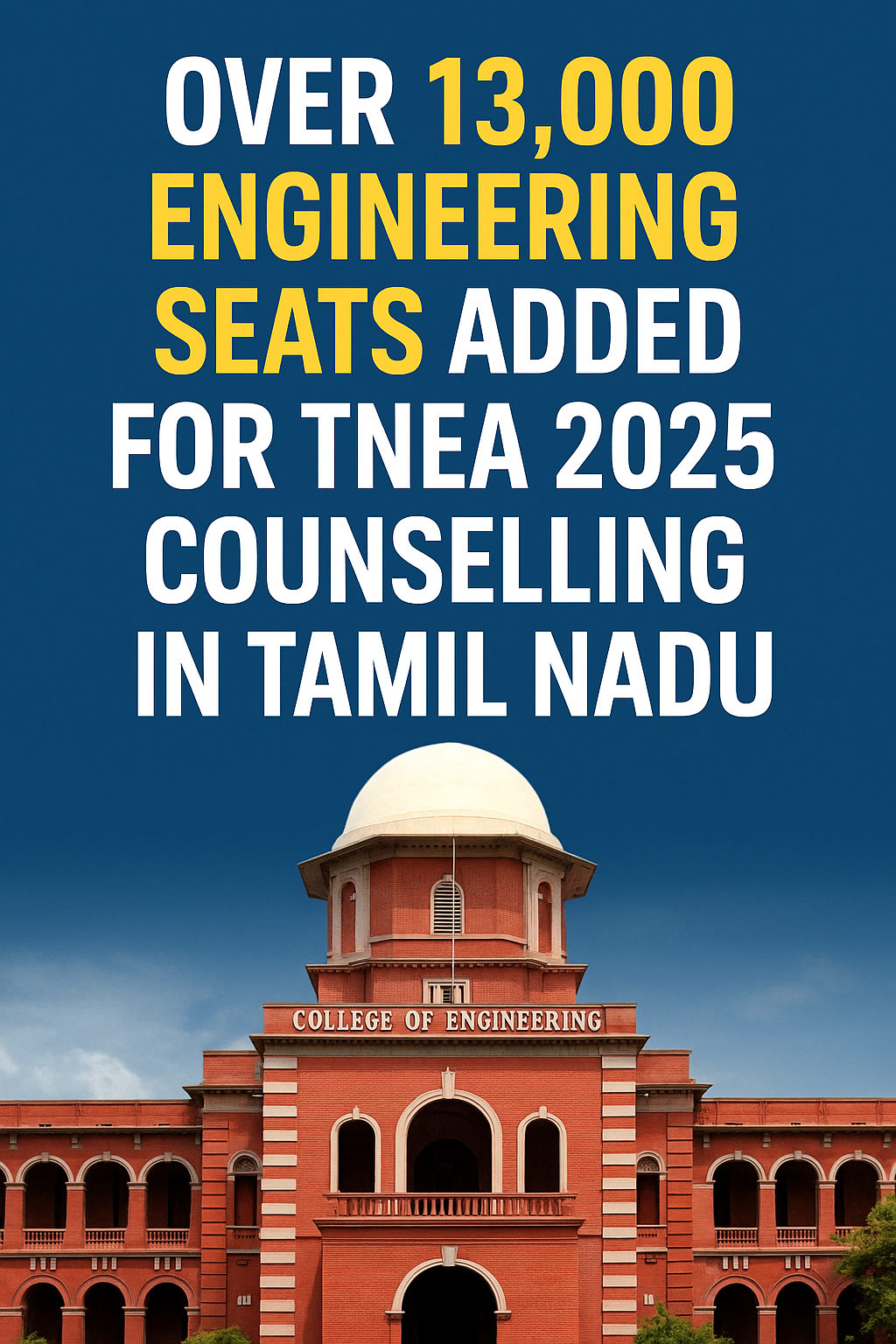
Tamil Nadu adds over 13,000 engineering seats for TNEA 2025 counselling, boosting opportunities for aspiring students. Get detailed seat distribution, counselling steps, and eligibility updates here.
Table of Contents
Introduction to TNEA 2025 Seat Expansion
The Tamil Nadu Engineering Admissions (TNEA) 2025 has announced an expansion of over 13,000 engineering seats across the state. This addition, implemented by the Directorate of Technical Education (DoTE), represents an 8.5% increase in total available seats for engineering aspirants.
The expansion brings the total seat count to approximately 1.65 lakh seats across government, government-aided, and self-financing institutions. This development aims to provide increased access to engineering education for students across Tamil Nadu.
TNEA is conducted annually by Anna University on behalf of the Tamil Nadu government. The admission system operates on a merit-based framework using Class 12 marks, eliminating the need for separate entrance examinations.
Understanding the TNEA Admission System
What is TNEA?
Tamil Nadu Engineering Admissions (TNEA) is the centralized admission system for undergraduate engineering programs in Tamil Nadu. The process is administered by Anna University under the guidance of the state government’s Directorate of Technical Education.
The system covers admissions to Bachelor of Engineering (B.E.) and Bachelor of Technology (B.Tech.) programs across all categories of engineering institutions in the state. This includes government colleges, government-aided institutions, and private self-financing colleges.
TNEA operates as a single-window system for engineering admissions. Students apply once through the centralized portal and participate in counseling rounds for seat allotment based on their merit ranking.
Key Features of TNEA Process
Merit-Based Selection: Admissions are based solely on Class 12 marks in Physics, Chemistry, and Mathematics. The system uses a normalization process to ensure fairness across different educational boards including state boards, CBSE, and ICSE.
No Entrance Examination: Unlike many other states, Tamil Nadu does not require students to take separate entrance tests for engineering admissions. This approach reduces the financial and academic burden on students and their families.
Transparent Counseling: The online counseling system allows students to fill their college and branch preferences. Seat allotment occurs through a computerized algorithm that considers merit rank, preferences, and available seats.
Details of 13,000+ Seat Addition in TNEA 2025
Overall Seat Increase Breakdown
The addition of 13,000+ engineering seats represents a significant expansion in Tamil Nadu’s engineering education capacity. This increase brings the total available seats to over 1.65 lakh for the academic year 2025-26.
The expansion is distributed across multiple engineering disciplines. Computer Science and allied branches have received substantial additions due to high industry demand and student preference.
Traditional engineering branches including Mechanical, Civil, and Electrical have also seen seat increases. This balanced approach ensures opportunities across both established and emerging technology fields.
Branch-Wise Seat Distribution
| Engineering Branch | Additional Seats (Approximate) |
|---|---|
| Mechanical Engineering | 2,800+ |
| Civil Engineering | 2,200+ |
| Electrical and Electronics Engineering | 1,900+ |
| Electronics and Communication Engineering | 1,800+ |
| Computer Science Engineering | 2,100+ |
| Information Technology | 1,200+ |
| Emerging Technologies (AI, ML, Data Science) | 1,000+ |
The allocation reflects both traditional engineering education needs and emerging technology sector requirements. Computer Science and Information Technology branches together account for approximately 3,300 new seats.
Emerging technology specializations including Artificial Intelligence, Machine Learning, and Data Science have been allocated 1,000+ seats. This addresses the growing demand for specialized technology professionals in these domains.
Institution Category-Wise Distribution
Government Colleges: Approximately 3,500 additional seats have been added to government engineering colleges. This expansion includes capacity enhancement in existing institutions and establishment of new colleges in underserved regions.
Government-Aided Colleges: Around 4,200 seats have been added to government-aided engineering institutions. These colleges operate with partial government funding and typically charge moderate fees compared to fully private institutions.
Self-Financing Private Colleges: Approximately 5,300 seats have been added to private self-financing engineering colleges. These institutions operate independently with modern infrastructure and industry partnerships.
Geographic Distribution Across Tamil Nadu
The seat expansion has been implemented across different regions of Tamil Nadu to ensure equitable access:
- Northern Tamil Nadu: 2,800+ additional seats
- Central Tamil Nadu: 3,200+ additional seats
- Southern Tamil Nadu: 2,900+ additional seats
- Western Tamil Nadu: 2,400+ additional seats
- Coastal Regions: 1,700+ additional seats
This regional distribution aims to reduce the need for students to relocate long distances for engineering education. It also supports balanced regional development through enhanced technical education infrastructure.
TNEA 2025 Eligibility Criteria
Educational Qualification Requirements
Candidates must have completed Higher Secondary Certificate (HSC) or equivalent examination from a recognized board. The qualifying examination must include Physics, Chemistry, and Mathematics as mandatory subjects.
Students who have completed 12th standard under state boards, CBSE, ICSE, or other recognized boards are eligible to apply. The educational qualification should be obtained in the academic year 2024-25 for fresh applicants.
Students who completed their 12th standard in previous years can also apply if they meet the eligibility criteria. However, preference may be given to current year passed candidates during the counseling process.
Subject-Wise Minimum Marks
General Category Requirements:
- Physics: Minimum 45% marks
- Chemistry: Minimum 45% marks
- Mathematics: Minimum 45% marks
- Aggregate of PCM: Minimum 45%
Reserved Category Requirements:
- SC/ST Candidates: Minimum 40% aggregate in Physics, Chemistry, and Mathematics
- OBC Candidates: Minimum 42% aggregate in Physics, Chemistry, and Mathematics
- Differently-abled Candidates: Minimum 40% with relaxation provisions
The minimum marks are calculated based on theory and practical marks combined for each subject. Grace marks awarded by examination boards are considered for meeting minimum eligibility requirements.
Nativity and Domicile Requirements
Tamil Nadu Domicile Criteria:
- Candidates born in Tamil Nadu with valid birth certificate documentation
- Continuous residence in Tamil Nadu for at least 8 years
- Completion of Classes 8 through 12 in Tamil Nadu educational institutions
Alternative Domicile Qualifications:
- Children of Tamil Nadu government employees posted in other states
- Children of defense personnel originally from Tamil Nadu
- Children of Tamil Nadu natives who have settled in other states (with documentary proof)
Nativity certificates must be obtained from competent authorities including Village Administrative Officers or Tahsildars. These documents are verified during the counseling and admission process.
Age Limit and Relaxations
There is no upper age limit for general category candidates applying to TNEA 2025. This provision allows students who took gap years or pursued other educational paths to apply for engineering programs.
Reserved category candidates may receive additional age relaxations according to government norms. Specific relaxations are announced in the official TNEA notification and information brochure.
TNEA 2025 Application Process
Step 1: Online Registration
Visit the official TNEA portal at tneaonline.org during the registration period. The portal is typically active from late May through late June, with exact dates announced in the official notification.
Create a candidate profile using a valid mobile number and email address. The system generates a unique application number that serves as the primary identifier throughout the admission process.
Complete the registration form with accurate personal details including name, date of birth, parent details, and contact information. Ensure all information matches supporting documents to avoid verification issues.
Step 2: Academic Details Entry
Enter Class 12 examination details including board name, roll number, and year of passing. Provide subject-wise marks for Physics, Chemistry, and Mathematics as mentioned in the mark sheet.
The system calculates the aggregate percentage and normalizes marks if applicable. Students from different boards undergo normalization to ensure fair comparison across various educational systems.
Upload a clear, legible copy of the Class 12 mark sheet in PDF format. The file size should not exceed the specified limit, typically 200-500 KB.
Step 3: Document Upload Requirements
Mandatory Documents:
- HSC or equivalent mark sheet (scanned copy)
- Recent passport-size photograph (digital format with white background)
- Candidate signature (digital format on white paper)
- Nativity or domicile certificate issued by competent authority
Additional Documents (if applicable):
- Community certificate for SC/ST/OBC candidates claiming reservation
- Income certificate for economically weaker sections
- Differently-abled certificate issued by medical board
- Sports or cultural quota certificates from recognized authorities
All documents must be uploaded in specified formats (typically JPEG or PDF) within size limits. Poor quality or illegible documents may lead to application rejection.
Step 4: Application Fee Payment
TNEA 2025 application fees vary by category. General category candidates typically pay higher fees compared to reserved category candidates who receive fee concessions.
Payment can be made through multiple modes including credit cards, debit cards, net banking, and UPI platforms. The system generates a payment receipt that should be saved for future reference.
After successful payment, the application status changes to “completed.” Candidates receive confirmation via registered email and SMS on their mobile number.
Step 5: Application Submission and Verification
Review all entered information carefully before final submission. Once submitted, most fields cannot be edited without specific correction windows announced by authorities.
Download and print the completed application form for personal records. This printed copy contains the application number and summary of entered information.
Note the application number and keep it secure for all future correspondence. This number is required for accessing rank cards, counseling participation, and admission procedures.
TNEA 2025 Important Dates and Timeline
| Event | Tentative Period | Duration |
|---|---|---|
| Official Notification Release | May 15-20, 2025 | 1 week |
| Online Registration Opens | May 28, 2025 | – |
| Online Registration Closes | June 25, 2025 | 4 weeks total |
| Document Verification Period | June 28 – July 5, 2025 | 1 week |
| Rank List Publication | July 10, 2025 | – |
| Choice Filling Opens | July 12, 2025 | – |
| Choice Filling Closes | July 18, 2025 | 1 week |
| First Round Allotment Results | July 22, 2025 | – |
| First Round Reporting | July 24-28, 2025 | 5 days |
| Second Round Allotment | August 2, 2025 | – |
| Second Round Reporting | August 4-7, 2025 | 4 days |
| Academic Session Commencement | August 15, 2025 | – |
Important Timeline Notes
Dates mentioned above are tentative and based on previous year patterns. Official dates are announced through the TNEA notification published by Anna University and DoTE.
Candidates should regularly check the official TNEA portal for date confirmations and any schedule changes. Email notifications are sent to registered email addresses for major updates.
The timeline may be adjusted based on administrative requirements or unforeseen circumstances. Following official channels ensures access to accurate, up-to-date information.
TNEA 2025 Rank Calculation Methodology
Normalization Process
TNEA uses a normalization formula to ensure fair comparison of marks across different educational boards. This process accounts for variations in difficulty levels and marking patterns among state boards, CBSE, ICSE, and other systems.
The normalization considers the highest marks scored in each subject across all boards. It also factors in the distribution of marks among candidates to create a standardized ranking system.
After normalization, all candidates are placed on a common merit scale regardless of their board of examination. This ensures that no student is advantaged or disadvantaged based on their educational board.
Subject Weightage Distribution
TNEA rank calculation assigns equal weightage to all three subjects:
- Physics: 33.33% weightage
- Chemistry: 33.33% weightage
- Mathematics: 33.33% weightage
The aggregate is calculated by combining the normalized marks of all three subjects. This equal distribution ensures comprehensive assessment of a candidate’s scientific and mathematical aptitude.
Only theory and practical marks in Physics, Chemistry, and Mathematics are considered for rank calculation. Marks in other subjects including languages do not factor into the engineering admission merit calculation.
Tie-Breaking Mechanism
When multiple candidates secure identical aggregate marks, TNEA applies a systematic tie-breaking protocol:
First Level: Mathematics marks comparison – Higher Mathematics score receives better rank
Second Level: If Mathematics marks are also equal, Physics marks are compared
Third Level: If both Mathematics and Physics marks are equal, Chemistry marks are compared
Final Level: If all three subjects have identical marks, the older candidate (by date of birth) receives preference
This transparent tie-breaking system ensures every candidate receives a unique rank position.
TNEA 2025 Counseling Process
Phase 1: Rank Card Download
After rank list publication on July 10, 2025, candidates can download their rank cards from the official portal. The rank card contains the candidate’s TNEA rank, category rank (if applicable), and other important details.
Log in to the TNEA portal using the application number and password. Navigate to the rank card section and download the PDF document.
Verify all details on the rank card including name spelling, rank position, and category. Report any discrepancies to TNEA authorities within the specified correction period.
Phase 2: Choice Filling Strategy
The choice filling window typically opens around July 12, 2025. Candidates can fill preferences for colleges and branches based on their rank and eligibility.
Recommended Approach:
Research colleges thoroughly before filling choices. Consider factors including location, infrastructure, faculty, placement records, and accreditation status.
Fill the maximum number of choices allowed (typically 200+ options). More choices increase the probability of seat allotment, especially in later counseling rounds.
Prioritize choices based on personal preferences. Decide whether branch preference or college preference is more important for your career goals.
Include diverse options across government, government-aided, and private colleges. Balance aspirational choices with realistic options based on previous year cutoffs.
Phase 3: Seat Allotment Mechanism
TNEA uses a computerized algorithm for seat allotment. The system considers candidate rank, filled preferences, seat availability, and reservation policies simultaneously.
Allotment Logic:
The algorithm processes candidates in rank order. Higher-ranked candidates are processed before lower-ranked candidates for seat allocation.
For each candidate, the system checks choices in the exact order filled. The first available seat matching the candidate’s eligibility is allotted.
Once a seat is allotted, the candidate moves out of the pool for that round. The seat is marked as provisionally occupied and not available for subsequent candidates.
Multiple Counseling Rounds
First Round: Primary allotment for all registered candidates based on their rank and choices. The highest-ranked candidates generally secure seats in their top preferences.
Second Round: Candidates who didn’t receive allotment in Round 1 participate again. Seats vacated by candidates who didn’t report or upgraded are redistributed.
Special Rounds: If applicable, additional rounds may be conducted for specific categories or to fill remaining vacant seats in participating institutions.
Phase 4: Admission Reporting
Candidates who receive seat allotment must report to the allotted college within the specified timeframe, typically 4-5 days. Failure to report results in forfeiture of the allotted seat.
Reporting Requirements:
Carry original certificates and mark sheets for verification. Institutions verify document authenticity before confirming admission.
Pay the prescribed fees through designated payment channels. Fee structure varies based on institution type (government/aided/private) and student category.
Complete admission formalities including biometric registration, medical examination (if required), and hostel allocation (if needed).
Reservation Policy in TNEA 2025
Category-Wise Reservation Breakdown
Tamil Nadu follows comprehensive reservation policies for engineering admissions:
| Category | Reservation Percentage | Special Provisions |
|---|---|---|
| Scheduled Caste (SC) | 15% | Across all institutions |
| Scheduled Tribe (ST) | 1% | With special provisions |
| Other Backward Classes (OBC) | 26.5% | In government institutions |
| Most Backward Classes (MBC/DNC) | 20% | With subcategory distributions |
| Differently-abled | 3% | Horizontal reservation |
| Sports Quota | 2% | In select institutions |
| Ex-servicemen Children | Special category | As per government norms |
Horizontal Reservation
Horizontal reservation applies across all vertical reservation categories. This means differently-abled candidates and sports quota candidates can avail benefits within their respective vertical categories (SC/ST/OBC/General).
For example, a differently-abled SC candidate can claim both SC reservation and the 3% horizontal reservation for differently-abled individuals. This dual benefit enhances opportunities for students with multiple eligible categories.
Community Certificate Requirements
Candidates claiming reservation benefits must possess valid community certificates issued by competent authorities. Certificates must be issued by Revenue Officials not below the rank of Tahsildar.
The community certificate should clearly mention the candidate’s name, parent’s name, community, and issuing authority details. Certificates issued in other states may require additional verification or endorsement from Tamil Nadu authorities.
Community certificates are verified during document verification and admission stages. Invalid or fake certificates lead to cancellation of admission and potential legal consequences.
Institution Categories and College Selection
Government Engineering Colleges
Government engineering colleges are directly operated by the Tamil Nadu government through the Directorate of Technical Education. These institutions charge minimal fees and offer high-quality education.
Notable Government Institutions:
- College of Engineering Guindy (CEG), Chennai – Anna University
- Madras Institute of Technology (MIT), Chennai – Anna University
- Government College of Engineering, Tirunelveli
- Government College of Technology, Coimbatore
Advantages:
- Highly affordable fee structure (₹25,000-50,000 annually)
- Strong placement records with established industry connections
- Research opportunities and well-qualified faculty
- Prestigious institutional reputation and alumni networks
Government-Aided Engineering Colleges
Government-aided colleges receive partial funding from the state government while maintaining private management. These institutions balance affordability with autonomous operations.
Prominent Aided Institutions:
- PSG College of Technology, Coimbatore
- Thiagarajar College of Engineering, Madurai
- Kumaraguru College of Technology, Coimbatore
Benefits:
- Moderate fee structure (₹80,000-1.5 lakhs annually)
- Quality infrastructure and experienced faculty
- Strong industry partnerships and placement support
- Active participation in technical and cultural activities
Private Self-Financing Colleges
Private self-financing institutions operate independently with modern infrastructure and industry-aligned curricula. These colleges charge higher fees but often provide contemporary facilities.
Leading Private Institutions:
- VIT University (Multiple campuses across Tamil Nadu)
- SRM Institute of Science and Technology
- Amrita Vishwa Vidyapeetham
Features:
- Modern laboratories and technology infrastructure
- International collaborations and student exchange programs
- Industry-oriented curriculum with practical training focus
- Entrepreneurship development and startup support initiatives
Fee Structure Analysis Across Institution Types
Government College Fees
Annual Cost Breakdown:
- Tuition fees: ₹25,000-40,000
- Examination fees: ₹2,000-5,000
- Library and laboratory fees: ₹3,000-8,000
- Total annual academic fees: ₹30,000-50,000
Additional Costs (if applicable):
- Hostel charges: ₹15,000-25,000 per annum
- Mess charges: ₹20,000-30,000 per annum
- Total annual cost (including hostel): ₹60,000-95,000
Government-Aided College Fees
Annual Cost Breakdown:
- Tuition fees: ₹80,000-1.2 lakhs
- Development and infrastructure fees: ₹10,000-20,000
- Examination and other fees: ₹10,000-20,000
- Total annual cost: ₹1-1.6 lakhs
Private College Fees
Annual Cost Breakdown:
- Tuition fees: ₹1.5-4 lakhs
- Development fees (one-time or annual): ₹50,000-1 lakh
- Examination and other charges: ₹20,000-50,000
- Total annual cost: ₹2-5 lakhs
Fee structures vary significantly among private institutions based on location, infrastructure, and program specialization. Urban institutions generally charge higher fees compared to rural or semi-urban colleges.
Scholarship and Financial Assistance Options
Government Scholarship Schemes
State Government Scholarships:
Tamil Nadu State Scholarship provides financial assistance to meritorious students from economically weaker sections. Eligibility is based on family income criteria and academic performance.
Post-Matric Scholarship for SC/ST students covers tuition fees and maintenance allowance. This central government scheme is implemented through the Tamil Nadu Social Welfare Department.
Minority scholarship programs support students from minority communities. These scholarships cover tuition fees partially or fully based on family income and merit.
Central Government Schemes:
National Scholarship Portal (NSP) consolidates various central government scholarship schemes. Engineering students can apply for multiple scholarships through this single platform.
Dr. Ambedkar Post-Matric Scholarship for Economically Backward Classes provides financial support based on income criteria and academic merit.
Institutional Merit Scholarships
Many private and aided colleges offer merit-based scholarships to attract high-ranking students. These scholarships can range from partial fee waivers to complete tuition fee exemptions.
Scholarship eligibility is typically based on TNEA rank, Class 12 percentage, or entrance test scores conducted by specific institutions. Criteria vary across colleges and should be verified directly with institutions.
Some colleges provide scholarships for sports achievers, cultural activity participants, and students with exceptional skills in specific domains. Documentation proving achievements is required during application.
Education Loan Facilities
Nationalized banks and private financial institutions offer education loans for engineering studies. Loans typically cover tuition fees, hostel charges, and other educational expenses.
Interest rates and repayment terms vary by institution. Many schemes offer interest subsidies for economically weaker sections during the study period.
Collateral requirements depend on loan amount. Loans up to ₹7.5 lakhs generally don’t require collateral, while higher amounts may need security or guarantors.
Branch-Wise Career Prospects and Industry Demand
Computer Science and Information Technology
Current Industry Demand:
The IT sector continues to show strong growth with increasing demand for software developers, data scientists, and cloud computing professionals. Tamil Nadu’s IT industry, particularly in Chennai, employs lakhs of engineering graduates annually.
Emerging technologies including Artificial Intelligence, Machine Learning, Blockchain, and Cybersecurity create specialized career opportunities. Entry-level positions offer starting packages ranging from ₹4-12 lakhs per annum in established companies.
Career Pathways:
Software development roles in product and service companies constitute the primary employment avenue. Companies including TCS, Infosys, Wipro, Cognizant, and numerous startups actively recruit CSE graduates.
Data science and analytics positions require additional skill development in statistics and programming languages. These roles offer competitive packages and growth opportunities in both domestic and international markets.
Electronics and Communication Engineering
Industry Applications:
Telecommunications infrastructure development continues to create opportunities for ECE graduates. The rollout of 5G networks and expansion of digital communication systems requires skilled professionals.
Consumer electronics manufacturing including smartphones, IoT devices, and smart home systems employs ECE graduates in design, testing, and quality assurance roles.
Defense and aerospace sectors recruit ECE graduates for communication systems, radar technology, and electronic warfare applications. These positions often come with government benefits and job security.
Mechanical Engineering
Traditional and Emerging Sectors:
Automotive industry remains a significant employer of mechanical engineers. Tamil Nadu hosts major automobile manufacturers including Hyundai, Renault-Nissan, Ford, and numerous component suppliers.
Manufacturing sector across various industries requires mechanical engineers for production planning, quality control, maintenance, and process optimization roles.
Renewable energy sector, particularly solar and wind energy installations, creates opportunities in design, installation, and maintenance domains.
Civil Engineering
Infrastructure Development Projects:
Government infrastructure projects including smart cities, metro rail systems, highways, and public buildings require civil engineers for planning, execution, and supervision.
Real estate and construction companies employ civil engineers across residential, commercial, and industrial project development. Growth in urban areas creates consistent demand for civil engineering professionals.
Water resource management and environmental engineering segments offer specialized opportunities focused on sustainable development and ecological conservation.
Preparation Strategy for TNEA 2025
Academic Excellence in Class 12
Focus on scoring maximum marks in Physics, Chemistry, and Mathematics as these subjects directly determine TNEA rank. Consistent preparation throughout the academic year yields better results than last-minute intensive study.
Subject-Wise Approach:
Physics: Develop strong conceptual understanding of fundamental principles. Practice numerical problems regularly to build problem-solving speed and accuracy.
Chemistry: Balance preparation across organic, inorganic, and physical chemistry sections. Memorize equations, reactions, and chemical properties systematically.
Mathematics: Master calculus, algebra, coordinate geometry, and other core topics. Practice previous year board examination papers to understand question patterns and marking schemes.
Time Management and Study Planning
Create a realistic study schedule allocating adequate time to each subject based on personal strengths and weaknesses. Dedicate more time to subjects or topics requiring additional effort.
Regular revision cycles help retain learned concepts. Weekly reviews of completed topics prevent forgetting and strengthen long-term memory retention.
Attempt mock tests and previous year question papers under examination conditions. This practice builds confidence and improves time management during actual board examinations.
Counseling Preparation Activities
Research engineering colleges thoroughly before counseling begins. Visit college websites, read reviews, and interact with current students or alumni when possible.
Understand previous year cutoff ranks for different colleges and branches. This data helps in making realistic choice filling decisions based on personal rank expectations.
Prepare all required documents in advance. Keep original certificates, photocopies, and digital scans organized for smooth document verification during counseling.
Frequently Asked Questions (FAQs)
What is the total number of engineering seats available in TNEA 2025?
TNEA 2025 offers approximately 1.65 lakh engineering seats across Tamil Nadu after the addition of 13,000+ new seats. This includes approximately 35,000 government college seats, 45,000 government-aided college seats, and 85,000+ private self-financing college seats. The seat distribution covers all major engineering branches across multiple institutions statewide.
How is the TNEA 2025 rank calculated?
TNEA rank is calculated through a normalization process that considers Physics, Chemistry, and Mathematics marks with equal 33.33% weightage for each subject. The normalization ensures fair comparison across different educational boards including state boards, CBSE, and ICSE. Tie-breaking criteria follow the sequence: Mathematics marks, then Physics marks, then Chemistry marks, and finally age priority (older candidates receive preference).
Is there any entrance examination for TNEA 2025 admissions?
No entrance examination is required for TNEA 2025 admissions. The system operates purely on merit based on Class 12 marks in Physics, Chemistry, and Mathematics. This approach eliminates the need for additional entrance test preparation and associated coaching expenses. Admissions are conducted through online counseling where candidates fill college preferences based on their TNEA rank.
What are the eligibility criteria for reserved category candidates in TNEA 2025?
Reserved category candidates (SC/ST) require minimum 40% aggregate marks in Physics, Chemistry, and Mathematics combined. OBC candidates need minimum 42% aggregate marks in these three subjects. Candidates must possess valid community certificates issued by competent authorities (Tahsildar or higher revenue officials). Differently-abled candidates receive 3% horizontal reservation across all categories with minimum 40% marks requirement.
Can students from other states apply for TNEA 2025?
Students from other states can apply through specific quota provisions. All India Quota accounts for 15% of government college seats and is open to students from any state. Management quota seats in private colleges may be available for non-Tamil Nadu students. NRI quota exists in select institutions with specific documentation requirements. However, 85% of government college seats are reserved for Tamil Nadu domicile students.
What is the fee structure for government versus private engineering colleges in Tamil Nadu?
Government engineering colleges charge ₹25,000-50,000 annually for tuition and related fees, with total annual costs (including hostel) ranging from ₹60,000-95,000. Government-aided colleges have moderate fees of ₹80,000-1.6 lakhs annually. Private self-financing colleges charge ₹1.5-4 lakhs per year for tuition, with total annual costs ranging from ₹2-5 lakhs depending on institution and location.
How many college preferences can students fill during TNEA 2025 counseling?
Students can typically fill 200+ college and branch preferences during TNEA counseling. The optimal strategy involves filling the maximum allowed choices to increase seat allotment probability. Candidates should prioritize choices based on personal preferences (branch versus college) and include diverse options across government, aided, and private institutions. Previous year cutoff data helps in making realistic choice selections.
What documents are required for TNEA 2025 registration and admission?
Essential documents include: HSC/Class 12 mark sheet (original and photocopies), transfer certificate from the last attended institution, community certificate (if claiming reservation), nativity certificate from Village Administrative Officer or Tahsildar, income certificate for fee concessions, Aadhar card for identity verification, recent passport-size photographs, and differently-abled certificate if applicable. Sports or cultural achievement certificates are required for quota admissions in those categories.
When does the TNEA 2025 application process begin?
Based on typical patterns, TNEA 2025 online registration is expected to begin around late May 2025 (tentatively May 28). The registration window typically remains open for approximately four weeks, closing around late June (tentatively June 25). Official dates are announced through the TNEA notification published by Anna University and Directorate of Technical Education. Candidates should check the official portal at tneaonline.org for confirmed dates.
What scholarship opportunities are available for TNEA admitted students?
Multiple scholarship options exist including Tamil Nadu State Scholarship for meritorious students, Post-Matric Scholarship for SC/ST students covering tuition and maintenance, minority scholarship programs, and central government schemes accessible through the National Scholarship Portal. Many institutions offer merit-based scholarships ranging from partial to complete fee waivers based on TNEA rank or Class 12 percentage. Education loans from nationalized banks and private institutions are available with interest subsidies for economically weaker sections.
Official Resources and Verification
Primary Official Sources
Anna University Official Portal: Regular updates on TNEA schedule, notifications, and procedural changes are published at annauniv.edu
TNEA Official Website: The dedicated TNEA portal at tneaonline.org serves as the primary application and counseling platform with comprehensive information.
Directorate of Technical Education: Official communications from DoTE Tamil Nadu provide authoritative information on policy decisions and seat expansion details.
Staying Updated
Candidates should register their mobile numbers and email addresses on the TNEA portal to receive official notifications. SMS and email alerts are sent for important updates including schedule changes and counseling announcements.
Follow official social media channels maintained by Anna University and DoTE for real-time updates. Verify information from official sources before acting on any admission-related news.
Avoid relying on third-party websites or coaching institutes for critical information. Always cross-verify with official portals and notifications for accuracy.
Key Takeaways and Next Steps
Summary of TNEA 2025 Seat Expansion
The addition of 13,000+ engineering seats in TNEA 2025 increases total available seats to approximately 1.65 lakhs across Tamil Nadu. This 8.5% expansion is distributed across government, government-aided, and private institutions covering all major engineering branches.
The expansion creates enhanced opportunities for students, reduces competition ratios, and potentially lowers cutoff ranks across various categories and branches. Regional distribution ensures improved access for students across different parts of Tamil Nadu.
TNEA’s merit-based admission system using Class 12 marks, without separate entrance examinations, continues to provide a transparent and accessible pathway to engineering education.
Immediate Action Points for Aspirants
For Class 12 Students (2024-25): Focus on scoring maximum marks in Physics, Chemistry, and Mathematics. Regular study, consistent preparation, and thorough understanding of concepts directly impact TNEA rank.
Document Preparation: Begin gathering required documents including birth certificate, community certificate (if applicable), and ensuring all Class 12 mark sheets are available and accurate.
Research and Planning: Study different colleges, branches, and career pathways. Understand the fee structure and scholarship opportunities to make informed decisions during counseling.
Monitor Official Updates: Regularly check the official TNEA portal for notification release, schedule announcements, and procedural guidelines. Register for updates once the portal opens.
Long-Term Preparation
Students in Classes 9-11 should build strong foundations in mathematics and science subjects. Early preparation and conceptual clarity in these subjects provide advantages during Class 12 board examinations.
Explore different engineering branches and career possibilities. Understanding various specializations helps in making informed choices during counseling based on personal interests and aptitudes.
About the Author
Nueplanet is an educational content specialist with expertise in engineering admissions and higher education systems across India. Nueplanet focuses on providing accurate, verified information sourced exclusively from official government notifications, university portals, and authorized educational bodies.
Expertise Areas: Engineering admission processes, merit-based selection systems, scholarship opportunities, and higher education policy analysis.
Commitment to Accuracy: All content is researched using official sources including Anna University notifications, Directorate of Technical Education announcements, and government policy documents. Information is regularly updated to reflect the latest official communications and ensure students receive current, factual guidance.
Contact and Updates: For corrections or additional information, readers can refer to official TNEA resources mentioned in this article.
Published: July 14, 2025
Last Updated: July 14, 2025
*Disclaimer: This article is for informational purposes only. Candidates must verify all information from official TNEA notifications, Anna University circular.
Helpful Resources
Latest Posts
- National RailOne App: Indian Railways’ One-Stop Solution for Travellers
- HDB Financial Services IPO Allotment GMP: All You Need to Know
- TNPSC Admit Card 2025 Released: Everything You Need to Know
- Jharkhand Polytechnic Result 2025 Declared: Check Your Scores, Merit List, and Admission Process
- 7th July Public Holiday India: Is Muharram 2025 a National Holiday?
Tag
TNEA 2025












Post Comment