









Ujjwal Nikam: Mumbai Blasts Lawyer Nominated to Rajya Sabha
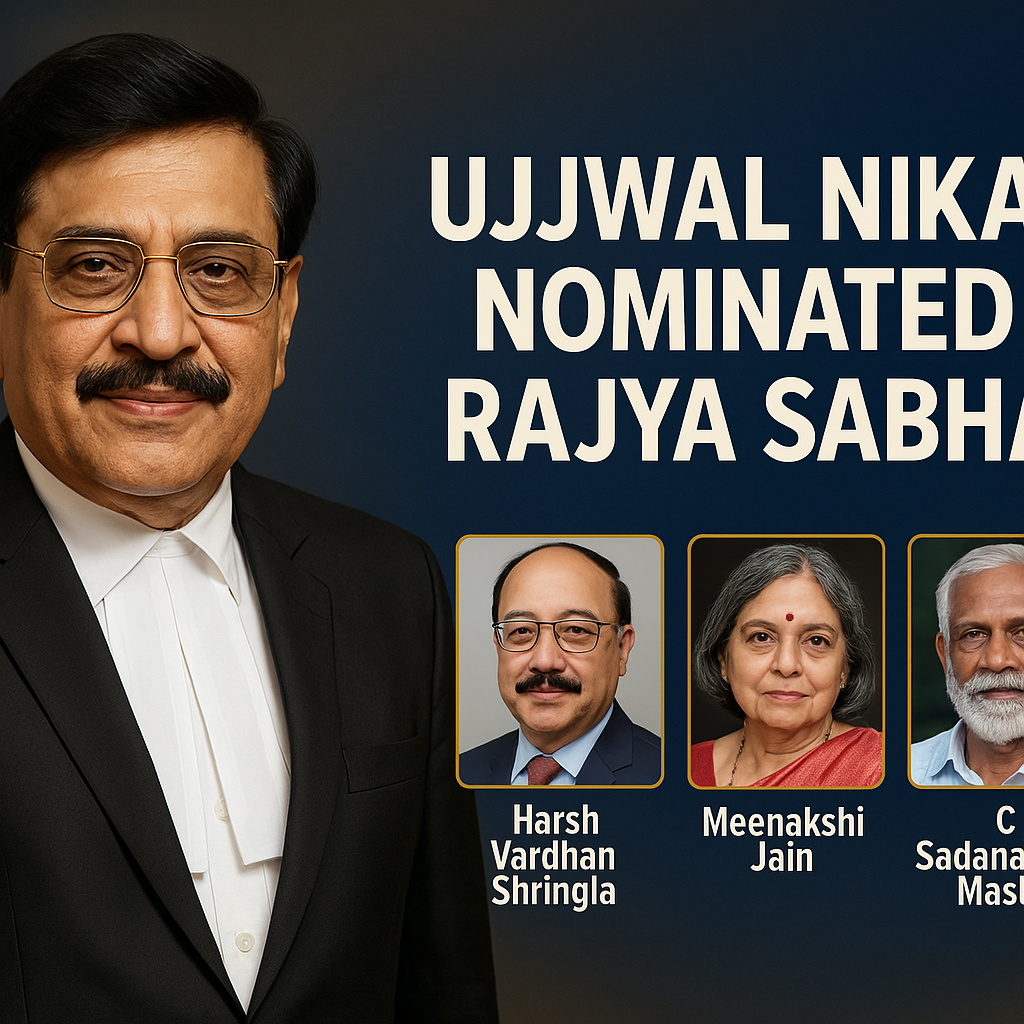
Eminent lawyer Ujjwal Nikam, known for his role in the 26/11 Mumbai attacks and 1993 blasts cases, has been nominated to Rajya Sabha alongside former Foreign Secretary Harsh Vardhan Shringla, educationist Meenakshi Jain, and Kathakali exponent C Sadanandan Master.
Table of Contents
Overview of the Rajya Sabha Nominations Announced July 15, 2025
On July 15, 2025, President Droupadi Murmu announced the nomination of four distinguished individuals to the Rajya Sabha, India’s Upper House of Parliament. Among the nominees was Ujjwal Nikam, a prominent public prosecutor known for handling high-profile terrorism cases. The announcement included three other professionals representing diverse fields of expertise.
The nominations were made under Article 80 of the Indian Constitution, which allows the President to nominate 12 members to the Rajya Sabha who have distinguished themselves in specific fields. These fields include literature, science, art, and social service. The selection process aims to bring specialized knowledge and professional experience into parliamentary proceedings.
The four individuals nominated on this date represent different professional backgrounds. Their combined expertise spans legal prosecution, diplomatic service, historical research, and classical performing arts. This selection reflects an approach to parliamentary composition that values domain-specific knowledge alongside elected representation.
Background on Ujjwal Nikam’s Legal Career
Ujjwal Nikam began his legal career in Maharashtra during the early 1980s. He chose to work as a public prosecutor rather than pursue private legal practice. His decision to focus on public prosecution shaped his subsequent professional trajectory over four decades.
His career includes involvement in several cases that received significant public and media attention. He served as a public prosecutor in Mumbai courts, handling cases related to organized crime and terrorism. His work required coordination with various investigation agencies and law enforcement bodies.
Nikam’s professional approach involved detailed case preparation and evidence compilation. His prosecution style combined legal research with courtroom presentation skills. Over the years, he became associated with cases that involved complex legal and procedural challenges.
The prosecutor’s career spans a period of significant changes in India’s criminal justice system. During this time, the country faced evolving challenges related to terrorism, organized crime, and cross-border criminal activities. His professional experience reflects this evolving landscape of criminal prosecution in India.
Major Cases in Ujjwal Nikam’s Prosecution Career
The 1993 Mumbai Serial Blasts Case
On March 12, 1993, Mumbai experienced a series of coordinated bomb explosions at multiple locations. The attacks resulted in 257 fatalities and over 1,400 injuries, according to official records. The case involved investigating links to international criminal networks and required coordination across multiple jurisdictions.
Ujjwal Nikam served as the special public prosecutor for this case. The prosecution involved managing evidence from various sources and handling proceedings with over 100 accused individuals. The case proceedings continued for several years through different levels of the judicial system.
The prosecution presented evidence related to conspiracy, planning, and execution of the attacks. This included documentation of financial transactions, communication records, and witness testimonies. The case required addressing legal questions about international conspiracy and cross-border criminal coordination.
Court proceedings resulted in convictions of multiple individuals involved in different aspects of the attacks. The case established certain legal precedents regarding the prosecution of terrorism-related offenses in India. It also highlighted challenges in handling cases with international dimensions within the domestic legal framework.
The 26/11 Mumbai Attacks Prosecution
On November 26, 2008, Mumbai faced coordinated attacks at multiple locations including hotels, a railway station, and other public spaces. The attacks resulted in 166 deaths and over 300 injuries, according to official reports. Nine attackers were killed during the operation, and one attacker, Ajmal Kasab, was captured alive.
Ujjwal Nikam was appointed as the special public prosecutor for the trial of Ajmal Kasab. The case involved presenting evidence of Kasab’s participation in the attacks, including forensic evidence, witness testimonies, and material recovered from the attack sites. The prosecution also addressed questions about the attacker’s age and identity.
The trial proceedings were conducted under security arrangements due to the nature of the case. Evidence presented included technological data from GPS devices and communication equipment used during the attacks. The prosecution coordinated with international agencies for certain aspects of evidence gathering.
The trial court convicted Ajmal Kasab and awarded a death sentence in May 2010. This conviction was subsequently upheld by the Bombay High Court and the Supreme Court of India. The sentence was carried out in November 2012. The case received significant attention in India and internationally due to its nature and circumstances.
Other Notable Cases
Ujjwal Nikam’s prosecution work extended beyond terrorism cases to include other criminal matters. In 2006, he handled the prosecution in the case related to the death of Pramod Mahajan, a political leader who was shot by his brother. The case involved navigating legal proceedings in a matter with political dimensions while maintaining focus on criminal aspects.
He also prosecuted cases related to sexual assault, including incidents that received public attention. These cases involved presenting evidence while addressing procedural requirements for victim protection and privacy. His work in these matters contributed to discussions about legal procedures in sensitive criminal cases.
Throughout his career, Nikam handled various cases involving organized crime in Mumbai. These prosecutions required understanding of criminal networks, financial transactions, and coordination between different criminal elements. His experience covered different types of criminal activities that occurred in urban Maharashtra over several decades.
Details of the July 15, 2025 Rajya Sabha Nominations
The Four Nominees Announced
President Droupadi Murmu announced four nominations to the Rajya Sabha on July 15, 2025. The nominees represent different professional fields and bring varied expertise to the Upper House. This selection approach reflects the constitutional provision for nominated members who have distinguished themselves in specific domains.
Ujjwal Nikam was nominated based on his extensive career as a public prosecutor. His four decades of legal service include prosecution of terrorism cases and other high-profile criminal matters. His appointment brings legal expertise specifically related to criminal law and prosecution procedures to parliamentary proceedings.
Harsh Vardhan Shringla served as India’s Foreign Secretary before his nomination. His diplomatic career included serving as India’s Ambassador to the United States and other postings. He also served as the G20 Chief Coordinator during India’s G20 Presidency. His nomination adds diplomatic and international relations expertise to the Rajya Sabha.
Dr. Meenakshi Jain is recognized for her work in history and education. She has authored multiple books on Indian history and cultural topics. Her academic work focuses on historical research and analysis. Her nomination brings scholarly perspectives on historical and cultural matters to parliamentary discussions.
C Sadanandan Master has dedicated over five decades to Kathakali, a classical dance form from Kerala. He has performed internationally and trained numerous students in this traditional art form. His nomination represents recognition of contributions to preserving and promoting classical Indian performing arts.
Constitutional Framework for Rajya Sabha Nominations
Article 80 of the Indian Constitution provides for the composition of the Rajya Sabha. The Upper House can have a maximum of 250 members, with 238 members elected by state legislative assemblies and 12 members nominated by the President. These nominated members must have special knowledge or practical experience in specific fields.
The fields specified in the Constitution for nominated members include literature, science, art, and social service. The purpose of these nominations is to bring specialized expertise into parliamentary proceedings that may not be adequately represented through electoral processes. This provision recognizes the value of domain-specific knowledge in legislative work.
Nominated members of the Rajya Sabha have the same rights and responsibilities as elected members. They can participate in debates, vote on legislation, and serve on parliamentary committees. However, they cannot vote in presidential elections or participate in proceedings to remove the President or Vice President from office.
The nomination process involves recommendations reviewed by the government before submission to the President for approval. Previous nominations have included individuals from various fields including sports, cinema, social work, and professional services. The selection aims to balance different domains of expertise over time.
Political and Professional Reactions to the Nominations
Responses from Political Parties
The July 15, 2025 nominations received comments from various political parties. Several opposition parties issued statements acknowledging the professional backgrounds of the nominees. Their responses focused on the merit-based aspects of the selections rather than purely political considerations.
The Congress party’s statement noted that the nominations represented recognition of professional achievement. Party spokespersons commented on the diverse expertise brought by the four individuals. They emphasized the importance of such domain knowledge in parliamentary functioning.
Regional political parties also issued statements regarding the nominations. Several parties highlighted the representation of different professional fields in the selection. Their comments focused on how specialized expertise could contribute to policy discussions in specific areas.
The governing party presented the nominations as part of its approach to strengthening parliamentary institutions. Party representatives emphasized the professional accomplishments of each nominee. They highlighted how these selections would enhance the quality of discussions on matters related to their respective fields of expertise.
Legal Community Perspectives
Professional legal associations issued statements following the announcement of Ujjwal Nikam’s nomination. The Bar Council of India, which regulates the legal profession in the country, acknowledged his extensive prosecution career. Their statement noted his involvement in significant criminal cases over four decades.
The Supreme Court Bar Association, representing lawyers practicing before India’s apex court, commented on the nomination. Their statement recognized Nikam’s experience in handling complex legal matters. They noted that his parliamentary service could bring practical insights from courtroom experience to legislative discussions.
Bar associations in Maharashtra, where Nikam practiced for most of his career, also issued statements. The Mumbai Bar Association highlighted his association with the city’s legal community. They noted his role in prosecuting cases that had significant impact on public safety and justice delivery.
Legal academics and researchers commented on the potential contributions Nikam could make to legislative work. Several law professors noted that his practical prosecution experience could inform discussions on criminal law reforms. They highlighted the value of bringing courtroom perspectives to policy-making processes.
Expected Areas of Parliamentary Contribution
Criminal Justice and Legal Reform
Ujjwal Nikam’s extensive prosecution experience positions him to contribute to discussions on criminal justice matters. India’s criminal justice system has been undergoing various reforms aimed at improving efficiency and effectiveness. His practical experience could inform debates on procedural changes and legal amendments.
Current discussions in Indian legal circles include reforms to criminal procedure codes and evidence laws. These reforms aim to address challenges such as case backlogs, witness protection, and adoption of technology in legal proceedings. Nikam’s experience prosecuting complex cases could provide insights into practical implementation of such reforms.
The question of anti-terrorism legislation continues to be relevant in India’s legal landscape. Laws governing investigation and prosecution of terrorism-related offenses undergo periodic review. Practical experience in prosecuting terrorism cases could inform discussions about balancing security concerns with legal safeguards.
Victim protection and rights represent another area of ongoing legal reform discussion. Indian law includes provisions for victim participation in criminal proceedings, but implementation faces various challenges. Experience from actual cases could contribute to discussions about strengthening victim-centric approaches in the justice system.
National Security and Related Legislation
National security legislation forms an important area of parliamentary work. Laws related to border security, intelligence gathering, and counter-terrorism require periodic review and updating. Practical experience in prosecuting cases with national security implications could inform such legislative discussions.
India’s legal framework for handling cross-border crimes and international criminal cooperation continues to evolve. This includes mechanisms for evidence sharing, extradition procedures, and coordination with foreign agencies. Experience from cases involving international dimensions could contribute to discussions on improving these frameworks.
Cyber security represents a growing area of concern in national security discussions. Criminal activities increasingly involve digital technologies, requiring legal frameworks that can address technological complexity. Experience prosecuting cases in the digital age could inform discussions about updating laws for contemporary challenges.
Intelligence sharing between different agencies within India’s security apparatus involves legal and procedural questions. Parliamentary oversight of such mechanisms requires understanding of practical challenges in coordination. Experience working with multiple agencies during case prosecution could provide relevant insights.
Committee Assignments and Legislative Work
Rajya Sabha members typically serve on various parliamentary committees that examine specific policy areas. These committees review legislation, scrutinize government expenditure, and investigate specific issues. Committee assignments for nominated members usually align with their areas of expertise.
The Parliamentary Standing Committee on Home Affairs examines matters related to internal security, police, and criminal justice. This committee reviews proposed legislation in these areas and examines the functioning of relevant ministries. Nikam’s prosecution experience would be particularly relevant to this committee’s work.
The Committee on Subordinate Legislation examines rules and regulations made by the executive under powers delegated by Parliament. This involves reviewing whether such delegated legislation stays within constitutional and legal boundaries. Legal expertise is valuable for such examination of regulatory frameworks.
Parliamentary committees also include ethics committees that address matters of member conduct and privileges. These committees require members with understanding of legal and ethical frameworks. Professional experience in legal matters could contribute to such committee functions.
Analysis of Merit-Based Nominations in Indian Democracy
Historical Context of Rajya Sabha Nominations
The provision for nominated members in the Rajya Sabha dates back to India’s Constitution. The framers of the Constitution recognized that electoral processes might not adequately represent all forms of expertise and achievement. This provision aimed to ensure that distinguished individuals from various fields could contribute to parliamentary proceedings.
Over the decades since independence, presidents have nominated individuals from diverse backgrounds. These have included scientists, artists, social workers, sportspersons, and professionals from various fields. The pattern of nominations has reflected evolving recognition of different forms of contribution to national life.
Analysis of nomination patterns shows variation in the professional backgrounds emphasized during different periods. Some periods saw more nominations from literary and artistic fields, while others emphasized scientific or social work contributions. These patterns reflect changing priorities and recognition of different forms of professional achievement.
The effectiveness of nominated members in parliamentary work varies based on individual engagement and area of expertise. Some nominated members have made significant contributions to specific policy discussions, while others have been less active. The value of such nominations depends partly on alignment between the nominee’s expertise and current parliamentary priorities.
Comparative Perspectives on Expert Representation
Different democratic systems employ various mechanisms for incorporating expert knowledge into legislative processes. Some countries use appointed upper houses where all or most members are selected rather than elected. Others rely primarily on committee systems that invite expert testimony without permanent membership.
The Westminster parliamentary system, which influenced India’s constitutional framework, includes provisions for appointed members in upper houses. The British House of Lords includes life peers appointed for their expertise or service. Other Commonwealth countries have adopted variations of this approach in their parliamentary structures.
Federal systems often structure their upper houses to represent constituent states or regions. In such systems, expert knowledge typically enters through committee processes rather than direct membership. India’s Rajya Sabha combines both state representation through elected members and expert representation through nominated members.
The effectiveness of different approaches to incorporating expertise depends on various factors. These include the specific policy challenges facing a country, the strength of committee systems, and the quality of civil service support for legislative work. India’s approach attempts to balance multiple objectives through its mixed composition of the Rajya Sabha.
Impact on India’s Parliamentary Functioning
Quality of Legislative Debates and Discussions
The presence of members with specialized expertise potentially enhances the quality of parliamentary debates. When discussions involve technical or specialized subjects, contributions from members with relevant professional backgrounds can add depth and practical perspectives. This can make legislative proceedings more informed and nuanced.
Parliamentary debates on criminal justice issues benefit from contributions by members with legal backgrounds. Understanding of legal technicalities, procedural requirements, and practical implementation challenges can inform discussions about proposed legislation. This applies to both new laws and amendments to existing legal frameworks.
Foreign policy and international relations discussions can benefit from diplomatic expertise. Members with experience in international negotiations and bilateral relations can provide context for foreign policy debates. This expertise is particularly relevant for discussions about international agreements and treaties requiring parliamentary approval.
Cultural and educational policy discussions benefit from contributions by scholars and practitioners in these fields. Members with academic backgrounds or experience in traditional arts can inform debates about heritage preservation, educational curricula, and cultural programs. Their perspectives can add depth to discussions that might otherwise remain at abstract policy levels.
Committee Work and Detailed Policy Examination
Much of substantive parliamentary work occurs in committees rather than on the floor of the House. Parliamentary committees examine proposed legislation in detail, scrutinize government expenditure, and investigate specific policy issues. Specialized expertise becomes particularly valuable in committee settings where detailed examination is possible.
Standing committees on various subjects benefit from members with relevant professional backgrounds. These committees examine bills referred to them by the House, allowing for detailed clause-by-clause consideration. Members with expertise in the subject matter can identify potential implementation issues or unintended consequences of proposed provisions.
Departmentally-related standing committees oversee the functioning of government ministries. These committees examine budget allocations, policy implementation, and administrative performance. Professional experience in areas relevant to specific ministries can enhance such oversight through informed questioning and analysis.
Special committees or joint committees investigating particular issues benefit from diverse expertise. When Parliament constitutes committees to examine specific problems or policy areas, having members with relevant professional backgrounds can improve the quality of investigation and recommendations. This can lead to more practical and implementable policy suggestions.
Broader Implications for Professional Recognition
Public Service and Professional Careers
Recognition of professional achievement through parliamentary nomination sends certain signals about the value placed on different forms of contribution to public life. Such nominations acknowledge that excellence in professional fields constitutes a form of national service deserving of formal recognition.
The nomination of a career public prosecutor highlights the importance of public service roles in the legal profession. In India’s legal system, public prosecutors handle criminal cases on behalf of the state. This role, while important, often receives less public attention than private legal practice or judicial service. Such recognition can enhance the prestige associated with public prosecution careers.
For professionals in various fields, the possibility of such recognition may influence career choices. When professional excellence in public service roles receives formal acknowledgment, it may encourage talented individuals to pursue such careers. This can have positive effects on recruitment and retention in important public service positions.
The balance between political considerations and merit in nomination decisions remains a subject of discussion. While the constitutional provision emphasizes special knowledge or practical experience, political factors inevitably influence the selection process. The professional credentials of nominees become one factor among several in nomination decisions.
Civil Society Perspectives on Institutional Quality
Civil society organizations focused on governance issues track patterns in parliamentary nominations. These organizations analyze whether nominations reflect genuine expertise and achievement or primarily serve political purposes. The professional credentials of nominees form part of assessments about the quality of parliamentary institutions.
Good governance advocates emphasize the importance of merit-based approaches to public appointments. They argue that selection based on professional achievement rather than political loyalty improves institutional quality. Parliamentary nominations that emphasize domain expertise align with such governance principles.
Public perception of parliamentary institutions is influenced by the caliber of members and quality of proceedings. When nominations bring recognized professionals with substantial achievements, this can enhance public regard for parliamentary work. Conversely, nominations perceived as primarily political can diminish public confidence in institutional functioning.
Media coverage of nominations reflects and shapes public discussion about parliamentary quality. Extensive coverage of professional credentials suggests public interest in the expertise brought to the Rajya Sabha. Media analysis of likely contributions based on professional backgrounds indicates expectations about how nominated members will engage with parliamentary work.
Challenges and Opportunities in Parliamentary Service
Transition from Professional Practice to Legislative Work
Professionals entering Parliament face the challenge of adapting to a different working environment. Legislative work involves different skills and processes than professional practice in most fields. Effective parliamentary participation requires understanding of procedures, building relationships with other members, and navigating political dynamics.
For legal professionals, the transition involves shifting from advocacy in courts to participation in legislative processes. While both involve legal knowledge, the contexts differ significantly. Court advocacy focuses on arguing specific cases within established legal frameworks, while legislative work involves shaping those frameworks through policy discussion and law-making.
The pace and nature of parliamentary work differs from professional practice in most fields. Parliament operates according to its own calendar and procedures. Members must balance various responsibilities including attendance in the House, committee work, constituency engagement, and study of policy issues. Time management becomes crucial for effective participation.
Building credibility in a new institutional context requires consistent engagement and substantive contributions. New members, whether elected or nominated, must establish themselves through their participation in debates and committee work. For nominated members with professional backgrounds, demonstrating how their expertise adds value to legislative discussions helps establish their role.
Leveraging Professional Expertise in Policy-Making
Nominated members face the opportunity and challenge of applying their professional knowledge to policy questions. This requires translating specialized expertise into terms relevant for legislative discussion and policy formulation. Effective communication of technical knowledge to non-specialist colleagues becomes important.
Contributing to legislation drafting involves understanding how legal provisions will be implemented in practice. Professional experience can identify potential implementation challenges or unintended consequences of proposed provisions. This practical perspective complements legal and policy expertise that government departments bring to legislation drafting.
Parliamentary questions and debates provide platforms for raising issues based on professional knowledge. Members can highlight gaps in existing policies or suggest improvements based on practical experience. These interventions can influence government policy even when not directly involved in drafting specific legislation.
Engagement with civil society and professional communities continues to be possible for parliamentary members. Nominated members with professional backgrounds can serve as bridges between their former professional communities and the legislative process. This can facilitate input from practitioners into policy development.
International Dimensions and Comparative Perspectives
Cross-Border Criminal Justice Cooperation
India’s engagement with international mechanisms for criminal justice cooperation has expanded over recent decades. This includes participation in various international conventions, bilateral agreements for legal assistance, and coordination with international law enforcement agencies. Professional experience in cases with international dimensions provides practical perspectives on such cooperation.
Extradition arrangements between India and other countries involve legal and diplomatic processes. Cases requiring extradition of accused or witnesses raise questions about legal procedures, evidence standards, and human rights protections. Experience prosecuting cases involving international aspects can inform discussions about improving extradition frameworks.
The Financial Action Task Force (FATF) and similar international bodies set standards for combating money laundering and terrorism financing. India’s compliance with such international standards requires appropriate legal frameworks and implementation mechanisms. Understanding practical challenges in investigating and prosecuting financial crimes can contribute to discussions about meeting international commitments.
International tribunals and courts addressing specific types of crimes operate under different legal frameworks than national courts. India’s engagement with such international mechanisms involves questions about sovereignty, legal procedures, and mutual recognition of judgments. Professional experience in related cases can provide context for discussions about India’s approach to international criminal justice mechanisms.
Diplomatic and Parliamentary Exchanges
Parliamentary diplomacy constitutes an important dimension of international relations. Parliamentary delegations visit other countries, and foreign parliamentary delegations visit India. Such exchanges allow for discussion of bilateral issues, sharing of legislative practices, and building of political relationships beyond purely governmental channels.
Members with diplomatic backgrounds bring experience in managing international relationships and understanding foreign policy considerations. This expertise becomes relevant when Parliament discusses international agreements, treaty ratifications, or foreign policy matters. Such members can provide context about international perspectives and likely reactions to policy decisions.
Parliamentary friendship groups and bilateral parliamentary forums exist between India and many countries. These forums facilitate regular exchanges on matters of mutual interest. Members participating in such forums benefit from understanding both domestic policy contexts and international relations considerations.
Regional parliamentary organizations like the Commonwealth Parliamentary Association provide platforms for sharing legislative practices and addressing common challenges. Indian parliamentarians’ participation in such organizations contributes to learning from international experiences while also presenting Indian perspectives to international audiences.
Technical Aspects of Criminal Justice Reform
Evidence Law and Procedural Reforms
India’s Evidence Act, dating from the 19th century, has undergone various amendments to address modern requirements. Questions about admissibility of electronic evidence, DNA evidence, and other scientific evidence require updating traditional legal frameworks. Practical experience with evidence presentation in courts can inform discussions about necessary legal reforms.
Procedural reforms aimed at reducing case delays represent ongoing priorities in India’s justice system. Proposals include time limits for different stages of criminal trials, mandatory video recording of certain proceedings, and use of technology for case management. Understanding practical challenges in trial processes can contribute to evaluating feasibility of such reforms.
Witness protection measures form an important aspect of criminal justice reform discussions. India enacted witness protection legislation relatively recently. Implementation challenges and gaps in protection frameworks become evident through actual cases. Experience with witness management in high-profile cases can inform discussions about strengthening protection mechanisms.
Plea bargaining provisions in Indian criminal law aim to reduce case loads while ensuring justice. The scope and application of plea bargaining raise questions about appropriate offenses, safeguards against coercion, and protection of victim interests. Practical experience with criminal case resolution can provide perspectives on balancing efficiency with justice considerations.
Technology Integration in Justice Delivery
Digital transformation of courts and legal processes accelerated during the COVID-19 pandemic. Virtual hearings, electronic filing of documents, and digital case management systems became more widespread. Questions about appropriate use of technology, access to justice, and procedural fairness require balancing efficiency gains with legal protections.
Artificial intelligence applications in legal processes raise various questions. These include use of AI for legal research, predictive analytics for case outcomes, and automated processing of routine legal matters. Discussions about appropriate uses of AI in justice systems benefit from understanding of how legal processes actually function.
Cybercrime investigation and prosecution present technical challenges for legal systems. Crimes involving digital evidence require specialized investigation capabilities and legal frameworks for obtaining and presenting such evidence. Experience prosecuting cases involving digital elements can inform discussions about necessary legal and technical infrastructure.
Blockchain technology and its potential applications in legal processes represent emerging areas of discussion. Possible uses include maintenance of legal records, verification of documents, and secure communication systems. Understanding practical requirements of legal processes helps evaluate whether such technological solutions address real needs.
Statistical Analysis of Legal System Performance
Criminal Justice System Metrics
India’s criminal justice system handles millions of cases annually across different levels of courts. According to data from the National Judicial Data Grid, pendency of criminal cases remains a significant challenge. As of recent statistics, several million criminal cases are pending across various courts in India.
Conviction rates in criminal cases vary significantly across different types of offenses. Serious crimes like murder typically show higher conviction rates compared to other criminal categories. According to National Crime Records Bureau data, conviction rates for different crime categories range from single digits to over 40%, depending on the offense type.
Average time taken for trial completion in criminal cases exceeds intended timelines in many instances. Factors affecting trial duration include case complexity, witness availability, evidence processing, and court workload. Statistical analysis shows significant variation in trial duration across different states and types of courts.
Pendency at different stages of the criminal justice process affects overall system performance. Delays can occur during investigation, trial, or appellate stages. Understanding bottlenecks in the system requires examination of statistics at each stage to identify where reforms could have greatest impact.
Terrorism Case Statistics and Trends
Cases related to terrorism and national security offenses represent a small but significant portion of India’s criminal caseload. According to government reports, the number of cases registered under anti-terrorism laws varies annually based on security situations in different regions.
Conviction rates in terrorism-related cases differ from general criminal cases. The complexity of evidence, involvement of multiple accused, and legal procedures specific to terrorism cases affect outcomes. Analysis of disposal rates and conviction rates in such cases provides insights into effectiveness of legal frameworks and prosecution.
Time taken for completion of terrorism trials has been a subject of policy discussion. The need for quick justice must be balanced with ensuring fair trial protections. Statistical analysis of trial durations in terrorism cases helps inform discussions about special procedures or courts for such matters.
Appeal processes in terrorism-related convictions involve higher courts reviewing both factual and legal aspects. Statistics on appeal outcomes indicate how higher courts approach questions raised in such cases. Rates of conviction confirmation, modification, or acquittal on appeal reflect judicial scrutiny of terrorism prosecutions.
Future Outlook and Long-Term Implications
Evolution of Parliamentary Representation
The balance between elected and nominated members in the Rajya Sabha reflects underlying questions about representation in democracy. Elected members represent geographical constituencies and their population’s preferences. Nominated members represent forms of achievement and expertise not directly linked to population or territory.
Future patterns of Rajya Sabha nominations will likely continue reflecting changing recognitions of expertise and achievement. As new fields emerge or existing fields evolve, the domains from which nominees are drawn may expand. The constitutional categories of literature, science, art, and social service can be interpreted broadly to accommodate evolving forms of professional accomplishment.
Public expectations about qualities desired in parliamentary members continue evolving. In addition to traditional political skills, there is growing emphasis on subject expertise, professional achievement, and ability to engage with complex policy issues. This shift in expectations may influence both electoral politics and appointment processes for nominated positions.
The effectiveness of nominated members in parliamentary work will influence future approaches to such selections. If nominated members make substantive contributions to legislative work, this validates the rationale for including non-elected members. Their track record shapes future expectations about what nominated members should bring to Parliament.
Criminal Justice Reform Trajectory
India’s criminal justice system continues to undergo gradual reform aimed at improving efficiency and fairness. Current reform priorities include reducing case pendency, improving investigation quality, strengthening victim rights, and integrating technology. The trajectory of these reforms will shape the justice system for coming decades.
Legislative changes form one aspect of criminal justice reform, but implementation remains equally important. Even well-designed laws can fail to achieve intended outcomes without proper implementation mechanisms, adequate resources, and trained personnel. Experience with implementation challenges can inform realistic policy-making.
International developments in criminal justice also influence Indian approaches. Global trends toward restorative justice, alternative dispute resolution, and rehabilitation-focused approaches to certain offenses affect thinking about criminal justice policy. India’s reforms occur in context of evolving international standards and practices.
Technological changes will continue affecting both criminal activities and justice system responses. Emerging technologies create new forms of crime while also providing new investigative and prosecutorial tools. Keeping legal frameworks updated for technological change represents an ongoing challenge for justice systems worldwide, including India’s.
Frequently Asked Questions
Q1: When and by whom was Ujjwal Nikam nominated to the Rajya Sabha?
Ujjwal Nikam was nominated to the Rajya Sabha on July 15, 2025, by President Droupadi Murmu. The nomination was made under Article 80 of the Indian Constitution, which allows the President to nominate 12 members who have distinguished themselves in specific fields including literature, science, art, and social service. Nikam was nominated based on his extensive career as a public prosecutor spanning over four decades.
He was one of four individuals nominated on this date, each bringing different areas of professional expertise to the Upper House. The other nominees were Harsh Vardhan Shringla (former Foreign Secretary), Dr. Meenakshi Jain (historian and educationist), and C Sadanandan Master (Kathakali exponent).
Q2: What were the major cases prosecuted by Ujjwal Nikam during his legal career?
Ujjwal Nikam served as special public prosecutor in several high-profile cases during his career. His most notable cases include the 1993 Mumbai Serial Blasts case, which involved prosecuting over 100 accused in connection with coordinated bomb explosions on March 12, 1993, that killed 257 people.
He also prosecuted Ajmal Kasab in the 26/11 Mumbai Attacks case from 2008, which resulted in Kasab’s conviction and death sentence. Other significant cases included the 2006 Pramod Mahajan murder case and various sexual assault cases including the Marine Drive rape case in 2005.
Throughout his career, he handled numerous cases related to organized crime and terrorism in Mumbai. His prosecution work required coordination with multiple investigation agencies and involved presenting complex evidence in court proceedings.
Q3: What are the other professional backgrounds of the individuals nominated alongside Ujjwal Nikam?
The three other individuals nominated to the Rajya Sabha on July 15, 2025, represent diverse professional fields. Harsh Vardhan Shringla had a diplomatic career spanning over 35 years, serving as India’s Foreign Secretary and Ambassador to the United States. He also served as G20 Chief Coordinator during India’s G20 Presidency, handling international relations and diplomatic negotiations.
Dr. Meenakshi Jain is a historian and educationist who has authored multiple books on Indian history and cultural topics, specializing in ancient Indian history and civilizational studies. C Sadanandan Master has dedicated over 50 years to Kathakali, a classical dance form from Kerala, performing internationally and training numerous students in this traditional art form.
Each nominee brings specialized knowledge from their respective professional domains to parliamentary proceedings.
Q4: What is the constitutional provision for nominated members in the Rajya Sabha?
Article 80 of the Indian Constitution provides the framework for Rajya Sabha composition. The Upper House can have a maximum of 250 members, consisting of 238 members elected by state legislative assemblies using proportional representation, and 12 members nominated by the President.
These nominated members must have special knowledge or practical experience in literature, science, art, or social service. The purpose is to bring specialized expertise into Parliament that may not be adequately represented through electoral processes.
Nominated members have the same rights as elected members to participate in debates, vote on legislation, and serve on committees, with the exception that they cannot vote in presidential elections or participate in proceedings to remove the President or Vice President from office.
Q5: How did the 1993 Mumbai Serial Blasts case proceed through the legal system?
The 1993 Mumbai Serial Blasts case began after coordinated explosions on March 12, 1993, killed 257 people and injured over 1,400. The investigation involved multiple agencies and resulted in charges against over 100 accused individuals.
Ujjwal Nikam served as special public prosecutor, presenting evidence of conspiracy, planning, and execution involving international criminal networks. The case included evidence from multiple countries and required addressing legal questions about international conspiracy. Trial proceedings continued for several years, with the court delivering judgments that included death sentences and life imprisonment for various convicted individuals.
The case established legal precedents for prosecution of terrorism-related offenses with international dimensions. Higher courts including the Supreme Court reviewed various aspects of the case through the appeals process.
Q6: What are the expected areas of contribution for Ujjwal Nikam in the Rajya Sabha?
Based on his professional background, Ujjwal Nikam is expected to contribute to parliamentary discussions on criminal justice matters, including reforms to criminal procedure codes and evidence laws.
His experience could inform debates on anti-terrorism legislation, victim protection measures, and court procedure reforms. He may serve on the Parliamentary Standing Committee on Home Affairs, which examines matters related to internal security and criminal justice. Other potential committee assignments include the Committee on Subordinate Legislation and ethics committees where legal expertise is valuable.
His practical prosecution experience could provide insights on implementation challenges for legal reforms, witness protection mechanisms, and coordination between investigation agencies. He may also contribute to discussions on national security legislation and cross-border crime cooperation frameworks.
Q7: What reactions did the July 15, 2025 nominations receive from different political parties?
The nominations received comments from various political parties across the spectrum. Opposition parties including the Congress issued statements acknowledging the professional backgrounds of the nominees and noting that the selections represented recognition of merit and expertise. Regional parties highlighted the diverse fields represented in the selection and emphasized the importance of specialized knowledge in parliamentary work.
The governing party presented the nominations as strengthening parliamentary institutions through professional expertise. Legal associations including the Bar Council of India and Supreme Court Bar Association issued statements recognizing Ujjwal Nikam’s extensive prosecution career.
Professional organizations in fields represented by other nominees also acknowledged their respective accomplishments. The general tone of reactions focused on the professional credentials of the nominees rather than purely political considerations.
Q8: How does India’s approach to expert representation in Parliament compare internationally?
Different democratic systems use various mechanisms for incorporating expert knowledge into legislative processes. The Westminster parliamentary system, which influenced India’s constitutional framework, includes provisions for appointed members in upper houses, such as life peers in the British House of Lords. Some Commonwealth countries have adopted variations of this approach.
Federal systems often structure upper houses primarily for state or regional representation, with expert knowledge entering through committee processes rather than membership. India’s Rajya Sabha combines state representation through elected members and expert representation through nominated members.
The effectiveness of different approaches depends on factors including the strength of committee systems, quality of civil service support, and specific policy challenges facing each country. India’s approach attempts to balance multiple objectives including federal representation and specialized expertise through its mixed composition.
Q9: What are current trends in criminal justice reform in India?
India’s criminal justice system is undergoing reforms aimed at improving efficiency and effectiveness. Current priorities include reducing case pendency through procedural reforms and increased judicial capacity.
Technology integration includes virtual hearings, electronic filing, and digital case management systems that became more widespread during the COVID-19 pandemic. Witness protection measures have been strengthened through recent legislation, though implementation challenges remain. Evidence law reforms address admissibility of electronic and scientific evidence in light of technological changes.
Plea bargaining provisions aim to reduce case loads while maintaining justice standards. Victim rights enhancement represents another reform focus, with measures to protect victim dignity and facilitate their participation in criminal proceedings. These reforms reflect both domestic priorities and alignment with evolving international standards for criminal justice systems.
Q10: What is the significance of merit-based nominations in India’s democratic system?
Merit-based nominations to the Rajya Sabha serve several purposes within India’s democratic framework. The constitutional provision for nominated members recognizes that electoral processes may not adequately represent all
forms of expertise and achievement relevant to legislative work. Such nominations bring specialized knowledge into parliamentary proceedings that complements the representation provided by elected members. This approach acknowledges that effective policy-making benefits from diverse forms of expertise beyond traditional political experience.
The emphasis on professional credentials in nominations signals that excellence in various fields constitutes a form of national service deserving formal recognition. This can influence career choices by demonstrating that achievement in public service roles or professional fields may lead to recognition at high institutional levels. For the legal profession specifically, recognition of a career public prosecutor highlights the importance of public service roles that may receive less attention than private practice or judicial service.
Merit-based selections potentially enhance public confidence in parliamentary institutions. When nominations emphasize domain expertise and professional achievement, this can improve perceptions of institutional quality and the seriousness of legislative work. Conversely, nominations perceived as primarily serving political purposes rather than bringing genuine expertise can diminish public regard for parliamentary functioning.
The balance between political considerations and merit in nomination decisions remains a subject of ongoing discussion. While constitutional provisions emphasize special knowledge or practical experience, political factors inevitably influence selection processes. The professional credentials of nominees become one consideration among several in appointment decisions, reflecting the inherently political nature of parliamentary institutions even in their non-elected components.
Regional Representation and Linguistic Diversity
Maharashtra’s Contribution to National Institutions
Ujjwal Nikam’s professional career was based primarily in Maharashtra, where he served as a public prosecutor in Mumbai courts for four decades. Maharashtra has historically contributed significantly to India’s legal profession, with Mumbai serving as a major center for legal practice and judicial proceedings. The state’s High Court handles substantial caseloads related to commercial matters, criminal cases, and constitutional questions.
Professional legal practice in Maharashtra reflects the state’s economic importance and diverse population. Mumbai, as India’s financial capital, generates legal matters related to commerce, finance, and corporate affairs alongside criminal and civil cases. The legal community in the state includes practitioners specializing in various domains from commercial law to public interest litigation.
Public prosecution services in Maharashtra handle cases arising from India’s most populous state. The state’s urban centers generate significant criminal caseloads requiring well-functioning prosecution systems. Maharashtra’s approach to organizing prosecution services and training public prosecutors has influenced practices in other states.
The nomination of a prosecutor with extensive Maharashtra experience brings perspectives from a state that has faced various security challenges over decades. From organized crime in the 1980s and 1990s to terrorism-related incidents, Maharashtra’s experience shapes understanding of criminal justice challenges in urban India.
Linguistic and Cultural Context
India’s linguistic diversity affects legal proceedings and parliamentary work. While English and Hindi serve as languages for parliamentary proceedings, members communicate in various Indian languages based on their preferences and constituencies. The Rajya Sabha’s simultaneous translation facilities allow members to speak in scheduled languages.
Legal proceedings in Maharashtra courts occur in Marathi, English, and sometimes Hindi depending on the court level and case nature. Prosecutors working in these courts navigate linguistic diversity while presenting cases. This experience with multilingual legal environments reflects broader Indian realities of governance across language communities.
Cultural context influences approaches to criminal justice and legal proceedings. Different regions of India have varying social structures, customary practices, and community relationships with law enforcement. Professional experience in a diverse state like Maharashtra provides exposure to varied cultural contexts within which the justice system operates.
Parliamentary representation ideally reflects India’s regional, linguistic, and cultural diversity. While Rajya Sabha members elected from states represent geographical constituencies, nominated members bring professional expertise that may have regional dimensions. The combination aims to ensure diverse perspectives inform parliamentary discussions.
Media Coverage and Public Discourse
Traditional Media Reporting
The July 15, 2025 nominations received coverage across Indian news media. National newspapers reported the announcement with articles detailing the professional backgrounds of the four nominees. Coverage emphasized the diverse fields represented and discussed likely areas of parliamentary contribution based on each nominee’s expertise.
Television news channels covered the nominations in their programming, with discussions featuring legal experts, political analysts, and journalists. Panel discussions examined the constitutional framework for nominations, the professional credentials of specific nominees, and expected impacts on parliamentary functioning. Different channels brought varying editorial perspectives to their coverage.
Regional media in states associated with the nominees provided additional coverage focusing on local connections. Maharashtra-based media gave particular attention to Ujjwal Nikam’s nomination, reviewing his career and discussing reactions from the state’s legal community. This regional coverage provided context about professional reputations and local perspectives.
Print media analysis pieces examined the nominations in context of previous Rajya Sabha appointments. Commentators compared the professional credentials of current nominees with earlier nominated members. Some analysis focused on whether nominations reflected merit-based selection or political considerations, a recurring theme in discussions about parliamentary appointments.
Digital Media and Social Platforms
Social media platforms saw significant discussion following the nomination announcement. Users shared news articles, posted comments about the nominees’ professional backgrounds, and discussed implications for parliamentary work. Hashtags related to the nominations trended on platforms like Twitter (now X) for a period following the announcement.
Legal professionals used social media to share perspectives on Ujjwal Nikam’s nomination. Lawyers posted about their professional interactions with him, discussed significant cases he prosecuted, and debated potential contributions to criminal justice reform. These discussions reflected the legal community’s interest in one of their members joining Parliament.
Online news portals and digital-native media outlets provided coverage emphasizing different aspects of the nominations. Some focused on detailed professional biographies, while others emphasized political dimensions of the selection process. The diversity of digital media sources meant varied perspectives reached different audience segments.
Professional networking platforms saw discussions among lawyers, diplomats, academics, and artists about the nominations in their respective fields. These specialized discussions often went deeper into technical aspects of the nominees’ work than general media coverage. Professional communities used digital platforms to share informed perspectives on the significance of the nominations.
Educational Implications and Knowledge Sharing
Legal Education and Professional Development
Ujjwal Nikam’s career trajectory offers lessons for legal education and professional development. His choice to focus on public prosecution rather than private practice demonstrates that public service careers in law can lead to professional recognition. Law schools can use such examples when discussing career options with students.
Professional development for public prosecutors benefits from examining successful prosecution strategies in complex cases. Case studies based on high-profile prosecutions can inform training programs for government lawyers. Understanding how evidence was compiled, witnesses were prepared, and courtroom presentations were structured provides practical learning opportunities.
Continuing legal education programs for practicing lawyers can examine specific aspects of criminal prosecution through analysis of significant cases. Topics might include handling complex evidence, managing high-pressure trials, witness examination techniques, and strategic decision-making during prosecution. Professional insights from experienced prosecutors contribute to such educational initiatives.
Mentorship relationships within the legal profession help transfer knowledge from experienced practitioners to newer professionals. Senior prosecutors sharing their experiences with younger government lawyers facilitates learning that formal training cannot completely provide. Recognition of successful careers in public prosecution may encourage more such mentorship relationships.
Public Understanding of Legal Processes
Media coverage of high-profile cases shapes public understanding of how the legal system functions. Cases involving terrorism, organized crime, or other serious matters that receive significant attention can either enhance or diminish public confidence in justice delivery. How such cases are prosecuted and reported affects citizen perceptions of legal institutions.
Educational initiatives aimed at improving legal literacy help citizens understand their rights and the functioning of justice systems. Information about criminal procedure, evidence requirements, and court processes enables people to engage more effectively with legal institutions when necessary. Professional experience from actual cases can inform such educational content.
Transparency in legal proceedings, within appropriate limits, allows public scrutiny that can strengthen institutional credibility. When prosecution strategies and evidence are presented in open court and reported in media, this demonstrates how justice is administered. Understanding that convictions result from systematic evidence rather than arbitrary decisions builds confidence in legal processes.
Discussions about legal reforms benefit from informed public participation. When citizens understand how current systems function and what challenges they face, public discourse about potential improvements becomes more substantive. Professional perspectives from practitioners help ground reform discussions in practical realities rather than abstract principles alone.
Economic Dimensions of Justice Delivery
Resource Allocation and Justice System Functioning
India’s criminal justice system requires substantial public resources for police, prosecution services, courts, and correctional facilities. Budget allocations for these components affect system capacity and effectiveness. Parliamentary oversight of such expenditure includes examination of whether resources are deployed effectively to achieve justice delivery goals.
Public prosecutors form an essential component of the criminal justice system requiring adequate numbers and training. States face challenges in recruiting and retaining qualified prosecutors, particularly in rural or less developed areas. Resource constraints affect the quality of prosecution services and consequently case outcomes.
Court infrastructure including buildings, technology, and support staff requires ongoing investment. Inadequate infrastructure contributes to case pendency and delays. Parliamentary committees examining judicial expenditure consider whether infrastructure investments receive adequate priority and are used effectively.
Victim compensation and support services represent growing areas of justice-related expenditure. Providing assistance to crime victims and witnesses involves costs that must be balanced against other priorities. Policy discussions about expanding such services must consider resource implications alongside justice considerations.
Economic Impact of Crime and Justice Delivery
Crime imposes economic costs on society through lost productivity, property damage, and resources devoted to prevention and response. Terrorism and organized crime particularly affect economic activity in affected regions. Effective prosecution and conviction contribute to deterrence that can reduce such economic costs over time.
Business confidence and investment decisions are influenced by perceptions of law and order. Foreign investors consider legal system reliability when making investment choices. A reputation for effective prosecution of commercial crimes, contract enforcement, and protection of property rights affects economic development.
Tourism and other service industries are particularly sensitive to security perceptions. Incidents of terrorism or high-profile crimes can affect tourist arrivals and consequently economic activity in affected regions. Swift and visible justice delivery in such cases helps restore confidence and minimize economic damage.
The legal profession itself represents significant economic activity employing millions of people in various capacities. From lawyers and judges to court staff and support services, the justice system sustains substantial employment. Policy decisions affecting legal services have economic implications beyond their direct justice delivery purposes.
Conclusion: Assessing the Nomination’s Significance
The nomination of Ujjwal Nikam to the Rajya Sabha on July 15, 2025, represents recognition of a career dedicated to public prosecution spanning over four decades. His involvement in high-profile terrorism cases including the 1993 Mumbai Serial Blasts and 26/11 Mumbai Attacks brought public attention to the work of public prosecutors in India’s criminal justice system.
The appointment, along with three other professionals from different fields, reflects the constitutional provision for bringing specialized expertise into Parliament through nominated members. This approach aims to complement elected representation with domain-specific knowledge that can enhance legislative discussions and policy-making.
The impact of this nomination will depend on how actively the appointed members engage with parliamentary work and whether their professional expertise translates into substantive contributions to legislation and policy. Their participation in committee work, debates, and cross-party discussions will determine the practical significance of their appointments.
For India’s justice system and legal profession, the nomination signals recognition of public service careers in law. Whether this encourages more talented lawyers to pursue public prosecution roles or influences approaches to criminal justice reform remains to be seen through future developments.
The broader question of balancing merit-based expertise with democratic representation through elections continues to shape discussions about parliamentary composition. India’s mixed approach in the Rajya Sabha represents one model among various democratic systems for incorporating specialized knowledge into legislative processes.
About the Author
Author Name: Nueplanet
Bio: Nueplanet is a news content writer specializing in Indian political affairs, legal developments, and institutional analysis. With extensive experience covering parliamentary proceedings, judicial appointments, and governance issues, Nueplanet provides detailed coverage based on official announcements, verified data, and authoritative sources.
The commitment to factual accuracy and comprehensive reporting ensures readers receive reliable information about significant developments in India’s democratic institutions. All content is researched using official government sources, established media reports, and publicly available institutional records.
Mission: To deliver accurate, well-researched journalism that helps readers understand political processes, institutional functioning, and policy developments in India. Content prioritizes factual reporting, official sources, and transparent analysis to maintain credibility and reader trust. Coverage focuses on providing context and background that enables informed civic engagement.
Last Updated: July 13, 2025
Published: July 13, 2025
Helpful Resources
Latest Posts
- National RailOne App: Indian Railways’ One-Stop Solution for Travellers
- HDB Financial Services IPO Allotment GMP: All You Need to Know
- TNPSC Admit Card 2025 Released: Everything You Need to Know
- Jharkhand Polytechnic Result 2025 Declared: Check Your Scores, Merit List, and Admission Process
- 7th July Public Holiday India: Is Muharram 2025 a National Holiday?
Tag
Ujjwal Nikam
Related Posts













Post Comment