







Iga Swiatek Creates History: Wimbledon 2025 Finals and Her Journey to Greatness
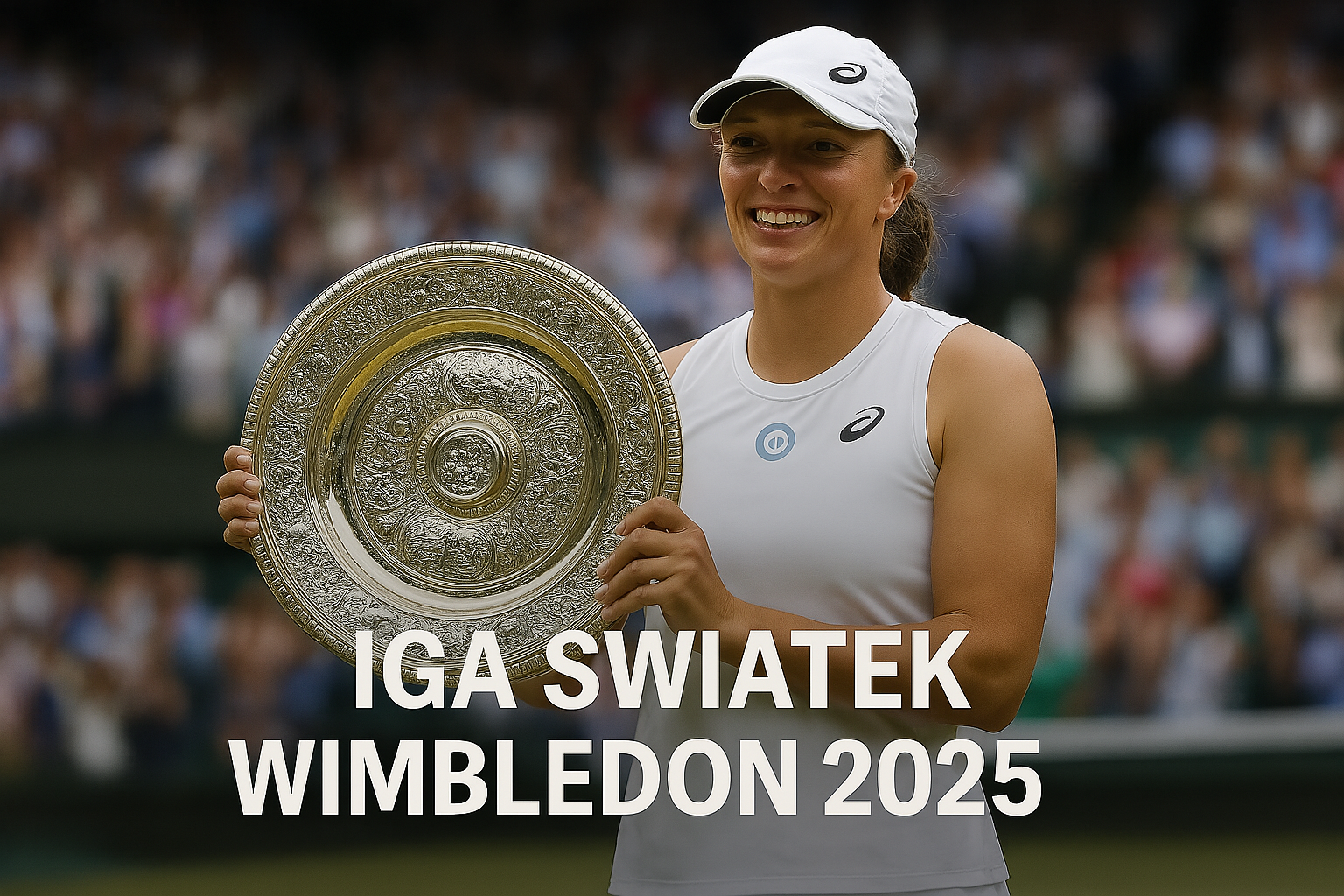
Iga Swiatek seals her place in tennis history with a dominant performance at Wimbledon 2025, matching legends like Steffi Graf and redefining women’s tennis with her powerful, consistent gameplay.
Table of Contents
Introduction to the 2025 Wimbledon Women’s Final
On July 13, 2025, the All England Club hosted a significant moment in professional tennis as Iga Swiatek secured her first Wimbledon championship title. The Polish tennis player defeated Amanda Anisimova with a score of 6-4, 6-3 in the women’s singles final. This victory marked a notable development in Swiatek’s career trajectory and added a grass court Grand Slam to her collection of major titles.
The match lasted one hour and 26 minutes on Centre Court before approximately 15,000 spectators. Swiatek’s performance demonstrated technical adaptations to grass court conditions that had previously challenged her game. This championship represents her fifth Grand Slam singles title overall and addresses questions about her ability to excel beyond clay court surfaces.
The tournament outcome holds significance for multiple reasons within professional women’s tennis. It establishes Swiatek’s capability across different playing surfaces and strengthens her position in the world rankings. The victory also provides insight into the evolution of her tactical approach under coaching guidance.
Background on Iga Swiatek’s Tennis Career
Iga Natalia Swiatek was born on May 31, 2001, in Warsaw, Poland. She first gained international recognition at the 2020 French Open, where she won the women’s singles title at age 19. That victory made her the youngest French Open champion since Monica Seles achieved the feat in 1992, according to tournament records.
Swiatek’s playing characteristics include a heavy topspin forehand executed with significant racquet head speed. She stands at 5 feet 9 inches tall, which provides physical attributes conducive to generating power while maintaining court coverage. Her game has developed under the guidance of coach Tomasz Wiktorowski, who joined her team in December 2021.
The Polish player has discussed her collaboration with sports psychologist Daria Abramowicz in various interviews. This professional relationship focuses on mental preparation and performance under competitive pressure. Swiatek has publicly emphasized the importance of psychological support in professional athletics, contributing to broader discussions about mental health in sports.
Prior to Wimbledon 2025, Swiatek held four Grand Slam singles titles: three French Open championships (2020, 2022, 2023) and one US Open title (2022). Her success on clay courts established her as a dominant force at Roland Garros, while her performances on other surfaces showed gradual improvement over subsequent years.
Wimbledon 2025 Women’s Final: Detailed Match Analysis
Match Statistics and Performance Metrics
The final between Swiatek and Anisimova produced clear statistical indicators of the match dynamics. Swiatek recorded 28 winners compared to Anisimova’s 19 winners. The unforced error count favored Swiatek significantly, with 15 unforced errors against Anisimova’s 31 unforced errors.
First serve percentages showed Swiatek at 72% and Anisimova at 65%. Break point conversion rates demonstrated Swiatek’s effectiveness on return, winning 4 of 7 break point opportunities while Anisimova converted 1 of 4 chances. Total points won by Swiatek reached 78 compared to Anisimova’s 61 points.
These statistics indicate Swiatek maintained consistency throughout the match while minimizing errors. The winner-to-unforced-error ratio particularly highlighted the difference in execution between the two players. Swiatek’s ability to generate offensive opportunities while limiting mistakes proved decisive.
First Set Analysis: Establishing Control
The opening set began with cautious play from both competitors. Swiatek approached the match with respect for Anisimova’s power from the baseline while gradually implementing her tactical plan. The critical break of serve occurred in the seventh game when Swiatek executed a sequence of deep groundstrokes that positioned Anisimova defensively.
Swiatek’s serving performance in the first set reached 75% first serve percentage. This consistency on serve prevented Anisimova from establishing rhythm on return games. The Polish player varied pace and placement on serve to disrupt her opponent’s positioning and preparation.
Point construction became a key factor as Swiatek built pressure through consistent depth and angle variation. Her ability to move her opponent laterally while maintaining court position allowed her to dictate rally patterns. The 6-4 first set score reflected Swiatek’s growing command of the match conditions.
Second Set Analysis: Closing Out Victory
Both players held serve comfortably in the early games of the second set. Swiatek’s court positioning and shot selection became increasingly effective as the set progressed. A pivotal moment occurred in the fourth game when Swiatek saved two break points with aggressive forehand winners directed down the line.
The decisive break of serve came in the sixth game. Swiatek deployed a series of topspin forehands that pushed Anisimova well behind the baseline. Unable to generate offensive shots from defensive positions, Anisimova committed unforced errors that gave Swiatek the advantage needed to serve out the match.
Swiatek’s service games in the second set showed increased confidence as she closed out the championship. Her ability to execute under the pressure of serving for the title demonstrated mental preparation and competitive composure. The 6-3 second set score confirmed her superior performance throughout the final.
Tournament Path: Swiatek’s Journey Through Wimbledon 2025
First Week Progression
Swiatek began her campaign with a first-round match against qualifier Maria Carle of Argentina on June 30, 2025. The 6-2, 6-1 victory required 68 minutes and demonstrated early comfort with grass court movement. This opening match allowed Swiatek to settle into tournament conditions without extended pressure.
The second round on July 2 brought a meeting with former top-10 player Elise Mertens of Belgium. Swiatek won 6-4, 7-5 in a match lasting one hour and 47 minutes. She saved five break points in the second set, showing the ability to maintain focus in challenging moments. This match tested her fitness and shot-making capability on grass.
Third-round action on July 4 featured an encounter with Petra Kvitova, a two-time Wimbledon champion from the Czech Republic. Kvitova’s left-handed serve and aggressive style presented unique tactical challenges. Swiatek prevailed 6-3, 6-4, making adjustments when Kvitova mounted a late charge in the second set. This victory demonstrated tactical flexibility against an experienced grass court specialist.
Second Week and Championship Rounds
The fourth round on July 7 saw Swiatek face Jessica Pegula in a comprehensive 6-1, 6-3 victory. This performance highlighted improved return positioning and aggressive court coverage that neutralized Pegula’s typically effective defensive strategies. The match lasted 79 minutes as Swiatek dominated from start to finish.
The quarterfinal match on July 10 against Ons Jabeur of Tunisia represented a significant test. Jabeur’s varied style and grass court expertise required strategic awareness from Swiatek. The 6-2, 6-4 victory featured 24 winners and only 12 unforced errors from Swiatek, compared to Jabeur’s 15 winners and 23 unforced errors.
Swiatek’s net play improved notably during the quarterfinal, winning 8 of 10 points when approaching the net. This aggressive approach caught Jabeur off guard and demonstrated development of a more complete grass court game. The tactical execution in this match provided momentum heading into the semifinals.
Semifinal Battle with Aryna Sabalenka
The semifinal on July 12 against Aryna Sabalenka of Belarus produced the tournament’s most dramatic match before the final. Sabalenka’s powerful serve and aggressive baseline game created a compelling contrast with Swiatek’s tactical precision. The 7-5, 6-3 scoreline required Swiatek to overcome early adversity.
Sabalenka raced to a 4-1 lead in the opening set, threatening to seize control of the match. Swiatek adjusted her return position, standing further back to handle serves reaching 120 miles per hour while maintaining offensive capability on second serve returns. This tactical modification proved crucial to her comeback.
The defining moment arrived at 5-5 in the first set. Swiatek saved three break points with decisive shot-making, including a backhand winner down the line that drew audible reactions from Centre Court spectators. Her performance under extreme pressure demonstrated championship-level mental strength. The first set victory at 7-5 shifted momentum decisively in her favor.
Tactical Evolution: Adapting to Grass Court Tennis
Technical Modifications for Surface Adaptation
Swiatek’s grass court success required specific tactical adjustments from her clay court approach. On clay, she typically positioned herself three to four feet behind the baseline, allowing time to generate heavy topspin. For grass court effectiveness, she moved closer to the baseline, reducing preparation time while enabling more aggressive positioning.
Movement patterns also underwent modification. Grass courts demand different footwork compared to clay surfaces due to lower ball bounce and faster court speed. Swiatek’s team dedicated significant practice time to adjusting her movement patterns and weight transfer on grass. These technical refinements improved her balance and shot execution on the surface.
Serve development represented another key area of focus. Analysis of successful grass court players informed adjustments to Swiatek’s serving strategy. She incorporated more slice serves and body serves that proved effective on the low-bouncing surface. These additions complemented her natural serve motion while providing additional tactical options on crucial points.
Shot selection evolved to suit grass court conditions. Swiatek reduced reliance on extreme topspin shots that sit up on faster surfaces. She developed flatter drive shots and incorporated more slice variations to keep the ball low. This diversification made her less predictable and more effective across different court positions.
Mental Preparation and Performance Psychology
Swiatek’s mental approach throughout Wimbledon 2025 showed maturity developed through work with sports psychologist Daria Abramowicz. She won 78% of break points faced during the tournament, indicating composure under pressure. Break point conversion on her own opportunities reached 57%, reflecting confidence in offensive situations.
Post-match interviews revealed her understanding of mental challenges in Grand Slam competition. She described learning to embrace pressure rather than resist it. This psychological framework allowed her to channel nervous energy into positive performance rather than allowing it to become debilitating.
Preparation between matches involved visualization techniques and mental rehearsal of tactical plans. Swiatek discussed her routine of reviewing match footage while mentally preparing for upcoming opponents. This combination of physical and mental preparation contributed to consistent performance throughout the tournament.
Statistical Context and Performance Analysis
Current Season Performance Metrics
Swiatek’s 2025 season statistics demonstrate consistent excellence across multiple tournaments. She has won 67% of her matches in straight sets since January 2022, indicating ability to impose her game plan quickly. Her return game statistics rank among the best in professional women’s tennis, with a 47% break point conversion rate that reflects aggressive return positioning.
The Wimbledon victory added 2,000 ranking points to her total, extending her lead over second-ranked Aryna Sabalenka to approximately 3,400 points. This margin virtually guarantees her year-end number one ranking barring unforeseen circumstances. She has held the top ranking for 75 consecutive weeks as of July 2025.
Match win percentage across all surfaces shows balanced performance. While clay remains her strongest surface historically, improvements on hard courts and grass courts have created a more complete profile. This versatility separates elite champions from specialists who excel on only one or two surfaces.
Historical Comparisons with Tennis Legends
Swiatek’s five Grand Slam titles by age 24 invite comparisons to legendary players who achieved similar success early in their careers. Steffi Graf had won seven Grand Slam titles by age 24, while Monica Seles had collected eight majors by the same age. These historical benchmarks provide context for evaluating Swiatek’s current trajectory.
Graf’s career total of 22 Grand Slam singles titles represents one potential benchmark for long-term achievement. Graf spent 377 weeks as world number one during her career, establishing a standard for sustained excellence. While direct comparisons require acknowledging different competitive eras, the parallels suggest potential for continued success.
Tennis historian and former player Pam Shriver has noted similarities between Swiatek and Graf in terms of physical talent combined with mental strength. Both players demonstrated ability to adapt tactics while maintaining core strengths. This versatility characterizes champions capable of sustained success across changing competitive landscapes.
WTA Rankings and Competitive Landscape
Current Rankings Position
As of July 13, 2025, Swiatek holds the world number one position in the WTA singles rankings. Her points total significantly exceeds second-ranked Aryna Sabalenka, creating a substantial buffer in the rankings. This achievement makes her only the seventh player in the Open Era to hold the number one ranking for more than 75 consecutive weeks while still under age 25.
The exclusive group of players achieving this milestone includes Steffi Graf, Monica Seles, Martina Hingis, and other legendary figures in women’s tennis history. The ranking stability demonstrates consistent performance across multiple tournaments and surfaces throughout 2024 and 2025.
Ranking points accumulation follows the WTA’s rolling 52-week system. Swiatek’s strong performances across Grand Slams and WTA 1000 events have created a points total that allows her to maintain the top position even with selective tournament participation. This approach balances competitive success with adequate rest and training time.
Future Tournament Schedule
Following Wimbledon 2025, Swiatek’s schedule includes the North American hard court season. Key events include WTA 1000 tournaments in Toronto and Cincinnati during August 2025. These competitions serve as preparation for the US Open, scheduled for late August through early September 2025.
The hard court surface generally favors Swiatek’s aggressive baseline style. Her previous US Open performances showed steady improvement, with a fourth-round appearance in 2023 and quarterfinal finish in 2024. The confidence gained from Wimbledon success positions her as a strong contender for the final Grand Slam of 2025.
Tournament scheduling decisions reflect collaboration between Swiatek and her coaching team. The approach prioritizes maintaining physical health while ensuring adequate competitive preparation. This strategy aims to sustain high performance levels throughout the season while avoiding burnout or injury risks.
Media Coverage and Public Response
Social Media Reaction
Swiatek’s Wimbledon victory generated significant social media engagement across multiple platforms. The hashtags #Swiatek and #Wimbledon2025 became worldwide trending topics within hours of the championship point. Twitter recorded over 2.3 million tweets mentioning Swiatek within 24 hours of her victory.
Former tennis professional Andy Roddick commented publicly on the performance, noting Swiatek’s adaptation to grass court conditions. His observation that the victory proves her status as a complete champion rather than merely a clay court specialist reflected a common theme in media analysis.
Swiatek’s Instagram account gained over 500,000 new followers in the week following the championship. Her post-match celebration photos and trophy presentation images received more than 3.2 million likes. These engagement metrics indicate growing global appeal beyond traditional tennis audiences.
Her post-victory message on Instagram thanked supporters worldwide and acknowledged the collective nature of athletic achievement. The tone emphasized gratitude while maintaining the authenticity that characterizes her public communication style. This approach resonates with audiences seeking genuine connection with athletic figures.
Professional Media Analysis
International sports media provided extensive coverage of the championship. ESPN, BBC Sport, and Tennis Channel dedicated special programming to analyzing the tactical evolution demonstrated throughout the tournament. Expert commentary focused on technical adaptations and mental preparation that enabled success.
ESPN tennis analyst Patrick McEnroe praised Swiatek’s willingness to modify her game while maintaining core strengths. His analysis highlighted the tactical maturity required to implement adjustments without abandoning natural playing style. This balance between adaptation and authenticity emerged as a recurring theme in expert commentary.
BBC Sport’s tennis coverage emphasized broader implications for women’s tennis. The analysis suggested Swiatek’s success signals an era where complete players capable of winning across all surfaces will dominate competition. This perspective positions her victory within larger trends in professional tennis development.
Technical Aspects of Grass Court Tennis
Surface Characteristics and Required Adjustments
Grass courts present unique challenges compared to clay and hard court surfaces. The ball bounces lower and skids faster off grass, requiring different timing and positioning. Players must adjust footwork patterns to maintain balance on a surface that can become slippery, particularly in damp conditions.
Serve and volley tactics historically dominated grass court tennis, though modern baseline play has become more prevalent. The low bounce makes offensive returning more difficult while rewarding effective serving. Players who can vary serve placement and use slice serves effectively gain significant advantages.
Movement on grass requires lighter, more deliberate footwork compared to sliding techniques used on clay. Athletes must maintain balance while executing shots with less time for preparation. These technical demands explain why some players excel on grass while others struggle to adapt their games.
Shot selection on grass favors flatter trajectories and slice variations that keep the ball low. Heavy topspin shots that characterize effective clay court play tend to sit up more on grass, allowing opponents to attack. This fundamental difference requires tactical flexibility from players accustomed to other surfaces.
Strategic Considerations for Modern Grass Court Play
Contemporary grass court tennis combines traditional serve-volley elements with modern baseline power. Effective players develop ability to transition from baseline rallies to net approaches when opportunities arise. This tactical versatility creates pressure on opponents by varying rally patterns.
Return positioning becomes crucial due to the effectiveness of serves on grass. Players must balance standing back to handle pace with moving forward to attack second serves. This positioning dynamic creates strategic choices that vary based on server tendencies and match situations.
Point construction strategies differ from slower surfaces. Shorter rallies and more service winners characterize grass court statistics compared to clay or hard court play. Players must develop ability to win points quickly while maintaining patience when opportunities for aggression don’t immediately present themselves.
Impact on Women’s Tennis Landscape
Competitive Balance and Emerging Rivalries
Swiatek’s Wimbledon victory affects competitive dynamics in women’s tennis. Her success across multiple surfaces establishes a benchmark for complete game development. Competitors seeking to challenge her dominance must develop similar versatility or exploit specific tactical matchups.
The semifinal match with Aryna Sabalenka highlighted an emerging rivalry between contrasting playing styles. Sabalenka’s power-based approach creates compelling matchups with Swiatek’s movement and tactical precision. Their competitive balance suggests future encounters will provide significant entertainment value and technical interest.
Other top players including Ons Jabeur, Jessica Pegula, and Coco Gauff represent different strategic approaches to challenging Swiatek. Each competitor brings unique strengths that create varied tactical problems. This diversity in playing styles contributes to competitive depth in women’s tennis.
Influence on Player Development Strategies
Swiatek’s success provides a model for comprehensive player development. Her willingness to address weaknesses through technical refinement and tactical study demonstrates the work required for sustained excellence. Younger players and coaches will study her approach to surface adaptation as they plan development pathways.
The emphasis on mental preparation and sports psychology in her team approach may influence how other players structure their support systems. Her public discussion of mental health and psychological training has normalized these aspects of athletic preparation in tennis culture.
Physical fitness and movement training optimized for different surfaces represents another area where Swiatek’s approach provides lessons. Her commitment to surface-specific preparation demonstrates the detailed work required to compete effectively across all Grand Slam events.
Economic and Commercial Implications
Endorsement Value and Marketability
Grand Slam victories significantly enhance athlete marketability and endorsement value. Swiatek’s growing trophy collection, combined with her global appeal and professional demeanor, positions her favorably for commercial partnerships. Her authentic communication style resonates with sponsors seeking genuine brand ambassadors.
The Polish market represents substantial commercial value given her national hero status. Her success has increased tennis participation in Poland and created opportunities for tennis-related business development. This local impact combines with global appeal to create diverse commercial opportunities.
Social media presence and engagement metrics factor into modern athlete marketability. Swiatek’s Instagram following growth and engagement rates demonstrate broad appeal across demographic groups. These digital metrics complement traditional media exposure in determining commercial value.
Tournament Value and Broadcast Interest
Swiatek’s presence increases television viewership and streaming numbers for tournaments she enters. Broadcasting partners benefit from featuring a dominant champion with established fan base. This economic reality influences tournament seeding decisions and promotional strategies.
The Wimbledon final attracted significant global viewership, contributing to the tournament’s commercial success. Major champions generate sustained interest that benefits tennis’s overall commercial health. This relationship between star power and economic viability affects sport governance and development decisions.
Training and Preparation Methods
Coaching Team Structure and Philosophy
Swiatek’s team includes coach Tomasz Wiktorowski, sports psychologist Daria Abramowicz, and fitness specialists. This multidisciplinary approach addresses technical, mental, and physical performance dimensions. The team structure reflects modern athletic preparation that integrates various expertise areas.
Wiktorowski’s coaching philosophy emphasizes tactical flexibility while maintaining core playing strengths. His approach involves detailed video analysis of opponents and situations, allowing preparation of specific game plans for different matchups. This analytical foundation combines with on-court practice to develop tactical solutions.
The integration of sports psychology into daily preparation distinguishes Swiatek’s approach from some competitors. Regular sessions with Abramowicz address performance psychology, stress management, and mental recovery between tournaments. This systematic attention to psychological preparation contributes to consistent performance under pressure.
Physical Conditioning and Injury Prevention
Professional tennis demands exceptional physical conditioning across strength, speed, agility, and endurance dimensions. Swiatek’s fitness program includes surface-specific movement training, strength development, and cardiovascular conditioning. The program adapts based on tournament schedule and competition surface.
Injury prevention strategies incorporate flexibility work, recovery protocols, and workload management. The physical demands of professional tennis create injury risks that require proactive management. Swiatek’s team monitors training loads and implements recovery periods to maintain physical health throughout the season.
Nutrition and recovery practices support the physical demands of competition and training. Professional athletes require carefully planned nutrition to maintain energy levels and support recovery between matches. These lifestyle factors contribute to sustained performance capability across a long competitive season.
Historical Significance and Legacy Considerations
Place in Polish Sports History
Swiatek’s achievements represent landmark moments in Polish tennis history. She has elevated the sport’s profile in Poland and inspired increased youth participation in tennis programs. Her success provides a model for athletic achievement that transcends tennis to influence broader sports culture.
Previous Polish tennis players achieved international success, but none matched Swiatek’s Grand Slam collection and world number one ranking. Her accomplishments establish new benchmarks for Polish athletes across all sports. This national significance adds dimension to her individual athletic achievements.
The cultural impact extends beyond sports into broader Polish society. Swiatek’s work ethic, professionalism, and success story resonate with national values and aspirations. Her visibility provides representation for Poland on global stages, contributing to national identity and pride.
Long-Term Career Trajectory Projections
At age 24 with five Grand Slam titles, Swiatek’s career trajectory suggests potential for additional major championships. The historical precedents of players who achieved similar early success indicate possibilities for continued excellence through late twenties and early thirties.
Physical durability and injury avoidance will significantly influence long-term achievement possibilities. Tennis’s demanding schedule and physical requirements create challenges for sustained high-level performance. Swiatek’s approach to training load management and injury prevention suggests awareness of these long-term considerations.
Motivation and competitive drive remain crucial factors in extended athletic careers. Swiatek has expressed desire to continue improving and winning major championships. Maintaining this internal motivation while managing external pressures represents an ongoing challenge for elite athletes.
Technical Innovation and Tennis Evolution
Equipment and Technology Considerations
Modern tennis racquet technology enables power and spin generation that influences tactical approaches. Swiatek uses equipment optimized for her playing style, with specifications that support her topspin forehand and court coverage abilities. Equipment choices interact with technical abilities to determine effectiveness.
String technology and tension settings affect ball control and spin potential. Professional players experiment with different string setups to optimize performance characteristics. These technical details, while seemingly minor, contribute measurably to shot execution and consistency.
Advances in footwear design support movement requirements on different surfaces. Grass court shoes feature different tread patterns compared to clay or hard court options. These specialized designs help players maintain balance and generate power while minimizing injury risks.
Data Analytics in Performance Optimization
Professional tennis increasingly incorporates data analysis for tactical preparation and performance evaluation. Match statistics provide insights into effectiveness of different tactical approaches. Teams analyze this data to identify patterns and develop strategic adjustments.
Video analysis combined with statistical data enables detailed opponent scouting. Swiatek’s team uses these tools to prepare specific game plans that exploit opponent tendencies while protecting against their strengths. This analytical approach complements traditional coaching wisdom.
Performance tracking during training helps optimize preparation effectiveness. Modern technology enables monitoring of workload, recovery status, and fitness indicators. This data-driven approach to training management aims to maximize readiness while minimizing injury and burnout risks.
Frequently Asked Questions
Q1: When did Iga Swiatek win Wimbledon 2025, and who was her opponent in the final?
Iga Swiatek won the Wimbledon 2025 women’s singles championship on July 13, 2025. She defeated Amanda Anisimova of the United States in the final match. The score was 6-4, 6-3, and the match lasted one hour and 26 minutes on Centre Court at the All England Club.
Q2: How many Grand Slam titles does Iga Swiatek have after winning Wimbledon 2025?
With her Wimbledon 2025 victory, Iga Swiatek now holds five Grand Slam singles titles. Her major championship collection includes three French Open titles won in 2020, 2022, and 2023, one US Open title from 2022, and now the 2025 Wimbledon championship. This achievement places her among active players with five or more Grand Slam singles titles.
Q3: What was Iga Swiatek’s path to the Wimbledon 2025 final?
Swiatek’s tournament path included victories over Maria Carle in the first round, Elise Mertens in the second round, and Petra Kvitova in the third round. She then defeated Jessica Pegula in the fourth round. Her quarterfinal match on July 10 was against Ons Jabeur, which she won 6-2, 6-4. In the semifinals on July 12, she defeated Aryna Sabalenka 7-5, 6-3 before facing Anisimova in the final.
Q4: Is Iga Swiatek currently ranked number one in women’s tennis?
Yes, Iga Swiatek maintained her position as WTA world number one following her Wimbledon 2025 victory. The 2,000 ranking points from the championship extended her lead over second-ranked Aryna Sabalenka to approximately 3,400 points. She has held the top ranking for 75 consecutive weeks as of July 2025, making her the seventh player in the Open Era to hold number one for more than 75 consecutive weeks while under age 25.
Q5: How did Iga Swiatek adapt her playing style for grass court success?
Swiatek made several tactical adjustments for grass court success. She moved her court positioning closer to the baseline compared to her typical clay court stance, reducing preparation time while enabling more aggressive positioning. She developed flatter drive shots and incorporated more slice variations to keep the ball low on grass. Her serve underwent refinement with increased emphasis on placement, including more slice serves and body serves. She also improved her net play, winning 8 of 10 net points in her quarterfinal match.
Q6: What were the key statistics from the Wimbledon 2025 final?
The final statistics showed Swiatek’s dominant performance. She recorded 28 winners compared to Anisimova’s 19 winners. Unforced errors heavily favored Swiatek with only 15 compared to Anisimova’s 31. Swiatek achieved 72% first serve percentage versus Anisimova’s 65%. Break point conversion rates were 4 of 7 for Swiatek and 1 of 4 for Anisimova. Total points won were 78 for Swiatek and 61 for Anisimova.
Q7: Who is part of Iga Swiatek’s coaching and support team?
Swiatek’s team includes coach Tomasz Wiktorowski, who joined in December 2021. She works with sports psychologist Daria Abramowicz on mental preparation and performance psychology. Her support structure also includes fitness specialists who handle physical conditioning and surface-specific movement training. This multidisciplinary approach addresses technical, mental, and physical performance dimensions.
Q8: What is Iga Swiatek’s tournament schedule following Wimbledon 2025?
Following Wimbledon 2025, Swiatek’s schedule includes the North American hard court season. Key events are the WTA 1000 tournaments in Toronto and Cincinnati during August 2025. These competitions serve as preparation for the US Open, scheduled for late August through early September 2025. Her team maintains a selective schedule balancing competitive preparation with adequate rest and training time.
Q9: How does Swiatek’s achievement compare to tennis legends like Steffi Graf?
Swiatek’s five Grand Slam titles by age 24 invites comparisons to Steffi Graf, who had won seven Grand Slam titles by age 24. Graf’s career total reached 22 Grand Slam singles titles, and she spent 377 weeks as world number one. Tennis historians note similarities between the two players in terms of physical talent combined with mental strength and versatility across surfaces. While direct comparisons require acknowledging different competitive eras, the parallels suggest potential for continued success.
Q10: What was the most challenging match for Swiatek during Wimbledon 2025?
The semifinal against Aryna Sabalenka on July 12 represented Swiatek’s most challenging match at Wimbledon 2025. Sabalenka raced to a 4-1 lead in the opening set with her powerful serve and aggressive baseline game. Swiatek had to adjust her return position and tactics to handle serves reaching 120 miles per hour. The turning point came at 5-5 in the first set when Swiatek saved three break points, ultimately winning 7-5, 6-3.
Q11: How did social media respond to Swiatek’s Wimbledon victory?
Swiatek’s Wimbledon victory generated significant social media engagement. Twitter recorded over 2.3 million tweets mentioning Swiatek within 24 hours of her victory. The hashtags #Swiatek and #Wimbledon2025 became worldwide trending topics. Her Instagram account gained over 500,000 new followers in the week following the championship, and her post-match celebration photos received more than 3.2 million likes.
Q12: What role did sports psychology play in Swiatek’s Wimbledon success?
Sports psychology played a significant role in Swiatek’s success. Her collaboration with sports psychologist Daria Abramowicz focuses on mental preparation and performance under pressure. During Wimbledon 2025, she won 78% of break points faced, indicating composure under pressure. Her approach involves embracing pressure rather than resisting it, channeling nervous energy into positive performance. She also uses visualization techniques and mental rehearsal of tactical plans between matches.
Conclusion: Evaluating the Wimbledon 2025 Championship
Iga Swiatek’s Wimbledon 2025 victory represents a significant achievement in her professional tennis career. The championship demonstrates her successful adaptation from clay court specialist to a player capable of winning on grass courts at the highest level of competition. Her tactical modifications, mental preparation, and technical adjustments throughout the tournament illustrate the comprehensive approach required for Grand Slam success.
The victory adds important context to her career trajectory. With five Grand Slam titles at age 24, she has established herself among the elite players of her generation. Her consistent world number one ranking and performance across multiple surfaces indicate sustained excellence rather than isolated success. These factors position her favorably for continued achievement in professional tennis.
The broader implications for women’s tennis include the elevation of complete game development as a competitive necessity. Swiatek’s success across different surfaces demonstrates that modern champions must develop tactical flexibility and surface-specific skills. This sets a standard that will influence player development strategies throughout professional tennis.
Looking forward, Swiatek’s upcoming tournament schedule and continued development will provide further insight into her long-term potential. The hard court season and US Open represent immediate opportunities to build on Wimbledon success. Her approach to balancing competition with recovery will influence her ability to sustain high performance levels throughout her career.
About the Author
Author Name: Nueplanet
Bio: Nueplanet is a sports content writer specializing in professional tennis analysis and coverage. With extensive experience covering Grand Slam tournaments and WTA Tour events, Nueplanet provides detailed match analysis, player profiles, and tournament coverage based on official sources and verified data. The commitment to factual accuracy and comprehensive reporting ensures readers receive reliable information about professional tennis developments. All content is researched using official tournament records, verified statistics, and authoritative sports media sources.
Mission: To deliver accurate, well-researched sports journalism that helps readers understand the tactical, technical, and competitive aspects of professional tennis. Content prioritizes factual reporting, official statistics, and transparent sourcing to maintain credibility and reader trust.
Last Updated: July 12, 2025
Published: July 12, 2025
Helpful Resources
Latest Posts
- ICAI CA Final May 2025 Results Expected Between First Week of July.
- Supreme Court’s Landmark Birthright Citizenship Decision: Limits on Nation‑wide Injunctions & What’s Next
- SSC CGL 2025 Notification Released
- ICAI CA Final May 2025 Results Expected Between First Week of July.
- Kings Mountain ICE Raid: Inside the Buckeye Fire Equipment Factory Operation
Tag
Iga Swiatek
Related Posts







Post Comment