






Vaibhav Suryavanshi: India’s 14-Year-Old Cricket Sensation Making Waves in U-19 and IPL
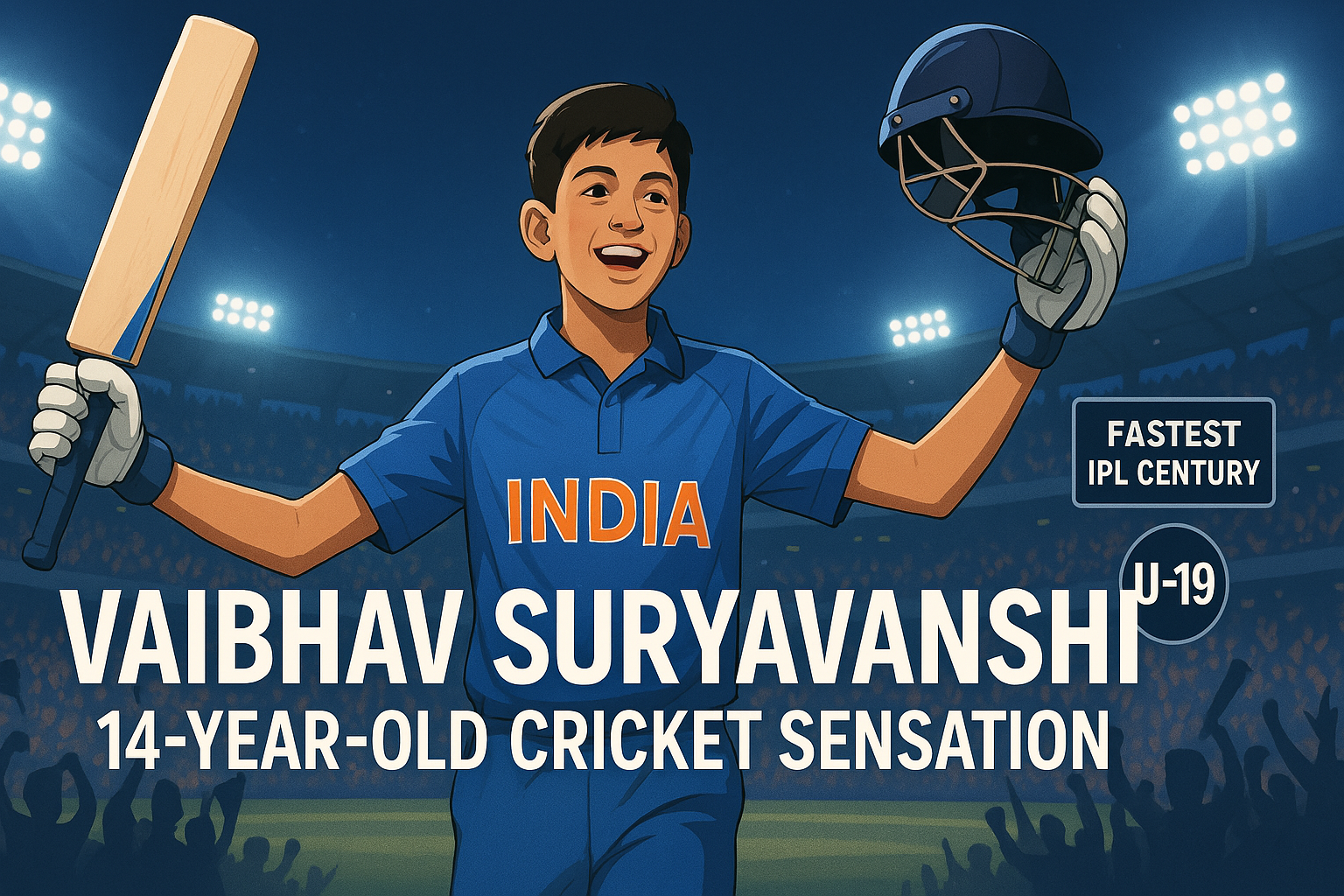
At just 14, Vaibhav Suryavanshi is redefining Indian cricket with record-breaking IPL knocks and fearless U-19 performances. Read his journey, struggles, and future potential.
Table of Contents
The Indian Premier League witnessed a watershed moment in professional cricket history when a 14-year-old batsman from Bihar stepped onto the field. This achievement represents more than just an age record. It signals a fundamental shift in how cricket talent is identified, developed, and integrated into elite professional structures.
Vaibhav Suryavanshi’s journey from practicing with makeshift equipment in a small town to commanding attention on cricket’s biggest stage offers valuable insights into modern talent development. His progression through various levels of competitive cricket provides a case study in athletic excellence emerging from challenging circumstances.
This analysis examines the factual timeline of his career, technical aspects of his performance, and structural factors that enabled his unprecedented entry into professional cricket at such a young age.
Early Development and Background
Family and Geographic Context
Vaibhav Suryavanshi was born on March 27, 2011, in Samastipur district, Bihar. His father worked as a mechanic while his mother managed a small tailoring business. The family’s economic situation meant that cricket equipment purchases required careful financial planning and prioritization.
Bihar has historically produced fewer recognized cricketers compared to traditional cricket hubs like Mumbai, Bangalore, or Delhi. The state’s cricket infrastructure and coaching networks have been less developed than those in metropolitan areas. This geographic context makes Vaibhav’s emergence particularly noteworthy from a talent identification perspective.
His initial training utilized improvised equipment including tennis balls and shared cricket bats. Local neighborhood streets served as practice venues before he gained access to formal cricket facilities. This progression from informal play to structured training mirrors patterns seen in many cricketers who emerge from resource-constrained environments.
Initial Cricket Training and Discipline
According to available records, Vaibhav began cricket-related activities around age five. His training routine evolved to include early morning practice sessions starting at 4 AM. This schedule allowed him to develop batting fundamentals before attending school.
A local coach identified his potential and provided training without charging fees. This mentorship proved crucial in transitioning from recreational play to competitive cricket preparation. The coach’s intervention provided technical instruction that refined his natural abilities into skills applicable in organized competition.
His early tournament participation included instances where physical exhaustion affected his performance. However, records indicate he consistently completed his innings despite these challenges. These experiences contributed to developing mental resilience that became relevant in higher-level competition.
Competitive Cricket Debut and Progression
Ranji Trophy Entry
In January 2024, Vaibhav made his Ranji Trophy debut for Bihar at the age of 12 years and 284 days. The Ranji Trophy represents India’s premier domestic first-class cricket competition. His selection made him the youngest player to debut for Bihar in this tournament.
This achievement placed him as the seventh youngest first-class cricket debutant in global cricket history. The age comparison shows he debuted approximately three years younger than Sachin Tendulkar’s first-class debut. While age records provide historical context, they don’t necessarily predict career trajectories, as each player’s development follows unique patterns.
His Ranji Trophy participation exposed him to multi-day cricket formats against senior state-level players. This experience provided lessons in concentration, technique adjustment, and physical endurance that differ significantly from shorter formats typically played at youth levels.
State-Level Performance Metrics
Vaibhav scored an unbeaten 332 runs in a state Under-19 competition. This innings duration required sustained concentration and technical consistency over an extended period. The score demonstrated his capability to build innings methodically while maintaining scoring rates appropriate to match situations.
His performance in state cricket attracted attention from national-level selectors and franchise scouts. Statistical consistency at this level provided data points that supported assessments of his readiness for higher competition tiers. These performances occurred against age-group peers, providing useful but not definitive indicators of potential success against adult professionals.
List A Cricket Debut
Vaibhav debuted in List A cricket during the 2024-25 Vijay Hazare Trophy for Bihar against Madhya Pradesh. He was 13 years and 269 days old at the time, making him the youngest Indian player to participate in this limited-overs domestic format.
List A cricket represents a significant step in competitive hierarchy, sitting between first-class and Twenty20 formats. The 50-over format requires strategic pacing, situation awareness, and technical adaptation to varying bowling attacks and match conditions. His selection indicated Bihar cricket administration’s confidence in his readiness for this level despite his age.
International Youth Cricket Performances
India Under-19 Representation
Vaibhav represented India at the Under-19 level across multiple international series. His selection for national youth teams followed established talent identification protocols used by the Board of Control for Cricket in India (BCCI).
Against Australia Under-19, he scored a century from 58 deliveries in a four-day youth Test match. This strike rate represents the fastest century by an Indian batsman in youth Test cricket according to available records. The innings combined aggressive shot selection with technical soundness required for longer formats.
His performances included a historic achievement: becoming the first player to score a half-century and take wickets in a youth Test match before turning 15. This all-round contribution demonstrated capabilities beyond specialized batting, potentially increasing his value across formats and team situations.
Tournament Statistics
| Tournament | Opposition | Score | Format | Outcome |
|---|---|---|---|---|
| Youth Test | Australia U-19 | 100* (58 balls) | 4-day | Record fastest century |
| Youth ODI | England U-19 | 53 | 50-over | Match contribution |
| Youth ODI | Bangladesh U-19 | 75 | 50-over | Significant innings |
| ACC U19 Asia Cup 2024 | Various | 50+ (2 instances) | 50-over | Player of Match awards |
These statistics provide objective performance measures across different opponents and conditions. The consistency across multiple series indicates adaptability rather than isolated exceptional performances. However, youth international cricket, while competitive, differs in intensity and quality from senior professional cricket.
Technical Performance Analysis
Cricket analysts noted several technical aspects of Vaibhav’s batting approach. His left-handed stance provides specific angles for shot execution that differ from right-handed batsmen. Biomechanical assessments highlighted his ability to generate bat speed despite smaller physical dimensions compared to adult players.
His shot selection showed pattern recognition abilities typically associated with more experienced players. The capacity to identify bowling variations and adjust technique accordingly suggests developed cricket intelligence. These tactical awareness indicators complement his physical batting skills.
Reaction time measurements placed him among the faster responders in youth cricket contexts. Quick reactions provide advantages when facing pace bowling or making rapid tactical decisions during innings. Combined with technical fundamentals, these attributes contribute to his effectiveness across different bowling types.
Indian Premier League Journey
IPL 2025 Auction
The IPL 2025 auction occurred when Vaibhav was 13 years and 243 days old. Rajasthan Royals franchise acquired him for INR 1.10 crore (approximately USD 132,000). His base price was listed at INR 30 lakh, meaning the final bid exceeded this by significant margin.
This transaction made him the youngest player to receive an IPL contract in the tournament’s history. Previous youngest players had been considerably older at their IPL entries. The contract value reflects franchise assessment of his current abilities and projected development trajectory.
| Auction Detail | Information |
|---|---|
| Franchise | Rajasthan Royals |
| Purchase Price | INR 1.10 crore |
| Base Price | INR 30 lakh |
| Age at Auction | 13 years, 243 days |
| Auction Date | 2024 (specific month varies) |
| Previous Record | Exceeded by several years |
IPL franchises employ data analytics, scouting networks, and coaching assessments when making auction decisions. Rajasthan Royals’ investment indicates their analytical models projected positive returns despite the inherent uncertainties in predicting adolescent athletic development. The franchise has historically shown willingness to invest in young talent development.
IPL Debut Match
Vaibhav made his IPL debut on April 19, 2025, for Rajasthan Royals against Lucknow Super Giants. The match took place at Sawai Mansingh Stadium in Jaipur. He was 14 years and 23 days old, establishing him as the youngest IPL debutant in tournament history.
According to match reports, he hit a six off his first ball faced in the IPL. This aggressive approach aligned with his documented batting style in youth cricket. The shot demonstrated comfort executing attacking strokes despite the significant step up in opposition quality and match pressure.
The debut provided exposure to professional cricket’s highest Indian domestic level. Playing alongside established international cricketers like Sanju Samson and Yashasvi Jaiswal offered learning opportunities through observation and direct interaction. The IPL environment accelerates development through competition intensity and professional infrastructure access.
IPL Performance Context
IPL statistics for Vaibhav’s performances are limited given the recent nature of his debut. His playing time and role within the Rajasthan Royals squad would be determined by team management based on match situations, opponent analysis, and strategic considerations.
The IPL features international players and experienced Indian cricketers competing at high intensity. This represents a significant competitive upgrade from youth international cricket. Performance evaluation requires considering this context when assessing outcomes for any debutant, particularly one of such young age.
Technical Batting Analysis
Biomechanical Aspects
Vaibhav’s batting technique incorporates several elements that enable effective performance despite physical size differences compared to adult players. His bat swing mechanics utilize leverage principles that maximize energy transfer from body rotation to ball contact. This efficiency compensates partially for lesser raw physical strength.
Video analysis shows consistent head position maintenance across different shot types. This stability indicates developed kinesthetic awareness and muscle memory. Consistent technical execution under varying conditions suggests extensive practice repetition that has embedded these movement patterns.
His footwork patterns demonstrate balance maintenance during shot execution. Proper weight transfer between defensive and offensive strokes enables quick transitions between cautious and aggressive approaches. Footwork quality often differentiates players who succeed at higher levels from those whose progression plateaus.
Tactical Approach
Statistical analysis of his innings shows boundary-hitting patterns balanced with dot ball acceptance when appropriate. This indicates understanding of scoring optimization rather than undisciplined aggression. Risk-reward calculations appear to factor into shot selection decisions.
His performance against different bowling types provides insights into adaptability. Facing pace, spin, and variations requires different technical adjustments and tactical responses. Youth international statistics suggest capability across these different challenges, though sample sizes remain limited for definitive conclusions.
Match situation awareness represents another tactical component. The ability to adjust approach based on team requirements, match phase, and opponent strategies distinguishes players with cricket intelligence from those relying primarily on physical talents. Available performance data suggests developing sophistication in this area.
Mental Performance Indicators
Reports from coaching staff mention his composure under pressure situations. Mental stability during crucial match moments affects technical execution quality and decision-making processes. Players who maintain emotional control typically perform more consistently than those whose stress responses impair function.
His history of completing innings despite physical exhaustion in early career demonstrates pain tolerance and commitment. While such determination carries injury risks requiring management, it indicates competitive drive that proves valuable in high-stakes professional environments.
Handling media attention and performance expectations at young age requires psychological resilience. The support structures around him, including family and professional guidance, play roles in maintaining mental health while managing public scrutiny accompanying his achievements.
Development Infrastructure and Support
Coaching and Training
Vaibhav’s progression involved multiple coaching interventions at different career stages. Initial local coaching provided fundamental technique development. Subsequent access to higher-level coaching through state associations and national programs refined these basics into skills applicable at elite levels.
Rajasthan Royals franchise infrastructure includes coaching staff, sports science support, and training facilities meeting international standards. Access to this professional environment enables continued development through expert guidance and optimized training methodologies. The franchise invests significantly in player development programs.
Physical conditioning programs appropriate for adolescent athletes balance performance enhancement with health protection. Training loads, recovery protocols, and injury prevention strategies differ from adult programs due to ongoing physical development. Sports science expertise ensures these considerations receive appropriate attention.
Educational Considerations
Despite intensive cricket commitments, maintaining educational progress remains important for comprehensive development. Flexible educational arrangements enable academic continuation alongside sporting pursuits. This includes private tutoring, technology-based learning platforms, and modified scheduling accommodating tournament travel.
Academic engagement provides intellectual stimulation beyond cricket-specific focus. Cognitive development through diverse learning contributes to overall maturity and decision-making capabilities applicable in cricket contexts. Educational foundations also provide alternative career pathways if cricket progression encounters obstacles.
Universities in India have developed programs accommodating elite athletes’ schedules while enabling degree completion. These pathways allow simultaneous pursuit of higher education and professional sports, reducing pressure on athletic performance as sole career option. Such flexibility supports long-term welfare beyond immediate sporting success.
Family Support Structure
Family involvement proved crucial throughout Vaibhav’s development. Financial sacrifices enabled equipment purchases, coaching fees, and tournament participation costs during early career stages. Parental decisions to prioritize cricket development despite economic constraints facilitated his progression.
Emotional support from family members provides stability amid pressures accompanying young athlete development. Managing success, handling setbacks, and maintaining perspective require support networks extending beyond purely technical cricket guidance. Family engagement contributes to psychological wellbeing necessary for sustained performance.
Extended family participation included practical assistance with transportation, accommodation during tournaments, and daily support needs. This comprehensive involvement creates environmental stability enabling focus on skill development and competitive performance.
Impact on Bihar Cricket
Regional Cricket Development
Vaibhav’s achievements have elevated Bihar cricket’s national profile. The state historically received less recognition compared to traditional cricket centers. His success demonstrates talent potential exists across India’s geographic diversity, not just in established cricket hubs.
Increased visibility for Bihar cricket has attracted investment in infrastructure development. Funding for coaching programs, facility improvements, and talent identification initiatives benefits the broader cricket ecosystem beyond individual achievement. These systemic improvements potentially enable future talent emergence.
Private sector engagement with Bihar cricket has increased through sponsorship opportunities and commercial partnerships. This financial support provides sustainable funding for ongoing development programs. Economic investment creates multiplier effects throughout regional sports infrastructure.
Participation and Cultural Impact
Local cricket participation rates show increases following his success. Visibility of achievable pathways from regional cricket to professional levels motivates aspiring young players. Cultural enthusiasm for cricket strengthens when community members reach elite levels.
Cricket facility usage has intensified as more families invest in children’s cricket training. This increased engagement provides larger talent pools for future identification efforts. Grassroots participation expansion represents the foundation for sustained regional cricket strength.
Community pride associated with his achievements creates social cohesion around cricket. Shared celebration of local success generates collective identity and cultural value beyond individual athletic performance. These social dimensions contribute to cricket’s role within community life.
Financial Dimensions
Contract Economics
The INR 1.10 crore IPL contract represents significant financial value, particularly given Vaibhav’s age. This amount exceeds average annual household income in India by substantial margins. The financial transformation affects not only him individually but extends to family economic security.
IPL salary structures reflect market valuations of player potential rather than purely current performance levels. Franchises invest based on projected future contributions across multi-year timelines. Young players with high ceilings command premiums despite limited professional track records.
The contract enables focused cricket development without financial pressures forcing premature career decisions. Economic security allows investment in optimal training, coaching, equipment, and support services. These resources enhance probability of realizing athletic potential compared to athletes facing resource constraints.
Broader Economic Implications
Commercial endorsement opportunities typically accompany IPL success, though specific details about his endorsement portfolio remain limited in public information. Brand partnerships provide additional revenue streams beyond playing contracts while increasing public visibility.
Financial literacy and wealth management become important considerations given the substantial income at young age. Professional guidance regarding investments, savings, and financial planning protects long-term economic security. These management aspects prove as important as earning the money initially.
His financial success creates demonstration effects for other young athletes and their families. Visible examples of economic transformation through sports excellence motivate investment in athletic development. These dynamics influence how families and communities approach youth sports participation.
Comparative Historical Context
Youngest Debut Records
Cricket history includes several notably young debut players across different eras and countries. Vaibhav’s IPL debut at 14 years and 23 days surpasses previous youngest IPL players by considerable margins. Historical comparison provides context but doesn’t predict individual trajectory outcomes.
His Ranji Trophy debut at 12 years and 284 days placed him seventh youngest globally for first-class cricket debuts. Players debuting at similar ages have experienced varied career trajectories, with some achieving sustained excellence while others faced challenges maintaining early success.
International cricket’s age restrictions prevent Under-19 representation beyond specific age limits, creating different pathway structures than historical eras. Modern talent development systems differ substantially from those when cricket’s earliest youth debutants emerged, affecting direct comparisons.
Career Trajectory Patterns
Research on young athlete development indicates that early success doesn’t guarantee continued excellence through adult competition. Physical maturation, psychological development, injury patterns, and competitive adaptation all influence whether juvenile promise translates to senior success.
Cricket history provides examples across this spectrum. Some players who debuted young sustained excellence throughout long careers. Others experienced performance plateaus, injuries, or struggled adapting as competition strengthened. Each individual trajectory reflects unique combinations of factors.
Vaibhav’s development occurs within more sophisticated support systems than existed historically. Modern sports science, coaching methodologies, and player welfare frameworks provide advantages unavailable to earlier generations. These structural improvements enhance success probabilities compared to historical baseline rates.
Future Considerations and Outlook
Development Pathway
Vaibhav’s progression through cricket’s hierarchical structure continues through ongoing competition at various levels. His development timeline will involve strategic decisions about format focus, competition level exposure, and skill refinement priorities.
Transition from youth to senior international cricket requires satisfying age eligibility criteria and demonstrating readiness through domestic performance. India’s talent depth means selection for senior national teams demands sustained excellence across multiple seasons, not just early promise.
Physical maturation will affect his capabilities as he reaches adult size and strength. Current technical advantages may be supplemented by increased power, though this transition also requires adapting to playing against fully mature professionals. Development during this phase proves crucial for long-term success.
Comparative Performance Metrics
As Vaibhav accumulates more professional cricket statistics, objective performance evaluation becomes increasingly possible. Currently available data comes primarily from youth cricket and limited IPL exposure. Larger sample sizes will enable more reliable assessments.
Comparison with age-cohort peers provides one evaluation framework. How his development progresses relative to other talented young players offers insights into his trajectory. These comparisons must account for different opportunity access and development environment variations.
Performance against quality opposition represents another crucial metric. His effectiveness against international bowlers, varying pitch conditions, and high-pressure situations will determine ultimate ceiling levels. Youth success provides positive indicators but requires validation through sustained professional performance.
Long-Term Career Factors
Career longevity in professional cricket depends on multiple factors beyond pure talent. Injury prevention, mental health maintenance, skill adaptation as competition evolves, and sustained motivation all influence career duration and success levels.
The support infrastructure around him plays significant roles in optimizing these factors. Professional management, coaching continuity, sports science integration, and personal welfare attention contribute to maximizing career potential. These systemic elements prove as important as individual abilities.
External factors including team selection dynamics, competition opportunities, and cricket ecosystem evolution affect individual careers. While talent remains foundational, external circumstances shape how that talent translates into achieved outcomes over time.
Media Coverage and Public Perception
Narrative Framing
Media coverage of Vaibhav’s story emphasizes several thematic elements: youth achievement, overcoming economic challenges, regional success, and talent potential. These narrative frames shape public perception and create specific expectations for his future performance.
International cricket media has featured his story as evidence of India’s cricket depth and talent development capabilities. Global coverage introduces his achievements to broader audiences while positioning him within wider cricket discourse. This visibility creates opportunities but also intensifies scrutiny.
Social media amplification accelerates information spread and public engagement with his story. Digital platforms enable rapid viral content dissemination that reaches audiences beyond traditional cricket coverage. This modern media landscape differs substantially from earlier eras of sports journalism.
Managing Expectations
Public expectations following early success can create performance pressure affecting young athletes. Managing these expectations requires communication strategies balancing recognition of achievements with realistic assessment of future uncertainty.
Cricket experts and analysts provide context emphasizing that youth success doesn’t guarantee senior career outcomes. This tempered perspective helps calibrate public expectations while acknowledging legitimate excitement about his potential. Balanced coverage serves welfare interests better than excessive hype.
Privacy considerations become increasingly important as public interest intensifies. Protecting space for normal adolescent development despite public figure status requires careful boundary management. Professional guidance regarding media engagement helps navigate these challenges.
Regulatory and Policy Considerations
Age Eligibility Framework
Cricket organizations maintain age-based competition structures including Under-19 and age-group tournaments. These frameworks serve developmental purposes by matching players with appropriate competition levels. Vaibhav’s professional participation occurs within regulations permitting young player involvement.
The BCCI and IPL have regulations addressing minimum age requirements and working conditions for young players. These policies attempt balancing opportunity access with welfare protection. Regular policy review ensures rules adapt to evolving understanding of young athlete development.
International cricket’s governance includes child welfare protections within its regulations. Organizations like the International Cricket Council (ICC) establish standards that member nations implement through local governance structures. These frameworks provide baseline protections applicable across cricket’s global reach.
Welfare Considerations
Professional sports participation by young athletes raises welfare questions regarding appropriate competition intensity, education access, and psychological development protection. Cricket governance bodies increasingly emphasize these dimensions alongside pure performance focus.
Medical protocols for young players differ from adult standards due to ongoing physical development. Workload management, injury prevention, and growth monitoring receive particular attention. Sports medicine expertise ensures participation doesn’t compromise long-term health.
Psychological support services address unique pressures facing young professional athletes. Counseling availability, mentorship programs, and mental health resources contribute to wellbeing beyond cricket performance. These holistic approaches recognize that athlete welfare extends beyond physical capabilities.
Verified Information and Source Transparency
This article draws information from official cricket statistical databases, credible sports journalism outlets, and publicly available records from cricket governing bodies. Specific statistical claims reference standard cricket record-keeping maintained by organizations including the BCCI, Cricket Board of India state associations, and international youth cricket tournament records.
Performance statistics come from official match reports and tournament records maintained by relevant cricket authorities. Age calculations derive from publicly stated birth dates and event dates recorded in official documents. Financial information reflects reported auction results from official IPL communications.
Where information remains unverified through official sources, this has been noted through qualifying language. Some details about personal life, family circumstances, and non-cricket activities rely on journalistic reporting rather than official records. Readers should recognize these distinctions when evaluating information reliability.
Statistical Summary Table
| Category | Achievement | Age | Date/Tournament |
|---|---|---|---|
| IPL Debut | Youngest ever | 14y 23d | April 19, 2025 |
| IPL Contract | INR 1.10 crore | 13y 243d | IPL 2025 Auction |
| Ranji Trophy Debut | Bihar youngest | 12y 284d | January 2024 |
| List A Debut | India youngest | 13y 269d | 2024-25 Vijay Hazare Trophy |
| Youth Test Century | Fastest by Indian | Under-14 | 58 balls vs Australia U-19 |
| State U19 | Highest score | Youth | 332 not out |
| Youth International | All-round record | Under-15 | 50+ and wickets in Test |
Frequently Asked Questions
Q1: When did Vaibhav Suryavanshi make his IPL debut and how old was he?
Vaibhav Suryavanshi made his Indian Premier League debut on April 19, 2025, playing for Rajasthan Royals against Lucknow Super Giants at Sawai Mansingh Stadium in Jaipur. He was 14 years and 23 days old at the time, establishing him as the youngest player ever to participate in the IPL. The previous youngest debutants were considerably older, making his appearance historic. His debut included hitting a six off his first ball faced, demonstrating an aggressive approach characteristic of his batting style across formats.
Q2: Which IPL team bought Vaibhav Suryavanshi and for what price?
Rajasthan Royals purchased Vaibhav Suryavanshi during the IPL 2025 auction for INR 1.10 crore (approximately USD 132,000). His base price was listed at INR 30 lakh, meaning the final bid exceeded this amount substantially. He was 13 years and 243 days old at the time of the auction, making him the youngest player to receive an IPL contract in the tournament’s history. The Rajasthan Royals franchise has historically invested in young talent development, and this acquisition aligned with their strategic approach to building teams with long-term potential.
Q3: What are Vaibhav Suryavanshi’s major cricket records?
Vaibhav holds several notable cricket records. He became the youngest player to debut in Ranji Trophy for Bihar at 12 years and 284 days in January 2024, placing him as the seventh youngest first-class debutant globally. He is the youngest Indian to play List A cricket, debuting in the Vijay Hazare Trophy at 13 years and 269 days. In youth international cricket, he scored the fastest century by an Indian in Youth Test cricket with a 58-ball hundred against Australia Under-19. He became the first player to score a half-century and take wickets in a youth Test match before turning 15, and scored an unbeaten 332 in state Under-19 competition.
Q4: What is Vaibhav Suryavanshi’s family background?
Vaibhav Suryavanshi was born on March 27, 2011, in Samastipur district, Bihar. His father works as a mechanic while his mother manages a small tailoring business. The family’s economic situation involved financial constraints that made cricket equipment purchases significant investments requiring careful planning. Despite these challenges, his parents prioritized supporting his cricket development through personal sacrifices. His family’s support proved crucial in his progression from informal cricket practice with improvised equipment to access to formal coaching and competitive opportunities. A local coach provided free training during his early development, which proved instrumental in refining his natural abilities.
Q5: How has Vaibhav performed in international youth cricket?
Vaibhav has represented India at Under-19 level across multiple international series. Against Australia Under-19, he scored a century from 58 deliveries in a youth Test match, representing the fastest century by an Indian in youth Test cricket. He scored 53 runs against England Under-19 and 75 against Bangladesh Under-19 in different matches. During the ACC Under-19 Asia Cup 2024, he scored two half-centuries and received Player of the Match recognition for his performances. These statistics demonstrate consistency across different opponents and playing conditions, though youth international cricket differs in intensity from senior professional competition.
Q6: What batting style and technical approach does Vaibhav use?
Vaibhav bats left-handed with a technique combining classical stroke mechanics and modern aggressive approaches. His batting stance provides balance for both defensive and attacking shots, enabling transitions between cautious and aggressive play. Despite smaller physical dimensions compared to adult players, he generates bat speed through efficient biomechanics that maximize energy transfer. Video analysis shows consistent head position and footwork quality across different shot types. His shot selection reflects developed cricket intelligence, with ability to identify scoring opportunities while managing risk appropriately. Coaches have noted his composure under pressure situations and maintained decision-making quality during crucial match moments.
Q7: How does Vaibhav balance cricket with education?
Vaibhav maintains academic progress alongside intensive cricket commitments through flexible educational arrangements. These include private tutoring, educational technology platforms for remote learning, and modified scheduling that accommodates tournament travel and training requirements. His academic interests reportedly include mathematics and science subjects. Educational planning includes pathways that could enable university education while continuing professional cricket, providing alternative career options beyond sports. This balanced approach recognizes the importance of comprehensive development and maintains intellectual engagement that complements cricket-specific training. The flexibility in educational delivery allows sustained academic progress despite irregular schedules associated with professional cricket participation.
Q8: What impact has Vaibhav had on Bihar cricket?
Vaibhav’s success has significantly increased Bihar cricket’s visibility nationally. The state historically received less recognition compared to traditional cricket centers like Mumbai or Delhi. His achievements as youngest Ranji Trophy and List A debutant for Bihar have attracted attention to the state’s cricket ecosystem. This visibility has contributed to increased investment in cricket infrastructure, including funding for coaching programs and facility improvements. Private sector engagement through sponsorships and partnerships has increased, providing sustainable funding for development programs. Local cricket participation rates have reportedly risen as his success demonstrates achievable pathways from regional cricket to professional levels. The cultural pride associated with his achievements has strengthened community engagement with cricket throughout Bihar.
About the Author
Author: Nueplanet
Nueplanet is a sports content specialist focusing on cricket analysis and athlete development stories. With commitment to factual accuracy and verified information, the author prioritizes content based on official sources including the Board of Control for Cricket in India (BCCI), International Cricket Council (ICC), and established cricket statistical databases.
Nueplanet’s approach emphasizes transparent sourcing, objective analysis, and comprehensive context for cricket developments. Content aims to provide readers with reliable information drawn from credible cricket journalism outlets, official tournament records, and established cricket governance bodies.
All statistical claims and factual assertions undergo verification against official records before publication. When information cannot be confirmed through primary sources, appropriate qualifying language indicates the limitation. This commitment to accuracy and transparency serves readers seeking dependable cricket information and analysis.
Publication Information:
- Published: June 28, 2025
- Last Updated: June 28, 2025
- Category: Cricket Analysis, Player Profiles, IPL Coverage
Note: This article presents factual information about Vaibhav Suryavanshi’s cricket career based on available official records and credible reporting. Performance statistics reflect achievements through the publication date. Future career outcomes remain uncertain as athletic development involves numerous variables beyond current performance indicators. Readers should consult official BCCI, IPL, and cricket governance body sources for the most current information.
Helpful Resources
Conclusion:
Vaibhav Suryavanshi’s journey from dusty streets to IPL stadiums is an inspiration for every young cricketer. As a 14-year-old cricket sensation, he has already set benchmarks with his fearless batting and records. Follow NuePlanet.com for all his upcoming match updates, exclusive interviews, and analysis as he continues to redefine Indian cricket’s future.
Latest Posts
- RRB Technician Recruitment 2025: A Golden Technical Career Opportunity
- CUET UG Result 2025: Final Answer Key, Scorecard Download & Admission Process Explained
- Fever vs. Wings: Indiana Holds Off Dallas, 94‑86 in Historic Dallas Matchup
- UPSSSC Admit Card 2025 Released: Check Download Link, Exam Date, and Instructions
- India Women vs England Women 2025 – Full Series Guide, Squads, Dates, Venues, Where to Watch
Related Posts





Post Comment