








SSC MTS Notification 2025: Selection Process, Dates & Eligibility
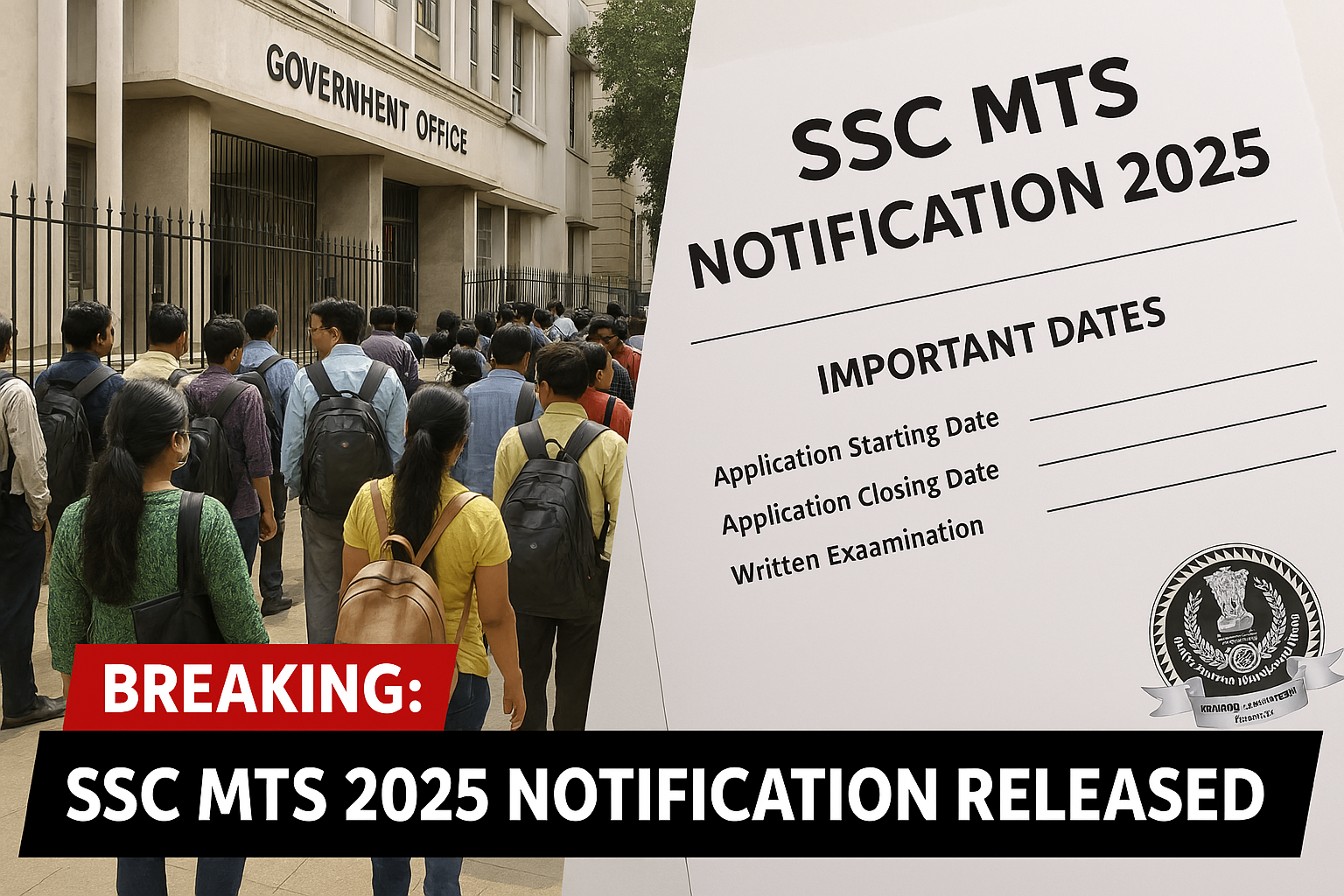
The Staff Selection Commission will release the SSC MTS (Multi-Tasking Staff) and Havaldar 2025 notification on June 26, 2025. This recruitment drive offers opportunities for Group-C government positions across various departments. Candidates can access the notification through the official website ssc.gov.in.
This guide provides detailed information about the application process, eligibility criteria, examination pattern, and selection procedure. The information presented is based on official SSC guidelines and historical recruitment patterns to help candidates prepare effectively.
Understanding SSC MTS and Havaldar Recruitment
The SSC MTS recruitment selects candidates for Multi-Tasking Staff positions in central government departments. These positions involve administrative support, document management, and general maintenance duties. The recruitment follows a transparent selection process based on merit and qualification standards.
The Havaldar positions are specific to the Central Board of Indirect Taxes and Customs (CBIC) and Central Board of Narcotics (CBN). These roles focus on enforcement, security operations, and documentation verification. Both recruitment categories provide stable career paths with promotion opportunities.
Key Updates in 2025 Recruitment Cycle
The 2025 notification introduces several procedural improvements. The application system now includes live photograph capture during registration to verify candidate identity. This measure enhances the authenticity of applications and reduces impersonation risks.
The digital application process eliminates physical documentation during initial submission. Candidates complete all forms online with document uploads in specified formats. Regional language support in the application interface makes the process accessible to candidates from different linguistic backgrounds.
Position-Specific Responsibilities and Career Growth
Multi-Tasking Staff (Non-Technical) Roles
MTS positions are available across central government offices and departments. Daily responsibilities include administrative assistance, maintaining filing systems, basic data entry operations, and general office maintenance. Reception duties and visitor assistance form part of the job profile.
Career advancement occurs through departmental promotion quotas. Experienced MTS employees can progress to clerical positions based on performance evaluations. Additional qualifications and training programs enable movement to specialized departmental roles.
Havaldar Positions in CBIC and CBN
Havaldar recruits work in customs enforcement and anti-smuggling operations. Duties include border security support, documentation processing, and physical security at government installations. The role requires alertness and adherence to security protocols.
Training programs provide specialized knowledge in law enforcement procedures. Career progression within enforcement departments offers supervisory positions and specialized assignments. The role combines field operations with administrative responsibilities.
Eligibility Requirements for SSC MTS 2025
Educational Qualification Standards
Candidates must have passed the Class 10 (Secondary School) examination from a recognized educational board. The requirement accepts certificates from CBSE, ICSE, state education boards, and the National Institute of Open Schooling (NIOS). International boards recognized in India also qualify.
The qualification must be completed before the application deadline. Candidates appearing for Class 10 examinations cannot apply until results are declared. Marksheets must clearly indicate pass status and year of completion.
Age Limit and Category-Based Relaxations
Age criteria follow standard SSC recruitment patterns. The typical range for General category candidates spans 18 to 25 years. Reserved category candidates receive age relaxations as per government norms.
Scheduled Caste and Scheduled Tribe candidates usually receive five years of relaxation. Other Backward Classes typically get three years of additional age consideration. Persons with Disabilities receive ten years of relaxation, with cumulative benefits for reserved categories.
Ex-servicemen receive age relaxation based on their service duration. The age calculation date references January 1st of the examination year. Precise cutoff dates appear in the official notification upon release.
Step-by-Step Application Process
Pre-Application Document Preparation
Gather all necessary documents before starting the online application. Required items include Class 10 marksheet, birth certificate or equivalent age proof, and recent passport-size photographs. Category certificate holders should prepare SC/ST/OBC certificates issued by competent authorities.
Ensure document scans meet specified size and format requirements. Photographs should have plain backgrounds with clear facial visibility. Digital files must be in JPG or PDF format within prescribed file size limits.
Online Registration Procedure
Visit the official SSC website at ssc.gov.in during the application window. Create a candidate profile using a valid email address and mobile number. Choose a secure password following the system requirements.
Complete the registration form with accurate personal details. Enter information exactly as it appears on official documents to avoid verification issues. The system validates critical fields like date of birth and educational qualifications.
Application Form Completion
Fill all sections of the application form systematically. Provide educational details including board name, roll number, and year of passing. Enter category information if claiming reservation benefits under SC/ST/OBC/PH quotas.
Select exam center preferences from the available options. Choose centers accessible from your location for examination convenience. Upload scanned documents in designated sections following size specifications.
The live photograph capture feature activates during application submission. Position yourself properly with adequate lighting for clear image capture. The system validates photograph quality before accepting the submission.
Fee Payment Methods
General and OBC category candidates pay ₹100 as examination fee. SC, ST, women, Persons with Disabilities, and Ex-servicemen candidates are exempt from fee payment. Female candidates from all categories receive fee exemption.
Payment options include debit cards, credit cards, net banking, and digital wallets. SBI Challan facility remains available for offline payment at designated bank branches. Complete payment within the specified timeframe to validate your application.
Save payment confirmation receipts and transaction reference numbers. These details help track payment status and resolve any transaction issues. Unsuccessful payment attempts require fresh transaction initiation.
Final Review and Submission
Review all entered information carefully before final submission. Check personal details, educational qualifications, and uploaded documents for accuracy. The system allows corrections during a designated window after initial submission.
Submit the completed application form and generate the confirmation page. Download and print multiple copies of the confirmation receipt. The confirmation page contains your registration number and application details.
Keep digital and physical backups of all application-related documents. These records prove useful during document verification and future correspondence with SSC.
Examination Pattern and Syllabus Details
Computer-Based Test Structure
The CBT consists of two sessions conducted on the same day. Both sessions are mandatory, and candidates must appear for complete examination. The test format includes objective-type multiple-choice questions.
Session I Duration: 90 minutes
Total Questions: 40
Maximum Marks: 120
Session II Duration: 90 minutes
Total Questions: 50
Maximum Marks: 150
Session I: Numerical and Reasoning Assessment
General Intelligence & Reasoning (20 Questions – 60 Marks)
This section tests logical thinking and problem-solving abilities. Questions cover analogies requiring pattern identification and relationship establishment. Classification problems test grouping abilities based on common characteristics.
Series completion questions assess sequential understanding. Coding-decoding problems evaluate symbolic and alphabetic pattern recognition. Direction sense questions test spatial orientation and navigation skills.
Blood relations questions examine family relationship understanding. Logical arrangement problems test sequencing and ordering capabilities. Statement analysis questions evaluate logical conclusion drawing from given information.
Numerical Ability (20 Questions – 60 Marks)
Questions test fundamental arithmetic operations and their applications. Percentage problems involve calculation and real-world application scenarios. Profit and loss questions assess commercial mathematics understanding.
Interest calculations cover both simple and compound interest formulas. Time and work problems test efficiency and collaboration calculations. Distance-speed-time questions evaluate motion and rate problems.
Data interpretation questions use tables, charts, and graphs. Problems require extracting information and performing calculations based on presented data.
Session II: Language and Awareness Assessment
General Awareness (25 Questions – 75 Marks)
This section covers current affairs from the preceding six months. Questions include important national and international developments, government schemes, and policy announcements. Sports events, awards, and appointments form regular question topics.
Indian history questions span ancient, medieval, and modern periods. The freedom movement and constitutional development receive significant coverage. Geography questions test physical features, climate patterns, and economic geography knowledge.
Polity questions cover constitutional provisions, fundamental rights, and government structure. Basic economics includes national income, inflation, and financial institutions. Science topics cover physics, chemistry, biology basics, and technological developments.
Environmental science questions address conservation, pollution, and sustainability. Cultural heritage questions test knowledge of Indian art, literature, and traditions.
English Language & Comprehension (25 Questions – 75 Marks)
Reading comprehension passages test understanding and interpretation skills. Questions assess main idea identification, inference drawing, and detail comprehension. Vocabulary questions evaluate word meanings through synonyms and antonyms.
Grammar sections cover parts of speech, tenses, and sentence structure. Error detection questions identify grammatical mistakes in given sentences. Sentence completion tests contextual word usage and logical expression.
Voice change questions convert between active and passive constructions. Narration questions test direct and indirect speech conversion. Fill-in-the-blanks assess appropriate word choice in context.
Marking Scheme and Strategy
Session I follows no negative marking policy. Candidates can attempt all questions without penalty for incorrect answers. This encourages comprehensive attempts while managing time effectively.
Session II implements negative marking of 1 mark per wrong answer. Strategic answer selection becomes crucial to maximize scores. Candidates should attempt questions with reasonable confidence to avoid unnecessary mark deductions.
The total score calculation combines both sessions. Higher marks in Session II carry more weight in final merit determination. Balanced preparation across all sections ensures competitive scores.
Document Verification Process
Candidates qualifying the CBT receive document verification calls. The commission announces verification schedules with specific dates and reporting times. Candidates must appear personally with original documents and attested copies.
Essential Documents Checklist
Bring Class 10 marksheet and passing certificate as educational proof. Date of birth certificate or equivalent acceptable documents establish age eligibility. Government-issued photo identity cards (Aadhaar, PAN, Driving License, Passport) verify identity.
Category certificate holders must present original SC/ST/OBC certificates from competent authorities. Certificates must be within validity periods specified in SSC guidelines. Persons with Disabilities bring disability certificates from authorized medical boards.
Recent passport-size photographs matching application submission are required. Signature specimens should match application records. Any discrepancy in documents or signatures may lead to candidature cancellation.
Verification Procedure
Commission officials examine original documents against application details. They verify photograph authenticity and signature consistency. Certificate validity and issuing authority credentials undergo scrutiny.
Candidates fill declaration forms confirming information accuracy. Officials retain attested document copies for records. The verification process typically takes 30-60 minutes per candidate.
Missing documents or information discrepancies result in disqualification. The commission rarely provides second opportunities for document submission. Candidates should ensure document completeness before attending verification.
Physical Standards and Efficiency Tests for Havaldar
Physical Standards Test Requirements
Male Candidates:
- Minimum Height: 157.5 cm
- Chest Measurement: 81 cm (unexpanded) with minimum 5 cm expansion capacity
Female Candidates:
- Minimum Height: 152 cm
- Weight: Proportionate to height and age as per medical standards
Measurements occur under medical supervision. Candidates not meeting standards face disqualification from Havaldar selection. No relaxation in physical standards applies across categories.
Physical Efficiency Test Benchmarks
Male Candidates:
- Walking 1,600 meters in 15 minutes, OR
- Cycling 8 kilometers in 30 minutes
Female Candidates:
- Walking 1 kilometer in 20 minutes, OR
- Cycling 3 kilometers in 25 minutes
Candidates choose between walking and cycling options. The test occurs on designated tracks under official observation. Completing within specified time limits is mandatory for qualification.
Regular cardiovascular exercise beginning three months before tests ensures adequate fitness. Walking, jogging, and cycling practice builds necessary endurance. Consistent training prevents last-minute fitness struggles.
Preparation Strategy for Success
Subject-Wise Preparation Approach
Mathematics and Reasoning Excellence
Build strong foundations in basic arithmetic operations. Practice number system concepts, fractions, decimals, and percentages thoroughly. Progress to advanced topics only after mastering fundamentals.
Develop pattern recognition skills through regular reasoning practice. Solve various question types to understand underlying logic. Time-bound practice builds speed while maintaining accuracy.
Use quality study materials from established publishers. R.S. Aggarwal’s Quantitative Aptitude provides comprehensive coverage. Kiran Publication series offers topic-wise practice with solutions.
English Language Development
Expand vocabulary through daily word learning with contextual usage. Read newspapers and quality English content to improve comprehension. Focus on grammar fundamentals including tenses, articles, and prepositions.
Practice previous year questions to understand examination patterns. Identify weak areas and allocate extra time for improvement. Regular writing practice enhances sentence construction abilities.
General Awareness Preparation
Maintain daily current affairs notes from reliable news sources. The Hindu and Indian Express provide quality coverage of important events. Monthly current affairs magazines offer consolidated information.
Study static GK systematically covering history, geography, and polity. Lucent’s General Knowledge provides concise information on core topics. Manorama Yearbook offers comprehensive annual coverage.
Create subject-wise notes for quick revision. Update current affairs regularly to include recent developments. Link current events with related static GK for better retention.
Time Management and Practice
Structured Preparation Timeline
Months 1-2: Complete syllabus coverage with basic understanding
Months 3-4: Intensive practice with topic-wise tests
Months 5-6: Mock tests and comprehensive revision
Allocate daily study hours consistently. Morning sessions suit high-concentration subjects like mathematics. Evening periods work well for current affairs and revision activities.
Mock Test Strategy
Take regular mock tests simulating actual examination conditions. Analyze performance to identify weak areas requiring additional focus. Track improvement across multiple tests to gauge preparation progress.
Practice time management during mock tests. Develop question selection strategies for maximizing scores. Learn to handle examination pressure through repeated test-taking.
Important Dates and Timeline
June 26, 2025: Official notification release
June 26 – July 24, 2025: Application window (29 days)
June 30, 2025: Correction window closure
August 2025: Admit card release (anticipated)
September 20 – October 24, 2025: Computer-Based Test period
November 2025: Result declaration (estimated)
December 2025 – January 2026: Document verification
February 2026: Final results publication
Dates are based on official notification and historical patterns. Candidates should monitor the official website for any schedule changes. Set reminders for critical dates to avoid missing important deadlines.
Recommended Preparation Resources
Quality Study Materials
Mathematics: R.S. Aggarwal (Quantitative Aptitude), Kiran Publication (MTS-specific guides), Arihant series
Reasoning: A Modern Approach to Verbal & Non-Verbal Reasoning by R.S. Aggarwal
English: Wren & Martin (Grammar), Objective English by Hari Mohan Prasad
General Knowledge: Lucent’s General Knowledge, Manorama Yearbook
Online Learning Platforms
Digital platforms offer structured courses with video lectures. Testbook provides comprehensive test series with performance analytics. Unacademy features experienced faculty covering complete syllabus.
Mobile applications enable learning flexibility and regular practice. Current affairs apps deliver daily updates with quiz features. Choose platforms offering SSC MTS-specific content for focused preparation.
Key Success Factors
Consistent preparation across all subjects ensures balanced performance. Regular practice builds speed and accuracy simultaneously. Mock tests identify improvement areas and build examination confidence.
Stay updated with official communications through ssc.gov.in. Maintain organized documentation for smooth application and verification processes. Approach preparation systematically with clear goals and timelines.
Physical fitness preparation for Havaldar positions requires equal attention. Begin cardiovascular training well in advance of tests. Combined academic and physical preparation maximizes selection chances.
Frequently Asked Questions (FAQ)
1. Which documents are mandatory during online application for SSC MTS 2025?
Candidates need their Class 10 marksheet showing pass status and year of completion. A government-issued photo ID such as Aadhaar card, PAN card, Driving License, or Passport serves as identity proof. Reserved category candidates require valid SC/ST/OBC certificates from competent authorities. Recent digital photographs meeting size specifications (typically 10-50 KB in JPG format) must be uploaded. Persons with Disabilities need disability certificates from authorized medical boards. All documents should be clearly scanned and within prescribed file size limits.
2. Are NIOS Class 10 pass students eligible for SSC MTS 2025 recruitment?
Yes, NIOS (National Institute of Open Schooling) candidates qualify for SSC MTS recruitment. NIOS is recognized by the Ministry of Education, Government of India, making its certificates valid for government job applications. The marksheet must clearly indicate pass status with the year of completion. NIOS candidates receive equal treatment as regular board students during the selection process. Ensure your NIOS certificate contains all required details including board seal and authorized signatures.
3. How does SSC prepare the final merit list for selected candidates?
The final merit list ranks candidates based on their Computer-Based Test performance. Higher total scores across both sessions result in better rankings. For Havaldar positions, candidates must first qualify the Physical Standards Test and Physical Efficiency Test before merit consideration. In cases of tied scores, SSC applies tie-breaking rules including age-based preference (older candidates ranked higher) and performance in specific test sections. Category-wise merit lists are prepared separately for General, OBC, SC, and ST categories.
4. What happens if candidates miss their scheduled document verification?
Missing the document verification appointment typically results in automatic candidature cancellation. SSC provides specific dates and time slots requiring personal attendance with original documents. Rescheduling options are extremely limited and generally unavailable except in extraordinary circumstances. Candidates must provide documented proof of emergencies like medical issues or natural calamities for consideration. The commission’s decision on rescheduling remains final. Candidates should prioritize attending verification on assigned dates to avoid disqualification.
5. Do cut-off marks vary by state or region in SSC MTS recruitment?
SSC MTS cut-off marks vary by category (General, OBC, SC, ST) rather than geographical location. The commission determines category-wise minimum qualifying marks based on examination difficulty and vacancy distribution. Regional variations may indirectly affect final selection as candidates compete for state-specific vacancies. Higher competition in certain states may result in effectively higher selection scores. Cut-offs depend on total candidates appearing, question paper difficulty, and available positions across categories.
6. Can married women apply for SSC MTS positions without restrictions?
Married women are fully eligible to apply if they meet standard age and educational qualifications. Marriage status does not affect application eligibility or the selection process. Government service rules support women employees with maternity leave provisions, childcare facilities, and transfer considerations. Marital status need not be declared during application unless specifically required in the form. Selected married women employees enjoy the same career progression opportunities as other candidates.
7. Is there a service bond requirement after selection in SSC MTS?
Selected candidates typically sign service agreements committing to minimum service periods, usually 2-3 years, before seeking transfers or voluntary retirement. Specific bond terms vary by recruiting department and are communicated during document verification or joining formalities. Breach of service conditions may require compensation payment as per departmental rules. Government guidelines govern these agreements to ensure workforce stability. Candidates should review bond terms carefully before accepting appointment orders.
8. How can candidates track their application status after submission?
Log in to the SSC portal using your registration credentials to check application status. The dashboard displays current application stage including payment confirmation and document upload verification. Admit cards become available for download through the same portal before examinations. Result announcements and document verification schedules also appear in candidate login sections. Enable email and SMS notifications during registration for automatic updates. Regularly check the official website for important announcements regarding your application.
About the Author
Nueplanet
Educational Content Specialist
I am an educational content writer specializing in government recruitment examinations and career guidance. My work focuses on providing accurate, verified information to help candidates make informed decisions about their career paths. I rely exclusively on official notifications, government portals, and verified sources to ensure content accuracy. My goal is to simplify complex recruitment information and present it in accessible formats for all aspirants.
Commitment to Accuracy: All information presented undergoes verification against official sources including SSC notifications, government portals, and authorized publications. Content is regularly updated to reflect the latest developments and policy changes.
Content Standards: I maintain transparency by citing official sources and acknowledging information limitations. When specific details await official announcement, I clearly indicate anticipated information based on historical patterns rather than speculation.
Published: June 26, 2025
Last Updated: June 26, 2025
Note: This guide is based on official SSC guidelines and historical recruitment patterns. Candidates should refer to the official notification on ssc.gov.in for confirmed details and any updates. Information presented here is for educational purposes and does not replace official communications from the Staff Selection Commission.
Helpful Resources
Official SSC Website: ssc.gov.in
Test Guidelines & Past Papers: Tech‑driven portals like Testbook, Embibe
Current Affairs Updates: The Hindu, Indian Express, Economic Times
Cut-Off Analysis: Historic MTS cut-offs via Testbook, Oliveboard
Correction Window Info: SSC OTR correction updates via Economic Times link (m.economictimes.com, indiatimes.com, m.economictimes.com, testbook.com, embibe.com, oliveboard.in)
Latest Posts
- SSC Stenographer 2025 Application Window Closes Today – Last Chance to Apply for 1,590 Posts
- Maharashtra FYJC Admission 2025: Complete Guide to CAP Round 1, Merit List, and Admission Process
- Amazon launches home diagnostic services in 6 cities through app
- Microsoft Xbox Division Layoffs 2025: What It Means and How Tech Professionals Can Respond









Post Comment