









Semicon India 2025: India’s Leap Towards Semiconductor Sovereignty
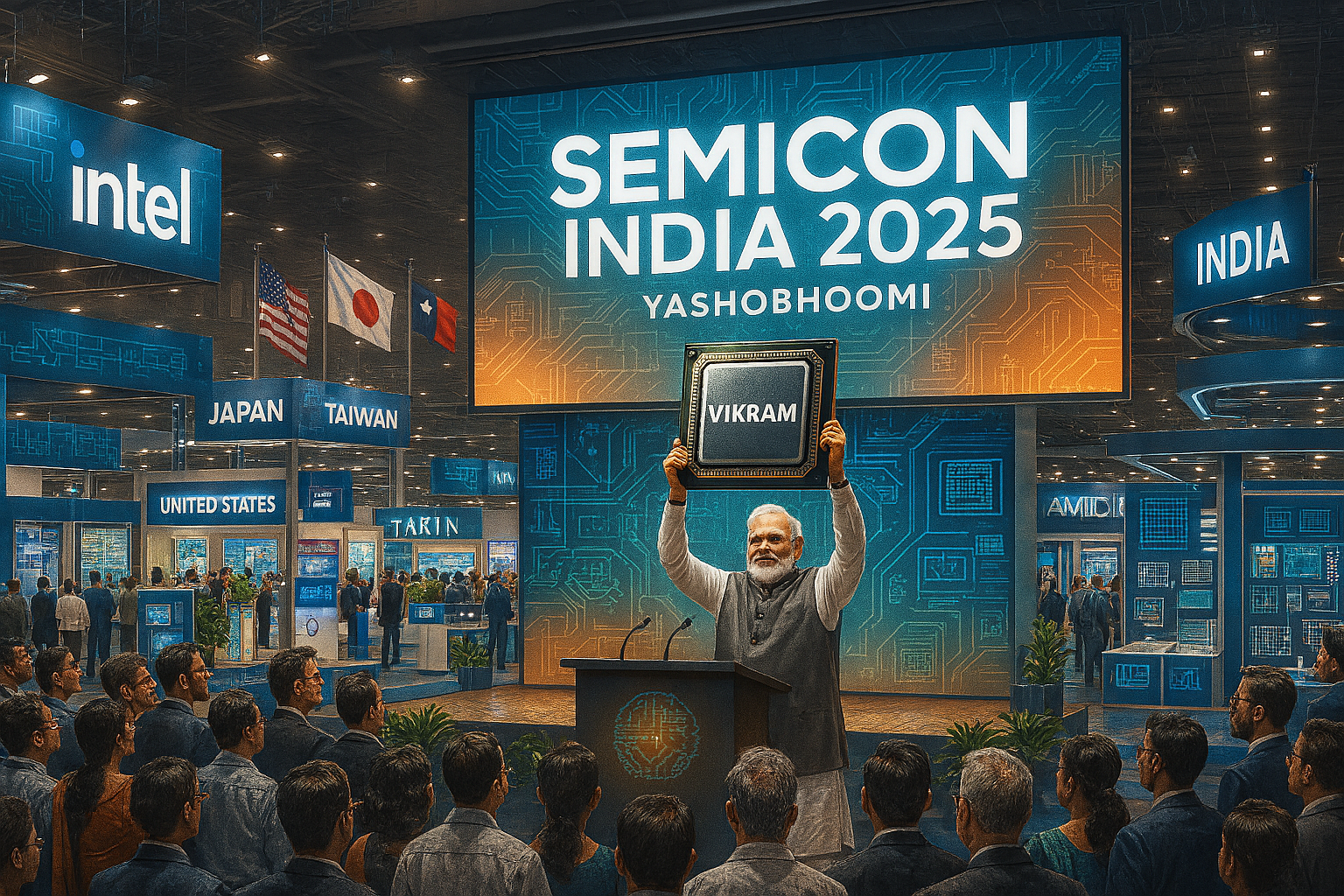
SEMICON India 2025 marked a pivotal moment in India’s journey to become a global semiconductor powerhouse. Inaugurated by Prime Minister Narendra Modi on 2nd September 2025 at Yashobhoomi, the three-day event brought together over 2,500 delegates from 48 countries, along with 350 exhibitors and 150+ global speakers. Key highlights—the unveiling of Vikram, India’s first indigenous 32-bit microprocessor, and the Odisha Pavilion inauguration—reflected India’s accelerating momentum in chip design and manufacturing. This blog dives deep into semicon india 2025, its global implications, strategic initiatives, and the road ahead.
Table of Contents
Published: September 02, 2025 | Last Updated: September 02, 2025
Overview: India’s Strategic Entry into Semiconductor Manufacturing
India has signaled its intention to develop a comprehensive domestic semiconductor ecosystem, moving beyond its traditional focus on chip design services. Between September 2 and 4, 2025, New Delhi hosted Semicon India 2025 at the Yashobhoomi convention center, bringing together stakeholders from the global semiconductor industry to discuss India’s manufacturing ambitions. The event attracted over 20,750 delegates representing 48 countries, alongside 350 exhibitors and 150 speakers, indicating significant international interest in India’s semiconductor development trajectory.
Semiconductors form the technological foundation of modern economies, powering devices ranging from smartphones and automobiles to artificial intelligence systems and renewable energy infrastructure. Nations controlling semiconductor design and manufacturing capabilities maintain substantial economic and strategic advantages. India’s shift from design services to integrated manufacturing represents a significant economic development, with implications for technology independence and long-term competitiveness.
Background: Why Semiconductors Matter to India’s Economy
Digital Economy Growth and Import Dependency
India’s digital economy continues expanding rapidly, supported by over 750 million internet users and the world’s second-largest smartphone market. The growth extends across multiple sectors including financial technology, e-commerce, and digital governance services. Despite this expansion, India currently imports nearly all semiconductors required to power its digital infrastructure, creating supply chain vulnerabilities and limiting domestic economic value capture.
The COVID-19 pandemic exposed critical weaknesses in global semiconductor supply chains. Automotive manufacturers halted production due to chip shortages, while consumer electronics prices fluctuated significantly. Critical infrastructure projects experienced delays when semiconductor components became unavailable. These disruptions demonstrated the strategic necessity of developing domestic semiconductor capabilities as an economic security measure rather than simply an industrial policy objective.
Geopolitical Positioning and Supply Chain Diversification
The semiconductor industry has become central to international technological competition. The United States, China, Taiwan, South Korea, and Japan compete intensely for dominance across different segments of the chip manufacturing value chain. This competitive landscape is characterized by export controls, technology transfer restrictions, and substantial government subsidies from competing nations.
India’s entry into semiconductor manufacturing positions the nation as a potential balancing force in an increasingly multipolar technological environment. Multinational corporations seeking to diversify manufacturing away from concentrated dependencies view India as an attractive alternative location. The country combines democratic governance, a skilled technical workforce, a growing domestic market, and demonstrated government commitment to sectoral development, making it compelling for companies reconsidering their Asia-Pacific manufacturing strategies.
Technological Sovereignty and National Security
Beyond economic considerations, semiconductor sovereignty addresses the fundamental question of whether a nation can independently design, manufacture, and secure the technological foundations of modern systems. As digital infrastructure penetrates defense systems, telecommunications networks, financial infrastructure, and governance platforms, ensuring these systems operate on trusted, domestically developed components becomes strategically important.
The unveiling of Vikram, India’s first fully indigenous 32-bit microprocessor, at Semicon India 2025 represented a concrete milestone toward technological sovereignty. The processor was developed entirely by Indian engineers without relying on foreign intellectual property licensing arrangements.
Semicon India 2025: Event Details and Global Participation
Event Scale and International Engagement
Yashobhoomi, inaugurated in 2023 as India’s largest convention center, provided the venue for this gathering. The facility spans over 100 acres in Delhi’s Dwarka district and symbolizes India’s infrastructure development capacity. The selection of this state-of-the-art venue communicated India’s readiness to host world-class industrial events and its ambitions to become a semiconductor manufacturing hub.
The India Semiconductor Mission (ISM), established under the Ministry of Electronics and Information Technology, co-organized the event with SEMI, the global industry association representing over 2,500 companies across semiconductor manufacturing supply chains. This public-private partnership structure ensured balanced discussion between government policy initiatives and practical industry requirements, combining strategic vision with market realities.
The event attracted 20,750 delegates from 48 countries representing the complete semiconductor value chain. Participants included equipment manufacturers, materials suppliers, fabless design companies, system integrators, venture capitalists, academic researchers, and government officials. This international participation validated India’s emergence as a serious player commanding global attention in semiconductor development.
Exhibition and Technical Programming
The event featured 350 exhibitors displaying technologies spanning chip design software, fabrication equipment, advanced packaging solutions, testing apparatus, and emerging technologies including gallium nitride (GaN) and silicon carbide (SiC) power semiconductors. Multiple country pavilions from the United States, Taiwan, South Korea, Japan, and European nations demonstrated the global industry’s commitment to engaging with India’s semiconductor initiatives.
More than 150 speakers, including 50 global industry leaders, participated in organized programming covering fabrication economics, design automation, workforce development, and sustainable manufacturing practices. Discussion tracks addressed dedicated topics including fabrication and manufacturing processes, advanced packaging and assembly techniques, chip design and intellectual property development, compound semiconductors, automotive and industrial applications, artificial intelligence hardware acceleration, workforce development frameworks, and investment and policy analysis.
The CEO-level participation from multinational semiconductor companies, government ministers, venture capitalists, startup founders, and academic researchers engaged in substantive discussions about India’s development path. This breadth of stakeholder participation provided comprehensive coverage of industry challenges and opportunities.
Prime Minister Modi’s Address and National Vision
Prime Minister Narendra Modi’s presence at the September 2, 2025 inauguration underscored the government’s prioritization of semiconductor self-reliance. His address connected semiconductor development to broader national objectives including Atmanirbhar Bharat (self-reliant India), Make in India manufacturing initiatives, and positioning India as a trusted technology partner in a fragmented global technology landscape.
Modi highlighted India’s specific advantages for semiconductor development including a massive domestic market providing inherent demand for semiconductors, a proven track record in semiconductor design services with Indian engineers designing chips for virtually every major global semiconductor company, a robust startup ecosystem demonstrating innovation capacity, and policy frameworks including the Production Linked Incentive scheme providing direct financial support for manufacturing investments.
The Prime Minister’s remarks emphasized that semiconductor sovereignty extends beyond industrial policy considerations to encompass national security, economic competitiveness, and India’s transition from a consumer of imported technology to a creator and exporter of critical technologies. The address balanced ambitious long-term vision with pragmatic recognition of challenges ahead, acknowledging that building world-class semiconductor manufacturing requires sustained multi-year commitment, significant capital investment, and deliberate international collaboration.
Vikram Microprocessor: India’s Indigenous Semiconductor Achievement
Technical Specifications and Development Process
The unveiling of Vikram, India’s first fully indigenous 32-bit microprocessor, represented the summit’s most symbolically significant moment. Union Minister for Electronics and Information Technology Ashwini Vaishnaw presented Vikram alongside test chips from four semiconductor projects to Prime Minister Modi in a ceremony receiving substantial national media attention.
The 32-bit microprocessor architecture positions Vikram in the category of microcontrollers and embedded processors suitable for industrial automation, IoT devices, automotive applications, and consumer electronics. The processor’s specifications, while modest by current global standards, demonstrate genuine technical achievement. Indigenous development means Indian engineers controlled every aspect of development—instruction set architecture, microarchitecture design, physical implementation, and verification—without relying on licensed intellectual property from international sources.
The Vikram project involved collaboration between academic institutions, government laboratories, and private sector partners, demonstrating the ecosystem coordination necessary for sustained semiconductor innovation. The development effort required expertise spanning digital circuit design, analog circuit design, semiconductor physics, semiconductor manufacturing processes, testing methodologies, compiler development, and operating system design.
Strategic Significance Beyond Technical Specifications
Vikram’s importance transcends its technical capabilities. The processor demonstrates that India possesses the talent, infrastructure, and determination necessary to master semiconductor design at fundamental levels. While long-term commercial success depends on factors including performance characteristics, power efficiency, manufacturing costs, and ecosystem support availability, the achievement establishes credibility that India can develop advanced semiconductor technology.
For defense and critical infrastructure applications, indigenous processors enable security assurances impossible when relying on foreign-designed chips. Concerns regarding hardware trojans, supply chain backdoors, and embedded vulnerabilities make trusted domestic semiconductor sources increasingly valuable. Vikram and subsequent indigenous processor designs could provide secure foundations for defense communications systems, military electronics, and critical civilian infrastructure applications.
The processor also supports educational objectives. Indian engineering programs can now teach chip design using a domestically developed architecture, creating learning opportunities grounded in national technological capabilities rather than relying exclusively on foreign examples. This pedagogical dimension strengthens the talent pipeline for future semiconductor innovation and reduces dependence on international architectural knowledge systems.
Broader Design Ecosystem Context
Vikram emerged from India’s existing semiconductor design ecosystem, which has positioned India as a global semiconductor design hub. Indian engineers design chips for virtually every major semiconductor company worldwide. Design centers for Intel, AMD, Nvidia, Qualcomm, Broadcom, Texas Instruments, and dozens of additional multinational corporations operate in Indian cities including Bangalore, Hyderabad, Pune, and Noida.
This established design strength provides foundational advantages for India’s manufacturing ambitions. Countries successfully building semiconductor fabrication facilities consistently possess strong design capabilities, as intimate connections between design and manufacturing enable continuous optimization and innovation. India’s established design expertise positions it advantageously as the nation develops domestic manufacturing capacity.
The Design Linked Incentive scheme, emphasized throughout Semicon India 2025, aims to accelerate domestic chip design by providing financial support for design companies, encouraging advanced technology node design, and promoting export of Indian-designed semiconductors. The scheme complements manufacturing-focused initiatives by ensuring India develops integrated capabilities spanning the complete semiconductor value chain.
State-Level Semiconductor Development Initiatives
Gujarat’s Emerging Semiconductor Corridor
Gujarat has emerged as the leading state in India’s semiconductor manufacturing ambitions. The state offers several competitive advantages including proximity to major ports facilitating equipment imports and finished product exports, established industrial infrastructure from its manufacturing base, progressive policies attracting investment, and availability of land suitable for large-scale fabrication facilities.
Dholera Special Investment Region, envisioned as a greenfield smart city, has been designated as a primary semiconductor manufacturing hub. Tata Electronics is establishing a semiconductor assembly and test facility in Dholera, representing one of India’s first major initiatives in semiconductor manufacturing. The project, supported by PLI scheme incentives, is expected to create thousands of employment opportunities and establish critical manufacturing capabilities. The facility is expected to begin operations in 2026-2027 according to project timelines.
Sanand, already home to automotive manufacturing including facilities from Tata Motors and Ford, is being positioned for automotive semiconductor production. The automotive industry’s growing electronics content—from advanced driver assistance systems to electric vehicle powertrains—creates substantial demand for specialized automotive-grade semiconductors. Co-locating semiconductor and automotive manufacturing creates supply chain synergies and reduces logistics complexity.
Gujarat’s pavilion at Semicon India 2025 showcased these projects alongside infrastructure development initiatives, skill training programs, and incentive frameworks designed to attract additional semiconductor investment. The state government has committed to providing industrial land at concessional rates, power supply guarantees, water infrastructure development, and expedited regulatory approvals for qualifying projects.
Tamil Nadu’s Electronics Manufacturing Foundation
Tamil Nadu leverages its established position as India’s primary electronics manufacturing center. The state produces substantial portions of India’s mobile phones, automotive electronics, and consumer appliances. This existing electronics ecosystem provides advantages for semiconductor-related activities including component testing, packaging, and system integration operations.
Chennai and surrounding districts host design centers for numerous semiconductor companies. The concentration of technical talent, proximity to educational institutions including IIT Madras, and quality of life factors make Tamil Nadu attractive for chip design activities. The state government has announced initiatives aimed at expanding from current design capabilities into manufacturing and advanced packaging operations.
Uttar Pradesh’s Scaling Opportunity
Uttar Pradesh, India’s most populous state, has entered semiconductor discussions with significant ambitions. The state offers advantages including a substantial labor pool, a large domestic market representing natural demand, and significant available land for industrial development. Government initiatives including single-window clearances and customized incentive packages aim to attract semiconductor investments.
Noida, already an established information technology and electronics hub, is being positioned as a semiconductor design center. The proximity to Delhi provides direct access to policy makers, international connectivity through Indira Gandhi International Airport, and well-established commercial infrastructure supporting technology businesses.
Assam’s Northeastern Manufacturing Initiative
The announcement of a semiconductor fabrication project in Jagiroad, Assam, represents deliberate strategy to extend semiconductor development beyond traditional industrial concentration areas. Establishing manufacturing in India’s northeast serves multiple objectives including regional economic development and employment generation in an area historically less industrialized, demonstrating that semiconductor manufacturing need not concentrate exclusively in established industrial hubs, and strategic geographic positioning given the region’s location.
The Assam project faces significant challenges including distance from established semiconductor supply chains, infrastructure development requirements, and talent attraction in a less developed technology hub. However, government support through the PLI scheme and strategic importance could overcome these obstacles, potentially creating a new manufacturing cluster in eastern India.
Odisha’s Eastern Coast Development
Odisha Chief Minister Mohan Charan Majhi’s inauguration of the state pavilion at Semicon India 2025 symbolized Odisha’s entry into semiconductor development discussions. Odisha brings several distinct assets including abundant and reliable power supply from its energy resources, port infrastructure facilitating import-export operations, mining and metallurgy expertise relevant for materials processing, and a developing higher education foundation.
The state has initiated discussions with potential semiconductor investors, offering industrial land, infrastructure support, and policy incentive packages. While Odisha’s semiconductor journey remains at earlier development stages compared to Gujarat or Tamil Nadu, the state’s resource endowments and strategic location on India’s eastern coast position it as a potential future manufacturing location.
Government Financial Support and Investment Architecture
The ₹76,000 Crore PLI Scheme
The Production Linked Incentive scheme for semiconductors represents India’s largest sectoral incentive program. The ₹76,000 crore (approximately $9 billion) allocation signals government commitment to developing domestic semiconductor capabilities. This substantial funding supports multiple activity categories:
Semiconductor Fabrication: Manufacturing facilities producing integrated circuits through photolithography, etching, doping, and other semiconductor processes. Fab investments require massive capital—advanced facilities cost between $10 billion and $20 billion—making government support crucial for project viability in India’s current development context.
Display Fabrication: Manufacturing facilities for display panels used in smartphones, televisions, monitors, and automotive displays. While related to semiconductor technology, display manufacturing involves distinct manufacturing processes and specialized equipment.
Compound Semiconductors: Materials beyond silicon including gallium nitride (GaN), silicon carbide (SiC), and gallium arsenide (GaAs) used in power electronics, RF applications, and optoelectronics. These materials enable emerging applications including 5G infrastructure, electric vehicle charging systems, renewable energy inverters, and advanced LED lighting.
Semiconductor Packaging and Testing: Facilities providing assembly, packaging, and testing services or outsourced semiconductor assembly and test (OSAT) operations. These facilities receive manufactured silicon wafers, dice them into individual chips, package them for integration into electronic systems, and perform comprehensive testing of functionality.
Design Linked Incentive: Supporting chip design companies to develop advanced semiconductor designs, create valuable intellectual property, and promote international exports of Indian-designed semiconductors.
Private Investment Mobilization Strategy
Government incentives aim to catalyze substantially larger private sector investment. The PLI scheme typically covers 30-50% of project costs depending on technology node sophistication and investment scale, with private companies contributing the remaining capital requirement. This financial structure ensures government funds leverage private investment rather than displacing market-driven capital allocation.
Major corporations including Tata Electronics, Vedanta-Foxconn partnership (though subsequently restructured), Micron Technology, and several additional companies have announced significant investments in India. International companies view India’s incentive programs alongside other factors including market access, talent availability, and strategic manufacturing diversification from concentrated East Asian production.
Venture capital and private equity investors increasingly focus on Indian semiconductor startups, particularly in chip design, design automation software, and specialized applications. The startup ecosystem benefits from both domestic venture funds and international investors seeking exposure to India’s emerging semiconductor sector.
Supporting Infrastructure Investment
Semiconductor manufacturing requires extensive infrastructure beyond fabrication facilities themselves. Critical infrastructure categories include:
Ultra-pure water treatment systems: Semiconductor manufacturing consumes substantial quantities of ultra-pure water for wafer cleaning and process operations. Treatment facilities ensuring required purity levels represent significant capital investment but remain essential for manufacturing viability.
Stable power supply infrastructure: Fabrication facilities operate continuously with extremely tight voltage and frequency tolerances. Power interruptions can destroy wafers in manufacturing process, costing millions in losses. Dedicated substations and backup power systems are essential components of fab infrastructure.
Specialized gases and chemicals supply: Semiconductor processes require dozens of specialized gases including silane, ammonia, and various fluorocarbons, plus numerous chemicals in ultra-pure form. Supply infrastructure must meet stringent quality specifications or damage manufacturing results.
Cleanroom construction and maintenance: Fabrication occurs in cleanrooms maintaining particle counts orders of magnitude below typical indoor environments. Cleanroom construction requires specialized materials, sophisticated HVAC systems, and comprehensive contamination control protocols.
Chemical waste treatment facilities: Semiconductor manufacturing generates chemical wastes requiring treatment before disposal. Environmental compliance necessitates proper waste processing facilities and disposal infrastructure.
Government support extends to infrastructure development supporting semiconductor manufacturing ecosystems, recognizing that functional fabs require comprehensive supporting infrastructure for operational success.
Semiconductor Workforce Development Framework
The 85,000 Professional Target
India aims to develop a semiconductor workforce of 85,000 specialized professionals over the coming years. This workforce target encompasses various technical and specialized roles required for industry development:
Design Engineers develop chip architectures, implement designs using hardware description languages, and verify functionality through comprehensive simulation testing.
Process Engineers develop and optimize manufacturing processes for specific technologies and individual products.
Equipment Engineers operate, maintain, and troubleshoot sophisticated fabrication equipment used in semiconductor manufacturing.
Quality and Reliability Engineers ensure manufactured chips meet engineering specifications and long-term reliability requirements.
Packaging Engineers design and implement advanced packaging solutions connecting semiconductor dies to circuit boards.
Test Engineers develop test programs verifying chip functionality and identifying manufacturing defects.
Educational Institution Expansion
Leading technical universities are expanding semiconductor education offerings. IIT Bombay, IIT Madras, and IIT Kanpur offer specialized courses and degree programs in VLSI design, semiconductor devices, and manufacturing processes. IIIT Hyderabad and BITS Pilani strengthen electronics and semiconductor curricula through expanded course offerings.
The National Program for Semiconductor Professionals represents a government initiative supporting curriculum development, faculty training, and student scholarship opportunities. Industry-academic partnerships are creating specialized training programs, with semiconductor companies establishing centers of excellence at universities, providing equipment, software tools, and internship opportunities ensuring educational programs align with current industry requirements.
Startup Ecosystem Contributions
Semiconductor startups, particularly chip design companies, contribute significantly to talent development objectives. Engineers gain practical experience in fast-paced startup environments while working on cutting-edge designs and learning advanced tools and methodologies. Bangalore, Hyderabad, and Pune host thriving semiconductor startup ecosystems providing employment opportunities and valuable training experience.
Gujarat’s emerging semiconductor cluster is establishing training programs specifically targeting manufacturing roles. As fabrication facilities achieve operational status, specialized technician training programs will prepare workers for cleanroom operations, equipment handling, and process monitoring responsibilities.
Addressing Talent Gaps and Competition
Despite India’s substantial engineering graduate population, semiconductor-specific skills require specialized technical training. The industry faces challenges attracting talent competing with high-paying software services employment options. Semiconductor companies must offer competitive compensation, technically challenging work, and clear career growth opportunities to build required workforce strength.
Government scholarships, industry-sponsored training programs, and university partnerships aim to channel more engineering students into semiconductor specializations. Increasing public awareness about career opportunities in semiconductors helps direct talented professionals toward the sector.
Advanced Technologies Driving Manufacturing Innovation
Artificial Intelligence Applications Across the Value Chain
Semicon India 2025 emphasized artificial intelligence applications throughout semiconductor value chain operations. AI technologies are transforming chip design through multiple mechanisms including design automation using machine learning algorithms optimizing chip layouts, reducing design timelines, and improving performance, power, and area metrics.
Verification and validation processes use AI systems to identify design bugs and edge cases more effectively than traditional manual verification methods. Process optimization applies machine learning models analyzing real manufacturing data to optimize process parameters, increase production yields, and reduce defects. Predictive maintenance deploys AI systems monitoring equipment health and predicting failures before they occur, minimizing unexpected downtime.
Quality control utilizes computer vision and machine learning for inspecting wafers and chips, detecting defects more accurately and consistently than human inspection processes.
Digital Twin Technology Implementation
Digital twins—virtual representations of physical fabrication facilities—enable engineers to simulate and optimize manufacturing operations before implementing changes in actual production facilities. Engineers can test new processes, equipment configurations, and production schedules in virtual environments, substantially reducing operational risk and accelerating innovation cycles. Several presentations at Semicon India 2025 highlighted digital twin applications in semiconductor manufacturing optimization.
Sustainable Manufacturing Practices
Environmental sustainability receives increasing attention in semiconductor manufacturing discussions. Fabs consume substantial energy and water while generating chemical wastes and greenhouse gas emissions. Semicon India 2025 sessions addressed sustainable manufacturing practices including energy efficiency improvements, advanced water recycling systems, chemical management improvements, and carbon footprint reduction initiatives.
India’s semiconductor facilities are incorporating sustainability considerations during facility design stages, aiming to establish environmentally responsible manufacturing practices from initial operations.
International Partnership and Technology Collaboration
Strategic Global Relationships
Semicon India 2025’s international participation reflected India’s strategy of building semiconductor capabilities through deliberate global collaboration rather than pursuing isolated indigenous development. The 48-country participation demonstrates this collaborative approach to semiconductor development.
Key partnerships include:
United States: Technology partnerships, direct investment from American semiconductor companies, and collaboration on secure and trusted semiconductor supply chains. The U.S.-India Initiative on Critical and Emerging Technologies (iCET) includes specific semiconductor cooperation frameworks.
Taiwan: Learning from Taiwan’s proven semiconductor development experience. Taiwanese companies including equipment manufacturers and potential fab partners demonstrated strong interest in India during Semicon 2025.
South Korea: Samsung and SK Hynix, major Korean semiconductor manufacturers, are exploring opportunities in India. Korean expertise in memory semiconductor manufacturing could complement India’s developing capabilities.
Japan: Japanese equipment manufacturers and materials suppliers represent essential partnership sources. Japan’s precision manufacturing expertise provides valuable knowledge for Indian semiconductor development.
European Union: European semiconductor companies and research institutions engage with India through various partnership frameworks, including collaborative research project opportunities.
Technology Transfer and Indigenous Capability Development
Building world-class semiconductor capabilities requires learning from established global players. India balances acquiring technology and manufacturing knowledge through partnerships while developing indigenous capabilities, an approach differing from purely indigenous development (too slow and capital-intensive) or complete foreign dependence (limiting long-term strategic autonomy).
Joint ventures between Indian and foreign companies facilitate technology transfer and knowledge exchange. Indian engineers working in foreign-owned design centers and manufacturing facilities gain expertise applicable to domestic projects. Government programs supporting talent exchanges and collaborative research accelerate learning and capability development timelines.
Development Timeline and Implementation Considerations
Expected Operational Timelines
Semiconductor facility development follows extended timelines due to manufacturing complexity and capital intensity requirements. Semiconductor assembly and test facilities, being less complex than fabrication facilities, may achieve operational status within 2-3 years from project announcement. Tata Electronics’ Dholera facility is expected to begin operations during 2026-2027.
Full-scale fabrication facilities require longer development periods—typically 4-6 years from site selection through construction, equipment installation, process qualification, and production ramp-up. Assam’s Jagiroad fab project announced timelines extending into the late 2020s. Realistic expectations suggest India will see first meaningful semiconductor manufacturing output in 2025-2026 from assembly and test operations, with fabrication facilities following in 2027-2029.
Key Challenges and Strategic Responses
Capital Intensity: Semiconductor manufacturing requires enormous capital investment with extended payback periods. Advanced fabs cost $10-20 billion while even older technology facilities require billions in investment. Sustaining these investments through multiple technology generations challenges even established companies globally. India must develop financial models ensuring long-term viability beyond initial government support.
Supply Chain Integration: Semiconductors involve complex global supply chains with manufacturing equipment originating primarily from Netherlands, Japan, and the United States. Specialized materials come from multiple countries. Even if India establishes fabs, integration into global supply chains requires sustained effort building supplier relationships and meeting stringent quality standards.
Technology Evolution: Semiconductor technology evolves rapidly with leading-edge manufacturing nodes advancing every 2-3 years. India entering manufacturing faces challenges with continuous technology upgrading to maintain competitive positioning. Strategic discussions continue regarding whether India should pursue leading-edge technologies or focus on mature nodes serving substantial market segments.
Market Competition: Indian-manufactured semiconductors must ultimately compete on cost, quality, and delivery against established manufacturers globally. Government support provides initial cushion, but long-term success requires genuine competitiveness without subsidy dependence. Building reputation and relationships with customers requires sustained effort and time investment.
Targeted Segment Strategy
Rather than competing head-on with established players in commodity semiconductor segments, India is strategically targeting specialized areas where competitive advantages can be developed:
Automotive Semiconductors: Growing demand from expanding automotive market, relatively mature technologies, and emphasis on reliability over cutting-edge performance create favorable conditions for Indian manufacturers.
Industrial and IoT Applications: Diverse customer requirements, moderate production volumes, and opportunities for customization provide opportunities for Indian manufacturers to establish market presence.
Defense and Aerospace: Premium pricing, domestic preference policies favoring indigenous sources, and security considerations supporting domestic semiconductor sources create favorable market conditions.
Compound Semiconductors: Growing markets for power electronics (electric vehicles, renewable energy) and RF applications (5G infrastructure) demonstrate less concentrated competition compared to commodity silicon chips.
This segmentation strategy allows Indian manufacturers to establish credibility, build capabilities, and develop customer relationships before expanding into broader, more competitive market segments where established global players maintain dominance.
Key Takeaways and Industry Implications
Semicon India 2025 marked a significant inflection point in India’s technological development journey. The event demonstrated comprehensive government commitment, substantial international interest, and emerging private sector investments in building an integrated Indian semiconductor ecosystem. The combination of government policy support, private investment, international partnerships, and educational institution engagement creates conditions for meaningful progress in semiconductor capability development.
India’s strategic focus on targeted market segments rather than pursuing direct competition with established manufacturers demonstrates pragmatic strategy. The country’s advantages in design services, massive domestic market, skilled workforce, and government support create genuine opportunities for establishing competitive semiconductor manufacturing capabilities.
Achieving meaningful progress requires sustained commitment over multiple years, continued capital investment, development of specialized workforce capabilities, and integration of advanced technologies including artificial intelligence and digital manufacturing. The timelines established through Semicon India 2025 announcements indicate first commercial production in 2025-2026 from assembly facilities, with fabrication operations following in 2027-2029.
Frequently Asked Questions
What is Semicon India 2025 and what made it significant?
Semicon India 2025 was a three-day semiconductor industry summit held from September 2-4, 2025, at the Yashobhoomi convention center in New Delhi. The event brought together 20,750 delegates from 48 countries, 150+ speakers including 50 global industry leaders, and 350+ exhibitors representing the complete semiconductor value chain. The summit’s significance lies in marking India’s formal entry into semiconductor manufacturing after decades focused primarily on design services. Prime Minister Modi’s inaugural address, the unveiling of Vikram indigenous microprocessor, and announcements of major investments demonstrated national commitment to building comprehensive semiconductor capabilities spanning design, manufacturing, and supply chain integration.
What is the Vikram microprocessor and what does it represent?
Vikram is India’s first fully indigenous 32-bit microprocessor unveiled at Semicon India 2025 by Union Minister Ashwini Vaishnaw. The processor was developed entirely by Indian engineers without licensing foreign intellectual property. While its technical specifications are modest by current standards, Vikram’s significance is primarily strategic, proving India possesses talent and infrastructure to master semiconductor design fundamentals. For defense and critical infrastructure applications, indigenous processors enable security assurances impossible with foreign-designed chips. The achievement establishes technological credibility and provides educational opportunities for engineering programs teaching chip design using domestically developed architecture.
How much government funding has been committed to semiconductor development?
The Indian government committed ₹76,000 crore (approximately $9 billion) through the Production Linked Incentive (PLI) scheme for semiconductors and display manufacturing. This represents India’s largest sectoral incentive program covering semiconductor fabrication facilities, display manufacturing, compound semiconductors, packaging and testing facilities, and chip design incentives. The PLI scheme typically covers 30-50% of project costs depending on technology node and investment scale, with private companies contributing the remainder. This government funding aims to catalyze substantially larger private investment, potentially mobilizing $30-40 billion in total semiconductor ecosystem development over the coming decade.
Which Indian states are leading semiconductor development initiatives?
Multiple states are developing semiconductor clusters. Gujarat leads with projects in Dholera Special Investment Region and Sanand, including Tata Electronics’ facility. Tamil Nadu leverages its electronics manufacturing strength with design centers in Chennai expanding toward manufacturing and advanced packaging. Assam is developing a fabrication project in Jagiroad representing northeastern expansion. Uttar Pradesh is positioning Noida as a semiconductor design hub with manufacturing plans. Odisha entered semiconductor discussions with abundant power, port infrastructure, and mining expertise. This multi-state competition creates positive dynamics with states offering competitive incentives and infrastructure support.
What international partnerships are central to India’s semiconductor strategy?
International collaboration forms a cornerstone of India’s semiconductor strategy rather than isolated indigenous development. The 48-country participation at Semicon India 2025 reflects this collaborative approach. Key partnerships include the United States through the Initiative on Critical and Emerging Technologies (iCET), Taiwan providing learning from successful semiconductor development experience, South Korea through Samsung and SK Hynix investments, Japan contributing precision manufacturing expertise and equipment, and the European Union through collaborative research frameworks. These partnerships facilitate technology transfer, equipment supply, talent exchanges, and market access while India develops indigenous capabilities.
How is India addressing the semiconductor workforce shortage?
India aims to develop 85,000 specialized semiconductor professionals through multi-pronged initiatives. Leading technical institutions (IITs Bombay, Madras, Kanpur; IIIT Hyderabad; BITS Pilani) are expanding semiconductor curricula. The National Program for Semiconductor Professionals supports curriculum development, faculty training, and scholarships. Industry-academic partnerships create university centers of excellence with equipment and internships ensuring education aligns with industry requirements. Semiconductor startups contribute through practical training. State governments establish manufacturing-focused training programs. Challenges include competition with high-paying software roles requiring competitive compensation and career growth opportunities from semiconductor companies.
What semiconductor applications will Indian manufacturers target initially?
India is strategically targeting specialized applications rather than competing immediately in commodity segments. Priorities include automotive semiconductors with growing demand from India’s automotive industry and emphasis on reliability over cutting-edge performance. Industrial and IoT applications offer diverse requirements and customization opportunities. Defense and aerospace semiconductors command premium pricing and benefit from domestic preference policies. Compound semiconductors for power electronics (electric vehicles, renewable energy) and RF applications (5G infrastructure) represent growing markets with less concentrated competition. Consumer electronics for India’s massive domestic market create natural demand.
What timeline should be expected for India’s semiconductor manufacturing operations?
Semiconductor assembly and test facilities may achieve operational status within 2-3 years from announcement, with Tata Electronics’ Dholera facility expected operational by 2026-2027. Full-scale fabrication facilities require 4-6 years from site selection through production ramp-up. Assam’s Jagiroad fab project extends into the late 2020s. India will likely see first meaningful manufacturing output in 2025-2026 from assembly operations, with fabrication facilities following in 2027-2029. Achieving substantial scale and ecosystem maturity requires 8-10 years of sustained effort and investment, similar to timelines observed in other countries developing semiconductor manufacturing from early stages.
About the Author
Nueplanet
Nueplanet is a technology research and analysis contributor specializing in semiconductor industry developments, government economic policy, and industrial transformation trends. With expertise in emerging technology sectors and international business development, Nueplanet provides comprehensive analysis of complex industrial initiatives and their implications for economic development. All content is based on verified information from government sources, industry organizations, official announcements, and authoritative research institutions.
Commitment to Accuracy: This article is based exclusively on information from official government sources, verified industry announcements, and credible research institutions. All figures, timelines, and policy details reflect publicly available information as of September 2025. Sources include official announcements from India’s Ministry of Electronics and Information Technology, the India Semiconductor Mission, SEMI industry association documentation, and press releases from participating companies.
Content Quality Assurance:
- All statistics and figures sourced from official government announcements
- Timelines based on company project announcements and industry publications
- Policy details verified through government ministry documentation
- International partnership information from official bilateral frameworks
- Neutral, factual presentation without promotional language
- Content designed for accessibility and comprehensive understanding
Helpful Resources
Latest Posts
Tag
Semicon India
Related Posts












Post Comment