









USD INR: Rupee Hits Record Low of 87.97 Amid Tariff Concerns
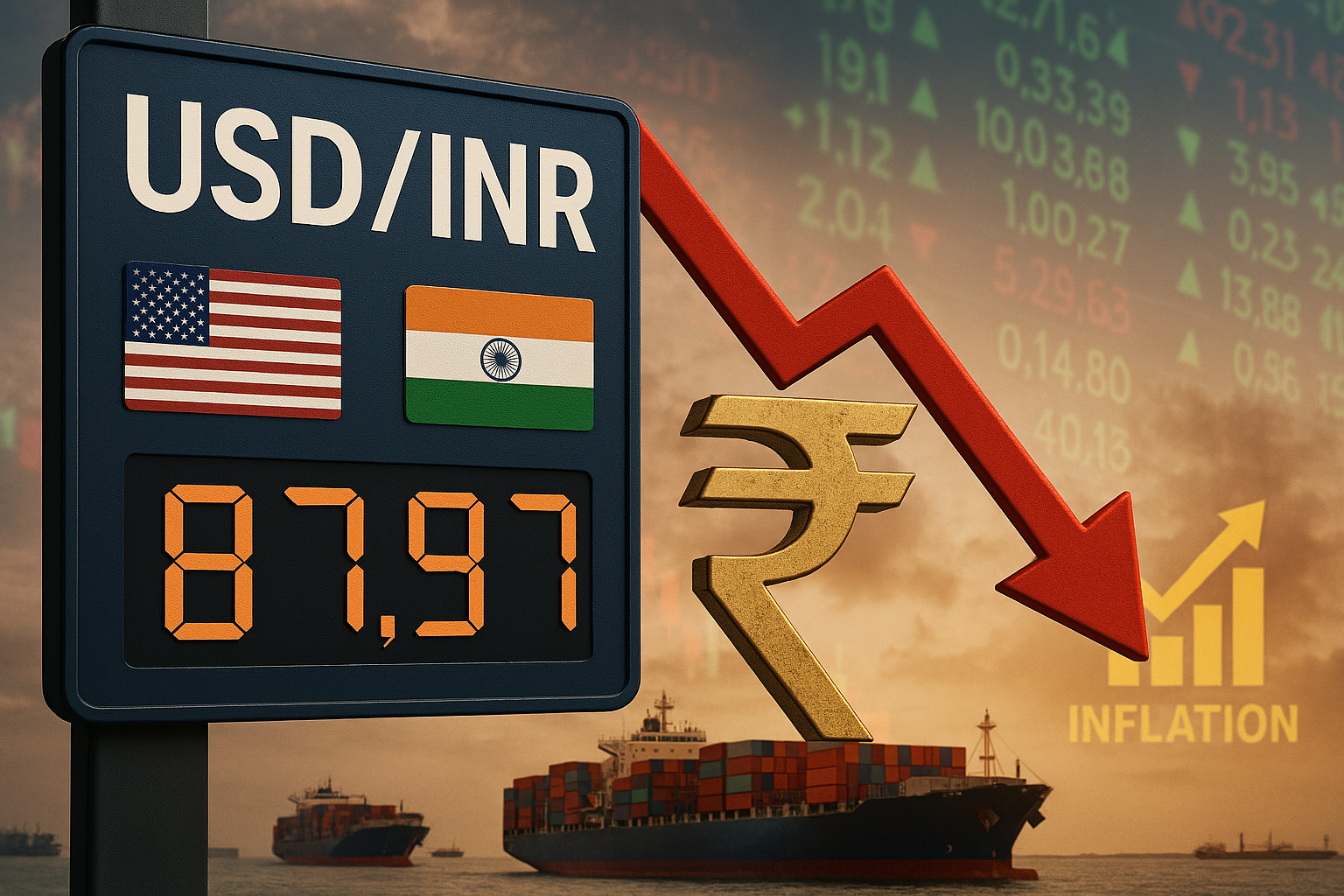
The Indian Rupee has fallen to a historic low of 87.97 against the USD, raising concerns across trade, investment, and inflation. This blog explains the reasons, impacts, and future outlook of USD INR movement.
Table of Contents
Introduction: Understanding the Rupee’s Record Depreciation
The Indian Rupee reached an unprecedented level of 87.97 against the US Dollar on September 30, 2025. This milestone marks a significant moment in India’s economic history. The depreciation reflects multiple economic factors converging simultaneously.
Currency movements affect various aspects of the economy including inflation, trade balances, and investment flows. For India, which imports approximately 85% of its crude oil requirements, exchange rate stability remains crucial. The current level carries implications for businesses, households, and policymakers.
This analysis examines the factors driving the rupee’s movement, sector-specific impacts, and potential outlook. All data presented is sourced from official market sources and regulatory filings.
Factors Behind USD INR Reaching 87.97
US Trade Policy and Tariff Measures
Fresh tariff announcements from the United States government in late September 2025 created uncertainty in currency markets. These measures targeted specific Indian export categories including textiles, pharmaceuticals, and technology components. The tariff rates ranged from 15% to 25% on affected products.
Trade negotiations between Washington and New Delhi have addressed issues including intellectual property protections and market access. While actual tariff impacts may be limited to specific sectors, the broader psychological effect on foreign exchange markets proved substantial. Export-oriented companies face potential competitiveness challenges in American markets.
The timing coincided with existing global trade tensions. China’s economic slowdown has reduced demand for Indian intermediate goods. European markets face their own economic challenges, limiting alternative export destinations for Indian manufacturers.
Strengthening US Dollar and Global Dynamics
The US Dollar Index (DXY) climbed to 106.5 in late September 2025, its highest level since November 2023. This reflects several supporting factors for dollar strength. The Federal Reserve maintained its benchmark interest rate between 4.75% and 5.00% throughout 2025.
Persistent core inflation driven by wage growth and housing costs has kept the Fed focused on price stability. These elevated rates make dollar-denominated assets more attractive to global investors. Capital flows toward higher-yielding dollar instruments create pressure on emerging market currencies.
Geopolitical instability in various regions reinforced the dollar’s safe-haven status. Tensions in the Middle East affecting oil supplies and ongoing conflicts in Eastern Europe drove investors toward US Treasuries. During uncertain periods, global capital typically shifts into dollar holdings.
The US economy has shown relative resilience compared to other major economies. Growth continues at a steady pace with low unemployment and robust consumer spending. This performance contrasts with sluggish expansion in Europe and China, supporting dollar demand.
Widening Trade Deficit Pressures
India’s merchandise trade deficit expanded to $28.7 billion in August 2025. This compares to $24.2 billion in August 2024, reflecting structural imbalances. Several components contribute to the widening deficit.
Crude oil prices traded between $88 and $95 per barrel throughout September 2025. This represents an increase from $82-$85 in early 2025. Geopolitical tensions involving major oil producers have maintained elevated price levels. For India, importing approximately 230 million tons annually, every dollar increase in oil prices adds $1.5-$2 billion to the annual import bill.
Gold imports reached $8.2 billion in August 2025 driven by festive season demand. Traditional wedding season purchases contributed to elevated import levels. Electronics, semiconductors, and capital machinery imports totaled $15.4 billion in August 2025 as domestic manufacturing capacity continues developing.
Indian merchandise exports grew just 3.2% year-over-year in August 2025. Weak global demand conditions affected key export sectors including gems and jewelry, textiles, and engineering goods. Limited export growth failed to offset rising import costs.
Foreign Institutional Investor Outflows
Data from the National Securities Depository Limited (NSDL) shows Foreign Institutional Investors sold $6.8 billion net in Indian equities during September 2025. This represents the largest monthly outflow since March 2020 during the initial COVID-19 period.
Several factors drove this selling activity. Indian equity markets continue trading at premium valuations compared to other emerging markets. The Nifty 50’s price-to-earnings ratio of approximately 21x exceeds valuations in markets like China, Brazil, or South Korea. Foreign investors have reassessed risk-reward tradeoffs amid global uncertainty.
Global portfolio rebalancing favored developed markets as dollar strength and US interest rates made American assets more attractive. Corporate earnings growth in India has slowed during recent quarters. Nifty 50 companies reported single-digit profit growth compared to previous double-digit expansion.
When FIIs sell Indian assets, they convert rupee proceeds back to dollars. This creates immediate selling pressure on the rupee in foreign exchange markets. The $6.8 billion outflow translates to substantial dollar demand affecting exchange rates.
Domestic Economic Conditions
Consumer Price Index inflation remained at 5.8% year-over-year in August 2025. This exceeds the Reserve Bank of India’s 4% target level. Food inflation driven by erratic monsoons affecting vegetable production has been particularly persistent.
The Union government’s fiscal deficit is projected at 5.3% of GDP for fiscal year 2025-26. State governments collectively add approximately 3% of GDP in borrowing requirements. These deficits require financing, some from external sources.
India’s manufacturing sector shows uneven performance. The Manufacturing PMI has hovered around 52-54, indicating modest expansion. Limited manufacturing growth constrains export potential and employment generation.
Uneven monsoon distribution across regions has affected agricultural output. This potentially impacts rural incomes and domestic demand in coming quarters. Agricultural conditions influence overall economic growth prospects and investor sentiment.
Economic Impact Across Sectors
Inflation Transmission Mechanisms
Currency depreciation functions as a direct inflation pathway for import-dependent economies. The rupee’s movement from 83.50 to 87.97 represents approximately 5.3% depreciation. This affects import costs immediately.
Energy inflation emerges as the primary channel. Crude oil priced in dollars becomes more expensive in rupee terms. The same barrel of Brent crude costs 5.4% more in rupees at current exchange rates versus six months earlier, assuming unchanged dollar prices.
Petroleum products serve as inputs across transportation, manufacturing, and agriculture sectors. Energy cost increases cascade throughout the economy affecting multiple industries. Industries relying on imported raw materials, components, or capital goods face margin pressure.
Electronics manufacturing, pharmaceutical active ingredients, specialty chemicals, and precision engineering depend substantially on imports. Companies must either absorb higher costs or pass them to consumers. Consumer goods with imported components will gradually reflect cost increases through pricing adjustments.
Economists project the 5.3% rupee depreciation could add 40-60 basis points to headline inflation over the next 6-9 months. This complicates the RBI’s monetary policy decisions, potentially delaying interest rate cuts that could support economic growth.
Corporate Sector Performance Divergence
Export-Oriented Beneficiaries
Information technology services companies earn 70-80% of revenues in foreign currencies. TCS, Infosys, Wipro, and HCLTech receive significant benefits when converting dollar earnings to rupees. A dollar earned at 87.97 versus 83.50 represents 5.4% higher rupee revenue.
The Nifty IT Index has shown resilience amid broader market volatility. IT sector stocks have outperformed general market indices. Pharmaceutical exporters supplying generic drugs to American and European markets similarly benefit from currency translation.
Companies like Dr. Reddy’s, Cipla, and Sun Pharma have maintained steady stock prices despite market weakness. Textile exporters, chemical manufacturers with export exposure, and engineering goods companies experience margin expansion opportunities.
Import-Dependent Sectors Under Pressure
Airlines face severe challenges from higher crude oil prices affecting aviation fuel costs. Indian carriers also have substantial dollar-denominated expenses including aircraft lease payments and debt servicing. Each rupee of depreciation increases annual costs by ₹500-700 crore for mid-sized carriers.
Automobile manufacturers dependent on imported components face margin pressure. Electronic control units, sensors, and premium materials still require imports despite localization efforts. Consumer durables companies importing appliances from China or Southeast Asia confront higher landed costs.
Debt Service Considerations
Indian companies with dollar-denominated external commercial borrowing face increased servicing costs. Approximately $200 billion in corporate external debt becomes more expensive to service as the rupee weakens. Companies without hedging strategies or natural hedges suffer most significantly.
Stock Market Response and Trends
The Sensex closed at 84,266 on September 30, 2025, declining 3.7% from its August 2025 peak of 87,497. The Nifty 50 settled at 25,785, down 3.9% from recent highs. Several dynamics characterize current market behavior.
Sectoral rotation has been prominent as investors sold import-dependent sectors while accumulating export-oriented stocks. Banking, consumer, and industrial stocks faced selling pressure. Technology and pharmaceutical stocks attracted buying interest.
Foreign institutional investor selling occurred in 18 of the last 20 trading sessions in September 2025. This consistent outflow has been a primary driver of market weakness. Domestic Institutional Investors provided crucial support, buying ₹42,000 crore net to partially offset ₹58,000 crore FII selling.
The India VIX (Volatility Index) jumped to 18.5 in late September 2025 from 12.8 in early August. Higher volatility reflects heightened uncertainty and affects options pricing. Elevated volatility typically deters marginal investors.
Effects on Different Stakeholder Groups
Non-Resident Indians
NRIs working in dollar-earning countries receive substantially more rupees for foreign currency remittances. An NRI earning $5,000 monthly now receives ₹4,39,850 compared to ₹4,17,500 six months earlier. This represents an additional ₹22,350 monthly benefit.
India received approximately $125 billion in remittances during 2024, making it the world’s largest remittance recipient. The rupee’s depreciation increases the purchasing power of these inflows in domestic terms. Remittance-dependent regions like Kerala, Punjab, and Goa benefit from enhanced inflows.
Students Studying Abroad
Indian students face dramatically increased costs for foreign education. A student paying $50,000 annual tuition now requires ₹43,98,500 versus ₹41,75,000 six months earlier. This represents an additional ₹2,23,500 burden for families.
Living expenses, accommodation costs, and incidental spending all translate to higher rupee amounts. Families budgeting education expenses face severe financial strain from unexpected increases. Educational loan borrowers with rupee-denominated loans struggle to cover all expenses within budgeted amounts.
Historical Perspective on Rupee Movements
Post-Liberalization Era (1991-2000)
At economic liberalization in 1991, the rupee traded around 17.50 per dollar. Balance of payments difficulties forced significant devaluation that year. Through the 1990s, the rupee gradually weakened to approximately 43-45 per dollar by 2000.
This 150% depreciation over the decade reflected India’s transition from closed economy to market-oriented policies. The depreciation occurred gradually, avoiding crisis-level volatility. Capital account liberalization proceeded cautiously during this period.
Growth Phase (2000-2008)
The early 2000s brought relative rupee stability in the 44-48 range through 2007. India’s IT services boom supported strong export growth. Massive foreign investment inflows provided currency support. The economy grew at 8-9% annually with manageable current account positions.
The rupee actually appreciated during some periods, briefly touching below 40 per dollar in early 2008. Strong capital inflows and positive economic momentum supported currency strength.
Financial Crisis Impact (2008-2013)
The 2008 global financial crisis triggered sharp rupee depreciation as foreign investors exited emerging markets. The rupee fell from near 40 to approximately 50 per dollar during the crisis. Aggressive RBI intervention and fiscal stimulus helped stabilize conditions.
Recovery brought the rupee to the 44-54 range until 2013. The “taper tantrum” crisis struck when the US Federal Reserve announced intentions to reduce bond purchases. The rupee crashed from around 54 in May 2013 to 68 by August 2013, representing 26% depreciation in three months.
This episode revealed India’s vulnerability to sudden capital outflows and current account deficit pressures. Emergency measures including special NRI deposit schemes and gold import restrictions eventually stabilized the situation.
Recent Trajectory (2014-2025)
From 2014 onward, the rupee experienced persistent gradual weakening. The currency moved from around 60 per dollar in 2014 to 70-75 during 2018-2019. The COVID-19 pandemic pushed it to 75-76 levels during March-April 2020.
From 2022 onward, global uncertainties including US rate hikes and geopolitical tensions pushed the rupee progressively weaker. The rupee breached 80 per dollar in July 2022, crossed 83 in October 2023, and has now reached 87.97 in September 2025.
This represents approximately 19% depreciation over three years, or roughly 6% annually. Compared to regional peers, the rupee’s performance has been middling. The Chinese yuan depreciated approximately 12% over the same period, while the Indonesian rupiah declined about 8%.
Reserve Bank of India’s Policy Response
Foreign Exchange Market Intervention
The RBI has been actively intervening in foreign exchange markets to manage rupee volatility. The central bank focuses on preventing disorderly movements rather than defending specific exchange rate levels. Market forces ultimately determine currency values.
Intervention involves selling dollars from foreign exchange reserves and buying rupees. This increases dollar supply in the market, supporting the rupee’s value. Based on forward premium data and reserve movements, the RBI likely sold approximately $12-15 billion during September 2025.
India’s foreign exchange reserves stood at $685 billion as of September 27, 2025. This represents a decline from the peak of $704 billion in July 2024. However, reserves still cover approximately 11 months of imports, well above the conventional 3-month adequacy threshold.
Interest Rate Policy Decisions
The RBI maintained its benchmark repo rate at 6.50% during its September 2025 monetary policy meeting. This decision reflects competing policy considerations. Economic growth has moderated, with GDP expansion projected at 6.5-6.8% for fiscal year 2025-26 compared to 8.2% previously.
Lower interest rates could stimulate investment and consumption, supporting growth objectives. With the US Fed potentially beginning rate cuts in late 2025 or early 2026, the RBI might gain room to reduce rates. However, persistent inflation above the 4% target suggests premature rate cuts could entrench inflationary expectations.
Rupee depreciation itself generates inflationary pressures, making rate cuts potentially counterproductive. Maintaining interest rate differentials with the US helps moderate capital outflows by keeping rupee assets relatively attractive. The RBI has signaled a cautious stance, prioritizing currency and price stability.
Regulatory Measures and Framework
The RBI has maintained relatively liberal foreign exchange regulations. The central bank has refrained from tightening the $250,000 annual limit under the Liberalized Remittance Scheme. This scheme allows individuals to send money abroad for investments, education, or other purposes.
External commercial borrowing norms remain favorable to attract dollar inflows. The RBI monitors total external debt levels to prevent excessive foreign currency exposure. The central bank has encouraged development of deeper foreign exchange forward and options markets.
These markets enable businesses to hedge currency risks more effectively. Reducing one-way speculation helps stabilize currency movements. The government and RBI maintain close coordination on currency issues, ensuring fiscal and monetary policies work in concert.
Future Outlook and Scenarios
Short-Term Trajectory (3-6 Months)
Near-term conditions suggest continued pressure on the rupee through early 2026. Seasonal factors typically increase import demand during October-December for gold, electronics, and festival-related goods. Foreign investor flows often remain subdued during year-end as global funds finalize annual performance.
US policy uncertainty following the 2024 presidential election maintains business caution. The new administration’s trade policy directions remain somewhat unclear. Oil price uncertainty from Middle East geopolitical developments keeps energy costs volatile and likely elevated.
The Federal Reserve’s interest rate trajectory significantly influences dollar strength. If inflation proves stickier than expected, delaying Fed rate cuts, dollar strength will persist. The rupee may test levels of 88.50-89.50 per dollar during Q4 2025 or Q1 2026 before finding support.
Medium-Term Possibilities (6-18 Months)
The medium term offers more optimistic possibilities if certain conditions materialize. Global oil prices moderating toward $80-85 per barrel would help narrow the trade deficit. Indian export recovery from improved global demand could reduce rupee pressure.
Once the US Federal Reserve begins rate cuts, potentially in H1 2026, dollar strength should moderate. Lower US rates reduce carry advantages of dollar assets. This could trigger capital flows back toward emerging markets including India.
If global risk sentiment improves and Indian corporate earnings accelerate, foreign institutional investors may resume buying Indian equities. This would bring dollar inflows supporting the rupee. With substantial reserves, the RBI can smooth volatility and prevent overshooting.
Stabilization in the 85-87 range by mid-to-late 2026 appears possible under favorable conditions. The rupee would avoid further significant depreciation while not necessarily appreciating substantially given structural current account challenges.
Long-Term Structural Factors (2-5 Years)
Long-term currency movements ultimately reflect underlying economic fundamentals. These include productivity growth, trade competitiveness, fiscal discipline, inflation differentials, and structural reforms. An optimistic scenario requires successful productivity-enhancing reforms.
Manufacturing exports reaching $600-700 billion annually from current $450 billion levels would support the rupee. Services exports continuing robust growth combined with FDI inflows of $80-100 billion annually would help. Fiscal deficit reduction below 4.5% of GDP and inflation maintained at 3-4% consistently are essential.
Under these conditions, the rupee could stabilize in the 82-85 range over 3-5 years. More likely, gradual depreciation of 2-3% annually continues, reaching 90-93 per dollar by 2028-2030. This reflects persistent current account deficits and moderate inflation differentials versus the US.
Strategic Responses for Stakeholders
Investment Strategy Considerations
Sectoral Selection
Investors should prioritize export-oriented sectors that benefit from rupee depreciation. IT services, pharmaceuticals, and chemicals with export focus offer opportunities. Caution is warranted with import-dependent sectors including automobiles, consumer durables, and metals facing margin pressure.
Large-cap stocks with proven business models tend to outperform during volatile periods. Companies with natural hedges such as dollar revenues offsetting dollar liabilities provide stability. Quality focus emphasizing companies with pricing power helps navigate inflationary environments.
Portfolio Approach
Maintaining long-term perspective remains essential despite short-term currency movements. India’s growth story remains intact despite near-term challenges. Systematic Investment Plans in quality mutual funds historically outperform market timing attempts.
Diversification across market sectors reduces concentration risk. Healthcare sector exposure provides defensive characteristics during volatility. Regular portfolio review ensures alignment with investment objectives and risk tolerance.
Business Strategy Adaptations
Currency Risk Management
Companies with significant foreign currency exposure should actively hedge using forwards, options, or natural hedges. Leaving positions unhedged exposes companies to unpredictable swings that can overwhelm operational performance. Hedging provides cash flow stability enabling better planning.
Supply chain diversification reduces dependence on imports from single countries or regions. Exploring domestic sourcing alternatives or alternative import sources limits vulnerability to currency fluctuations and geopolitical disruptions.
Operational Excellence
Companies facing higher input costs must carefully balance margin protection against volume risks. Gradual price increases communicated transparently often work better than sudden large hikes. Currency pressures underscore the importance of operational efficiency.
Process optimization, waste reduction, and productivity improvements can partially offset currency headwinds. For companies with export potential, rupee depreciation creates competitive advantages. This timing favors investment in export market development and distribution network strengthening.
Individual Financial Planning
Foreign Currency Exposure
Families with children studying abroad should explore forward contracts locking current rates for future expenses. While these involve commitment, they provide certainty against further depreciation. Building 10-15% contingency into education budgets absorbs unexpected currency movements.
NRIs should capitalize on favorable exchange rates for remittances supporting family in India. Establishing systematic remittance schedules works better than attempting to time currency moves. Real estate investment in India becomes more attractive in dollar terms at current exchange rates.
Investment Diversification
Maintaining geographical diversification protects against India-specific risks including currency volatility. Understanding differences between NRE and NRO accounts helps optimize tax efficiency and repatriation flexibility. Consulting cross-border tax advisors ensures compliance while maximizing after-tax returns.
Policy Imperatives for Stability
Export Competitiveness Enhancement
Manufacturing scale-up requires infrastructure improvements and labor law reforms. Logistics efficiency and consistent policy frameworks give investors confidence. Services diversification beyond IT into financial services, education services, and healthcare services would diversify dollar earnings.
Quality standards improvement opens premium markets and justifies higher prices. Strategic free trade agreements with key markets provide preferential access. Agreements with the European Union, United Kingdom, and Gulf Cooperation Council would support export growth.
Energy Security Measures
Accelerating solar, wind, and renewable energy deployment reduces crude oil dependence. Renewable energy for electricity generation directly reduces import bills. Scaling ethanol blending in petrol and developing biodiesel alternatives reduces petroleum imports.
Faster electric vehicle adoption reduces long-term liquid fuel imports. This requires charging infrastructure development and battery manufacturing scale-up. Building larger strategic petroleum reserves allows bulk purchases during price troughs, reducing average costs.
Foreign Investment Attraction
Further opening sectors to foreign direct investment attracts stable long-term capital. Insurance, defense manufacturing, and multi-brand retail offer opportunities. Continuing improvements in business environment through single-window clearances and digital processes enhances attractiveness.
Quality infrastructure including ports, highways, power, and digital connectivity directly impacts investment decisions. Strengthening intellectual property protection addresses major concerns of technology-intensive foreign investors.
Fiscal Consolidation Path
Bringing combined central and state fiscal deficits below 6% of GDP reduces government borrowing. Better targeting of subsidies to genuinely needy populations improves fiscal efficiency. Expanding the tax base brings more economic activity into formal, tax-paying economy.
Efficiently monetizing government assets including land, spectrum, and public sector undertakings generates revenues. This reduces deficits and debt burdens without compromising essential services.
Frequently Asked Questions (FAQ)
Why did the Indian Rupee fall to 87.97 against the US Dollar?
The rupee’s depreciation to 87.97 per dollar on September 30, 2025, resulted from multiple converging factors. Immediate triggers included fresh US tariff measures targeting Indian exports announced in late September 2025. These measures affected textiles, pharmaceuticals, and technology components.
The US Dollar Index surged to 106.5, its highest since November 2023. The Federal Reserve maintained interest rates at 4.75-5.00% despite earlier market expectations of cuts. Safe-haven demand amid Middle East tensions supported dollar strength.
India’s trade deficit widened to $28.7 billion in August 2025 from elevated crude oil prices and increased imports. Merchandise exports grew just 3.2% year-over-year due to weak global demand. Foreign Institutional Investors sold $6.8 billion net in Indian equities during September 2025, the largest monthly outflow since March 2020.
Domestic factors including inflation at 5.8% and fiscal deficit concerns added pressure. These multiple factors created simultaneous downward pressure on the rupee.
Which sectors benefit from rupee depreciation and which face challenges?
Export-oriented sectors are primary beneficiaries of rupee weakness. IT services companies earning 70-80% of revenues in dollars receive higher rupee revenues when converting at 87.97 versus 83.50. Companies like TCS, Infosys, Wipro, and HCLTech benefit directly from currency translation.
Pharmaceutical exporters serving US and European markets gain similar advantages. Textile exporters, chemical manufacturers with international exposure, and engineering goods companies experience margin expansion. Non-Resident Indians remitting money to India receive substantially more rupees for their foreign currency.
Conversely, airlines face severe challenges from higher fuel costs and dollar-denominated aircraft lease payments. Automobile and consumer durables manufacturers dependent on imported components confront margin pressure. Indian students studying abroad and their families bear dramatically increased costs.
Companies with unhedged dollar-denominated debt face increased servicing costs. Import-dependent sectors generally suffer while export-oriented businesses benefit from currency movements.
How does the Reserve Bank of India manage currency volatility?
The RBI employs multiple tools to manage rupee volatility while allowing market forces to determine fundamental currency values. The central bank intervenes by selling dollars from foreign exchange reserves and buying rupees. This increases dollar supply in markets, supporting the rupee.
The RBI likely sold approximately $12-15 billion during September 2025 based on reserve movements. India’s foreign exchange reserves stood at $685 billion as of September 27, 2025, covering approximately 11 months of imports.
The RBI maintained its benchmark repo rate at 6.50% during its September 2025 meeting. This decision balances growth support against inflation control and currency stability. Maintaining interest rate differentials with the US helps moderate capital outflows.
The central bank has maintained liberal foreign exchange regulations. The $250,000 annual limit under the Liberalized Remittance Scheme remains unchanged. External commercial borrowing norms stay favorable to attract dollar inflows. The RBI encourages deeper foreign exchange forward and options markets for business hedging.
What are the inflation implications of rupee depreciation?
Currency depreciation functions as a direct inflation transmission mechanism for import-dependent economies. The rupee’s 5.3% depreciation from 83.50 to 87.97 affects import costs immediately. Energy inflation emerges as the primary channel since crude oil is priced in dollars.
The same barrel of Brent crude costs 5.4% more in rupees at current exchange rates versus six months earlier. Petroleum products serve as inputs across transportation, manufacturing, and agriculture sectors. Energy cost increases cascade throughout the economy.
Industries relying on imported raw materials, components, or capital goods face margin pressure. Electronics manufacturing, pharmaceutical active ingredients, specialty chemicals, and precision engineering depend substantially on imports. Companies must either absorb higher costs or pass them to consumers.
Economists project the 5.3% rupee depreciation could add 40-60 basis points to headline inflation over 6-9 months. Combined with elevated food inflation, total CPI inflation could reach 6.5-7% in coming quarters. This exceeds the RBI’s 4% target and complicates monetary policy decisions.
When can the rupee be expected to stabilize or recover?
The rupee’s trajectory depends on multiple factors with different timelines. Short-term outlook through early 2026 suggests continued pressure as seasonal factors increase imports during October-December. US policy uncertainty and oil price volatility maintain challenging conditions.
The rupee may test 88.50-89.50 levels during Q4 2025 or Q1 2026 before finding support. Medium-term outlook for 6-18 months offers more optimism if global oil prices moderate and the US Federal Reserve begins rate cuts in H1 2026.
If Indian corporate earnings accelerate and foreign institutional investors resume buying, the rupee could stabilize around 85-87 by mid-to-late 2026. Long-term trajectory over 2-5 years ultimately reflects fundamental economics.
An optimistic scenario with successful reforms and scaled manufacturing exports could stabilize the rupee at 82-85. More likely, gradual depreciation of 2-3% annually continues, reaching 90-93 by 2028-2030, reflecting persistent current account deficits.
How does current rupee depreciation compare to historical patterns?
The rupee’s fall to 87.97 represents the culmination of a multi-decade weakening trend. At economic liberalization in 1991, the rupee traded around 17.50 per dollar. By 2000 it had weakened to approximately 43-45 per dollar, representing 150% depreciation.
The 2008 global financial crisis pushed it to around 50. The 2013 “taper tantrum” saw the rupee crash from 54 to 68 in three months. From 2014 onward, persistent weakening moved the rupee from 60 to 70-75 during 2018-2019.
The rupee crossed 80 in July 2022, breached 83 in October 2023, and reached 87.97 in September 2025. This represents approximately 19% depreciation over three years, or roughly 6% annually.
Compared to regional peers, the Chinese yuan depreciated about 12% over three years, Indonesian rupiah declined around 8%, and Thai baht approximately 10%. The rupee’s 19% decline reflects India’s specific vulnerabilities including current account deficits and dependence on foreign portfolio capital.
Should businesses and individuals hedge their foreign currency exposure?
Hedging makes compelling sense for anyone with predictable foreign currency cash flows. Businesses with significant import dependencies should actively hedge using forward contracts, currency options, or natural hedges. Leaving positions unhedged exposes companies to unpredictable swings that can overwhelm operational performance.
Exporters face opposite exposure and should consider hedging dollar revenues against unexpected rupee strength. The key principle is that hedging reduces cash flow volatility, enabling better planning even if hedged rates ultimately prove suboptimal versus spot rates.
Families with children studying abroad should explore forward contracts locking current rates for future tuition payments. NRIs with regular remittance needs might establish systematic schedules rather than timing markets.
For average investors, currency risk is best managed through diversified portfolios. Holding some foreign assets provides natural hedge against rupee depreciation. Consulting financial advisors or treasury professionals helps determine appropriate strategies matching individual circumstances.
What long-term implications exist if rupee depreciation continues?
Persistent rupee depreciation carries complex long-term implications. Primary concerns involve erosion of purchasing power and living standards. Imported goods become increasingly expensive, reducing real incomes particularly for middle-class consumers purchasing electronics and appliances.
Chronic inflation from import price increases can become structurally embedded if wage-price spirals develop. This forces the RBI to maintain higher interest rates that constrain investment and growth. External debt servicing becomes progressively more burdensome.
India’s approximately $620 billion in external debt requires more rupees for servicing as currency weakens. International investors may gradually lose confidence if depreciation appears uncontrolled, potentially triggering capital flight.
However, potential benefits exist if depreciation reflects market adjustment. Export competitiveness improves, potentially enabling India to scale manufacturing and services exports. Tourism becomes more attractive for foreign visitors. Import-competing domestic industries gain protection.
The critical distinction lies between managed gradual depreciation reflecting economic fundamentals versus disorderly collapse. If India addresses structural vulnerabilities through reforms, gradual depreciation can accompany strong growth.
About the Author
Nueplanet
Economic Policy Analyst & Currency Markets Specialist
Nueplanet is an economic policy analyst with the years of experience covering currency markets, monetary policy, and macroeconomic trends. With expertise in foreign exchange dynamics and central banking operations, Nueplanet provides fact-based analysis for investors and policymakers.
Nueplanet specializes in emerging market currencies with particular focus on India’s economic development. All content is researched using official data from the Reserve Bank of India, Ministry of Finance, stock exchanges, and international financial institutions.
Commitment to Accuracy: Analysis is grounded in verified economic data and official sources. Content is updated regularly to reflect current market conditions and policy developments. The author maintains editorial independence and does not provide personalized investment or trading advice.
Disclaimer
This article is for informational and educational purposes only. It does not constitute financial advice, investment recommendation, or solicitation to trade currencies or securities. Currency markets are highly volatile and carry substantial risk of loss.
All exchange rate data, economic projections, and policy assessments are based on information available as of the publication date. Market conditions change rapidly and past performance does not guarantee future results. Readers should conduct independent research and consult qualified financial advisors before making investment or business decisions.
The author and publisher assume no responsibility for financial decisions made based on this content. Currency trading involves leverage and significant risk of capital loss. Investors should carefully assess their risk tolerance and financial situation.
Published: August 29, 2025
Last Updated: August 29, 2025
Helpful Resources
Latest Posts
Tag
USD INR
Related Posts












Post Comment