








Trump Tariffs: Global Trade Impact and India’s Economic Challenge
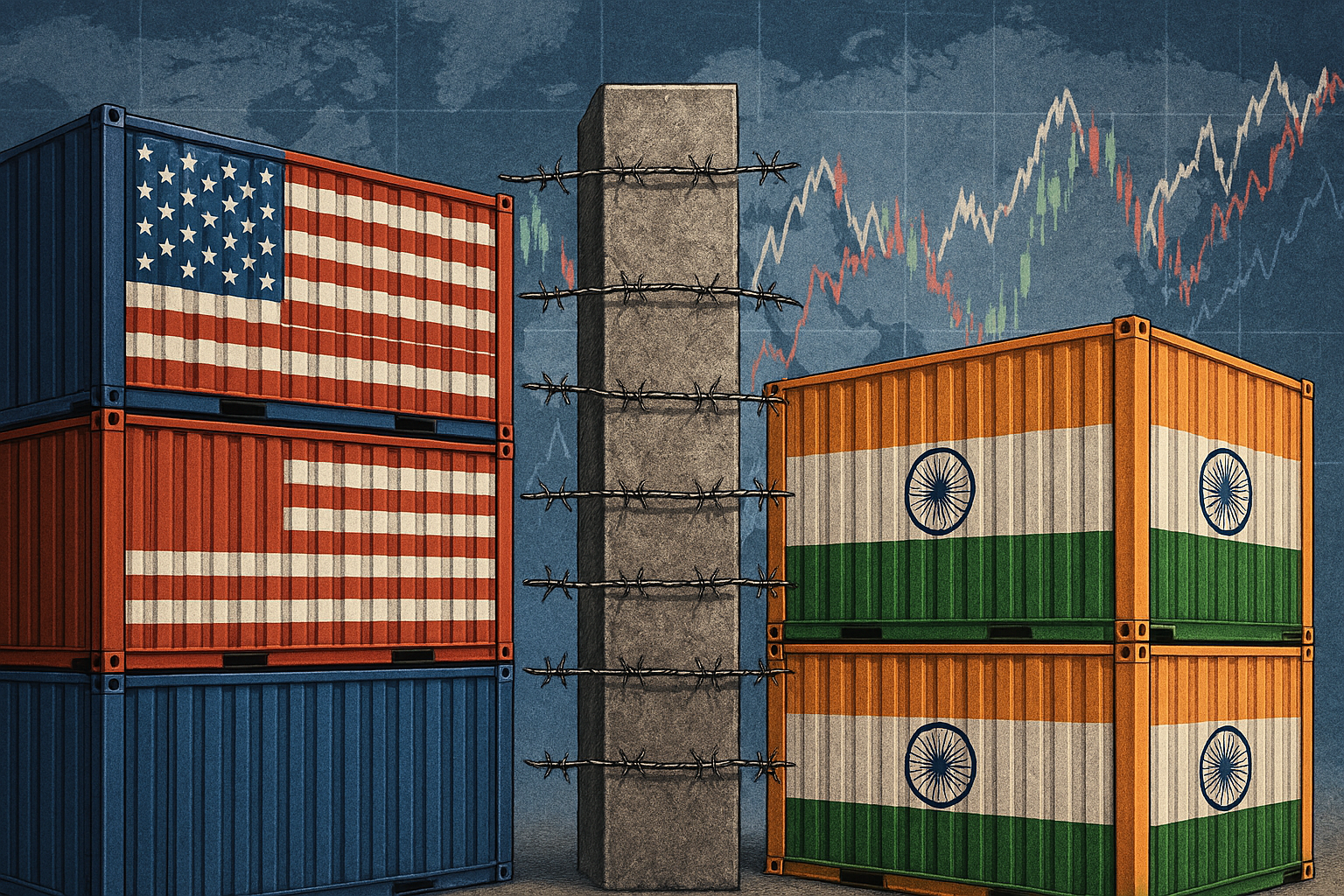
Trump tariffs continue to dominate global trade debates. This blog explores their impact on India, global markets, and the future of U.S. trade policy.
U.S. Tariffs on Indian Imports 2025: Comprehensive Analysis of Trade Policy Impact and Economic Implications
The United States implemented substantial tariff increases on imports from India during 2025, marking a significant shift in bilateral trade relations between the world’s largest and most populous democracies. On August 27, 2025, tariffs on Indian goods reached 50%, representing one of the highest rates imposed on a major trading partner in recent decades. This policy change reflects broader debates about international trade practices, economic sovereignty, and geopolitical considerations.
The tariff implementation occurred in phases, beginning with an initial 25% rate announced in late July 2025, which subsequently doubled to 50% in August. According to official U.S. Trade Representative statements and White House announcements, the tariff policy aims to address perceived trade imbalances and encourage changes in India’s trade and energy policies. This article examines the factual details of these tariff measures, their economic impacts, and the responses from both governments based on official sources and verified economic data.
Understanding the full scope of these trade measures requires analysis of official government communications, trade statistics from both countries’ commerce departments, and economic impact assessments from recognized research institutions. The following sections provide comprehensive coverage of the tariff structure, affected sectors, economic projections, and policy responses.
Background: U.S.-India Trade Relations and Policy Context
Historical Trade Relationship
U.S.-India bilateral trade has expanded significantly over the past two decades. According to U.S. Census Bureau trade statistics, bilateral goods trade totaled approximately $128 billion in 2023, with services trade adding substantial additional value. India represented the United States’ 9th-largest goods trading partner by 2024, reflecting the deepening economic relationship between the two nations.
Trade data from India’s Ministry of Commerce and Industry shows that the United States remains among India’s top export destinations. Key Indian exports to the U.S. include pharmaceuticals, textiles and apparel, precious stones and jewelry, machinery, and organic chemicals. U.S. exports to India feature aircraft, machinery, medical equipment, agricultural products, and energy-related goods.
The trade relationship has involved periodic tensions regarding market access, intellectual property protection, and tariff levels. The Office of the U.S. Trade Representative has published annual reports documenting specific trade concerns with India, including tariff levels on certain products, regulatory barriers, and intellectual property enforcement issues. These documented concerns provide context for the 2025 tariff actions.
Tariff Policy Justifications
Official White House statements and U.S. Trade Representative announcements cited multiple justifications for the 2025 tariff increases:
Trade Balance Concerns: U.S. government officials referenced the bilateral goods trade deficit with India, which reached approximately $36 billion in 2023 according to U.S. Census Bureau data. Policymakers characterized this imbalance as reflecting unfair trade practices requiring corrective action.
Reciprocal Tariff Arguments: According to World Trade Organization tariff data and U.S. Trade Representative analysis, India’s average applied tariff rates on goods exceed U.S. rates. U.S. officials cited these statistics as justification for “reciprocal” tariff measures designed to equalize trade conditions.
Energy Policy Considerations: Official statements linked tariff increases to India’s energy import sources, particularly petroleum products from Russia. U.S. government communications characterized India’s energy purchasing decisions as contrary to U.S. foreign policy objectives regarding Russia sanctions.
Legal and Regulatory Framework
The tariff actions were implemented under various provisions of U.S. trade law:
Section 301 Authority: The U.S. Trade Representative possesses authority under Section 301 of the Trade Act of 1974 to investigate and respond to foreign trade practices deemed harmful to U.S. commerce. This authority provides legal basis for tariff actions following investigation and determination procedures.
National Security Provisions: Some sector-specific tariffs on steel and aluminum products were implemented under Section 232 of the Trade Expansion Act of 1962, which addresses imports affecting national security. These measures apply separate tariff rates beyond the general 50% rate.
Presidential Trade Authority: The President possesses broad authority under U.S. law to adjust tariffs for national security, economic, or foreign policy reasons. Executive orders and proclamations published in the Federal Register document the specific legal justifications and implementation procedures for the 2025 tariff measures.
Detailed Tariff Structure and Implementation Timeline
Phase One: Initial Tariff Announcement
On July 30, 2025, the White House announced an initial 25% tariff on goods imported from India. Official statements characterized this action as a “reciprocal measure” responding to India’s tariff structure on U.S. exports. The announcement provided a 30-day implementation timeline allowing affected businesses to prepare for the rate change.
The initial tariff applied broadly across product categories with specific exceptions for certain high-priority items. U.S. Customs and Border Protection issued technical guidance documents detailing the application procedures, affected Harmonized Tariff Schedule codes, and documentation requirements for importers.
Phase Two: Tariff Escalation
On August 6, 2025, the administration announced a doubling of the tariff rate to 50%, effective August 27, 2025. White House statements explicitly linked this escalation to India’s energy import policies, particularly petroleum purchases from Russia. The accelerated timeline between announcement and implementation provided limited adjustment period for affected businesses.
The 50% rate represents one of the highest tariff levels imposed by the United States on a major trading partner in the post-World War II era. For historical context, U.S. average tariff rates have generally remained below 5% on most trading partners since the 1960s, according to U.S. International Trade Commission historical data.
Sector-Specific Tariff Variations
While the 50% rate applies broadly to Indian imports, several sectors face differentiated treatment:
Steel and Aluminum Products: These products face additional Section 232 tariffs of 25% on steel and 10% on aluminum, layered on top of the general 50% rate. This creates effective tariff rates exceeding 75% on certain metal products. The U.S. Department of Commerce maintains the exclusion process for these tariffs through a formal petition system.
Semiconductors and Electronics: The U.S. Trade Representative announced separate, sector-specific tariff structures for semiconductors and consumer electronics. These rates vary by product subcategory and incorporate considerations of supply chain dependencies and national security implications. Specific rates appear in Federal Register notices published by the Commerce Department.
Pharmaceutical Products: Certain pharmaceutical products received exemptions or reduced rates given their critical nature for U.S. healthcare supply chains. The Department of Health and Human Services and Food and Drug Administration provided input on essential medicine classifications eligible for tariff relief.
Tariff Comparison Table
Based on official U.S. government data and international trade databases:
| Country/Region | General Tariff Rate | Implementation Date | Primary Justification |
|---|---|---|---|
| India | 50% | August 27, 2025 | Trade balance, energy policy |
| China | 25-100% (product-specific) | Various 2024-2025 | Technology transfer, IP protection |
| European Union | 0-25% (product-specific) | Various | Sector-specific disputes |
| Canada | 0-25% (product-specific) | Various | USMCA-related issues |
| Mexico | 0-25% (product-specific) | Various | USMCA-related issues |
Source: U.S. Trade Representative, U.S. Customs and Border Protection
Economic Impact Analysis
Macroeconomic Projections for India
Indian government economic advisers and independent research institutions have published analyses of the tariff impact on India’s economy:
GDP Growth Effects: India’s Chief Economic Adviser, in statements reported through official government channels, estimated potential GDP impact ranging from 0.5% to 0.9% depending on tariff duration and scope. The Ministry of Finance’s Economic Survey documents provide detailed methodology for these calculations based on export exposure and multiplier effects.
The Reserve Bank of India’s monetary policy statements and economic outlook reports incorporate tariff effects into growth projections. The central bank’s assessment considers both direct export impacts and indirect effects through business confidence, investment decisions, and financial market conditions.
Export Volume Projections: India’s Directorate General of Commercial Intelligence and Statistics tracks monthly export data by destination and product category. Preliminary data from September-October 2025 shows declining export volumes to the United States across affected categories, though full-year impacts require longer observation periods.
Sector-Specific Economic Impacts
Different Indian industries face varying degrees of exposure to U.S. tariffs based on their export concentration and alternative market availability:
Textile and Apparel Sector: India’s textile industry represents a major employment sector with significant U.S. export exposure. According to the Ministry of Textiles, the sector employs approximately 45 million workers directly and indirectly across manufacturing, processing, and ancillary services.
The Apparel Export Promotion Council reports that the United States accounts for roughly 30% of India’s textile and garment exports. The 50% tariff significantly affects price competitiveness versus alternative suppliers from Bangladesh, Vietnam, and other Southeast Asian nations. Industry associations have documented order cancellations and production slowdowns in major textile hubs.
Gems and Jewelry Industry: India’s Gem and Jewellery Export Promotion Council tracks trade statistics for this sector. The United States represents approximately 35% of India’s gem and jewelry exports, with significant concentration in diamonds and gold jewelry. The sector employs over 4 million workers across cutting, polishing, design, and retail functions.
The additional 50% tariff compounds existing tariff rates on jewelry products, creating effective rates that significantly impact pricing. Industry representatives report shifting export patterns toward Middle Eastern, European, and East Asian markets to diversify away from U.S. dependence.
Pharmaceutical and Chemical Sector: India’s pharmaceutical industry holds strategic importance as a major supplier of generic medications globally. According to the Department of Pharmaceuticals, India supplies approximately 40% of U.S. generic drug requirements by volume. The sector faces complex tariff implications given the essential nature of pharmaceutical products.
While some critical medications received tariff exemptions, many pharmaceutical intermediates and finished products face the full 50% rate. The Pharmaceutical Export Promotion Council of India reports uncertainty regarding long-term supply contracts and potential supply chain restructuring by U.S. pharmaceutical companies.
Automotive Components: India’s auto component manufacturing sector, tracked by the Automotive Component Manufacturers Association of India (ACMA), exports significant volumes to U.S. automobile manufacturers and aftermarket suppliers. The sector faces combined challenges from the 50% general tariff plus additional rates on certain metal-intensive components.
Major Indian auto component manufacturers with U.S. operations or supply relationships have announced reviews of their export strategies. Some companies report shifting production to facilities in Mexico or other locations with preferential U.S. market access.
Information Technology Services: While the 50% tariff primarily affects goods trade, India’s IT services sector monitors potential spillover effects. The National Association of Software and Services Companies (NASSCOM) tracks both services trade and the regulatory environment for IT professionals.
Services trade faces different policy instruments than goods trade, including visa policies and professional credential recognition requirements. The IT sector’s resilience reflects the difficulty of substituting service relationships and the integrated nature of global software development and support operations.
Employment and Labor Market Effects
Economic research institutions in India have analyzed employment implications of reduced export volumes:
Direct Employment Impacts: Labor-intensive export sectors including textiles, leather goods, and jewelry face immediate employment pressures from order reductions. Government labor statistics agencies track formal sector employment, though significant informal employment in these sectors complicates comprehensive impact assessment.
Regional Variations: Employment effects concentrate in specific geographic regions. Tamil Nadu’s textile clusters around Tirupur, Gujarat’s chemical and diamond processing facilities, and Maharashtra’s automotive and pharmaceutical manufacturing centers face disproportionate impacts. State governments have announced targeted support measures for affected workers.
Workforce Transition Challenges: Workers displaced from export-oriented manufacturing require retraining and skill development for alternative employment. Government skill development programs administered through the Ministry of Skill Development and Entrepreneurship have expanded capacity to address workforce transition needs.
India’s Policy Response Strategy
Official Government Statements
India’s Ministry of External Affairs and Ministry of Commerce and Industry have issued official statements regarding the U.S. tariff actions:
Diplomatic Engagement: Official communications emphasize India’s commitment to resolving trade issues through dialogue and negotiation. Foreign ministry statements characterize the tariffs as contrary to principles of free and fair trade and express willingness to address legitimate U.S. concerns through bilateral consultation mechanisms.
WTO Engagement: India filed formal complaints with the World Trade Organization challenging the legal basis for the U.S. tariffs. These WTO dispute settlement filings, available through the WTO’s official database, argue that the tariffs violate U.S. commitments under the General Agreement on Tariffs and Trade (GATT) and other WTO agreements.
Retaliatory Tariff Measures
India’s Ministry of Finance announced reciprocal tariff increases on selected U.S. products:
Agricultural Products: India imposed increased tariffs on U.S. agricultural exports including almonds, apples, walnuts, and certain other tree nuts and fruits. These product selections target politically significant U.S. agricultural regions to create domestic pressure for tariff reconsideration.
According to India’s Directorate General of Foreign Trade notifications, these retaliatory tariffs range from 20% to 70% depending on product category. The measures affect approximately $850 million in annual U.S. agricultural exports to India based on historical trade data.
Industrial Products: Additional tariffs apply to selected U.S. industrial exports including certain chemicals, machinery, and equipment categories. These measures aim to impose economic costs while minimizing impact on Indian consumers and manufacturers dependent on U.S. inputs.
Trade Diversification Initiatives
India’s government announced accelerated efforts to diversify trade relationships:
European Union Engagement: The Ministry of Commerce and Industry reports progress in free trade agreement negotiations with the European Union. These talks address market access for goods and services, regulatory cooperation, and investment protection. Successful conclusion would provide enhanced access to European markets as a partial offset to U.S. market disruption.
ASEAN Economic Integration: India’s participation in the ASEAN-India Free Trade Area provides framework for enhanced trade with Southeast Asian nations. Government officials announced initiatives to increase utilization of preferential tariff access under existing agreements and to expand agreement coverage to additional sectors.
Middle East Economic Partnerships: Bilateral agreements with United Arab Emirates and ongoing negotiations with Saudi Arabia and other Gulf Cooperation Council members offer alternative export markets. The India-UAE Comprehensive Economic Partnership Agreement, implemented in 2022, provides preferential access across multiple sectors.
African Continental Free Trade Area (AfCFTA): India announced enhanced engagement with African nations under the AfCFTA framework. The Ministry of External Affairs established dedicated teams to facilitate increased trade and investment linkages with African economies.
Industrial Policy Adjustments
The Indian government announced several policy initiatives responding to trade disruptions:
Production Linked Incentive (PLI) Schemes: The Department for Promotion of Industry and Internal Trade administers PLI schemes across 14 manufacturing sectors. Government announcements indicated expanded funding allocations and enhanced incentive structures to promote domestic manufacturing capacity and reduce import dependence.
PLI scheme sectors include electronics manufacturing, pharmaceutical ingredients, automotive components, advanced battery technology, and textile products. The schemes provide financial incentives linked to incremental production and investment in priority sectors.
Make in India Enhancement: The Make in India initiative, launched in 2014 and overseen by the Department for Promotion of Industry and Internal Trade, received renewed emphasis following the tariff actions. Government policy statements emphasized accelerating domestic manufacturing capacity to reduce vulnerability to external trade restrictions.
Specific measures include streamlined regulatory approvals, enhanced infrastructure development in industrial corridors, and targeted support for small and medium enterprises in strategic sectors.
Atmanirbhar Bharat (Self-Reliant India) Acceleration: The self-reliance initiative announced in 2020 gained additional policy focus. Government communications emphasized reducing import dependence in critical sectors including defense manufacturing, pharmaceutical active ingredients, electronics components, and renewable energy equipment.
The initiative encompasses multiple ministries and focuses on both import substitution and export competitiveness enhancement. Budget allocations reflect prioritization of strategic sectors for self-reliance objectives.
Financial Market Impacts
Indian Equity Market Response
India’s securities markets, regulated by the Securities and Exchange Board of India (SEBI), experienced notable volatility around tariff announcements:
Index Performance: The BSE Sensex and NSE Nifty 50, India’s primary equity indices, showed significant movement during key tariff announcement dates. Market data from the Bombay Stock Exchange and National Stock Exchange indicates:
- July 30, 2025 (initial 25% tariff announcement): Sensex declined 1.8%, with export-oriented sectors showing steeper losses
- August 6, 2025 (escalation to 50%): Sensex fell 2.3%, with particular pressure on textile, gems, and automotive component stocks
- August 27, 2025 (tariff implementation): Mixed trading with volatility reflecting uncertainty about duration and potential negotiations
Sector-Specific Performance: Exchange data shows varied performance across sectors. Export-oriented industries including textiles, gems and jewelry, and auto components experienced sustained pressure. Domestic consumption-oriented sectors including financial services, telecommunications, and consumer goods showed relative resilience.
Foreign Institutional Investment Flows: SEBI publishes data on foreign institutional investor (FII) and foreign portfolio investor (FPI) activity. August and September 2025 showed net FII/FPI outflows from equity markets, though multiple factors beyond tariffs influenced these patterns including global monetary policy and emerging market sentiment.
Currency Market Developments
The Indian rupee’s exchange rate against the U.S. dollar reflects multiple influences including the tariff situation:
Exchange Rate Movements: Reserve Bank of India reference rates show rupee depreciation pressure following tariff announcements. The currency moved from approximately 82-83 rupees per dollar in early July 2025 to 84-85 rupees per dollar by September 2025. However, attributing these movements exclusively to tariffs oversimplifies, as currency markets respond to numerous domestic and international factors.
RBI Intervention: The Reserve Bank of India intervenes in foreign exchange markets to manage excessive volatility. RBI’s periodic reports and monetary policy statements discuss foreign exchange market operations, though specific intervention details remain confidential for operational reasons.
Capital Flow Impacts: India’s balance of payments data, published quarterly by RBI, tracks capital flows across categories including foreign direct investment, portfolio investment, and external borrowing. Reduced export earnings from U.S. market access restrictions affect current account dynamics, while capital flow volatility influences overall balance of payments positions.
Commodity Market Effects
Global and domestic commodity markets showed responses to trade policy developments:
Precious Metals: Gold and silver prices, tracked by exchanges including the Multi Commodity Exchange of India, experienced increased volatility. Uncertainty regarding trade policies traditionally drives safe-haven demand for precious metals. India represents the world’s second-largest gold consumer, making domestic price movements significant for consumer purchasing and jewelry manufacturing sectors.
Industrial Metals: Steel and aluminum prices in domestic Indian markets reflected both tariff impacts and global commodity price trends. The Ministry of Steel tracks domestic production and pricing data. The tariffs on Indian metal exports to the U.S. affected pricing dynamics while separate U.S. Section 232 tariffs on steel and aluminum from all countries influenced global metal market conditions.
Trade Policy Analysis and Economic Theory
Tariff Economics Fundamentals
Economic analysis of tariff policies draws on established international trade theory:
Consumer and Producer Effects: Standard economic models indicate that tariffs raise domestic prices for imported goods, imposing costs on consumers while potentially benefiting domestic producers of competing products. The net welfare effect typically shows overall economic loss as consumer losses exceed producer gains.
Deadweight Loss Calculations: Tariffs create deadweight losses by distorting consumption and production decisions away from efficient market outcomes. Economic research quantifies these losses using models incorporating elasticities of supply and demand. The magnitude of deadweight loss increases with tariff rates, suggesting the 50% rate generates substantial inefficiency costs.
Terms of Trade Effects: For large economies, tariffs can potentially improve terms of trade by forcing foreign exporters to absorb some tariff burden through price reductions. However, this benefit diminishes when trading partners implement retaliatory tariffs, potentially leaving both countries worse off than free trade equilibrium.
Protectionist Policy History
Historical economic research documents experiences with protectionist trade policies:
Smoot-Hawley Tariff Act (1930): Economic historians widely cite the Smoot-Hawley tariff increase as exacerbating the Great Depression by triggering retaliatory tariffs and collapsing international trade. While contemporary conditions differ substantially, the historical episode illustrates risks of escalating trade restrictions.
Post-WWII Trade Liberalization: The General Agreement on Tariffs and Trade (GATT), established in 1947 and succeeded by the World Trade Organization in 1995, facilitated decades of trade barrier reductions. This liberalization correlated with expanded global commerce and economic growth, though causality debates continue among economists.
Contemporary Trade Policy Debates: Recent years have witnessed renewed policy interest in strategic trade policies, industrial policy, and economic security considerations. These debates reflect concerns about supply chain resilience, technology competition, and national security implications of economic interdependence.
India-Specific Trade Policy Context
India’s trade policy history reflects distinct development strategy considerations:
Import Substitution Heritage: Following independence in 1947, India pursued import substitution industrialization with high tariff barriers and industrial licensing. Economic reforms beginning in 1991 reduced these barriers substantially, though India maintains higher average tariffs than many developed economies.
WTO Commitments: As a WTO member since 1995, India maintains bound tariff rates (maximum allowable under WTO agreements) significantly higher than applied rates (actual current tariffs). This provides policy space for tariff adjustments within WTO commitments. India’s tariff schedules are publicly available through WTO databases.
Development Stage Considerations: As a developing economy, India utilizes tariffs as policy instruments for infant industry protection, revenue generation, and economic development objectives. This approach differs from developed economy perspectives emphasizing consumer welfare through trade liberalization.
Geopolitical and Strategic Dimensions
U.S.-India Strategic Partnership
The tariff actions occur within broader U.S.-India strategic relationship context:
Defense and Security Cooperation: The United States and India maintain expanding defense cooperation including military exercises, intelligence sharing, and defense equipment sales. The U.S. State Department and India’s Ministry of External Affairs publish information about strategic dialogues and partnership frameworks.
Official statements from both governments emphasize the strategic partnership’s importance despite trade tensions. The 2+2 Ministerial Dialogue between U.S. Secretaries of State and Defense and their Indian counterparts continues addressing regional security cooperation.
Technology and Innovation Partnerships: Both countries cooperate on technology development, space exploration, and innovation initiatives. The U.S.-India Strategic Partnership Forum and various bilateral working groups address technology collaboration opportunities.
However, some technology sectors face restrictions on cooperation due to export controls, intellectual property concerns, and national security considerations. These technology dimensions interact with trade policy in complex ways.
Regional Geopolitical Context: U.S.-India relations reflect shared interests in Indo-Pacific stability, counterterrorism cooperation, and multilateral engagement. The Quadrilateral Security Dialogue (Quad) involving the United States, India, Japan, and Australia represents an important regional cooperation framework.
Trade tensions introduce complications into this strategic relationship, potentially affecting broader cooperation across security, technology, and diplomatic dimensions.
Energy Security Considerations
Energy policy factors significantly influenced the tariff escalation:
India’s Russian Oil Imports: Following Russia’s February 2022 invasion of Ukraine, India substantially increased petroleum imports from Russia, taking advantage of discounted pricing as Western nations reduced Russian energy purchases. According to India’s Petroleum Planning and Analysis Cell, Russian crude oil imports increased from minimal levels pre-2022 to becoming India’s largest single crude supplier by 2023-2024.
The U.S. government explicitly cited these energy purchasing patterns as justification for tariff escalation. Official statements characterized Indian purchases as undermining Western sanctions strategies and providing financial resources to Russia.
India’s Energy Security Position: India’s government defends energy purchasing decisions based on energy security requirements and economic considerations. With limited domestic oil production relative to consumption needs, India relies heavily on imports. Official statements emphasize securing affordable energy supplies for economic development as a national priority.
The Ministry of Petroleum and Natural Gas publishes data on India’s energy supply patterns and import dependencies. These documents underscore India’s position that global oil markets enable purchasing from available suppliers at competitive prices.
Multilateral Trade Architecture
The tariff actions raise questions about multilateral trade system functioning:
WTO Dispute Settlement: India’s WTO complaint challenges the U.S. tariffs’ consistency with WTO rules. The WTO dispute settlement process, outlined in the Dispute Settlement Understanding, provides formal mechanisms for resolving trade disputes between members.
However, the WTO Appellate Body has been non-functional since 2019 due to U.S. blocking of judge appointments. This creates uncertainty about effective dispute resolution for complex trade disagreements.
Regional Trade Agreement Implications: Both the United States and India participate in various regional trade initiatives. The U.S. maintains the United States-Mexico-Canada Agreement (USMCA) and various bilateral trade agreements. India participates in ASEAN-India FTA, India-UAE CEPA, and negotiates additional agreements.
The proliferation of regional agreements alongside bilateral tariff actions illustrates the evolving and fragmented nature of contemporary trade governance compared to the multilateral GATT/WTO framework’s original vision.
Business and Investment Implications
Multinational Corporation Strategy Adjustments
Global companies with operations spanning both countries must adapt to new trade realities:
Supply Chain Reconfiguration: Companies dependent on India-U.S. trade flows are reassessing supply chain structures. Options include shifting production locations, identifying alternative suppliers, or absorbing tariff costs through margin compression.
Major global manufacturers with Indian operations have announced supply chain reviews. These strategic assessments consider not only current tariff levels but also uncertainty about future trade policy direction and potential further escalations.
Investment Decision Impacts: Foreign direct investment decisions incorporate trade policy risk assessment. Companies planning manufacturing investments in India for U.S. export must now account for substantial tariff barriers affecting market access and competitive positioning.
The Department for Promotion of Industry and Internal Trade tracks FDI flows to India. Future data will reveal whether trade tensions materially affect investment patterns across sectors.
Risk Management Approaches: Multinational corporations employ various risk management strategies including geographic diversification, contract flexibility clauses, and financial hedging. Trade policy uncertainty requires robust scenario planning and contingency preparation.
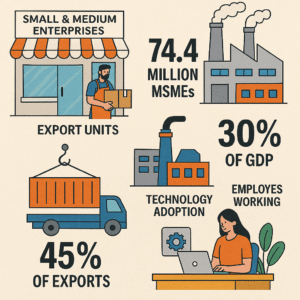
Small and Medium Enterprise Impacts
Smaller businesses face distinct challenges from tariff policies:
Limited Flexibility: Unlike large multinationals with global operations, small and medium enterprises (SMEs) often lack resources for rapid supply chain restructuring. Indian SMEs dependent on U.S. export markets face particularly acute challenges from the 50% tariff.
Export Finance Challenges: Banks and financial institutions reassess credit risk for export-oriented SMEs facing market access disruption. This can create financing constraints precisely when businesses need capital for market diversification and restructuring.
Government Support Programs: India’s Ministry of Micro, Small and Medium Enterprises administers various support programs. Following the tariff implementation, the government announced enhanced credit facilities and market development assistance for affected SMEs.
Investment Research and Analysis
Financial analysts and research institutions publish ongoing assessments of tariff impacts:
Equity Research Updates: Investment research firms covering Indian equities have revised sector outlooks and company-specific earnings projections to reflect tariff impacts. These research reports inform investor decisions and market expectations.
Credit Rating Implications: Credit rating agencies evaluate whether tariff-induced revenue pressures affect companies’ debt servicing capacity. While broad market impacts have been manageable, specific heavily-exposed companies face potential rating actions.
Macroeconomic Forecasts: International financial institutions including the International Monetary Fund and World Bank, as well as domestic institutions like the Reserve Bank of India, incorporate trade policy developments into economic growth projections. These forecasts influence investment strategy and policy planning.
Future Outlook and Scenario Analysis
Potential Resolution Pathways
Several possible trajectories exist for U.S.-India trade relations:
Negotiated Settlement: Bilateral negotiations could produce a comprehensive trade agreement addressing U.S. concerns about market access while providing Indian exports restored access to U.S. markets. Such an agreement would require compromises from both sides on sensitive issues.
Historical precedents include trade agreements following prior U.S. tariff actions against other countries. Success depends on political will, domestic interest group pressures, and broader geopolitical considerations.
Partial De-escalation: Selective tariff reductions or expanded exemptions could provide partial relief without fully resolving underlying policy disagreements. This might involve sector-specific agreements or interim arrangements pending comprehensive negotiations.
Prolonged Trade Tensions: Absent negotiated resolution, tariffs could remain in place for extended periods. This scenario would accelerate supply chain restructuring and trade diversification efforts, with lasting impacts on bilateral economic relationships.
Long-Term Structural Implications
Beyond immediate economic impacts, the tariff actions may generate lasting structural changes:
Manufacturing Location Decisions: Companies’ long-term manufacturing investment decisions increasingly incorporate trade policy risk. This may accelerate trends toward regional manufacturing networks serving specific market regions rather than globalized production for worldwide distribution.
Supply Chain Resilience Priority: Businesses and governments alike increasingly prioritize supply chain resilience over pure efficiency optimization. This reflects not only trade policy uncertainty but also pandemic-era disruptions and geopolitical tensions.
Technology and Innovation Patterns: Trade restrictions interact with technology policies including export controls and investment screening. These combined measures may influence innovation patterns, technology diffusion, and research collaboration structures.
Indian Economic Development Trajectory
Trade policy developments influence India’s broader economic development path:
Domestic Market Emphasis: Reduced export market access increases importance of domestic market expansion. This aligns with government initiatives promoting consumption growth, infrastructure investment, and urbanization.
Manufacturing Sector Evolution: India’s manufacturing sector development strategy must adapt to changed external environment. This may involve greater emphasis on intermediate goods and machinery production, technology-intensive manufacturing, and value chain diversification.
Service Sector Dynamics: India’s substantial services sector, particularly information technology and business process services, demonstrates relative resilience to goods tariffs. Continued services sector growth could partially offset merchandise export challenges.
Frequently Asked Questions
What is the current tariff rate on Indian goods imported to the United States?
The United States currently imposes a 50% tariff on most goods imported from India, effective August 27, 2025. This rate applies broadly across product categories with certain exceptions for specific sectors. Steel and aluminum products face additional separate tariffs under Section 232 provisions, while semiconductors and electronics are subject to distinct sector-specific tariff structures. These rates are documented in Federal Register notices and U.S. Customs and Border Protection guidance materials available through official government websites.
Which Indian industries face the greatest impact from U.S. tariffs?
The textile and apparel sector, gems and jewelry industry, automotive components manufacturing, and pharmaceutical sectors experience particularly significant impacts according to Indian government economic assessments and industry association reports. The textile sector’s labor-intensive nature and substantial U.S. export dependence create employment concerns. The gems and jewelry sector faces high effective tariff rates affecting competitiveness. Automotive components and pharmaceuticals must navigate both direct tariff impacts and supply chain restructuring by U.S. customers.
How has the Indian government responded to the U.S. tariff actions?
India implemented reciprocal tariffs on selected U.S. products, particularly agricultural items including almonds, walnuts, and apples, according to notifications from India’s Directorate General of Foreign Trade. The government filed formal complaints with the World Trade Organization challenging the tariffs’ legality. Additionally, India announced accelerated trade diversification efforts through free trade agreement negotiations with the European Union, enhanced engagement with ASEAN economies, and expanded Middle Eastern partnerships. Domestic policy responses include enhanced Production Linked Incentive schemes and renewed emphasis on the Make in India and Atmanirbhar Bharat initiatives.
What is the estimated economic impact of these tariffs on India’s GDP?
India’s Chief Economic Adviser estimated potential GDP impact ranging from 0.5% to 0.9% according to government statements and economic analysis documents. Independent economists’ assessments suggest approximately $36 billion economic impact, representing roughly 0.9% of GDP. These projections account for direct export effects and indirect impacts through business confidence, investment decisions, and employment. Actual impact depends on tariff duration, potential negotiations, success of export market diversification, and domestic policy responses. The Reserve Bank of India incorporates these factors into monetary policy deliberations and economic outlook assessments.
Could these tariffs be challenged or removed through international trade mechanisms?
India filed formal complaints with the World Trade Organization challenging the tariffs’ consistency with U.S. commitments under WTO agreements, according to WTO dispute settlement records. The WTO dispute process typically requires several years for resolution. However, the WTO Appellate Body remains non-functional due to member disagreements about judge appointments, creating uncertainty about final dispute resolution. Beyond WTO mechanisms, bilateral negotiations between the U.S. and Indian governments could result in tariff modifications or removal. Historical precedents show trade agreements following prior U.S. tariff actions, though success depends on political factors and policy priorities in both countries.
How do these tariffs compare to U.S. tariff rates on other countries?
The 50% rate on Indian goods represents one of the highest U.S. tariff rates on a major trading partner according to U.S. International Trade Commission data. For comparison, U.S. tariffs on Chinese imports vary by product but reach 100% on certain categories, while tariffs on goods from Canada, Mexico, and European Union countries generally remain below 25% except for specific disputed sectors. The 50% India rate exceeds typical U.S. Most Favored Nation tariff rates, which average around 3-4% across all trading partners according to WTO data. This elevated rate reflects the specific political and policy considerations underlying U.S.-India trade tensions.
What options do Indian exporters have to reduce tariff impact?
Indian exporters can pursue several strategies according to industry association guidance and government advisory resources. Market diversification involves developing sales relationships in the European Union, ASEAN countries, Middle East, and African markets where India maintains preferential trade agreements or lower tariff barriers. Supply chain restructuring might involve establishing production facilities in countries with U.S. free trade agreements or preferential access. Product repositioning can shift focus toward higher-value items where tariff percentage impacts total cost less significantly. Some exporters negotiate with U.S. buyers to share tariff costs through price adjustments. Government support programs provide financial assistance for market development and restructuring initiatives.
What factors could lead to tariff reduction or elimination?
Several scenarios could produce tariff modifications according to analysis of U.S. trade policy history and current bilateral relationship dynamics. Successful bilateral trade negotiations addressing U.S. concerns about market access, tariff reciprocity, and regulatory barriers could result in phased tariff reductions. Changes in India’s energy import patterns, particularly regarding Russian petroleum purchases, explicitly factored into tariff escalation and could influence de-escalation decisions. Broader geopolitical developments affecting U.S.-India strategic partnership might create incentives for resolving trade tensions. Domestic political pressures in either country from affected industries and interest groups could influence government policy positions. WTO dispute settlement findings, if the appellate process becomes functional, could legally require tariff adjustments.
About the Author
Nueplanet
International Trade and Economic Policy Analyst
Nueplanet is an international trade and economic policy analyst specializing in U.S.-India commercial relations, global supply chain dynamics, and multilateral trade systems. With over the years of experience analyzing trade policy developments, Nueplanet provides factual assessments based on official government sources, academic research, and verified economic data. Nueplanet expertise includes tariff policy analysis, World Trade Organization dispute mechanisms, and the intersection of trade policy with strategic international relationships. Vikram’s work focuses on delivering accurate, balanced information that helps businesses, policymakers, and readers understand complex trade developments and their practical implications. All content is researched using authoritative sources including U.S. government publications, international organization reports, peer-reviewed economic studies, and official statements from relevant authorities, with regular updates reflecting evolving policy conditions.
Published: August 29, 2025
Last Updated: August 29, 2025
This article is based on publicly available court documents, government sources, economic research, and verified news reports regarding U.S. trade policy and the September 2024 court ruling. Analysis represents factual assessment of documented events and their implications rather than political advocacy or investment advice. Readers should consult official sources and appropriate professional advisors for specific business or legal decisions related to international trade. Content is intended for informational purposes only and does not constitute legal, financial, or policy recommendations.
Helpful Resources
Latest Posts
Tag
Trump Tariffs
Related Posts










Post Comment