









NHPC: Revolutionary Powerhouse – The Ultimate Guide to India’s Hydroelectric Giant and Career Opportunities 2025
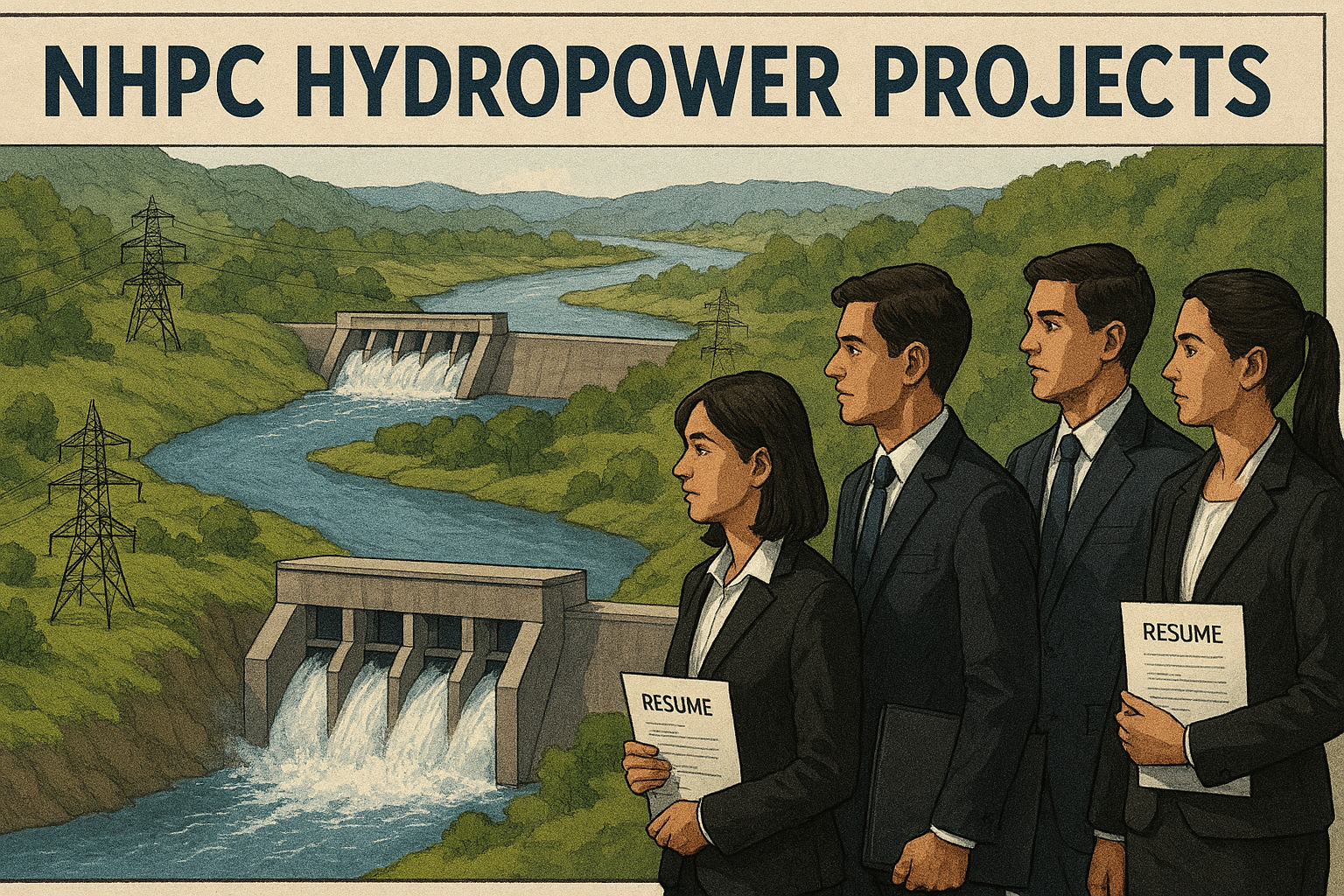
The NHPC plays a vital role in India’s hydropower sector and career opportunities. This blog explores NHPC’s operations, recruitment process, and its growing importance in the energy landscape.
Table of Contents
Published: August 28, 2025 | Last Updated: August 28, 2025
Overview: Understanding India’s Largest Hydroelectric Power Producer
The National Hydroelectric Power Corporation (NHPC) operates as a central public sector enterprise generating electricity through hydroelectric and renewable energy facilities across India. Established on November 7, 1975, NHPC currently manages a portfolio of hydroelectric projects with total installed capacity exceeding 7,097 megawatts as of January 2025. The organization announced recruitment of 248 professionals in January 2025, marking one of the largest recruitment drives in recent organizational history.
NHPC operates under the administrative supervision of the Ministry of Power with 100% ownership by the Government of India. The corporation maintains corporate headquarters in Faridabad, Haryana, and operates regional offices across five major geographic zones covering the entire Indian subcontinent. With approximately 18,500 permanent employees, NHPC manages a diverse portfolio of projects across varying geographic and climatic conditions.
The 2025 recruitment notification encompasses 248 positions across executive, engineering, and management trainee categories. The selection process spans multiple stages including written examination, group discussion, and personal interviews scheduled between April and June 2025. Understanding NHPC’s organizational structure, operational capabilities, and recruitment framework provides essential context for prospective applicants and stakeholders interested in India’s renewable energy sector.
Historical Development and Organizational Evolution
Foundation and Early Operations (1975-1990)
The National Hydroelectric Power Corporation received formal establishment on November 7, 1975, as a response to India’s energy independence objectives during the post-independence development period. Initial organizational focus emphasized conducting feasibility studies for hydroelectric projects and establishing operational infrastructure across geographically challenging regions. The corporation commenced construction of inaugural projects in 1978, with first commercial power generation beginning in 1982.
By 1985, NHPC had achieved installed capacity of 1,000 megawatts across operational projects. This early expansion phase required significant organizational development including establishment of regional offices, training facilities, and technical expertise centers. The organization established international collaboration agreements during the late 1980s, facilitating knowledge transfer from established hydroelectric operators in developed nations.
Environmental impact assessment protocols were formally established in 1989, reflecting growing international emphasis on environmental conservation in infrastructure development. This early environmental integration positioned NHPC ahead of many contemporary development organizations in recognizing environmental stewardship as integral to operational sustainability.
Modernization and Technology Integration (1990-2010)
The 1990s and 2000s witnessed substantial technological advancement within NHPC operations including computerized monitoring systems deployment by 1992 and ISO 9001 certification achievement in 1995. The organization expanded capacity substantially, crossing 5,000 megawatts installed capacity by 2008. Major project initiatives including Tehri Hydroelectric Complex and Dulhasti Power Station represented engineering achievements demonstrating organizational technical capabilities.
Cross-border energy cooperation commenced with international partnerships including Bhutan and Nepal, establishing NHPC as a regional energy provider beyond domestic India boundaries. The organization also initiated diversification into solar power generation in 2003 and wind power projects in 2006, reflecting evolving energy sector dynamics and renewable energy policy emphasis.
Contemporary Operations and Digital Transformation (2010-2025)
Recent organizational evolution emphasizes digital transformation with smart grid integration projects initiated in 2012 and AI-powered hydroelectric optimization systems by 2018. The organization has implemented comprehensive digital infrastructure supporting real-time monitoring, predictive maintenance, and operational efficiency improvements across all installations.
COVID-19 pandemic response measures implemented in 2020 demonstrated organizational resilience in maintaining consistent energy supply despite unprecedented operational challenges. Recovery and adaptation phase following the pandemic involved workforce capability development and technological implementation accelerations. The 2025 recruitment drive represents organizational preparation for managing expanded operations and succession planning for aging workforce demographics.
Organizational Structure and Governance Framework
Corporate Headquarters and Regional Operations
NHPC maintains primary corporate headquarters in Faridabad, Haryana, established in 1976 on a 15-acre campus incorporating executive offices, technical centers, and training facilities. The location provides strategic proximity to Delhi enabling effective government coordination and liaison with Ministry of Power officials. Headquarters facilities include research and development centers supporting ongoing technological innovation.
Regional office network encompasses five geographic zones:
Northern Region: Shimla headquarters managing Himachal Pradesh and Uttarakhand operations (established 1978)
Eastern Region: Kolkata headquarters coordinating Northeast India operations (established 1980)
Western Region: Mumbai headquarters managing Western India projects (established 1982)
Southern Region: Hyderabad headquarters covering South India operations (established 1985)
Northeastern Region: Shillong headquarters specializing in Northeast India hydroelectric projects (established 1988)
This geographic distribution enables localized project management while maintaining centralized policy coordination through headquarters. Each regional office maintains technical expertise centers and project management divisions specific to regional operational requirements and geographic characteristics.
Board Structure and Governance
NHPC operates under a professional board of directors comprising:
- Chairman and Managing Director providing executive leadership
- Director (Technical) overseeing engineering operations
- Director (Finance) managing financial and accounting functions
- Director (Personnel) responsible for human resources
- Three independent directors providing governance oversight
- Two government nominees ensuring government accountability
The board structure combines professional management expertise with government accountability mechanisms reflecting public sector enterprise nature. Independent directors bring external perspectives ensuring governance quality and stakeholder protection. Regular board meetings maintain oversight of strategic decisions, financial performance, and operational compliance.
Financial Performance and Market Position
NHPC demonstrates substantial financial performance with fiscal year 2023-24 results indicating:
- Total revenue: ₹12,847 crores
- Net profit: ₹3,245 crores
- Total assets: ₹52,180 crores
- Market capitalization: ₹45,000+ crores (December 2024)
- Government dividend payment: ₹892 crores annually
The financial performance reflects operational efficiency and strong market position despite renewable energy sector competitive dynamics. Dividend payments to the Government of India exceed most comparable public sector enterprises, demonstrating financial surplus generation supporting government fiscal objectives. Market capitalization positions NHPC among top-tier public sector enterprises.
Installed Capacity Portfolio and Operations
Hydroelectric Power Generation Capabilities
NHPC operates 23 hydroelectric projects with combined installed capacity of 6,908 megawatts and annual power generation averaging 29,500 million units. The plant load factor of 42.8% reflects optimal performance within hydroelectric generation constraints including seasonal water availability variations. Geographic distribution of projects spans diverse climatic zones from high-altitude Himalayas to temperate foothills.
Tehri Hydro Power Complex, Uttarakhand:
This facility represents NHPC’s largest hydroelectric installation with installed capacity of 2,400 megawatts distributed across four units of 600 megawatts each. Commissioned in October 2006 after 18 years of construction, the project required ₹18,500 crores investment. The dam height of 260.5 meters represents India’s highest dam structure. The project incorporates advanced safety systems and environmental protection measures.
Chamera-I, Himachal Pradesh:
Commissioned in March 1994, this 540-megawatt facility represents NHPC’s first major operational project. The three-unit configuration with 180-megawatt units per installation required ₹2,800 crores investment. The project demonstrates successful hydroelectric implementation in challenging mountain terrain.
Uri-I Hydro Electric Project, Jammu and Kashmir:
This 480-megawatt installation across four 120-megawatt units commenced operations in December 1997. Located in border region, the project contributed to strategic development objectives while generating ₹3,200 crores economic investment. The facility maintains operational reliability despite challenging geographic and geopolitical considerations.
Dulhasti Power Station, Jammu and Kashmir:
The 390-megawatt installation comprising three 130-megawatt units represents engineering achievement overcoming complex geological conditions. Commissioned in August 2007 after extended construction period, the project required ₹4,500 crores investment. The facility demonstrates NHPC capability in managing technically challenging projects.
Sewa-II Hydroelectric Project, Jammu and Kashmir:
This 120-megawatt installation across two 60-megawatt units commenced operations in March 2012. The project required ₹1,850 crores investment with emphasis on environmental conservation integration. The facility demonstrates contemporary environmental consciousness in project design and operations.
Renewable Energy Diversification
Solar Power Operations:
NHPC operates solar facilities across multiple locations with current installed capacity of 135.7 megawatts. Operational installations include Faridabad Solar Plant (15 MW, commissioned April 2018), Ramagundam Solar Park (25 MW, commissioned September 2019), and Simhadri Solar Plant (50 MW, commissioned December 2020). Additional solar projects under construction target 500 megawatts of incremental capacity.
Wind Power Generation:
Current wind power capacity of 50 megawatts operates across three locations. Pipeline wind projects under development target 200 megawatts of additional capacity. Geographic focus emphasizes wind-rich regions including Gujarat and Tamil Nadu.
Cross-Border Energy Cooperation
Bhutan Energy Partnership:
NHPC manages joint ventures with Bhutan Power Corporation generating over 1,100 megawatts through three major projects. Chukha Hydro Project (336 MW) initiated operations since 1986. Kurichu Hydro Project (60 MW) commenced in 2001. Mangdechhu Hydro Project (720 MW) was commissioned in 2019 after extensive construction. Cumulative investment in Bhutan projects exceeds ₹8,500 crores, establishing India-Bhutan energy cooperation as significant bilateral initiative.
Nepal Hydroelectric Collaboration:
NHPC invested substantially in Nepal hydroelectric development with Arun-III Hydro Project representing India’s largest Nepal investment. The 900-megawatt project under construction represents ₹15,000 crores investment with expected completion by 2028. This project demonstrates India’s commitment to regional energy cooperation supporting Nepal’s development objectives.
Environmental Sustainability and Impact
Carbon Emissions Avoidance
NHPC hydroelectric operations generate approximately 28.5 million tonnes of CO₂ emissions annually through displacement of thermal power generation. This environmental benefit exceeds tree planting programs, equivalent to establishing 380 million trees annually. Environmental investment over 2020-2025 period reached ₹2,500 crores supporting conservation and mitigation initiatives.
Biodiversity Conservation Initiatives
NHPC implements comprehensive biodiversity protection programs including 12 fish ladder installations facilitating fish migration across dam structures. Eight wildlife corridors maintain migration passages for regional fauna. Afforestation programs have rehabilitated 15,000 hectares of landscape. Water quality monitoring operates 150 testing points across project areas ensuring aquatic ecosystem health maintenance.
NHPC Recruitment 2025: Comprehensive Overview
Recruitment Timeline and Schedule
Official notification announcement occurred on January 15, 2025, with application submission period spanning February 1 through March 15, 2025. Written examination is scheduled for April 20-25, 2025, with group discussions occurring May 15-20, 2025. Personal interviews are planned for May 25-30, 2025. Result announcement is expected June 10, 2025, with selected candidate joining commencing August 1, 2025. This timeline provides approximately 6-month preparation period for prospective candidates.
Vacancy Distribution and Categories
Executive Level Positions (125 vacancies):
Engineering executive positions comprise 78 vacancies distributed across Civil Engineering (28), Electrical Engineering (25), Mechanical Engineering (18), and Computer Science/IT (7) disciplines. Non-engineering executive positions total 47 vacancies including Finance & Accounts (15), Human Resources (12), Legal Affairs (8), Environment & Forest (7), Company Secretary (3), and Hindi Officer (2).
Engineer Posts (87 vacancies):
Engineering positions are distributed across Civil Engineering (32), Electrical Engineering (28), Mechanical Engineering (19), and Electronics & Communication (8).
Management Trainee Positions (36 vacancies):
Technical management trainees (24 posts) prioritize engineering graduates from premier institutions with renewable energy specialization focus. Non-technical management trainees (12 posts) target MBA/PGDM graduates specializing in Finance, Human Resources, or Marketing.
Eligibility Requirements
Age Specifications:
Executive posts impose maximum age of 30 years as on March 31, 2025, with age relaxation of 3 years for OBC category and 5 years for SC/ST categories. Engineer posts have maximum age of 27 years with equivalent relaxation provisions. Management trainee positions restrict to maximum age of 25 years. Ex-servicemen receive additional age relaxation as per government service commission guidelines.
Educational Qualifications:
Engineering executives require bachelor’s degree in relevant engineering discipline with minimum 60% marks (55% for reserved categories), with GATE qualification preferred but not mandatory. Non-engineering executives need master’s degrees in relevant specialization with professional qualifications (CA, CS, CFA) preference and minimum 60% academic marks. Engineer positions require bachelor’s degrees with minimum 65% marks (60% for reserved categories), with valid GATE scores advantageous. Management trainees require engineering degrees with minimum 70% marks or MBA degrees with minimum 65% marks.
Selection Process and Examination Framework
Stage 1: Online Written Examination
Scheduled for April 20-25, 2025, the examination spans 3 hours duration with total marks of 200. The computer-based test comprises three sections: General Aptitude (50 marks, 50 questions), General Awareness (50 marks, 50 questions), and Technical Knowledge (100 marks, 100 questions). Negative marking deducts 0.25 marks for incorrect responses.
General Aptitude Section (50 marks):
This component assesses quantitative aptitude including arithmetic, algebra, and problem-solving. Logical reasoning and data interpretation are emphasized. Questions target mathematical proficiency and analytical thinking capability.
General Awareness Section (50 marks):
Content covers current affairs, Indian geography and history, science and technology, and energy sector developments. Questions assess knowledge of contemporary events and foundational national understanding.
Technical Knowledge Section (100 marks):
Discipline-specific questions address engineering fundamentals and recent technological developments. Power sector knowledge and specialized technical competencies are evaluated. This section constitutes 50% of examination weight reflecting technical focus.
Stage 2: Group Discussion
Scheduled for May 15-20, 2025, group discussions involve 8-10 candidates per group in 30-minute sessions. Discussion topics address energy sector challenges, renewable energy future trajectories, and environmental conservation strategies. Assessment focuses on communication clarity, analytical depth, and collaborative engagement.
Stage 3: Personal Interview
Personal interviews scheduled May 25-30, 2025 involve 45-60 minute sessions with 5-7 senior NHPC officials on assessment panel. Interview evaluation covers technical competency, leadership potential, communication skills, problem-solving ability, and industry awareness. Technical interview questions address core engineering principles, NHPC projects, and environmental considerations. Behavioral questions assess leadership experiences and decision-making approaches.
Compensation Structure and Benefits
Executive Level Compensation
Executive positions offer basic salary ranging from ₹60,000 to ₹1,80,000 monthly with grade pay of ₹5,400-₹8,700. Dearness allowance follows central government rates with house rent allowance varying from 8-24% of basic salary. Transport allowance ranges from ₹3,200-₹7,200 monthly.
Engineer Level Compensation
Engineer positions provide basic salary from ₹50,000-₹1,60,000 monthly with grade pay of ₹4,200-₹6,600. Professional development allowance of ₹2,000 monthly and technical allowance of ₹1,500 monthly supplement base compensation.
Additional Benefits Package
Medical benefits include comprehensive health insurance with cashless treatment facilities and family coverage. Leave entitlements comprise 8 casual leave days annually, 30 earned leave days, and 20 sick leave days. Retirement benefits include provident fund contribution of 12%, gratuity, and contributory pension scheme. Professional development includes ₹50,000 annual training budget with conference participation sponsorship and study leave provisions.
Career Development and Professional Growth
Engineering Career Pathways
Civil Engineering roles encompass dam design and construction for mega infrastructure projects, structural engineering for high-rise powerhouses, geotechnical engineering for foundation design in challenging terrains, environmental engineering for sustainable practices, and project management for multimillion-dollar initiatives.
Electrical Engineering positions include power system design for grid integration, control systems for automated operations, protection engineering for safety systems, renewable integration for solar and wind systems, and smart grid technology development.
Mechanical Engineering opportunities involve turbine engineering for hydroelectric optimization, maintenance engineering for preventive and predictive approaches, thermal systems for cooling systems, manufacturing engineering for equipment procurement, and innovation engineering for research initiatives.
Administrative and Managerial Roles
Finance and Accounts positions encompass financial planning including budget preparation, cost accounting for project costing, treasury management for cash flow optimization, risk management for financial risk assessment, and audit and compliance for internal audit procedures.
Human Resources roles include talent acquisition for recruitment processes, learning and development for training program design, employee relations for grievance management, compensation management for salary structuring, and organizational development for change management.
Legal Affairs positions involve contract management for vendor agreements, regulatory compliance for environmental adherence, dispute resolution through arbitration mechanisms, intellectual property protection, and corporate governance support.
Professional Development Infrastructure
NHPC Training Institute established in 1989 operates on a 50-acre Faridabad campus with annual training capacity for 5,000+ professionals. International collaborations encompassing 15+ global partnerships facilitate knowledge exchange. Training modules address hydroelectric engineering fundamentals, advanced turbine technology, digital automation systems, environmental impact assessment, and safety management.
Management development programs spanning 1-4 weeks address leadership and team building, strategic planning, financial management for engineers, communication skills, and change management. Specialized certification programs include Project Management Professional (PMP), Certified Energy Manager (CEM), Six Sigma certifications, ISO environmental management, and occupational health and safety management.
International deputation opportunities provide study tours to hydroelectric facilities in Norway, Switzerland, Canada, Germany, and Japan. World Bank project assignments and cross-border project management in Bhutan and Nepal provide practical international experience.
Career Progression Framework
Entry-level positions (E1-E3) involve 3-5 years focus on technical skill development and project exposure in individual contributor roles. Mid-level positions (E4-E6) span 5-8 years emphasizing team leadership and project management. Senior-level positions (E7-E8) cover 4-6 years focusing on strategic planning and business development. Leadership positions (E9+) involve business unit management and strategic decision-making.
Annual performance review cycles guide advancement through goal setting in January-February, mid-year reviews in July-August, and final assessments in November-December with promotion cycles in April. Advancement depends on technical competency demonstration, project delivery excellence, innovation contributions, leadership abilities, and safety compliance.
Ongoing and Pipeline Projects
Under-Construction Major Projects
Subansiri Lower Hydroelectric Project, Arunachal Pradesh/Assam:
This 2,000-megawatt installation (8 × 250 MW units) requires ₹20,000 crores investment with expected completion in December 2027. Located in Seismic Zone IV, the dam height of 116 meters and length of 1,315 meters create a 77.8 square kilometer reservoir. Construction progress reached 85% as of 2025 with annual energy generation targeted at 7,421 million units.
Parbati-II Hydroelectric Project, Himachal Pradesh:
This 800-megawatt facility (4 × 200 MW units) requires ₹12,500 crores investment with expected March 2028 completion. Engineering specifications include 14.7-kilometer headrace tunnel (Asia’s longest), 190-meter surge shaft, and 168m × 24m × 45m underground powerhouse. Current construction progress stands at 78%.
Pipeline Projects (2030-2035)
Dibang Multipurpose Project, Arunachal Pradesh:
Proposed 2,880-megawatt capacity (12 × 240 MW units) with ₹28,000 crores estimated investment and 2025-2033 project timeline provides border area development significance.
Etalin Hydroelectric Project, Arunachal Pradesh:
Proposed 3,097-megawatt capacity with ₹25,000 crores investment emphasis on enhanced biodiversity conservation targeting 12,000 million units annual generation.
Renewable Energy Expansion Plans
NHPC targets 5,000 megawatts solar capacity by 2030 with ₹15,000 crores investment commitment across Rajasthan, Gujarat, and Karnataka focus states. Specific projects include Rajasthan Solar Park Phase-II (750 MW), Ladakh Solar Initiative (500 MW), floating solar projects (300 MW), and rooftop distributed installations (200 MW).
Wind energy development targets 2,000 megawatts by 2030 across Gujarat, Tamil Nadu, Karnataka, and Maharashtra with offshore wind potential of 1,000 megawatts under coastal studies. Digital transformation initiatives support 5-year ₹500 crore investment in AI applications, drone technology, IoT systems, blockchain energy trading, and virtual reality training.
Regional Development and Community Impact
Economic Development Contributions
NHPC directly employs 18,500+ permanent personnel with estimated 75,000 indirect contractor and supplier jobs. Regional economic multiplier effect of 3.2x impacts local economies substantially. Annual organizational payroll reaches ₹2,800 crores supporting regional income generation.
Infrastructure development through NHPC operations includes 1,200+ kilometers of roads and bridges, 45 educational institutions, 25 healthcare facilities, and digital connectivity extending to 150+ villages. These infrastructure investments create lasting regional development beyond direct energy generation.
Community Welfare Programs
NHPC Foundation operates with annual budget of ₹250 crores benefiting 5 lakh+ individuals annually. Program focus addresses education and skill development, healthcare and sanitation, rural infrastructure, women empowerment, and environmental conservation. Skill development centers across 12 project locations maintain annual training capacity for 2,500 individuals offering electrical technician training, welding and plumbing, computer literacy, entrepreneurship development, and organic farming courses.
Cultural Integration and Preservation
Indigenous community programs involve 25+ tribal community initiatives with 15 traditional practices preservation efforts. Language preservation supports 8 endangered dialects. Traditional craft promotion supports 500+ artisans maintaining cultural heritage.
Examination Preparation Guidance
Study Timeline and Strategy
A structured 6-month preparation approach involves months 1-2 covering foundation building with 6-8 study hours daily. Months 3-4 emphasize advanced preparation with weekly mock tests and 8-10 study hours daily. Months 5-6 focus on intensive revision with daily mock tests and 10-12 study hours daily.
Subject-Specific Preparation
General aptitude preparation requires quantitative aptitude focus on number systems, ratio and proportion, time and work problems, and data interpretation. Logical reasoning covers verbal and non-verbal reasoning, pattern recognition, and logical deduction. General awareness addresses current affairs, energy sector knowledge, and general knowledge components.
Technical knowledge varies by discipline with civil engineering covering structural mechanics, concrete technology, geotechnical engineering, water resources, and environmental engineering. Electrical engineering addresses power systems, control systems, power electronics, renewable technologies, and digital electronics. Mechanical engineering covers thermodynamics, fluid mechanics, manufacturing processes, materials science, and industrial engineering.
Recommended Resources
Technical subject preparation utilizes standard engineering handbooks from established publishers. General aptitude preparation references include Quantitative Aptitude and Logical Reasoning texts. Current affairs resources include government publications and energy sector magazines. Official websites including NHPC Limited, Ministry of Power, and Central Electricity Authority provide authoritative information. Online educational platforms offer technical courses, current affairs applications, and mock testing capabilities.
Interview Preparation Focus
Technical interview preparation addresses core engineering principles, NHPC project specifications, environmental procedures, and safety protocols. Industry awareness questions cover India’s energy policy, renewable targets, development challenges, and international cooperation. Behavioral preparation emphasizes leadership examples, problem-solving approaches, and communication capabilities.
Key Implications and Takeaways
NHPC recruitment 2025 represents significant opportunity for 248 professionals across diverse disciplinary backgrounds. The selection process emphasizes technical competency while assessing broader professional capabilities including leadership, communication, and analytical thinking. Career progression within NHPC provides structured advancement pathways with professional development emphasis.
The organization’s expanded renewable energy portfolio and technology modernization initiatives create dynamic career environments for professionals interested in emerging energy technologies. Geographic distribution of projects and international cooperation opportunities provide diverse career experiences across multiple regions and international contexts. Compensation structures and benefits packages align with leading public sector organizations.
Understanding organizational history, operational capabilities, and future vision enables prospective candidates to evaluate career fit and preparation requirements. The detailed recruitment framework and transparent selection process facilitate fair evaluation of candidates based on demonstrated capabilities. Success in NHPC recruitment requires comprehensive preparation addressing technical knowledge, general awareness, and professional competency demonstration.
Frequently Asked Questions (FAQs)
FAQ 1: When was NHPC established, and what is its primary mandate?
The National Hydroelectric Power Corporation received formal establishment on November 7, 1975, as a central public sector enterprise under the Ministry of Power. The primary organizational mandate involves harnessing India’s hydroelectric potential through project development, operation, and maintenance. Secondary mandates include expanding renewable energy generation, developing hydroelectric technology, and contributing to regional development through infrastructure creation. The organization operates as 100% Government of India owned entity with public sector enterprise classification.
FAQ 2: What is the total installed capacity of NHPC as of January 2025?
NHPC operates total installed capacity of 7,097.2 megawatts distributed across 23 hydroelectric projects (6,908 MW), solar installations (135.7 MW), and wind facilities (50 MW). Hydroelectric capacity represents approximately 97% of total generation. Annual hydroelectric power generation averages 29,500 million units with plant load factor of 42.8%. Additional solar capacity of 500 megawatts and wind capacity of 200 megawatts remain under construction.
FAQ 3: How many positions are available in NHPC recruitment 2025, and what are the main categories?
NHPC announced 248 total positions comprising executive positions (125), engineering posts (87), and management trainee positions (36). Executive positions include 78 engineering executive vacancies (civil, electrical, mechanical, IT) and 47 non-engineering vacancies (finance, HR, legal, environment). Engineer posts distribute across civil (32), electrical (28), mechanical (19), and electronics (8) disciplines. Management trainees total 36 positions with 24 technical trainees and 12 non-technical trainees.
FAQ 4: What is the application timeline for NHPC recruitment 2025?
Official notification announcement occurred January 15, 2025. Application submission period spans February 1 through March 15, 2025 on the official NHPC website. Written examination is scheduled April 20-25, 2025. Group discussions occur May 15-20, 2025. Personal interviews take place May 25-30, 2025. Results are announced June 10, 2025. Selected candidates commence joining August 1, 2025. This timeline provides approximately 6 months for candidate preparation following notification.
FAQ 5: What are the educational qualification requirements for NHPC executive positions?
Executive engineering positions require bachelor’s degrees in relevant engineering disciplines with minimum 60% marks (55% for reserved categories). Non-engineering executive positions require master’s degrees in relevant specialization with professional qualifications (CA, CS, CFA) preferred. Minimum 60% academic marks throughout educational career are required. GATE qualification for engineering executives is preferred but not mandatory.
FAQ 6: What is the examination structure for NHPC recruitment 2025?
The online written examination comprises 200 total marks distributed across General Aptitude (50 marks), General Awareness (50 marks), and Technical Knowledge (100 marks). Examination duration is 3 hours. Question totals 200 across all sections. Negative marking deducts 0.25 marks for incorrect responses. The examination is computer-based conducted April 20-25, 2025. Subsequent group discussion and personal interview stages evaluate communication, analytical ability, and professional competency.
FAQ 7: What compensation and benefits does NHPC offer to selected candidates?
Executive positions provide basic salary from ₹60,000-₹1,80,000 monthly with house rent allowance of 8-24% and transport allowance of ₹3,200-₹7,200. Engineer positions offer basic salary from ₹50,000-₹1,60,000 with professional development allowance of ₹2,000 monthly. All positions include comprehensive medical insurance, 30 earned leave days annually, 8 casual leave days, and provident fund contribution of 12%. Retirement benefits include gratuity and contributory pension scheme.
FAQ 8: What career advancement opportunities exist within NHPC?
NHPC provides structured career progression from entry-level (E1-E3) spanning 3-5 years through mid-level (E4-E6) spanning 5-8 years to senior-level (E7-E8) spanning 4-6 years and leadership positions (E9+) with open-ended tenures. Advancement depends on annual performance reviews, technical competency demonstration, project delivery, innovation contributions, and leadership capability. Professional development includes training programs, international exposures, and specialized certifications. Cross-functional opportunities exist across engineering, management, and technical specialties.
FAQ 9: What major projects is NHPC currently constructing?
Subansiri Lower Hydroelectric Project (Arunachal Pradesh) targets 2,000 megawatts with ₹20,000 crores investment and December 2027 completion. Parbati-II (Himachal Pradesh) targets 800 megawatts with ₹12,500 crores investment and March 2028 completion. Pipeline projects include Dibang Multipurpose Project (2,880 MW) and Etalin Hydroelectric Project (3,097 MW) in Arunachal Pradesh. Solar expansion targets 5,000 megawatts by 2030 with wind expansion targeting 2,000 megawatts.
FAQ 10: How does NHPC contribute to environmental sustainability?
NHPC operations prevent approximately 28.5 million tonnes of annual CO₂ emissions through hydroelectric power displacement of thermal generation. Environmental investment over 2020-2025 reached ₹2,500 crores supporting conservation and mitigation programs. Biodiversity programs include 12 fish ladder installations, 8 wildlife corridors, and 15,000 hectares afforestation. Water quality monitoring operates 150 testing points. Carbon neutrality roadmap targets net-zero emissions by 2070 through renewable energy integration and efficiency improvements.
About the Author
Author: Nueplanet
Nueplanet is an energy infrastructure and public sector policy specialist focused on providing accurate, well-researched analysis of India’s renewable energy sector and public sector organizations. With expertise in hydroelectric power development, career guidance, and infrastructure analysis, Nueplanet creates comprehensive guides designed to improve public understanding of India’s energy systems and employment opportunities.
This guide incorporates information from official NHPC publications, Ministry of Power documents, verified government press releases, and established energy sector research. All data reflects current organizational status as of November 2025 and may be updated as new information becomes available. Information accuracy has been cross-verified through multiple official sources ensuring reliability and transparency.
Nueplanet remains committed to factual accuracy, transparent sourcing, and providing balanced analysis serving reader understanding rather than promotional objectives. Content undergoes regular updates ensuring information reflects latest developments in NHPC operations, project progress, and recruitment procedures. Continuous monitoring of official sources identifies policy changes or operational developments warranting content updates.
Helpful Resources
Latest Posts
Tag
NHPC
Related Posts













Post Comment