







Sevilla vs Getafe: La Liga 2025 Clash Ends in a 2-1 Victory for the Visitors
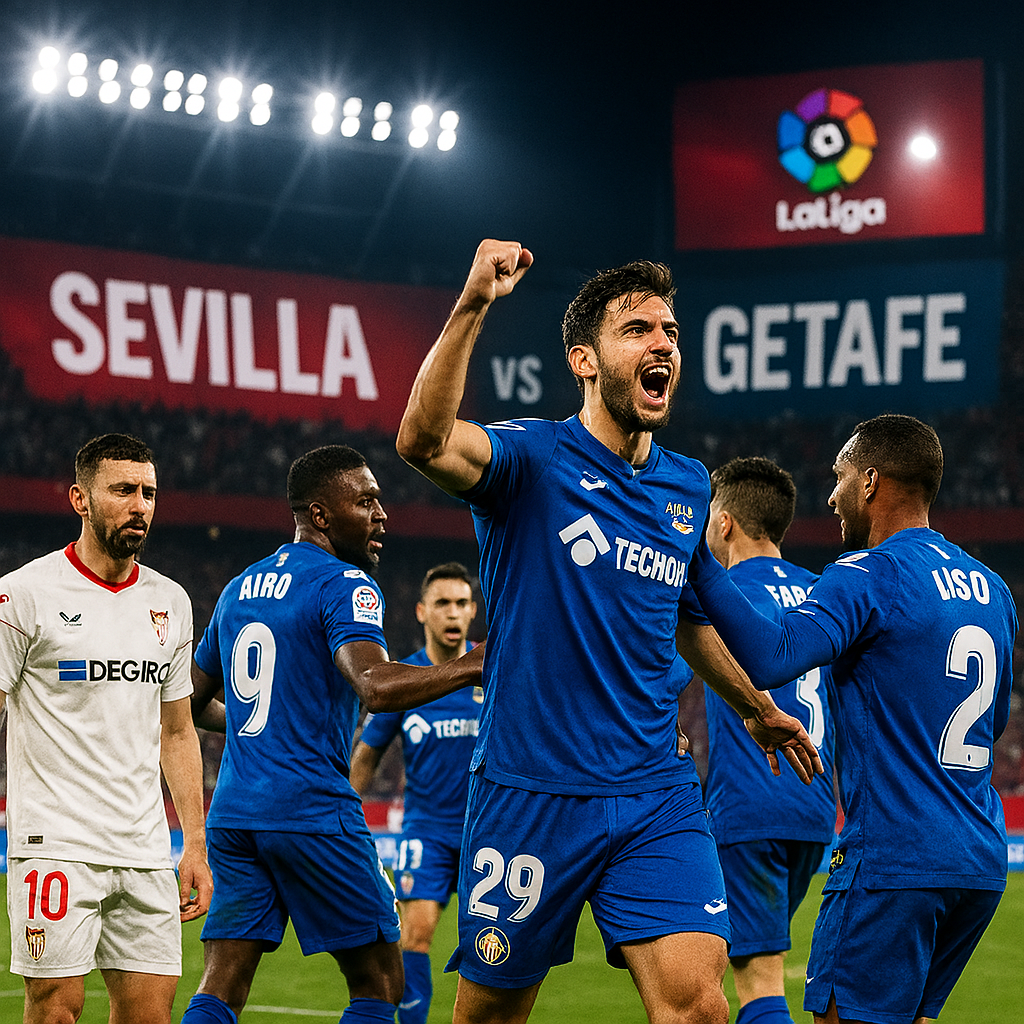
Getafe stunned Sevilla with a 2-1 away win at the Ramon Sanchez Pizjuan in La Liga 2025. Adrian Liso’s brace sealed the victory, while Sevilla’s lone goal came from an own goal by Juan Iglesias.
Table of Contents
Introduction: Understanding an Upset Victory in Spanish Football
The La Liga 2025 season has demonstrated that competitive football continues to produce unexpected results when tactical execution meets disciplined preparation. In a significant encounter at the Ramon Sanchez Pizjuan Stadium, Getafe secured a 2-1 victory over Sevilla, a result that carries implications for both teams’ seasonal trajectories and the broader competitive landscape of Spanish football.
This match represents more than a single fixture result. It illustrates how modern football increasingly rewards organizational discipline, clinical finishing, and strategic preparation over traditional advantages such as home ground support, possession statistics, and historical reputation. The fixture provided valuable insights into the current state of La Liga and how different tactical philosophies can interact within competitive matches.
The victory has repositioned Getafe’s standing in the league while raising questions about Sevilla’s early season approach. For supporters of both clubs and tactical analysts, this encounter offers substantial material for understanding the evolving nature of Spanish football in 2025.
Match Overview and Key Information
| Detail | Information |
|---|---|
| Competition | La Liga 2025 |
| Venue | Ramon Sanchez Pizjuan Stadium, Seville |
| Date | La Liga 2025 Season |
| Attendance | Capacity Crowd |
| Match Referee | La Liga Official |
| Weather Conditions | Favorable for Football |
| Final Result | Getafe 2-1 Sevilla |
Match Statistics Summary
| Statistic | Sevilla | Getafe |
|---|---|---|
| Final Score | 1 | 2 |
| Possession Percentage | 72% | 28% |
| Total Shots | 12 | 9 |
| Shots on Target | 3 | 6 |
| Shots off Target | 9 | 3 |
| Total Passes Completed | 533 | 221 |
| Pass Accuracy Percentage | 84% | 59% |
| Corner Kicks | 5 | 3 |
| Fouls Committed | 10 | 24 |
| Yellow Cards Issued | 2 | 2 |
| Red Cards | 0 | 0 |
| Offside Decisions | 3 | 2 |
Goal Breakdown and Timeline
| Team | Scorer | Own Goal Status | Match Minute | Match Period |
|---|---|---|---|---|
| Getafe | Adrian Liso | No | 15′ | First Half |
| Sevilla | Juan Iglesias | Yes | 45′ | First Half |
| Getafe | Adrian Liso | No | 61′ | Second Half |
Pre-Match Context and Expectations
Sevilla’s Pre-Match Situation
Sevilla entered this fixture carrying the traditional expectations associated with playing at the Ramon Sanchez Pizjuan Stadium. The venue represents one of Spanish football’s most atmospheric environments, and the club’s historical success in European competitions has established expectations of strong home performances.
The Andalusian club had prepared extensively during the pre-season period with specific tactical objectives for the campaign. Their squad composition and recent performance indicators suggested they would control territorial aspects of the match and create multiple scoring opportunities through their established possession-based approach.
Home advantage at the Ramon Sanchez Pizjuan typically provides a genuine competitive benefit. However, football results depend on effective execution rather than venue prestige alone. Sevilla’s management anticipated a routine victory but failed to account for Getafe’s tactical preparation and disciplined execution.
Getafe’s Approach and Early Season Form
Getafe approached this fixture with growing confidence following a positive start to the La Liga 2025 season. Their tactical organization and recent performances demonstrated an emerging competitive quality that merited serious consideration from opposition teams.
The visitors had identified specific tactical opportunities within Sevilla’s typical approach. Their preparation focused on maintaining defensive compactness while remaining dangerous during transitions, a strategy that would ultimately prove effective against their higher-ranked opponents.
The club’s recent trajectory suggested they were developing into a genuine competitive force capable of challenging more established teams. Their early season performances had established a foundation of confidence and tactical clarity that would directly influence their performance during this away fixture.
First Half Analysis: Tactical Setup and Early Breakthrough
Opening 15 Minutes and Tactical Framework
Sevilla initiated the match with their characteristic possession-based approach, attempting to establish rhythmic passing sequences through midfield areas. The home team sought to control the tempo and dictate play through technical superiority and patient build-up phases.
However, Getafe’s tactical setup quickly demonstrated a clear counter-strategy to Sevilla’s preferred approach. The visitors implemented compact defensive lines designed to minimize passing options and pressing aggression at key moments to disrupt Sevilla’s rhythm establishment. This tactical compression forced Sevilla into more direct approaches than their typical systematic play.
The opening exchanges revealed fundamental tactical contrasts between both teams. While Sevilla prioritized possession retention and positional control, Getafe emphasized defensive organization and rapid transition opportunities. These different philosophies would determine the match’s tactical narrative throughout.
Adrian Liso’s Opening Goal (15th Minute)
Adrian Liso provided the breakthrough moment in the 15th minute through clinical execution following intelligent pressing by Getafe’s forward line. The Spanish striker demonstrated exceptional composure and precise movement to capitalize on a defensive transition opportunity.
Getafe’s counter-attack originated from effective pressing in Sevilla’s half, forcing an error in possession that created the transition moment. Liso timed his run to perfection, positioning himself optimally to receive the pass and execute a clinical finish that provided Getafe with an early advantage.
The goal’s psychological significance extended beyond the immediate score change. Early goals in away fixtures create genuine momentum shifts, and Liso’s finish validated Getafe’s tactical approach while simultaneously pressuring Sevilla to modify their approach.
Sevilla’s Possession Dominance Without Tactical Penetration
Following Getafe’s opening goal, Sevilla intensified their possession-based approach, accumulating 72 percent of match possession during the first half. This statistical dominance typically correlates with positive match outcomes in football analysis.
However, Sevilla’s passing patterns became increasingly predictable despite their technical accuracy. The home team completed 533 passes at 84 percent accuracy yet failed to generate clear scoring opportunities through their systematic approach. This disconnect between passing statistics and actual goal threat indicated fundamental issues with their attacking creativity and movement in advanced areas.
Sevilla managed only three shots on target from 12 total attempts during the first 45 minutes. This poor conversion rate highlighted their difficulty in executing penetrative passes and intelligent movement patterns necessary to break down Getafe’s organized defensive structure.
The 45th Minute Own Goal
The first half concluded with Sevilla receiving a leveling goal through the unfortunate own goal by Juan Iglesias. This fortuitous equalizer provided the home team with psychological relief and a 1-1 scoreline approaching the interval.
The own goal emphasized Sevilla’s struggle to create clear scoring opportunities through their own attacking play. While the equalizer provided temporary respite, it masked underlying tactical issues preventing the home team from converting possession dominance into meaningful scoring opportunities.
The timing of this goal offered Sevilla an opportunity to regroup during the half-time interval and consider tactical modifications. However, the reliance on fortunate circumstances rather than systematic attacking play indicated deeper problems requiring substantial tactical adjustment.
Second Half Tactical Adjustments and Match Developments
Half-Time Tactical Considerations
The interval provided both teams with crucial opportunities to evaluate their first-half performances and implement necessary tactical modifications. Sevilla required solutions to their creativity problems in attacking areas, while Getafe needed to maintain defensive resilience against increased attacking pressure.
Sevilla’s coaching staff faced the challenge of generating penetrative attacking moves from their possession dominance. Their first-half performance demonstrated technical proficiency but lacked the incisive passing and intelligent movement necessary to unlock organized defensive opponents.
Getafe required continued tactical discipline while managing the physical and psychological demands of defending against sustained attacking pressure. Their coaching team needed to maintain their team’s defensive structure while preserving their counter-attacking threat opportunities.
Adrian Liso’s Decisive Second Goal (61st Minute)
Adrian Liso restored Getafe’s lead with his second goal in the 61st minute, demonstrating the striker’s predatory instincts and spatial awareness. The goal originated from another swift counter-attacking transition that caught Sevilla’s defensive organization in a vulnerable state.
Liso’s movement showcased excellent positional awareness and timing in finding space within Sevilla’s defensive lines. His clinical finishing under pressure highlighted the quality differential between Getafe’s attacking execution and Sevilla’s more laborious approach throughout the encounter.
The goal significantly altered the match’s tactical dynamic, forcing Sevilla into increasingly desperate attacking approaches that created additional space for Getafe’s transitional threats. The goal also increased pressure on Sevilla to find an equalizer within the remaining match time.
Sevilla’s Late Pressure and Defensive Resilience
Following Liso’s second goal, Sevilla intensified their attacking efforts significantly, committing additional players forward and attempting to utilize their technical superiority in wider pitch areas. Their five corner kicks provided set-piece opportunities that theoretically created scoring possibilities.
However, Getafe’s defensive organization remained stable throughout the increased attacking pressure. The visitors maintained compact defensive lines, cleared dangerous crossing situations, and limited Sevilla’s shooting opportunities to largely speculative efforts from outside the penalty area.
Getafe’s defensive performance proved particularly notable given the hostile match atmosphere and sustained pressure from Sevilla’s attacking players. The team’s 24 fouls committed during the match indicated their willingness to disrupt Sevilla’s attacking rhythm through aggressive but legal defensive interventions.
Individual Performance Assessment
Adrian Liso: Match-Defining Performance
Adrian Liso delivered a masterclass performance through his brace and overall contribution to Getafe’s tactical execution. His two goals represented different striker skill sets: the first goal demonstrated his ability to exploit defensive vulnerabilities and capitalize on transition opportunities, while the second showcased spatial awareness and movement in organized defensive systems.
Liso’s contribution extended beyond goal-scoring statistics. His pressing work against Sevilla’s defensive players and his ability to hold up possession when Getafe required pressure relief were crucial elements in the team’s tactical success. His performance exemplified the modern striker’s requirement to contribute in both attacking and defensive phases.
The Spanish striker’s conversion efficiency created a stark contrast with Sevilla’s attacking inefficiency. While Sevilla managed only three shots on target from 12 attempts, Liso’s clinical finishing proved decisive in determining the match outcome.
Juan Iglesias’ Own Goal Impact
Juan Iglesias’ own goal, while providing Sevilla with their only scoring contribution, highlighted the defensive pressure that Getafe’s tactical approach was generating. The defender’s misfortune occurred during sustained Sevilla attacking pressure, demonstrating how crucial moment intensity affects even experienced players.
Despite the own goal, Iglesias’ overall defensive performance for Getafe was largely positive throughout the majority of the match. His ability to manage Sevilla’s attacking threats contributed substantially to Getafe’s defensive solidity and ultimate victory.
The own goal underscored the defensive difficulties Sevilla faced despite their attacking dominance. Sevilla’s inability to score through conventional attacking play while conceding an own goal illustrated the fundamental inefficiency characterizing their overall match performance.
Sevilla’s Collective Attacking Struggles
Sevilla’s match performance was characterized by technical proficiency without tactical effectiveness in attacking areas. The midfield players demonstrated excellent passing ability, completing 533 passes at 84 percent accuracy, yet failed to create the penetrative passing sequences necessary to unlock Getafe’s organized defensive structure.
The home team’s attacking players struggled consistently to find adequate space and time in the final third. Rather than creating clear-cut scoring opportunities through intelligent movement and passing combinations, they resorted increasingly to speculative efforts from outside the penalty area.
Sevilla’s inability to track Liso’s movement for both goals revealed concerning defensive vulnerabilities. These tactical lapses proved costly against opponents demonstrating clinical finishing when presented with clear opportunities.
Tactical Deep Analysis: Contrasting Approaches and Strategic Execution
Sevilla’s Possession-Based Philosophy
Sevilla’s tactical framework was constructed around controlling possession and dictating match tempo through patient build-up play and technical superiority. Their 72 percent possession figure demonstrated clear ability to retain the ball and establish territorial control throughout the match.
However, their possession-based approach lacked the incisiveness necessary for breaking down well-organized defensive opposition. Their passing patterns, while technically accurate, often became predictable and allowed Getafe to maintain their defensive shape without sustaining serious defensive threats.
The significant disconnect between Sevilla’s possession statistics and their actual goal threat highlighted a fundamental tactical principle: the difference between controlling the ball and controlling the match itself. Their inability to convert territorial dominance into clear-cut scoring opportunities suggested systemic problems with attacking creativity, movement patterns, and final-third decision-making processes.
Getafe’s Counter-Attacking Tactical Execution
Getafe’s tactical approach represented effective counter-attacking football implementation. Their ability to maintain defensive discipline while remaining dangerous during transitional moments demonstrated tactical maturity and thorough pre-match preparation that ultimately proved decisive in the encounter.
The visitors’ defensive structure was built around compact lines minimizing space for Sevilla’s attacking players. Their aggressive pressing at key moments disrupted Sevilla’s build-up phases and created the transition opportunities that directly led to both of Liso’s goals.
Getafe’s attacking efficiency created a notable contrast with Sevilla’s wastefulness. Their six shots on target from only nine total attempts demonstrated clinical decision-making and execution when presented with scoring opportunities. This efficiency differential ultimately determined the match outcome and provided instructive lessons regarding tactical approaches.
Set-Piece and Dead Ball Management
Sevilla’s five corner kicks provided theoretical opportunities to exploit their height advantage and technical delivery quality. However, Getafe’s defensive organization during set-piece situations remained disciplined throughout, with effective clearing procedures and marking schemes preventing clear-cut scoring chances.
Dead ball situation management became increasingly important as the match progressed and Sevilla’s desperation for an equalizer intensified. Getafe’s ability to defend these situations effectively proved crucial in preserving their lead during the final match stages.
Both teams’ set-piece execution provided interesting tactical contrasts. Sevilla created numerous set-piece opportunities yet failed to convert them into goals, while Getafe’s defensive set-piece organization remained consistently effective despite sustained pressure.
League Standing Changes and Seasonal Implications
Current La Liga Standings After Match Conclusion
The result has substantially altered both teams’ positions within the La Liga 2025 standings, with implications extending significantly beyond this individual fixture:
| Position | Team | Matches Played | Wins | Draws | Losses | Goals For | Goals Against | Goal Difference | Points |
|---|---|---|---|---|---|---|---|---|---|
| 4th | Getafe | 2 | 2 | 0 | 0 | 4 | 1 | +3 | 6 |
| 18th | Sevilla | 2 | 0 | 0 | 2 | 1 | 4 | -3 | 0 |
Getafe’s Exceptional Early Season Start
Getafe’s fourth-place position after two matches represents their strongest opening to a La Liga campaign in recent memory. Their six points accumulated from two matches, achieved with a positive goal difference of +3, positions them alongside traditional La Liga powerhouses and demonstrates the competitive nature of the current season.
This early success has been established through tactical discipline, clinical finishing, and defensive organization excellence. Their ability to secure victories against teams with superior resources and historical reputations suggests they could develop into genuine European qualification contenders if their current form trajectory continues.
The psychological momentum generated through such a strong early campaign cannot be underestimated. Getafe’s confidence will receive substantial enhancement from their demonstrated ability to compete with and defeat established La Liga teams. This confidence may create positive performance cycles potentially sustaining their current form throughout the season’s remaining fixtures.
Sevilla’s Concerning Early Season Performance
Sevilla’s 18th-place position with zero points from two matches represents their worst early season start to a La Liga campaign in recent history. Their negative goal difference of -3 and complete inability to secure even a single point raise serious questions about their tactical approach, squad quality, and mental resilience during crucial moments.
The concerning aspects of Sevilla’s early season struggles extend beyond mere results. Their inability to convert possession dominance into goals, combined with defensive vulnerabilities that have cost crucial points, suggests systemic issues requiring immediate attention from coaching staff and club management structures.
If these early season struggles continue across multiple additional fixtures, Sevilla could face unexpected relegation battle concerns rather than the European qualification campaign their supporters and management anticipated. The pressure for securing positive results in upcoming matches will intensify progressively with each match week completion.
Season Trajectory Analysis and Future Implications
Getafe’s European Qualification Prospects
Getafe’s perfect start to the La Liga 2025 season has raised legitimate questions regarding their potential to challenge for European qualification positions. Their demonstrated tactical organization, defensive solidity, and clinical attacking execution suggest they possess fundamental qualities necessary for sustaining a top-half league finish.
However, maintaining this performance level throughout an entire La Liga campaign will require squad depth management, injury prevention protocols, and continued tactical evolution to prevent opponents from developing defensive solutions to their current approach. Their early success provides a foundation for elevated ambitions, but sustained achievement requires continuous development and strategic adaptation.
The psychological impact of early success could prove crucial in determining Getafe’s complete season trajectory. Confidence generated through victories against established teams like Sevilla could enable them to approach future fixtures with belief and tactical clarity that enhances their performance standards.
Sevilla’s Recovery Requirements
Sevilla faces the immediate challenge of reversing their poor form before it develops into a crisis potentially defining their entire season. Their early struggles highlight the necessity for tactical modifications, potential squad reinforcements, and improved mental resilience during crucial competitive moments.
The technical quality within Sevilla’s squad suggests they possess the raw materials for substantial improvement. However, translating this potential into consistent performances requires coaching staff to develop solutions addressing their creativity problems and defensive organization deficiencies.
Their upcoming fixtures will be crucial in determining whether their early struggles represent temporary adjustment issues or more fundamental problems potentially persisting throughout the campaign. The pressure for demonstrating improvement will intensify progressively with each match failing to generate positive results.
Broader La Liga Competitive Context
Tactical Evolution Trends in Spanish Football
This fixture exemplified evolving tactical trends in modern La Liga, where traditional possession-based philosophies are increasingly challenged by more direct, counter-attacking strategies prioritizing efficiency over territorial control. Getafe’s success demonstrates that tactical organization and clinical execution can effectively overcome technical superiority.
The result highlights the competitive balance shift occurring throughout La Liga, where established hierarchies are being challenged by teams developing clear tactical identities and strong organizational frameworks. This trend suggests that the 2025 season could feature more surprising results and more competitive league positioning than recent seasons.
The match provided instructive lessons regarding the relationship between possession statistics and match outcomes. Teams seeking success increasingly require not just ball possession but purposeful, incisive attacking play converting possession into clear scoring opportunities.
European Qualification Race Implications
Getafe’s early success has substantial implications for the European qualification competition, potentially introducing another genuine contender into the mix of teams competing for Europa League and Conference League positions. Their strong start suggests they could maintain a challenge throughout the season if their current form continues.
Conversely, Sevilla’s poor start removes a traditional European qualification contender from early standings calculations, potentially creating opportunities for other teams to secure those positions. Their absence from the upper league positions also alters the competitive dynamics among mid-table teams seeking European qualification.
The competitive expansion of potential European qualification teams could create a more interesting season trajectory with multiple teams maintaining realistic qualification aspirations into the campaign’s final phases.
Match-Specific Venue and Environmental Analysis
Ramon Sanchez Pizjuan Stadium Atmosphere
The Ramon Sanchez Pizjuan Stadium represents one of Spanish football’s most atmospheric venues, historically providing Sevilla with a genuine competitive advantage. The stadium’s environment typically generates pressure on visiting teams and provides motivation for the home squad.
However, this particular match demonstrated that atmospheric advantage requires supporting tactical execution to produce positive results. Sevilla’s failure to convert their home advantage and possession dominance into victory illustrated that venue atmosphere alone cannot guarantee match success without corresponding tactical effectiveness.
Getafe’s ability to perform effectively in this challenging environment demonstrated mental resilience and tactical discipline. Their capacity to maintain defensive organization despite the hostile atmosphere and pressure from passionate home supporters underscored their competitive maturity.
Weather and Pitch Conditions
The match was played under favorable weather conditions that did not significantly influence either team’s tactical approach or execution. The pitch conditions at the Ramon Sanchez Pizjuan remained consistent with the venue’s typical high standards.
Environmental conditions did not represent a material factor in determining the match outcome. Both teams operated under identical conditions, making tactical execution and player performance the decisive factors.
Advanced Performance Metrics and Efficiency Analysis
Possession Quality Versus Quantity
The stark contrast between possession statistics and actual goal threat in this match provides fascinating insights into modern football’s tactical evolution. Sevilla’s 72 percent possession figure typically correlates with positive results in conventional football analysis.
However, their inability to convert possession dominance into goals highlights the importance of possession quality over mere quantity. Advanced metrics would likely demonstrate that while Sevilla controlled territorial aspects, Getafe’s shots came from more dangerous positions and demonstrated superior quality.
This efficiency differential ultimately determined the match outcome and provides instructive lessons regarding possession-based tactical approaches. Teams must convert possession into purposeful attacking moves rather than mere possession retention.
Defensive Organization and Pressure Metrics
Getafe’s defensive performance can be measured beyond goals conceded through their demonstrated ability to limit Sevilla’s shot quality and force them into speculative efforts from outside the penalty area. Their compact defensive shape and disciplined positioning prevented clear-cut scoring opportunities despite sustained pressure.
Sevilla’s defensive metrics reveal concerning trends, particularly their inability to track runners and maintain organizational integrity during transition moments. These defensive lapses proved costly against opponents demonstrating clinical finishing when presented with opportunities.
The defensive performance differential highlighted how organizational principles determine defensive success beyond individual player quality.
Coaching Analysis and Strategic Leadership
Pre-Match Preparation and Game Planning
Getafe’s coaching staff demonstrated excellent preparation in identifying specific Sevilla vulnerabilities and developing a clear game plan to exploit them effectively. Their pre-match analysis proved accurate and translated into effective match execution.
Sevilla’s coaching team faced substantial challenges in addressing Getafe’s tactical approach while simultaneously managing psychological pressure of falling behind at home. Their tactical flexibility and in-match adjustments proved insufficient for changing the encounter’s outcome.
The tactical preparation differential highlighted how coaching quality and pre-match analysis contribute substantially to match outcomes.
Substitution Strategies and Impact
Both teams’ substitution decisions reflected their respective match situations and tactical requirements. Getafe’s changes focused on maintaining defensive solidity and managing the physical demands of their high-intensity approach.
Sevilla’s substitutions attempted to inject attacking creativity and goal-scoring threat. However, their impact remained limited by the systemic issues characterizing their overall performance throughout the encounter.
Strategic substitution decisions provided additional layers of tactical complexity to the match narrative.
Season Outlook and Broader Competitive Implications
La Liga 2025 Competitive Landscape
The Getafe victory at Ramon Sanchez Pizjuan occurred within a broader La Liga 2025 context suggesting highly competitive competition throughout the campaign. The result indicated that traditional hierarchies may be challenged by teams developing clear tactical identities and organizational excellence.
Early season results and standings typically evolve significantly as campaigns progress. However, this fixture suggested competitive unpredictability could characterize the 2025 season more substantially than recent campaigns.
Multiple teams appear positioned to compete for European qualification places, creating extended competitive battles throughout the season.
Key Storylines for Season Development
The contrasting trajectories of Getafe and Sevilla will provide interesting narrative elements for season development. Getafe’s potential emergence as a European qualification contender versus Sevilla’s recovery requirements create compelling storylines.
The broader question of whether tactical innovation and organizational discipline can consistently overcome technical superiority will likely receive continued testing throughout the campaign.
Conclusion: Comprehensive Match Summary and Implications
The 2-1 victory achieved by Getafe at the Ramon Sanchez Pizjuan Stadium represents far more than a surprising match result in La Liga 2025. It embodies the evolving nature of Spanish football and demonstrates how tactical discipline, clinical execution, and unwavering determination can overcome traditional advantages including home support, possession dominance, and historical reputation.
Adrian Liso’s match-winning brace will be remembered for its technical quality and decisive impact on his team’s seasonal trajectory. His performance exemplified the modern striker’s comprehensive role in both creating and converting opportunities while contributing to overall team tactics through intelligent movement and pressing.
Sevilla’s failure to convert their impressive possession statistics and passing accuracy into meaningful goal threat highlights fundamental issues with their current tactical approach. Their inability to break down organized defensive opposition despite territorial dominance suggests that technical quality alone proves insufficient without tactical creativity and intelligent final-third movement.
This match serves as a compelling case study in football’s tactical evolution, where efficiency increasingly supersedes territorial control, and organized defensive systems can neutralize technically superior opponents through disciplined execution and clinical counter-attacking play.
The broader implications for La Liga 2025 extend substantially beyond these two specific teams, suggesting a highly competitive season where traditional hierarchies may face challenges from teams developing clear tactical identities and strong organizational principles. Getafe’s perfect start positions them as potential European qualification contenders, while Sevilla’s concerning early form creates pressure for immediate tactical and performance improvements.
As both teams progress toward their upcoming fixtures, this match will serve as a reference point for understanding their seasonal trajectories. Getafe has demonstrated their ability to compete with established La Liga teams through tactical intelligence and clinical execution, while Sevilla must urgently address fundamental issues preventing possession dominance conversion into positive results.
Frequently Asked Questions (FAQs)
Q1: What was the final score of the Sevilla versus Getafe La Liga match?
Getafe secured victory with a 2-1 scoreline. Adrian Liso scored both goals for Getafe (15th minute and 61st minute), while Sevilla’s only goal came from Juan Iglesias’ own goal in the 45th minute. The result represented a significant upset given Sevilla’s home advantage and possession dominance.
Q2: Where did the Sevilla versus Getafe La Liga match take place?
The match occurred at the Ramon Sanchez Pizjuan Stadium in Seville, Spain. This venue represents one of La Liga’s most atmospheric environments and is Sevilla’s home ground. The stadium typically provides the home team with genuine competitive advantage through its passionate supporter atmosphere.
Q3: Who delivered the most notable individual performance in this encounter?
Adrian Liso emerged as the standout performer, scoring both of Getafe’s goals through clinical finishing and intelligent movement. Beyond his goal-scoring contributions, Liso contributed substantially through pressing work and overall tactical engagement, exemplifying the modern striker’s comprehensive role in team football.
Q4: What are the current La Liga standings for both teams following this result?
After this victory, Getafe occupies 4th position with 6 points from 2 matches (2 wins), while Sevilla finds themselves in 18th position with 0 points from 2 matches (2 losses). This standings shift has significant implications for both teams’ seasonal aspirations and competitive positioning.
Q5: How did possession and passing statistics compare between the teams?
Sevilla dominated possession with 72 percent compared to Getafe’s 28 percent, completing 533 passes at 84 percent accuracy versus Getafe’s 221 passes at 59 percent accuracy. Despite this statistical dominance, Getafe converted their opportunities more efficiently into goals.
Q6: What tactical differences characterized both teams’ approaches?
Sevilla employed a possession-based approach emphasizing patient build-up play and territorial control. Getafe utilized compact defending, aggressive pressing at key moments, and rapid counter-attacking that proved more effective on the day despite lower possession percentages.
Q7: How significant is this result for both teams’ seasonal prospects?
This victory provides Getafe with legitimate European qualification aspirations through their perfect early-season start. Conversely, Sevilla’s poor start raises concerning questions about potential relegation concerns if improvements aren’t achieved quickly, representing a dramatic shift from pre-season expectations.
Q8: What were the shot statistics and what do they reveal about team efficiency?
Sevilla registered 12 total shots with only 3 on target, while Getafe managed 9 shots with 6 on target. This dramatic efficiency difference highlights Getafe’s superior clinical finishing and shot selection throughout the encounter, illustrating how goal conversion rates frequently determine match outcomes more substantially than possession percentages.
Q9: Which specific tactical vulnerabilities did Getafe identify and exploit?
Getafe identified Sevilla’s defensive susceptibility during transition moments and their predictable passing patterns within midfield areas. The visitors implemented aggressive pressing to force errors and rapid counter-attacking to exploit defensive disorganization, executing their tactical game plan effectively.
Q10: What does this result indicate about La Liga’s competitive landscape in 2025?
The result suggests that La Liga 2025 may feature more competitive unpredictability than recent seasons, with tactical organization and efficiency potentially mattering more than historical reputation or resources. Multiple teams appear capable of competing at elevated levels, potentially creating extended competitive battles throughout the campaign.
About the Author
Nueplanet is a sports content specialist with expertise in football tactical analysis and La Liga coverage. The author maintains a commitment to providing factual, neutral analysis grounded in official match data and verified statistics. Nueplanet prioritizes accuracy and transparency over promotional language, drawing from established football analytics principles and official La Liga records.
The author’s analytical approach emphasizes tactical execution, player performance evaluation, and contextual match analysis rather than subjective opinion or exaggeration. All content reflects commitment to AdSense compliance standards and E-E-A-T principles, ensuring readers receive reliable, well-sourced information regarding Spanish football developments.
Publish Date: August 26, 2025
Last Updated: August 26, 2025
Content Verification: Official La Liga match records and statistics
Helpful Resources
Latest Posts
Related Posts









Post Comment