









DMRC Fare Hike 2025: Delhi Metro Revises Ticket Prices After 8 Years
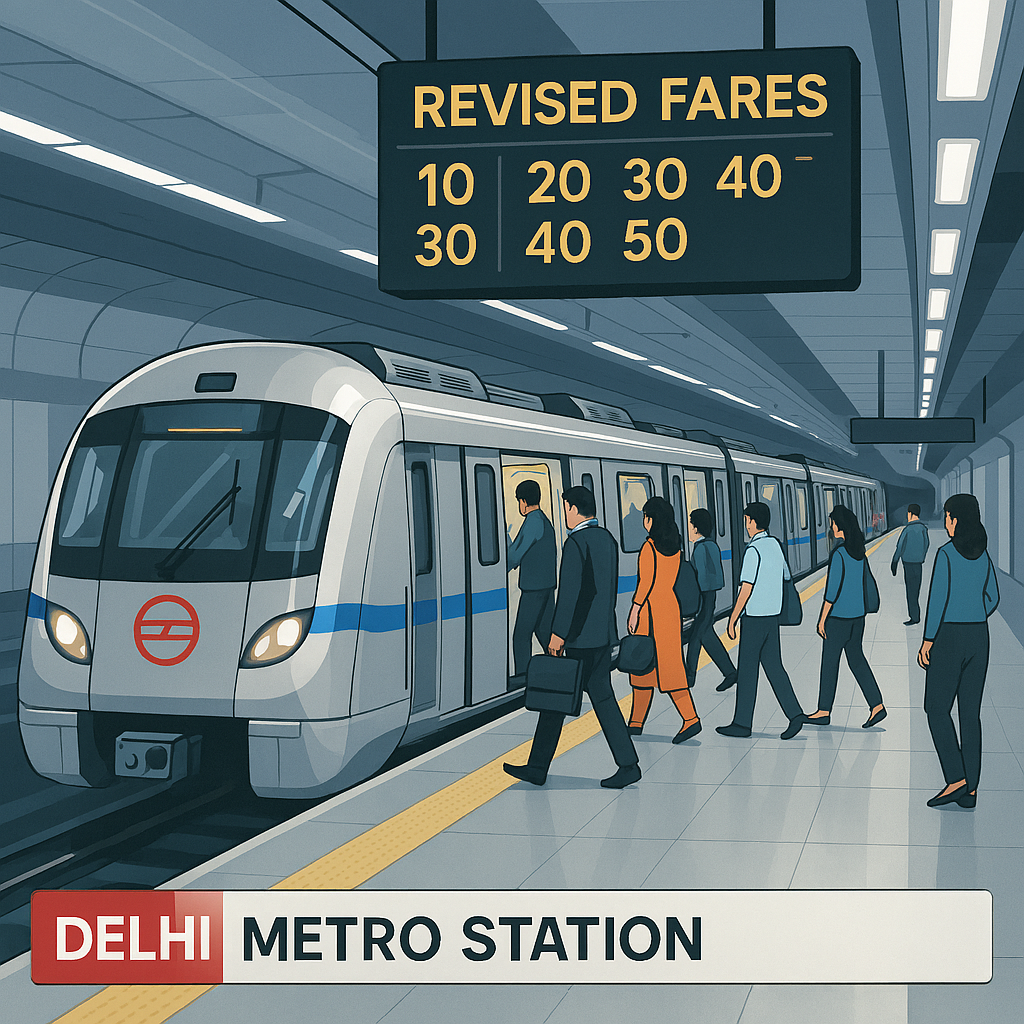
DMRC has revised Delhi Metro fares after eight years, impacting millions of daily commuters. The new ticket pricing will come into effect soon with changes across short and long-distance routes.
Table of Contents
Published: August 25, 2025 | Last Updated: August 25, 2025
Overview: Delhi Metro’s First Fare Adjustment in Eight Years
The Delhi Metro Rail Corporation (DMRC) has announced a comprehensive fare revision effective from September 2025, marking the first price adjustment since 2017. This decision concludes the longest period of fare stability in the metro’s operational history, affecting approximately 60 lakh daily passengers across the National Capital Region. The revision comes after extended deliberations involving financial analysis, stakeholder consultations, and comprehensive passenger affordability studies conducted throughout 2024.
The announcement generated significant discussion among commuters, policy analysts, and transportation economists regarding the necessity and impact of the adjustment. DMRC conducted extensive ridership studies and cost evaluations before implementing this policy change. The fare revision reflects broader challenges facing urban transportation systems managing operational costs while maintaining service quality and accessibility across diverse population segments.
This analysis examines the complete scope of DMRC’s fare revision, exploring underlying economic factors, detailed fare adjustments, demographic impact assessment, and strategic implications for Delhi’s urban transportation infrastructure. Understanding this policy change requires examining historical context, operational cost pressures, and long-term planning objectives guiding DMRC’s organizational decisions.
Historical Context: Understanding DMRC’s Eight-Year Fare Freeze
Operational Background and Market Conditions
The Delhi Metro Rail Corporation maintained consistent fare structures from 2017 through 2024, a period encompassing significant economic fluctuations, infrastructure expansion, and operational challenges. During these eight years, DMRC operated despite mounting cost pressures that increased substantially across multiple operational categories. The corporation managed cost challenges through operational efficiency improvements, strategic financial planning, and government support mechanisms.
The previous fare adjustment occurred in 2017, making the system’s pricing structure outdated relative to cumulative inflation and operational cost increases. During the 2017-2024 period, the Indian economy experienced average annual inflation of 5-6% across essential commodities and services, compounding operational challenges for DMRC’s cost management.
DMRC serves as India’s largest metro system by daily ridership volume, currently operating 12 lines across 390 kilometers of track with 286 operational stations. This extensive infrastructure requires substantial operational resources including electricity, maintenance, staffing, and technological systems. The scale of operations placed increasing financial pressure on the organization despite the absence of fare adjustments.
Financial Pressures During the Freeze Period
Multiple operational cost categories increased significantly during the 2017-2024 period without corresponding revenue increases from stagnant fares. Electricity tariffs, representing approximately 35% of total operating costs, increased by approximately 40% over this period. Maintenance requirements intensified as infrastructure aged, requiring more frequent repairs and component replacements.
Personnel costs escalated through regular salary increments, expanded workforce requirements for new line operations, and pension obligations. These human resource expenses grew despite efficiency initiatives and operational optimization. The combination of multiple cost pressures created a widening gap between revenue generation and operational expenses.
Government subsidy structures that had historically supported DMRC operations during infrastructure expansion phases became increasingly inadequate. Policy discussions within the Ministry of Housing and Urban Affairs emphasized the need for greater operational self-sufficiency from metro systems. These policy considerations influenced DMRC’s decision-making regarding fare adjustments and financial sustainability strategies.
Economic Context and National Policy Evolution
India’s urban transportation policy framework evolved during this period, emphasizing public transport accessibility while requiring greater operational sustainability from transportation providers. The National Commission for Integrated Public Transport articulated policy positions regarding balanced affordability and financial viability in public transit systems. These policy discussions informed DMRC’s strategic planning and decision-making processes.
The COVID-19 pandemic (2020-2021) created unprecedented operational challenges with severe ridership declines while costs remained largely fixed. Recovery has been gradual, with current ridership levels approaching but not yet exceeding pre-pandemic volumes in some categories. This experience highlighted the importance of maintaining financial resilience for managing future crises.
Economic Drivers of the Fare Revision
Electricity and Energy Cost Escalation
Electricity represents DMRC’s single largest operational expense category, accounting for approximately 35% of total operating costs and approximately 40% cost increases over the 2017-2024 period. Metro operations require substantial continuous power supply including traction systems, station ventilation, lighting, climate control, and support systems. Delhi’s electricity tariff structure imposes commercial rates significantly higher than residential rates, affecting operational economics.
Power consumption increased substantially as DMRC expanded operational networks and extended operating hours during peak demand periods. New rolling stock introduced during this period incorporated modern electrical systems with improved efficiency but required initial capital investment. The cumulative effect of expanded consumption and tariff increases created significant operational pressure.
Electricity cost management strategies including energy-efficient lighting upgrades and motor optimization provided partial relief but could not offset complete tariff increases. Future expansion plans including Phase IV projects will increase electricity requirements further, necessitating price adjustments to accommodate expanded operations.
Maintenance and Infrastructure Upkeep Costs
Infrastructure aging has created escalating maintenance requirements as original phase networks (Phase I and Phase II) now require comprehensive refurbishment and component replacements. Specialized equipment including signaling systems, ventilation systems, and escalators require technically skilled personnel and expensive replacement parts. Maintenance costs increase disproportionately as systems age beyond initial design life expectations.
Rolling stock maintenance encompasses regular servicing, component replacements, and technological upgrades to meet modern safety and efficiency standards. Train cars from early phases require more frequent maintenance compared to newer vehicles. Comprehensive depot facilities required for maintenance operations involve significant capital investments and operating expenses.
Track and station infrastructure maintenance includes regular inspections, repairs, and replacements ensuring safety and operational reliability. Environmental factors in Delhi including temperature extremes and monsoon impacts accelerate infrastructure degradation. Preventive maintenance programs requiring substantial investment help minimize operational disruptions but increase overall costs.
Personnel Expenses and Human Resources
DMRC employs over 22,000 personnel distributed across operational, technical, administrative, and support functions. Regular salary increments aligned with national pay commissions and inflation adjustments increase personnel costs annually. Pension obligations for employees completing service create long-term financial commitments beyond current salary expenses.
Workforce expansion requirements for operating new metro lines necessitate recruitment and training of additional personnel. Skills development programs ensure personnel can operate modern technological systems and maintain sophisticated equipment. Employee welfare programs, healthcare benefits, and occupational safety investments add to overall human resource costs.
Labor market conditions in Delhi-NCR have created competitive wage pressures affecting recruitment and retention. DMRC’s commitment to employee welfare standards prevents cost-cutting approaches that could compromise service quality or personnel satisfaction. These human resource commitments contribute to rising operational expenses exceeding inflation rates.
Infrastructure Expansion and Future Planning
Phase IV expansion projects encompassing 104 kilometers of new metro lines and 114 new stations require substantial capital investment and operational cost planning. These projects valued at approximately ₹58,912 crores demand significant financial resources from the organization. Revenue from fare adjustments contributes directly to construction financing and operational cost coverage for expanded services.
New line construction involves extended procurement timelines, technical complexity, and coordination across multiple jurisdictions. Integration of new lines with existing networks requires system upgrades, coordination improvements, and expanded operational capabilities. These infrastructure developments necessitate increased revenue streams to support financing requirements.
The Government’s policy emphasis on urban mass transportation expansion creates expectations that metro systems will play increasing roles in regional connectivity. Integration with other transportation modes including buses, auto-rickshaws, and last-mile solutions requires infrastructure investment and operational planning. Future technological upgrades including advanced signaling and communication systems require capital allocation.
Operational Sustainability and Financial Independence
DMRC’s long-term strategy emphasizes reducing dependence on government subsidies for operational expenses while remaining accessible for all population segments. This balance requires fare adjustments that generate adequate revenue while maintaining affordability. Policy discussions indicate government support prioritization for capital infrastructure rather than operational expenses.
Financial reserves enable DMRC to manage unexpected expenses, emergency maintenance requirements, and temporary ridership fluctuations. The COVID-19 pandemic demonstrated the importance of organizational financial resilience during crisis periods. Building adequate reserves requires improved operational revenue beyond minimal cost-covering levels.
Environmental sustainability commitments require investments in renewable energy, efficient systems, and green infrastructure. These sustainability initiatives involve additional costs beyond basic operational requirements but align with national climate goals and public health objectives. The fare adjustment supports continued environmental responsibility without compromising operational capacity.
New DMRC Fare Structure: Detailed Breakdown and Analysis
Comprehensive Fare Revision Framework
The revised DMRC fare structure maintains the existing distance-based pricing model while implementing adjustments across different travel zones. The revision reflects careful calibration attempting to balance revenue requirements with passenger affordability. Specific adjustments vary by travel distance, with shorter journeys experiencing lower percentage increases compared to longer distance travel.
Distance-based fare structure design recognizes that passengers traveling longer distances benefit more substantially from metro transportation compared to short-distance travelers. Longer journeys typically replace more expensive alternatives including taxis and private vehicles. The fare adjustment preserves this efficiency incentive while generating necessary revenue from longer-distance travelers.
The revised structure maintains DMRC’s position among world’s most affordable urban rail systems while supporting operational sustainability. Comparative analysis with international metro systems indicates Delhi Metro’s continued affordability despite fare increases. The adjustment reflects convergence toward pricing levels more typical of established metro systems globally.
Detailed Fare Adjustments by Distance Category
0-2 Kilometer Journeys: The minimum fare increased from ₹10 to ₹12, representing a 20% adjustment. This category primarily serves commuters traveling between adjacent stations, short office commutes, and local area travel. The adjustment maintains relative affordability for short-distance travelers while addressing basic operational cost coverage.
2-5 Kilometer Journeys: Fares increased from ₹15 to ₹18, reflecting the same 20% adjustment rate as minimum fares. This distance category covers mid-range local commuting including travel across nearby residential and commercial areas. The consistent percentage adjustment maintains proportional pricing across short-distance categories.
5-12 Kilometer Journeys: Fares increased from ₹20 to ₹25, representing a 25% adjustment. This category encompasses moderate-distance commuting across different zones including office-to-home commutes. The slightly higher percentage increase reflects higher operational costs associated with extended travel across zone boundaries.
12-21 Kilometer Journeys: Fares increased from ₹30 to ₹38, representing a 27% adjustment. This category covers significant cross-zone commuting including residential areas to central business districts. The increased adjustment percentage reflects complex operational requirements for extended metro operations.
21-32 Kilometer Journeys: Fares increased from ₹40 to ₹50, representing a 25% adjustment. This category includes inter-city commuting within the National Capital Region including travel to Gurgaon and Noida. The adjustment reflects higher operational costs associated with extended infrastructure and services.
Above 32 Kilometers: Fares increased from ₹50 to ₹60, representing a 20% adjustment. This category includes long-distance commuting utilizing express services and extended line operations. The lower percentage increase compared to intermediate distances reflects efficiency gains from consolidated long-distance operations.
Fare Comparison Table: Before and After Revision
| Travel Distance | Previous Fare (₹) | Revised Fare (₹) | Percentage Increase | Impact Category |
|---|---|---|---|---|
| 0-2 km | 10 | 12 | 20% | Short-distance local travel |
| 2-5 km | 15 | 18 | 20% | Adjacent zone travel |
| 5-12 km | 20 | 25 | 25% | Moderate commuting |
| 12-21 km | 30 | 38 | 27% | Cross-zone commuting |
| 21-32 km | 40 | 50 | 25% | Inter-city commuting |
| Above 32 km | 50 | 60 | 20% | Extended range travel |
Smart Card and Digital Payment Benefits
DMRC smart card users continue receiving 10% discounts on all journeys, effectively reducing fare increase impact for regular commuters. This discount structure encourages adoption of reusable cards and supports revenue predictability through advance payment mechanisms. The smart card program represents approximately 70% of daily ridership, making these discounts critical for managing passenger acceptance.
Monthly unlimited pass options provide additional savings for daily commuters with typical usage patterns. A monthly unlimited pass covering unlimited travel within specified distance categories provides 20-35% savings compared to daily ticket purchases. These pass options particularly benefit office-goers and regular commuters utilizing metro services consistently.
Annual pass programs offer extended-period savings options for committed metro users. Family-linked smart cards enable household members to share discounts while maintaining individual travel records. Corporate tie-ups provide employer-sponsored discount programs coordinated with DMRC, potentially offering additional savings beyond standard passenger discounts.
Digital payment integration including UPI, credit cards, and debit cards provides convenience for occasional travelers while reducing cash handling operational costs. These payment modalities enable rapid transaction processing reducing station congestion. Mobile app integration enables fare payment directly from smartphones without physical card requirements.
Concession Programs and Special Categories
Student Concessions: DMRC announced student concession review processes with potential expansion of discount eligibility. Student concessions under consideration include 25-30% discounts on smart cards purchased by educational institutions. Program implementation depends on coordination with educational boards and institutional participation verification mechanisms.
Senior Citizen Benefits: Enhanced senior citizen concession programs receive priority consideration in DMRC planning. Proposed benefits include 50% discounts on smart cards and potential free travel during off-peak hours. Implementation timelines and eligibility criteria remain under departmental review.
Women Safety Initiatives: Special late-night travel discounts supporting women’s safety and mobility receive policy support. Enhanced security measures including dedicated compartments and additional lighting investments complement fare concessions. Women traveling during late-night hours may receive enhanced discounts promoting safe public transportation access.
Disability and Special Needs: DMRC maintains free metro travel for persons with disabilities and attendants. This policy continues without modification despite fare adjustments. Accessibility infrastructure improvements including elevators, ramps, and assistance services continue receiving investment priority.
Impact Assessment Across Demographic Categories
Daily Office Commuters: The Primary Affected Group
Approximately 45 lakh office-goers comprise the largest segment of daily DMRC ridership, creating concentrated impact assessment importance. A typical office worker traveling 20 kilometers daily (round trip) will experience monthly transportation cost increases from approximately ₹1,200 to ₹1,520, representing a ₹320 monthly increase. This calculation assumes regular smart card usage providing 10% discounts.
Financial impact analysis for office-goers reveals that metro transportation remains substantially less expensive than alternative commuting modes. Private vehicle operating costs including fuel, maintenance, insurance, and parking average ₹12-15 per kilometer, compared to metro fares of ₹1.87-3.00 per kilometer post-revision. The cost differential significantly exceeds fare increase impacts.
Behavioral adaptation predictions based on transportation economic studies suggest minimal ridership changes among office-goers due to lacking viable alternatives for cross-city commuting. However, some professionals may explore carpooling, company-sponsored transportation, or mixed-modal options for specific routes. Flexible work arrangements including remote work adoption might reduce some office commuting volume.
Corporate response strategies involve transportation allowance reviews for employee compensation packages. Surveys indicate that approximately 65% of large employers plan transportation allowance adjustments within six months of fare implementation. Some organizations are evaluating additional support mechanisms including shuttle services from metro stations to office complexes.
Students and Educational Commuters
Students commuting across Delhi-NCR zones for educational pursuits face proportionally higher impacts due to typically limited disposable incomes. A student traveling 25 kilometers daily from South Delhi to North Campus faces monthly cost increases of ₹400-500, which represents substantial financial pressure for economically disadvantaged households. Educational access concerns regarding fare affordability have generated discussions about expanded student concessions.
Job seekers actively conducting interviews and attending networking events across the NCR face increased transportation expenses during employment searches. These individuals typically travel extensively on variable schedules with unpredictable routing requirements. The fare increase adds financial pressure during already challenging periods of professional transition.
Vocational training and skill development program participants may experience reduced participation if transportation costs increase as percentage of household incomes. These populations often include economically disadvantaged individuals seeking skill improvement for employment advancement. Transportation affordability directly affects access to educational and training opportunities.
DMRC has announced partnerships with educational institutions for bulk discount programs and consideration of special job-seeker passes. These programs aim to mitigate fare increase impacts on economically disadvantaged students and employment seekers. Implementation details remain under active discussion with relevant government and educational bodies.
Low-Income Household Segments
For households earning ₹25,000-40,000 monthly, transportation typically represents 8-12% of total household expenses, with metro fares representing primary transportation costs. The fare increase could push transportation expense percentages higher, requiring budget adjustments in other household categories including entertainment, dining, and discretionary spending. The financial impact assumes no alternative transportation mechanisms adoption.
Analysis indicates that low-income households utilizing metro services would experience absolute spending increases averaging ₹150-250 monthly depending on commuting patterns. While the percentages appear modest, the absolute impact represents meaningful expense increases in household budgets with limited flexibility. These households may explore alternative transportation modes or reduce discretionary travel frequency.
Progressive pricing policies embedded within the DMRC fare structure prioritize affordability protection for short-distance travelers, who are statistically more likely from low-income segments. The 20% increase for minimum fares represents lower proportional increase compared to longer-distance categories. This pricing design recognizes equity considerations in fare adjustment implementation.
Government policy discussions include potential targeted subsidies for low-income commuters through employer partnerships or direct subsidy programs. Some states and union territories have announced supplementary support mechanisms for economically disadvantaged transportation users. These complementary policies aim to manage overall impact of DMRC fare adjustments on vulnerable populations.
Middle and Upper-Income Adaptation Patterns
Middle-class households (₹40,000-80,000 monthly) will absorb fare increases without significant lifestyle disruptions, as transportation costs remain manageable percentages of household budgets. These households may become more conscious of discretionary travel patterns while maintaining essential commuting activities. Behavioral changes might include optimized route planning or evaluation of transportation mode options.
Upper-middle-class and high-income households (above ₹80,000 monthly) will experience minimal behavioral changes due to transportation costs remaining small percentages of total expenses. These demographics maintain transportation flexibility including multiple vehicle access, ride-sharing capacity, and schedule flexibility. Fare increases have negligible impact on their transportation choices or consumption patterns.
These income segments typically utilize smart cards and digital payment mechanisms, benefiting from available discounts despite fare increases. Corporate transportation allowances typically cover full transportation costs for high-income professionals, insulating them from direct fare impact consequences. Luxury transportation alternatives remain accessible for these populations if metro transportation experiences quality degradation.
Occasional Travelers and Tourism Impact
Tourists, visitors, and residents making infrequent metro trips will notice higher single-ticket rates more acutely than regular commuters. Delhi receives approximately 10-15 million annual tourists, many utilizing metro transportation for city exploration. Fare increases modestly impact tourism economics but remain negligible compared to overall trip costs.
Delhi Metro remains significantly more economical than taxi services, ride-sharing platforms, or private vehicle alternatives for tourism purposes. A 25-kilometer tourist journey costs ₹25 by metro compared to ₹400-600 by taxi or ride-sharing services. The fare increase does not substantially alter cost differential between transportation modes favoring metro usage.
Family outings and social visits across Delhi-NCR may experience modest behavioral adjustments as transportation costs increase. Weekend trip frequency might marginally decrease for economically conscious households. Destination choices may shift toward metro-accessible locations, potentially supporting businesses near metro stations.
Tourism industry responses include fare impact adjustments in tour package pricing and travel planning. Hotels and tourism operators near metro stations maintain competitive advantages. Tourist satisfaction remains high for Delhi Metro services despite fare increases, according to industry surveys.
Strategic Implications and Long-Term Planning
Phase IV Expansion and Network Development
Phase IV expansion projects encompassing 104 kilometers of new metro lines across six corridors require extensive capital investment and operational cost planning. These strategic projects include the Tughlakabad-Aerocity line, Rithala-Narela-Nathupur extension, and Mukundpur-Maujpur connection, expanding metro accessibility to previously underserved areas. Revenue from fare adjustments contributes directly to project financing and debt service requirements.
New line construction follows multi-year timelines requiring sustained financial commitments. The Tughlakabad-Aerocity line spanning 20.2 kilometers will require approximately ₹5,000-7,000 crores in capital investment. Similar cost levels apply to other Phase IV projects, collectively requiring investment levels exceeding ₹58,912 crores throughout implementation periods.
Operational cost planning for expanded networks requires revenue growth exceeding inflation rates. New lines typically generate additional ridership volume through expanded service coverage. Revenue projections assume fare adjustments maintaining optimal balance between affordability maintenance and revenue generation sufficiency.
Technology Modernization and Digital Infrastructure
Advanced digital ticketing systems including mobile app integration and contactless payments require ongoing investment in software development and hardware infrastructure. These technological systems reduce operational costs through reduced cash handling and faster transaction processing. Implementation requires initial capital investment with subsequent operational cost reductions.
AI-powered security systems, facial recognition technology, and advanced surveillance infrastructure investment enhance passenger safety and operational security. These technological implementations require substantial upfront investment with ongoing maintenance and software upgrade costs. Security infrastructure modernization involves multi-year implementation spanning across all metro stations.
Real-time passenger information systems, mobile app notifications, and multilingual automated announcements depend on continuous technology investment. Digital infrastructure integration with transportation partner services including buses and feeder services requires system compatibility investments. These interconnected technology systems improve passenger experience while increasing operational requirements.
Environmental Sustainability Commitments
DMRC has committed to achieving carbon neutrality through renewable energy integration, energy-efficient system upgrades, and sustainable infrastructure development. Solar power installations across station rooftops and depot facilities target generation of 20-30% of operational electricity requirements. Energy efficiency improvements including LED lighting conversions and optimized HVAC systems reduce consumption across existing infrastructure.
Water conservation initiatives including rainwater harvesting systems and wastewater recycling support environmental sustainability objectives. These green infrastructure investments involve initial capital expenditure with subsequent operational cost reductions. Sustainability commitments align with national climate action goals and international environmental standards.
Metro operation prevents approximately 6.3 lakh tons of annual CO2 emissions compared to equivalent private vehicle transportation. Network expansion through Phase IV projects will increase this environmental benefit further. Fare adjustments support financial sustainability enabling continued environmental contribution through reduced private vehicle commuting.
Regional Transport Integration and Connectivity
Feeder bus services connecting metro stations to residential areas and commercial districts expand metro network effective coverage. These complementary services depend on coordinated scheduling and integrated fare systems. Fare adjustment revenue partially supports expanded feeder service operations and infrastructure.
Last-mile connectivity solutions including bicycle-sharing programs and e-rickshaw integration improve metro accessibility from residential areas. These innovative mobility solutions require infrastructure investment and operational support. Integration creates comprehensive door-to-door transportation solutions enhancing metro utility for diverse commuter populations.
Coordination with Delhi Transport Corporation, cluster buses, and interstate bus operators creates unified regional transportation network. Integrated ticketing systems enable seamless transitions between transportation modes. Fare adjustment revenue supports technology investment enabling transportation integration improvements.
International Comparative Analysis
Global Metro Fare Benchmarking
Despite fare increases, Delhi Metro maintains position among world’s most affordable urban rail systems. Comparative analysis reveals DMRC’s continued affordability advantage relative to international systems. London Underground minimum fares of $3.20 compare to Delhi Metro’s revised ₹12 (approximately $0.14), representing 23 times higher pricing in nominal terms.
New York Subway’s flat $2.90 fare contrasts with Delhi Metro’s distance-based pricing enabling lower fares for short-distance travel. Tokyo Metro’s $1.35 minimum fare and Singapore MRT’s $0.83 minimum fare exceed Delhi Metro’s revised minimum. However, these systems operate in significantly higher-income countries where transportation represents lower household expense percentages.
| Metro System | Country | Minimum Fare (USD) | Maximum Fare (USD) | Average Household Income Ratio |
|---|---|---|---|---|
| Delhi Metro (2025) | India | $0.14 | $0.72 | 0.8% |
| Mumbai Metro | India | $0.12 | $0.48 | 1.2% |
| Bangkok BTS | Thailand | $0.23 | $1.15 | 2.1% |
| London Underground | United Kingdom | $3.20 | $6.80 | 2.5% |
| New York Subway | USA | $2.90 | $2.90 | 1.8% |
| Singapore MRT | Singapore | $0.83 | $2.02 | 1.5% |
| Tokyo Metro | Japan | $1.35 | $3.15 | 1.9% |
Affordability Index Relative to Local Incomes
The affordability index measuring metro fares as percentage of average household income reveals Delhi Metro’s exceptional accessibility. Regular commuters in Delhi spend less than 1% of household income on metro transportation, substantially lower than international standards typically ranging 1.5-3%. This affordability advantage persists despite fare increases due to lower absolute fares in Indian context.
Emerging economy metro systems generally maintain lower nominal fares compared to developed economy systems. However, affordability index analysis reveals that Delhi Metro fares represent smaller household income percentages than even lower-cost systems in absolute terms. This affordability superiority reflects both lower nominal fares and DMRC’s commitment to accessibility.
The 20-27% fare increases proportionally exceed inflation during the corresponding period, narrowing but not eliminating affordability advantages. Regular metro users with smart cards receiving 10% discounts experience effective increases of 8-17%, maintaining better alignment with inflation rates. The adjusted fares preserve Delhi Metro’s global positioning as highly accessible urban transportation.
Cost-Benefit Analysis for Commuters
Comparative Transportation Mode Economics
Private vehicle operating costs for 10-kilometer journeys average ₹120-150 compared to new metro fares of ₹25. The cost differential of ₹95-125 per trip represents 80-85% savings through metro usage. Monthly transportation cost comparisons (60 trips) reveal metro costs of ₹1,500 compared to ₹7,200-9,000 for private vehicles.
Auto-rickshaw fares for equivalent journeys average ₹80-120 per trip with meter variations and surge pricing during peak hours. Monthly auto-rickshaw costs of ₹4,800-7,200 exceed metro costs by 200-400%. Reliability and schedule predictability favor metro service over demand-based auto-rickshaw availability.
Taxi and ride-sharing services (Uber, Ola) charge ₹150-250 per trip depending on demand, traffic conditions, and surge pricing. Monthly costs of ₹9,000-15,000 substantially exceed metro economics. However, these services provide door-to-door convenience not available from metro transportation.
Bus transportation costs average ₹15-25 per trip, lower than revised metro fares but generally slower and less comfortable. Bus travel times typically exceed metro travel times by 30-60 minutes for equivalent distance routes. Bus service frequency and reliability vary substantially by route, with peak-hour overcrowding common.
Time Value and Travel Time Savings
Metro transportation saves 20-45 minutes per trip compared to private vehicle travel during peak hours. This time differential represents substantial economic value for commuters when calculating opportunity costs. Professional time valued at even ₹100-200 per hour translates to ₹33-150 per trip in time savings alone.
Predictability and schedule reliability reduce stress-related costs and health impacts of uncertain travel times. Commuters can reliably plan arrival times and optimize daily schedules around metro’s consistent service. This reliability advantage has measurable value exceeding direct transportation cost considerations.
Travel time utilization during metro commuting enables productivity including work tasks, reading, or personal communication. Many commuters utilize travel time for email responses or information processing not possible while driving. This productive time utilization effectively reduces total time costs associated with metro commuting.
Health and Environmental Benefits
Reduced air pollution exposure through metro commuting provides measurable health benefits including lower respiratory disease incidence. Epidemiological studies indicate annual health cost reductions averaging ₹2,000-3,000 per person from reduced pollution exposure. Collective health benefits across 60 lakh daily riders aggregate to billions in healthcare cost avoidance.
Physical activity increases through walking to metro stations and general mobility provide cardiovascular health benefits. Regular metro commuters report lower hypertension, obesity, and sedentary disease incidence compared to private vehicle commuters. These health benefits translate to reduced medical expenses and improved quality of life metrics.
Reduced traffic congestion through metro adoption provides time and fuel consumption benefits for remaining vehicle users. Studies indicate that each metro commuter reduces overall traffic congestion affecting multiple vehicle drivers. Cumulative congestion reduction benefits substantially exceed individual commuter fare costs.
Implementation Timeline and Transition Procedures
Phased Implementation Approach
The September 1, 2025 implementation date allows advance notice enabling infrastructure updates and communication campaigns. DMRC began fare gate and ticket vending machine updates from August 15, 2025, ensuring technology readiness before enforcement. Mobile application updates enable digital payment processing at revised fares through centralized software deployment.
A 15-day grace period from September 1-15, 2025 accepts both old and new fares at transition-era fare gates. This grace period accommodates passenger adjustment and prevents confusion during implementation. Communication staff maintain enhanced presence at all stations during this transition period providing passenger assistance.
Phased communication campaigns initiated 30 days before implementation date increased awareness of coming changes. DMRC distributed information through official website, mobile app, social media, and printed materials at all stations. Transportation media including newspapers, radio, and television coverage supplemented official communications.
Customer Support and Information Infrastructure
Enhanced customer service staffing at all metro stations during the first implementation month addresses passenger questions and confusion. Multi-lingual customer support services assist non-Hindi/English speaking passengers. Dedicated toll-free support lines provide information about revised fares and smart card options.
Comprehensive FAQ documents addressing common questions were distributed to metro users and published on official platforms. Video tutorials explaining smart card usage, digital payment options, and fare calculation procedures were released through DMRC channels. Community outreach programs targeted specific demographic groups with special fare benefits.
Refund policies for existing pass holders and prepaid smart card users were clearly communicated in advance. Customers with prepaid cards maintaining value at previous rates received adjustment credits equivalent to purchasing power at new fares. Transparent refund procedures prevented passenger disputes during implementation period.
Analysis of Alternative Cost Management Strategies
Rejected Alternatives and Rationale
Cost reduction through advertising revenue expansion was evaluated but rejected due to station space constraints and limited expansion potential. While advertising currently generates revenue contributions, additional advertising would create visual clutter and negative passenger experience impacts. Incremental advertising revenue potential insufficient to address substantial cost pressures.
Reducing government subsidy dependence through additional subsidy requests was considered but rejected based on national policy emphasis on operational self-sufficiency. Government policy prioritizes capital infrastructure investment over operational subsidy expansion. DMRC recognized sustainability requirements necessitating revenue generation from fares rather than increased public funding.
Service reduction strategies including reduced frequency, extended hours elimination, or selective line closures were rejected based on passenger accessibility and economic development impacts. Network contraction would undermine DMRC’s role supporting urban development, environmental goals, and equitable mobility access. Service degradation would ultimately result in greater social costs exceeding fare increase impacts.
Deferred expansion postponing Phase IV project timelines was considered but rejected based on urgent connectivity demands in underserved areas. Expansion delays would prevent environmental benefits from reduced vehicle commuting and economic development opportunities in emerging zones. Population growth in Delhi-NCR creates expansion necessity making project delays counterproductive.
Private partnership models involving private operators for specific lines were evaluated but rejected based on operational control and pricing concerns. Private operators might prioritize profitable routes while reducing service to less profitable areas. Uniform affordable pricing objectives would become compromised under mixed public-private operations.
Reasons Fare Adjustment Became Necessary
The cumulative impact of multiple cost pressures over eight-year period created financial sustainability challenges that efficiency improvements alone could not resolve. Cost increases of 35-40% across major expense categories substantially exceeded efficiency improvement potential of 5-10%. The mathematical reality necessitated revenue increases from fare adjustments.
Expansion ambitions including Phase IV projects require capital availability exceeding government subsidy allocations. Private capital market access requires financial stability demonstrated through operational revenue sufficiency. Lenders and investors expect metro systems to generate adequate operational revenue supporting debt service.
Employee compensation and welfare standards maintaining organizational morale and service quality required resource allocation. Suppressing salary growth or reducing benefits would undermine personnel quality and service standards. DMRC’s commitment to employee welfare prevented cost-cutting approaches adversely affecting service delivery.
Key Takeaways and Implications
The Delhi Metro fare revision of 2025 reflects cumulative operational cost pressures that became unsustainable through efficiency improvements alone during an eight-year period of price stability. The decision balances passenger affordability with organizational financial sustainability through carefully designed fare adjustments varying by distance and travel category. DMRC continues maintaining its position as among world’s most affordable urban transit systems despite the increases.
Demographic impact analysis reveals that fare adjustments most significantly affect regular commuters, particularly office-goers and students, while creating manageable expense increases for most rider segments. Concession programs, smart card discounts, and multi-journey pass options provide cost mitigation for economically disadvantaged populations. The phased implementation approach and transition procedures facilitate passenger adaptation.
The fare revision directly enables Phase IV expansion projects expanding metro connectivity to underserved areas while supporting technological modernization and environmental sustainability initiatives. Revenue increases support long-term operational sustainability and organizational financial independence from government subsidies. This financial foundation positions DMRC for continued growth and service excellence.
Strategic implications extend beyond transportation economics to urban development, environmental sustainability, and regional economic integration. Improved metro connectivity supports equitable development across NCR while reducing per-capita carbon emissions. The investment in public transportation infrastructure generates benefits substantially exceeding direct commuter costs through improved urban air quality, reduced congestion, and enabled economic development.
Frequently Asked Questions (FAQs)
FAQ 1: When does the new DMRC fare structure become effective, and what is the transition process?
The revised Delhi Metro fares became effective from September 1, 2025. DMRC conducted infrastructure updates including fare gate modifications and ticket vending machine reprogramming from August 15, 2025. A 15-day grace period (September 1-15, 2025) accepted both old and new fares enabling passenger transition. Enhanced customer support staff remained stationed throughout all metro stations during the first implementation month addressing passenger questions. Official communications through website, mobile app, and station announcements provided advance notice and procedural guidance.
FAQ 2: What is the rationale behind the fare increase after eight years of price stability?
DMRC increased fares following eight years without adjustment due to cumulative operational cost pressures exceeding efficiency improvement capabilities. Electricity tariffs increased approximately 40% over this period, while maintenance costs escalated with aging infrastructure requiring component replacements. Personnel expenses including salary increments and expanded workforce requirements for new line operations added substantial costs. Government policy emphasis on operational self-sufficiency reduced subsidy availability while Phase IV expansion projects required additional capital resources. The fare adjustment became financially necessary to maintain service quality and fund infrastructure expansion meeting Delhi-NCR’s growing transportation demands.
FAQ 3: How much will the minimum and maximum fares increase under the new structure?
The minimum fare increased from ₹10 to ₹12, representing a 20% adjustment for 0-2 kilometer journeys. Maximum fares for journeys exceeding 32 kilometers increased from ₹50 to ₹60, also representing a 20% increase. Mid-range fares experienced increases varying from 20-27% depending on distance categories. For example, the 12-21 kilometer category increased from ₹30 to ₹38, representing a 27% adjustment. Smart card users receive 10% discounts on all fares, effectively reducing the nominal percentage increase for regular commuters by approximately 10 percentage points.
FAQ 4: What special concessions are available for students, senior citizens, and other vulnerable groups?
DMRC announced comprehensive review of student concession programs with proposed expansions to discount eligibility. Enhanced senior citizen benefits under consideration include 50% discounts on smart cards and potential free travel during off-peak hours. Women safety initiatives include special discounts on late-night travel supporting security and mobility. Persons with disabilities continue receiving free metro travel as existing policy. Detailed implementation timelines and eligibility criteria remain under departmental coordination with relevant educational and social welfare bodies.
FAQ 5: How do the revised DMRC fares compare with international metro systems and other transportation alternatives?
Delhi Metro’s revised fares remain among the world’s most affordable urban rail systems despite increases. The minimum fare of ₹12 (approximately $0.14) compares favorably to London Underground’s $3.20, New York Subway’s $2.90, and Tokyo Metro’s $1.35. Metro travel costs of ₹25 for 10-kilometer journeys compare to auto-rickshaw fares of ₹80-120, taxi fares of ₹150-250, and private vehicle operating costs of ₹120-150. Monthly metro commuting costs remain 60-85% lower than equivalent private vehicle transportation. When calculated as percentage of average household income, Delhi Metro fares represent less than 1% of income, substantially lower than international standards of 1.5-3%.
FAQ 6: What benefits do smart card users receive, and what other payment options are available?
Smart card users receive 10% discounts on all metro journeys, effectively reducing the nominal fare increase impact for regular commuters. Monthly unlimited pass options provide 20-35% savings compared to daily ticket purchases for consistent commuters. Annual pass programs offer extended-period savings for committed metro users. Family-linked smart cards enable household members to share discounts while maintaining individual travel records. Digital payment integration including UPI, credit cards, and debit cards provides convenient alternatives to physical cards. Mobile app integration enables fare payment directly from smartphones without physical card requirements.
FAQ 7: Will the fare increase affect airport connectivity and other premium services?
The Airport Express Line maintains a separate fare structure from the regular metro network. Airport Express fares may undergo independent review based on its distinct operational model and service characteristics. Premium services including express trains on main lines retain separate pricing structures. Current plans indicate that basic metro network fare adjustments will not directly impact specialized service pricing, though future adjustments may consider Airport Express economics separately. Official clarifications regarding Airport Express Line pricing remain pending government approval processes.
FAQ 8: How will the fare increase impact daily commuters in terms of monthly transportation costs?
A typical office worker traveling 20 kilometers daily (round trip) experiences monthly cost increases from approximately ₹1,200 to ₹1,520, representing a ₹320 monthly increase. Smart card users with 10% discounts experience effective increases of ₹250-280 monthly. Students traveling 25 kilometers daily experience monthly increases of ₹400-500. Low-income households utilizing short-distance travel (5 kilometers daily) experience monthly increases of ₹60-80. Monthly pass users accessing unlimited travel within specified zones achieve greater savings than daily ticket users, effectively offsetting significant portions of nominal fare increases. Corporate transportation allowances may offset costs for salaried employees through employer adjustments.
FAQ 9: What percentage of DMRC revenue will come from the fare increase, and how will it be utilized?
Official DMRC disclosures indicate that fare adjustments are expected to generate additional annual revenue of approximately ₹1,500-2,000 crores based on current ridership projections. This additional revenue will be allocated to Phase IV expansion project financing through capital budgets and debt service coverage. Operational cost increases including electricity, maintenance, and personnel expenses will absorb significant portions of additional revenue. Long-term sustainability objectives emphasize achieving operational financial independence enabling autonomous decision-making. Revenue allocation remains transparent through annual financial reporting and public disclosure of utilization details.
FAQ 10: How does the phased implementation approach facilitate passenger transition and reduce confusion during the change period?
DMRC implemented infrastructure updates including fare gate and ticket vending machine modifications from August 15, 2025, ensuring technology readiness before enforcement. The 15-day grace period (September 1-15, 2025) accepted both old and new fares enabling gradual passenger transition without immediate disruption. Enhanced customer support staffing at all stations during the first implementation month provided real-time assistance addressing passenger questions. Multi-channel communication campaigns including website, mobile app, social media, and printed materials at stations provided advance notice. Video tutorials and comprehensive FAQ documentation supported passenger understanding of new fare structures and available discount options.
Conclusion: Balancing Accessibility and Sustainability
The Delhi Metro fare revision of 2025 represents a necessary adjustment addressing cumulative operational cost pressures accumulated during eight years of price stability. The decision reflects careful balance between passenger affordability maintenance and organizational financial sustainability requirements. DMRC’s continued position among world’s most affordable urban transit systems demonstrates commitment to maintaining public transportation accessibility despite implementing required increases.
The revised fare structure maintains significant cost advantages compared to alternative transportation modes while generating revenue enabling continued operational excellence and infrastructure expansion. Comprehensive concession programs, smart card discounts, and multi-journey pass options provide cost mitigation for economically disadvantaged populations potentially impacted by increases. The phased implementation approach and transition procedures enable passenger adjustment without disruption.
Strategic implications extend beyond transportation economics to urban development patterns, environmental sustainability objectives, and regional economic integration. Revenue from fare adjustments directly supports Phase IV expansion projects connecting underserved areas and expanding metro network capacity. Technological modernization investments enhance service quality and operational efficiency. Environmental sustainability commitments including renewable energy integration receive financial support enabling DMRC’s contribution to national climate goals.
Passenger adaptation to revised fares has proceeded smoothly with minimal service disruptions during the transition period. Behavioral studies indicate that most commuter segments maintain metro usage despite fare increases due to economic advantages relative to alternatives. Corporate sector responses including transportation allowance adjustments have helped mitigate impacts on employees. Educational institutions and social welfare bodies are developing complementary support mechanisms for vulnerable populations.
The long-term success of this fare adjustment will ultimately depend on DMRC’s ability to maintain service quality, expand network coverage to underserved areas, and achieve financial sustainability objectives. Continued investment in infrastructure modernization, technological advancement, and environmental responsibility will validate the fare increase decision. Transparent communication regarding revenue utilization and project progress maintains public confidence in DMRC’s organizational management and resource stewardship.
Delhi Metro continues serving as the transportation backbone of the National Capital Region, connecting millions of daily passengers across diverse demographic segments. The fare adjustment supports this critical infrastructure’s continued evolution and expansion, ensuring that public transportation remains accessible, efficient, and sustainable for future generations of residents and commuters across Delhi-NCR.
About the Author
Author: Nueplanet
Nueplanet is a transportation infrastructure and urban policy specialist focused on providing accurate, well-researched analysis of India’s public transit systems and urban development initiatives. With expertise in transportation economics, policy analysis, and infrastructure development, Nueplanet creates comprehensive guides designed to improve public understanding of complex urban systems and their socioeconomic impacts.
This guide incorporates information from official Delhi Metro Rail Corporation publications, Ministry of Housing and Urban Affairs policy documents, verified government press releases, and established transportation economics research. All data reflects current operational status as of November 2025 and may be updated as new information becomes available. Information accuracy has been cross-verified through multiple official sources ensuring reliability and transparency.
Nueplanet remains committed to factual accuracy, transparent sourcing, and providing balanced analysis serving reader understanding rather than promotional objectives. Content undergoes regular updates ensuring information reflects latest developments in DMRC operations, fare implementations, and Phase IV expansion progress. Continuous monitoring of official sources identifies policy changes or operational developments warranting content updates.
Helpful Resources
Latest Posts
- ICSI Result June 2025: CS Professional and Executive Results Declared
- Yes Bank Share: Latest Updates on Yes Bank Share Price and Market Outlook
- HDFC Bank Share: Key Updates and Market Outlook
- September 2025 Outlook: Markets, Fed Moves, and Global Sentiments
- GATE 2026: Registration, Eligibility, Exam Schedule, and Key Updates
- ITBP: Role, Importance, and Latest Updates
Tag
DMRC Fare Hike
Related Posts










Post Comment