









National Space Day: Celebrating India’s Giant Leap with Chandrayaan 3
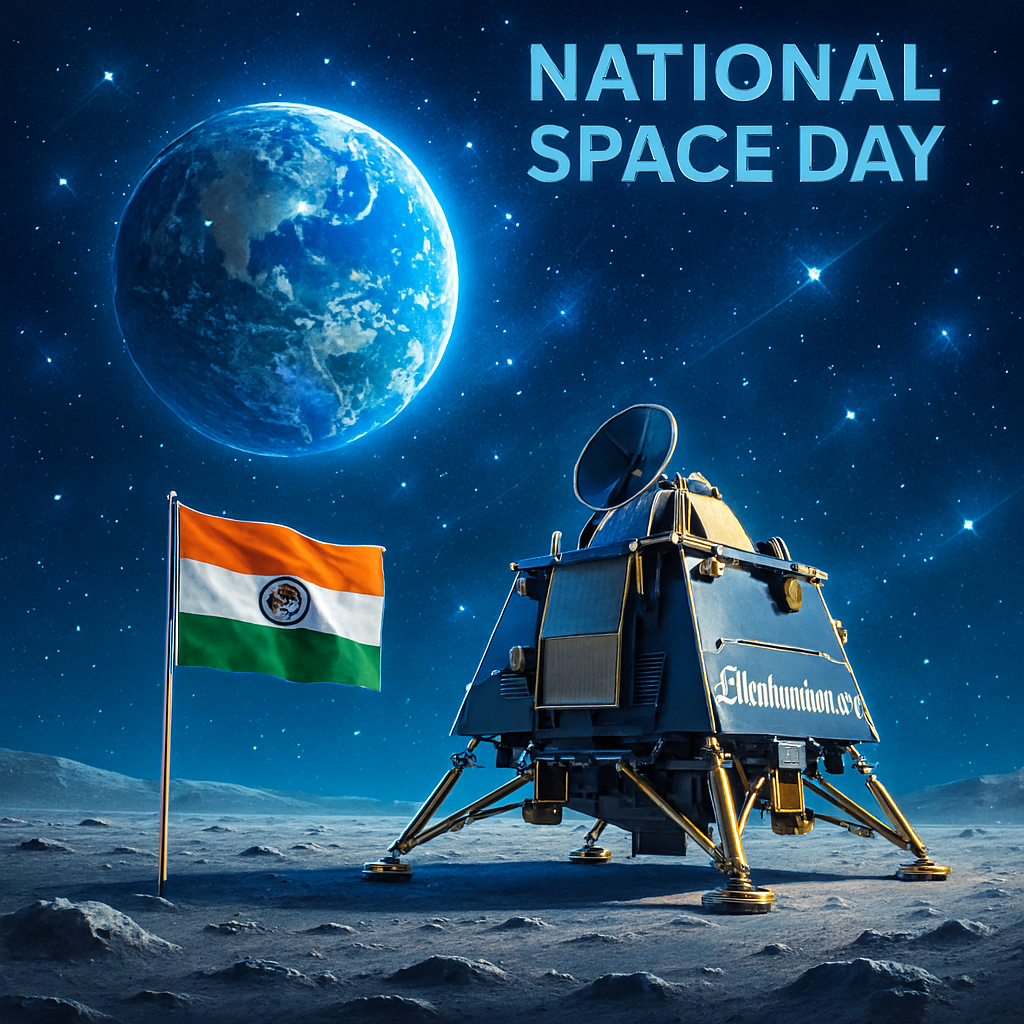
National Space Day marks India’s proud achievement in space exploration, celebrating the success of Chandrayaan 3 and its historic lunar landing. It highlights ISRO’s innovation, global recognition, and India’s journey towards becoming a space superpower.
Table of Contents
Published: August 23, 2025 | Last Updated: August 23, 2025
On August 23, 2023, India achieved a significant milestone in space exploration when the Chandrayaan-3 mission successfully executed a soft landing on the Moon’s south polar region. This accomplishment positioned India as the fourth nation worldwide to achieve lunar landing capability. More notably, it marked the first successful landing near the Moon’s southern polar area, a region that presents considerable technical challenges due to its terrain characteristics and environmental conditions.
The Indian government subsequently designated August 23 as National Space Day to commemorate this achievement. The establishment of this observance reflects the mission’s importance in India’s scientific and technological development. This article examines the technical aspects of the Chandrayaan-3 mission, its scientific contributions, and the broader implications for India’s space program and international space exploration efforts.
Understanding Chandrayaan-3: Mission Overview and Technical Specifications
The Chandrayaan-3 mission represents India’s third lunar exploration effort, developed and executed by the Indian Space Research Organisation (ISRO). The mission addressed technical challenges identified during the Chandrayaan-2 attempt, incorporating design modifications and enhanced systems to ensure successful landing operations.
Launch and Journey Parameters
The spacecraft launched on July 14, 2023, utilizing the LVM3 (Launch Vehicle Mark-3) rocket from the Satish Dhawan Space Centre in Sriharikota. The mission architecture involved a multi-phase approach spanning approximately 40 days from launch to lunar touchdown. During this period, the spacecraft performed orbital maneuvers to achieve the required trajectory for lunar approach and landing.
The lander module separated from the propulsion module on August 17, 2023, initiating the final phase of descent preparation. On August 23, 2023, at 18:04 Indian Standard Time, the Vikram lander touched down within the designated landing zone. The touchdown occurred within 300 meters of the targeted coordinates, demonstrating precision navigation capabilities in challenging lunar conditions.
Technical Components and Payload Configuration
The mission consisted of two primary surface elements: the Vikram lander and the Pragyan rover. The Vikram lander, with a mass of 1,749 kilograms, served as the primary platform carrying scientific instruments and the rover deployment system. The design incorporated enhanced sensors and landing algorithms developed through analysis of previous mission data.
The Pragyan rover, weighing 26 kilograms, featured a six-wheeled mobility system enabling surface exploration within the landing zone vicinity. Both components carried specialized instruments designed to collect data on lunar surface properties, composition, and environmental conditions.
Scientific Instrumentation: Research Capabilities and Objectives
The Chandrayaan-3 mission carried multiple scientific instruments designed to study various aspects of the lunar environment. Each instrument addressed specific research objectives contributing to broader understanding of lunar characteristics and formation processes.
Vikram Lander Instrument Suite
The lander platform housed four primary scientific instruments:
RAMBHA (Radio Anatomy of Moon Bound Hypersensitive ionosphere and Atmosphere): This instrument measures the density and temporal variations of the lunar plasma environment. The data contributes to understanding the Moon’s tenuous atmosphere and its interaction with solar radiation.
ChaSTE (Chandra’s Surface Thermophysical Experiment): Designed to measure thermal conductivity and temperature profiles of the lunar surface and subsurface layers. The instrument includes temperature sensors deployed at multiple depths to characterize heat transfer properties.
ILSA (Instrument for Lunar Seismic Activity): Functions as a seismometer detecting ground vibrations from natural seismic events and artificial sources. The data provides information about lunar internal structure and geological activity.
Laser Retroreflector Array: A passive instrument consisting of reflectors enabling precise distance measurements between Earth and the Moon. This supports lunar ranging experiments conducted by international research facilities.
Pragyan Rover Analytical Tools
The rover carries two instruments focused on surface material analysis:
APXS (Alpha Particle X-ray Spectrometer): Utilizes radioactive sources to determine elemental composition of lunar soil and rocks. The technique identifies major and minor elements present in surface materials.
LIBS (Laser Induced Breakdown Spectroscopy): Employs laser pulses to vaporize small material samples, analyzing the resulting plasma to identify constituent elements. This method provides rapid compositional analysis at multiple locations.
Landing Site Selection: Strategic and Scientific Considerations
The mission targeted a landing zone located at approximately 69.37 degrees south latitude and 32.35 degrees east longitude. This location lies within the lunar south polar region, an area of significant scientific interest due to its unique environmental characteristics and potential resource deposits.
Environmental Characteristics of the South Polar Region
The lunar south pole exhibits distinct features compared to equatorial and mid-latitude regions. Permanently shadowed craters in this area maintain extremely low temperatures throughout the lunar day-night cycle. These conditions potentially preserve volatile substances, including water ice, that would sublimate in regions receiving direct solar exposure.
Conversely, certain elevated areas receive extended periods of sunlight, offering advantages for solar-powered missions while presenting thermal management challenges. The region features complex topography with significant elevation variations, crater formations, and boulder distributions requiring advanced hazard detection systems for safe landing operations.
Accessibility and Resource Utilization Potential
Previous orbital observations indicated the presence of hydrogen signatures consistent with water ice deposits in south polar regions. Confirming the distribution and accessibility of these resources holds implications for future exploration efforts. Water ice represents a potential resource for life support systems, radiation shielding, and propellant production through electrolysis processes.
Following the successful landing, the site received the designation “Statio Shiv Shakti,” combining Sanskrit terms representing power and strength. This naming convention follows international protocols for lunar feature nomenclature while reflecting cultural significance.
Key Scientific Findings: Expanding Lunar Knowledge
Data collected during the Chandrayaan-3 mission has contributed multiple findings to lunar science. Analysis conducted by research institutions, including the Physical Research Laboratory in Ahmedabad, has yielded insights into surface properties and environmental conditions.
Water Ice Distribution Analysis
Research utilizing ChaSTE instrument data suggests that stable water ice deposits may exist beyond permanently shadowed regions. Analysis indicates that slopes exceeding 14 degrees can maintain subsurface temperatures below the stability threshold for water ice, even with periodic solar illumination. This finding expands the potential locations where future missions might access water resources.
The research methodology involved thermal modeling based on measured temperature profiles and heat transfer properties. Results suggest that sloped terrain provides thermal conditions conducive to ice preservation through reduced solar heating angles and enhanced cooling during lunar night periods. These areas potentially offer more accessible alternatives to permanently shadowed craters for resource extraction operations.
Surface Composition Determinations
Spectroscopic analysis conducted by the rover’s instruments confirmed the presence of multiple elements in lunar regolith samples. Detected elements include sulfur, aluminum, calcium, iron, chromium, titanium, manganese, silicon, and oxygen. The sulfur detection holds particular interest as this element occurs at varying concentrations across different lunar regions, providing information about local geological processes.
Compositional data contributes to understanding the Moon’s formation history and differentiation processes. The distribution of elements in surface materials reflects impact processes, volcanic activity, and space weathering effects accumulated over geological timescales.
Thermal Property Measurements
Temperature measurements obtained by ChaSTE instruments revealed significant vertical temperature gradients within the upper layers of lunar regolith. Surface temperatures varied substantially between illuminated and shadowed conditions, while subsurface measurements showed dampened variations with depth. These thermal property data inform models of heat transfer processes and assist in designing thermal control systems for future lunar missions.
India’s Space Program Development: Historical Context
Understanding Chandrayaan-3’s significance requires perspective on India’s space program evolution. The Indian Space Research Organisation, established in 1969, initially focused on satellite technology applications for communications, weather monitoring, and resource management. Over subsequent decades, the organization expanded capabilities to include satellite navigation, interplanetary missions, and launch vehicle development.
Previous Lunar Missions
Chandrayaan-1, launched in 2008, served as India’s first lunar mission. The orbiter carried instruments from multiple international partners and provided significant scientific data, including evidence supporting water ice presence in polar regions. The mission operated for 312 days before communication ceased.
Chandrayaan-2, launched in 2019, included an orbiter, lander, and rover. While the orbiter component continues operating successfully, the lander experienced difficulties during descent, preventing surface operations. The mission provided valuable engineering data that informed Chandrayaan-3 design modifications.
Technical Improvements Implementation
Chandrayaan-3 incorporated multiple design enhancements addressing challenges identified in previous attempts. These included expanded landing zone specifications, enhanced sensor systems for terrain assessment, modified descent algorithms allowing greater autonomous decision-making, redundant propulsion systems, and strengthened structural components.
The modifications reflect ISRO’s systematic approach to addressing technical challenges through data analysis and iterative design improvement. This methodology has characterized the organization’s development process across various mission categories.
International Space Exploration Context: Comparative Analysis
Examining Chandrayaan-3 within the broader context of international lunar exploration provides perspective on its significance and contributions. Four nations have demonstrated lunar soft landing capability: the Soviet Union (1966), the United States (1966), China (2013), and India (2023). Each program reflects different technological approaches, objectives, and resource allocations.
Mission Cost Efficiency Considerations
The Chandrayaan-3 mission budget approximated $74 million according to government statements. This figure contrasts with typical costs for comparable international missions, which often exceed several hundred million dollars. The cost efficiency results from multiple factors including labor cost structures, focused mission scope, utilization of existing infrastructure, and engineering approaches emphasizing simplicity and reliability.
This cost-effective approach has attracted international attention and generated interest in potential collaboration opportunities. Several nations and organizations have expressed interest in utilizing Indian launch services and technical capabilities for future missions.
Collaborative Opportunities and Partnerships
ISRO has established cooperative relationships with multiple international space agencies. These partnerships involve data sharing, instrument integration on respective missions, and joint mission planning discussions. The Chandrayaan-3 success has enhanced India’s position in such collaborative frameworks, with agencies including NASA and ESA exploring expanded cooperation possibilities.
International collaboration provides mutual benefits through shared costs, complementary technical capabilities, and broader scientific expertise. India’s demonstrated capabilities in cost-effective mission execution represent valuable contributions to international exploration efforts.
National Space Day: Establishment and Significance
Prime Minister Narendra Modi announced the designation of August 23 as National Space Day during remarks following the Chandrayaan-3 landing. The inaugural observance occurred on August 23, 2024, marking the first anniversary of the lunar landing achievement.
Observance Objectives and Activities
National Space Day serves multiple purposes within India’s educational and scientific communities. The observance aims to recognize contributions of space program personnel, promote awareness of space technology applications, encourage student interest in scientific and technical fields, and celebrate achievements in space exploration.
Activities conducted during the 2024 observance included educational workshops at schools and universities, public lectures by space scientists and engineers, exhibitions showcasing spacecraft models and mission accomplishments, documentary screenings on India’s space program history, and competitions encouraging student engagement with space-related topics.
Educational Impact and Engagement
Educational institutions reported increased interest in aerospace and space science programs following the Chandrayaan-3 mission and National Space Day establishment. Universities noted enrollment growth in relevant degree programs, while schools incorporated additional space science content in curricula.
The observance provides opportunities for direct interaction between students and space program professionals through organized events. Such engagement helps students understand career pathways in space technology and related fields while providing realistic perspectives on technical challenges and problem-solving approaches.
Future Mission Planning: ISRO’s Roadmap
The Chandrayaan-3 success informs planning for subsequent missions in ISRO’s exploration program. The organization has announced intentions to pursue various objectives including human spaceflight, sample return missions, and expanded planetary exploration.
Gaganyaan Human Spaceflight Program
The Gaganyaan program aims to demonstrate India’s capability to launch, sustain, and safely return human crews from space. Initial mission planning envisions a three-person crew spending approximately three days in low Earth orbit. The program requires development of life support systems, crew escape mechanisms, and precision recovery capabilities.
Technologies developed for Chandrayaan-3, particularly landing and descent systems, contribute to human spaceflight program development. The mission demonstrated autonomous navigation and hazard avoidance capabilities applicable to crewed vehicle operations.
Chandrayaan-4 Planning Considerations
Preliminary planning for Chandrayaan-4 includes proposals for sample return capabilities. Such missions would collect lunar material samples and transport them to Earth for detailed laboratory analysis. Sample return missions present significant technical challenges including sample collection mechanisms, containment systems, lunar ascent propulsion, and Earth reentry systems.
The scientific value of returned samples exceeds that of in-situ analysis due to the range and precision of laboratory instrumentation available on Earth. Samples would enable detailed mineralogical, chemical, and isotopic studies informing understanding of lunar formation and evolution.
Planetary Exploration Initiatives
ISRO has expressed interest in missions to Mars and Venus, building upon the Mars Orbiter Mission (Mangalyaan) success in 2014. Planned missions would incorporate lessons from lunar exploration while addressing distinct challenges of interplanetary travel and different planetary environments.
Venus missions hold scientific interest due to the planet’s extreme atmospheric conditions and surface properties. Mars exploration continues to attract attention due to questions regarding past water presence and potential habitability. Each destination requires specialized instruments and mission designs addressing specific environmental factors.
Economic Implications: Space Sector Development
The space sector represents an expanding component of India’s economy, encompassing government programs, commercial services, and private sector participation. Recent policy reforms have opened certain space activities to private enterprises, stimulating entrepreneurial activity and investment.
Commercial Launch Services Market
India offers commercial launch services through Antrix Corporation and NewSpace India Limited, providing access to orbit for domestic and international customers. The reliability and cost-competitiveness of Indian launch vehicles have attracted commercial satellite operators seeking launch opportunities.
The global commercial launch services market experiences ongoing growth driven by satellite communications, Earth observation applications, and emerging satellite constellation deployments. India’s demonstrated capabilities position the country to capture market share in this expanding sector.
Technology Development and Applications
Technologies developed for space missions often find applications in other sectors. Chandrayaan-3 mission technologies with potential terrestrial applications include advanced sensors and instrumentation, materials capable of extreme environment operation, autonomous navigation and control systems, and precision manufacturing techniques.
Such technology transfer effects multiply the economic returns from space program investments. Industries including telecommunications, agriculture monitoring, disaster management, and manufacturing benefit from adapted space technologies.
Private Sector Participation Growth
Indian space startups have increased in number following policy changes enabling private sector involvement. These companies pursue various activities including small satellite development, launch vehicle design, ground station services, and space applications development.
The entrepreneurial ecosystem benefits from the inspiration and technical expertise generated by high-profile missions like Chandrayaan-3. Engineers and scientists with space program experience increasingly transition to private sector ventures, bringing valuable knowledge and capabilities.
Global Recognition: International Response and Cooperation
The international space community acknowledged India’s Chandrayaan-3 achievement through statements from space agencies, scientific organizations, and government officials. The mission received recognition for its technical accomplishment and contribution to lunar science.
Scientific Data Sharing
ISRO has indicated willingness to share scientific data collected during the mission with international researchers. Such data sharing practices benefit the global scientific community by providing multiple researchers access to observations for analysis and interpretation. Collaborative data analysis often yields more comprehensive insights than individual efforts.
The mission’s findings regarding water ice distribution and lunar surface properties contribute to international knowledge bases informing future exploration planning. Organizations including NASA and ESA utilize data from international missions when developing their own exploration strategies.
Joint Mission Discussions
Success in lunar landing operations has positioned India for potential participation in international collaborative missions. Various proposals under discussion include joint lunar exploration initiatives, Mars mission cooperation, and contributions to international space station programs.
Collaborative missions enable sharing of development costs, risks, and technical expertise among participating nations. Each partner contributes specialized capabilities, creating mission architectures exceeding what individual organizations might accomplish independently.
Technical Challenges and Solutions: Engineering Analysis
The Chandrayaan-3 mission confronted numerous technical challenges requiring innovative solutions. Understanding these challenges and their resolution provides insights into space mission complexity and engineering problem-solving approaches.
Descent and Landing Sequence
Lunar landing operations present significant challenges due to the absence of atmosphere for aerodynamic braking, limited real-time communication during descent, requirement for autonomous decision-making, and need for precise velocity and attitude control. The descent sequence involves multiple phases with distinct requirements.
The mission utilized enhanced terrain mapping sensors providing high-resolution surface imagery during descent. These data fed algorithms assessing landing zone safety and enabling last-minute trajectory modifications if necessary. The system incorporated decision-making logic allowing the spacecraft to autonomously select optimal touchdown points within the designated area.
Communication Systems Design
Maintaining reliable communication between the lunar surface and Earth requires overcoming distance limitations, power constraints, and line-of-sight requirements. The mission employed multiple communication methods including direct Earth communication links, relay through the propulsion module, and redundant transmission systems.
Communication system design balanced competing requirements for data transmission rates, power consumption, and equipment mass. The solutions enabled transmission of scientific data, telemetry information, and system status updates throughout surface operations.
Power System Configuration
Solar power represents the primary energy source for lunar surface missions in regions receiving sunlight. The mission’s power system included solar panels, battery storage for nighttime operations, and power management electronics. System design accounted for solar panel orientation constraints, dust accumulation effects, and thermal environment impacts on component performance.
Power availability directly influences mission duration and scientific data collection capacity. The system provided sufficient power for planned operations while incorporating margins for unexpected situations.
Impact on Indian Society: Cultural and Educational Dimensions
The Chandrayaan-3 mission and National Space Day establishment have influenced Indian society beyond technical and scientific domains. The achievement has cultural significance and affects educational priorities and career aspirations.
Public Awareness and Engagement
The mission generated substantial media coverage and public interest throughout India. Television broadcasts of the landing attracted large viewership, while social media platforms carried extensive discussions of the mission’s significance. This public engagement reflects growing awareness of space exploration and its importance.
Public interest in space exploration contributes to support for continued investment in space programs. Understanding scientific achievements helps citizens appreciate the value of research and technology development investments.
Role Model Effects
The mission highlighted contributions of numerous scientists and engineers involved in its success. Media coverage featured profiles of team members, including women engineers holding key positions. Such visibility provides role models for young people considering scientific and technical careers.
Representation matters in encouraging diverse participation in technical fields. Seeing individuals from various backgrounds succeeding in challenging roles helps students envision similar career possibilities for themselves.
Scientific Temperament Development
National Space Day activities emphasize scientific methods, evidence-based reasoning, and systematic problem-solving approaches. Educational programs associated with the observance help develop scientific temperament among students and the general public.
Scientific temperament involves questioning, critical thinking, and reliance on empirical evidence rather than superstition or unfounded beliefs. Cultivating these attributes contributes to societal development and informed decision-making across various domains.
Comparative Space Programs: Global Perspective
Examining India’s space program relative to other nations provides context for understanding achievements and capabilities. Different countries pursue space exploration with varying objectives, budgets, and technical approaches.
United States Space Initiatives
NASA maintains the world’s largest space program budget, enabling ambitious missions including Mars rover programs, outer planet exploration, and planned human lunar return through the Artemis program. The agency pursues cutting-edge technologies and high-risk scientific objectives.
The U.S. space program benefits from substantial funding, extensive technical infrastructure, and long operational history. However, mission costs frequently exceed those of comparable international efforts due to regulatory requirements, labor costs, and programmatic complexity.
Chinese Space Program Development
China has rapidly expanded space capabilities over recent decades, achieving human spaceflight, lunar sample return, and Mars rover landing. The program demonstrates systematic capability building and long-term strategic planning.
Chinese missions often feature ambitious objectives and significant resource commitments. The program’s growth reflects national priorities emphasizing technological advancement and international prestige through space achievements.
European Space Agency Approach
ESA operates through collaboration among member nations, pooling resources for missions exceeding individual country capabilities. The agency emphasizes scientific research, Earth observation, and international partnerships.
The collaborative model enables cost and risk sharing while maintaining technological sovereignty across Europe. ESA missions frequently feature advanced scientific instruments and innovative mission designs.
Lunar Exploration Future: International Planning
Multiple nations and organizations are developing plans for expanded lunar exploration activities. These initiatives reflect growing interest in lunar science, resource utilization potential, and the Moon’s role as a platform for deeper space exploration.
Artemis Program Objectives
NASA’s Artemis program aims to establish sustainable human presence on the Moon, including construction of the Gateway space station in lunar orbit and periodic surface missions. The program involves international partners contributing various mission elements.
Artemis architecture envisions reusable transportation systems, surface habitats supporting extended stays, and resource utilization demonstrations. India has expressed interest in potential participation through various mechanisms.
Commercial Lunar Services
Private companies increasingly pursue lunar mission opportunities, including payload delivery services, resource prospecting, and infrastructure development. NASA and other agencies procure services from commercial providers under public-private partnership models.
This commercial involvement potentially reduces costs while stimulating private sector innovation. Companies compete on price, capability, and schedule to secure contracts for lunar missions.
International Cooperation Frameworks
Various proposals suggest international cooperative approaches to lunar exploration, sharing costs and risks while pooling technical expertise. Such frameworks might involve mission element contributions by different nations, shared utilization of infrastructure, and coordinated exploration activities.
Cooperative approaches enable more ambitious exploration programs than individual nations might undertake independently. Diplomatic and coordination challenges require resolution through negotiated agreements and governance structures.
Resource Utilization Concepts: Future Applications
Water ice and other lunar resources represent potential inputs for future exploration activities. Concepts for resource utilization, termed In-Situ Resource Utilization (ISRU), aim to reduce mission costs and enable expanded operations.
Water Processing Applications
Water ice can be processed through electrolysis to produce hydrogen and oxygen. Liquid hydrogen and liquid oxygen serve as propellants for rocket engines, while oxygen supports life support systems. Producing these materials on the Moon rather than transporting from Earth substantially reduces mission costs.
Technical challenges include water ice extraction from regolith, purification processes, storage in cryogenic conditions, and propellant production at required scales. Demonstration missions testing these capabilities inform feasibility assessments and architecture development.
Construction Material Utilization
Lunar regolith might serve as construction material for surface infrastructure through various processing methods. Concepts include sintering using solar concentrators, additive manufacturing techniques, and binding agent applications.
Using local materials for construction reduces transportation requirements from Earth, lowering mission costs and enabling larger structures. Technical demonstrations must validate material properties and construction techniques in lunar environmental conditions.
Solar Power Generation
The Moon’s lack of atmosphere enables efficient solar power generation in illuminated regions. Certain polar locations receive near-continuous sunlight, offering advantages for power infrastructure supporting long-duration operations.
Solar power systems on the Moon must address dust accumulation, extreme temperature variations, and meteoroid impacts. Advanced photovoltaic technologies and protective measures can mitigate these challenges.
Author Information
About the Author: Nueplanet
Nueplanet is a dedicated science and technology content writer specializing in space exploration, aerospace developments, and scientific breakthroughs. With a commitment to accuracy and verified information, Nueplanet delivers well-researched articles based on official sources, government announcements, and authoritative scientific publications.
The goal is to make complex scientific topics accessible to general audiences while maintaining technical accuracy and factual integrity. All content undergoes thorough verification against multiple reliable sources before publication, ensuring readers receive trustworthy information about important scientific and technological developments.
For questions, corrections, or additional information, readers are encouraged to verify details through official sources including ISRO’s website (www.isro.gov.in) and other authoritative scientific institutions.
Frequently Asked Questions About National Space Day and Chandrayaan-3
What is National Space Day in India and when is it observed?
National Space Day is observed annually on August 23 in India. The date commemorates the successful landing of the Chandrayaan-3 mission on the Moon’s south polar region on August 23, 2023. Prime Minister Narendra Modi announced the designation of this date as National Space Day following the landing achievement. The observance aims to celebrate India’s space program accomplishments, recognize contributions of space scientists and engineers, and promote awareness of space technology among the public, particularly students.
Why did India choose the Moon’s south pole region for Chandrayaan-3?
The lunar south polar region offers significant scientific value due to several factors. Permanently shadowed craters in this area potentially contain water ice deposits preserved in extremely cold conditions. Understanding water ice distribution and accessibility has implications for future lunar exploration and potential resource utilization. Additionally, the region presents unique geological features and environmental conditions differing from previously explored lunar areas. The challenging terrain, including complex topography and lighting conditions, provided an opportunity to demonstrate advanced landing technologies. India became the first nation to successfully land a spacecraft in this region.
What were the major scientific instruments carried by Chandrayaan-3?
The Chandrayaan-3 mission carried multiple scientific instruments distributed between the Vikram lander and Pragyan rover. The lander instruments included RAMBHA for studying the lunar plasma environment, ChaSTE for measuring surface and subsurface temperatures, ILSA for detecting seismic activity, and a Laser Retroreflector Array for precise distance measurements. The Pragyan rover carried APXS for determining elemental composition through X-ray spectroscopy and LIBS for rapid elemental analysis using laser-induced plasma. These instruments collectively addressed research objectives related to lunar surface composition, thermal properties, seismic characteristics, and atmospheric conditions.
How much did the Chandrayaan-3 mission cost compared to other lunar missions?
According to official government statements, the Chandrayaan-3 mission cost approximately $74 million. This figure is notably lower than typical costs for comparable international lunar missions, which often range from several hundred million to over a billion dollars. The cost efficiency results from multiple factors including India’s labor cost structures, focused mission objectives, utilization of existing infrastructure developed for previous missions, and engineering approaches emphasizing reliability and simplicity. This cost-effectiveness has generated international interest in India’s space program and potential collaborative opportunities for future missions.
What improvements did Chandrayaan-3 incorporate from the previous Chandrayaan-2 mission?
Chandrayaan-3 incorporated multiple technical improvements addressing challenges encountered during the Chandrayaan-2 landing attempt. These enhancements included expanded landing zone specifications allowing greater area for touchdown site selection, improved terrain mapping sensors providing higher resolution surface imagery during descent, modified landing algorithms enabling enhanced autonomous decision-making, additional fuel reserves for extended maneuvering capability, strengthened structural components increasing landing impact tolerance, and enhanced communication systems ensuring reliable data transmission. These modifications reflected systematic analysis of Chandrayaan-2 flight data and represent ISRO’s iterative design improvement methodology.
What are the key findings about water ice from Chandrayaan-3 data?
Research based on ChaSTE instrument data from Chandrayaan-3 suggests that water ice may exist in locations beyond permanently shadowed craters. Analysis indicates that sloped terrain with angles exceeding 14 degrees can maintain subsurface temperatures sufficiently low to support stable water ice, even with periodic solar illumination. This finding expands the potential areas where future missions might access water resources. The thermal modeling, based on measured temperature profiles and heat transfer properties, suggests that sloped regions experience reduced solar heating angles and enhanced nighttime cooling, creating conditions conducive to ice preservation. This discovery has implications for future resource utilization planning.
How has Chandrayaan-3 influenced India’s position in the global space industry?
The Chandrayaan-3 success elevated India’s standing in the international space community. India joined an exclusive group of four nations demonstrating lunar soft landing capability while becoming the first to land near the south polar region. The mission’s cost-effectiveness attracted international attention and generated increased interest in commercial collaborations and launch service contracts. Space agencies and organizations have expressed interest in partnerships with ISRO for future missions, recognizing India’s capabilities in executing complex space projects efficiently. The achievement enhanced India’s credibility as a reliable partner for international space ventures and positioned ISRO favorably in the growing commercial space services market.
What future space missions is India planning after Chandrayaan-3?
ISRO has outlined plans for multiple future missions building on Chandrayaan-3’s success. The Gaganyaan program aims to demonstrate human spaceflight capability with plans for a three-person crew mission to low Earth orbit. Chandrayaan-4 concepts include sample return capabilities that would collect lunar material and transport it to Earth for detailed laboratory analysis. ISRO has also expressed interest in missions to Mars and Venus, incorporating lessons from lunar exploration. Additionally, the organization continues developing the Aditya-L1 solar observatory mission. These initiatives reflect India’s expanding capabilities and ambitions in space exploration across multiple domains.
Conclusion: Significance and Future Outlook
The Chandrayaan-3 mission represents a milestone achievement in India’s space exploration program and contributes meaningfully to international lunar science. The successful landing demonstrated technological capabilities in autonomous navigation, precision control, and complex mission operations. Scientific findings from the mission, particularly regarding water ice distribution and thermal properties, inform understanding of lunar environmental conditions and resource potential.
The establishment of National Space Day creates an annual opportunity to recognize space program achievements and encourage continued development of scientific and technical capabilities. The observance plays a role in promoting educational engagement with space science and inspiring interest in technical careers among young people.
India’s space program continues evolving with planned missions addressing diverse objectives from human spaceflight to planetary exploration. The program’s demonstrated cost-effectiveness and technical competence position India as an important participant in international space exploration efforts. Future missions will build upon the foundation established by Chandrayaan-3 and earlier achievements.
The mission’s impact extends beyond immediate technical accomplishments to influence education, inspire innovation, and contribute to India’s broader technological development. As space exploration activities expand globally, India’s capabilities and contributions position the nation to participate meaningfully in humanity’s continuing exploration of the solar system.
National Space Day serves as an annual reminder of these achievements while looking forward to future accomplishments. The date commemorates not only a specific mission success but represents India’s ongoing commitment to advancing knowledge through scientific exploration and technological innovation.
Content Verification Note: This article is based on official information from the Indian Space Research Organisation (ISRO), government announcements, and published scientific research. Readers are encouraged to consult official sources at www.isro.gov.in for the most current information about India’s space program and mission updates.
Helpful Resources
Latest Posts
Related Posts













Post Comment