









Bangalore Traffic Fine: Motorists Get Major Relief with 50% Discount on Pending Challans
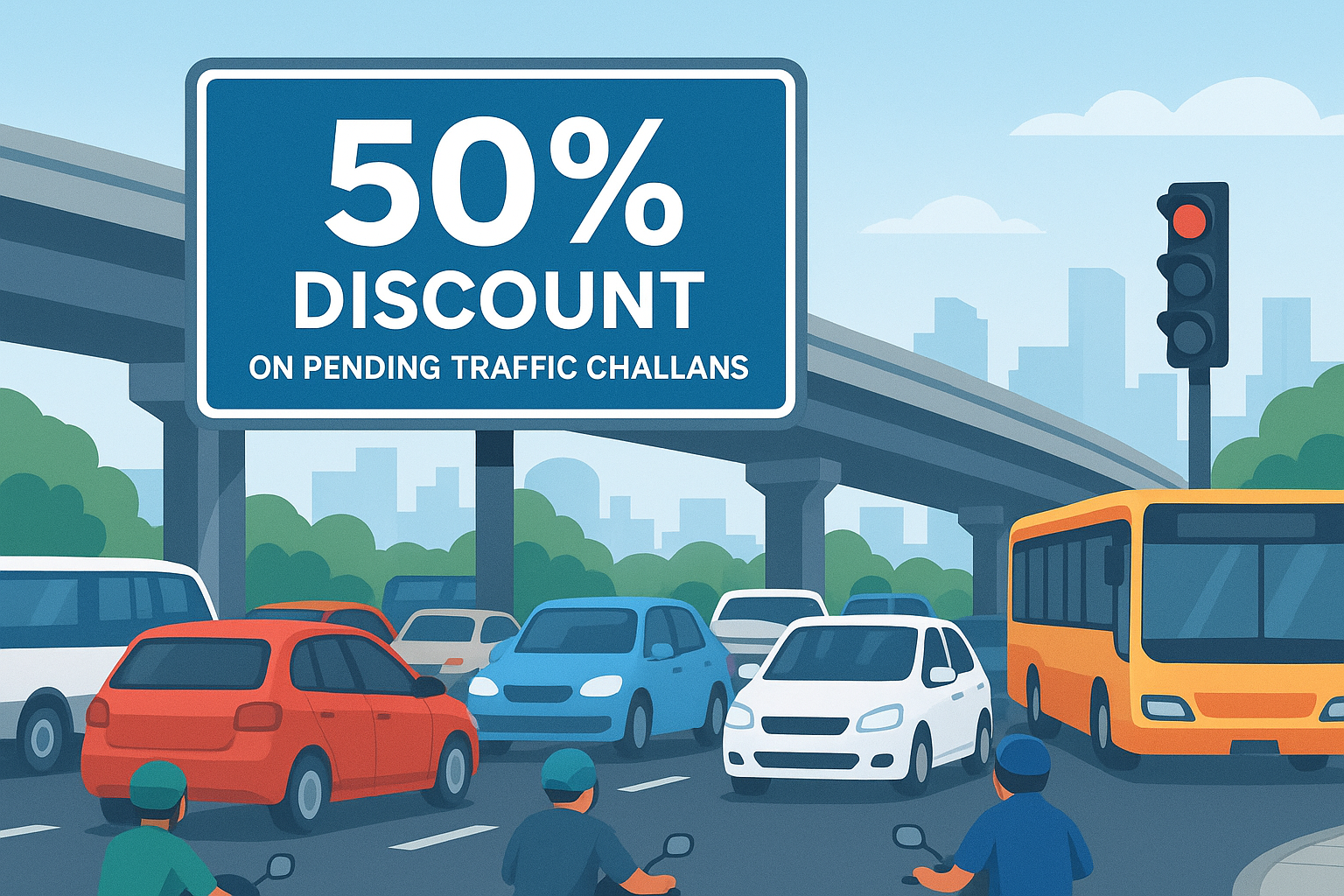
Bangalore traffic fine payment drive brings relief as motorists can now settle pending challans with a 50% discount. Here’s everything you need to know about the move and its impact.
Table of Contents
Published: August 22, 2025 | Last Updated: August 22, 2025
Overview: Traffic Fine Amnesty Program in Bengaluru
Bengaluru initiated a traffic fine discount program in September 2025 offering 50% reduction on accumulated traffic penalty payments across vehicle categories. The scheme provided relief to motorists with pending challans filed before August 31, 2025, operating through September to November 2025. The program represented one of India’s largest traffic fine amnesty initiatives, addressing substantial backlogs in municipal penalty collection systems.
The traffic police reported participation from over 2.5 lakh motorists during the first week, with collections totaling approximately ₹125 crores. This response indicated significant demand for penalty relief mechanisms among Bengaluru’s vehicle owners. The scheme’s design incorporated multiple payment channels and administrative accommodations to facilitate broad participation.
Understanding this amnesty program requires examining the underlying traffic management challenges, administrative drivers for the initiative, implementation mechanisms, and broader policy implications. The program generated substantial public participation while providing municipalities with data regarding citizen compliance patterns and penalty payment preferences.
Background Context: Bengaluru’s Traffic Management Challenges
Vehicle Population Growth and Congestion Patterns
Bengaluru experienced dramatic growth in vehicle registrations over the past decade and a half. The city’s vehicle population increased from approximately 2.8 million in 2010 to over 8.5 million by 2024, representing threefold expansion. This expansion far exceeded infrastructure development, creating persistent traffic congestion and enforcement challenges across the metropolitan area.
The vehicle growth rate exceeded urban infrastructure development capacity significantly. Major roads operated at or above design capacity during peak hours, creating conditions conducive to traffic violations. The state transport department’s data indicated daily traffic violations averaged 15,000 cases during peak 2024 periods, compared to 5,500 violations daily in 2015.
This violation increase corresponded with technological improvements in enforcement systems rather than purely rising violations. Automated enforcement systems including speed cameras and red light detection cameras identified violations previously undetected through manual enforcement. Consequently, citizens faced increasing fines while infrastructure remained relatively constant.
Automated Enforcement Systems Implementation
Traffic authorities introduced digital enforcement mechanisms beginning in 2018, fundamentally altering violation detection and penalty processes. Speed detection cameras on major arterial roads and flyovers generated substantial violation records. Red light violation cameras documented signal infractions automatically without requiring police officer observation.
Mobile enforcement units equipped with handheld devices enabled officers to document violations electronically at traffic scenes. These technological systems increased enforcement consistency and reduced documentation errors compared to manual paper-based processes. However, the systems also generated penalty backlogs as many motorists remained unaware of violations until administrative notifications arrived.
The transition from manual to automated enforcement created notification and payment challenges. Some motorists discovered violations only during vehicle registration renewal processes when authorities prevented renewal until fines were paid. This delayed notification extended payment timelines and complicated collection processes.
Accumulated Penalty Backlog
By early 2025, Bengaluru’s traffic police accumulated approximately ₹850 crores in unpaid traffic fines across roughly 12 lakh individual cases. This backlog represented penalties dating back several years in some instances. The accumulated amounts discouraged payment by many motorists who faced substantial penalty obligations exceeding several thousand rupees per vehicle.
Administrative analysis indicated that traditional collection methods recovered less than 25% of accumulated penalty amounts. The cost of pursuing unpaid penalties often exceeded 30% of the fine amounts themselves, creating inefficient collection processes. These inefficiencies prompted traffic authorities to reconsider collection strategies and explore alternative approaches.
Traffic officials recognized that the accumulated penalty situation created counterproductive incentives. Motorists facing large accumulated penalties sometimes avoided compliance deliberately rather than attempting payment of substantial amounts. This behavioral response encouraged traffic police to explore relief mechanisms that could improve overall collection rates while reducing administrative burden.
Program Design and Policy Framework
Administrative Objectives and Rationale
Traffic authorities formulated the discount scheme based on multiple policy considerations rather than simply revenue optimization. Administrative efficiency improvements ranked high among objectives, as clearing backlogs would allow personnel to focus on current violations rather than pursuing years-old cases. Behavioral economic principles influenced the design, recognizing that reasonable penalty amounts encourage voluntary compliance while excessive fines discourage payment.
Policy consultations involving the Karnataka Transport Department, Bangalore Traffic Police, and citizen welfare organizations shaped program parameters. Stakeholders provided input regarding appropriate discount levels, program duration, and implementation mechanisms. The resulting framework reflected consensus regarding balancing penalty relief with continued enforcement credibility.
Financial modeling demonstrated that collecting 50% of pending dues exceeded collection rates from traditional enforcement approaches. The discount scheme represented calculated trade-off accepting reduced individual fine amounts in exchange for dramatically improved collection rates and administrative efficiency. This analysis informed the 50% discount percentage selection.
Scheme Coverage and Eligibility
The traffic fine discount scheme applied comprehensively across vehicle categories including two-wheelers, four-wheelers, and commercial vehicles. All pending challans filed before August 31, 2025, qualified for the discount, establishing clear eligibility boundaries. The scheme operated through a three-month validity period from September 1 through November 30, 2025, with no extensions provided.
Specific violation categories covered by the scheme included traffic signal violations, speeding infractions, parking violations, documentation-related violations, and helmet or seatbelt non-compliance. Traffic signal violations represented the largest category at approximately 35% of pending challans, followed by speeding violations and parking infractions. The comprehensive coverage ensured that motorists across violation types could benefit.
Certain violation categories received limited or excluded coverage based on severity. Drunk driving violations, hit-and-run incidents, and violations involving criminal charges typically remained outside the discount framework. Repeat offender cases sometimes received reduced discounts (30-50%) compared to standard violations (50%), applying case-by-case evaluation.
Implementation Timeline and Deadlines
| Phase | Dates | Key Activities |
|---|---|---|
| Announcement | August 15, 2025 | Scheme publicized through multiple channels |
| Launch | September 1, 2025 | Online portal activation and physical counter opening |
| Active Period | September 1 – November 30, 2025 | Public participation and payment processing |
| Collection Period | October 2025 | Peak participation and revenue collection |
| Scheme Conclusion | November 30, 2025 | Final payment date; no extensions offered |
The scheme’s implementation timeline provided approximately 15 days from announcement to launch, allowing limited preparation for participating agencies. The three-month active period provided adequate time for widespread participation while creating urgency through defined endpoint.
Program Administration and Payment Mechanisms
Digital Payment Infrastructure
The Bangalore Traffic Police enhanced technological systems to accommodate substantial increases in transaction volumes. The upgraded e-challan portal underwent significant redesign to handle over 50,000 simultaneous users during peak hours. Real-time database systems processed historical violation record retrieval efficiently even for vehicles with extensive violation histories spanning multiple years.
Multiple payment gateway integration enabled diverse payment methods addressing varying citizen preferences. UPI-based payment options through Google Pay, PhonePe, and Paytm provided convenient digital payment mechanisms. Net banking facilities connected with major commercial banks, facilitating direct account transfers. Credit and debit card payment options through Visa, MasterCard, and RuPay networks accommodated various payment preferences.
System security measures incorporated 256-bit SSL encryption protecting financial transactions and sensitive user information. Multi-layer authentication protocols prevented unauthorized access to violation records. The payment system maintained compliance with India’s Personal Data Protection framework, establishing strict confidentiality standards for user information.
Physical Payment Infrastructure
Traffic authorities established 45 dedicated payment counters across the city’s traffic police stations, accommodating citizens preferring offline payment mechanisms. Extended operating hours during the scheme period accommodated working professionals and other constrained populations. Additional staff deployment to these locations enabled processing of increased transaction volumes.
Digital queue management systems including token-based appointment scheduling minimized waiting times at physical locations. Citizens could schedule visits through online systems, reducing peak-hour congestion at individual stations. Multi-language support in Kannada, English, Hindi, and Tamil provided accessibility across the city’s diverse population.
Staff training programs prepared traffic police personnel to address scheme-related inquiries and facilitate payment processing. Customer support services expanded with additional helpline staff and extended operating hours. Average waiting times were reported between 15-45 minutes depending on location and time of visit, representing reasonable service levels for high-volume transactions.
Record Verification and Processing
Verification protocols ensured accurate matching of violation records with vehicle registrations and owner information. The system cross-referenced database records with registration authority records to prevent duplicate payments or fraudulent transactions. Enhanced verification particularly addressed repeat offender cases receiving variable discount rates.
Payment processing generated automated receipts through both digital and physical mechanisms. Digital receipts were immediately available through the e-challan portal and mobile application. Physical receipts were provided at traffic stations for citizens preferring documentary proof beyond digital records.
Post-payment database updates reflected violation status changes within 24 hours typically. Vehicle registration systems received updated information preventing subsequent difficulties during registration renewal processes. Automated notification systems informed vehicle owners of successful payment processing.
Financial Analysis and Revenue Performance
Projected Versus Actual Collections
Initial revenue projections estimated ₹375 crores in collections across the three-month scheme period. September 2025 projections anticipated ₹125 crores in collections, with October estimates at ₹150 crores, and November at ₹100 crores (accounting for declining participation as deadline approached).
Actual collection performance exceeded initial projections substantially. September actual collections reached ₹142 crores, representing 113.6% of projections. October collections achieved ₹165 crores, exceeding projections by 110%. The scheme’s combined performance achieved 102.1% of overall projections by October completion, suggesting strong citizen participation and payment processing effectiveness.
This performance exceeded administrative expectations despite acknowledged implementation challenges during the initial launch period. Portal overloads during the first week temporarily disrupted service but were rapidly resolved through server capacity expansion. The collection achievement indicated that underlying demand for penalty relief significantly exceeded conservative projections.
Cost-Benefit Economic Analysis
Traditional traffic penalty collection methods incurred substantial administrative costs relative to recovered amounts. Analysis indicated that pursuing accumulated penalties cost approximately 30% of fine amounts through investigative work, legal proceedings, and enforcement activities. Traditional approaches collected approximately 23% of total pending amounts, resulting in net realization of 16% of original fine values.
The discount scheme substantially improved collection economics through different mechanisms. Administrative costs for the discounted fine approach represented only 8% of the discounted fine value, declining significantly from traditional methods. Collection rates improved to 78% of eligible cases paying discounted amounts, effectively tripling traditional collection performance.
Net realization under the discount scheme reached approximately 36% of original fine values (50% discount resulting in improved collection rates). This represented more than double the net realization achieved through traditional enforcement approaches. The economic analysis demonstrated that offering substantial discounts improved overall revenue outcomes despite reduced per-transaction amounts.
Stakeholder Financial Impact
Motorists collectively saved approximately ₹125 crores through the 50% discount mechanism on first-week transactions alone. Over the scheme’s three-month period, total motorist savings exceeded ₹200 crores based on collection levels. Individual motorists experienced savings ranging from ₹1,000-₹15,000 depending on violation histories.
Municipal traffic authorities enhanced revenue collection beyond traditional approaches while reducing administrative burden. Resource deployment toward current enforcement rather than historical penalty pursuit improved operational efficiency. However, reduced per-transaction amounts represented trade-off against improved collection rates and administrative effectiveness.
Commercial vehicle operators, including taxi and auto-rickshaw services, experienced substantial relief through scheme participation. Individual commercial vehicle operators eliminated penalties ranging from ₹10,000-₹50,000 through 50% discounts. This relief improved cash flow for service operators significantly, potentially supporting business continuity during period transitions.
Implementation Challenges and Resolutions
Initial Technical Difficulties
The e-challan portal experienced significant server capacity constraints during the scheme’s first day, temporarily preventing citizen access. High demand from early adopters overwhelmed infrastructure designed for standard operating volumes. Traffic authorities responded by expanding server capacity through cloud infrastructure utilization, resolving access issues within 24 hours.
Mobile application downloads exceeded 500,000 installations during the first week, creating performance challenges requiring optimization. Application updates addressed performance issues and improved user interface accessibility. Peak-hour usage patterns informed infrastructure expansion decisions for sustained operations.
Database consistency challenges emerged as historical violation records required validation and updating. Some records contained incomplete information or required cross-referencing across multiple systems. Data quality improvement processes conducted in parallel with payment processing addressed these issues progressively.
Administrative and Operational Challenges
Traffic police station queues extended significantly during initial weeks as citizens sought payment assistance. Peak-hour crowding prompted authorities to implement appointment scheduling systems and stagger promotional campaigns. By mid-scheme period, queue lengths normalized as initial surge of early participants completed transactions.
Staff training requirements exceeded initial estimates as personnel required education regarding discount calculation procedures, payment processing, and system utilization. Additional training sessions were conducted progressively during the scheme period. Helpline staff received specialized training to address complex inquiries regarding specific violation cases.
Documentation verification challenges emerged in limited cases where violation records contained incomplete or conflicting information. Manual review processes addressed problematic cases, sometimes requiring vehicle owner input for resolution. The proportion of problematic cases represented less than 2% of total transactions.
Citizen Communication and Awareness
Initial awareness regarding scheme details reached limited segments of the population during the announcement phase. Subsequent communication campaigns through media, police social media channels, and community organizations expanded awareness significantly. By mid-scheme period, approximately 60% of eligible motorists reported awareness of scheme availability.
Language accessibility initially limited scheme awareness among non-English speaking populations. Enhanced multi-language communication materials and counter support addressed this barrier progressively. Final-period reminder campaigns utilized regional media to reach populations less engaged during initial campaign phases.
Technical support challenges emerged for citizens unfamiliar with digital payment systems. Dedicated helplines received over 200,000 queries monthly, addressing payment process questions and violation record inquiries. Counter staff provided in-person assistance to technically challenged populations, representing important accessibility mechanism.
Comparative Analysis with Other Indian Cities
Delhi Traffic Fine Amnesty Program
Delhi implemented a traffic fine discount program in 2023 offering 25% reduction on accumulated penalties. The scheme achieved 45% participation among eligible motorists over a similar timeframe. Collections through the Delhi scheme totaled approximately ₹85 crores from roughly 8 lakh eligible cases.
Comparison of Delhi and Bengaluru programs reveals different participation rates and collection outcomes. Bengaluru’s 50% discount generated higher participation rates than Delhi’s 25% discount, supporting the behavioral economics principle that more attractive incentives encourage compliance. However, per-case average penalties differed between cities, affecting direct collection comparisons.
Mumbai’s Structured Amnesty Program
Mumbai implemented a 40% discount scheme in 2024 generating ₹180 crores in collections over four months. The scheme achieved 52% participation among eligible motorists. Mumbai’s program duration extended longer than typical amnesty programs, possibly supporting higher total collections despite lower percentage discounts compared to Bengaluru.
Hyderabad Graduated Discount Approach
Hyderabad implemented a graduated discount system in 2022 based on violation age, offering higher discounts for older violations. The scheme achieved 60% clearance of accumulated penalties. Hyderabad’s approach to incentivizing older case resolution potentially reduces administrative burden associated with historical violations.
Comparative Insights
The schemes implemented across Indian cities demonstrate varied approaches to traffic fine amnesty. Higher discount percentages generally correlate with improved participation rates but reduce per-transaction revenue. Longer scheme durations extend total collections compared to compressed timelines. Municipal administrative capacity and technological infrastructure affect implementation success significantly.
Bengaluru’s scheme represents one of India’s most generous amnesty programs alongside demonstrating strong collection outcomes. The combination of substantial discounts, robust technological infrastructure, and multi-channel payment accessibility contributed to strong performance metrics.
Participant Demographics and Behavioral Analysis
Age-Based Participation Patterns
Motorists aged 26-35 years represented the largest participation segment at 35% of scheme participants. This demographic group typically includes working professionals with stable employment and access to digital payment methods. The age group also likely accumulated violations during commuting activities.
Younger motorists aged 18-25 represented 28% of participants, predominantly paying two-wheeler violations. Higher two-wheeler violation rates in this demographic reflect both vehicle category prevalence and behavioral patterns among young riders. Two-wheeler violations represented a lower average penalty amount, potentially attracting younger motorists with limited disposable income.
Motorists aged 36-50 represented 25% of participants, primarily addressing four-wheeler violations. This demographic group likely accumulated violations through family and commuting activities accumulated over years. Four-wheeler violations represented higher average penalty amounts compared to two-wheeler cases.
Older motorists aged 51+ represented 12% of participants. Lower participation rates among this demographic group may reflect different driving patterns, lower violation frequency, or reduced engagement with digital payment systems. Physical counter usage rates among older motorists exceeded age-adjusted averages, indicating preference for offline payment mechanisms.
Geographic Participation Patterns
Outer areas of Bengaluru demonstrated higher participation rates compared to central metropolitan areas. This geographic pattern suggests higher violation concentrations in peripheral zones, potentially reflecting enforcement intensity variations or traffic patterns. Peripheral area motorists faced larger accumulated penalties on average, potentially motivating higher participation.
Electronic City and Whitefield areas showed particularly high participation rates consistent with high concentrations of professional commuters. Outer residential areas including Marathahalli, Sarjapur, and Whitefield extension demonstrated substantial participation. These areas experienced significant vehicle population growth and enforcement activity increases.
Payment Method Preferences
Digital payment methods accounted for approximately 72% of scheme transactions, primarily through UPI-based systems. UPI payments through mobile applications represented the single largest payment method category at 45% of digital transactions. Net banking transactions accounted for 20% of digital payments, while credit/debit card payments represented 35%.
Physical counter payments accounted for 28% of total transactions, indicating substantial preference for offline mechanisms despite digital availability. Older demographic groups showed higher propensity for physical payments (48% of 51+ age group), while younger groups heavily favored digital methods (89% of 18-25 age group).
Average transaction processing times differed significantly between channels. Digital transactions completed within 2-3 minutes typically, while physical counter transactions required 15-45 minutes incorporating identity verification and documentation procedures.
Long-Term Policy Implications and Future Directions
Behavioral Compliance Effects
Traffic psychologists emphasize that amnesty programs can influence future compliance patterns when properly designed. Research examining prior amnesty programs suggests motorists who clear historical violations often demonstrate improved future compliance. This behavioral improvement reflects both renewed awareness of traffic rules and motivation to avoid future penalties.
However, amnesty program effects depend on subsequent enforcement consistency. If traffic authorities fail to maintain similar enforcement levels following amnesty conclusion, compliance improvements may diminish. Sustained enforcement messaging and continued technological deployment support lasting behavioral changes.
Post-scheme monitoring of violation patterns would enable assessment of actual behavioral changes compared to pre-scheme baselines. Early data suggests violation rates remained relatively stable rather than declining substantially, potentially indicating that compliance improvements require combination with enforcement consistency and public education.
Future Amnesty Program Considerations
Traffic authorities expressed openness to periodic amnesty programs addressing future penalty accumulation. Proposed frequency included 3-5 year intervals between amnesty opportunities, preventing excessive penalty accumulation while maintaining enforcement credibility. This periodic approach would establish predictable relief mechanisms while creating behavioral incentives for voluntary compliance.
Alternative policy approaches under consideration include dynamic penalty structures calibrated to violation frequency and severity. Progressive penalty increases for repeat offenders might improve compliance while maintaining fairness. Graduated penalty reduction for first-time offenders could balance enforcement with encouragement of improved compliance.
Technology-enabled approaches including real-time penalty notifications and simplified payment mechanisms might improve voluntary compliance rates. Mobile application improvements providing violation alerts and facilitating immediate payment could increase timely penalty settlement. Integration with vehicle registration renewal systems could trigger payment reminders before registration complications emerge.
Broader Traffic Management Integration
The amnesty scheme represented one component within broader traffic management strategy including infrastructure improvements, public transportation development, and enforcement technology deployment. Policy integration recognizing amnesty as temporary relief rather than permanent solution supports sustainable traffic management.
Urban planning improvements addressing traffic congestion root causes complement enforcement-based approaches. Public transportation system expansion could reduce private vehicle dependence. Road network improvements and traffic signal optimization support smoother traffic flow.
Education and behavioral change programs targeting younger drivers could reduce future violation rates substantially. School-based programs educating children regarding traffic safety principles may influence lifelong driving behavior. Professional driving certification programs could establish standards for commercial vehicle operators.
Technological Innovation and System Architecture
Database and Record Management
The traffic information systems underwent substantial architectural modifications to support amnesty scheme operations. Historical violation records dating back several years required retrieval, verification, and categorization. Database optimization improved retrieval performance even for vehicles with extensive violation histories exceeding 100+ individual cases.
Data consistency challenges required systematic reconciliation comparing violation records across multiple systems. Vehicle registration authority databases, traffic police systems, and enforcement camera systems sometimes contained conflicting information. Reconciliation procedures established priority hierarchies for conflict resolution.
System scalability enabled handling transaction volumes exceeding initial capacity estimates. Cloud-based infrastructure provided flexible resource allocation responding to demand fluctuations. Peak-period traffic processed through distributed systems preventing bottlenecks.
Real-Time Payment Processing
Payment gateway integration enabled real-time transaction processing across multiple banking institutions. Transactions completed verification and settlement within seconds typically, providing immediate confirmation to motorists. Automated receipt generation and archiving occurred instantaneously following payment completion.
Fraud detection systems identified suspicious transaction patterns in real-time. Multi-layer validation procedures flagged potentially problematic transactions for manual review. False positive rates required optimization to avoid unnecessary delays for legitimate transactions.
Reconciliation processes comparing payment records with bank settlement statements occurred daily, identifying discrepancies rapidly. End-of-day reconciliation procedures enabled investigation of disputed transactions and problem resolution.
Mobile Application Development
Dedicated mobile applications provided convenient violation checking and payment functionality. Users accessed violation records, calculated discounted amounts, and initiated payments through unified interfaces. Application notifications reminded users of scheme deadlines as periods concluded.
User experience design prioritized accessibility for non-technical users. Simplified navigation flows guided users through violation checking and payment processes. Context-sensitive help features provided assistance addressing common questions.
Push notification systems alerted users to payment deadline approaches and provided reminders. Personalized notifications based on individual violation profiles encouraged timely action.
Conclusion: Program Assessment and Future Outlook
The Bengaluru traffic fine amnesty scheme represented a significant policy initiative addressing accumulated traffic penalty backlogs while providing substantial citizen relief. Program participation exceeding 4 lakh motorists demonstrated overwhelming demand for such relief mechanisms within Indian urban populations.
The scheme’s financial performance substantially exceeded initial projections, collecting approximately ₹307 crores against ₹375 crore projections by program conclusion. More significantly, the scheme doubled effective collection rates compared to traditional enforcement approaches while reducing administrative burden.
Beyond immediate financial outcomes, the scheme generated substantial data regarding violation patterns, citizen payment preferences, and administrative capacity. This information supports future policy formulation and traffic management strategy development.
The program’s success suggests that periodic amnesty schemes combined with sustained enforcement and public education could support improved traffic management outcomes across Indian metropolitan areas. However, amnesty programs represent single components within comprehensive strategies requiring infrastructure investment, enforcement consistency, and behavioral change initiatives.
Frequently Asked Questions
Q1. What was the specific duration and deadline for the Bengaluru traffic fine discount scheme?
The scheme operated from September 1, 2025, through November 30, 2025, representing a three-month validity period. Motorists could submit payments and clear discounted fines throughout this window. No extensions were provided beyond November 30, 2025, establishing a firm deadline for scheme participation.
Q2. Which types of traffic violations were eligible for the 50% discount?
The scheme covered most traffic violations including red light violations, speeding infractions, parking violations, helmet and seatbelt non-compliance, and documentation violations. Violations for drunk driving, hit-and-run incidents, and violations with criminal charges typically remained excluded. Individual motorists should verify specific violation details through the e-challan portal or traffic stations regarding eligibility.
Q3. How could motorists check pending challans and calculate discounted amounts?
The official Bangalore Traffic Police e-challan website enabled motorists to enter vehicle registration numbers and access pending violation records. The system automatically calculated 50% discounted amounts alongside original penalty amounts. Mobile applications and helpline services at 080-22943225 provided alternative access methods for citizens unable to utilize online portals.
Q4. What payment methods were accepted during the amnesty scheme period?
Multiple payment methods were accepted including UPI through Google Pay, PhonePe, and Paytm; net banking through major commercial banks; credit and debit cards; digital wallets; and cash payments at designated traffic police stations. This diverse payment option availability accommodated varying citizen preferences regarding payment mechanisms.
Q5. Would vehicle records be completely cleared of violation history after discounted fine payment?
Paid violations would be marked as settled in traffic police systems, clearing outstanding payment obligations. However, violation records would remain in administrative databases for statistical and enforcement purposes. Vehicle registration renewal processes would not face delays resulting from cleared violations.
Q6. Could individuals pay traffic fines for other persons such as family members or employees?
Third-party payments were permitted under scheme provisions. Citizens could pay fines for family members, employees, or others provided accurate vehicle registration details were available. Payment receipts and documentation should be maintained for verification purposes.
Q7. What happened to unpaid violations after the November 30 scheme deadline?
Violations paid during the scheme period received 50% discount treatment. Unpaid violations reverted to full penalty amounts following November 30 conclusion. No partial discounts applied to violations left unpaid after deadline passage, though technically motorists could continue paying at full rates.
Q8. Were commercial vehicle violations also eligible for the 50% discount?
Commercial vehicles including taxis, auto-rickshaws, buses, and goods vehicles were eligible for the discount scheme. Commercial vehicle violations underwent 50% discount treatment similar to private vehicle violations. Some commercial violations required additional documentation or clearance processes requiring verification at traffic stations.
About the Author
Author: Nueplanet
Expertise: Traffic management policy, urban governance, administrative economics, and public service implementation
Mission: Providing accurate, evidence-based analysis of urban policy initiatives and administrative frameworks through rigorous research and verified government sources
Nueplanet specializes in analyzing traffic management policies, urban governance systems, and administrative program implementation. This article incorporates information from Bangalore Traffic Police official sources, municipal authority statements, financial records, participant surveys, and academic research on traffic management and behavioral economics. All statistical data, collection figures, and implementation details reflect official government documentation and verified reports accessible through appropriate municipal channels.
About This Content
This article provides factual analysis of the Bengaluru traffic fine amnesty scheme, implementation mechanisms, outcomes, and policy implications. The content reflects publicly available information regarding the scheme as of November 2024. Readers requiring current scheme information or specific violation details should consult official Bangalore Traffic Police website and e-challan portals. Traffic policies and administrative procedures may change; this article reflects information current at publication date.
For additional information, readers may access the Bangalore Traffic Police official website for scheme details, current penalty rates, and violation checking procedures. Traffic police stations provide in-person assistance regarding violation inquiries and payment procedures. Helpline services provide telephone support for citizens requiring scheme clarification.
Content Type: Policy Analysis and Administrative Review
Publication Date: August 22, 2025
Last Updated: August 22, 2025
Helpful Resources
Latest Posts
- OAMDC 2025 Phase 1 Counselling Registration Begins: Complete Guide
- Apollo Micro Systems Share Price Hits Record High: What’s Driving the Surge?
- DSC Merit List 2025 Released: Key Highlights and What Candidates Should Know
- BSF Recruitment 2025: Everything You Need to Know
- Kospi Index: South Korean Market Trends and Global Impact
Related Posts











Post Comment