









GST News: Revamp on Track as GoM Backs Two-Slab Tax Plan
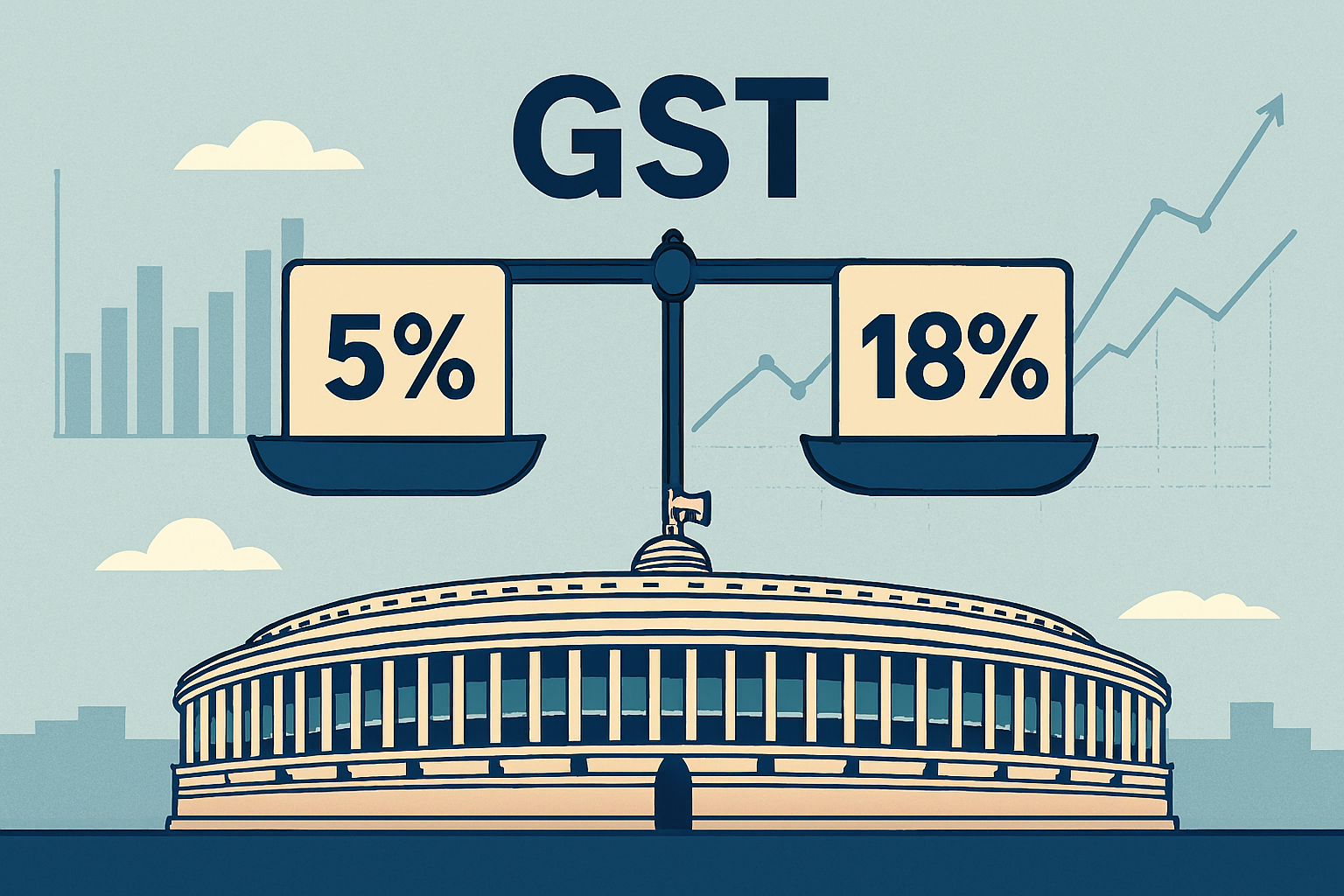
The latest GST news highlights a major revamp as the Group of Ministers backs the Centre’s proposal for a two-slab structure, scrapping 12% and 28% rates. This could reshape India’s indirect tax system and impact consumers, businesses, and state revenues.
Table of Contents
Introduction: Understanding India’s Proposed GST Transformation
India’s taxation framework stands at a critical juncture as the Group of Ministers (GoM) has formally endorsed a proposal to restructure the Goods and Services Tax system into a simplified two-slab framework. This development, emerging from deliberations concluded in September 2025, represents the most substantial reform to India’s indirect tax system since GST implementation in July 2017.
The proposed restructuring aims to streamline the existing four-tier rate structure—currently comprising 5%, 12%, 18%, and 28% slabs—into a more manageable two-tier system. This initiative reflects years of stakeholder consultations highlighting complexities in the current framework that affect businesses, consumers, and tax administrators. The reform seeks to balance simplification objectives with revenue adequacy requirements while maintaining the progressive taxation principles underlying India’s fiscal policy.
Understanding this proposed transformation requires examining its origins, structural mechanics, stakeholder implications, and potential economic consequences. This analysis provides comprehensive insights into how the two-slab system may reshape India’s commercial landscape and taxation practices.
Background: Evolution of GST and Reform Imperatives
GST Implementation and Initial Challenges
The Goods and Services Tax system launched on July 1, 2017, aimed to create a unified national market by replacing multiple central and state-level indirect taxes. The “one nation, one tax” concept promised to eliminate cascading tax effects, reduce compliance burdens, and facilitate seamless interstate commerce. However, implementation revealed complexities not fully anticipated during the design phase.
The four-slab rate structure emerged from political compromises necessary to secure state government support for constitutional amendments enabling GST. Different tax rates reflected efforts to maintain progressivity by taxing luxury goods higher while keeping essential items affordable. This approach, while politically pragmatic, created classification challenges and compliance complexities for businesses operating across multiple product categories.
Businesses encountered difficulties determining appropriate tax classifications for products, particularly those straddling the 12% and 18% rate boundaries. These classification disputes generated litigation, increased compliance costs, and created uncertainty in pricing strategies. Small and medium enterprises faced disproportionate challenges due to limited resources for managing complex compliance requirements.
Consultation Process and Stakeholder Engagement
Throughout 2024 and early 2025, the Ministry of Finance conducted extensive consultations with state governments, industry associations, and tax experts. These discussions examined revenue implications, compliance burden assessments, and economic impact projections across various sectors. The Group of Ministers, comprising finance ministers from key states, undertook a six-month comprehensive analysis before delivering their recommendation in September 2025.
State governments initially expressed concerns about potential revenue disruptions from rate consolidation. Detailed financial modeling exercises demonstrated that simplified structures could maintain revenue adequacy through improved compliance rates and reduced administrative costs. These projections, combined with proposed compensation mechanisms for transition periods, gradually built political consensus for reform.
Industry associations consistently emphasized compliance cost reduction as a critical business need. Surveys indicated that classification disputes and multiple rate management consumed significant resources, particularly for smaller enterprises. The business community’s unified support for simplification provided additional momentum for reform initiatives.
Proposed Structure: Mechanics of the Two-Slab System
Lower Slab: Essential Goods and Services
The lower tax slab will encompass goods and services considered essential for basic livelihood and welfare. This category typically includes unprocessed food items, basic healthcare products, educational services, and other necessities forming the foundation of household consumption. The objective is maintaining affordability for essential goods across income demographics.
Food grains, pulses, fruits, vegetables, and dairy products generally qualify as essential items warranting favorable tax treatment. Healthcare services including diagnostic tests, hospital treatments, and essential medicines maintain lower taxation to ensure healthcare accessibility. Educational services from primary through higher education levels receive preferential treatment supporting human capital development.
The lower slab rate has not been officially announced but is expected to remain close to current rates for essential goods (0-5%). This continuity ensures price stability for basic necessities while achieving overall system simplification. Specific classifications will be finalized through GST Council deliberations incorporating stakeholder feedback.
Standard Slab: Consolidation of Middle Rates
The standard slab represents the reform’s core innovation, consolidating current 12% and 18% rates into a unified rate structure. This consolidation eliminates classification disputes between these categories while providing predictable tax treatment for the majority of goods and services. Most manufactured goods, processed foods, consumer durables, and commercial services will likely fall within this category.
The consolidated rate will be determined through careful balancing of revenue neutrality requirements and economic impact considerations. Initial discussions suggest a rate between 15-18%, though final determination awaits formal GST Council approval. This rate must generate equivalent revenue to current combined collections from 12% and 18% slabs while considering compliance improvement effects.
Standard slab items include most consumer products, electronic goods, textiles, automobiles in certain segments, restaurant services, and professional services. The unified treatment simplifies input tax credit calculations, reduces classification controversies, and provides businesses with pricing predictability. This simplification particularly benefits companies with diverse product portfolios previously spanning multiple rate categories.
Treatment of Luxury and Demerit Goods
Luxury goods and demerit items (products whose consumption is discouraged for public health or social reasons) will continue receiving higher taxation treatment. This category includes luxury automobiles, tobacco products, aerated beverages, high-end electronics, and certain services like five-star hotel accommodations. The higher taxation maintains policy objectives of progressive taxation and consumption discouragement for harmful products.
The luxury/demerit goods category serves dual purposes: generating substantial revenue from high-value transactions and implementing social policy through taxation. Products in this category typically have lower price sensitivity, making them suitable for higher taxation without significantly affecting demand. This approach preserves fiscal policy flexibility while achieving overall system simplification.
Compensation cess on certain products like automobiles and tobacco may continue alongside the restructured slab system. These additional levies address specific policy objectives including environmental concerns and public health protection. The continuation or modification of compensation cess will be determined through separate GST Council deliberations.
Economic Impact Analysis Across Sectors
Manufacturing Sector Implications
Manufacturing enterprises will experience significant operational changes under the simplified structure. Companies currently managing multiple rate classifications for raw materials, components, and finished products face complex input tax credit calculations and compliance procedures. Consolidation into standard rates reduces this complexity substantially.
The automotive sector exemplifies these challenges and potential benefits. Automobile manufacturers source components taxed at various rates, creating intricate credit calculations and cash flow management requirements. A standardized rate structure simplifies these processes, potentially reducing administrative costs by 20-30% according to industry estimates. This efficiency improvement could enhance competitiveness and support manufacturing growth.
Textile manufacturers, long challenged by differential taxation across the production chain, anticipate substantial simplification. Raw cotton, yarn, fabric, and finished garments currently face varying tax treatments, creating classification disputes and credit calculation complexities. Unified rate treatment could reduce compliance costs while improving cash flow predictability for this labor-intensive sector.
Small and medium manufacturing enterprises stand to gain disproportionately from simplification. Limited resources for tax compliance management make complex rate structures particularly burdensome for smaller firms. Simplified structures enable resource reallocation toward productive activities, potentially accelerating growth and competitiveness for this critical employment sector.
Service Sector Considerations
Services contribute over 55% to India’s GDP, making their tax treatment economically consequential. Professional services including legal, accounting, consulting, and architectural services currently taxed at 18% will likely continue under the standard rate. This continuity maintains revenue stability while providing predictable taxation for knowledge-intensive industries.
Information technology services, a major export sector, will benefit from simplified domestic market taxation. While export services remain zero-rated, IT companies serving domestic markets face compliance complexities under current multiple-rate structures. Standardization reduces these burdens, potentially encouraging greater domestic market engagement alongside export operations.
Healthcare services present nuanced considerations given their essential nature and social importance. Basic healthcare services likely remain in the lower slab supporting accessibility objectives. However, elective procedures, cosmetic treatments, and luxury healthcare services may face standard or higher taxation reflecting their discretionary nature. This differentiation balances affordability imperatives with revenue considerations.
Financial services including banking, insurance, and investment products require careful consideration given their systemic importance and complex product structures. Current exemption treatments for certain financial services may continue, though the reform provides opportunity for rationalization. Financial sector taxation affects credit availability, insurance penetration, and investment flows, necessitating careful policy calibration.
Agricultural Sector and Food Processing
Agriculture and related activities receive special consideration in India’s tax policy given the sector’s social importance and farmer welfare considerations. Agricultural inputs including fertilizers, seeds, and machinery will likely maintain favorable taxation supporting productivity objectives. This approach aligns with broader agricultural support policies while achieving revenue objectives from other sectors.
Food processing industries bridge agricultural production and consumer markets, making their tax treatment economically significant. Processing activities add value to agricultural products while supporting farmer incomes through expanded market opportunities. Simplified input credit mechanisms under consolidated rate structures could reduce processing costs, potentially benefiting both processors and farmers through improved value chain economics.
Essential food items including grains, pulses, milk, and basic cooking ingredients will continue enjoying lower taxation maintaining affordability. Processed and packaged foods may face standard rate treatment, creating clear differentiation between basic necessities and value-added products. This distinction supports nutrition access objectives while generating appropriate revenue from higher-value food products.
State Revenue Implications and Fiscal Federalism
Revenue Projection Methodology
State governments’ revenue concerns necessitated detailed modeling exercises examining reform impacts on fiscal positions. The GST Council secretariat conducted comprehensive analyses incorporating historical collection patterns, compliance rate projections, and economic growth assumptions. These models examined both aggregate national impacts and state-specific implications recognizing diverse economic structures.
Revenue neutrality emerged as a critical design criterion ensuring states maintain fiscal capacity for public service delivery. Modeling suggested that improved compliance rates and reduced administrative costs could offset potential revenue reductions from rate consolidation. Enhanced compliance may result from simplified structures reducing evasion opportunities and lowering compliance costs that sometimes encourage informal operations.
Different states exhibit varying consumption patterns and economic structures affecting their revenue sensitivities to rate changes. Manufacturing-intensive states like Gujarat and Tamil Nadu have different exposure than service-dominated economies like Karnataka and Maharashtra. Modeling incorporated these variations ensuring the reform design addresses diverse state circumstances.
Compensation Framework During Transition
The Centre has proposed extending targeted support mechanisms ensuring states maintain revenue adequacy during structural adjustment periods. This commitment addresses legitimate state concerns about fiscal disruption while the new system stabilizes. Compensation arrangements build on precedents from initial GST implementation when states received guaranteed revenue growth for five years.
Revenue-sharing mechanisms may require calibration reflecting changed dynamics under the two-slab structure. States with higher consumption of goods moving from lower to higher rates, or vice versa, may experience differential impacts requiring adjusted compensation. The framework aims to maintain equity in revenue distribution across states with different economic profiles.
Integrated GST (IGST) mechanisms for interstate transactions will be simplified correspondingly, reducing settlement complexity between Centre and states. Current IGST settlement processes involve complex calculations distributing revenue between origin and destination states. Simplified rate structures could streamline these processes, accelerating revenue transfers and improving fiscal planning predictability.
Long-Term Fiscal Sustainability
Beyond transition periods, the reform aims to improve long-term revenue sustainability through enhanced compliance and administrative efficiency. Simplified structures reduce opportunities for misclassification-based evasion while lowering legitimate compliance costs. This combination could expand the tax base by encouraging voluntary compliance from previously informal enterprises.
Reduced dispute resolution requirements free administrative resources for compliance monitoring and enforcement activities. Current classification disputes consume significant administrative capacity across state and central tax authorities. Simplification enables resource reallocation toward productive enforcement targeting actual evasion rather than classification controversies.
Digital infrastructure improvements accompanying the reform enhance monitoring capabilities and reduce collection leakages. Automated systems with simplified rate structures can more effectively identify anomalies and potential compliance issues. These technological improvements support revenue objectives while reducing taxpayer compliance burdens through streamlined processes.
Business Response and Operational Adaptations
Industry Association Perspectives
Major business associations have broadly welcomed the reform initiative while highlighting implementation considerations. The Confederation of Indian Industry characterized the proposal as potentially transformative for India’s business environment, praising efforts to reduce compliance burdens without compromising revenue objectives. Industry bodies emphasize that simplification will enable businesses to focus resources on growth rather than tax management.
The Federation of Indian Chambers of Commerce and Industry highlighted improved predictability as beneficial for investment planning and pricing strategies. Businesses operating across multiple states face particularly complex compliance requirements under current structures. Standardization facilitates expansion strategies by reducing state-specific complications in tax management.
Sector-specific associations express varied concerns reflecting unique industry circumstances. Automobile manufacturers anticipate significant compliance cost reductions but seek clarity on specific rate determinations for various vehicle categories. Pharmaceutical associations want clear differentiation between essential and non-essential medicines ensuring affordable access to critical healthcare products while accepting higher taxation for lifestyle medications.
Technology and System Adaptations
Enterprise Resource Planning (ERP) system providers have begun developing updated software modules accommodating the simplified structure. Major providers including SAP, Oracle, and local solutions like Tally Solutions announced preparation timelines for transition support. Software updates must ensure seamless transition without disrupting ongoing business operations or compliance activities.
The Goods and Services Tax Network (GSTN), the technology backbone supporting GST operations, requires comprehensive infrastructure upgrades. System modifications must maintain operational stability while implementing structural changes. GSTN has outlined phased testing and implementation protocols ensuring reliability throughout the transition period.
Small businesses using simplified accounting software will benefit from reduced complexity in tax calculations and filing procedures. Current software must accommodate multiple rate classifications, input credit calculations across rates, and complex filing requirements. Simplified structures reduce software complexity, potentially lowering costs and encouraging technology adoption among smaller enterprises currently relying on manual processes.
Pricing and Competitive Strategy Adjustments
Businesses must reassess pricing strategies considering potential rate changes affecting their product portfolios. Products currently taxed at 12% may face price pressures if moved to an 18% standard rate, requiring competitive positioning adjustments. Conversely, some items previously taxed at 28% could become more affordable, creating market expansion opportunities.
Supply chain agreements may require renegotiation reflecting changed tax treatments and cost structures. Long-term supply contracts often include specific tax treatment assumptions. Rate structure changes necessitate contract reviews ensuring fair cost allocation between parties. Early renegotiation discussions prevent disputes and maintain commercial relationships during transition.
Market entry and expansion decisions may be influenced by simplified tax administration reducing interstate expansion complexity. Current multiple-rate structures create state-specific compliance challenges sometimes deterring geographic expansion, particularly for smaller firms. Simplification reduces these barriers, potentially encouraging market integration and competitive intensity across regions.
Consumer Impact and Price Dynamics
Direct Price Effects Across Categories
Consumer goods currently taxed at 12% may experience price increases if shifted to an 18% standard rate. Basic consumer products including certain processed foods, household items, and mid-range electronics could be affected. However, actual price impacts depend on businesses’ ability to absorb increased taxes through margin adjustments or pass costs to consumers based on competitive dynamics.
Luxury items previously taxed at 28% may become more accessible if certain categories receive reduced taxation under the simplified structure. This potential democratization effect could stimulate consumption in previously price-sensitive segments. However, genuine luxury goods and demerit items will likely maintain higher taxation, limiting affordability improvements to marginal luxury categories.
Essential goods maintaining favorable taxation treatment will preserve affordability for basic necessities. Food staples, basic healthcare, and educational services will continue receiving preferential treatment protecting lower-income households. This approach ensures simplification doesn’t compromise equity objectives or create hardship for vulnerable populations.
Supply Chain Efficiency and Cost Reductions
Simplified tax structures may generate supply chain efficiencies partially offsetting rate increase impacts. Current compliance costs including classification disputes, complex credit calculations, and administrative overhead add to product prices. Businesses may pass through cost savings to consumers through competitive pressure, moderating net price effects from rate adjustments.
Input tax credit simplification improves cash flow management, potentially reducing financing costs embedded in product prices. Current complex credit calculations create working capital challenges and administrative costs. Streamlined processes reduce these burdens, creating savings that may flow through to consumer prices depending on competitive market conditions.
Reduced litigation and dispute resolution costs represent another source of potential savings. Classification controversies currently generate significant legal and administrative expenses that ultimately affect consumer prices. Simplified structures reduce these costs, creating efficiency gains that may benefit consumers through lower prices or improved product offerings.
Long-Term Consumption Pattern Changes
Relative price changes across categories may alter consumption patterns over time. Products experiencing tax increases may face demand reductions, while items receiving tax relief could see consumption growth. These demand shifts will affect sector growth dynamics, employment patterns, and market structures across industries.
Market competition may intensify as simplified taxation reduces business expansion barriers and operational complexity. Easier market entry and interstate expansion could increase competitive pressure, potentially benefiting consumers through improved choices and competitive pricing. However, competitive effects depend on various factors including market structure, regulatory environment, and capital requirements.
Consumer behavior adaptation may occur gradually as households adjust to price changes and market conditions evolve. Initial price volatility may moderate as businesses optimize operations under the new structure and competitive dynamics stabilize. Long-term effects will reflect underlying economic factors beyond tax structure including income growth, technological change, and demographic trends.
Implementation Timeline and Transition Management
Phased Rollout Framework
The GST Council is expected to approve a carefully sequenced implementation timeline spanning 12-18 months from formal authorization to complete transition. This phased approach allows businesses adequate preparation time for system updates and process modifications while maintaining revenue collection continuity. Rushing implementation could create disruptions risking both revenue stability and business operations.
Phase One involves finalizing specific rate classifications and publishing detailed implementation guidelines. This stage includes further stakeholder consultations addressing implementation concerns and refining classification criteria. Clear, detailed guidance documents help businesses plan transitions and prepare compliance systems appropriately.
Phase Two encompasses system testing and pilot programs in selected states identifying potential challenges before nationwide rollout. Pilot implementations provide valuable feedback for refining processes, addressing unforeseen issues, and validating technical readiness. This cautious approach minimizes disruption risks and ensures smoother national implementation.
Phase Three involves full nationwide implementation with comprehensive monitoring and rapid response support mechanisms. Dedicated helplines, troubleshooting resources, and feedback channels ensure issues receive immediate attention during critical transition periods. Continuous monitoring enables quick identification and resolution of emerging problems.
Business Preparation Requirements
Companies should begin immediate preparation through accounting system updates accommodating new rate structures. Enterprise systems require configuration changes, testing, and validation before implementation dates. Early preparation prevents last-minute rushes and ensures compliance readiness from transition commencement.
Personnel training programs must familiarize staff with revised procedures, rate determinations, and filing requirements. Accounts personnel, tax managers, and relevant operational staff need comprehensive training ensuring smooth operational transitions. Training should commence well before implementation dates allowing adequate learning and practice time.
Pricing strategy reviews become essential as businesses assess rate change impacts on product portfolios and competitive positions. Companies must analyze margin structures, competitive dynamics, and demand sensitivities determining optimal pricing responses. Early strategic planning enables measured responses rather than reactive adjustments under time pressure.
Government Support and Guidance Mechanisms
Tax authorities will establish dedicated support infrastructure assisting businesses through transitions. Helplines, clarification mechanisms, and guidance documents will address implementation questions and concerns. Comprehensive support reduces uncertainty and facilitates smoother transitions, particularly for smaller businesses with limited tax expertise.
Technology infrastructure upgrades by GSTN will provide enhanced system capacity and reliability during transitions. Additional server capacity, backup systems, and performance optimization ensure systems handle increased loads during filing periods. Technical reliability is crucial maintaining business confidence and compliance during structural changes.
Stakeholder engagement through regular communication updates, frequently asked question publications, and consultation forums maintains transparency and addresses concerns proactively. Open communication channels build confidence and enable collaborative problem-solving when challenges emerge. Regular updates keep stakeholders informed about implementation progress and timeline adjustments.
International Comparisons and Global Best Practices
VAT Systems in Developed Economies
Most developed economies operate simplified Value Added Tax or GST systems with two to three rate structures. The European Union’s VAT framework typically includes standard rates (ranging from 17-27% across member states) with reduced rates for essentials and zero-rating for exports. This structure balances revenue needs with social policy objectives while maintaining relative simplicity.
Canada’s federal GST operates at 5% with provincial sales taxes added in most provinces, creating combined rates varying by location. Some provinces have harmonized sales taxes integrating federal and provincial levies into unified systems. Canada’s experience demonstrates how federal and regional taxation can coexist while maintaining reasonable simplicity through clear delineation of responsibilities.
Australia implemented a 10% GST in 2000 with zero-rating for essentials including most food, healthcare, and education. The Australian model represents one of the broader-based GST systems with relatively few exemptions. Australia’s experience shows that simplified structures can maintain revenue adequacy while reducing compliance complexity compared to previous multi-tax systems.
Lessons from International Reform Experiences
International evidence suggests well-planned GST reforms typically achieve objectives without significant revenue loss. Countries implementing simplifications generally experience improved compliance rates offsetting initial revenue impacts from rate adjustments. Enhanced compliance results from reduced complexity lowering compliance costs and evasion opportunities.
Transition management emerges as the critical success factor across reform experiences globally. Countries providing adequate preparation time, comprehensive stakeholder support, and clear communication typically achieve smoother implementations with minimal economic disruption. Rushed implementations without sufficient preparation create avoidable problems undermining reform objectives.
Communication strategies prove essential for successful reform implementation. Clear, consistent messaging to businesses and consumers reduces uncertainty and facilitates adaptation to new structures. Governments should maintain transparency about objectives, timeline, and expected impacts while providing regular updates about implementation progress.
Comparative Tax Burden Analysis
India’s proposed reform must be evaluated within the context of overall tax burdens and economic structures. International tax burden comparisons consider not just GST/VAT rates but total tax revenue as percentage of GDP, direct versus indirect tax balance, and overall fiscal architecture. India’s tax-to-GDP ratio (approximately 17-18%) remains lower than most developed economies, providing context for rate structure decisions.
Economic development levels influence optimal tax structures with developing economies often relying more heavily on indirect taxation given enforcement challenges with direct taxes. As economies develop and formalize, the balance typically shifts toward greater direct tax contributions. India’s reform fits within broader fiscal development trajectories while addressing immediate simplification needs.
Trade competitiveness considerations require examining how tax structures affect export competitiveness and import duty interactions. Zero-rating for exports maintains competitiveness, but domestic tax structures affect input costs for exporters even with credit mechanisms. Simplified structures reduce administrative costs for exporters improving overall competitiveness independent of direct tax treatment.
Technology Integration and Digital Transformation
GSTN Infrastructure Enhancements
The Goods and Services Tax Network infrastructure requires comprehensive upgrades supporting simplified structures while enhancing reliability and processing capacity. System modifications must handle increased transaction volumes as economic growth continues while improving user experience through faster processing and better interface design. Infrastructure investments represent crucial foundations for reform success.
Artificial intelligence and machine learning applications in tax administration will expand under simplified structures. Automated compliance monitoring can more effectively identify anomalous patterns and potential evasion with standardized rates. Machine learning algorithms can analyze transaction patterns, identify risks, and prioritize enforcement resources more efficiently than with complex multiple-rate structures.
Blockchain technology integration possibilities increase with simplified structures, potentially enabling more secure and transparent tax collection and distribution mechanisms. Distributed ledger technology could enhance transaction verification, reduce fraud opportunities, and improve settlement processes between Centre and states. While technical challenges remain, simplification facilitates such advanced technological applications.
Small Business Technology Adoption
Simplified taxation structures encourage technology adoption among small businesses previously deterred by complex compliance requirements. When underlying tax calculations become straightforward, small business accounting software becomes more accessible and affordable. This accessibility improvement could significantly increase voluntary compliance rates among smaller enterprises currently operating informally.
Mobile-based compliance solutions may expand rapidly under simplified structures, enabling small businesses to manage GST obligations efficiently without sophisticated accounting systems. Mobile applications can provide user-friendly interfaces for invoice generation, payment processing, and return filing. This accessibility is particularly important in India where mobile penetration far exceeds computer access among small businesses.
Cloud-based accounting solutions become more attractive for small businesses when tax calculations simplify. Cloud services offer affordability through subscription models while eliminating hardware investments and maintenance requirements. Simplified tax structures remove barriers to cloud adoption, potentially accelerating digital transformation across India’s vast small business ecosystem.
Data Analytics and Compliance Monitoring
Tax authorities can deploy more sophisticated data analytics for compliance monitoring and risk assessment under simplified structures. Standardized rates enable clearer anomaly detection and pattern recognition identifying potential non-compliance. Advanced analytics can segment taxpayers by risk profiles, optimizing enforcement resource allocation toward high-risk cases.
Real-time compliance monitoring becomes more feasible with simplified structures and enhanced digital infrastructure. Automated systems can flag discrepancies, validate transactions, and identify potential issues immediately rather than through periodic audits. Real-time monitoring improves revenue protection while providing taxpayers immediate feedback about potential compliance errors enabling quick corrections.
Predictive analytics capabilities enable proactive tax administration anticipating collection patterns, identifying emerging compliance risks, and forecasting revenue trends. Machine learning models can incorporate economic indicators, seasonal patterns, and taxpayer behavior data generating accurate predictions. These capabilities support both revenue forecasting and strategic enforcement planning.
Future Outlook and Long-Term Evolution
Continuous Improvement Framework
The GST Council has established mechanisms for ongoing system evaluation and refinement based on implementation experience and changing economic conditions. Periodic reviews will assess rate adequacy, classification appropriateness, and administrative efficiency. This adaptive approach ensures the tax structure remains relevant and effective as economic conditions evolve.
Review cycles should incorporate stakeholder feedback, economic data analysis, and international best practice monitoring. Regular evaluation enables timely adjustments addressing unforeseen issues or changing circumstances. However, excessive frequent changes create uncertainty, necessitating balance between responsiveness and stability.
International best practice monitoring informs continuous improvement efforts ensuring India’s GST system remains competitive with global standards while addressing domestic requirements effectively. Learning from other countries’ experiences, both successes and failures, accelerates institutional learning and helps avoid repeating others’ mistakes.
Integration with Broader Tax Reforms
GST simplification may catalyze broader tax system reforms including direct tax simplification and better integration between direct and indirect taxation. Comprehensive tax reform could further improve India’s business environment and international competitiveness. Coordinated reform across tax categories creates synergies exceeding individual reform benefits.
Digital India initiatives will increasingly integrate with simplified GST administration, creating seamless digital interfaces for tax compliance and business operations. Integration across government digital systems reduces redundant data provision, streamlines processes, and improves user experience. Technology-enabled governance transforms how businesses interact with government systems.
Economic policy coordination between fiscal, monetary, and regulatory authorities may improve through simplified tax administration providing clearer economic indicators and policy transmission mechanisms. Better data quality and clearer economic signals enable more effective macroeconomic management. Tax system efficiency contributes to overall economic policy effectiveness.
Potential for Further Simplification
Some economists advocate for eventual progression toward single-rate GST structures as seen in countries like New Zealand. While India’s economic diversity and social policy objectives currently necessitate differentiated rates, future evolution toward further simplification remains possible as the economy develops and administrative capacity strengthens.
However, single-rate systems face equity concerns without complementary transfer mechanisms ensuring lower-income households maintain essential good affordability. India’s current approach maintains progressivity through differentiated taxation while achieving substantial simplification. Future evolution must balance efficiency objectives with equity and social policy considerations.
The reform demonstrates institutional capacity for substantial tax system changes, potentially enabling future adaptations as circumstances warrant. Building change management capabilities and stakeholder consultation processes creates foundations for future reforms. Institutional learning from current reform experiences will inform future tax policy evolution.
Conclusion: Assessing Reform Significance and Implications
The Group of Ministers’ endorsement of a two-slab GST structure represents a significant development in India’s taxation evolution. This reform promises substantial compliance burden reductions for businesses while maintaining revenue adequacy and progressive taxation principles. The initiative reflects years of consultation, analysis, and consensus-building among diverse stakeholders with varying interests.
Implementation success requires careful execution of phased rollout plans, comprehensive stakeholder support, and continuous monitoring with rapid response capabilities. The 12-18 month timeline provides necessary preparation time while maintaining momentum toward simplification objectives. Attention to implementation details will determine whether potential benefits materialize effectively.
Long-term economic impacts depend on multiple factors including actual rate determinations, business adaptations, compliance rate improvements, and broader economic conditions. While the reform creates foundations for improved efficiency and competitiveness, realizing these benefits requires supportive policies across multiple domains. Tax structure simplification represents important progress but functions within broader economic policy ecosystems.
The reform positions India more favorably in international comparisons of tax system complexity and business environment quality. Simplified taxation contributes to improved ease of doing business rankings and investment attractiveness perceptions. These factors influence investment decisions, both domestic and foreign, affecting long-term growth trajectories.
As implementation proceeds, maintaining transparency, supporting businesses through transitions, and remaining responsive to emerging challenges will be crucial. The GST Council’s commitment to ongoing evaluation and refinement provides mechanisms for addressing unforeseen issues and adapting to changing circumstances. Sustained attention and adaptive management will determine ultimate reform success.
Frequently Asked Questions
Q1: What is the two-slab GST structure endorsed by the Group of Ministers in September 2025?
The Group of Ministers endorsed a proposal to simplify India’s current four-slab GST structure (5%, 12%, 18%, 28%) into a two-tier system. The reform will consolidate the middle rates (12% and 18%) into a single standard slab while maintaining differentiated treatment for essential goods in a lower slab and luxury/demerit goods in an upper slab. This restructuring aims to reduce compliance complexity, eliminate classification disputes, and improve administrative efficiency. The GST Council is expected to finalize specific rate determinations and implementation timelines in early 2026, with phased rollout anticipated over 12-18 months to ensure smooth transition without revenue disruption.
Q2: Which goods and services will be affected by the GST rate consolidation?
Essential goods including unprocessed food items, basic healthcare products, educational services, and other necessities will remain in the lower tax bracket maintaining affordability. The standard slab will encompass most manufactured goods, processed foods, consumer durables, electronics, textiles, automobiles in certain categories, and commercial services currently taxed at either 12% or 18%. Luxury automobiles, tobacco products, aerated beverages, high-end electronics, and certain premium services will continue facing higher taxation. Specific classifications will be finalized through GST Council deliberations incorporating stakeholder consultations and revenue impact assessments.
Q3: How will this GST reform benefit businesses and reduce compliance burdens?
Businesses will benefit through multiple mechanisms: elimination of classification disputes between 12% and 18% rate categories that currently generate substantial litigation and compliance costs, simplified input tax credit calculations across standardized rates improving cash flow management, reduced administrative overhead enabling resource reallocation toward productive activities, enhanced pricing strategy predictability facilitating better business planning, and decreased audit and dispute resolution costs. Small and medium enterprises will particularly benefit as compliance cost reductions have disproportionate positive impacts on businesses with limited administrative resources. Industry associations estimate potential compliance cost reductions of 20-30% for businesses managing diverse product portfolios.
Q4: What are the expected consumer price impacts from the GST restructuring?
Consumer price impacts will vary by product category. Items currently taxed at 12% may experience modest price increases if moved to an 18% standard rate, potentially affecting basic consumer products and mid-range electronics. However, some items previously taxed at 28% could become more affordable if reclassified to lower slabs, creating consumption opportunities in previously price-sensitive segments. Essential goods maintaining favorable taxation will preserve affordability for basic necessities protecting lower-income households. Businesses may pass through compliance cost savings partially offsetting rate increase impacts. Net price effects will reflect competitive market dynamics, margin structures, and demand sensitivities varying across product categories and regional markets.
Q5: How will state governments maintain revenue adequacy during the GST transition?
State governments have secured revenue protection assurances through extended compensation mechanisms during transition periods. The Centre committed to closely monitoring revenue patterns and providing necessary support maintaining state fiscal stability. Revenue-sharing formulas may be calibrated reflecting new dynamics, with states experiencing differential impacts receiving adjusted compensation. Financial modeling by the GST Council secretariat projects revenue neutrality with potential long-term improvements through enhanced compliance rates and reduced administrative costs. The compensation framework builds on precedents from initial GST implementation when states received guaranteed revenue growth. Integrated GST (IGST) mechanisms for interstate transactions will be simplified correspondingly, reducing settlement complexity and improving revenue flow predictability.
Q6: When will businesses need to implement systems changes for the new GST structure?
The GST Council is expected to finalize the framework by early 2026 with phased implementation over 12-18 months. Businesses should begin immediate preparation through Enterprise Resource Planning (ERP) system updates accommodating new rate structures, personnel training programs on revised compliance procedures, pricing strategy reviews considering potential rate changes, and supply chain agreement renegotiations reflecting new cost structures. Major software providers including SAP, Oracle, and Tally Solutions have announced preparation timelines for transition support. Phase One involves finalizing rate classifications and publishing guidelines, Phase Two encompasses system testing and pilot programs in selected states, and Phase Three involves full nationwide implementation with comprehensive monitoring and support mechanisms.
Q7: How does India’s proposed GST reform compare with international tax systems?
The reform aligns India’s tax structure with global practices where most developed economies operate simplified GST/VAT systems with two to three rate structures. The European Union typically employs standard rates (17-27%) with reduced rates for essentials. Australia operates a 10% GST with zero-rating for essentials, while Canada uses a 5% federal GST with provincial additions. International reform experiences suggest well-planned simplifications typically achieve objectives without significant revenue loss, with improved compliance rates offsetting rate adjustment impacts. Key success factors include adequate preparation time (India’s 12-18 month timeline follows this principle), comprehensive stakeholder communication, phased implementation, and continuous monitoring mechanisms ensuring smooth transformation.
Q8: What long-term economic benefits can India expect from implementing the simplified GST structure?
Long-term benefits include accelerated economic growth through reduced transaction costs and improved business efficiency, enhanced foreign investment attractiveness due to simplified and predictable taxation systems, increased domestic investment through reduced compliance costs enabling productive resource allocation, improved manufacturing competitiveness supporting industrial growth initiatives, stimulated small business growth through reduced barriers and compliance costs, enhanced export competitiveness through simplified input credit mechanisms, and overall economic dynamism improvement through efficient resource allocation. The reform may also catalyze broader tax system reforms and better integration between direct and indirect taxation. Technology adoption acceleration, particularly among small businesses, could drive digital transformation across India’s business ecosystem. Success depends on effective implementation, supportive complementary policies, and sustained commitment to continuous improvement based on operational experience.
About the Author
Nueplanet is a specialized content researcher and analyst focusing on taxation policy, economic reforms, and fiscal governance systems. With expertise in interpreting complex policy developments and translating technical information into accessible analysis, Nueplanet is committed to providing readers with accurate, well-researched content based on official sources and authoritative data.
The mission at Nueplanet is delivering transparent, objective analysis of policy developments affecting businesses, consumers, and economic stakeholders. All content undergoes rigorous fact-checking processes, incorporates multiple authoritative sources, and maintains strict neutrality in presenting policy implications and stakeholder perspectives.
Content focuses on helping readers understand complex economic and policy developments through clear explanations, comprehensive context, and balanced analysis of various stakeholder perspectives without promotional bias or subjective advocacy.
Published: August 21, 2025
Last Updated: August 21, 2025
Content Verification Status: All information sourced from official government announcements, GST Council communications, and authenticated financial publications
Disclaimer: This article provides informational analysis of proposed GST reforms based on publicly available information as of November 2025. Final implementation details remain subject to official GST Council approval. Readers should consult official government sources and qualified tax professionals for specific compliance guidance and business planning purposes.
Helpful Resources
Call to Action
As the GST system evolves, staying informed is crucial for both individuals and businesses. Keep following NuePlanet.com for the latest GST news, financial updates, and expert insights that matter to you.
Latest Posts
- Indian Navy: Operation Sindoor and Strategic Dominance
- SBI PO Prelims Result 2025: Expected Date, Cut-Off Trends, and Next Steps
- OP Jindal Students Raise Safety Concerns Amid Hostel Flooding and Infrastructure Issues
- IDBI Share Price Rises on Divestment Progress and Market Optimism
- Kolkata Weather Update: Rain and Humidity to Persist This Week
Tag
GST New
Related Posts












Post Comment