









HAL Share Price Soars Amid ₹62,000 Crore Tejas Mk1A Deal
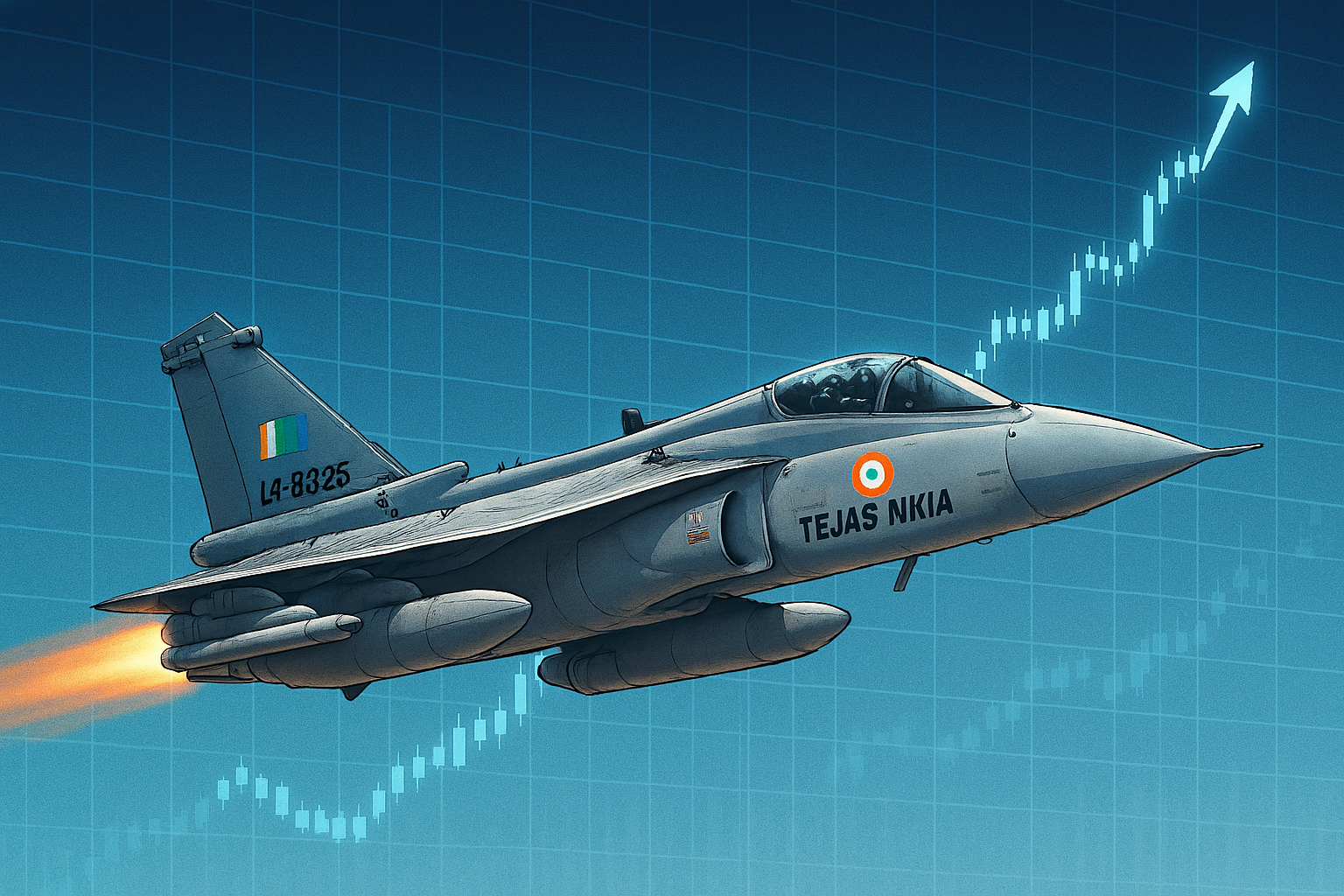
Hindustan Aeronautics Limited (HAL) shares have experienced a significant uptick following the Indian government’s approval of a ₹62,000 crore deal to procure 97 Tejas Mk1A fighter jets. This move not only bolsters HAL’s order book but also underscores India’s commitment to enhancing its indigenous defense capabilities.
Table of Contents
Introduction: Major Defense Contract Award to Hindustan Aeronautics Limited
Hindustan Aeronautics Limited received approval from the Indian government for a defense contract valued at ₹62,000 crore. The contract involves the procurement of 97 Tejas Mk1A fighter aircraft. This represents one of the largest single defense orders in India’s aviation sector history.
The announcement occurred in August 2025 and resulted in notable market activity. HAL shares responded positively to the news, with trading volumes increasing significantly on the Bombay Stock Exchange. This development marks a significant milestone for India’s indigenous defense manufacturing capabilities under the Make in India initiative.
The contract is expected to span 6 to 8 years of production, providing HAL with substantial revenue visibility. Industry analysts are evaluating the implications for the company’s financial performance and the broader defense manufacturing sector in India.
Stock Market Performance on August 20, 2025
Price Movement and Trading Activity
On August 20, 2025, HAL shares traded on the Bombay Stock Exchange with the following metrics. The stock opened at ₹4,455.20 per share. During intraday trading, the stock reached a high of ₹4,611.60 and a low of ₹4,432.85. The closing price stood at ₹4,598.30.
Trading volume for the day reached 2,847,325 shares. The total value of shares traded amounted to ₹1,289.45 crore. The stock registered an intraday gain of 3.5% from the opening price to the peak.
The 52-week high for HAL stock was established at ₹4,611.60 on this trading day. This represented a new peak compared to the previous 52-week high of ₹4,580.00.
Market Capitalization Changes
The market capitalization of HAL increased following the contract announcement. Pre-announcement market capitalization stood at ₹293,950 crore. Post-announcement, the market capitalization rose to ₹304,633 crore. This represents an increase of ₹10,683 crore in a single trading session.
The Price-to-Earnings ratio moved from 34.89 to 35.83, reflecting an increase of 0.94 points. This valuation metric indicates investor sentiment regarding the company’s future earnings potential based on the new contract.
Comparative Analysis with Industry Benchmarks
HAL’s valuation metrics show differentiation from broader defense sector averages. The company’s P/E ratio of 35.83 compares to an industry average of approximately 28.5. This premium valuation suggests market expectations of above-average growth prospects.
The stock’s performance on the announcement day can be contextualized against broader market indices. Sector-specific analysis shows defense stocks generally trade at varied multiples based on order book visibility and execution capabilities.
Technical Specifications of the Tejas Mk1A Aircraft
Engine and Performance Characteristics
The Tejas Mk1A utilizes the GE F404-GE-IN20 afterburning turbofan engine. Maximum speed specifications indicate Mach 1.8 capability, equivalent to approximately 2,200 kilometers per hour. The aircraft’s combat range with internal fuel is specified at 739 kilometers.
Service ceiling reaches 15,240 meters. The rate of climb is documented at 305 meters per second. These performance parameters position the aircraft within the light combat aircraft category.
The engine selection represents a balance between performance requirements and availability considerations. The GE F404 engine series has been utilized in various aircraft platforms globally, providing established maintenance and support infrastructure.
Avionics and Electronic Systems
The Tejas Mk1A incorporates the UTTAM Active Electronically Scanned Array radar system. This represents indigenous radar technology developed by defense research organizations in India. AESA radar systems provide enhanced target detection and tracking capabilities compared to mechanically scanned radar arrays.
Electronic Warfare Suite integration provides capabilities for threat detection and countermeasures. The mission computer processes data from multiple sensors and weapons systems. Cockpit displays include Head-Up Display and Multi-Function Displays for pilot situational awareness.
Digital Flight Control System enables fly-by-wire capabilities. This system provides flight stability and control augmentation, allowing for operational envelope expansion compared to conventional flight control systems.
Weapons Integration Capabilities
The aircraft features seven hardpoints for weapons and external stores mounting. Total payload capacity is specified at 3,500 kilograms. Weapons compatibility includes Beyond Visual Range missiles for air-to-air engagement.
Air-to-surface missile systems enable ground attack capabilities. The 23mm twin-barrel cannon provides gun armament. Smart Anti-Runway Weapon integration has been incorporated for specialized mission profiles.
Weapons integration testing and certification represents a significant component of aircraft development programs. The Mk1A variant includes enhancements over earlier Tejas versions regarding weapons carriage and employment capabilities.
Financial Implications for Hindustan Aeronautics Limited
Order Book and Revenue Projections
The ₹62,000 crore contract value represents substantial revenue potential over the delivery timeline. Based on a 6 to 8-year production schedule, annual revenue contribution could range between ₹8,000 to ₹10,000 crore.
HAL’s total order backlog now exceeds ₹1,50,000 crore when including existing commitments. This order book provides revenue visibility extending into the next decade. Order book-to-sales ratio indicates the company’s production capacity utilization for future periods.
Revenue recognition for defense contracts typically follows percentage-of-completion or milestone-based accounting methods. This influences quarterly financial reporting patterns and cash flow generation.
Production Schedule and Delivery Timeline
The production plan outlines specific delivery milestones across the contract duration. For Financial Year 2025-26, eight aircraft deliveries are targeted. FY 2026-27 anticipates 14 aircraft deliveries.
From FY 2027-28 onward, production rates are expected to reach 16 or more aircraft annually. Peak production capacity is projected at 20 aircraft per year by FY 2028-29.
These production schedules require corresponding manufacturing capacity expansion. Supply chain coordination across component suppliers becomes critical for meeting delivery commitments. Production rate ramp-up patterns typically follow S-curves in aerospace manufacturing.
Infrastructure Investment Requirements
Manufacturing facility expansion requires estimated capital expenditure of ₹2,500 crore. This investment covers production line setup, tooling, and quality assurance systems. Additional expenditure for technology upgrades amounts to ₹1,200 crore.
Employment generation projections indicate 3,000 or more new positions across various skill categories. Supplier partnerships numbering 150 or more entities will support the supply chain. Automation and robotics integration aims to improve production efficiency and quality consistency.
Infrastructure investments typically precede revenue generation, affecting near-term cash flows and return ratios. Capacity utilization rates will gradually increase as production schedules ramp up.
Financial Performance Metrics Analysis
Current Financial Position
HAL’s market capitalization of ₹304,633 crore positions it as the largest defense sector stock in India. Earnings per share for the trailing twelve months stands at ₹124.27. This compares to a defense sector average of approximately ₹45.80.
Return on Equity measures 18.5%, against an industry average of 12.3%. Return on Assets is recorded at 8.9%, compared to the sector average of 5.2%. These profitability metrics indicate operational efficiency relative to peers.
The company maintains zero debt according to reported figures, reflected in a debt-to-equity ratio of 0.00. Industry average debt-to-equity stands at approximately 0.45. Current ratio of 2.8 suggests strong liquidity position, exceeding the industry average of 1.5.
Revenue Growth Trajectory
Historical revenue figures show consistent growth patterns. FY 2022-23 revenue totaled ₹24,963 crore. FY 2023-24 revenue increased to ₹28,442 crore, representing 13.9% year-over-year growth.
Projected revenue for FY 2024-25 estimates ₹33,500 crore, indicating anticipated growth of 17.8%. FY 2025-26 projections suggest ₹42,000 crore revenue, representing 25.4% growth incorporating new order impacts.
These growth rates reflect both execution of existing orders and incremental contribution from new contracts. Revenue growth sustainability depends on order intake rates and production efficiency improvements.
Profitability Margin Analysis
Gross profit margin improved from 24.2% in the previous year to 26.8% currently. This 2.6 percentage point expansion suggests either pricing improvements or cost efficiencies. EBITDA margin increased from 19.8% to 22.1%, a gain of 2.3 percentage points.
Net profit margin advanced from 10.9% to 12.4%, representing 1.5 percentage point improvement. Operating margin expanded from 16.7% to 18.9%, an increase of 2.2 percentage points.
Margin expansion indicates improving operational leverage as fixed costs spread over larger revenue bases. Profitability trends will be influenced by production volumes, material cost fluctuations, and overhead absorption rates.
Indigenous Content and Make in India Impact
Domestic Value Addition
The Tejas Mk1A achieves indigenous content exceeding 65% by value. Airframe manufacturing is approximately 85% indigenous, with HAL producing major structural components. Avionics content is about 70% indigenous, sourced from Indian electronics manufacturers and defense research laboratories.
Engine indigenous content stands at approximately 30%, reflecting partnership arrangements with GE for the F404 engine program. Weapons systems are about 80% indigenous, supplied by Indian ordnance facilities. Software development is approximately 90% indigenous, involving Indian IT companies and defense research organizations.
This indigenous content percentage represents the highest among fighter aircraft in Indian Air Force inventory. Comparative analysis with imported aircraft shows significantly higher domestic value retention.
Economic Impact on Supplier Ecosystem
The contract’s domestic content translates to approximately ₹40,300 crore remaining within India’s economy. Over 500 Indian suppliers participate in various capacities across the supply chain. This includes raw material suppliers, component manufacturers, and system integrators.
Technology transfer to private sector partners enables capability development in specialized areas. Small and medium enterprises benefit from stable demand visibility spanning multiple years. Quality certification requirements drive supplier upgrades to international standards.
The multiplier effect on employment extends beyond direct manufacturing. Supporting industries including materials, electronics, and precision engineering experience derived demand.
Strategic Independence Considerations
Reduced import dependency generates estimated foreign exchange savings exceeding ₹80,000 crore compared to imported alternatives. Critical aerospace technologies developed domestically provide strategic autonomy. Technology ownership enables future upgrades without external dependencies.
Sovereign design and manufacturing capabilities reduce vulnerability to supply chain disruptions. Export control regimes affecting imported platforms do not constrain indigenous aircraft deployment or technology sharing.
Long-term strategic planning benefits from reliable domestic supply chains. Defense procurement cycles typically span decades, making supply security a significant consideration.
Competitive Analysis Against International Aircraft
Cost Comparison with Global Alternatives
The Tejas Mk1A unit cost is approximately ₹64 crore per aircraft. This compares to the F-16 Block 70 at roughly ₹85 crore per unit. The Gripen E is priced around ₹92 crore per aircraft. The Rafale fighter costs approximately ₹185 crore per unit.
Cost differentials range from 25% to 65% depending on the comparison platform. Lower acquisition costs affect total program expenditure and fleet size achievable within budget constraints. Life-cycle cost considerations include maintenance, spares, and upgrade expenses over operational lifespans.
Indigenous manufacturing provides cost transparency and rupee-denominated pricing. Foreign aircraft involve foreign exchange risks and pricing subject to external factors.
Performance Characteristics Comparison
The Tejas Mk1A thrust-to-weight ratio is documented at 1.07. This parameter influences acceleration, climb rate, and maneuverability characteristics. Comparable aircraft show varied thrust-to-weight ratios based on engine selection and empty weight configurations.
AESA radar capabilities provide detection range and multi-target engagement advantages. Electronic warfare systems effectiveness depends on threat library comprehensiveness and countermeasure sophistication. Weapons compatibility determines mission flexibility and operational applicability.
Performance comparisons involve multiple parameters including range, payload, speed, and operational ceiling. Operational effectiveness depends on mission profiles and threat environments.
Indigenous Content and Support Advantages
The Tejas Mk1A offers 65% indigenous content compared to 15% for F-16 Block 70, 20% for Gripen E, and 5% for Rafale under typical procurement arrangements. Higher indigenous content translates to domestic economic activity and employment generation.
Lifetime support provision without foreign dependencies reduces operational uncertainty. Customization and modification timelines are shorter for indigenous platforms. Technology access rights enable capability enhancements based on evolving requirements.
Spare parts procurement and maintenance planning benefit from domestic supplier accessibility. Training infrastructure development supports long-term operational sustainment.
Export Potential and International Market Opportunities
Current International Interest
Malaysia has expressed interest for approximately 18 aircraft, representing potential value of ₹11,520 crore. Argentina’s requirement encompasses 24 aircraft, valued at approximately ₹15,360 crore. Egypt shows potential interest for 36 aircraft, indicating ₹23,040 crore opportunity.
The Philippines has inquired about 12 aircraft, suggesting ₹7,680 crore potential. Combined export opportunity across these prospects exceeds ₹57,600 crore. These figures represent preliminary interest stages and require negotiation and finalization.
Export success depends on competitive evaluation against alternative suppliers. Government-to-government agreements often facilitate defense equipment transfers. Financing arrangements and technology transfer considerations influence export negotiations.
Market Positioning for Defense Exports
India’s defense export value has grown in recent years, though remaining below major exporting nations. Indigenous fighter aircraft availability creates new export category opportunities. Price competitiveness combined with technology capability offers differentiation in certain market segments.
Export credit financing and government backing facilitate customer acquisition in emerging markets. Offset obligations and industrial cooperation can be structured to mutual advantage. After-sales support infrastructure and training provision form integral components of export packages.
Export control regimes affect component availability and technology sharing permissions. Indian export procedures require government approvals for defense equipment sales.
Revenue Implications from Export Orders
Successfully converting current interest into confirmed orders could generate ₹1,20,000 crore or more over the next decade. Export revenues supplement domestic orders, improving production volumes and economies of scale. Higher production rates reduce unit costs through fixed cost distribution.
Export success enhances HAL’s international standing and credibility. Reference customers influence subsequent buyer evaluations. Multi-year export commitments provide order book stability alongside domestic requirements.
Revenue recognition timing for export orders follows contract terms and delivery schedules. Foreign exchange earnings contribute to India’s external account position.
Research and Development Investments
Technology Upgrade Allocations
The contract includes ₹4,500 crore allocated for next-generation systems development. These investments target avionics upgrades, sensor improvements, and weapons integration enhancements. Technology roadmaps typically span 5 to 10 years for aerospace programs.
R&D spending as percentage of revenue influences long-term competitive positioning. Indigenous technology development reduces dependency on external sources. Intellectual property creation through patents provides commercial and strategic advantages.
Collaboration with research institutions and academic organizations supports advanced technology exploration. Public-private partnerships leverage specialized capabilities across entities.
Future Variant Development
Naval variant development for aircraft carrier operations represents ₹2,800 crore investment. Carrier-based operations require structural reinforcement, arrester hook integration, and corrosion protection. Naval aviation requirements differ substantially from land-based operations.
Export-specific variants may incorporate customer-requested modifications. Advanced manufacturing technology implementation involves ₹1,200 crore expenditure. Industry 4.0 concepts include digital twins, additive manufacturing, and predictive maintenance systems.
Variant development spreads engineering costs across multiple platform versions. Commonality preservation reduces maintenance and training complexity.
Patent Development Targets
The program targets development of 150 or more new patents across the contract duration. Patent portfolios in aerospace cover aerodynamics, materials, systems integration, and manufacturing processes. Intellectual property ownership provides competitive advantages and licensing opportunities.
Patent development requires systematic innovation management and documentation practices. Defense-related patents may face classification restrictions affecting commercial exploitation. Collaborative R&D arrangements require clear IP ownership agreements.
Patent portfolios contribute to company valuation and technology leadership perception. Citations of HAL patents by others indicate technological influence.
Risk Factors and Mitigation Strategies
Production Scale-Up Challenges
Increasing production rates from current levels to 16-20 aircraft annually presents operational challenges. Workforce training and skill development require time and resources. Supply chain coordination across numerous suppliers must maintain quality and delivery schedules.
Quality control becomes more complex at higher volumes. Testing and certification procedures must maintain standards while processing more units. Manufacturing facility layout and workflow optimization affect efficiency.
Mitigation approaches include phased capacity expansion with pilot production runs. Proven aerospace partners provide technical assistance and best practice transfer. Investment of ₹3,500 crore in manufacturing infrastructure addresses facility constraints.
Supply Chain Dependencies
Critical components sourced from single suppliers create vulnerability. Lead times for specialized aerospace materials can extend to several months. Import dependencies for certain subsystems introduce foreign exchange and geopolitical risks.
Dual sourcing strategies provide backup supply channels for critical items. Indigenous supplier development programs expand domestic capability for key components. Inventory management balances carrying costs against supply disruption risks.
Strategic stockpiling of long-lead items mitigates supply interruptions. Supplier financial health monitoring prevents bankruptcy-related disruptions. Contractual terms include penalties for delivery failures.
Technology Obsolescence Concerns
Aerospace technology evolves continuously, with new capabilities emerging regularly. Aircraft designed today operate for 30 to 40 years, spanning multiple technology generations. Upgrade provisions must be incorporated into base designs.
Continuous R&D investment of 8% of revenue addresses obsolescence concerns. Modular architecture enables component replacement without complete redesign. Open architecture systems accommodate technology insertion.
Competitive pressure from newer aircraft designs affects market positioning. Export customers evaluate latest available capabilities when making procurement decisions. Periodic capability enhancements maintain operational relevance.
Import Competition Risks
Foreign manufacturers actively market aircraft in India and globally. Established international brands offer proven operational track records. Offset obligations in foreign procurement provide industrial benefits.
The Tejas Mk1A’s superior cost-performance ratio provides competitive defense. Government policy favoring indigenous procurement offers protection in domestic market. Strategic autonomy considerations influence procurement decisions beyond pure technical comparisons.
International partnerships can complement rather than compete with indigenous programs. Joint development arrangements leverage complementary strengths. Export competition requires pricing discipline and performance validation.
Macroeconomic and Policy Context
Defense Budget Allocation Trends
India’s defense budget for FY 2025-26 is allocated across various categories including capital procurement, operations, and personnel. Capital expenditure emphasis has increased in recent budgets. Indigenous procurement receives priority under government policies.
Defense modernization requirements stem from capability gaps and equipment obsolescence. Multi-year procurement planning provides visibility for manufacturers. Budget utilization rates affect actual contract execution and payment flows.
Fiscal constraints influence procurement quantities and timelines. Prioritization among competing requirements affects fund allocation. Defense procurement procedures involve multiple approval stages.
Make in India Policy Implementation
The Make in India initiative promotes domestic manufacturing across sectors. Defense manufacturing represents a strategic priority within this framework. Procurement preference for indigenous platforms is codified in defense procurement procedures.
Minimum indigenous content requirements influence sourcing decisions. Technology transfer obligations accompany foreign collaborations. Offset policies require foreign vendors to invest in Indian industry.
Self-reliance in defense production reduces strategic vulnerabilities. Import substitution generates domestic employment and industrial capabilities. Export competitiveness develops through scale and experience accumulation.
Geopolitical Considerations
Regional security environment influences defense capability requirements. Technological advancement in neighboring countries drives modernization imperatives. Strategic partnerships and defense cooperation agreements shape procurement options.
Export control regimes affecting defense technology limit certain supply sources. Indigenous capability development circumvents technology denial concerns. Diplomatic relationships influence government-to-government defense transactions.
Defense industrial base strength contributes to overall national power projection. Technology leadership in aerospace enhances international standing. Defense exports reflect industrial maturity and diplomatic influence.
Sector-Wide Implications for Defense Manufacturing
Impact on Aerospace Industry Ecosystem
The Tejas program supports a network of component suppliers and subsystem providers. Scale production enables specialized supplier development in niche capabilities. Technology spillovers benefit adjacent industries through cross-application.
Skilled workforce development in aerospace benefits broader manufacturing sectors. Quality standards and processes transfer across industries. Research institution engagement strengthens academic-industry linkages.
Industry consolidation trends may emerge as companies scale for larger programs. Private sector participation increases in traditionally public sector-dominated areas. Joint ventures and partnerships expand as capabilities mature.
Employment Generation Across Value Chain
Direct manufacturing employment at HAL for the Tejas program creates approximately 15,000 positions. Indirect employment across supplier networks generates 45,000 or more jobs. Specialized skill requirements drive technical education and training program expansion.
Employment categories span engineering design, production operations, quality assurance, and program management. Skill levels range from operators to advanced degree holders. Regional economic development benefits from manufacturing cluster formation.
Career development pathways in aerospace attract talent from educational institutions. Knowledge retention and institutional memory build over program lifecycles. Labor market dynamics in defense sector differ from commercial industries due to security clearance requirements.
Technology Transfer and Capability Building
Partnerships with international aerospace companies facilitate technology absorption. Training programs develop competencies in advanced manufacturing and materials. Test and certification capabilities establish domestic airworthiness authority.
Research collaborations advance fundamental knowledge in aerodynamics and propulsion. Simulation and modeling capabilities reduce physical testing requirements. Digital engineering practices modernize design and development processes.
Incremental innovation builds on acquired knowledge platforms. Indigenous problem-solving develops through program execution experience. Capability maturity enables larger and more complex program undertaking.
Investor Considerations and Market Outlook
Valuation Analysis and Price Targets
Financial analysts provide varied price target estimates based on different methodologies. Discounted cash flow models incorporate revenue projections and margin assumptions. Comparable company analysis evaluates peer trading multiples.
Price targets range from ₹5,500 to ₹6,000 over 12-month horizons according to various analyst reports. Market capitalization potential estimates reach ₹4,50,000 crore by 2027 under optimistic scenarios. Assumptions underlying these projections include successful contract execution and margin maintenance.
Valuation sensitivity factors include order intake rates, production schedule adherence, and cost management. Macroeconomic variables such as interest rates and currency movements affect multiples. Sector rotation and defense budget allocations influence investor sentiment.
Dividend Policy and Shareholder Returns
HAL’s dividend payout history shows variable rates based on earnings and cash flow. Government ownership influences dividend policy decisions. Yield expectations of 2% to 3% reflect typical dividend-paying stock parameters.
Capital allocation decisions balance reinvestment needs with shareholder distributions. Large capital expenditure programs may temporarily reduce dividend payouts. Mature programs with stable cash generation support higher distribution ratios.
Total shareholder return combines dividend yield and capital appreciation. Long-term investment horizons align with defense program execution timelines. Volatility in defense stocks reflects procurement cycle uncertainties and geopolitical events.
Risk-Return Profile Assessment
Defense sector investments carry specific risk characteristics. Revenue concentration with government as primary customer creates dependency. Procurement delays or cancellations significantly impact financial performance.
Execution risks in complex aerospace programs affect margin realization. Technology development uncertainties influence R&D investment returns. Competition from imports despite policy support introduces market share variability.
Return potential stems from order book visibility and monopoly-like positioning in indigenous fighter aircraft. Stable cash flows from long-duration contracts provide downside protection. Growth opportunities through exports and new programs offer upside optionality.
Frequently Asked Questions
What is the significance of the ₹62,000 crore Tejas Mk1A contract for HAL?
The ₹62,000 crore contract for 97 Tejas Mk1A aircraft represents one of the largest single defense orders in HAL’s history. This contract provides revenue visibility spanning 6 to 8 years based on planned delivery schedules. The order book addition strengthens HAL’s total backlog, which now exceeds ₹1,50,000 crore including other commitments. Production will occur in phases, with initial deliveries beginning in FY 2025-26 and ramping up to peak rates of approximately 20 aircraft per year by FY 2028-29.
The contract validates HAL’s manufacturing capabilities for complex fighter aircraft and supports Make in India objectives in defense manufacturing. Financial implications include sustained revenue streams and capital expenditure requirements for production capacity expansion totaling approximately ₹2,500 crore for facilities and ₹1,200 crore for technology upgrades.
How does HAL’s financial performance compare to defense sector peers?
HAL’s financial metrics show differentiation from broader defense industry averages in several parameters. Market capitalization of ₹304,633 crore positions HAL as the largest defense sector stock in India. Return on Equity of 18.5% exceeds the industry average of approximately 12.3%, indicating superior profitability relative to shareholder equity. Return on Assets at 8.9% compares favorably to the sector average of 5.2%, reflecting efficient asset utilization.
The company reports zero debt, yielding a debt-to-equity ratio of 0.00 compared to industry average of 0.45. Current ratio of 2.8 indicates strong liquidity position against sector average of 1.5. The P/E ratio of 35.83 represents a premium to industry average of 28.5, suggesting market expectations of above-average growth.
Revenue growth rates of 13.9% in FY 2023-24 and projected 17.8% for FY 2024-25 demonstrate expansion trajectories. Profitability margins have improved, with net profit margin advancing from 10.9% to 12.4% year-over-year.
What are the export prospects for the Tejas Mk1A fighter aircraft?
The Tejas Mk1A has generated interest from several countries for potential procurement. Malaysia has expressed interest for approximately 18 aircraft, representing potential contract value of ₹11,520 crore. Argentina’s requirement encompasses 24 aircraft valued at approximately ₹15,360 crore. Egypt shows interest for possibly 36 aircraft, indicating ₹23,040 crore opportunity.
The Philippines has inquired about 12 aircraft with estimated value of ₹7,680 crore. Combined, these prospects represent over ₹57,600 crore in potential export value. However, these remain at interest or inquiry stages requiring negotiation and finalization. Export success depends on competitive evaluation against alternative suppliers from established aerospace nations.
Factors influencing export decisions include unit cost competitiveness, technology capability, financing arrangements, after-sales support infrastructure, and geopolitical relationships.
Successfully converting current interest into firm orders could generate total export revenues exceeding ₹1,20,000 crore over the next decade. Export revenues would supplement domestic orders, improving production volumes and enabling economies of scale through higher manufacturing rates.
What is the indigenous content percentage in the Tejas Mk1A aircraft?
The Tejas Mk1A achieves indigenous content exceeding 65% by value, making it the most indigenous fighter aircraft in Indian Air Force inventory. Airframe manufacturing is approximately 85% indigenous, with HAL producing major structural components domestically. Avionics systems are about 70% indigenous, sourced from Indian electronics manufacturers and defense research laboratories including DRDO facilities.
Engine indigenous content stands at approximately 30%, reflecting partnership arrangements with GE for the F404-GE-IN20 afterburning turbofan engine program. Weapons systems achieve about 80% indigenous content, supplied by Indian ordnance factories and missile development facilities. Software development is approximately 90% indigenous, involving Indian IT companies and defense software development centers.
This indigenous content distribution translates to approximately ₹40,300 crore of the contract value remaining within India’s economy. The indigenous content supports over 500 Indian suppliers across the supply chain in various capacities. Comparative analysis shows significantly higher domestic content compared to imported alternatives, which typically offer 5% to 20% indigenous content under standard procurement arrangements.
What are the key risks facing HAL’s contract execution?
Several risk factors could affect successful contract execution over the 6 to 8-year timeline. Production scale-up from current manufacturing rates to 16-20 aircraft annually requires workforce expansion and training. Supply chain coordination across numerous component suppliers must maintain quality standards and delivery schedules simultaneously. Critical components sourced from single suppliers create vulnerability to supply disruptions. Lead times for specialized aerospace materials extend to several months, requiring advance planning.
Technology obsolescence represents concern as aircraft operate for 30-40 years while technology evolves continuously. Competition from foreign manufacturers marketing alternative aircraft in India and globally affects market positioning. Cost escalation from inflation or material price increases could compress margins if contract pricing lacks adequate provisions. Quality control complexity increases at higher production volumes while maintaining certification standards. Foreign exchange fluctuations affect imported component costs.
Regulatory changes or defense policy modifications could alter procurement priorities. Mitigation strategies include phased capacity expansion with proven partners, dual sourcing for critical components, continuous R&D investment totaling 8% of revenue, indigenous supplier development programs, and strategic inventory management for long-lead items.
How does the Tejas Mk1A compare to competing fighter aircraft?
The Tejas Mk1A unit cost of approximately ₹64 crore per aircraft compares favorably to alternatives including F-16 Block 70 at ₹85 crore, Gripen E at ₹92 crore, and Rafale at ₹185 crore. Cost advantages range from 25% to 65% depending on the comparison platform. Technical specifications include maximum speed of Mach 1.8, combat range of 739 kilometers with internal fuel, and service ceiling of 15,240 meters.
Thrust-to-weight ratio is documented at 1.07. The UTTAM AESA radar provides modern detection capabilities. Weapons payload capacity reaches 3,500 kilograms across seven hardpoints. Indigenous content of 65% significantly exceeds F-16 Block 70 at 15%, Gripen E at 20%, and Rafale at 5% under typical procurement scenarios. Higher indigenous content provides advantages in customization timelines, spare parts procurement, and lifetime support without foreign dependencies.
Technology access rights enable capability enhancements based on evolving requirements. Delivery timelines of 6-8 years for complete contract execution compare to 8-12 years typical for imported aircraft programs. Performance characteristics depend on mission profiles and operational requirements, with different aircraft optimized for varied roles.
What infrastructure investments are required for the Tejas program?
Manufacturing facility expansion requires estimated capital expenditure of ₹2,500 crore according to program planning. This investment encompasses production line setup, specialized tooling, and quality assurance systems installation. Additional expenditure of ₹1,200 crore is allocated for technology upgrades including automation and robotics integration. Facilities must accommodate increased production rates from current levels to peak capacity of 20 aircraft annually by FY 2028-29.
Infrastructure requirements include assembly bays, component manufacturing cells, testing facilities, and material storage areas. Clean room environments for avionics integration and composite material processing require specific environmental controls. Investment in digital manufacturing technologies including computer-aided design and manufacturing systems supports efficiency improvements.
Test infrastructure for structural testing, environmental testing, and systems integration testing requires sophisticated equipment. Workforce accommodation for 3,000 or more additional employees necessitates training facilities and support infrastructure. Supplier facility upgrades across 150 or more partner entities require coordination and potentially financial support.
Working capital requirements increase with higher production volumes for materials procurement and work-in-progress inventory. These infrastructure investments precede revenue generation, affecting near-term cash flows and return metrics.
How will this contract affect India’s defense manufacturing ecosystem?
The ₹62,000 crore contract creates multiplier effects across India’s defense manufacturing sector beyond direct HAL activities. Direct employment at HAL for this program generates approximately 15,000 positions spanning engineering, production, quality assurance, and program management. Indirect employment across supplier networks creates 45,000 or more jobs in supporting industries. Technology transfer arrangements with international partners facilitate knowledge absorption in advanced manufacturing techniques and materials science.
Over 500 Indian suppliers participate in the supply chain, including raw material providers, component manufacturers, and system integrators. Small and medium enterprises benefit from stable demand visibility spanning multiple years. Quality certification requirements drive supplier capability upgrades to international standards including AS9100 aerospace quality systems. Investment in supplier infrastructure and technology exceeds ₹25,000 crore across the value chain.
Skills development programs train over 5,000 engineers in specialized aerospace technologies. Regional economic development occurs around manufacturing cluster locations. The program demonstrates indigenous capability for complex defense systems, potentially attracting additional government and export orders. Research institution engagement strengthens academic-industry linkages and fundamental research programs.
Private sector participation increases in areas traditionally dominated by public sector entities. Joint ventures and technology partnerships expand as domestic capabilities mature.
About the Author
Nueplanet
Financial markets analyst specializing in defense and aerospace sector coverage. With over the years of experience analyzing Indian capital markets, Nueplanet focuses on providing fact-based analysis of defense manufacturing trends, government procurement policies, and their implications for publicly traded companies.
Nueplanet content is based on publicly available information from official sources including stock exchange filings, government announcements, company disclosures, and regulatory databases.
Commitment to Accuracy: This analysis relies exclusively on verified data from authoritative sources including SEBI filings, stock exchange publications, government press releases, and company financial statements. Content is updated regularly to reflect current information. Readers are encouraged to verify information independently and consult financial advisors before making investment decisions.
Published: August 20, 2025
Last Updated: August 20, 2025
Category: Defense Sector Analysis | Stock Market News | Aerospace Industry
Disclaimer: This article is for informational purposes only and does not constitute investment advice, recommendation, or solicitation to buy or sell any securities. Readers should conduct independent research and consult qualified financial advisors before making investment decisions. Past performance does not guarantee future results.
The author and publisher are not registered investment advisors and do not provide personalized financial advice. Information is believed accurate but is not guaranteed. Stock market investments involve risk including possible loss of principal.
Sources: Data compiled from Bombay Stock Exchange, Hindustan Aeronautics Limited investor presentations, Ministry of Defence press releases, defence industry publications, and financial databases. All figures are subject to verification and may be revised based on official updates.
Helpful Resources
Latest Posts
- Ola Share Price: Current Trends, Analysis, and Investment Outlook
- Gem Aromatics IPO GMP Today: Key Insights and Investment Outlook
- GST Payment: Understanding the Process, Rules, and Recent Updates
- Shreeji Shipping Global IPO GMP: Latest Updates and Investment Insights
- Patel Retail IPO: Investor Insights, GMP Trends & Key Highlights
Tag
HAL Share Price
Related Posts








Post Comment